Can You Donate Plasma or Blood If You Smoke Weed? The Rules
Using cannabis does not by itself disqualify you from giving plasma or blood in the US. Being high at the appointment does, under a federal rule. Here is which rules are law and which are house policy, what centers test for, and the one real exception.

Can you donate plasma if you smoke weed? Maybe you had an edible last weekend, or you smoke most evenings, and you want to give plasma or blood. Will the center test you for THC? How long should you wait? The answers online disagree, mostly because they mix up federal law with each center's own house rules.
The short answer: in the US, using cannabis does not by itself disqualify you from donating blood, plasma or platelets. What federal donor eligibility rules do reach is impairment: the person who interviews you must judge whether you appear to be under the influence of any drug or alcohol, so being high at the appointment is what gets you deferred. None of the organizations we checked says it tests donations for THC. The waiting times you see online (none, 12 hours, 24 hours) are house recommendations, and the center you visit makes the call. Rules checked September 27, 2026.
Can you donate plasma if you smoke weed? Federal law vs house policy
Here is what each source actually says. The only federal rule is the FDA's donor eligibility regulation, 21 CFR 630.10, which applies to every blood and plasma collector in the country. Everything else is one organization's own policy: the American Red Cross guidance on cannabis (dated April 18, 2024), the Bloodworks Northwest page on marijuana and donating (undated), the PlasmaSource FAQ on smoking marijuana (undated), and the eligibility guides from CSL Plasma and BioLife Plasma Services, two of the largest plasma chains. For contrast we added one non-US operator, Canadian Blood Services. We read every page on September 27, 2026.
| Source | What it says about cannabis | Stated wait | Tests donations for THC? | Status and date |
|---|---|---|---|---|
| FDA, 21 CFR 630.10 | No cannabis rule. The interviewer must judge whether you appear to be under the influence of any drug or alcohol | None | Not required | Federal law (2025 CFR edition) |
| American Red Cross | Use does not disqualify you; you cannot give if cannabis use impairs your memory or comprehension | None set ("no data" for one) | No | House policy, April 18, 2024 |
| Bloodworks Northwest (Seattle area) | Use alone does not disqualify you; no donation while under the influence | 24 hours (recommendation) | No | House policy, undated |
| PlasmaSource | Asks donors to refrain before plasma or platelet appointments | 12 hours (recommendation) | Says plasma centers do not | House policy, undated |
| CSL Plasma | Eligibility guide does not address cannabis | Not stated | Not stated | Checked September 27, 2026 |
| BioLife Plasma Services | Eligibility guide does not address cannabis; its "don't smoke" tip does not say what | Not stated for cannabis | Not stated | Checked September 27, 2026 |
| Canadian Blood Services (non-US) | Users may be eligible; must not be impaired, so consent can be obtained | Not stated | Not stated | Canadian policy, for contrast only |
Read down the columns and one thing stands out: only the first row is law, and it contains no cannabis rule and no waiting period. Every number in the wait column is one organization's recommendation. CSL's and BioLife's public eligibility guides do not mention marijuana, cannabis, weed or THC at all. That is not the same as having no policy; it means the guide does not state one, so ask the center before you book. And no organization we read says it tests donations for THC.
Why being high, not using, is what disqualifies you
Federal law starts from a broad test. Under 21 CFR 630.10(a), a donor "must be in good health," and a center must turn you away if it identifies anything that could harm your health or "the safety, purity, or potency" of the donation. The regulation never names cannabis. What it does name is impairment. During the medical-history interview that comes before every donation, the interviewer has to assess this:
“Whether, in the opinion of the interviewer, the donor appears to be under the influence of any drug, alcohol or for any reason does not appear to be providing reliable answers to medical history questions, or if the donor says that the purpose of donating is to obtain test results for a relevant transfusion-transmitted infection”
Notice what that rule is and is not. It is about appearing to be under the influence at the interview, of any drug, alcohol included. It is not about whether you use cannabis, and there is no test and no threshold behind it: it is the interviewer's judgment. The Red Cross puts it plainly: cannabis use "does not disqualify an individual from blood donation, but potential donors cannot give if cannabis use impairs their memory or comprehension." Canada's national blood operator uses the same test, saying donors "must not be impaired at the time of donation as this prevents us from obtaining informed consent."
The reason is consent and reliable answers. Before each donation, federal rules require that you are told a sample of your blood "will be tested for specified relevant transfusion-transmitted infections" and that you have "the opportunity to ask questions and withdraw from the donation procedure." For plasma, 21 CFR 630.15 goes further: the center's responsible physician must get your informed consent at your first donation and again at intervals "no longer than 1 year," explained so that you have "a clear opportunity to refuse." You can only do that well with a clear head. Your health history is also how the center protects both you and whoever receives the product, so it only works if your answers are accurate.
What federal rules check on donation day
- A medical-history interview, including the interviewer's judgment of whether you appear to be under the influence of any drug or alcohol
- Temperature no higher than 37.5 C (99.5 F)
- Blood pressure between 90/50 and 180/100 mm Hg
- A regular pulse between 50 and 100 beats per minute
- Hemoglobin of at least 12.5 g/dL for female donors and 13.0 g/dL for male donors (or a hematocrit of at least 38% or 39%)
- Weight of at least 110 lb (50 kg)
- Arms free of punctures and scars that indicate injected drug use
- For plasma: a weigh-in at every donation and a total protein between 6.0 and 9.0 g/dL before each collection
The center's responsible physician can accept a pulse or blood pressure outside those ranges in some cases, so they are not automatic cutoffs. We are not predicting that cannabis will push you outside them. If you want the evidence on THC and heart rate, our write-up of a controlled THC and CBD heart rate trial covers it. And if you have ever greened out after too much THC, you already know the state in which you should reschedule rather than show up.
How long after smoking weed should you wait to donate?
This is the question the internet answers worst, because every number you find is somebody's house rule. The Red Cross says "there isn't a set amount of time you are required to wait after consuming," and goes further: "there is no data that specifies how long an individual should wait." Bloodworks Northwest recommends waiting 24 hours between using cannabis and donating. PlasmaSource encourages you to refrain for at least 12 hours before a plasma or platelet appointment. Other pages repeat 24 to 48 hours without a source. None of these is a federal requirement, and they cannot all be the rule, because there is no single rule.
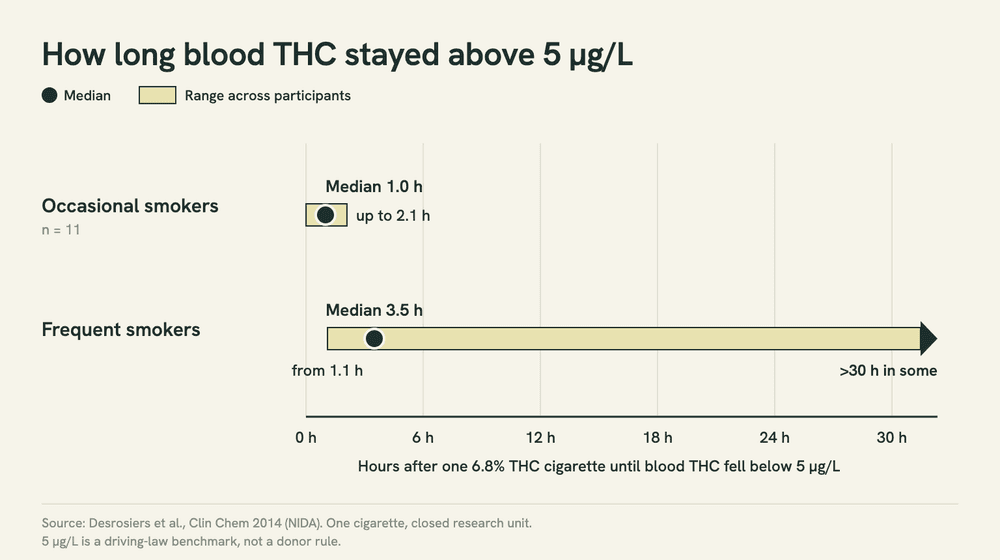
Why not simply wait until THC has left your blood? Because for some people that takes much longer than the high does. In a 2014 NIDA study of frequent and occasional smokers, participants smoked one 6.8% THC cigarette in a closed research unit. Blood THC fell below 5 µg/L (a benchmark some driving laws use) within a median of 1.0 hour in the 11 occasional smokers, and never lasted past 2.1 hours. In frequent smokers the median was 3.5 hours, and some stayed above that level for more than 30 hours. A THC-free standard would shut out many daily users who are not impaired, which helps explain why donor rules look at how you are at the interview, not at a number in your blood. (Bloodworks says THC clears the bloodstream in two or three hours; that fits occasional users, not frequent ones.)
Edibles are a different route. Swallowed THC passes through your liver before it reaches the rest of your body, and the liver turns a much larger share of it into a related compound, 11-hydroxy-THC, than smoking does. If you had one the night before, judge the morning by how you actually feel rather than by the clock, and follow your center's rule if it is stricter.
A checklist before your appointment
- 1Do you feel any effect from cannabis right now, including a lingering edible? If yes, reschedule.
- 2Could you read and answer a medical questionnaire accurately and understand a consent form? If not, reschedule.
- 3Does your center publish its own wait (Bloodworks 24 hours, PlasmaSource 12 hours, Red Cross none)? Follow the stricter of your center's rule and how you feel.
- 4Have you used K2, Spice or any synthetic cannabinoid, or had unexplained bleeding or bruising? Call the center before booking.
- 5Answer the donor questionnaire honestly, and tell staff about every medicine you take, including prescription cannabinoids.
- 6If staff think you seem impaired, they can defer you for the day. That is the federal rule working, not a penalty.
Do blood and plasma centers drug test for THC?
Not for THC, according to every organization we checked that addresses it. The Red Cross says it "does not test blood donations for the presence of tetrahydrocannabinol, or THC," and that "the FDA does not require blood collectors to test for THC." It also points out that donor eligibility is regulated by the FDA, not the Drug Enforcement Administration. Bloodworks Northwest says it does not test donors for THC or other cannabinoids, and PlasmaSource says plasma donation centers do not test for THC.
What centers must test for is infection. Under 21 CFR 610.40, every donation is tested for HIV, hepatitis B and hepatitis C. Blood for transfusion is also tested for HTLV, syphilis, West Nile virus and Chagas disease. Source Plasma, the plasma collected at commercial centers and pooled to make medicines, is exempt from the HTLV, West Nile and Chagas tests and handles syphilis under a separate rule. That rule, 21 CFR 640.65, requires regular plasma donors to have a syphilis test, a total protein check and a protein electrophoresis at their first exam and at least every 4 months after that.
Nothing in the regulations stops a center from adding a drug test, but none of the pages we read says any does. Could a patient fail a drug test because of your blood? The Red Cross says "even heavy cannabis use won't cause a transfusion recipient to test positive." It gives no study for that, and we could not find one that measured it either way. Workplace drug testing is a separate question with its own rules; for that, see how CBD and THC show up on a drug test and how long CBD stays in your system.
Plasma, whole blood and platelets: does anything change?
Not the cannabis rule. The Red Cross is explicit: "For a cannabis user donating platelets or plasma, the guidelines are the same as they are for donating whole blood." What differs between donation types is how often you can give and what else gets checked. At the Red Cross, the schedule for each type of donation looks like this:
| Donation type | How often you can give | Cannabis rule | Cannabis-specific wait |
|---|---|---|---|
| Whole blood | Every 56 days, up to 6 times a year | Not impaired, able to consent | None |
| Power Red | Every 112 days, up to 3 times a year | Same as whole blood | None |
| Platelets (apheresis) | Every 7 days, up to 24 times a year | Same as whole blood | None |
| Plasma | Every 28 days, up to 13 times a year | Same as whole blood | None |
Commercial plasma centers set their own schedules, which can differ from the Red Cross's, so ask your center for its numbers. The plasma-specific federal checks (physician consent, a weigh-in every visit, protein before every collection) apply the same way whether or not you use cannabis.
Platelet donation is where cannabis science and donor rules come closest. The Red Cross already has platelet-specific waits for drugs that change how platelets work: its eligibility A-Z list asks you to wait 2 full days after aspirin, 3 days after Effient and 7 days after Brilinta before donating platelets by apheresis. It lists no such wait for cannabis. Whether one is justified is the open question behind the lab studies in the next section. If you want the difference between antiplatelet drugs and anticoagulants, our guide to CBD and blood thinners walks through it.
Is THC in donated blood a problem for the patient?
Three studies speak to this question, and none measured what happens to patients. The first is about donors' habits. In a 2022 survey of Colorado blood donors, 979 of 12,186 donors answered (an 8% response rate). About 1 in 4 (23.5%) said consuming cannabis before donating was acceptable, and use within 72 hours before donating was reported in every age group surveyed except 18 to 24. Among daily users who answered, 52.6% said they had donated platelets by apheresis. The authors called for research on whether cannabis metabolites affect recipients, especially vulnerable ones such as children and pregnant women. It was one site with a low response rate, and it measured habits, not harm.
The second is a lab study from Héma-Québec, the province's blood operator. In a 2023 study in Blood Transfusion, researchers added a mixture of eight cannabinoids, dissolved in methanol, to donated whole blood overnight at 1, 6 or 24 µg/mL, then processed and stored it the way a blood bank would. Free hemoglobin, a marker of damaged red cells, rose with the dose to 1.75, 7.75 and 23.5 times the untreated level. Hemolysis and methemoglobin were higher, and platelet counts and aggregation were lower after processing and through storage. The authors concluded that "pre-donation cannabis use might impair the quality of blood products."
The caveats are large. The three doses assumed that 2%, 12.5% or 50% of the cannabinoids in a 1 g joint at 24% reached the blood, and the blood-bag experiments used the highest of them. The methanol alone raised free hemoglobin at the higher volumes, and the authors write that "synergistic effects of methanol and the cannabinoid mixture cannot be ruled out." No donor used cannabis. The authors themselves say further studies among blood donors who use cannabis are needed.
The third, from the same group, is a 2026 pilot study in the journal Platelets. It exposed human platelets in the lab to increasing concentrations of extracts from two cannabis joints, one at 10.4% THC and 14.7% CBD, the other at 25.5% THC and 0.04% CBD. The platelets became pre-activated, showed signs of energy depletion, and responded less well to several clotting signals. Blocking CB1 and CB2 receptors did not stop it. The abstract does not report how many donors' platelets were used or the exact concentrations, and the authors write that the findings "require confirmation in vivo to determine their clinical relevance."
You will also see confident claims in both directions. Bloodworks Northwest says there is no evidence that blood from cannabis users poses any risk to recipients, and some plasma center FAQs claim the opposite. Neither side cites a study, and we found none that measured recipient outcomes, so we repeat neither as fact. What cannabis does to platelets and clotting in the person using it is a separate question, covered in our review of whether CBD and THC thin your blood.
The real exception: synthetic cannabinoids like K2 and Spice
Synthetic cannabinoids are lab-made chemicals sold under names like K2 and Spice. They are not the cannabis plant and they are not CBD; our overview of cannabinoid types explains the difference. In 2018 some batches were contaminated with brodifacoum, a long-acting rat poison that stops blood from clotting. On June 29, 2018, the FDA told blood and plasma establishments it had "recently received several reports of Source Plasma donors who used synthetic cannabinoids contaminated with brodifacoum." It noted that Source Plasma "is not directly transfused into individual patients," that pooling would dilute any contamination, and that it had no reports of brodifacoum in blood components meant for transfusion.
The FDA left the decision to each center's responsible physician, and said some establishments had added questions to the donor questionnaire and deferral periods of up to one year. The AABB, the blood-banking professional body, reported in 2018 that Illinois had notified the FDA of three plasma donations made at Illinois plasma centers that tested positive for brodifacoum.
The outbreak itself was serious. The CDC's report on the Illinois cluster counted 155 cases (76 confirmed, 79 probable) by April 25, 2018. Four people (2.6%) died from major bleeding, all 81 clinical specimens analyzed were positive for brodifacoum, and 38 more patients were reported in eight other states. The poison lingers: in a Wisconsin case report, a patient began bleeding two weeks after her last reported use. And it was not a one-off. An outbreak in northern Israel in 2021 and 2022 involved 98 patients, four of whom died, with brodifacoum found in every available blood sample.
This is why centers treat K2 and Spice differently from plant cannabis. The Red Cross says the FDA has no universal guideline on synthetic marijuana and leaves decisions to local centers. It asks anyone who has used a synthetic cannabinoid, recreational or prescribed, to call its Donor and Client Support Center at 1-866-236-3276 before donating. If you buy from unregulated sources, the warning signs that weed may be laced are worth knowing.
Red flags after using a synthetic cannabinoid
The signs below come from the case definition in the CDC's Illinois report, and the Wisconsin case shows they can appear weeks after the last use:
- Bruising you cannot explain
- Nosebleeds or bleeding gums
- Blood in your urine or stool
- Vomiting or coughing up blood
- Unusually heavy menstrual bleeding, or bleeding out of proportion to an injury
- Bleeding that starts days or even weeks after your last use
CBD, delta-8 and medical marijuana cards
CBD on its own is not intoxicating, and none of the donor guidance we read defers people for it. Bloodworks Northwest says that if you use marijuana or CBD products for medical purposes, "you can still donate blood," and adds a point worth keeping in mind: "The medical condition for which you use marijuana may affect your eligibility more than the marijuana itself." Tell staff about every product and medicine you take.
None of the donor pages we read names delta-8 THC. The FDA's consumer update on delta-8 says it "has psychoactive and intoxicating effects," so the same impairment rule is what applies. For how it compares chemically and legally, see delta-8 vs CBD.
A medical marijuana card does not change the federal donor rule in either direction. As the Red Cross notes, donor eligibility is set by the FDA, not the DEA, so cannabis's legal status is not what decides it; being clear-headed and able to consent is. For the legal side of hemp and cannabis, including what federal law allows, see our guide to whether CBD is legal.

What nobody knows yet
The rules are clear enough. The science behind them is thin, and it is worth being plain about where it stops:
- No study has measured outcomes in patients transfused with blood, plasma or platelets from people who use cannabis.
- Both studies of cannabinoids and blood products were done in lab dishes. One used a high dose and a solvent that caused damage by itself; the other is a pilot.
- The FDA has no guidance specific to plant cannabis and donors. Its 2018 notice covered contaminated synthetic cannabinoids only.
- No one has tested whether a waiting period of any length makes a difference to the donation, which is why the Red Cross says there is no data for one.
- Center policies change, and several pages we relied on are undated (Bloodworks Northwest, PlasmaSource and the Red Cross A-Z list).
Until better evidence arrives, the rule that applies is the one written down: be in good health, be clear-headed enough to consent, and give reliable answers. The center applies it on the day.
Frequently asked questions
In the US, using cannabis does not by itself disqualify you from giving plasma. Federal rules require the interviewer to judge whether you appear to be under the influence of any drug or alcohol; if you do, you will be asked to come back another day. The Red Cross says the guidelines for plasma and platelets are the same as for whole blood. The center makes the final decision.
The same answer applies. The Red Cross says cannabis use does not disqualify you, but you cannot give if your use impairs your memory or comprehension. Bloodworks Northwest says marijuana use alone does not disqualify you and that it cannot draw blood while you are under the influence.
There is no federal wait. The Red Cross says there is no set time and no data to base one on. Bloodworks Northwest recommends 24 hours and PlasmaSource 12. After an edible, go by how you feel rather than the clock. Check your center's own rule and do not go while you feel any effect.
None of the organizations we checked says it tests donations for THC, and the Red Cross says the FDA does not require it. The tests federal rules require are for infections: HIV, hepatitis B and hepatitis C on every donation, plus others for blood meant for transfusion, and regular syphilis and protein checks for plasma donors.
If the interviewer thinks you appear to be under the influence, or cannot give reliable answers, they can defer you for the day. It is not a penalty; it is the federal rule doing its job, because you need to be able to consent and answer the health questions accurately.
The Red Cross says even heavy cannabis use won't cause a transfusion recipient to test positive. It does not cite a study for that, and no study we found has measured it either way.
There is no separate federal donor rule for either. Bloodworks Northwest says people who use marijuana or CBD for medical purposes can still donate, and that the condition you use it for may matter more than the product. Tell staff about every medicine and product you take.
That is different. After the 2018 outbreak of synthetic cannabinoids contaminated with brodifacoum, a rat poison, the FDA left the decision to each center's physician, and some centers defer donors for up to a year. The Red Cross asks you to call 1-866-236-3276 before donating.
Answer every question on the donor questionnaire honestly, and if you are unsure whether something matters, ask. Under the policies we read, cannabis use by itself is not a reason to turn you away, and your honest health history is what keeps you and the patient safe.
Where to go next: if you give platelets, or you are simply curious what THC and CBD do to clotting in your own body, read our evidence review on CBD, THC and blood thinning. Whatever you use, the center decides on the day, so answer honestly and go when you are clear-headed.
Writing about hemp, wellness and the small rituals that keep us balanced.