Random Drug Tests: How Workers Get Picked, How Often, and What Refusing Means
A random drug test usually means a computer drew your number from a pool where everyone had the same odds. Here are the 2026 federal rates, the six reasons you can be tested at work, post-accident rules, and what refusing costs.
You were just told you have been picked for a random drug test, and you want to know how that happened, whether it is really random, and what you have to do next. This guide is written for the person who was selected, not the employer buying a testing program.
The short answer: a random drug test usually means a computer drew your number from a pool of covered workers in which everyone had the same chance on that draw. If you hold a job regulated by the U.S. Department of Transportation (DOT), federal rules set the minimum number of tests (50% of the pool for truck and bus drivers' drug tests in 2026), require you to go to the test right away, and treat refusing as a violation. Everyone else is tested under the employer's written policy, within the limits of state law.
What "random" actually means, and why you can be picked twice
For truck and bus drivers regulated by the Federal Motor Carrier Safety Administration (FMCSA), the random testing rule, 49 CFR 382.305, spells out what "random" has to mean. Selection must use "a scientifically valid method, such as a random number table or a computer-based random number generator that is matched with drivers' Social Security numbers, payroll identification numbers" or similar identifiers. Every driver must have "an equal chance of being tested each time selections are made," and "each driver selected for testing shall be tested during the selection period." The tests must be "unannounced," and their dates must be "spread reasonably throughout the calendar year." There is no safe week. The other DOT agencies' rules work the same way in substance.
Who sits in the pool matters too. The rule says "covered employees, and only covered employees, are to be in an employer's random testing pool, and all covered drivers must be in the random pool." Your coworkers in non-covered jobs cannot be mixed into a DOT pool, and no covered driver can be left out. An employer may also use a consortium or third-party administrator (C/TPA) that runs one larger pool of covered employees from several companies, which the rule allows. One more detail people miss: the rate counts tests, not people. A 50% rate means the number of tests over the year must equal at least half of the average number of driver positions. It does not mean half of the drivers get tested exactly once.
Because every draw starts fresh, getting picked again is chance, not targeting. Here is what equal odds look like in practice. Our illustration assumes an employer that draws four times a year at the 50% FMCSA drug rate, so each draw selects 12.5% of a stable pool. For any one driver, the chance of never being picked in a year is 0.875 multiplied by itself four times, about 58.6%. The chance of exactly one test is 33.5%, and the chance of two or more is 7.9%, roughly 1 driver in 13. With monthly draws at the same annual rate, the numbers barely move (60.0%, 31.3% and 8.7%). At a 25% rate with quarterly draws, about 2.2% of workers are picked two or more times. Real pools change as people are hired and leave, so treat this as an illustration of the math, not a prediction for your workplace.
How often: the 2026 federal minimum random testing rates
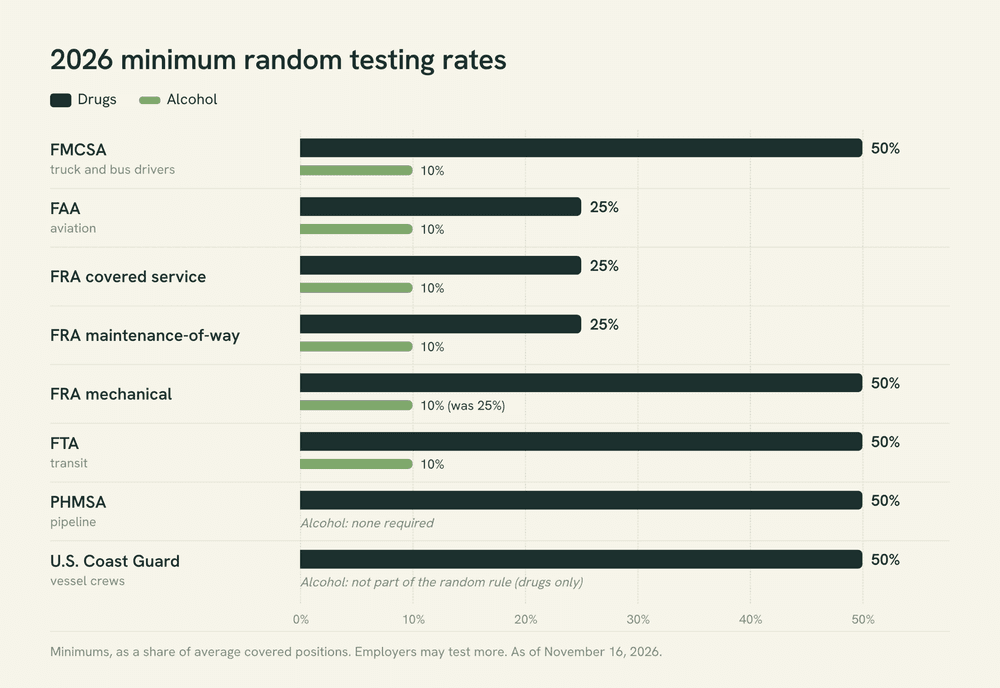
Each DOT agency sets a minimum share of its industry's covered positions that must be randomly tested each year, one rate for drugs and one for alcohol. We built the table below from each agency's own Federal Register notice or regulation, not from a summary chart. The FAA's December 5, 2025 notice for aviation, the Federal Railroad Administration's January 8, 2026 notification, the Federal Transit Administration's January 15, 2026 notice and PHMSA's December 9, 2025 notice for pipelines each set their 2026 rates. FMCSA publishes a notice only when its rate changes. Its rates are written into 382.305 itself, and the drug rate has not moved since a December 2019 FMCSA notice raised it to 50% beginning January 1, 2020. DOT's own January 8, 2026 bulletin on random testing rates confirms the picture: "the FRA Mechanical annual random alcohol testing rate will be 10% in 2026. For all other DOT agencies, the 2026 annual random testing rates will remain the same as the 2025 rates."
Two rows need a note. PHMSA's alcohol rules list post-accident, reasonable suspicion, return-to-duty and follow-up tests, with no random category in 49 CFR 199.225, so pipeline workers face random drug tests only. The Coast Guard sits in the Department of Homeland Security, not DOT, and its random program covers drugs only. Its rule, 46 CFR 16.230, sets a default minimum of 50% of covered crewmembers, and its last published rate notice, for 2021, also set 50%. We found no Coast Guard rate notice for 2026.
| Agency | Who it covers | Drugs, 2026 | Alcohol, 2026 | Primary record |
|---|---|---|---|---|
| FMCSA | CDL truck and bus drivers | 50% | 10% | 49 CFR 382.305(b); drug rate unchanged since January 1, 2020 (FR Doc 2019-28164) |
| FAA | Safety-sensitive aviation employees | 25% | 10% | FR Doc 2025-22036 (December 5, 2025) |
| FRA, covered service | Railroad covered service employees | 25% | 10% | FR Doc 2026-00167 (effective January 8, 2026) |
| FRA, maintenance-of-way | Railroad maintenance-of-way employees | 25% | 10% | FR Doc 2026-00167 |
| FRA, mechanical | Railroad mechanical employees (covered since 2022) | 50% | 10% (lowered from 25%) | FR Doc 2026-00167; the only DOT rate change for 2026 |
| FTA | Safety-sensitive employees of FTA-funded transit | 50% | 10% | FR Doc 2026-00644 (January 15, 2026) |
| PHMSA | Covered pipeline employees | 50% | None required (no random alcohol category) | FR Doc 2025-22326 (December 9, 2025); 49 CFR 199.225 |
| U.S. Coast Guard (DHS, not DOT) | Covered commercial vessel crewmembers | 50% | Not part of the random rule (drugs only) | 46 CFR 16.230(e) default; last notice was for 2021 (FR Doc 2021-08706); no 2026 notice found |
The rates are not arbitrary. They follow each industry's own results. Under 382.305, FMCSA may lower the drug rate to 25% when the industry's random positive rate stays below 1.0% for two consecutive calendar years, and it raises the rate to 50% when the positive rate reaches 1.0% or more. That is what happened to trucking: the 2018 random positive rate "increased to 1.0 percent," so the minimum doubled for 2020. Aviation stayed at 25%; its 2024 random drug positive rate was 0.816%, under the 1% line. Transit stayed at 50%, with verified positive rates of 1.24% in 2024 and 1.23% in 2023, and PHMSA reported a 2024 random positive rate "greater than one percent." Alcohol uses different thresholds. Every number in the table is a floor: your employer may test more often, and FRA's notice says outright that railroads may test at higher rates.
Six reasons you can be drug tested at work
A random draw is only one of six reasons a DOT-covered worker can be tested, and it helps to know which one you are facing. FMCSA's rules make a clear worked example; the other DOT agencies use the same core categories, with some agency-specific differences. Before your first safety-sensitive work, the pre-employment rule, 382.301, bars the employer from letting you start until it has received "a verified negative test result." A test under the reasonable suspicion rule, 382.307, needs "specific, contemporaneous, articulable observations concerning the appearance, behavior, speech or body odors" of the driver, made by a supervisor or company official who is trained, with a written record made within 24 hours of the observed behavior or before the results are released, whichever is earlier.
After a violation, the return-to-duty rule, 49 CFR 40.305, requires a negative drug test and/or an alcohol test below 0.02 once the substance abuse professional (SAP) process is done. It also says: "you are not required to return an employee to safety-sensitive duties because the employee has met these conditions." Then the follow-up rule, 49 CFR 40.307, requires at a minimum "six unannounced follow-up tests in the first 12 months" back on the job. Testing can continue for up to 48 more months, and the plan follows you to later employers.
| Reason | What triggers it | Federal rule (FMCSA example) | Advance notice? |
|---|---|---|---|
| Pre-employment | Before your first safety-sensitive work; the employer needs a verified negative result | 49 CFR 382.301 | You know it is coming |
| Random | A scientifically random draw from the pool of covered employees | 49 CFR 382.305 | None: unannounced, and you go immediately |
| Post-accident | A crash with a death, or a citation plus off-scene medical treatment or a tow-away | 49 CFR 382.303 | None: it follows the accident |
| Reasonable suspicion | A trained supervisor's specific, contemporaneous, articulable observations, documented within 24 hours | 49 CFR 382.307 | None |
| Return-to-duty | After a violation and the SAP process; a negative drug result and/or an alcohol result below 0.02 | 49 CFR 40.305 (FMCSA 382.309) | Follows completion of the SAP process |
| Follow-up | At least 6 unannounced tests in the first 12 months back, possibly up to 48 more months | 49 CFR 40.307 (FMCSA 382.311) | None: unannounced |
Outside DOT-covered jobs, there is no federal random rate to look up. Federal agencies test "employees in sensitive positions" under Executive Order 12564 (1986). For everyone else, the rules come from your employer's written policy, within the limits of state law, and some states restrict random testing itself. Minnesota's drug and alcohol testing statute, Minn. Stat. 181.951, allows random testing only of employees in safety-sensitive positions, or professional athletes whose collective bargaining agreement permits it. State rules vary widely, so we keep the state-by-state picture in our guide to losing your job over a failed drug test. Testing ordered by a judge runs on separate rules, covered in our court-ordered drug test guide.
Post-accident drug test: when a work accident triggers one
For CDL drivers, FMCSA's post-accident rule, 49 CFR 382.303, decides whether a crash requires a test, and it is narrower than many people assume. A crash that "involved the loss of human life" always requires one. Otherwise, a test is required only if the driver receives a citation and either someone is injured and "immediately receives medical treatment away from the scene," or a vehicle has disabling damage and is towed away. The citation window is 32 hours for the drug test and 8 hours for the alcohol test. The rule does not apply to an occurrence that involves only boarding or getting off a stationary vehicle, or only loading or unloading cargo.
| What happened | Citation issued to the driver? | DOT post-accident test required? |
|---|---|---|
| Someone died | Yes or no | Yes |
| Someone was injured and treated away from the scene | Yes | Yes |
| Someone was injured and treated away from the scene | No | No |
| A vehicle had disabling damage and was towed away | Yes | Yes |
| A vehicle had disabling damage and was towed away | No | No |
| None of the above | Either | No DOT test (employer policy may still apply) |
The rule also sets deadlines, and they bind the employer. If the alcohol test is not given within 2 hours, the employer must record why, and if it is not given within 8 hours, the employer stops trying. Attempts at the drug test stop at 32 hours. None of this is a window to wait out: the driver "shall remain readily available for such testing or may be deemed by the employer to have refused." Medical care comes first, because "nothing in this section shall be construed to require the delay of necessary medical attention." A breath, blood or urine test done by federal, state or local police can satisfy the rule if it meets the requirements and the employer obtains the result.

Outside DOT: what OSHA says about testing after an injury
Most workplaces are not DOT-covered, and for them the question after an injury usually involves OSHA's injury reporting rule. 29 CFR 1904.35 has two sentences that matter here. Paragraph (b)(1)(i): "A procedure is not reasonable if it would deter or discourage a reasonable employee from accurately reporting a workplace injury or illness." Paragraph (b)(1)(iv): "You must not discharge or in any manner discriminate against any employee for reporting a work-related injury or illness."
OSHA's reading of those words has changed. When it added them, the preamble to OSHA's May 12, 2016 final rule took a hard line: "blanket post-injury drug testing policies deter proper reporting," and it would likely not be reasonable to drug-test an employee who reports "a bee sting, a repetitive strain injury, or an injury caused by a lack of machine guarding or a machine or tool malfunction." That is no longer OSHA's position. On October 11, 2018, OSHA issued a memo clarifying its position on post-incident drug testing that superseded its 2016 interpretive documents. It says the rule "does not prohibit workplace safety incentive programs or post-incident drug testing," and that testing would violate it "only" if "the employer took the action to penalize an employee for reporting a work-related injury or illness." The memo lists permissible kinds of testing, starting with random drug testing, and including testing unrelated to injury reporting, testing under a state workers' compensation law, testing under other federal law such as a DOT rule, and testing to evaluate the root cause of an incident. As of November 16, 2026, the memo is still posted on osha.gov with no supersession notice.
“If the employer chooses to use drug testing to investigate the incident, the employer should test all employees whose conduct could have contributed to the incident, not just employees who reported injuries.”
What this means for you: outside DOT, an employer can generally test after an incident under its written policy and state law. The line OSHA draws is retaliation. If you believe a test was ordered to punish you for reporting an injury, that is the specific situation the rule addresses, and your union representative, HR or an employment attorney can tell you how to raise it.
You got the call: what happens next
Under FMCSA's rule, a driver who is notified of selection "proceeds to the test site immediately." Immediately means now, not after your shift. If you are doing a safety-sensitive task other than driving, the employer has you stop that task and go "as soon as possible." Here is the sequence from that moment, in plain terms.
- 1You are told you were selected. Under DOT rules there is no advance notice, and you head to the collection site right away.
- 2At the site, a trained collector runs the collection and fills out the federal chain-of-custody paperwork that tracks your specimen to the lab.
- 3You stay until the collection is complete. Leaving before the process is finished can be ruled a refusal under DOT rules, and your employer makes that call.
- 4If you cannot provide enough urine, the collector follows the federal shy-bladder procedure instead of ending the test.
- 5The lab screens the specimen and confirms any non-negative screen with a second test. A Medical Review Officer (MRO), a physician, reviews confirmed results and may contact you first.
- 6The employer receives the verified result: negative, negative-dilute, positive, refusal, or cancelled.
Each of those steps has its own guide. Urine is still the standard specimen for DOT tests; oral fluid has been authorized with conditions, explained in how a mouth swab drug test works. If you struggle to give a sample on demand, read what happens with a shy bladder at a drug test. A random test cancelled under that procedure leaves you in the random pool. What the lab actually screens for, and how the MRO step works, is in our explainer on what a 10-panel drug test checks. And if your result comes back flagged as dilute, see what a negative-dilute result means.
Can you refuse a random drug test?
You can physically say no, but under DOT rules the refusal is itself the violation. The federal refusal rule, 49 CFR 40.191, lists what counts as refusing, and your employer, not the collector, makes the final call on whether a refusal happened. Key items from that list:
- Failing to appear for any test, other than a pre-employment test, within a reasonable time, as determined by the employer.
- Failing to remain at the collection site until the testing process is complete.
- Failing to provide a specimen for a required test.
- Providing an insufficient specimen with no adequate medical explanation.
- Failing to cooperate with the process, for example refusing to empty your pockets when told to, or behaving in a confrontational way.
- Possessing a prosthetic or other device that could be used to interfere with the collection.
- Admitting to the collector or the MRO that you adulterated or substituted the specimen.
- A specimen that the MRO verifies as adulterated or substituted.
The refusal rule says those consequences "cannot be overturned or set aside by an arbitration, grievance, State court or other non-Federal forum." FMCSA's refusal section, 382.211, adds that no employer may let a driver who refuses "perform or continue to perform safety-sensitive functions." For CDL drivers, the Clearinghouse reporting rule, 382.705, requires an MRO to report a refusal it determines within 2 business days, and an employer to report a refusal it determines by the close of the third business day.
The same rule draws a clear line around tests that are not DOT tests: "when you refuse to take a non-DOT test or to sign a non-DOT form, you have not refused to take a DOT test. There are no consequences under DOT agency regulations for refusing to take a non-DOT test." That does not make refusing a company-policy test free. Your employer's written policy can still treat it as grounds for discipline, depending on state law. As for why the government can require testing without suspicion at all: in Skinner v. Railway Labor Executives' Association, decided March 21, 1989, the Supreme Court upheld FRA post-accident testing as "reasonable under the Fourth Amendment even though there is no requirement of a warrant or a reasonable suspicion that any particular employee may be impaired." That case was about government-required testing after railroad accidents. It did not decide random testing, and it does not govern a private employer's own policy.
Marijuana, Schedule III and DOT testing: what changed in 2026 and what did not
Three dated federal statements shape the answer, and they should be read in order. On December 19, 2025, DOT's notice on testing for marijuana said: "until the rescheduling process is complete, the Department of Transportation's drug testing process and regulations will not change. Transportation employees in safety-sensitive positions will still be subject to testing for marijuana." On April 28, 2026, the DEA's final rule, 91 FR 22714, moved marijuana in FDA-approved drug products and marijuana subject to a state medical marijuana license to Schedule III. Everything else, including adult-use marijuana, "remains a schedule I controlled substance," and the rule does not mention workplace drug testing. As of November 16, 2026, the rule is in effect for that scope, court challenges to it are pending, and broader rescheduling of all marijuana is still a proposal, not a final rule. Our explainer on the medical marijuana Schedule III ruling tracks the litigation.
Then DOT answered the question many workers with a medical card were asking, in its May 2026 Part 40 question-and-answer guidance. We cite it by name rather than linking it because the file did not load for us; trade publications report the same wording. Asked whether an MRO could verify a marijuana positive as negative because of a state-licensed product, DOT wrote:
“No. Currently, there is no instance when the MRO could verify a laboratory-confirmed marijuana positive drug test result as 'negative' when an employee claims the positive was caused by a State licensed marijuana product. Even after rescheduling, State-dispensed marijuana does not constitute an FDA-approved drug.”
In plain terms: for DOT-covered workers, a state medical card does not turn a marijuana positive into a negative, and the same guidance states that "marijuana use is not compatible with safety-sensitive functions." The testing itself has not changed. Separately, HHS has proposed changes to the federal drug testing guidelines that certified labs follow, and a proposal is not a final rule. If you are not in a DOT-covered job, your employer's written policy and your state's law decide how a marijuana positive is handled, which varies by state.
Using CBD or hemp? The test does not care where the THC came from
A drug test looks for THC or its breakdown product. It does not ask how it got there. DOT's February 18, 2020 notice on CBD is blunt: "The Department of Transportation requires testing for marijuana and not CBD," and "CBD use is not a legitimate medical explanation for a laboratory-confirmed marijuana positive result." MROs will verify a positive at the required cutoffs "even if an employee claims they only used a CBD product," and the notice warns that product labels "may be misleading." DOT's December 2025 notice said its CBD guidance is still in effect. Full-spectrum hemp products can contain trace THC, so a positive is possible, and no product can guarantee a test result. How CBD products and trace THC interact with testing is covered in our guide to CBD and drug tests, and passive exposure in whether secondhand smoke can make you fail.
What this guide cannot tell you
DOT's summary chart of random rates would not open for us, and FMCSA and the Coast Guard published no 2026 notices, so those two rows reflect the rates written into their rules. FMCSA is our worked example for selection, notice and post-accident rules; the FAA, FRA, FTA and PHMSA rules are similar in substance but not identical, so check your agency's own part. We did not tabulate state law, and your employer's written policy may test more often than any minimum here. If one of these gaps matters to your situation, ask your union representative, HR or an employment attorney.
Random drug test FAQ
For DOT-covered jobs, by a scientifically valid method, usually a computer random number generator matched to employee or payroll numbers. Everyone in the pool has an equal chance on every draw, and only covered employees can be in the pool. Outside DOT, your employer's written policy describes the method.
Yes. Each draw starts fresh, so being picked again is chance, not targeting. In our illustration of a 50% annual rate with quarterly draws, about 7.9% of drivers, roughly 1 in 13, are picked two or more times in a year.
DOT sets annual minimums by industry. For 2026: 50% for drugs for truck and bus drivers, transit, pipeline and rail mechanical workers, and 25% for aviation and most rail. Tests must be unannounced and spread through the year. Employers outside DOT set their own frequency within state law.
Essentially none under DOT rules. Tests must be unannounced, and FMCSA drivers must go to the test site immediately once notified. Failing to appear within a reasonable time, as the employer determines, counts as a refusal.
You can physically decline, but under DOT rules a refusal is treated as a violation: you are removed from safety-sensitive work until you complete the return-to-duty process, and a grievance or state court cannot overturn that. Refusing a non-DOT test has no DOT consequence, but it can break your employer's policy.
Under FMCSA rules, always after a crash involving a death, and after a crash with an injury treated away from the scene or a tow-away only if the driver was cited. Outside DOT, OSHA's current position from its October 11, 2018 memo is that post-incident testing is generally allowed unless it is used to punish someone for reporting an injury.
Rescheduling did not change DOT testing. In May 2026, DOT said an MRO cannot verify a marijuana positive as negative because of a state-licensed product, even after rescheduling. Its 2020 notice says CBD use is not a legitimate explanation for a THC positive. Hemp products can contain trace THC, so a positive is possible.
This is general information as of November 16, 2026, not legal advice. Your next steps are your employer's written testing policy, your union representative, HR or an employment attorney. If you want to know what happens after a positive result, including state employment protections, read whether you can be fired for failing a drug test. For the bigger picture on hemp and the law, start with our hub on whether CBD is legal.
Writing about hemp, wellness and the small rituals that keep us balanced.