Shy Bladder at a Drug Test: The Three-Hour Rule, the Medical Evaluation and When It Counts as a Refusal
If you can't pee at a federally regulated drug test, there is a written procedure: up to three hours and 40 ounces of fluid you may decline, then a doctor's evaluation within five business days. Here is each step from the rule, and what changes outside DOT.
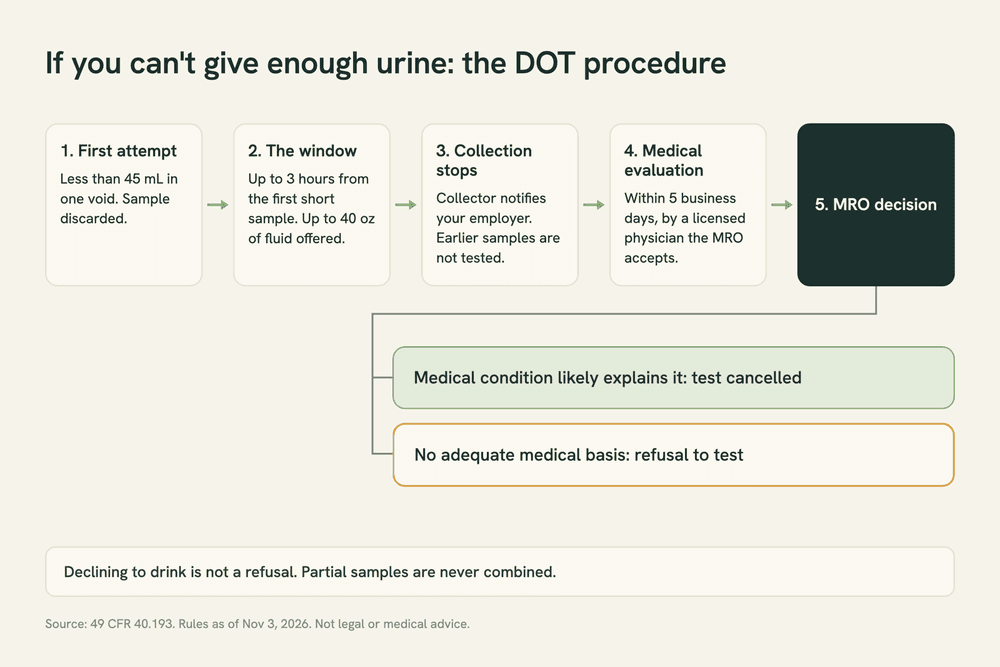
Shy bladder at a drug test has a written answer. If your test falls under Department of Transportation (DOT) rules, you get a second chance: up to three hours and up to 40 ounces of fluid, which you may decline. If you still cannot give 45 mL in one go, the collection stops, a doctor the Medical Review Officer (MRO) accepts evaluates you within five business days, and the MRO either cancels the test or records a refusal.
The detail most people miss is the standard the doctor applies. A psychological condition such as paruresis, the clinical name for shy bladder, can excuse the missing sample, but only if it was medically documented before the test. The rule excludes "situational anxiety" and dehydration by name. Everything else on this page, from the clock to the checklist, follows from that line. Two terms come up throughout: the MRO is the licensed physician who reviews drug-test results, and the DER (designated employer representative) is the person at your company who receives collection problems and makes employer decisions. If you want the background on what the lab actually screens a urine sample for, start with our guide to the 10-panel drug test; this page covers what happens before any sample reaches the lab.
What happens at a DOT collection when you can't pee: the timeline
DOT's testing rule covers safety-sensitive jobs such as commercial truck and bus drivers, pilots, and railroad, transit and maritime workers. Under DOT's shy-bladder rule, 49 CFR 40.193, a urine test needs at least 45 mL, about an ounce and a half, "in a single void," meaning one trip to the bathroom. If you come out with less, the collector must give you "another opportunity." The process starts on time even if you warn the collector you can't go: the rule on preparing for a collection, 49 CFR 40.61, says the collector "must not wait because the employee says he or she is not ready or is unable to urinate." The shy-bladder clock is the safety valve. Here is the sequence, with the paragraph of the rule for each step.
- 1First attempt: you come out with less than 45 mL. The collector discards it, unless the temperature is out of range or there are signs of tampering (40.65(a)).
- 2No topping up: the collector may never combine urine from separate voids to reach 45 mL (40.65(a)(3)).
- 3The clock starts: the collector writes down the time and tells you when your three hours begin and end (40.193(b)(1)(ii)).
- 4Fluids are offered: the collector urges you to drink up to 40 ounces, spread reasonably over the window. Declining to drink is not a refusal (40.193(b)(1)(ii)).
- 5Further attempts: you try again when you are ready, until you give a sufficient sample or three hours pass from the first short sample.
- 6The stop: at three hours the collector discontinues the collection, notes it on the custody form, tells the DER and discards anything you gave earlier (40.193(b)(1)(iv)).
- 7The referral: your employer, after consulting the MRO, directs you to get a medical evaluation within five days, which DOT counts as business days (40.193(c)).
- 8The decision: the MRO reviews the doctor's written recommendation and either cancels the test or records a refusal to test (40.193(d), (h)).
A few points in the timeline are easy to get wrong. The three hours start at "the very first time the employee comes out of the urination area with less than 45 mL," according to DOT's published Q&A on 40.193, not when you arrived. Three hours is a ceiling, not a guaranteed minimum, although the same Q&A says collectors "are advised to provide the full three hours," and DOT "sees no situations for which an employee should be given more than 3 hours and offered more than 40 ounces." For scale, 40 fluid ounces is about 1.2 liters, a little more than two standard 20-ounce bottles, spread over as much as three hours. You can drink some, all or none of it. Partial samples do not add up either: the urine collection rule, 49 CFR 40.65, says "You are never permitted to combine urine collected from separate voids to create a specimen." Two half-cups never make one test.
Is it a refusal? What counts and what doesn't
Not being able to pee is not, by itself, a refusal. It becomes one only through specific events, and DOT's refusal rule, 49 CFR 40.191, lists them. The table below is built only from that rule, from 40.193 and from DOT's own examples. Where the rule says "the employer decides," outcomes can vary between employers.
| What happens | Is it a refusal? | Rule |
|---|---|---|
| You decline the fluids the collector offers | No. The rule says so in plain words. | 40.193(b)(1)(ii) |
| Three hours pass without 45 mL in one void | Not yet. The medical evaluation decides. | 40.193(c)-(d) |
| The evaluation finds no adequate medical explanation | Yes | 40.191(a)(5), 40.193(d)(2) |
| You skip the medical evaluation | Yes. For a pre-employment test, only if you already had a contingent job offer; otherwise the MRO cancels the test. | 40.191(a)(7) |
| You refuse to try, or leave before the process is complete | It can be. Failing to stay until the process is complete is on the refusal list, and your employer makes the call. | 40.193(b)(1)(iii), 40.191(a)(2) |
| You leave a pre-employment test before the testing process has begun | No | 40.191(a)(2) |
| The site closes and sends you away before your three hours are up | Your employer can conclude there was no refusal | DOT 2023 preamble, Example 1 |
| You decline a directly observed collection when one is required | Yes | 40.67(m) |
| You refuse a company (non-DOT) test | Not a DOT refusal. Company policy decides what follows. | 40.191(e) |
Why the stakes are high: a refusal brings the consequences your DOT agency's rules set for a violation of those rules, and 40.191(c) says those consequences "cannot be overturned or set aside by an arbitration, grievance, State court or other non-Federal forum." For how that plays out at work, see whether you can get fired for failing a drug test, and for benefits, whether you can collect unemployment after a failed or refused test. The site-closing row comes from the 2023 DOT final rule that added oral fluid testing. In its first example, a collection site sends a worker away because it is closing, and DOT says the employer "could determine there was no possibility the employee could have completed the test, and therefore could conclude there was no refusal." Note the word "could": it is the employer's call, which is why the time and the name of whoever sent you away matter.
The medical evaluation: who does it, what counts and what happens next
After the collection stops, your employer, having consulted the MRO, directs you to obtain "within five days, an evaluation from a licensed physician, acceptable to the MRO, who has expertise in the medical issues raised." DOT's published Q&A says the five days are business days, with weekends and holidays not counted. The MRO can do the evaluation personally if the MRO has the right expertise. The referral doctor knows the stakes: the MRO must explain that the test was required and what a refusal means under your DOT agency's rules. What comes back is short. The doctor sends "a written statement of your recommendations and the basis for them," and the rule says it must not include detailed information on your medical condition beyond what is necessary. The decision turns on one paragraph of 40.193.
“A medical condition includes an ascertainable physiological condition (e.g., a urinary system dysfunction in the case of a urine test ...), or a medically documented pre-existing psychological disorder, but does not include unsupported assertions of "situational anxiety" or dehydration.”
Read it closely. A physical problem with the urinary system counts if it can be ascertained. A psychological condition counts if it was documented before the test. Feeling nervous on the day, with nothing on record, does not count, and neither does being dehydrated. The doctor then recommends one of two outcomes, and the MRO, who must "seriously consider" the recommendation, decides and reports in writing.
- Test cancelled: a medical condition "has, or with a high degree of probability could have, precluded" a sufficient sample (40.193(d)(1)).
- Refusal to test: there is "not an adequate basis" for concluding a medical condition explains it (40.193(d)(2)).
- After a cancelled random test: the employer takes no further action, and you stay in the random testing pool (40.193(i)).
- After a cancelled pre-employment, return-to-duty or follow-up test: a cancellation is not a pass, because these tests need a negative. See the next paragraph.
That last case is covered by DOT's rule on permanent or long-term medical conditions, 49 CFR 40.195. If the referral doctor finds a serious condition that is permanent or long-term, the MRO looks for "clinical evidence that the individual is an illicit drug user" and "may conduct an alternative test (e.g., blood)." No such evidence means the MRO reports a negative. Evidence of drug use means the test stays cancelled, which "does not serve the purposes of a negative test," so you cannot start or return to safety-sensitive work. The rule gives "a severe psychiatric disorder focused on genito-urinary matters" as one example of a qualifying condition, and it says temporary conditions such as cystitis, urethritis or prostatitis do not qualify. This is the only place in the shy-bladder rules where a blood test appears, and the MRO orders it, not the worker.
What paruresis is, and why documentation is the hinge
Paruresis, often called shy bladder, "refers to the inability to initiate or sustain urination where individuals are present due to the fear of perceived scrutiny from others," in the words of a 2017 systematic review in the Journal of Psychosomatic Research. Across the 10 studies it included, prevalence estimates ranged from 2.8% to 16.4%, and the authors flagged "notable methodological problems and lack of standardisation" in how it is measured. So treat any single headline figure with caution. The low end comes from a representative sample of 1,105 German men, 2.8% of whom met the researchers' cutoff, a group the authors found was not tied to lower education or job level.
Where paruresis belongs in psychiatry is debated. Psychiatric manuals have grouped it with social anxiety disorder (social phobia), but a 2006 questionnaire study of 226 people found results that "question the classification of paruresis as simply being a form of social phobia." Work is where it bites. In a 2002 survey of 63 members of the International Paruresis Association, 59 of them men, just over half said it limited the jobs they chose, and on average they had lived with symptoms for 24.5 years. That sample was self-selected, so it describes people who sought out a support group, not everyone with the condition.
This is why documentation is the hinge of the federal rule. 40.193(e) accepts a "medically documented pre-existing psychological disorder" and rejects "unsupported assertions of 'situational anxiety.'" The rule does not define what documentation must look like; the MRO judges it. What it does make clear is that the record has to exist before the test, not be created afterward. If shy bladder affects your daily life, it is worth raising with a clinician.
A real case: how strict the standard can be
In Kinneary v. City of New York, 601 F.3d 151 (2d Cir. 2010), a New York City boat captain selected for a Coast Guard random test in December 2001 could not produce enough urine within three hours. About a week later he brought a doctor's note to the clinic, but the Medical Review Officer "found no medical reason to explain the inability to void." Notes from a neuropsychiatrist and a urologist reached the city "around a half-year after the regulatory time limit had expired" and could not count. On his own initiative he passed a blood test and a hair test, and a later saliva test came back negative, but none of that changed the outcome: an administrative law judge ruled the shy-bladder episode a refusal, and his license was suspended for 12 months. The federal appeals court reversed a jury verdict in his favor under the Americans with Disabilities Act (ADA), and in a footnote said it "need not and do[es] not resolve here whether 'shy bladder syndrome' can be a disability under the ADA."
Can you switch to a mouth swab or a blood test?
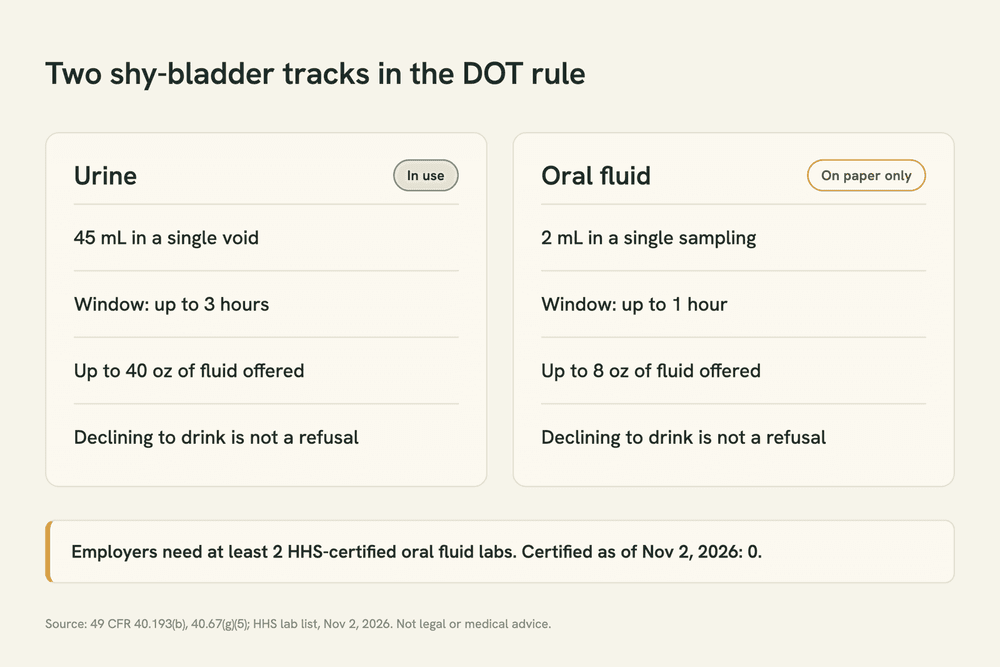
Since the 2023 oral-fluid rule, 40.193 has said the second attempt can be made "using the same specimen type" or by a collector qualified to use an alternate specimen, "in accordance with the employer's instructions." On paper, a shy-bladder collection can move to a mouth swab. In practice, three things stand in the way.
- It is the employer's choice. Commenters, including the International Paruresis Association, asked DOT to let workers choose. DOT declined, though it strongly suggested employers consider oral fluid for these cases.
- Employers can use oral fluid only once at least two labs are certified by the Department of Health and Human Services (HHS) to test it (49 CFR 40.67(g)(5)).
- As of HHS's November 2, 2026 lab list, not one lab was certified to test oral fluid.
- The rule already has a dry-mouth version: up to one hour and up to 8 ounces of fluid, for 2 mL in a single sampling. It is not in use yet for the same reason.
- Blood appears only in the MRO's permanent-condition process under 40.195. A worker cannot request it as a substitute at the collection site.
The lab status is the deciding fact. HHS's November 2, 2026 notice of certified laboratories states: "At this time, there are no laboratories certified to conduct drug and specimen validity tests on oral fluid specimens." The list is updated monthly, so check the current one if you are reading this later. Until that changes, a DOT shy-bladder case still runs on urine. For how saliva testing works and what it detects, see our mouth swab drug test guide. One more development to watch: on October 29, 2026, HHS proposed that, in federal-agency testing, a shy-bladder test cancelled for a temporary condition be followed by an immediate new collection when the job requires a negative result. It is a proposal, and it does not change DOT rules (our explainer on the HHS drug-testing proposal covers the rest of it).
Will they watch you? Shy bladder and observed collections
Not being able to go is not, on its own, a reason for a directly observed collection. DOT's observation rule, 49 CFR 40.67, lists specific triggers: a sample outside the 90 to 100 °F temperature range, signs of tampering, certain lab findings such as an invalid result without a medical explanation, and every return-to-duty and follow-up test. If one of those happens during your window, for example a later attempt comes out at the wrong temperature, the next attempt is observed. The clock does not restart. DOT's published Q&A works through that exact case: a first short sample at noon, an out-of-range sample at 2 o'clock, and the worker "has up to 3 o'clock" with whatever is left of the 40 ounces, with no new three hours. The observer must be the same sex as you; the rule says a person of the opposite sex must never act as the observer. Declining a required observed collection is a refusal. No one will catheterize you, either: 40.61 forbids catheterizing a conscious employee, though if you normally void by self-catheterization, you will be asked to provide the sample that way.
Outside DOT: company tests and federal employees
If your employer is not DOT-regulated, none of the above binds it. DOT's rule on separating programs, 49 CFR 40.13, says "DOT tests must be completely separate from non-DOT tests in all respects," and 40.191(e) adds that refusing a non-DOT test carries "no consequences under DOT agency regulations." Outside DOT and federal programs, what happens when you can't give a sample is set by your employer's written policy and your state's testing law. Many policies copy the three-hour procedure, but they do not have to, and state laws differ. Ask for the policy in writing before test day.
Federal executive-branch employees tested under the HHS Mandatory Guidelines for federal workplace urine testing go through nearly the same steps. Section 13.6(b) also calls for an evaluation "within five days" by a licensed physician acceptable to the MRO, and it repeats the DOT exclusion word for word: a "medically documented pre-existing psychological disorder" counts, "unsupported assertions of 'situational anxiety' or dehydration" do not.
One caution about the fluids. Drinking far more than the collector offers can bring back a dilute result, which has its own set of rules; our guide to a negative-dilute drug test explains what happens next if that is how your sample is reported.
Before the test: a procedure checklist
None of this is about forcing yourself to go. It is about following the procedure so that, if you can't, the record shows what happened. These steps come straight from the rules quoted above.
- 1Ask whether it is a DOT test. If it is not, ask for your employer's written testing policy before test day.
- 2If a clinician has already diagnosed a condition that affects urination, keep a copy of the records. The rule credits only conditions documented before the test.
- 3Tell the collector at the start that you may need the shy-bladder procedure, and make sure they tell you when your three hours begin and end.
- 4Stay until the collector tells you the process is complete. You may decline the fluids; leaving is what creates risk.
- 5If the site closes or sends you away early, write down the time and the name of the person who sent you.
- 6Keep medications and medical details off the custody form. The rule tells collectors to instruct you not to list them; they go to the MRO or the referral doctor.
- 7If the collection is stopped, arrange the evaluation promptly. You have five business days, and missing it is a refusal.
- 8Bring relevant records to the evaluation. The doctor addresses whether a condition has, or with a high degree of probability could have, prevented a sufficient sample.
- 9You can ask whether your employer uses an alternate specimen. As of November 2026, expect the answer to be no.
Shy bladder drug test FAQ
At a DOT-regulated test, you get a second chance: up to three hours from your first short sample and up to 40 ounces of fluid, which you may decline. If you still cannot give 45 mL in a single void, the collection stops, a physician the MRO accepts evaluates you within five business days, and the MRO either cancels the test or records a refusal. Company tests outside DOT follow the employer's written policy and state law.
Under DOT rules, up to three hours, counted from the first time you come out with less than 45 mL. DOT's published Q&A calls three hours a maximum and says no one should get more than three hours or more than 40 ounces, though collectors are advised to give the full window. Non-DOT tests can set their own limit.
Not automatically. Under DOT rules it becomes a refusal if the medical evaluation finds no adequate medical explanation, if you skip the evaluation, or if you refuse to try or leave before the process is complete and your employer treats that as a refusal. Declining the offered fluids is expressly not a refusal.
The employer decides, not you. The DOT rule allows an employer to switch a shy-bladder collection to oral fluid, but DOT requires at least two certified labs first, and as of HHS's November 2, 2026 list there were none. Blood appears only in the MRO's process for permanent or long-term conditions under 40.195, and the MRO orders it.
What the rule weighs is the evaluation by a licensed physician the MRO accepts, done within five business days, and that physician's written recommendation on whether a condition has, or with a high degree of probability could have, prevented a sufficient sample. A psychological condition counts only if it was medically documented before the test. In the Kinneary case, a note in which the MRO found no medical reason, and specialist notes that arrived months late, did not prevent a refusal finding.
Not because of shy bladder alone. Under 49 CFR 40.67, observation follows specific triggers, such as a sample outside the temperature range, signs of tampering, certain lab results, and every return-to-duty and follow-up test. If observation starts during your window, the original three hours keep running. The observer must be the same sex as you.
The collector offers up to 40 ounces, about 1.2 liters, spread over up to three hours, and you can decline it. Drinking much more than that can produce a dilute sample, which leads to its own rules and possibly a retest.
Courts have not settled it. In Kinneary v. City of New York (2d Cir. 2010), the federal appeals court expressly declined to decide whether shy bladder syndrome can be a disability under the ADA. This page is not legal advice; an employment lawyer can assess a specific situation.
Once a sufficient sample does reach the lab, the next questions are what it is screened for and how results are confirmed and reviewed; the 10-panel drug test explained walks through that step by step. If you use hemp products and wonder how trace THC can show up on a urine test, our CBD drug test guide covers it, and for the wider legal picture around hemp and cannabinoids, see is CBD legal.
Writing about hemp, wellness and the small rituals that keep us balanced.