Negative Dilute Drug Test: What It Means and What Happens Next (DOT Rules, 2026)
A negative-dilute is a negative result on urine more watered-down than the lab's thresholds. It is not a fail. What happens next depends on your creatinine level and whether you are DOT-regulated. Here is the rule, quoted, and the innocent reasons it happens.

Your urine drug test came back "negative-dilute." A negative dilute drug test is still a negative: the lab found no drug above the cutoff. The "dilute" part means the urine was more watered-down than the lab's thresholds for creatinine and specific gravity. What happens next turns on one number, your creatinine level, and one question: is your test run under Department of Transportation (DOT) rules, a federal agency program or a private employer's policy? Rules as of November 1, 2026. This is not legal advice; your program's written policy and the medical review officer decide.
Here is the short version. Under DOT rules, a negative-dilute with creatinine between 2 and 5 mg/dL means an immediate new collection under direct observation, with no advance notice. Above 5 mg/dL, a retest is your employer's choice, set in advance and applied to everyone, and it is not observed. The retest becomes the result of record, and a second negative-dilute cannot trigger a third test because of the dilution. The one move that turns a negative-dilute into a real problem is declining the retest, which counts as a refusal. If you came here from our guide to what a 10-panel drug test screens for, this page picks up where the lab report ends.
What "dilute" means on a drug test, in numbers
Before a federal lab looks for drugs, it measures the urine itself. Under the HHS Mandatory Guidelines for federal workplace urine testing, every specimen gets a creatinine test, and anything under 20 mg/dL also gets a specific gravity test. Creatinine is a normal waste product in urine, so a very low level points to extra water. Specific gravity measures how concentrated urine is compared with plain water. The guidelines define a dilute specimen as one whose creatinine and specific gravity are "lower than expected but are still within the physiologically producible ranges of human urine." In other words, dilute urine is real human urine. DOT-regulated labs follow these same HHS standards.
| Result | What the lab found | How DOT treats it |
|---|---|---|
| Dilute (criterion a) | Creatinine greater than 5 mg/dL but less than 20 mg/dL, and specific gravity equal to or greater than 1.002 but less than 1.003 | Reported only with a negative or positive result; the 40.197 steps below apply |
| Dilute (criterion b) | Creatinine equal to or greater than 2 mg/dL but less than 20 mg/dL, and specific gravity greater than 1.0010 but less than 1.0030 | Same; a negative with creatinine of 2 to 5 mg/dL triggers an observed recollection |
| Substituted | Values outside what a human body can produce | A refusal to test |
| Adulterated | A substance that does not belong in urine, or a normal one at an abnormal level | A refusal to test |
| Invalid | No positive, negative, adulterated or substituted result could be established | Reviewed by the MRO under separate rules, not covered on this page |
Two things stand out. First, a dilute flag never stands alone. The guidelines say a dilute result "may be reported only in conjunction with the positive or negative drug test results." There is no such thing as failing a test for being dilute. Second, dilute is the only one of the four outcomes that the rules treat as possible for real human urine. Substituted means the numbers fall outside what a body can make, adulterated means something was found that should not be there, and invalid means the lab could not establish any result. The line between dilute and substituted was drawn from human data: an HHS-funded 2000 review in the *Journal of Analytical Toxicology* pooled reference ranges, water-loading studies and medical conditions that cause overhydration, to separate urine that is merely dilute from urine no body could produce. Outside federal programs the routine is similar. A 2025 lab-medicine review in *Clinics in Laboratory Medicine* describes pH, specific gravity and creatinine tests as the measures that "help identify diluted or altered samples."
Negative-dilute vs positive-dilute: why they are treated so differently
Extra water can only hide a drug. It cannot create one. That is why the two combinations go in opposite directions. Under DOT's dilute-specimen rule, 49 CFR 40.197, when a positive is also dilute, the employer simply treats it "as a verified positive test" and "must not direct the employee to take another test based on the fact that the specimen was dilute." A drug found in watered-down urine was found anyway. For federal agencies, the HHS guidelines go one step further: on a positive, the MRO "may choose not to report the dilute result" at all.
A negative-dilute is the opposite case. No drug was found above the cutoff, but because the sample was watery, the lab cannot rule out that a drug was present and the extra water pushed it below the line. The result is still a negative. When DOT wrote the current version of the rule in 2008, its final rule in the Federal Register said negative specimens that are also dilute "will continue to be viewed as negative specimens, but with the option for employer policies to determine if there is to be a recollection." The same document explains why one narrow band gets special treatment. Creatinine of 2 to 5 mg/dL "is not the norm," DOT wrote, so "a recollection under direct observation is a reasonable requirement." DOT also declined to adopt the terms "hyperdilute" and "superdilute." If you see them online, they are not regulatory categories.
If you are DOT-regulated: the decision tree, quoted from the rule
DOT's testing rule, 49 CFR Part 40, covers tests required by a DOT agency, which means safety-sensitive jobs such as commercial truck and bus drivers, pilots, and railroad and transit workers. Here is what 40.197 and the related sections say happens after the lab reports a dilute result, step by step. Section numbers are in parentheses so you can match them against any letter you receive.
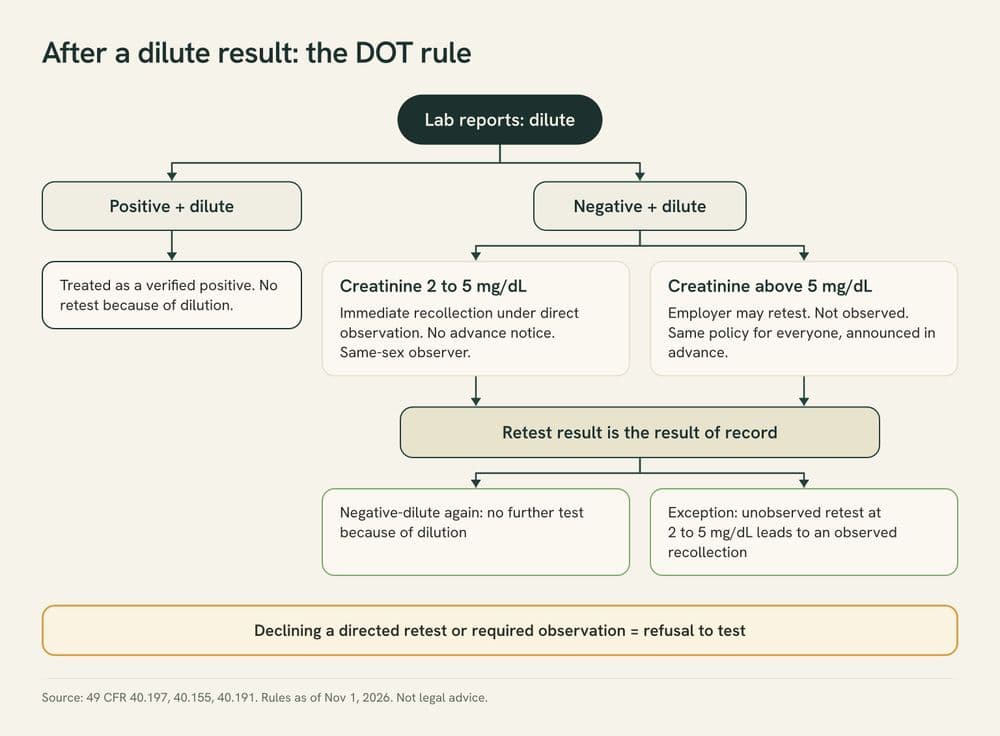
- 1Positive and dilute: treated as a verified positive. No retest is ordered because of the dilution (40.197(a)).
- 2Negative-dilute, creatinine 2 to 5 mg/dL: the MRO directs the employer to send you for an immediate new collection under direct observation, with no advance notice and an observer of the same sex (40.197(b)(1), 40.155(c), 40.67(a)(3)).
- 3Negative-dilute, creatinine above 5 mg/dL: the employer may, but is not required to, order an immediate retest (40.197(b)(2)).
- 4That retest must not be observed unless another reason for observation applies, the same policy must cover every employee, and employees must have been told in advance (40.197(b)(2)).
- 5Notice and result of record: you get the minimum possible advance notice of the retest, and its result replaces the first one (40.197(c)(1)-(2)).
- 6Second negative-dilute: the employer may not make you take another test because the result was dilute (40.197(c)(3)-(4)).
- 7The one exception: if an unobserved retest comes back negative-dilute with creatinine of 2 to 5 mg/dL, the MRO directs an observed recollection, and it must happen immediately (40.197(c)(4)).
- 8Observed recollection, dilute again: the MRO checks the custody form. If it shows the collection was observed, the result is reported as negative-dilute. If it does not, no result is reported and the observed collection is done again (40.155(d)).
- 9Declining any directed retest, or declining to be observed when observation is required, is a refusal to test (40.197(c)(5), 40.191(a)(4) and (a)(6)).
“If the result of the test you directed the employee to take ... is also negative and dilute, you are not permitted to make the employee take an additional test because the result was dilute.”
Two details trip people up. The observed band is narrow: only creatinine of 2 to 5 mg/dL makes the watched collection mandatory, and a retest the employer chooses above 5 mg/dL must not be observed unless another reason applies. And the "no third test" rule is about dilution. Its wording is "because the result was dilute," so it does not speak to a separate test with its own basis, such as a later random selection. Your employer will also know the specimen was dilute. Under 49 CFR 40.155, the MRO, the physician who reviews lab results, reports that the specimen, "in addition to being negative or positive, is dilute," and explains the 40.197 steps to the employer.
The negative-dilute is not the problem. Walking away from the retest is. Under DOT's refusal rule, 49 CFR 40.191, you have refused to test if you "fail or decline to take an additional drug test the employer or collector has directed you to take," and the same is true if you do not permit observation when it is required. The consequences of a refusal "cannot be overturned or set aside by an arbitration, grievance, State court or other non-Federal forum." For how a refused or failed test can play out at work, see whether you can get fired for failing a drug test.
If you work for a federal agency or a private employer
DOT is not the only rulebook. If you are a federal executive-branch employee tested under the HHS guidelines, Section 13.5(b) is stricter on the retest and gentler on the outcome. After every negative-dilute, whatever the creatinine level, the MRO directs the agency "to immediately collect another specimen." But if that recollection comes back negative or negative-dilute, "the MRO reports a negative result to the agency, with no further action required." The guidelines' list of reasons for a directly observed collection (Section 8.9) does not include a dilute result.
If your employer is neither DOT-regulated nor a federal agency, neither rule binds it. Part 40 covers only tests that DOT agency regulations require, and DOT's rule on separating programs, 49 CFR 40.13, says "DOT tests must be completely separate from non-DOT tests in all respects." If a company also runs its own test, that is a separate collection under the company's policy. Outside DOT and federal-agency programs, what happens after a negative-dilute is set by your employer's written policy and your state's drug-testing law. Many policies borrow the DOT tree, but they do not have to, and state laws differ. If a test result ends up affecting your job, whether you can collect unemployment after a drug-test problem is covered separately.
| Question | DOT-regulated | Federal agency (HHS program) | Private, non-regulated employer |
|---|---|---|---|
| Which rule applies | 49 CFR Part 40, mainly 40.197 | HHS Mandatory Guidelines, Section 13.5(b) | The employer's written policy and state law |
| Is a retest required? | Yes if creatinine is 2 to 5 mg/dL; the employer's choice above 5 mg/dL | Yes, after every negative-dilute | Depends on the policy |
| Is the retest observed? | Yes for 2 to 5 mg/dL; no for an employer-chosen retest above 5 mg/dL | Dilute is not on the list of reasons for observation | Depends on the policy and state law |
| Second negative-dilute | No further test because of dilution; the retest is the result of record | Reported to the agency as negative, no further action | Depends on the policy; ask to see it in writing |
| Declining the retest | A refusal to test, with the consequences of a verified positive | Check your agency's written program | Check the written policy |
Why dilute results happen to people who were not trying to cheat
Dilute does not mean dishonest, and the research on this is better than most people expect. In a study of 4,227 samples at a Michigan toxicology lab, 209 (4.94%), about 1 in 20, had creatinine under the 20 mg/dL line. The authors concluded that creatinine under 20 "do[es] not always implicate sample adulteration." That count uses creatinine alone, which is only half of the federal dilute test, and the samples were clinical and forensic, not workplace. A 2026 study of 24,018 drug-test records at a hospital lab in Türkiye found 118 (0.49%), about 1 in 200, were dilute under that lab's own definition, more often in forensic testing (0.7%) than in administrative and clinical testing (0.2%). Age, sex and season made no significant difference, and the authors warned that the pattern does "not establish intentional manipulation." The two studies used different definitions and populations, so their rates should not be compared or averaged.
Ordinary drinking can do it. At the Federal Aviation Administration's Civil Aerospace Medical Institute, Chaturvedi and colleagues gave 12 men and 12 women one measured drink, a different beverage on each of four separate occasions (Journal of Analytical Toxicology, 2013). Of 376 usable samples, 27 met the dilute criteria, and 20 of those 27 came from women. Women with a dilute sample tended to be shorter and lighter, and men leaner, but those body differences were not statistically significant, and with 24 volunteers the study is too small to say who is more likely to test dilute. The larger Turkish data set found no significant sex difference at all. The FAA researchers' conclusion is the useful part: "a dilute sample does not necessarily indicate that it was intentionally diluted." In an earlier study whose lead author worked at the Department of Transportation (Edgell et al., Journal of Analytical Toxicology, 2002), 56 volunteers drank large amounts of fluid under supervision. Nearly three in four produced at least one dilute sample, and none produced a sample that met the federal substituted criteria in use at the time. Real urine can be dilute. It does not drop below what a human body can make.
Your body sets the baseline. Creatinine is "made when you use your muscles," as MedlinePlus's guide to the creatinine test puts it, and people make different amounts depending on how much muscle they have, what they eat, their age and how active they are. A CDC analysis of urine creatinine in more than 22,000 Americans found that age group, sex, race and ethnicity, body mass index and fat-free mass all predicted creatinine levels. None of that tells you whether a given person will test dilute. It does explain why the same everyday habits can leave a smaller, older or less muscular person closer to the line than someone else.
Medical conditions can lower specific gravity too. MedlinePlus's page on the urine specific gravity test lists kidney damage or failure, a severe kidney infection, low blood sodium (hyponatremia) and diabetes insipidus, alongside drinking too much fluid. Some blood-pressure and swelling medicines are diuretics, or water pills. The MedlinePlus entry for hydrochlorothiazide explains that this kind of medicine works by causing the kidneys to "get rid of unneeded water and salt from the body into the urine." If you take one, tell the MRO and keep your prescription handy. Never start or change a medicine because of a drug test. One case shows how a dilute flag can point to a health problem: a kidney specialist described a patient whose dilute drug-test sample was thought to be watered down on purpose. A medical workup traced it to chronic water intoxication from a very strict weight-loss diet.
- Ordinary fluid intake: shown to produce dilute samples in controlled studies. It is not a finding of tampering.
- Body size, sex, age and muscle mass: they shape how much creatinine you make. Mention them if the MRO asks.
- Kidney conditions, low blood sodium or diabetes insipidus: tell the MRO, and your doctor if it is news to you.
- A prescribed water pill: tell the MRO and have the prescription ready.
- A very strict diet with unusual fluid habits: one case report traced a dilute flag to water intoxication, which is a medical problem in its own right.
If you arrived here wondering whether dilution can be used on purpose, the short answer is that labs are built to flag exactly that. Our look at the Certo pectin method walks through why, and why drinking large amounts of water around a test carries real medical risk.
What you can ask for after a negative-dilute, and what you cannot change
You have more standing in this process than a result letter suggests. These are the concrete things the DOT rules let you ask for or expect. If you are not DOT-regulated, use them as questions for your employer's program.
- Ask for the written retest policy and when employees were told about it. A retest above 5 mg/dL is allowed only under a policy applied to everyone and announced in advance (40.197(b)(2)(ii)).
- Ask why a collection is observed. You must be told the reason for a directly observed collection (40.67(d)).
- Expect an observer of the same sex. The rule says a person of the opposite sex must never act as the observer (40.67(g)).
- Request your records in writing. The MRO or service agent must send copies of your DOT test records within 10 business days of a written request, and the lab report comes through the MRO (40.329).
- Tell the MRO about prescriptions and medical conditions. It will not cancel a required DOT recollection, but it belongs in your record.
- If you are an applicant and are told a second negative-dilute disqualifies you, ask to see the written policy.
Two record questions come up often. For commercial driver's license (CDL) holders regulated by the Federal Motor Carrier Safety Administration, the Drug and Alcohol Clearinghouse list is short. Under the Clearinghouse reporting rule, 49 CFR 382.705, MROs report verified positive, adulterated and substituted results and refusal determinations, and employers report refusals, including declining an additional test the employer directed, along with alcohol violations and return-to-duty steps. A negative-dilute is not one of the reportable violations. Declining the retest is, because it counts as a refusal. (The one negative result that does get reported is a negative return-to-duty test, which records progress back to work after an earlier violation.) The Clearinghouse covers CDL drivers only; other DOT industries have no equivalent database. For your own copy of what was reported, DOT's records-access rule, 49 CFR 40.329, requires the MRO or service agent to provide your test records "within 10 business days of receiving a written request."

What is still unsettled, and the date on this page
Rules as of November 1, 2026. This is not legal advice; your program's written policy and the MRO decide. On October 29, 2026, HHS proposed revisions to the federal urine guidelines, including an optional biomarker test, authorized by the MRO, for some specimens reported invalid on the basis of creatinine and specific gravity; the proposal is not in force, comments close December 28, 2026, and it leaves the dilute criteria unchanged (our explainer on the HHS drug-testing proposal covers the rest of it). A few other points are open:
- Oral fluid: DOT's rule (49 CFR 40.67) now lets a mouth swab stand in for an observed urine collection in some cases, such as when no same-sex observer is available, but only once at least two labs are certified for oral fluid.
- Oral fluid labs: as of HHS's notices in September and October 2026, none is certified.
- Applicants and a second negative-dilute: the DOT rule does not let an employer keep testing you for dilution, and it treats the retest as the result of record. It does not spell out every hiring decision.
- If an employer says a second negative-dilute disqualifies you, ask to see the written policy.
- Private employers: state drug-testing laws differ, and this page does not cover them state by state.
- Federal agencies: individual agency programs can add their own procedures on top of the HHS guidelines.
On the oral-fluid point, HHS's September 2026 notice of certified laboratories states that "there are no laboratories certified to conduct drug and specimen validity tests on oral fluid specimens." That list changes monthly. For how saliva testing works and what it looks for, see our mouth swab drug test guide.
Negative dilute drug test FAQ
No. It is a negative. When DOT wrote its current dilute rule in 2008, it said negative specimens that are also dilute "will continue to be viewed as negative specimens." What can follow is a retest: mandatory and observed if creatinine was 2 to 5 mg/dL, optional and unobserved above 5 mg/dL. Declining that retest is what counts as a refusal.
Under DOT rules, only if your creatinine was 2 to 5 mg/dL, or if another reason for observation listed in 49 CFR 40.67 applies. A retest your employer chooses after a negative-dilute above 5 mg/dL must not be observed. If observation is required, the observer must be the same sex as you, and you must be told why the collection is observed.
Under DOT rules, the employer may not make you take another test because the result was dilute (40.197(c)(3)-(4)), and the retest is the result of record. The one exception: if an unobserved retest comes back with creatinine of 2 to 5 mg/dL, the MRO must order an observed recollection. Under the HHS guidelines for federal agencies, a negative or negative-dilute recollection is reported as negative. Private employers follow their written policy.
The MRO reports the dilute flag to your employer along with the negative result. For CDL drivers, the FMCSA Clearinghouse records violations such as verified positive, adulterated and substituted results and refusals; a negative-dilute is not one of them. Declining a directed retest is, because it counts as a refusal. Other DOT industries have no Clearinghouse.
It means the lab found no drug, including the THC metabolite, above the cutoff in that sample. If your employer orders a retest, the retest becomes the result of record. If you use CBD: workplace urine tests look for a THC metabolite, not CBD, but full-spectrum products can contain trace THC, so no product can guarantee a drug-test result.
Yes. Controlled studies have found that ordinary fluid intake can produce dilute samples, and that heavy fluid intake made most volunteers produce one, without any sample falling into the substituted range. Body size, age and muscle mass, some kidney and hormone conditions, and prescribed water pills also play a part. If any of these apply to you, tell the MRO.
Under the HHS guidelines, a specimen is dilute when creatinine is at least 2 mg/dL and under 20 mg/dL with low specific gravity, as set out in the criteria table above. Under DOT rules, the creatinine number then sets the next step: 2 to 5 mg/dL means an observed recollection, above 5 mg/dL means an optional, unobserved retest.
A drug was found above the cutoff even though the urine was dilute. Under DOT rules it is treated as a verified positive, and the employer may not order another test because of the dilution. Under the HHS guidelines, the MRO may choose not to mention the dilute part at all.
For the bigger picture of how workplace drug tests are screened, confirmed and reviewed by an MRO, start with the 10-panel drug test explained. If you use CBD and wonder how trace THC can show up, our CBD drug test guide walks through it. For the wider legal landscape around hemp and cannabinoids, see is CBD legal.
Writing about hemp, wellness and the small rituals that keep us balanced.