Does Certo Work for a Drug Test? What Pectin Can and Can't Do to a Urine Sample
Certo is a jam-making pectin, and no study shows it lowers THC in urine. The method dilutes your sample, which is the first thing a regulated lab measures. What the lab checks, what a dilute result triggers, and where THC really leaves the body.
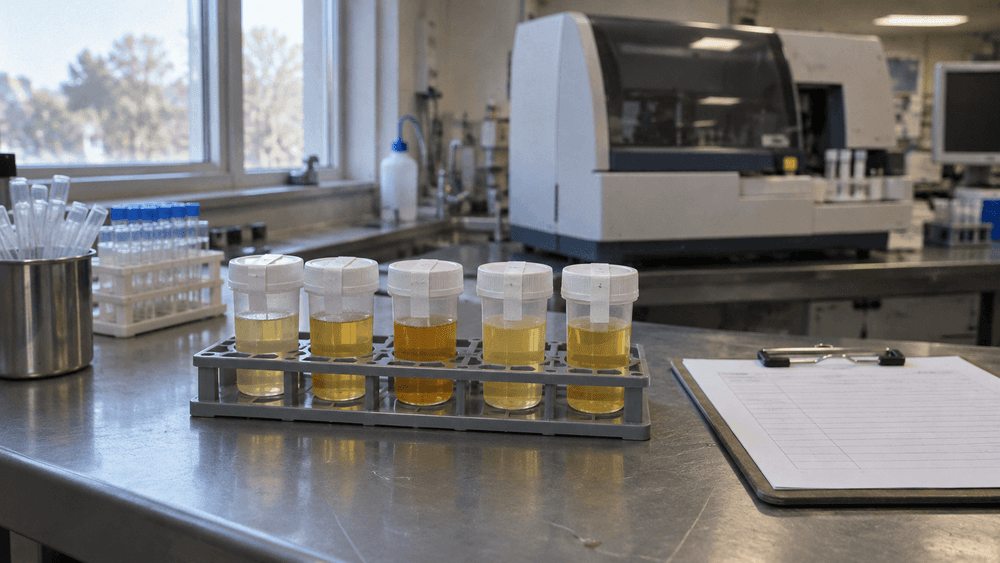
Certo, a liquid fruit pectin sold by Kraft Heinz for making jam, has a second life online as a supposed way to pass a urine drug test. We searched the medical literature and found no human study showing that pectin lowers THC in urine. What the method really does is dilute your urine with a large volume of fluid, and dilution is the first thing a regulated lab measures, before it ever looks for drugs. Current as of October 27, 2026.
Here is the short version. The folk method has two parts: pectin, and a lot of fluid. The pectin part has no evidence behind it. The fluid part does change your urine, but in exactly the way specimen validity testing is built to catch: it lowers creatinine and specific gravity, two markers that federal workplace labs measure as a matter of routine. A sample that is too watery is reported as dilute, and under Department of Transportation (DOT) rules a negative-dilute result can mean a new test, sometimes with someone watching. This page explains what the lab checks, what each result means and what happens next. It is not a how-to, and it gives no amounts, timing or products.
What Certo is, and how a jam ingredient became a drug-test myth
Pectin is the gelling fiber in fruit, the reason jam sets. Commercially it is extracted from citrus peel, apple pomace or beet pulp, and FDA's food regulation for pectin notes it can also be concentrated and sold as liquid pectin. FDA lists it among food ingredients affirmed as generally recognized as safe, for use as a stabilizer and thickener at normal manufacturing levels. The liquid jam product is mostly water and fruit pectin, with a little lactic and citric acid, potassium citrate and a preservative. Nothing on its label mentions drug tests.
The drug-test idea lives on forums and blogs, not in lab journals. The version that circulates pairs pectin with a large volume of fluid before a urine test. The theory offered is that pectin, a soluble fiber, "binds" THC in the gut so it leaves in your stool instead of your urine. When we read the top search results for this topic on October 27, 2026, page one was made up of hacked subdomains and content farms. Several printed step-by-step instructions, and none cited a laboratory, a regulator or a peer-reviewed study. Other claims on those pages, about sugar and fat burning, came with no source at all.
Claim vs evidence: what the pectin method promises
The fairest way to judge the method is to split it into the claims made for it and check each one against the best source available. Where no study exists, the table says so. Absence of evidence is not proof that something cannot work, but it does mean nobody has shown that it does.
| Claim | What the evidence says | Source |
|---|---|---|
| Pectin binds THC so it leaves in stool, not urine | No human study has tested it. Pectin raised stool bile acids by about a third over three weeks of daily intake in 9 adults; no cannabinoid was measured. | Kay and Truswell 1977; our PubMed search, Oct 27, 2026 |
| The effect lasts a set number of hours | No study has measured any effect of pectin on a drug test, so there is no duration to report. | Our PubMed search, Oct 27, 2026 |
| It works on mouth swabs too | A mouth swab is a different sample with a different target: THC itself in saliva, collected under observation. | 49 CFR 40.72 and 40.91 |
| Herbal or fiber additives do the work | In a 1998 NIDA study, herbal flush products added nothing beyond plain water, and every excess-fluid treatment pushed the sample into the dilute range. | Cone, Lange and Darwin, J Anal Toxicol, 1998 |
| The lab will not notice | Federal labs measure creatinine and pH on every specimen, and specific gravity whenever creatinine is under 20 mg/dL. | HHS Mandatory Guidelines (urine), Section 3.1(c) |
What the lab checks before it ever looks for THC
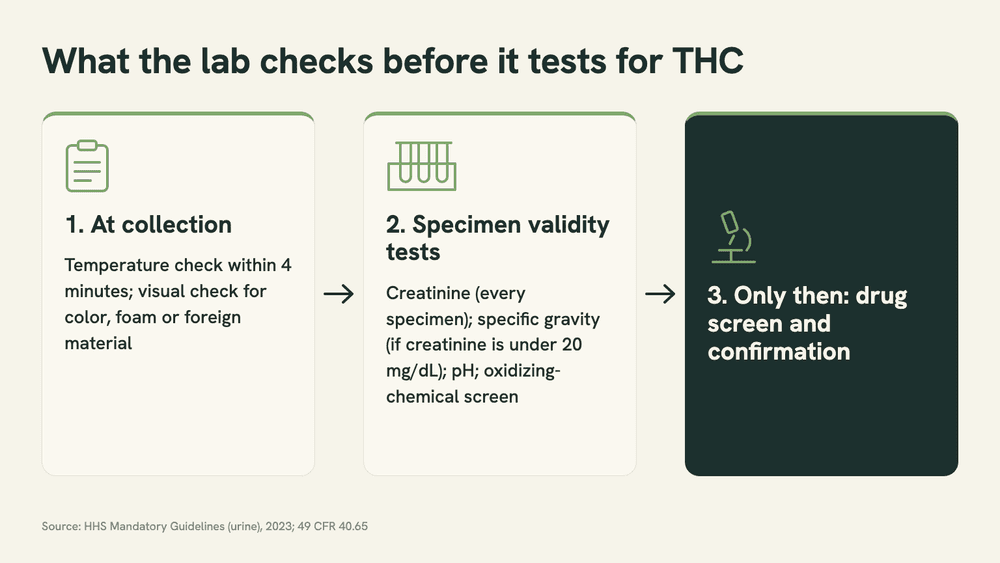
Under the HHS Mandatory Guidelines for federal workplace urine testing, the lab tests the urine itself before it reports a drug result. Every specimen gets a creatinine test and a pH test, plus at least one screen for oxidizing chemicals. If creatinine comes back under 20 mg/dL, the lab also measures specific gravity, which is how concentrated the urine is compared with water. Creatinine is a normal waste product in urine, so a very low level points to extra water. DOT-regulated labs follow the same HHS standards. Outside federal programs, a 2025 review of toxicology lab practice in *Clinics in Laboratory Medicine* describes the same routine: a visual inspection and a temperature check, then pH, specific gravity and creatinine tests that "help identify diluted or altered samples."
Some checks happen before the sample reaches the lab. Under DOT's collection rule (49 CFR 40.65), the collector checks within four minutes that the sample is at body temperature, and inspects it for unusual color, foreign material or other signs of tampering. A sample outside the acceptable temperature range triggers an immediate new collection under direct observation, or an oral fluid collection instead.
| Check | What it looks at | When it runs | What a flag leads to |
|---|---|---|---|
| Temperature | Whether the sample is at body temperature | At collection, within 4 minutes | A new collection under direct observation (DOT also allows oral fluid) |
| Visual inspection | Unusual color, odor, foam or foreign material | At collection | A new collection under direct observation |
| Creatinine | A normal waste product; very low levels point to extra water | Every specimen | Feeds the dilute and substituted calls |
| Specific gravity | How concentrated the urine is compared with water | Every specimen with creatinine under 20 mg/dL | Feeds the dilute and substituted calls |
| pH | How acidic or alkaline the urine is | Every specimen | An abnormal value is one sign of an altered sample |
| Oxidizing-chemical screen | Chemicals that do not belong in urine | Every specimen | Can make the result adulterated |
| Dilute call | Creatinine at least 2 and under 20 mg/dL, with specific gravity above 1.0010 and under 1.0030 | After creatinine and specific gravity | Reported with the negative or positive result; DOT retest rules apply |
Those measurements sort a sample into named outcomes. The federal rule defines dilute as urine whose creatinine and specific gravity are "lower than expected but are still within the physiologically producible ranges of human urine." A dilute result never stands alone: it is reported with the negative or positive drug result. The other outcomes are defined in words. If the values fall outside what a human body can produce, the result is substituted. If the lab finds a substance that is not a normal part of urine, or a normal one at an abnormal level, the result is adulterated. If a positive, negative, adulterated or substituted result cannot be established, the result is invalid.
The part that actually does something: fluid, and why the lab sees it
The only controlled human test we found of a "flush" approach is old and small, but it asked the right question. In a 1998 study at the National Institute on Drug Abuse (Cone, Lange and Darwin, Journal of Analytical Toxicology, 1998), volunteers who had smoked marijuana took herbal flush products or plain water. Water did the diluting on its own: after every excess-fluid treatment, creatinine and specific gravity dropped to levels that indicate a diluted specimen. The water could turn a marijuana screen negative in that study, and the sample read as dilute, which is the flag federal labs now check on every specimen. The authors concluded that the claims of herbal products to help pass a urine test "appear to be unfounded." The study had four or five volunteers per condition, a single smoking session and the screening tests of its era.
Newer reviews land in the same place. A 2026 review in *Therapeutic Drug Monitoring* went through four decades of research on beating drug tests by swallowing "detoxifying" agents or altering urine. Its conclusion is that labs run specimen validity tests and specialized adulterant tests, and that an adulterated specimen "is considered equivalent to refusal." It also states a limit plainly: labs cannot catch an adulterant nobody has seen yet. The review's abstract does not discuss pectin. Separately, when researchers working with SAMHSA's Division of Workplace Programs coded 634 online posts about getting around drug tests, 85% were about urine tests and 72% were about marijuana. Their summary is the useful part: "little evidence was provided as to the effectiveness of these strategies."
“Drug-testing laboratories conduct specimen validity tests (pH, creatinine, specific gravity, and temperature tests) and specialized tests to identify adulterants.”
What happens after a dilute result
This is where "it might not work" turns into something specific. Under DOT's rule on dilute results, 49 CFR 40.197, the chain runs like this:
- 1A positive result that is also dilute is treated simply as a verified positive.
- 2A negative-dilute result with creatinine of 2 to 5 mg/dL means an immediate new collection under direct observation.
- 3A negative-dilute result with creatinine above 5 mg/dL may mean an immediate retest, if the employer announced that policy in advance and applies it to everyone.
- 4The retest comes with the minimum possible notice, it replaces the first result, and declining it counts as refusing the test.
- 5A verified adulterated or substituted result is a refusal, which carries the same consequences as a verified positive.
The dilute flag is not hidden from your employer. Under 49 CFR 40.155, the medical review officer (MRO), the physician who reviews lab results, must report that the specimen, "in addition to being negative or positive, is dilute." And under 49 CFR 40.191, the consequences of a refusal "cannot be overturned or set aside by an arbitration, grievance, State court or other non-Federal forum." These are DOT rules for safety-sensitive employees. Private employers outside federal programs set their own policies, and they vary. For how a failed or refused test can play out at work, see what happens to your job after a failed drug test.
The real risk is the water, not the pectin
Pectin itself is an ordinary food ingredient. The risk in the method is the fluid. Military doctors have reported a 37-year-old Air Force officer who developed acute water intoxication during a urine drug screen. When water intake outruns what the kidneys can excrete, blood sodium falls (hyponatremia) and the brain swells. A 2002 report from the Armed Forces medical examiner (Gutmann and Gardner, Military Medicine, 2002) describes an Army trainee who died of water intoxication during urine drug testing, which the authors called the first report of a fatality related to urine drug testing. Both cases involved people drinking to produce a sample under pressure, not trying to dilute one. The body's response to too much water is the same either way.
Where THC actually leaves your body, and why that matters for every flush
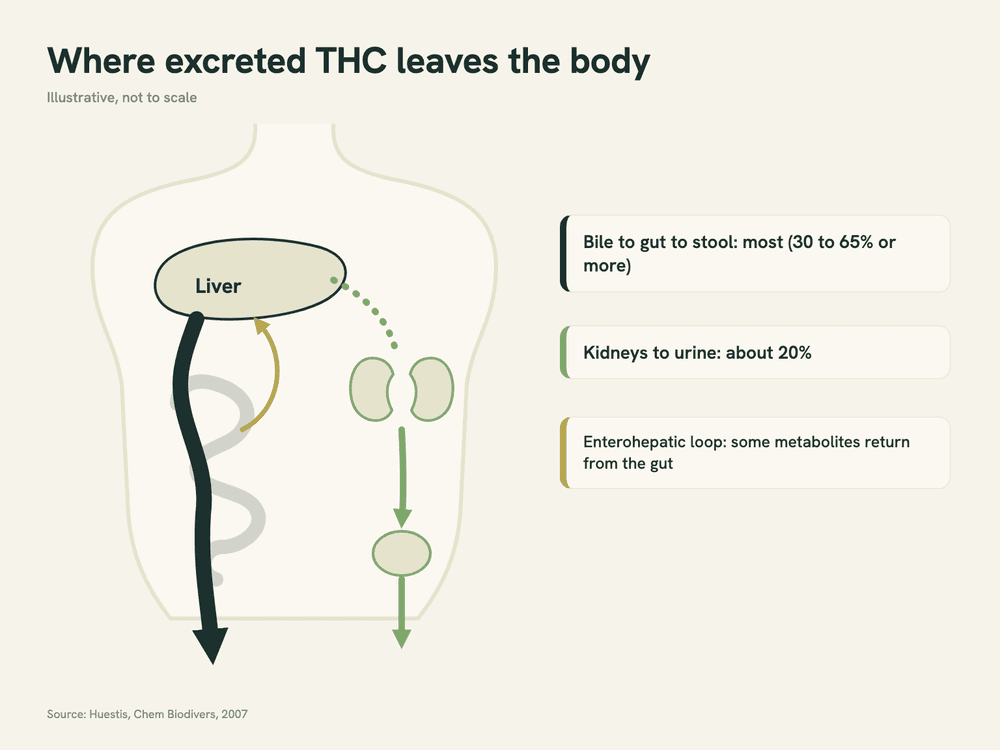
A NIDA review of human cannabinoid pharmacokinetics puts most excreted THC in feces and about 20% in urine. The review gives the fecal share two ways, as 30 to 65% in one section and more than 65% in another, but both put the urine share at roughly a fifth. What a urine test reads is mostly a metabolite, THC-COOH, which the body carries out in urine attached to glucuronic acid. THC metabolites also cycle out through bile into the gut and back again, a loop called enterohepatic circulation, which the review links to THC's long terminal half-life. That loop is the one real biological hook a "fiber binds THC" theory could have. It has never been tested.
Pectin is not inert in the gut. In a 1977 study of nine adults on controlled diets, daily citrus pectin for three weeks raised the bile acids in their stool by 33% and lowered plasma cholesterol by 13%. That is weeks of daily intake, measured for cholesterol and bile acids, and nobody measured a cannabinoid. A study of nine people on a diet says nothing about a drug test. On October 27, 2026 we searched PubMed for any study linking pectin, fiber or bile-acid binders to cannabinoid excretion. Pectin with cannabis terms returned 43 records, all on materials science, hemp fiber, food packaging or CBD formulation. Fiber with cannabinoids and urine returned 11, none on excretion. Bile-acid binders with THC returned 8, all reviews on unrelated topics. Nobody has published a trial showing that pectin changes what a urine test reads.
Mouth swab, blood and hair: a urine method says nothing about them
Every version of the pectin method is about urine. Other sample types measure other things, at other points in time.
Mouth swab. Oral fluid testing looks for THC itself in saliva, not the urinary metabolite. Under DOT's oral fluid collection rule, the collector inspects your mouth for anything that could interfere, then starts a 10-minute wait before collecting, all under observation. Nothing about a urine method applies. Detection windows and cutoffs are covered in our guide to mouth swab drug tests.
Blood. A blood test measures THC circulating at the time of the draw, which answers a different question from a urine screen. How long it stays measurable is covered in how long THC stays in your blood.
Hair. A hair test reads hair that grew before the collection, so nothing you drink around the test reaches what is already there. Which panels test for what is explained in our 10-panel drug test guide.
What actually changes a result
With the pectin method off the table, what is left is knowing your test and how the process works. A practical checklist:
- Find out which sample is collected (urine, oral fluid, blood or hair) and which program runs it. DOT and federal programs follow the rules on this page; private employers set their own.
- Know that time since use and how often you use are what drive detection. Rely on published detection data, not a number from a forum.
- If you take a prescription medicine, the medical review officer interview is where you disclose it.
- If you get a dilute result, know what it means: under DOT rules it can lead to a retest, but it is not a finding of tampering.
- If you use CBD, know that no product can guarantee a drug-test result.
- Do not drink large amounts of water around a test. Water intoxication is a documented risk.
For time frames, see how long CBD stays in your system alongside the blood guide above. The prescription step, from initial screen to confirmation to the MRO interview, is laid out in how a 10-panel test is screened, confirmed and reviewed. A dilute flag can also have an innocent cause: a kidney specialist described a patient whose dilute drug-test sample was suspected of being watered down, and it turned out to come from chronic water intoxication caused by a very strict weight-loss diet. Dilute does not mean dishonest. And if your worry is exposure you did not choose, the guide to secondhand smoke and drug tests covers what the studies found.
Frequently asked questions
No study shows that it does. A PubMed search on October 27, 2026 found no human study of pectin and THC in urine. The fluid that comes with the method dilutes urine, and federal labs measure dilution before they report a drug result. A dilute result is reported to the employer, and under DOT rules it can trigger a new collection, sometimes under direct observation.
No federal validity test looks for pectin, and the lab does not need one. The tests look for dilution, through creatinine and specific gravity, and dilution is what the method produces.
A mouth swab is a different sample with a different target: THC itself in saliva, not the urinary metabolite. Under DOT rules the collection is observed, the collector inspects your mouth, and there is a 10-minute wait before collecting. A urine method has no bearing on it.
There is no honest answer to give, because no study has measured any effect of pectin on a drug test. A duration you see online is not based on a published measurement.
The drug result was negative, but creatinine and specific gravity were lower than expected for human urine. Under DOT rules, creatinine of 2 to 5 mg/dL means an immediate new collection under direct observation. Above 5 mg/dL, the employer may order a retest if it announced that policy in advance and applies it to everyone. The retest becomes the result of record, and declining it counts as a refusal.
Pectin itself is a food ingredient affirmed as generally recognized as safe for food use. The risk is the fluid. Drinking large amounts of water can cause water intoxication, and military doctors have reported a serious case and a death during urine drug testing. Separately, under DOT rules an adulterated or substituted result counts as a refusal, with the same consequences as a verified positive.
Water does not create a positive. Very dilute urine is flagged as dilute, and what happens next depends on the program; under DOT rules it can mean a retest, sometimes observed. A dilute flag can also have innocent causes, including medical ones. Under DOT rules a dilute result can lead to a retest, but it is not a finding of tampering.
Workplace urine tests look for a THC metabolite, not CBD. Full-spectrum CBD products contain trace THC below 0.3%, and broad-spectrum batches can still carry traces, so no product can guarantee a drug-test result. Our CBD drug test guide walks through how that happens.
For the full picture of how workplace drug tests work, from the panels to the confirmation step, start with our guide to the 10-panel drug test. If you use CBD and wonder about trace THC, the CBD drug test guide explains how it can show up. For the wider legal picture, see is CBD legal.
Writing about hemp, wellness and the small rituals that keep us balanced.