Can You Fail a Drug Test From Secondhand Smoke? The Chamber Studies, the Cutoffs, and the One Variable That Decides It
Possible, under conditions researchers have actually measured: a sealed room, no airflow, a low cutoff or a saliva test. The chamber studies, the concert and coffee-shop data, and what none of it can tell you about your own test.

Can you fail a drug test from secondhand smoke? It is possible, and researchers have measured when. In a sealed, unventilated room full of cannabis smoke, a few non-smokers produced positive results, mostly on a low urine cutoff or on a saliva test. With ordinary ventilation, at an open-air concert and in a busy coffee shop, urine stayed below a 50 ng/mL screen in every study we read. Saliva did not always. "Unlikely" is not the whole answer. The airflow, the cutoff and the specimen are.
One thing before the numbers. A drug test is an employment matter, and sometimes a legal one, and this page is not a prediction about yours. It explains what controlled studies measured. It cannot tell you how your employer, the medical review officer (the MRO, a doctor who reviews lab results in regulated programs) or a court will treat a result, or whether any of them will accept someone else's smoke as the explanation. For your own situation, the documents that matter are your employer's written testing policy and, if you are contacted, the MRO process. If a job is at stake, talk to a licensed employment attorney in your state.
What a drug test looks for, and why smoke matters
A standard urine screen does not look for THC. It looks for THC-COOH, an inactive metabolite your liver makes after THC has been absorbed into your blood. So for secondhand smoke to show up in urine, you have to breathe in enough THC for your body to absorb and process it. A saliva test works differently: it looks for THC itself, and smoke can leave THC in your mouth directly. Our guide to how drug tests treat CBD and THC covers the chemistry and the product side in full.
The federal numbers make that split concrete. Under the HHS workplace testing panels published March 13, 2026, federal workplace programs screen urine for the metabolite at 50 ng/mL and confirm at 15 ng/mL. In oral fluid (saliva) they look for THC itself, at 4 ng/mL for the screen and 2 ng/mL for confirmation. Those levels bind federal and federally regulated programs; private employers set their own specimen and cutoff. We print them once, here, so you can read every study result below against them.
| Specimen | What it looks for | Federal screen / confirm | How someone else's smoke can reach it |
|---|---|---|---|
| Urine | THC-COOH, the inactive metabolite | 50 / 15 ng/mL | Only after THC is absorbed and processed by your body |
| Oral fluid (saliva) | THC itself | 4 / 2 ng/mL | Directly, as THC deposited in the mouth |
| Hair | Not in the 2026 federal panels | None set (HHS proposed adding hair in 2020) | From outside as well as inside: smoke, a user's hands, sweat |
You may have read that employers are switching to saliva. The record is narrower. The Department of Transportation added oral fluid as an authorized specimen in a rule published May 2, 2023, effective June 1, 2023. But in a rule published May 11, 2026, DOT wrote that "there are no HHS-certified laboratories to conduct oral fluid testing" as of that date, so DOT-regulated testing was still running on urine. Private employers can use saliva under their own policies. That matters here, because saliva is the specimen where secondhand smoke shows up most.
The Johns Hopkins chamber: six smokers, six non-smokers, one small room
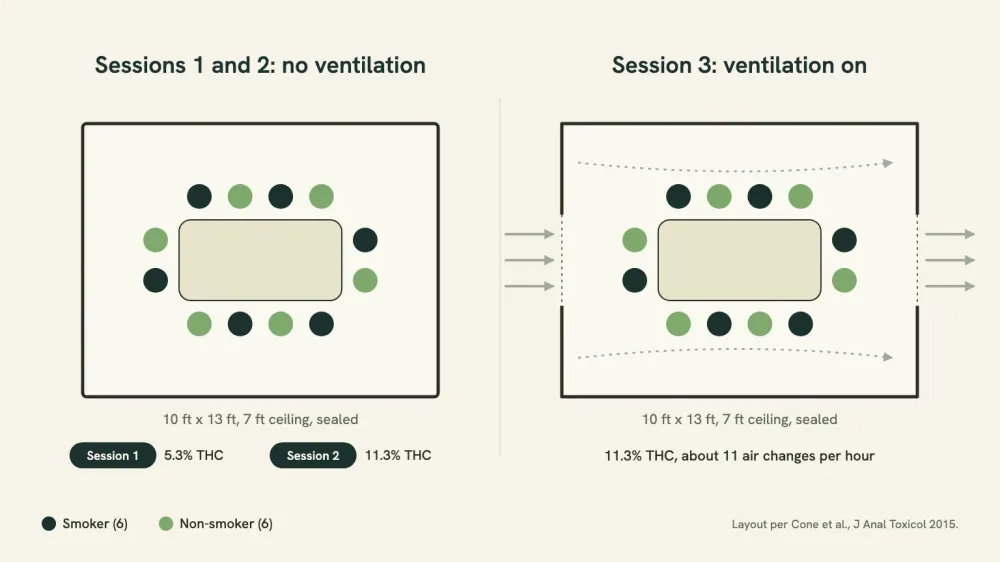
The best evidence on this question comes from a 2015 controlled exposure study in the Journal of Analytical Toxicology, run at the Johns Hopkins University School of Medicine. Researchers built a sealed room with plexiglass walls, 10 feet by 13 feet with a 7-foot ceiling, about the size of a small bedroom. Six experienced cannabis users sat around a table with six non-smokers in alternating seats and smoked for one hour. There were three sessions, each with a new group of six non-smokers (18 in all): cannabis at 5.3% THC with no ventilation, then 11.3% THC with no ventilation, then 11.3% THC with the ventilation on. The smokers went through 10.3 g, 14.4 g and 16.5 g of cannabis in those three one-hour sessions.
Two things about who ran it and how. The co-authors include staff of SAMHSA, the federal office that administers workplace drug testing, alongside researchers from Johns Hopkins and RTI International, so this is not an outside critique of drug testing. And the conditions were deliberately extreme: a sealed room, non-smokers seated right beside smokers, and a lot of cannabis in one hour. Keep that in mind when you compare it to your own evening.
The team collected the non-smokers' urine repeatedly after each session and ran it through five laboratories' screening tests at several cutoffs. At 100 and 75 ng/mL, nothing screened positive. At 50 ng/mL, 1 specimen out of 250 screened positive, from the unventilated 11.3% session, on one of the five laboratories' tests; the other four read the same sample negative. Measured directly, it held 46.3 ng/mL of THC-COOH. Lower the screen to 20 ng/mL and the picture changes: the two unventilated sessions produced 14 to 34 positive specimens between them, depending on which of four commercial test brands was used (6 to 12 in the 5.3% session, 8 to 22 in the 11.3% session).
A screen is only the first step, so the team also measured the metabolite directly by GC-MS (gas chromatography with mass spectrometry, the kind of method used for confirmation). Of the 250 specimens, 27 reached 15 ng/mL: 3 from the first session, 22 from the unventilated high-potency session and 2 from the ventilated one, coming from 7 of the 18 people. That is not the same as 27 positive tests. In a real program, confirmation only runs on a sample that has already screened positive, and at a 50 ng/mL screen only one did. Every one of the 18 non-smokers had some measurable metabolite, which tells you exposure registers in the body even when it never becomes a reportable result.
Ventilation: the variable that changed the result
The third session is the one to remember. Same room, same 11.3% cannabis, and the smokers actually went through more of it, 16.5 g. The only change was ventilation moving the air about 11 times an hour, which the researchers described as comparable to home air-conditioning. A companion paper in Drug and Alcohol Dependence compared the unventilated and ventilated high-potency sessions head to head. In the sealed room, 1 of the 6 non-smokers had a urine specimen positive at a 50 ng/mL screen with 15 ng/mL confirmation, and 4 of 6 were positive at a 20 ng/mL screen with the same confirmation. With the air moving, the authors reported no positive urine screen at either level on their assay, much lower blood cannabinoid levels, and no significant heart-rate, sedation or performance effects (covered below). The first paper, testing four brands of screen, found one ventilated-session specimen positive at 20 ng/mL on one brand. Both statements are true; they describe different tests.
| Session 1 | Session 2 | Session 3 | |
|---|---|---|---|
| Cannabis potency | 5.3% THC | 11.3% THC | 11.3% THC |
| Cannabis smoked in 1 hour (6 smokers) | 10.3 g | 14.4 g | 16.5 g |
| Ventilation | None | None | 11.2 air changes per hour |
| Urine positive at a 50 ng/mL screen (specimens) | 0 | 1, on one lab's test of five | 0 |
| Urine positive at a 20 ng/mL screen (specimens, range across 4 brands) | 6 to 12 | 8 to 22 | 0 to 1 |
| Urine THC-COOH at or above 15 ng/mL by GC-MS: specimens (people) | 3 (2) | 22 (4) | 2 (1) |
| Saliva confirmed positive at 4 / 2 ng/mL THC (specimens) | 17 | 18 | 6 |
| Non-smokers' estimated THC dose, compared with smokers | Under 5% | 6 to 18% | Under 5% |
The last row is where a line on some testing-lab pages falls apart: that secondhand smoke is "100 times less" than smoking. That figure traces back to a 2005 study in an unventilated van, where peak saliva THC in the smokers was about 100 times that of the passive riders, in that one setup. In the chamber, the oral-fluid paper from the same sessions estimated that in the worst condition the non-smokers received 6 to 18% of the dose the smokers did, and under 5% with lower potency or with ventilation. There is no universal ratio. It depends on the room.
The cutoff decides whether a trace becomes a result
A drug test is not a yes-or-no detector of THC. It is a threshold, and the chamber shows how much work that threshold does. Everyone exposed absorbed some THC. At a 50 ng/mL screen, one specimen crossed. At 20 ng/mL, 14 to 35 did across the three sessions, depending on the test brand. The authors noted that some private, non-regulated testing programs screen at 20 ng/mL, and wrote that their study shows this lower level increases the likelihood of a positive result in exposed non-smokers.
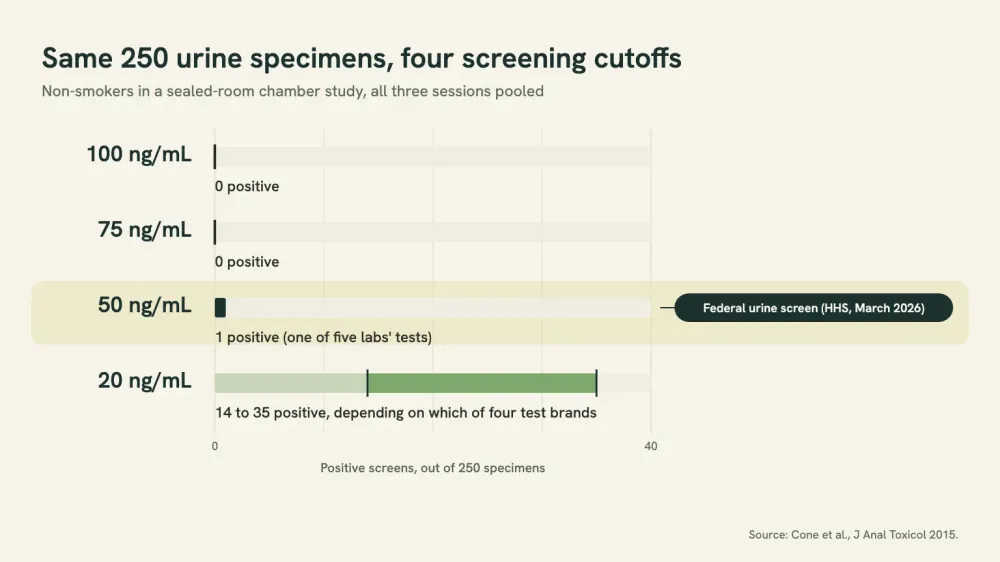
You will also read that the 50 ng/mL level "accounts for" incidental exposure, as if that were why it was chosen. None of the records we read states that as the reason. What the chamber shows is the effect: the higher screen is what kept extreme passive exposure from producing positives. That is an observation about one experiment, not a promise, and it only applies when the program actually screens at 50.
Secondhand smoke on saliva, blood and hair tests
Saliva is where secondhand smoke shows up most. Using the same 4 and 2 ng/mL THC levels as today's federal oral-fluid panel, 41 of 302 non-smoker saliva samples in the chamber confirmed positive: 17 in the first session, 18 in the second and 6 in the ventilated third. Ventilation cut the count; it did not erase it. The positives clustered in the hours right after exposure. The samples were collected in a separate, cannabis-free room after participants removed the disposable clothing they wore in the chamber and washed their hands and faces, so the THC was not the collection device picking up smoky air.
One detail stands out. The non-smokers' saliva held THC but none of THC-COOH, the metabolite the body makes from it. The researchers suggested that marker could help separate use from exposure. The federal oral-fluid panel, though, confirms THC itself, so that distinction is a research finding, not something a standard saliva result reports.
Where the swab is taken matters too. In the 2005 van study, four non-smokers sat beside four people each smoking one joint (5.4% THC in one study, 10.4% in the other), which is far less smoke than the chamber. Saliva was judged against a 3 ng/mL screen and 1.5 ng/mL confirmation. When it was collected inside the smoky van, the collection devices themselves picked up THC from the air, reading 3 to 14 ng/mL. When collection moved outside, every non-smoker was negative at those cutoffs throughout. Cone, the chamber study's lead author, is a co-author of this one too.
Real rooms did what the chamber did. In a 2011 study in two Groningen coffee shops, ten non-smokers spent three hours inside, and saliva was collected outside. At the three-hour mark, half of them had saliva above a 4 ng/mL THC screen, and 70% of specimens were above 2 ng/mL, while none held any THC-COOH. The lead author and several co-authors worked for Immunalysis, a company that makes oral-fluid tests, which is worth knowing when you weigh the result.
Blood is not a workplace specimen, but it shows how much actually got in. In the unventilated high-potency session, non-smokers had blood THC of up to 5.6 ng/mL; with ventilation, levels were much lower. Hair is often described as the safe specimen for this question. It is not a safe harbor. A 2015 forensic study in Scientific Reports, from the University of Freiburg, found cannabinoids can reach a non-user's hair through a user's hands, their sweat and skin oils, or cannabis smoke, and its title states the conclusion: finding cannabinoids in hair does not prove cannabis consumption. That makes a hair result say less about use than people assume. For context, HHS proposed adding hair to federal workplace testing in 2020; the panels it published in March 2026 list urine and oral fluid.
Contact high: what the non-smokers felt
The same sessions answer the other question people ask. In the sealed, high-potency room, the Drug and Alcohol Dependence paper found detectable cannabinoids in the non-smokers' blood, a minor rise in heart rate, mild to moderate self-reported sedation, and worse scores on a timed symbol-coding task (a standard test of processing speed). With the air moving, the authors found no significant effects of that kind. There was no placebo condition, so expectation may have played a part. The oral-fluid paper's authors concluded that extreme exposure could produce "drug-induced behavioral changes not unlike those produced by active cannabis smoking", with implications for "those engaged in safety-sensitive activities (e.g., driving)". If you have spent time in a heavily smoky, closed room and feel sedated, that is a reason not to drive.
Ambient smoke does one more thing to bystanders. In the concert study below, 31% of the officers reported burning, itchy or red eyes. The reasons eyes redden around cannabis are covered in why cannabis turns your eyes red.
Can you fail a drug test from being around smoke in real places?
Chambers are useful because they control everything. Your evening did not. The concert data comes from a 2020 field study by NIOSH, the federal occupational safety research institute, with a CDC laboratory running the analysis: 29 police officers on duty in the crowd at two open-air stadium concerts in July 2018. Personal air samplers picked up 53 to 480 ng of THC per cubic meter. Afterward, small amounts of THC-COOH, all under 1.0 ng/mL, were found in the urine of 34% of the officers, which the authors described as well below any 50 ng/mL screening or 15 ng/mL confirmation threshold. No THC or metabolite turned up in any blood sample. And in a 2010 study in a busy Maastricht coffee shop, eight volunteers spent three hours inside. All absorbed some THC, none produced urine above a 25 ng/mL immunoassay screen, and the highest metabolite level was 7.8 ng/mL.
| Setting | Study | Specimen and cutoff | What happened |
|---|---|---|---|
| Open-air stadium concerts, two nights | NIOSH 2020, 29 officers | Urine, read against 50 / 15 ng/mL | 34% had trace THC-COOH, all under 1.0 ng/mL; nothing in blood |
| Busy coffee shop, 3 hours | Maastricht 2010, 8 volunteers | Urine immunoassay, 25 ng/mL | None above the screen; highest metabolite 7.8 ng/mL |
| Two busy coffee shops, 3 hours | Groningen 2011, 10 volunteers | Saliva, 4 / 2 ng/mL THC | Half above 4 ng/mL at the three-hour mark |
| Closed van, one joint per smoker | Van study 2005, second of two studies, 4 non-smokers | Saliva, 3 / 1.5 ng/mL, collected outside | All negative |
| Sealed small room, home-level airflow, 16.5 g at 11.3% | Chamber session 3, 6 non-smokers | Urine at 50 and 20 ng/mL; saliva 4 / 2 ng/mL | 0 at 50; 1 specimen at 20 on one brand; 6 saliva positives |
| Sealed small room, no airflow, 14.4 g at 11.3% | Chamber session 2, 6 non-smokers | Urine at 50 and 20 ng/mL; saliva 4 / 2 ng/mL | 1 specimen at 50; 4 of 6 people positive at 20 (confirmed at 15); 18 saliva positives |
| Living with someone who smokes daily | None found | Not measured | No study we found measured it |

The last row of that table is the one many readers came for, so here it is plainly: no study we found measured someone living with a daily smoker. The chamber paper notes that an older, lower-potency experiment, which exposed people for one hour a day over six consecutive days, "produced only suggestive evidence of accumulation or enhancement of positivity rates." That is an old study with weaker cannabis, and it does not tell you your risk. What the research does tell you is which conditions to look at: how small and closed the space is, how much the air moves, how close you sit, how much is smoked and how strong it is, and which specimen and cutoff your test uses.
If you use hemp or CBD: whose smoke matters
If you vape CBD, or someone near you smokes hemp flower, the risk tracks THC in the air, not CBD. A standard urine screen is not looking for CBD: a 2023 test of six commercial urine immunoassays found that none reacted to CBD itself, and none reacted to any of the CBD compounds tested at the standard 50 ng/mL cutoff. Hemp flower smoke is a different matter. Burning turns THCA, the acid form in the raw plant, into THC, so what reaches the air depends on how much THC and THCA the flower held; our page on THCA and drug tests explains that conversion. We found no study measuring secondhand hemp-flower smoke or secondhand CBD vapor against a drug test. The only direct measurement of secondhand THC vapor we found is a 2018 report on two research staff who administered vaporized THC in a clinical study, whose blood stayed below detection, and two people cannot answer the vaping question. If what worries you is something you ate, hemp seed oil and drug tests covers accidental exposure through food.
Before a test: a checklist for knowing, not beating
Nothing below is a way to pass, delay or challenge a test, and we will not help with that. It is a list of things to find out, so you understand the risk you actually face.
- 1Read your employer's written drug-testing policy. Find which specimen it collects (urine, saliva or hair) and which screening cutoff it uses.
- 2Find out whether your program is federally regulated, such as DOT testing, or private. Federal programs use the HHS levels; private programs set their own.
- 3Know the sequence in federally regulated programs: a positive screen goes to a confirmation test and then to a medical review officer before a result is reported. Private programs may differ.
- 4If you must be able to show you are abstinent, follow a 2016 review's advice: avoid heavily smoky, unventilated spaces.
- 5Do not treat this page as evidence about your own specimen. The studies describe what is possible in general, not what happened to you.
- 6If a job, license or case is at stake, talk to a licensed employment attorney in your state.
The abstinence advice comes from a 2016 systematic review in Forensic Science International, which screened 958 papers and kept 21. It reported that positive tests had been observed in every specimen type following extremely high passive exposure, and concluded that in everyday conditions urine metabolite levels should fall below the positivity threshold. How confirmation and the MRO step work is laid out in our delta-8 drug testing guide, and what can happen to a job after a positive is covered in can you get fired for failing a drug test. Military service runs on its own rules; see our page on CBD in the military.
What this page cannot tell you
It cannot tell you what your own test will show. The chamber studies had 6 non-smokers per condition, ran the sessions in a fixed order, seated non-smokers right beside smokers and tested two potencies. The chamber's saliva analyses were run by Immunalysis, an oral-fluid test maker whose staff also co-wrote the Groningen coffee-shop study, and some chamber co-authors worked for the federal office that runs workplace testing. The real-world studies are small: 29 officers, 8 and 10 coffee-shop volunteers, 4 people per van study. None measured a roommate who smokes daily, a vape pen at close range, or exposure repeated over weeks. This page also publishes no detection windows; how long THC and its metabolite stay detectable is covered in how long CBD and THC stay in your system. Above all, it cannot tell you how an employer, an MRO or a court will treat a positive result.
Questions people ask
It is possible under extreme conditions. Across 250 non-smoker urine specimens in a sealed-room study, 1 screened positive at 50 ng/mL, from the unventilated high-potency session; at a 20 ng/mL screen, 14 to 35 did, depending on the test brand. With ventilation of about 11 air changes an hour, no urine specimen screened positive at 50 ng/mL. Saliva tests, which look for THC itself, register smoke more readily. None of this predicts your own result.
Yes, more readily than on urine, and mostly in the hours right after exposure. In the Johns Hopkins chamber, 41 of 302 non-smoker saliva samples confirmed positive at 4 and 2 ng/mL THC, including 6 with the ventilation on. In two Dutch coffee shops, half of ten non-smokers were above a 4 ng/mL screen after three hours. Where the swab is taken also matters: collection devices left in a smoky van picked up THC from the air.
Hair can be contaminated from outside. A 2015 forensic study found cannabinoids can reach a non-user's hair from smoke, from a user's hands or from their sweat. None of the studies we read gives a cutoff-level passive-smoke result for hair. The federal panels published in March 2026 list urine and oral fluid, but private programs can use hair.
No study we found measured that situation, so nobody can give you an honest number. The research shows which conditions matter: a small closed room, little airflow, sitting close, heavy and potent smoking, a low cutoff and a saliva test all push risk up. An older six-day, lower-potency study found only suggestive evidence of accumulation. If you must show you are abstinent, a 2016 review advised avoiding heavily smoky, unventilated rooms.
In the sealed, high-potency chamber session, non-smokers reported mild to moderate sedation, had a minor rise in heart rate and did worse on a timed symbol-coding task. With ventilation, the researchers found no significant effects. The study had no placebo condition. If you feel sedated after time in a heavily smoky room, do not drive.
This page cannot answer that, and neither can any study. Whether an explanation is accepted is decided by your testing program's rules, the medical review officer who reviews the result and, if it comes to that, the law. Read your employer's written policy, and if a job is at stake, talk to a licensed employment attorney in your state.
Standard urine screens do not target CBD: in a 2023 test, none of six commercial urine immunoassays reacted to it. The risk from someone else's hemp flower comes from THC, because burning converts THCA into THC, so the smoke can carry THC depending on the flower. We found no study of secondhand hemp-flower smoke or CBD vapor against a drug test.
If your real question is about THC in something you use rather than smoke in the air, the next page to read is the full CBD drug test guide, which covers spectrum, trace THC and what the federal cutoffs mean for products.
Writing about hemp, wellness and the small rituals that keep us balanced.