FDA Drops Premarket Review for Federal Drug-Test Devices: What Changed, and What Did Not
On October 6, 2026, FDA let drug-test systems in 14 categories, including cannabinoid tests, skip 510(k) review for federal programs. Saliva testing for DOT jobs is still not here: HHS's latest list shows no certified oral-fluid lab.
On October 6, 2026, the U.S. Food and Drug Administration published a final order, effective the same day, that lets drug-test systems in 14 categories be marketed for federal drug testing programs without first clearing 510(k) premarket review. The categories include the cannabinoid test system, the device category behind marijuana screens, and opiate tests, which FDA says cover fentanyl. Federal programs include those run by SAMHSA, the Department of Transportation (DOT) and the U.S. military. What the order does not do is put saliva testing into DOT jobs. HHS's most recent list of certified labs, published September 30, 2026, includes no laboratory certified to test oral fluid.
The order is Federal Register document 2026-20448 (91 FR 63478, docket FDA-2026-N-4268), and you can read FDA's final order exempting these drug-test systems in full. Many commenters called the change a necessary step toward saliva testing in federal programs. It is one step, and not the last one. This page covers what the order changes, what it leaves alone, and what still has to happen before a truck driver, pilot or federal employee is handed a swab instead of a cup. It reflects the FDA, HHS and DOT records as we read them on October 6, 2026, and it is not legal advice.
What FDA's 510(k) exemption order changed on October 6
A 510(k) premarket notification is the filing a device maker sends FDA to show that a new device is "substantially equivalent" to one already legally on the market. The device may not be marketed until FDA agrees. Before this order, drug-test systems in these 14 categories could already skip that filing, but only for employment and insurance testing, and only if the device was not intended for federal drug testing programs. A test meant for a federal program needed its own clearance. The order deletes that carve-out. In FDA's words: "In this order, FDA is removing the exception to the 510(k) exemption for devices intended for Federal drug testing programs." A footnote defines those programs: they "include, for example, programs run by the Substance Abuse and Mental Health Services Administration (SAMHSA), the Department of Transportation (DOT), and the U.S. military."
The change went through notice and comment. FDA proposed it in a May 1, 2026 notice requesting comments (91 FR 23427), took comments for 60 days until June 30, 2026, and published the final order, signed by Deputy Commissioner Grace R. Graham, on October 6. Here is what moved, using the cannabinoid category as the example.
| Item | Before October 6, 2026 | From October 6, 2026 |
|---|---|---|
| Exemption text, cannabinoid test system (21 CFR 862.3870) | "Exemption is limited to test systems intended to measure any of the cannabinoids for employment and insurance testing and for which the test system labeling includes a statement that the device is intended solely for employment and insurance testing, and does not include devices intended for Federal drug testing programs." | "Exemption is limited to test systems intended to measure any of the cannabinoids for employment and insurance testing and for which the test system labeling includes a statement that the device is intended solely for employment and insurance testing." |
| Tests intended for SAMHSA, DOT or military programs | Outside the exemption; needed 510(k) clearance | Inside the exemption, if the test meets its conditions and the general limits in 21 CFR 862.9 |
| Registration, listing, quality system, adverse-event reporting, labeling | Required | Still required |
| Tests FDA already cleared for federal programs | In use | Can continue to be used, "assuming compliance with other applicable laws" |
Read the two quoted cells side by side and the only difference is the final clause. The labeling condition stays: an exempt test must still say it is "intended solely for employment and insurance testing." The order makes the same change across all 14 categories: amphetamine, barbiturate, benzodiazepine, cocaine, codeine, LSD, methamphetamine, methadone, methaqualone, morphine, opiate, propoxyphene, cannabinoid and tricyclic antidepressant test systems. FDA says fentanyl tests belong to the opiate class, so "fentanyl test systems intended for Federal drug testing programs are included in the 510(k) exemptions finalized in this order." One drug on every federal panel is not on the list: PCP (phencyclidine). Commenters asked FDA to add PCP tests, and FDA answered that the request was "outside the scope of this final order." The exemption also remains subject to FDA's general limits in 21 CFR 862.9, which spell out when an otherwise exempt test still needs a 510(k), for example when it uses a different fundamental scientific technology. For which drugs a federal panel actually screens, see our breakdown of what a 10-panel drug test looks for.
Why supporters wanted it, and what FDA says it does not decide
FDA received comments from about 70 commenters, including individuals, trade organizations, regulated industry, labor unions and other interested parties, and the order says most of them supported the change. Saliva testing came up again and again. In FDA's summary, many commenters said the exemption is "a necessary step for the implementation of oral fluid testing in Federal drug testing programs," and others made the same argument for hair. That framing came from the commenters. FDA's May proposal did not mention oral fluid at all, and FDA's response is carefully worded.
“While FDA understands that the expansion of the exemptions finalized in this order may facilitate the use of oral fluid testing in Federal drug testing programs, FDA does not oversee Federal drug testing programs ... and so does not decide whether oral fluid testing may be used in such programs.”
FDA spells out the division of labor elsewhere in the order: "FDA does not administer or implement Federal drug testing programs. However, FDA regulates test systems used in Federal drug testing programs." The program side belongs to SAMHSA, whose Division of Workplace Programs oversees federal drug-free workplace programs and also oversees the National Laboratory Certification Program (NLCP), which certifies the laboratories. DOT writes the testing rules for its regulated transportation workers. FDA's job is the device. So the order, on its own, does not decide whether you are ever asked for a saliva sample.
What did not change
The order exempts devices from one FDA filing. It does not exempt anything from the rules that decide how a federal drug test is run. As of October 6, 2026, all of the following still hold.
- FDA still does not run federal drug testing. SAMHSA sets the HHS Mandatory Guidelines and oversees lab certification through the NLCP; DOT sets the rules for transportation workers.
- The HHS Mandatory Guidelines for urine and for oral fluid still govern federal testing, including cutoffs, confirmation testing at a certified lab and Medical Review Officer review.
- Exempt does not mean unregulated. Establishment registration, device listing, quality management system, adverse-event reporting and labeling requirements still apply.
- FDA declined to adopt a general enforcement discretion policy, and said transferring jurisdiction over these tests to another federal agency would require statutory changes by Congress.
- Tests FDA already authorized for federal programs can continue to be used.
- Oral fluid collection devices, the swab-and-tube kits, were not exempted. They still go through 510(k), and FDA notes that cleared ones already exist.
- PCP (phencyclidine) tests are not part of the order.
- Hemp law and marijuana's federal scheduling are untouched. The order amends only FDA's device classification rules in 21 CFR part 862.
The urine rulebook behind the second bullet is the HHS Mandatory Guidelines for urine drug testing, revised in October 2023; its oral-fluid counterpart comes up in the next section. FDA says exempt devices "remain subject to other applicable regulatory requirements, including SAMHSA's mandatory guidelines, to the extent they are used in Federal drug testing programs." On collection kits, FDA wrote that it "has not made a determination that a 510(k) is not necessary to assure the safety and effectiveness of oral fluid collection devices." And because the order touches only device rules, nothing about the legal status of hemp moves. For that question, see our guide to whether CBD is legal under federal and state law.
Is saliva testing coming to DOT jobs?
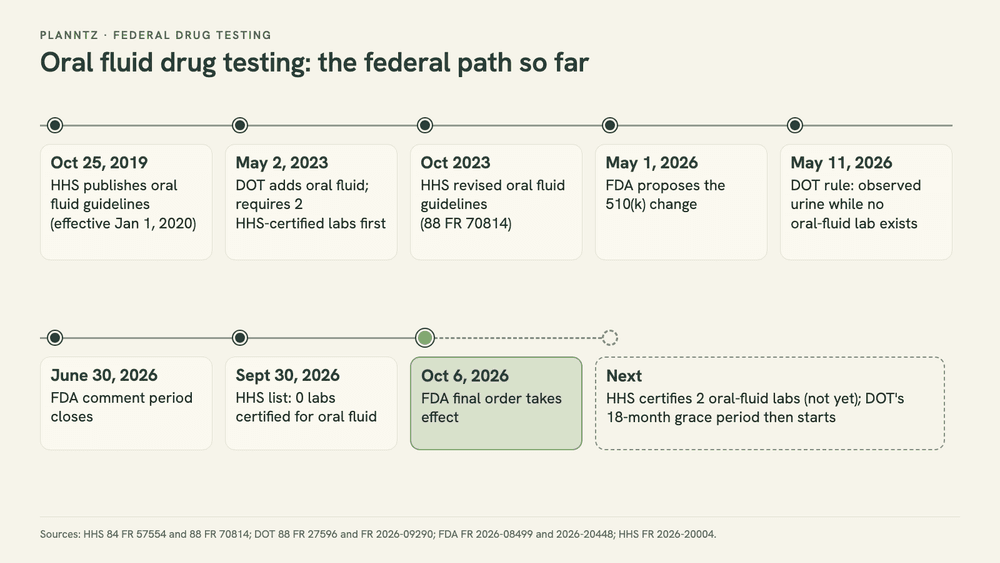
Not yet, and the order does not change the reason. HHS first published Mandatory Guidelines for oral fluid on October 25, 2019, effective January 1, 2020, and revised them in 2023. DOT added oral fluid to its own testing rules in May 2023, with a condition that still controls the timeline: "in order for an employer to implement oral fluid testing there must be at least two HHS-certified laboratories." The reason is the split specimen. When a worker's test is positive, the worker can ask for the second sample to be tested, and DOT says that must happen at "a different HHS-certified laboratory." If the worker asks for that retest and no second certified lab exists, DOT says, the result would be cancelled.
On the latest record, there are zero. HHS's monthly list of certified laboratories, published September 30, 2026, says: "At this time, there are no laboratories certified to conduct drug and specimen validity tests on oral fluid specimens." Certification takes "three rounds of performance testing plus an on-site inspection," so a lab does not appear overnight. In the meantime, DOT's May 11, 2026 rule handles the gap. It says "Because there are no HHS-certified oral fluid laboratories, it is not yet possible to comply" with the provision that calls for oral fluid, so a directly observed urine collection is used instead. The same rule sets the exit: once HHS gives notice of a second certified oral-fluid lab, employers get an 18-month grace period in which they can keep using directly observed urine collections until they are set up for oral fluid. DOT had proposed one year and lengthened it after comments.
Saliva testing also measures something different from urine. Under the HHS Mandatory Guidelines for oral fluid, the federal marijuana test targets delta-9 THC itself, with a 4 ng/mL screening cutoff and a 2 ng/mL confirmation cutoff, while urine panels look for a THC metabolite. Neither the analyte nor the cutoffs change with this order. For the wider science of measuring recent THC use, see our explainer on how a weed breathalyzer works and where it falls short. If you hold a safety-sensitive job, our guide to whether you can be fired for failing a drug test covers what happens after a positive result.
The objections, and FDA's answer
Not every commenter supported the order. Some argued that "the quality of test systems could decrease, including worse accuracy and reliability, because the devices will no longer undergo premarket review," and others warned it could lead to increased medical device fraud. Others opposed it because they believed it "could lead to increased highway safety incidents, including increased crashes, injuries, and/or loss of life," and raised the same concern for aviation, rail, transit and maritime work. The order lists labor unions among the roughly 70 commenters but does not say which side any union took, so we do not either.
FDA rejected both arguments. It wrote that it "disagrees that the quality of test systems available for Federal drug testing programs will decrease" because of the exemption, or that fraudulent devices will enter the market as a result. Its reasons: exempt devices still carry registration, listing, quality-system, adverse-event and labeling duties, and the laboratories that run federal tests remain subject to SAMHSA's oversight and Mandatory Guidelines. FDA concluded that it "does not believe this order will result in newly exempted test systems lacking reasonable effectiveness in detecting positive samples," and that "the only effect this order will have on Federal drug testing programs is the possible increase in the number of test systems that may be utilized in such programs." Those are FDA's expectations; the order does not cite new performance data for them. We report both positions and take no side.
If you use hemp or CBD products
Nothing in this order changes what a federal drug test looks for. Federal panels look for THC, not CBD: delta-9 THC itself in oral fluid, and a THC metabolite in urine. One nuance is worth knowing, because it trips up a lot of marketing copy. The FDA device category is broader than the federal panel. The cannabinoid test system definition in 21 CFR 862.3870(a) says cannabinoid compounds "include delta-9-tetrahydrocannabinol, cannabidiol, cannabinol, and cannabichromene," so do not trust any claim that drug tests as a class cannot detect CBD. The practical risk with a hemp product is the THC it contains, whether by design in full-spectrum products or through contamination. DOT also closes one door explicitly. Under 49 CFR 40.151(f), a Medical Review Officer "must not accept an assertion of consumption or other use of a hemp or other non-prescription marijuana-related product as a basis for verifying a marijuana test negative."
No product can guarantee a drug-test result. How trace THC in CBD products can lead to a positive is covered in our guide to CBD and drug tests, and the food-grade side is in whether hemp seed oil can trigger a positive test. If you serve, the military has its own rule, explained in whether service members can use CBD.
What to watch next
These are the records that would actually move oral fluid testing forward, each with its status as of October 6, 2026.
- HHS's monthly list of certified laboratories in the Federal Register. A first oral-fluid lab would appear there. Status: none on the September 30, 2026 list.
- DOT's web page of HHS-certified oral fluid laboratories, on its Office of Drug and Alcohol Policy and Compliance (ODAPC) site, where DOT says it intends to list labs once they are certified.
- The second certification. DOT needs two labs before employers can use oral fluid. HHS's notice of the second starts DOT's 18-month grace period for the observed-urine stopgap.
- DOT's fentanyl rule. Status: proposed September 2, 2025; no final rule in the Federal Register as of October 6, 2026.
- A DOT notice published October 1, 2026, about a petition to change how Part 40 handles invalid-specimen determinations. Status: a petition for rulemaking, not a proposal.
- Hair testing. FDA says it "does not decide whether hair testing may be used" in federal programs, and this order does not add it.
The two DOT documents in that list are the September 2, 2025 proposal to add fentanyl and norfentanyl to DOT testing and the October 1, 2026 notice of a petition for rulemaking. Neither has the force of a final rule, and neither is changed by FDA's order.
Frequently asked questions
Not yet. DOT added oral fluid to its rules in May 2023, but employers cannot use it until HHS has certified at least two laboratories, so that a different lab is available for split-specimen testing. HHS's most recent list, published September 30, 2026, shows no lab certified for oral fluid. Where DOT's rules call for an oral fluid collection, a directly observed urine collection is used instead.
A 510(k) is the premarket notification a device maker files to show FDA that a new device is substantially equivalent to one already legally sold; until FDA agrees, the device cannot be marketed. An exempt device skips that filing. It is still regulated: establishment registration, device listing, quality management system, adverse-event reporting and labeling requirements continue to apply.
No. FDA regulates the test devices. SAMHSA sets the HHS Mandatory Guidelines and oversees the National Laboratory Certification Program, which certifies the labs, and DOT sets testing rules for transportation workers. In this order FDA says it "does not decide whether oral fluid testing may be used" in federal programs.
Some commenters argued it could, citing accuracy, device fraud and highway safety. FDA disagreed, pointing to the device requirements that still apply and to SAMHSA's oversight of the laboratories that run federal tests. Under the federal rules, a positive screen is still confirmed by a certified laboratory and reviewed by a Medical Review Officer.
It does not change what federal tests look for. Federal panels target THC, and a hemp product's risk comes from the THC it contains. DOT rules say a Medical Review Officer must not accept hemp product use as a basis for verifying a marijuana test negative. No product can guarantee a drug-test result.
Yes. FDA says fentanyl tests fall under the opiate test system category, so those intended for federal programs are included. Separately, DOT's proposal to add fentanyl to its own testing panel, published September 2, 2025, is still a proposal: no final rule had appeared in the Federal Register as of October 6, 2026.
No. FDA said it "has not made a determination that a 510(k) is not necessary" for oral fluid collection devices, so they were not exempted. FDA also noted that 510(k)-cleared oral fluid collection devices already exist.
For the bigger picture of federal drug panels, including which drugs they cover and how urine, saliva and hair testing compare, start with our 10-panel drug test guide. This page is dated October 6, 2026. If you are reading it later, check HHS's monthly list of certified laboratories in the Federal Register for anything newer before relying on the oral-fluid status above.
Writing about hemp, wellness and the small rituals that keep us balanced.