DEA Proposes a New 7-OH Threshold and Withdraws the July One: What Changes, and When
On October 9, 2026, DEA filed a notice of intent proposing a new 7-OH threshold: more than 1 mg per gram or per mL, or a mitragynine ratio under 100. DEA says it is withdrawing the July 6 version. No order can issue before November 13, 2026.

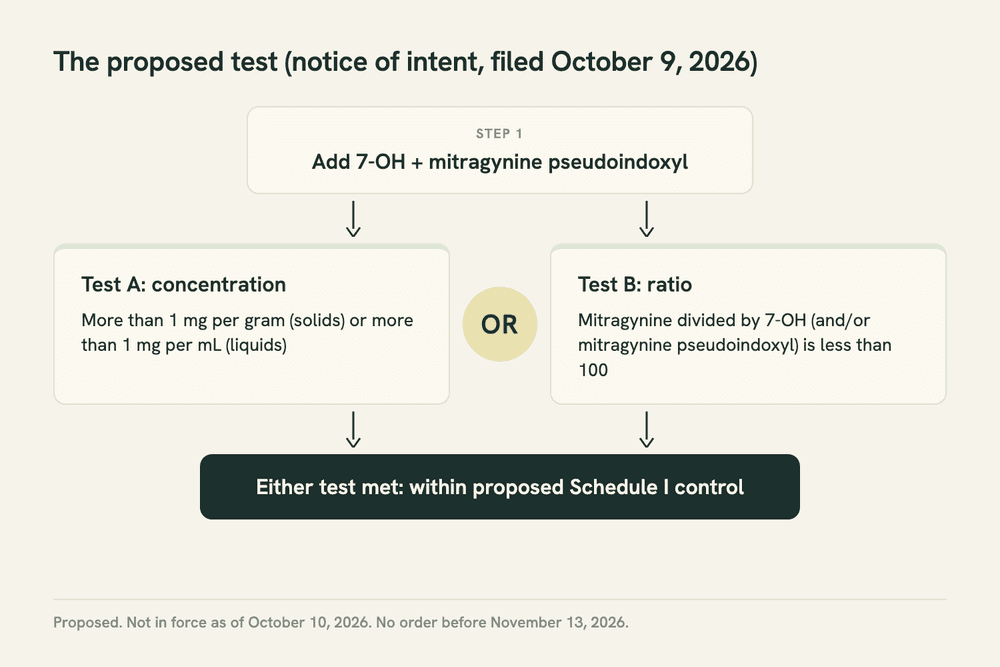
On October 9, 2026, the Drug Enforcement Administration filed a notice of intent that rewrites its plan for 7-hydroxymitragynine, better known as 7-OH. It proposes a new threshold recommended by the Department of Health and Human Services: more than 1 mg per gram of a solid product, or more than 1 mg per milliliter of a liquid, counting 7-OH and mitragynine pseudoindoxyl together, or a mitragynine-to-7-OH ratio below 100. DEA says it is withdrawing the threshold it proposed on July 6. The notice is scheduled to be published in the Federal Register on October 14, 2026, and no order under it can issue before November 13, 2026. As of October 10, 2026, none of the new threshold is in force.
What DEA filed on October 9
The document is FR Doc. 2026-20943 on Docket DEA-1570, titled Temporary Placement of 7-Hydroxymitragynine and Mitragynine Pseudoindoxyl Above a Specified Threshold in Schedule I. Its action line reads "Proposed amendment; notice of intent." Administrator Terrance C. Cole signed it on October 8, and it was filed for public inspection at 12:00 p.m. on October 9, 2026. Until the issue prints, the readable copy is DEA's 36-page notice of intent on the public inspection desk. DEA presents it as the replacement for the July 6, 2026 notice of intent on the same docket, published at 91 FR 40917. DEA states in the new notice that it is withdrawing the July notice "in a separate document contained in this issue of the Federal Register". As of October 10 that withdrawal document is not yet on public inspection, so we cite DEA's statement and will add the document's number once it posts. The new numbers come from HHS. DEA quotes them from an HHS letter that, according to this notice, is dated October 8, 2026:
“The substances [7-hydroxymitragynine] and [mitragynine pseudoindoxyl] be controlled in schedule I [pursuant to 21 U.S.C. 811(h)] when either substance alone, or their combined amount if both present, is: (A) Above a specified threshold concentration, that is, greater than 1 mg per gram (for solid powders, encapsulated material, or other solid forms) or greater than 1 mg per milliliter (for liquid preparations), OR (B) The mass of mitragynine present divided by the mass of [7-hydroxymitragynine], or [mitragynine pseudoindoxyl], or the combined amount of [7-hydroxymitragynine] and [mitragynine pseudoindoxyl] if both present, is less than 100.”
Read it slowly, because three details change how the proposal works. First, the two substances are counted together. The text applies to "either substance alone, or their combined amount if both present", so a product carrying both has its 7-OH and its mitragynine pseudoindoxyl added before either test is run. Second, the two tests are joined by OR: under the proposal, a product would fall within Schedule I control if it meets either one. Third, the measure is concentration, not dose. It counts milligrams per gram of the whole product, or per milliliter of a liquid, and the October text has no per-tablet or per-serving cap and no dry-weight clause. On the bookkeeping side, the proposed regulatory text would add 7-hydroxymitragynine to 21 CFR 1308.11 at paragraph (h)(96) with drug code 9676, add mitragynine pseudoindoxyl at (h)(97) with its existing code 9672, and remove and reserve paragraph (h)(89). That paragraph is where the August 26 order on mitragynine pseudoindoxyl and two related analogs placed it, with no threshold at all. DEA's stated reason for using a threshold instead of a flat listing is that both substances "have supposedly been found in trace amounts in some botanical kratom products".
July vs October: the two 7-OH thresholds side by side
| Item | July 6, 2026 notice (DEA says it is withdrawing it) | October 9 notice of intent (proposed) | August 26, 2026 order (mitragynine pseudoindoxyl) |
|---|---|---|---|
| Instrument | Notice of intent, 91 FR 40917, FR Doc. 2026-13580 | Notice of intent, FR Doc. 2026-20943, scheduled for the October 14 Federal Register | Temporary scheduling order, 91 FR 54948, FR Doc. 2026-17429 |
| Docket | DEA-1570 | DEA-1570 | DEA-1644 |
| Substances | 7-OH | 7-OH and mitragynine pseudoindoxyl, counted together | Mitragynine pseudoindoxyl, MGM-15 and MGM-16 |
| Concentration test | More than 0.050% (0.5 mg per gram); botanical material on a dry weight basis | Proposed: more than 1 mg per gram (solids) or 1 mg per mL (liquids) | None. Any amount |
| Per-article test | More than 1.00 mg of 7-OH in the article | None in the October text | None |
| Ratio test | None | Proposed: mitragynine divided by 7-OH, mitragynine pseudoindoxyl or both is less than 100 | None |
| Earliest order | Not before August 5, 2026 | On or after November 13, 2026, counted from the scheduled October 14 publication | Effective August 26, 2026 to August 26, 2028 |
| Status, October 10, 2026 | No order was ever published under it | Proposal only. No order | In force until it expires or a new order replaces it |
Here is the arithmetic, without a verdict attached. The July 6 proposal drew its concentration line at 0.050%. A percentage by weight is grams per 100 grams, so 0.050% is 0.05 g in 100 g, which is 0.5 mg per gram (and 0.5 mg per milliliter for a weight-per-volume liquid). The October notice of intent proposes 1 mg per gram. On concentration alone, the proposed line sits at twice the July number. The other changes point the opposite way. The July cap of 1.00 mg of 7-OH in the article does not appear in the October text, so under the proposal a single tablet would not be tested on its own milligrams. But the proposal adds a ratio test that does not depend on concentration at all, and it would add mitragynine pseudoindoxyl, which the July notice did not cover, to 7-OH before either test is applied. On its plain arithmetic, the ratio test reaches products where 7-OH is high relative to mitragynine, which describes an enriched or synthetic product more than a ground leaf. Coverage that calls the October notice a loosening, or a ban, is reading one of these changes and skipping the others.
Reading a label against the proposed test
Most 7-OH products are sold by the tablet, the shot or the scoop, and their labels print milligrams per unit. The proposed test asks for something else: milligrams per gram or per milliliter of the whole product, plus a ratio to mitragynine. Converting one into the other is division, and it is worth doing once so you can see where real-looking numbers land. The three labels below are hypothetical, with illustrative numbers and no brand. This is label arithmetic only. It is not a dose and not a statement about what anyone should take.
For scale, DEA cites a product survey by Hill and colleagues, published in 2025 in Drug and Alcohol Dependence, and summarizes it as finding that 7-OH content varied, "ranging from 1 mg to 700 mg in a single dose or serving." Those are figures read from product labels and listings, not lab assays, so they say what was marketed, not what was measured. They do show why a per-serving reading of the proposal misleads: the same milligram figure can be a high or a low concentration depending on the mass it sits in. And most labels leave out at least one of the four things the arithmetic needs:
- The weight of the tablet or the volume of the bottle, which you need to turn milligrams per unit into milligrams per gram or per mL.
- Mitragynine content. Without it the ratio test cannot be run at all.
- Mitragynine pseudoindoxyl content, which the proposal would add to 7-OH before either test.
- A test method. The notice of intent does not specify one, so a label cannot tell you how its number was measured.
That list is why most labels do not print enough to decide either test. The document that would is a batch certificate of analysis that quantifies all three alkaloids (mitragynine, 7-OH and mitragynine pseudoindoxyl) in milligrams per gram or per milliliter, with the lab's method named. If you have never read one, our line-by-line guide to reading a certificate of analysis shows how labs report concentration. Running this arithmetic tells you where a label sits against a proposal. It does not tell you a product is legal where you live, and it says nothing about safety, a point DEA's notice makes in so many words.
What did not change
- Kratom leaf and mitragynine are not scheduled. The notice proposes controlling 7-OH and mitragynine pseudoindoxyl only, and DEA still describes kratom and mitragynine as drugs of concern.
- No 7-OH order is in force. As of October 10, 2026 there is only a notice of intent, and no temporary order for 7-OH has been published.
- Mitragynine pseudoindoxyl is still in Schedule I under the August 26 order, with no threshold, until that order expires or is replaced.
- MGM-15 and MGM-16 stay in Schedule I without change, according to the companion notice, FR Doc. 2026-20942.
- State law is its own layer. DEA writes that its action does not preempt more restrictive state law.
- CBD, hemp and marijuana are untouched. Neither notice proposes any action on cannabidiol, hemp or marijuana.
On mitragynine pseudoindoxyl, the instrument that matters today is the August 26 temporary scheduling order at 91 FR 54948, which placed it in Schedule I with no threshold. DEA says it intends to withdraw the temporary order placing mitragynine pseudoindoxyl and replace it with a new one, and that, to avoid an enforcement gap, the August order "remains in effect until either it expires or the new temporary order is published and the previous order is withdrawn, whichever occurs first." Reports that the mitragynine pseudoindoxyl ban was lifted have it backwards: the proposal keeps the substance in Schedule I, now above the same threshold as 7-OH and counted together with it.
Two of the other points need a sentence more. Not being on a federal schedule is not the same as being approved: the FDA's page on kratom says kratom "is not lawfully marketed in the U.S. as a drug product, a dietary supplement, or a food additive in conventional food." For how kratom and CBD differ as chemical and legal questions, our side-by-side of CBD and kratom covers it. Nothing in either notice reaches a CBD product or the definition of hemp; where CBD stands under federal and state law is a separate set of rules, and the federal change to hemp runs on a different law with a different date. On state law, the notice lists states that already prohibit or limit 7-OH and notes, as one example, that Mississippi sets its own limit at one percent of total alkaloid content of 7-OH or 0.5 mg per container.
“While the new threshold recommended by HHS would permit certain products to remain in the marketplace without being subject to schedule I controls, neither HHS nor DEA has made a finding that these substances are safe to use at below-threshold levels.”
Two letter dates, and the MGM-15 and MGM-16 notice
DEA filed a second notice the same day: the companion notice of intent on MGM-15 and MGM-16, FR Doc. 2026-20942 on Docket DEA-1644, 21 pages, also scheduled for October 14. It changes nothing of substance. DEA says it will publish a new temporary order that will "maintain the temporary placement of these substances in schedule I of the CSA without change", and that it is doing so "only for the technical and procedural purpose of distinguishing MGM-15 and MGM-16 from mitragynine pseudoindoxyl." It also notes that "HHS did not recommend controlling MGM-15 or MGM-16 above any threshold". The two notices do not date the HHS letter the same way. FR Doc. 2026-20943 dates it October 8, 2026 and describes it as covering both 7-OH and mitragynine pseudoindoxyl. FR Doc. 2026-20942 says "By letter dated October 6, 2026" and that HHS's letter "related only to mitragynine pseudoindoxyl." We report each date as its own document states it. The record available on October 10 does not explain the difference, and we are not going to guess at one.
What happens next, by date
| Date | What | Status as of October 10, 2026 |
|---|---|---|
| July 6, 2026 | DEA notice of intent on 7-OH, 91 FR 40917, Docket DEA-1570 | No order published under it. DEA states it is withdrawing it |
| August 26, 2026 | Temporary order placing mitragynine pseudoindoxyl, MGM-15 and MGM-16 in Schedule I, 91 FR 54948 | In force, no threshold |
| August 26, 2026 | American Kratom Association sues DEA, No. 1:26-cv-02997 (D.D.C.) | Pending. Motion to stay and an order on it dated October 9. No merits ruling or dismissal on the docket |
| September 10, 2026 | HHS comment window on the July threshold closes, Docket HHS-OASH-2026-0232 | Closed |
| October 9, 2026 | Both new notices of intent filed for public inspection | Public |
| October 14, 2026 | Both notices scheduled to be published; DEA says its withdrawal of the July notice is in the same issue | Scheduled |
| On or after November 13, 2026 | Earliest date DEA can issue the new temporary orders, counted 30 days from October 14 | Not yet possible |
| The day an order publishes | An order would take effect on publication and run two years, with a possible one-year extension | Not started |
| August 26, 2028 | Outer end of the current August 26 order if nothing replaces it first | Running |
The date that matters most is November 13, and it is a floor, not a schedule. Under 21 U.S.C. 811(h), the temporary scheduling statute, an order "may not be issued before the expiration of thirty days from" both the publication of the notice of intent and the date the notice is transmitted to HHS. Counted from an October 14 publication, 30 days is November 13, 2026, and the published notice will print its own date in place of the bracket in the public inspection copy. DEA writes that the Administrator "intends to issue a temporary scheduling order as soon as possible after the expiration of 30 days", and that once issued, "it will take effect on the date the order is published in the Federal Register and remain in effect for two years, with a possible extension of an additional year, pending completion of the regular (permanent) scheduling process." DEA also says it intends to pursue formal rulemaking under 21 U.S.C. 811(a) for permanent control, that temporary scheduling orders "are not subject to judicial review", and that the Administrative Procedure Act's notice-and-comment requirements do not apply to this notice. There is no public comment period on it. The comment window many readers remember, the one HHS reopened to September 10, 2026, was a request for information on the July threshold. It has closed. The new threshold came from an HHS letter, and DEA's notice does not say how, or whether, those comments shaped it.
On the lawsuit: as of October 10, 2026, the court docket in the American Kratom Association's case against DEA (No. 1:26-cv-02997, D.D.C.) shows a complaint filed August 26, a motion for summary judgment filed September 2, a September 18 minute order noting that the defendants "anticipate that the parties may be able to resolve this suit without further need for litigation", and then a motion to stay and an order on it, both dated October 9. The text of that order is not in the public mirror we read. The docket shows no ruling on the merits and no dismissal. The AKA says it welcomes "the resolution of its litigation". That is a party's statement, not a court record, and DEA's notice cites the HHS letter as the basis for the new threshold.

Why DEA says it is acting
DEA's notice sets out its grounds mostly in surveillance counts. We report them as DEA's figures, with what they do and do not measure.
Those counts come from three systems DEA describes in the notice. A query of FDA's Adverse Event Reporting System (FAERS), run February 27, 2026, returned 86 cases involving 7-OH, 79 of them reported as serious and 9 resulting in death. DEA's own toxicology program, DEA TOX, identified 7-OH in 85 cases since 2019, 55 of them fatal, and mitragynine pseudoindoxyl in at least 31 overdose cases between February 2025 and February 2026, 25 of them fatal. Forensic laboratories reported 7-OH 42 times from 12 states in 2025, according to the NFLIS figures DEA cites. Detection in a case is not proof that the substance caused the outcome, and DEA notes that the toxicology samples often contained other substances, including fentanyl, bromazolam and ketamine. FDA's consumer page, its warning on concentrated 7-OH products, was last updated July 13, 2026, according to its page footer, and predates the October notice. For the retail side of the story, see our earlier piece on 7-OH and hemp THC sold at the same counter.
Questions readers are asking
Not under a federal 7-OH scheduling order, as of October 10, 2026: none has been published. DEA has filed a notice of intent, and an order under it cannot issue before November 13, 2026, counted from the scheduled October 14 publication. Mitragynine pseudoindoxyl is different, because it has been in Schedule I since August 26, 2026. DEA's notice also lists states that already prohibit or limit 7-OH under their own laws. This is not legal advice.
The October notice does not schedule kratom leaf or mitragynine. It proposes controlling 7-OH and mitragynine pseudoindoxyl above a threshold. DEA still calls kratom and mitragynine drugs of concern, and FDA says kratom is not lawfully marketed in the U.S. as a drug product, a dietary supplement or a food additive in conventional food. Not being scheduled is not the same as being approved.
It is a concentration, not a dose. It means milligrams of 7-OH, plus mitragynine pseudoindoxyl if present, per gram of the whole product, or per milliliter for a liquid. For comparison, the July proposal's 0.050% works out to 0.5 mg per gram. A hypothetical 0.5 g tablet carrying 15 mg of 7-OH is 30 mg per gram. All of these lines are proposals, not law, as of October 10, 2026.
It is test B in the notice of intent. Divide the mass of mitragynine by the mass of 7-OH, or of mitragynine pseudoindoxyl, or of both combined. Under the proposal, a result below 100 would fall within Schedule I control whatever the concentration. A product with 40 mg of mitragynine and 0.8 mg of 7-OH per gram has a ratio of 50. On the plain arithmetic, a product with no mitragynine has a ratio of zero.
HHS's request for information on the July threshold closed on September 10, 2026. DEA's October notice quotes a new HHS recommendation in a letter it dates October 8, and DEA states it is withdrawing the July 6 notice in a separate document in the October 14 issue. The notice does not say how the comments were weighed, and there is no comment period on the October notice.
Yes. The August 26, 2026 order placed it in Schedule I with no threshold, and DEA says that order stays in effect until it expires or a new order is published and the old one is withdrawn, whichever comes first. The proposed replacement keeps it in Schedule I above the same threshold as 7-OH, with the two counted together.
No. Neither notice proposes any action on cannabidiol, hemp or marijuana, and nothing in them applies to a CBD product. The federal change to the hemp definition runs on a different law and a different date.
If you want the background on the instrument itself, start with our explainer on the August 26 order and the two kratom dockets, which we are updating to show that DEA is withdrawing the July threshold. We will update this page when the October 14 issue prints, when DEA's withdrawal document posts, and if an order is published.
Writing about hemp, wellness and the small rituals that keep us balanced.