Kratom and Weed: What Mixing Them Has Been Measured to Do
Kratom and weed are used together far more often than they have been studied together. We read the surveys, the mouse studies, the toxicology records and the shared shop shelf: what is known, what is not, and when to call for help.
If you use kratom and weed, you are far from alone. In the most recent national survey analysis, about two in three people who had used kratom before the past year had used cannabis in the past year, and the two sit on the same vape-shop and smoke-shop shelves. Yet no human study has measured what happens when kratom and THC are taken together, and no clinical trial of the pair is registered. This page lays out what has been measured instead.
The short answer: there is no evidence-based verdict that mixing kratom and weed is safe, and no study showing exactly how the combination goes wrong. What exists is survey data on how often people combine them, mouse studies showing that kratom's main alkaloid touches the same receptor system THC acts on, and poison-center and toxicology records in which the substances named most often alongside kratom, and flagged in a national poison-center report, are alcohol, opioids and benzodiazepines. This page is about THC-containing cannabis, including hemp-derived THC. CBD with kratom is a different question, covered in our review of CBD and kratom, and our CBD vs THC guide explains why the two cannabinoids are not interchangeable. It is written for adults 21 and over and does not replace a clinician who knows everything you take.
The short answer: a risk map, not a verdict
Here is what is known. Co-use is common and has been counted in several national surveys. Both substances can cause drowsiness, dizziness and confusion on their own: those effects appear in the NIH's summaries for kratom and on the FDA-approved label for oral THC. In US poison-center reports that involve kratom plus something else, the other substances listed most often are alcohol, opioids, benzodiazepines and antidepressants, with cannabis products further down. Here is what is not known: what kratom does to THC blood levels or the reverse, how the pair affects driving, and whether the combined effect is simply additive, larger, or something else. Until someone measures those, the useful answer is a map of the situations that raise the stakes.
- 1Anything else that slows you down, especially opioids, benzodiazepines or alcohol. These are among the kratom combinations flagged in a national poison-center report, and the drug classes the oral THC label names for added sedation.
- 2Driving, operating machinery or safety-sensitive work. Both substances can cause drowsiness and dizziness, and nobody has measured the pair behind the wheel.
- 3Concentrated 7-OH products, which are high-potency, semisynthetic formulations. NIDA notes that 7-OH can slow breathing in laboratory models, and the 2025 jump in poison-center reports coincides with their arrival.
What each one does on its own
Kratom (Mitragyna speciosa) is a Southeast Asian plant whose leaves contain mitragynine and related alkaloids. NIDA's kratom research summary says people who use kratom report both stimulant-like effects (more energy, alertness and a rapid heart rate) and effects similar to opioids and sedatives, such as relaxation and confusion. Mitragynine breaks down into 7-hydroxymitragynine (7-OH) in the body. Both act at mu-opioid receptors, the receptor opioid medicines work through, and mitragynine may also bind adrenergic, serotonin and dopamine receptors. NIDA notes that kratom leaf and mitragynine generally do not appear to cause the slowed breathing of an opioid overdose, but that 7-OH can in laboratory models. The NCCIH kratom page, last updated April 2022, lists mild effects such as nausea, constipation, dizziness and drowsiness, and rare but serious effects such as seizures, high blood pressure and liver problems. The FDA's kratom page states that "Kratom is not appropriate for use as a dietary supplement," and our kratom vs CBD comparison covers what that means for how it is sold.
THC produces its high mainly by activating CB1, a cannabinoid receptor found throughout the brain. The most carefully documented list of what THC does on its own is the FDA-approved prescribing information for oral THC (dronabinol, sold as Marinol), revised January 2023. Its most common adverse reactions are abdominal pain, dizziness, euphoria, nausea, paranoid reaction, somnolence (sleepiness), abnormal thinking and vomiting. It warns that people with heart conditions may experience low or high blood pressure, fainting or a fast heart rate, and it tells prescribers to weigh the risks for anyone with a history of seizures. That label covers a prescription capsule, not flower or a hemp product, but line it up against the NIH summaries for kratom and the overlap is hard to miss.
| Effect | Reported for kratom (NIDA, NCCIH) | Listed on the oral THC label | Measured for the pair? |
|---|---|---|---|
| Drowsiness | Drowsiness (NCCIH) | Somnolence, among the most common reactions | No |
| Dizziness | Dizziness (NCCIH) | Dizziness, among the most common reactions | No |
| Confusion or slowed thinking | Confusion (NIDA) | Abnormal thinking, among the most common reactions | No |
| Nausea or vomiting | Nausea (NCCIH) | Nausea and vomiting, among the most common reactions | No |
| Fast heart rate | Rapid heart rate (NIDA) | Tachycardia, in the cardiac warning | No |
| Blood pressure changes | High blood pressure, rare but serious (NCCIH) | Low or high blood pressure, in the cardiac warning | No |
| Seizures | Rare but serious (NCCIH) | Warning for people with a history of seizures | No |
| Paranoia | Not listed in the NIH summaries | Paranoid reaction, among the most common reactions | No |
Overlap is not the same as a measured interaction. It means two things. First, if you use both and feel very drowsy, dizzy or confused, you cannot tell which one did it. Second, the effects that overlap are the ones most likely to add up. That is a reason for caution, and it is as far as the evidence goes.
How many people use both
Each figure comes from a different slice of the National Survey on Drug Use and Health (NSDUH), with its own window and denominator, so read them side by side and never as one average. McCabe and colleagues' 2026 analysis of the 2021 to 2024 surveys, covering 169,408 people aged 12 and older, found that 65.7% of people whose kratom use was before the past year had used cannabis in the past year, with similar results among past-year kratom users. Kratom use was highest among adults aged 21 to 34 (3.40% lifetime, 1.01% past year). Falise and colleagues' 2023 analysis of the 2019 survey looked at 412 adults who had used kratom plus at least one other substance in the past year: 90.0% had used alcohol, 69.8% tobacco and 67.8% marijuana, and they averaged 3.4 other substances. The researchers sorted them into three use profiles, each built on high rates of marijuana, alcohol and/or tobacco use: 63.3% in the core group, 19.3% who also used psychedelics, and 17.4% who also used psychedelics, heroin and prescription drugs. Palamar's 2021 analysis of the same 2019 survey, with 56,136 respondents, put past-year kratom use at 0.7% and found that past-year cannabis use without a use disorder carried 4.57 times the adjusted odds of kratom use.
Other datasets point the same way: Hill and colleagues (2024) found lifetime cannabis use above 92% among people who had used kratom in two separate 2022 datasets. That figure is about cannabis use in general, not CBD-only products, and the CBD side of the same study is covered in our CBD and kratom guide.
One caveat changes how to read all of this: same year is not same time. Falise's team defined polysubstance use "within the past 12 months, rather than simultaneously or sequentially." The only real-time data comes from a 2024 smartphone study in JAMA Network Open that followed 357 US adults who used kratom at least 3 days a week and logged 13,401 kratom-use events in 2022. At the start, caffeine and cannabis were the non-kratom substances participants said they preferred most. Asked what they had taken during or since their last kratom use, they named nicotine and caffeine most often, with cannabis among the others; the paper gives no cannabis percentage. It was a convenience sample of frequent users, and several authors disclosed industry-adjacent consulting or work on kratom-related legal disputes.
Where kratom and the cannabinoid system meet in the lab
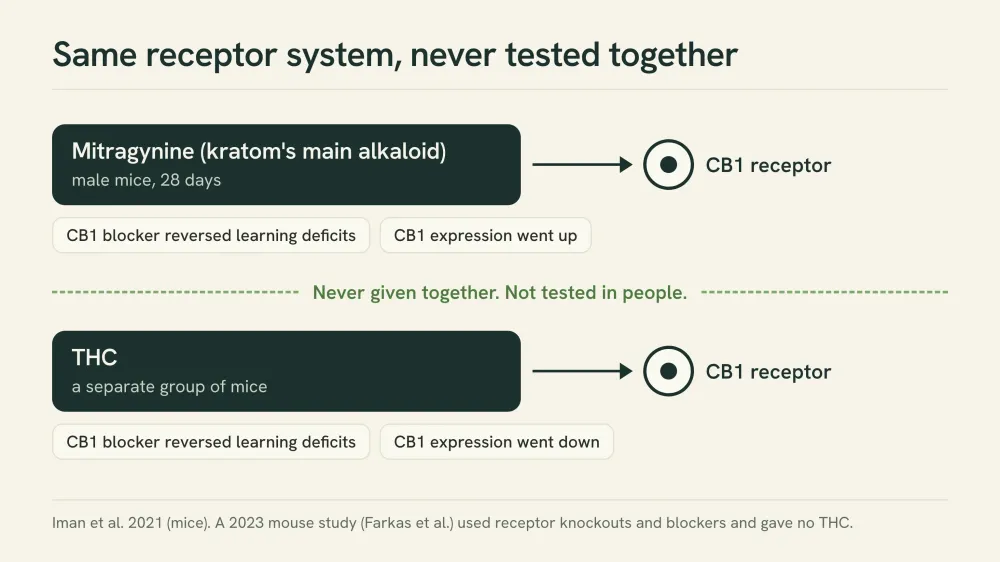
The mechanism evidence is animal-only. In a 2021 mouse study in Frontiers in Pharmacology, researchers injected adult male Swiss albino mice with mitragynine over 28 days. High repeated doses, not low ones, impaired place learning, and separate groups of mice given THC or morphine showed comparable deficits. A drug that blocks the CB1 cannabinoid receptor, given from day 15, reversed the deficits in all three groups. The receptor changes did not line up, though: CB1 expression went up in two brain regions (part of the hippocampus and the ventral tegmental area) after chronic high-dose mitragynine, as it did after morphine, and went down after chronic THC. The mice never received mitragynine and THC at the same time, and nothing about this has been tested in people. "They act on the same system" does not mean "they add up."
A 2023 mouse study in Life Sciences asked whether cannabinoid receptors are involved in mitragynine's effects. In a mouse model of chemotherapy nerve injury, part of the effect the researchers measured was lost in mice bred without both CB1 and CB2 receptors, and it was blocked by drugs that block CB1, CB2 or TRPV1 receptors. In a second model, there was little cannabinoid involvement. No THC was given. Together, the two studies show that kratom's main alkaloid engages the cannabinoid system in mice. Neither tested the combination, and our PubMed and ClinicalTrials.gov searches on September 18, 2026 found no human study that has.
The "metabolic competitors" claim, checked
Some top-ranking pages for this question say kratom and cannabis are "metabolic competitors" for the same liver enzymes, implying that each can raise the other's levels. Here is what was actually tested. The only controlled human kratom interaction study our PubMed search found, a 2023 clinical study of 12 healthy adults in Clinical Pharmacology and Therapeutics, used probe drugs rather than THC: a single low dose of kratom tea raised exposure to midazolam, a standard probe for the CYP3A enzyme, by about 39%, and left a CYP2D6 probe unchanged. The authors attribute the effect to CYP3A in the gut. THC's own route is spelled out on the oral THC label, which cites published laboratory (in vitro) data: CYP2C9 and CYP3A4 are the primary enzymes in its metabolism, and CYP2C9 "appears to be the enzyme responsible for the formation of the primary active metabolite," the compound covered in our guide to 11-hydroxy-THC.
| Claim you'll read | What was actually tested | Result |
|---|---|---|
| They compete for the same liver enzymes | Kratom tea with probe drugs, not THC, in 12 healthy adults (2023) | Midazolam exposure up about 39%, attributed to gut CYP3A; CYP2D6 probe unchanged |
| THC is broken down by the same enzyme kratom affects | The FDA-approved oral THC label, clinical pharmacology section | Citing lab data, the label says CYP2C9 appears to form THC's main active metabolite, which is not the gut CYP3A route kratom was shown to affect |
| Kratom makes weed stronger, or the reverse | Human pharmacokinetic or interaction studies of the pair | None found. Not measured in either direction |
| Several times more kratom in the blood | A study that gave CBD, not THC, to rats | A CBD result in animals, not a THC result in people |
So the enzyme story is a guess dressed as a mechanism. Kratom was measured changing one enzyme route in the gut. THC relies mostly on a different enzyme for its main conversion step, with CYP3A4 involved mostly downstream, in clearing metabolites. Nobody has measured THC blood levels with kratom on board, or kratom levels with THC on board. The "several times more" figure quoted on some pages comes from rats given CBD, which is a separate question from THC. Unmeasured does not mean there is no interaction. It means nobody can tell you its size or direction.
What shows up when things go wrong
The largest record is a 2026 report on US poison-center data in the CDC's journal MMWR, written by a University of Virginia-led team of medical toxicologists. Poison centers logged 14,449 kratom exposure reports among people aged 12 and older from 2015 to 2025, rising from 258 in 2015 to 3,434 in 2025. Reports involving kratom plus other substances carried more hospitalizations (44-56% a year, against 24-29% for kratom alone) and more serious outcomes (57-66% against 41-49%), and 184 of 233 kratom-associated deaths (79%) involved more than one substance. These are calls to poison centers, not confirmed harms and not a rate. Reporting is voluntary, the authors write that "determining which substance was most related to clinical effects or medical outcome, including death, was not possible," and the data cannot tell leaf from 7-OH products.
The report does name the other substances. In multiple-substance kratom reports, it lists ethanol (alcohol) at 22%, opioids 16%, benzodiazepines 15%, antidepressants 14%, cannabis and cannabinoids 12%, and stimulants 11%. The cannabis category is broad: the report defines it to include plant material, concentrates, edibles, cannabidiol (CBD), synthetic cannabinoids and minor cannabinoids, so the 12% is not a THC figure. For the deaths, the report's text names opioids (62%), benzodiazepines (20%), stimulants (20%) and ethanol (19%). The authors' list of kratom combinations that "might increase risk" is "alcohol, opioids, benzodiazepines, stimulants, and antidepressants." Cannabis is not in either sentence. That is not a clean bill of health: the data cannot say which substance caused an outcome, and nobody has studied the pair directly.
| Record | What was counted | Where cannabis appears | What it cannot show |
|---|---|---|---|
| National poison-center report (MMWR, 2026) | 14,449 kratom exposure reports, 2015-2025; 233 deaths | "Cannabis and cannabinoids" at 12% in multiple-substance reports; not named in the deaths sentence | Which substance caused any outcome; THC vs CBD vs synthetics |
| Coroner reports, one California county, 2020 | 214 accidental opioid-overdose deaths, 4 with mitragynine | Among the substances co-detected with mitragynine; every case also had at least one other substance, fentanyl in 3 | Cause of death, or anything beyond four cases |
| Forensic case report (2019) | One man with a history of opioid use and mental illness | Low levels of THC alongside a very high mitragynine level; death certified as mitragynine toxicity | A rate, or what THC contributed |
| Psychiatric case report (2025) | One man with a history of daily cannabis use | Cannabinoids (type not specified) with mitragynine, 7-OH and morphine | Which substance did what |
| California crash victims (2025) | Serum from 1,000 people injured in roadway crashes | Not with mitragynine: no mitragynine-positive case also had delta-9-THC | Impairment (victims include passengers) |
Behind those rows: a 2023 coroner-toxicology study in Frontiers in Psychiatry found mitragynine in 4 of 214 accidental opioid-overdose deaths (1.9%) in Kern County, California, in 2020; every one also had at least one other substance, fentanyl in three, and cannabis appears among the co-detected substances. In a 2019 forensic case report in the Journal of Forensic Sciences, a 33-year-old man with a history of opioid use and mental illness had a small amount of THC and a very high level of mitragynine in his blood, and the medical examiner attributed the death to mitragynine. One case shows this happened once; it gives no rate. A 2025 psychiatric case report describes a psychotic episode with serious self-harm in a 31-year-old man whose toxicology showed cannabinoids, kratom alkaloids and morphine. He also had a history of alcohol use and occasional methamphetamine and psilocybin use, so the report cannot say which substance did what. And in a 2025 study of 1,000 California crash victims, mitragynine was among the three new psychoactive substances detected most often, alongside opioids or on its own, but never together with THC. That is a reminder that "kratom and weed" is often not what the toxicology shows.
How to read records like these: co-detection is not causation, a case report is not a rate, and a substance missing from an agency's list is not a safety finding. We read case records the same way in our look at sertraline and THC. The NCCIH summary fits everything above: "Fatal overdoses from kratom alone appear to be extremely rare. The use of kratom in combination with other drugs has been linked to deaths and severe adverse effects such as liver problems. More research is needed on drug interactions involving kratom." The FDA puts it this way: "In rare cases, deaths have been associated with kratom use, as confirmed by a medical examiner or toxicology reports. However, in these cases, kratom was usually used in combination with other drugs, and the contribution of kratom in the deaths is unclear."
Adding alcohol, benzodiazepines or opioids
This is where the documented concern is clearest. The MMWR report's authors write that kratom use with alcohol, opioids, benzodiazepines, stimulants and antidepressants "might increase risk through additive pharmacodynamic effects on central nervous system pathways and through pharmacokinetic interactions." The oral THC label says additive effects such as dizziness, confusion, sedation and sleepiness "may occur" with other drugs that act on the central nervous system, and its list includes benzodiazepines, ethanol and opioids. The label does not mention kratom. It does list opioids, and kratom's main alkaloids act at opioid receptors, which is a reason for caution, not a measured interaction. Add NIDA's note that 7-OH can slow breathing in laboratory models, and a stack of kratom, THC and a sedative combines every documented concern on this page. For alcohol on top of THC, see what happens when you get crossfaded. The CBD side of opioid interactions is covered in our review of CBD and opioid pain medicines.
Driving and work
No study has put people on kratom and THC in a driving simulator. Both can cause drowsiness, dizziness and confusion on their own, and the oral THC label tells patients not to drive or operate dangerous machinery until they are reasonably certain it does not affect them adversely. The kratom driving record is thin and mostly toxicology: the first published suspected-DUI case involving mitragynine, from 2018; a review of 25,398 impaired-driving cases in Orange County, California, from 2017 to 2019; the crash-victim study above; and the 2021 national recommendations for toxicology testing in impaired-driving cases. Per se THC limits and how impairment is judged are covered in our guide to CBD, THC and driving. Here is what the kratom record shows:
- 2018 case: a 37-year-old driver nearly struck an oncoming vehicle, and the drug recognition expert concluded the driver was impaired by a stimulant and cannabis.
- In that case, the blood results in the paper's summary list amphetamine, mitragynine and citalopram (an antidepressant), with no cannabinoid result reported. A published letter disputes the attribution.
- Orange County, 2017-2019: mitragynine turned up in 60 of 25,398 impaired-driving cases (0.24%), never on its own. Depressants and opioids were the most common co-detected drugs.
- In the same Orange County cases, 7-OH was found in 27 of the 44 screened for it.
- California crash victims, 2025: mitragynine appeared with opioids or alone, and in no case together with THC. Victims included passengers, so detection is not proof of impaired driving.
- Testing: in the 2021 recommendations, mitragynine sits in the optional Tier II, not the mandatory Tier I scope, so standard impaired-driving panels are not required to look for kratom.
7-OH, gas-station products and hemp THC on the same shelf
The two are often sold at the same counter. In a national phone survey of 520 US vape shops, 10 per state plus Washington, DC and Puerto Rico, called in November and December 2023, 71.5% (372 shops) sold kratom. An analysis of the same 520 shops in the American Journal of Preventive Medicine found intoxicating cannabis products, such as hemp-derived delta-8 THC and HHC, in 74% of them, including 43% of shops in states with delta-8 bans. Neither paper reports how many shops sold both. Our explainer on hemp-derived THC covers what "hemp THC" on a shop shelf actually means.
The advice at those counters is uneven. In a 2025 secret-shopper study of 100 smoke shops in San Antonio and Austin, Texas, every shop stocked THC, half of the employees made at least one health claim about it (most often about pain, insomnia or mental health), and when asked about adverse effects, 22% disclosed no THC risks at all; sedation (36%) and psychiatric effects (31%) were the risks named most often. The newest kratom products are also not leaf. The MMWR report says the large 2025 increase in poison-center reports "coincides with the emergence of high-potency, semisynthetic formulations, including 7-hydroxymitragynine," and the FDA's public health page on 7-OH products calls 7-OH a potent opioid and an emerging public health threat. "Coincides" is not "caused", and poison-center data cannot separate leaf from 7-OH.
On the law, one dated line: as of September 18, 2026, the DEA has temporarily scheduled three kratom-derived compounds (mitragynine pseudoindoxyl, MGM-15 and MGM-16), not kratom leaf or 7-OH, and no temporary scheduling order for 7-OH has been published. Every date and detail lives in our explainer on what the DEA's kratom scheduling changed. A disclosure: Planntz sells hemp-derived CBD products, including full-spectrum tablets that contain delta-9 THC, does not sell kratom, and nothing on this page is a recommendation to use any cannabis product with kratom.
Red flags: when to call Poison Help or 911
You do not need to know which substance is responsible before you act. Get help right away for any of these signs, drawn from the NIDA and NCCIH kratom summaries, the oral THC label, NIDA's list of opioid overdose signs, the National Library of Medicine's guide to recognizing medical emergencies and America's Poison Centers:
- Slow, shallow or stopped breathing
- Can't be woken, or not responding
- A seizure
- Chest pain or discomfort lasting two minutes or more
- A racing heart that does not settle
- Severe confusion, paranoia or hallucinations
- Severe or persistent vomiting
- Pale skin, or purple lips or fingernails
The Poison Help line is run by America's Poison Centers and connects you to your local poison center. If the problem is too much THC on its own, our guide to greening out covers what that looks like and when it needs care. If you want help cutting back on either substance, the federal treatment locator at FindTreatment.gov lists options near you, and the SAMHSA National Helpline is 1-800-662-4357.
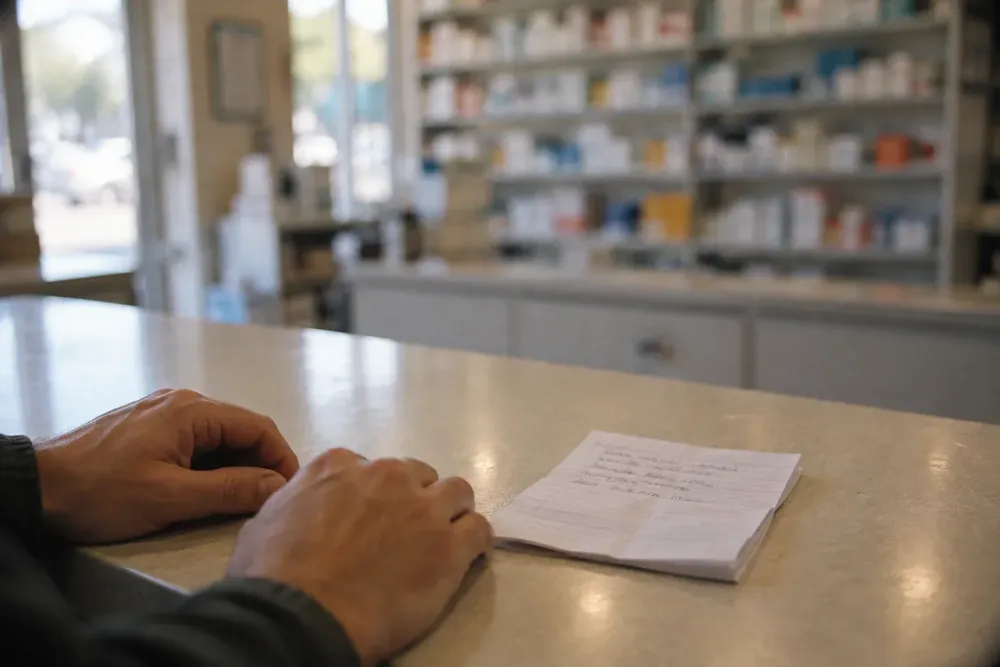
What to tell a pharmacist or clinician
Pharmacists say people rarely ask. In a survey of 99 Texas pharmacists published in Substance Use, 81.8% had never been asked about kratom and 48.5% had never been asked about hemp-derived cannabinoids. Asking is the step most people skip, and it is the one that lets someone check your whole picture. Bring these points:
- Each product by name and form: kratom leaf, extract, or a 7-OH tablet or shot; cannabis flower, edible, vape or a hemp THC product
- How often you use each one, and whether you use them on the same day
- Every prescription and over-the-counter medicine and supplement you take
- How much alcohol you drink
- Whether you drive for work or do safety-sensitive work
- Any reaction you have had before, such as heavy drowsiness, a racing heart, vomiting or confusion
What nobody has measured yet
As of our September 18, 2026 searches, no human study has measured what happens to either substance when kratom and THC are taken together, and no clinical trial of the pair is registered. Nobody has tested the pair in a driving study, compared edibles with smoking or vaping in people who also use kratom, or studied 7-OH products with THC. The animal work never gave the two together. The toxicology record offers co-detections and single cases, not a rate for any harm. That is a lot of blank space for something this common. Until it is filled, the honest position is the risk map at the top of this page, not a verdict in either direction.
Questions people ask about kratom and weed
People do, and often: in the most recent national survey analysis, about two in three people who had used kratom before the past year had used cannabis in the past year. But no human study has measured the combination. Both can cause drowsiness, dizziness and confusion on their own, and the stakes rise with other depressants such as alcohol, opioids or benzodiazepines, with driving, and with concentrated 7-OH products. Whether it is reasonable for you is a question for a clinician who knows everything you take.
Nobody has measured it in either direction. The "several times more kratom" figure some pages quote comes from a study of CBD in rats, not THC in people. Kratom's measured effect in people is on a gut enzyme (CYP3A), while THC's main conversion step runs through a different one (CYP2C9). Unmeasured is not the same as no effect.
That is an inference, not a finding. The only controlled human kratom interaction study we found used probe drugs, not THC, and found an effect on CYP3A in the gut. The oral THC label, citing laboratory data, names CYP2C9 as the enzyme that appears to form THC's main active metabolite, with CYP3A4 also involved. No study has measured THC blood levels with kratom on board, or the reverse.
There is no study of either. Swallowed THC is processed differently from smoked or vaped THC and lasts longer, and delta-8 and other intoxicating hemp products were sold in 74% of the vape shops in one national survey, where kratom is also common. The honest answer is "unknown", which is not the same as "fine".
NCCIH says fatal overdoses from kratom alone appear to be extremely rare, and that kratom used with other drugs has been linked to deaths and severe adverse effects. In the national poison-center data published in MMWR, the deaths most often involved opioids, benzodiazepines, stimulants or alcohol as well, and the data cannot say which substance caused an outcome. NIDA notes that 7-OH can slow breathing in laboratory models. Trouble breathing, collapse, unresponsiveness or a seizure means calling 911.
No study has tested the pair behind the wheel. Both can cause drowsiness and dizziness, and the oral THC label tells patients not to drive until they are reasonably certain it does not affect them. In one California county, mitragynine turned up in 60 of 25,398 impaired-driving cases and never on its own. Kratom is also in the optional tier of the 2021 impaired-driving testing recommendations, so standard panels are not required to look for it.
Every product by name and form (including any 7-OH product or hemp THC), how often you use each, every medicine and supplement, how much alcohol you drink, whether you drive or do safety-sensitive work, and any past reaction. In one Texas survey, 81.8% of pharmacists had never been asked about kratom, so bringing it up yourself matters.
If you use CBD rather than THC, or both, the evidence is different, and it includes a measured interaction in animals. Our guide to CBD and kratom walks through what has been tested on that side and what to bring to a pharmacist.
Writing about hemp, wellness and the small rituals that keep us balanced.