Crossfaded: What Alcohol Does to a THC High, Study by Study
Crossfaded means drunk and high at the same time. Here is what controlled studies measured on blood THC and driving impairment, what is known about vomiting and the order folklore, and the signs that mean you should call 911.
Crossfaded is slang for being drunk and high at the same time. The word hides two separate questions: does alcohol change how much THC reaches your blood, and does the combination impair you more than either one alone? Controlled human studies give a fairly clean answer to the second and a mixed answer to the first. Here is what they measured, study by study, plus the vomiting claim, the order folklore, driving, and when to call 911.
The short answer: none of the controlled driving studies below found cannabis offsetting alcohol, and whether alcohol raises the THC in your blood depends on the study. Neither answer makes any amount or any order safe. This page is written for adults 21 and over and gives no amounts or timing advice. One disclosure: Planntz sells a full-spectrum tablet that contains delta-9 THC, and nothing here recommends combining it, or any THC product, with alcohol.
What crossfaded means, and how common it is
The word comes from young adults, not medicine. In a 2018 survey of 807 young adults aged 18 to 23 in Seattle, 87% had heard of "cross-faded", most often describing it as using alcohol and marijuana simultaneously (43%) or being both drunk and high (25%). The "18.2% of youth" figure sometimes credited to the CDC comes from this survey: it is the share who rated being cross-faded moderately or very desirable, not a CDC figure and not a count of who has done it.
Each figure counts something different. The 10.00% is from an analysis of the National Survey on Drug Use and Health, 2008 to 2019, up from 6.07% in 2008 in that age group. The "about 30%" is from the Monitoring the Future panel, and its denominator is young adults who drink. The 14-20% is from a 2026 telephone survey of 9,146 drivers in six states. And in the US National Alcohol Survey, using both at the same time was associated with roughly double the odds of drunk driving compared with drinking only, an association in 2005 and 2010 data, not proof of cause.
Two questions hiding in one word
The first question is chemistry: does alcohol change how much THC gets into your blood? The second is performance: are coordination, reaction time and judgment worse with both? The answers need not match, and in two of the studies below blood THC did not change while driving still got worse. Three papers by Hartman and colleagues come from one study with 19 people who completed it, so we count them once. CBD with alcohol is a different pairing, covered in our review of the human studies on CBD and alcohol.
Does alcohol make you higher? What the blood tests found
| Study | People | How cannabis was taken | What came first | Blood THC with alcohol |
|---|---|---|---|---|
| Perez-Reyes 1988 | 6 men | Smoked | Alcohol, 15 minutes before | No significant change |
| Lukas and Orozco 2001 | Men (number not in the abstract) | Smoked | Alcohol | Higher, and effects were noticed sooner |
| Downey 2013 | 80 recreational users | Smoked | Both in the same session | Higher than cannabis alone |
| Hartman 2015 | 19 occasional users who completed the study | Vaporized, at their own pace | Alcohol, 10 minutes before | Substantially higher only at the higher strength |
| Zamarripa 2026 | 25 adults | Brownie, eaten | Cannabis, 45 minutes before | No change |
The Hartman study is the most detailed. In its 2015 Clinical Chemistry paper, 19 occasional users completed six sessions: placebo or alcohol aimed at a peak breath level of about 0.065%, each with placebo, lower-strength or higher-strength vaporized cannabis. At the higher strength, median peak blood THC was 42.2 μg/L without alcohol and 67.5 μg/L with it, with wide, overlapping ranges; at the lower strength it was 32.7 and 35.3 μg/L. That is about 1.6 times in one arm, not the "doubled" figure that circulates. People inhaled at their own pace, and the study's driving paper reports that 52.6% showed evidence of self-titration, so blood levels partly reflect how people inhaled. The authors wrote that the higher levels "possibly explain" worse performance, a hypothesis rather than a test.
The other studies pull in both directions. In Lukas and Orozco's 2001 study, men who drank before smoking noticed cannabis effects sooner, reported more episodes of euphoria and had higher plasma THC. Downey and colleagues' 2013 study of 80 recreational users also found higher blood THC with alcohol. But in a 1988 study of 6 men by Perez-Reyes and colleagues, drinking first did not significantly change plasma THC or the rated high, and in a 2026 crossover trial of THC brownies and alcohol in JAMA Network Open, "THC and metabolite pharmacokinetics were not influenced by alcohol." Its authors suggest the gap between doses and giving cannabis first may explain the difference, which the trial did not test. A 2024 review called the experimental findings inconsistent, likely shaped by dose, route and people's substance use histories.
Does the combination impair you more? The driving studies
This is the question with the cleaner answer. None of the six controlled studies below found cannabis offsetting alcohol. Four reported the combination as worse than alcohol on its own; Downey's reported driving more impaired in the combined conditions, and Hartman's found the two effects on lane weaving added together. The alcohol levels tested are low by legal standards, which is part of the point.
| Study | Setting and people | Alcohol level | What the combination did |
|---|---|---|---|
| Perez-Reyes 1988 | Driving-skills tasks, 6 men | Not given in the abstract | Alcohol's losses in driving skills were enhanced by cannabis, "in an additive and perhaps synergistic manner" |
| Ramaekers 2000 | Real car in normal traffic, 18 people | 0.04% blood alcohol | Lane weaving equal to that at 0.09% (lower THC dose) and 0.14% (higher THC dose) blood alcohol |
| Ronen 2010 | Simulator, 12 recreational users | 0.05% blood alcohol | The most intense effect of any condition, yet the distance people were willing to drive did not differ |
| Downey 2013 | Simulator, 80 recreational users | 0.03% or 0.05% blood alcohol | Driving more impaired in the combined conditions |
| Hartman 2015 | Advanced driving simulator, 18 occasional users | About 0.065% peak breath alcohol | Effects on lane weaving added together: "additive rather than synergistic" |
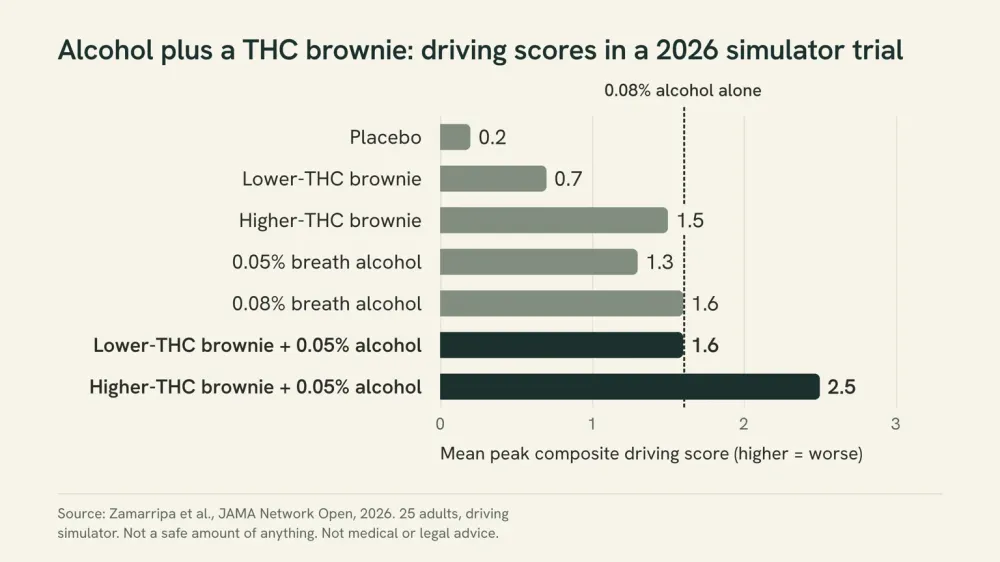
| Zamarripa 2026 | Simulator, 25 adults, THC brownies | 0.05% or 0.08% breath alcohol | Lower-THC brownie plus 0.05% matched 0.08% alone; higher-THC brownie plus 0.05% was worse than 0.08% alone |
The on-road study is the closest to real life. In Ramaekers and colleagues' 2000 study, 18 people drove a real car in normal traffic. Deficits were minor after 0.04% alcohol alone and moderate after cannabis alone, but "Combining THC with alcohol dramatically impaired driving performance": lane weaving matched blood alcohol levels of 0.09% and 0.14%, and in a car-following test reaction time was 1.6 seconds longer than on placebo under alcohol plus the higher THC dose. The Hartman simulator paper found the effects "additive rather than synergistic", which does not mean mild: a blood THC of 5 μg/L with 0.05% breath alcohol produced lane weaving similar to 0.08% alcohol alone. That is a lab measurement in occasional users, not a safe line, and the authors note that people who know they are watched "may drive with greater caution or focus."
“The legal alcohol intoxication limit in most of the US (0.08% BrAC) may be too liberal if a driver has co-used cannabis and alcohol.”
In the 2026 brownie trial, every active condition significantly worsened a composite driving score compared with placebo except the lower-THC brownie on its own (P=.06), and that same brownie plus 0.05% breath alcohol impaired driving about as much as 0.08% alcohol alone (mean scores of 1.6 each). The higher-THC brownie plus 0.05% was significantly worse than 0.08% alcohol alone (2.5 against 1.6). Field sobriety tests, the roadside checks police use, did not detect impairment in several conditions where simulated driving had clearly worsened. Self-awareness is inconsistent: Ronen and colleagues' 2010 simulator study found no difference in how far people were willing to drive, while in the 2026 trial only 2 of 25 were willing to drive for the entire higher-THC brownie plus alcohol session, against 21 of 25 on placebo.
How it feels, and the nausea question
Feeling higher and being more impaired are different measurements. In the Hartman study's paper on subjective effects, ratings such as "high", "stoned" and "difficulty concentrating" stayed above baseline longer after cannabis with alcohol than without it. On getting sick, a 2023 study that followed 341 college students through 56 days of five daily surveys found that days with both substances did not differ from alcohol-only days in blackout, nausea or vomiting and injury, while cannabis-only days carried less of each; driving high or drunk was more likely on days with both than on alcohol-only days. The authors concluded that most of the negative co-use consequences they studied "appear to be driven by alcohol consumption rather than cannabis use." Their models controlled for how much people drank, so this does not make adding cannabis harmless: it points at the alcohol, and at the driving.
Can weed stop you throwing up when you are drunk?
You may have read that THC suppresses the gag reflex, letting alcohol build to dangerous levels. The idea starts somewhere real: dronabinol, a synthetic THC, carries an FDA label for nausea and vomiting from cancer chemotherapy in patients who have not responded adequately to standard treatment. That does not show cannabis hides alcohol poisoning. A PubMed search on September 15, 2026, for human studies of cannabis, alcohol and vomiting, emesis or the gag reflex found no study testing whether cannabis masks alcohol poisoning, which makes the idea neither a myth nor true. What is established concerns alcohol: the National Institute on Alcohol Abuse and Alcoholism (NIAAA) lists vomiting and "no gag reflex" among the critical signs of alcohol overdose, and warns that blood alcohol can keep rising after a person stops drinking or passes out. For bedtime, our guide to what THC does to sleep covers stacking it with alcohol and sleep medicines.
When it is an emergency, and what to do while you wait
These are NIAAA's critical signs of alcohol overdose. They are written about alcohol and apply whether or not cannabis was also used. Call 911 if you see any of them. In NIAAA's words: "Do not wait for the person to have all the symptoms."
- Mental confusion, stupor
- Difficulty remaining conscious, or inability to wake up
- Vomiting
- Seizures
- Slow breathing (fewer than 8 breaths per minute)
- Irregular breathing (10 seconds or more between breaths)
- Slow heart rate
- Clammy skin
- Dulled responses, such as no gag reflex (which prevents choking)
- Extremely low body temperature, bluish skin color, or paleness
While you wait for help, every step below comes from the same NIAAA page.
- 1Do not leave the person alone.
- 2If they are vomiting, help them lean forward to prevent choking.
- 3If they are unconscious or lying down, roll them onto one side with an ear toward the ground.
- 4Tell the responders what they drank and any other drugs they took, including cannabis, if you know.
- 5Skip cold showers, hot coffee and walking it off. NIAAA says these do not reverse an alcohol overdose and could make things worse.
The phone line is America's Poison Centers' Poison Help, and the more-than-one-substance rule and 911 criteria come from the National Capital Poison Center's triage page. Outside the US, use your local emergency and poison-center numbers.
Beer before grass: what the evidence says about order
Folk rules like "beer before grass" and "grass before beer" claim the order decides how the night goes. A PubMed search on September 15, 2026, for clinical trials of cannabis and alcohol mentioning sequence or order and blood concentrations returned 8 records, and none compared the two orders head to head. What exists is indirect. In a 1992 study of 15 men who drank and then smoked, plasma alcohol after the higher alcohol dose peaked lower and later with the higher-strength cannabis cigarette (54.80 mg/dL at 105 minutes after drinking began) than with a placebo cigarette (78.25 mg/dL at 50 minutes). That is still alcohol first, and a lower alcohol reading is not less impairment, as the driving studies show. The alcohol-first inhaled studies disagree on blood THC, and the one cannabis-first study, the brownie trial, found no blood interaction. No order has been shown to make the combination less impairing, and this page does not recommend one.
Edibles and THC drinks with alcohol
Swallowed THC is slow, and the body processes it differently. In the 2026 trial, people ate the brownie before drinking, and measured impairment peaked well after the drinks, when breath alcohol was already falling. That describes one study design, not a timeline for anyone else. Our guide to 11-hydroxy-THC explains how swallowing THC changes the mix of THC and its 11-hydroxy metabolite compared with inhaling it. If the drink is itself a hemp THC beverage, its THC is part of the same evening: our guide to hemp drinks sorts out the products sold under that name, and our explainer on hemp-derived THC covers what the THC figure on a hemp product means. None of the controlled studies on this page tested a THC beverage with alcohol.
Driving crossfaded: crash data and the law
Crash studies measure who was in crashes, not impairment. In a 2017 case-control study by Chihuri, Li and Chen, 1,944 drivers killed in US crashes from 2006 to 2008 were compared with 7,719 drivers in the 2007 National Roadside Survey, and 8.9% of the killed drivers tested positive for both alcohol and marijuana, against 0.8% of roadside drivers. Compared with drivers negative for both, the adjusted odds of fatal-crash involvement were 16.33 for alcohol only, 1.54 for marijuana only and 25.09 for both. The authors note that "a positive test for marijuana indicates marijuana use but not necessarily marijuana-induced impairment", because metabolites can remain in the blood for weeks. Read those numbers as associations, not as your personal chance of crashing. They still show that alcohol carries most of the association and that cannabis on top of it made the association larger. The "eightfold" crash-risk figure that circulates is one we could not trace to a primary study.
Among 34,514 drivers in a national survey, 2016 to 2019, who had used both alcohol and cannabis in the past year, 42% reported driving under the influence in that year: 8% alcohol only, 20% cannabis only and 14% both. On the legal side, the Governors Highway Safety Association notes that every state has laws on alcohol-impaired and drug-impaired driving, but that drugged-driving laws are "nuanced, difficult to enforce and prosecute and vary substantially by state." Our guide to cannabinoids, driving and per se THC laws explains what those laws actually punish.
Numbers you may have seen that do not hold up
| What you may have read | What the source actually says | Verdict |
|---|---|---|
| The CDC says 18.2% of youth have been crossfaded | 18.2% of 807 young adults in a 2018 Seattle survey rated being cross-faded moderately or very desirable | Not a CDC figure and not a prevalence |
| Alcohol doubles your blood THC | Hartman study: median peak THC rose from 42.2 to 67.5 μg/L at the higher strength only; two other studies found no change | About 1.6 times in one arm, not doubled |
| Crossfading doubles reaction-time deficits | The 2017 review it has been credited to describes "additive performance impairment effects" and contains no doubling statement | Not in the cited source |
| An eightfold fatal crash risk | No primary study located; the traceable figures are the 2017 case-control odds ratios above, which reflect positive tests, not proven impairment | Not traced |
| Weed suppresses the gag reflex, so alcohol poisoning builds up | We found no human study testing it; NIAAA lists a missing gag reflex as a sign of alcohol overdose | Untested; the alcohol danger is real |
| Drinking first opens blood vessels or primes the liver to absorb more THC | No source is given; inhaled THC is absorbed through the lungs, and blood results with alcohol are mixed | Mechanism unsupported |
The reaction-time claim has been credited to a 2017 review by Yurasek, Aston and Metrik. We read it: it describes "additive performance impairment effects" and says nothing about reaction time doubling. The one reaction-time figure we found is the 1.6 seconds from the on-road study above.
What the evidence cannot tell you
- How the findings apply to heavy daily users. The controlled studies mostly enrolled occasional or infrequent users, and several older ones enrolled only men.
- Whether order matters. No study we found gave the same people both orders and compared them.
- How simulators compare with real roads. Only one study on this page used a real car in traffic: 18 people, in 2000.
- Your personal crash risk. Crash studies record positive tests, which show use but not necessarily impairment.
- What THC beverages do with alcohol. None of the controlled studies on this page tested a drink.
- How much independent evidence there is. The three Hartman papers are one study, and several samples are under 20 people.
None of those gaps changes the practical line: don't drive after drinking, using cannabis or both, and treat the emergency signs above the same way whatever was taken.
Questions people ask about getting crossfaded
It is slang for being drunk and high at the same time. In a 2018 survey of 807 young adults, 87% had heard the term. Nationally, 10.00% of US adults aged 21 to 30 reported using cannabis while drinking or within a couple of hours of drinking in 2019.
It depends on the study. Three studies of smoked or vaporized cannabis found higher blood THC with alcohol, and in the most detailed one the rise was substantial only at the higher strength. A 1988 study of 6 men and a 2026 brownie trial found no change. Feeling higher is also a different measurement from being more impaired.
For impairment, none of the six controlled driving studies we tabled found cannabis offsetting alcohol, and four reported the combination as worse than alcohol alone. In a daily-survey study of college students, blackouts, nausea and vomiting were no more common on days with both than on alcohol-only days, but driving high or drunk was. Neither finding makes any combination safe.
No study we found compared the two orders in the same people (PubMed search, September 15, 2026). A 1992 study found a lower, later alcohol peak when men smoked after drinking, but a lower alcohol reading is not less impairment. No order has been shown to make the combination less impairing, so this page does not recommend one.
We found no human study testing whether cannabis masks alcohol poisoning. A synthetic THC is FDA-labeled for chemotherapy nausea and vomiting, which is where the idea starts. Vomiting and a missing gag reflex are among NIAAA's signs of alcohol overdose: if someone is vomiting, confused or hard to wake, call 911.
In the 2026 trial on this page, 25 adults ate a THC brownie and then drank alcohol. Alcohol did not change their blood THC, but a lower-THC brownie plus 0.05% breath alcohol impaired driving as much as 0.08% alcohol alone, and a higher-THC brownie plus 0.05% impaired it more. Our greening-out guide explains why edibles are slow to be felt.
None of the studies on this page tested a safe waiting time for the combination, and in the 2026 trial roadside sobriety tests missed impairment in several conditions. Don't drive after drinking, using cannabis or both, and arrange a ride in advance. Our guide to cannabinoids and driving covers per se THC laws.
If you are reading this because drinking or cannabis use feels hard to control, the SAMHSA National Helpline at 1-800-662-4357 is free and confidential, and the federal FindTreatment.gov locator lists treatment options near you.
And if the problem on a given night is too much THC rather than the mix, our guide to greening out, including why edibles catch people out and when to call for help is the next page to read.
Writing about hemp, wellness and the small rituals that keep us balanced.