California Sober: What It Means and What the Research Says
California sober means different things to different people, and the research answers each differently. For people in recovery, two Los Angeles cohorts found cannabis use went with more drinking. For everyone else, the evidence is mixed.
California sober, also written Cali sober, usually means staying off alcohol and hard drugs while still using cannabis. The dictionary also records a broader sense that allows alcohol too. Whether swapping alcohol for weed works depends on who is asking. For people in recovery from a substance use disorder, the studies built around sober living houses found cannabis use went together with more drinking, not less. For people who are not in recovery and want to drink less, the evidence is mixed: one lab trial in regular cannabis users found less drinking after THC, diary studies point both ways, and using both has costs of its own.
Most of what you find when you search this phrase comes from two kinds of sites. Addiction treatment centers conclude that it does not work. Dispensaries describe it as a lifestyle. Both have a stake in the answer. This page does not sell either verdict. It separates the two very different people the phrase describes, gives the size and design of every study we cite, and says plainly what each one can and cannot tell you. It is general information for adults 21 and over, not medical advice, and it follows the same approach as our evidence-first guide to CBD's benefits: name the study, say who was in it, state the limit.
What California sober means
Merriam-Webster lists California sober as an informal adjective with two senses. The broad one is "engaging in or characterized by recreational use of marijuana and/or alcohol combined with abstinence from other drugs (such as cocaine or methamphetamine)." The narrower one, marked "often, specifically," is "using only marijuana while abstaining from alcohol and other drugs." The dictionary lists Cali sober as a variant and dates the first known use to 2015. The narrow sense is the one most articles use, which is why the phrase usually gets flattened to "weed instead of alcohol." The broad version is worth knowing, because it is closer to how the phrase became famous.
The phrase went mainstream in 2021, when Demi Lovato described being California sober in their docuseries Dancing With the Devil. After a near-fatal overdose in 2018, Lovato said at the time that they still drank and used marijuana in moderation. Lovato said they were "done with the stuff that's going to kill me" but that "swearing off alcohol and marijuana entirely is just setting myself up for failure." In December 2021, Lovato wrote on Instagram Stories that they no longer supported the approach.
“I no longer support my "California sober" ways ... Sober sober is the only way to be.”
There is still no agreed definition. A 2026 review by researchers at Johns Hopkins and other universities describes the approach as abstaining from "all intoxicating substances except cannabis and potentially, psychedelics" and points to "the lack of clear standards" for what it means. It is a narrative review, not new data, so read it as a map of how the term is used. If your version includes psychedelics, the psilocybin research on alcohol use disorder, such as a 2022 trial in 95 adults with alcohol dependence, paired two supervised doses with 12 weeks of structured therapy, which is not the same thing as using on your own. The rest of this page is about cannabis.
Two readers, two different questions
The phrase covers two situations, and the research answers them separately. If you are recovering from an alcohol or drug use disorder, the question is whether cannabis helps you stay off alcohol and other drugs. If you are not in recovery but drink more than you would like, the question is whether cannabis helps you drink less, and at what cost. For the first reader, the closest evidence comes from a 2024 study of Los Angeles sober living residents, a follow-up in residents who all had alcohol use disorder, and a reanalysis of a large US alcohol treatment trial. For the second, there is one placebo-controlled lab trial of THC and drinking and a handful of daily-diary studies. The table sorts them by reader; the sections that follow explain each one.
| Who you are | The real question | Best evidence so far | What it found | Main limit |
|---|---|---|---|---|
| In recovery from an alcohol or drug use disorder | Does cannabis help me stay off alcohol and other drugs? | Two Los Angeles sober living cohorts (557 and 205 residents); a reanalysis of the COMBINE treatment trial (206 cannabis users, 999 abstainers) | Cannabis use went with more drinking, more alcohol problems and fewer alcohol-free days | Observational: shows the two went together, not that cannabis caused it; no data on amount or potency |
| Not in recovery, want to drink less, already use cannabis | Will I drink less on the days I use cannabis? | One lab trial (157 people randomized); daily-diary studies in college students, veterans and heavy drinkers in treatment | THC cut drinking 19% to 27% in one lab session; diary results mixed, and co-use days more often heavy | The trial was one lab session per dose in near-daily users, most with a cannabis use disorder; diaries are self-report |
| Thinking of CBD instead | Can a non-intoxicating product stand in for a drink? | Two small placebo-controlled trials in adults with alcohol use disorder | CBD did no better than placebo on drinking outcomes | Small, short trials; see the CBD section below |
What the sober living studies found
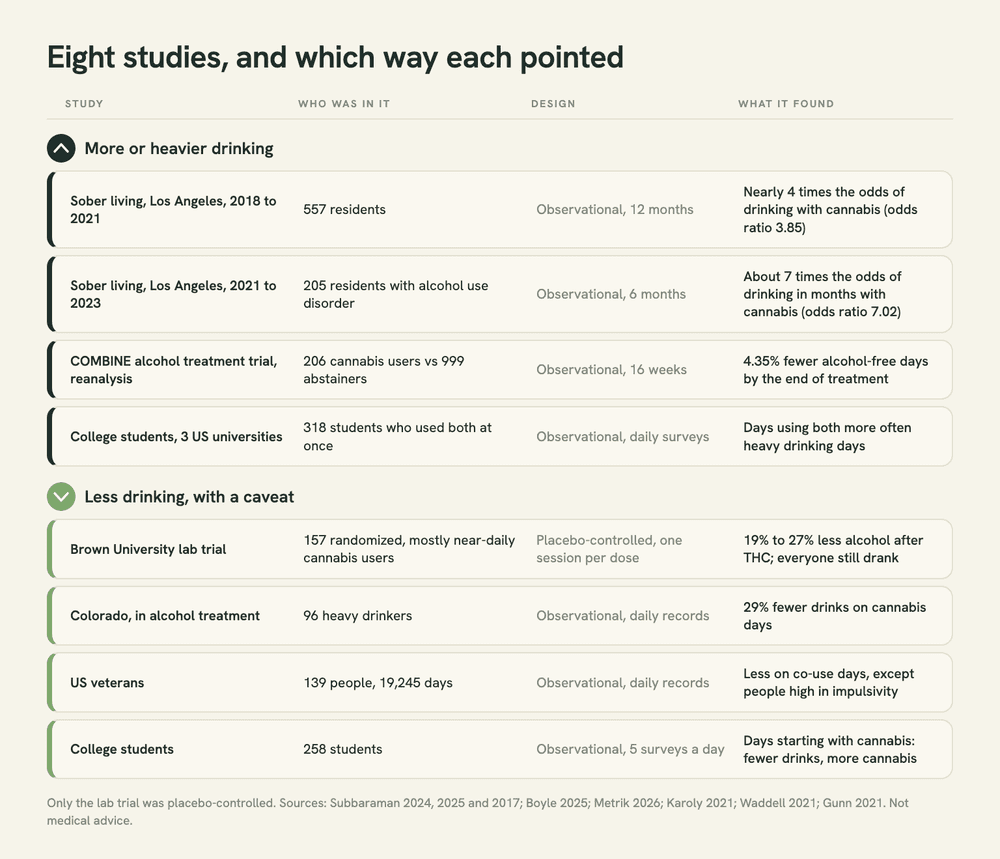
Sober living houses are shared homes where many people live during early recovery. Their residents are the population the Lovato version of California sober describes, and they are where the most relevant studies were done. The 2024 study followed 557 residents of 48 Los Angeles sober living houses for 12 months, between 2018 and 2021, with adult-use cannabis legal throughout. At the start, 19.2% had used cannabis in the previous six months. Compared with residents who had not, those who used cannabis had nearly four times the odds of having had a drink in the past month (odds ratio 3.85), about 76% more drinking days (incidence rate ratio 1.76) and higher odds of alcohol problems (odds ratio 2.74). The link with other drugs was stronger still: odds ratios of 10.41 for any drug use and 14.99 for drug problems. The authors' conclusion was direct: "Cannabis does not appear to work as a substitute for alcohol or other drugs in this population."
The same team asked the question again in 205 people entering 28 Los Angeles sober living houses between 2021 and 2023, all of whom met criteria for alcohol use disorder in the past year, interviewed at the start and at 1, 2, 3 and 6 months. In a month when they had used cannabis, their odds of drinking at all were about seven times higher (odds ratio 7.02), they had roughly twice as many drinking days (incidence rate ratio 2.03), and their odds of alcohol problems were about three times higher (odds ratio 3.21). The authors spelled out the logic: if cannabis were acting as a substitute, alcohol problems should also go down. "We did not find that."
A third data point comes from outside sober living. COMBINE was a large US trial of treatments for alcohol dependence, with 1,383 participants and data collected in the early 2000s. The reanalysis compared 206 people who used cannabis during the 16 weeks of treatment with 999 who did not. By the end of treatment, the cannabis users had 4.35% fewer alcohol-free days. A year later the difference had weakened and was no longer statistically clear, and cannabis use was not linked to how much people drank on the days they did drink or to their number of heavy drinking days.
Read all three carefully. They are observational: they show that cannabis use and drinking went together, not that cannabis caused the drinking. People who were already struggling may simply have been more likely to use both. The 2024 authors write that their study "was not designed to examine cannabis substitution" and call for detailed daily data. Neither Los Angeles study measured how much cannabis people used or how strong it was, and the 2024 study also had no data on why they used it. Still, these are the studies closest to the person the phrase was coined for, and none of them found what substitution would predict: less drinking alongside cannabis.
The lab trial that tested THC against a placebo
The only placebo-controlled test of THC and drinking we found is a Brown University trial published online in November 2025 in the American Journal of Psychiatry. It was double-blind and crossover, meaning each person tried every condition on a different day. Of 157 people randomized, 138 completed at least two sessions. Participants were 21 to 44 (average age 25.6), drank heavily at least once a month, used cannabis at least twice a week (confirmed by urine test), and had no intention of quitting or seeking treatment. After a night without cannabis, they smoked cannabis with 7.2% THC, 3.1% THC or a placebo with 0.03% THC, then were offered drinks in the lab. After the 3.1% cannabis they drank 19% less than after placebo; after the 7.2% cannabis, 27% less. The researchers had expected the opposite.
- It did show that, in this group, THC reduced how much people drank in one lab session, and the stronger cannabis produced the larger drop.
- It did not show that anyone stopped drinking. The authors note that participants "still consumed alcohol after smoking cannabis with THC", just less of it.
- It did not study people in recovery or trying to quit. Most already used cannabis nearly daily, and more than three-quarters met criteria for a current cannabis use disorder.
- It did not reduce craving on the main questionnaire. The 7.2% dose lowered a single urge rating taken right after smoking.
- A longer wait before the first drink (33.4 vs 22.5 minutes at 7.2% THC) was an exploratory result, not a main finding.
- It did not measure harm. Whether the drop reduces the harms of using both, the authors write, "is unknown."
What the reviews say about substitution
Researchers have argued for years about whether cannabis and alcohol act as substitutes (one replaces the other) or complements (they go together). A 2020 systematic review led by King's College London researchers gathered 65 studies, 64 in humans and 1 in animals. Thirty found evidence for substitution, 17 for complementarity, 14 for neither and 4 for both. The authors' verdict was that the evidence is "mixed": they saw stronger support for substitution than complementarity, but also "different effects in different populations and to some extent across different study designs", and they noted that few of the studies were designed to answer the question at all. An earlier 2016 review of 39 studies found the same split: 16 for substitution, 10 for complementarity, 12 for neither and 1 for both.
Two findings from the same literature matter more if you are in recovery. A 2014 review that checked cannabis against seven criteria used for alcohol substitute medications found that, on paper, the criteria appeared "either satisfied or partially satisfied", but it also found "no clear pattern of outcomes related to cannabis substitution" and flagged the weak designs of the studies behind it. Its conclusion was that recommending cannabis to people with alcohol dependence to help them drink less was "premature." And a 2021 systematic review of 96 studies on addiction substitution, the idea that people in recovery trade one substance or behavior for another, found it was the minority pattern. Of the studies with statistics, 17.65% supported substitution, while 52.94% supported concurrent recovery, meaning people cut back on other substances as they recovered. Where substitution did happen, it was linked to poorer treatment outcomes, and it was more common in men, younger people, people with more severe use and people with mental health conditions.
You will also see surveys of medical cannabis patients who say they drink less. In a 2020 Canadian survey of 973 patients who drank, 44% reported drinking less often after starting cannabis, 34% reported fewer drinks per week and 8% reported no alcohol in the past 30 days. Those are recollections from people who chose cannabis, with no comparison group, and the lead author listed an affiliation with a cannabis company. They are a signal worth studying, not evidence that the swap works.
If you are not in recovery and just want to drink less
Far more people are asking this second question. Gallup's August 2026 poll found 54% of US adults say they drink alcohol at all, tied for the lowest reading since Gallup started asking in 1939, and 17% said they had drunk nonalcoholic beer, wine or spirits instead of an alcoholic drink at some point in the past year. The poll says nothing about cannabis. For people who already use cannabis, the best evidence on whether it lowers drinking comes from daily-diary studies, which track the same people day by day and compare their cannabis days with their other days. They point in more than one direction.
Some found less drinking. In a Colorado study of 96 heavy drinkers in alcohol treatment who also used cannabis, people drank about 29% fewer drinks, and were less likely to binge, on days they used cannabis. The authors' reading is that these drinkers "appear to increase their cannabis use on days when they reduce their alcohol consumption." That is a day-by-day pattern, not evidence that cannabis helped anyone recover. In 139 US veterans who used both, tracked across 19,245 days, people with average or low scores on two impulsivity traits drank less on days they also used cannabis than on alcohol-only days. People high in those traits drank just as heavily either way.
Others found the total simply moved. In a study of 258 college students who answered five surveys a day across two 28-day stretches, days that started with cannabis had fewer drinks but more cannabis. And in 318 college students from three US universities who reported using both at the same time, days of using both were more likely to be heavy drinking days (four or more drinks for women, five or more for men) than days with alcohol alone, and the more cannabis they used, the heavier the drinking. Put together, the diary studies say:
- For some people, on some days, drinking went down when cannabis went up.
- For impulsive people, and on many co-use days in young adults, drinking stayed high or rose.
- Everyone studied already used cannabis. None of these studies tested starting cannabis in order to cut down.
- All of it is self-report, and none showed that a lower-drinking pattern lasts or improves health.
- The order finding describes what happened on those days. It is not a recommendation to use cannabis first or in any sequence.
The co-use trap: when "instead of" becomes "both"
In practice, California sober can quietly turn into using both, sometimes at the same time. A 2022 scoping review of 74 studies in young adults found that using alcohol and cannabis simultaneously was linked with more perceived negative consequences, as well as more of the effects people were after, and that it was most common among people who used heavier amounts more often. The combination also has its own effects; our guide to being crossfaded covers what the blood tests and driving studies show when alcohol and THC are mixed, so we will not repeat it here.
What swapping does not remove
Replacing one substance with another changes the risks rather than removing them. NIDA estimates that 22% to 30% of people who use cannabis have cannabis use disorder, and it names how often someone uses as "the strongest predictor of cannabis use disorder" in its fact sheet. In a national survey of 36,309 US adults, 30.6% of people who had used marijuana in the past year met the older DSM-IV criteria for a use disorder in 2012 to 2013, nearly 3 in 10. Those figures describe THC cannabis, not CBD. A full swap for daily drinking can easily mean daily cannabis, and frequency is exactly what NIDA flags.
If you want to understand how dependence is defined and why CBD is a different case, our guide to whether CBD is addictive explains both. If you already use regularly and want to see how you feel without it, planning a tolerance break covers what to expect. Other things a swap leaves in place:
- Other drugs. In the 2024 sober living study, cannabis use went with far higher odds of other drug use (odds ratio 10.41), not only drinking.
- Impairment. THC is intoxicating, so the rule about not driving after drinking applies after cannabis too.
- Your treatment plan. If you are in recovery, a change like this is one to make with your care team, not around them.
- Pregnancy and youth. If you are pregnant, breastfeeding or under 21, take this question to a clinician before anything else.
Two related guides go deeper on the everyday side: how impairment rules treat cannabis and CBD behind the wheel, and what the research says about weed and motivation, which separates the effects while high from what regular use leaves behind.
Where CBD fits
CBD is a different question. It does not produce a high, and in two small placebo-controlled trials in adults with alcohol use disorder, CBD did no better than placebo on drinking outcomes. So it is not a stand-in for cannabis in the California sober sense, and it is not a treatment for problem drinking. What CBD can and cannot replace in an evening routine is covered in our guide to trying CBD instead of alcohol, and what happens when you take CBD with a drink has its own page, including those trials.
If you are asking because of your drinking
Sometimes the question behind "does California sober work" is really "am I drinking too much?" That deserves a direct answer of its own, without judgment. NIAAA's guide to alcohol use disorder asks questions like these about the past year. Have you:
- 1Had times when you ended up drinking more, or longer, than you intended?
- 2More than once wanted to cut down or stop drinking, or tried to, but couldn't?
- 3Wanted a drink so badly you couldn't think of anything else?
- 4Continued to drink even though it was causing trouble with your family or friends?
- 5Given up or cut back on activities you found important, interesting, or pleasurable so you could drink?
- 6Continued to drink even though it was making you feel depressed or anxious or adding to another health problem? Or after having had an alcohol-related memory blackout?
NIAAA's own wording: "Any of these symptoms may be cause for concern. The more symptoms, the more urgent the need for change." These questions are a starting point, not a diagnosis; only a clinician can diagnose a use disorder. If you are already in treatment or recovery, talk to your care team before changing anything, including adding cannabis. If you want to look at your options, NIAAA's Alcohol Treatment Navigator explains them, and NIAAA's page on finding help lists SAMHSA's national helpline number. To find providers near you, use FindTreatment.gov.
What is still unknown
The honest summary has gaps, and they limit how far any of the findings above can travel. We searched PubMed in September 2026 for randomized trials on cannabis and drinking (148 records). One lab trial gave people THC and measured how much they drank: the single-session study above. A 2025 University of Colorado Boulder trial randomly assigned 152 adults from groups underrepresented in research a legal-market cannabis product, either THC or CBD, to use as they chose for four weeks. It tracked drinking days as a main outcome and reported "no significant effects on alcohol-related outcomes." Everyone in its two arms used cannabis, so it compared two kinds of cannabis rather than testing cannabis as a way to drink less. We found no trial that tested cannabis as a way to cut down or stay off alcohol over weeks or months.
- Both sober living studies were observational and done only in Los Angeles County, where adult-use cannabis was legal.
- Neither measured how much cannabis people used or how strong it was.
- The lab trial studied mostly near-daily users, most with a cannabis use disorder, so it says little about occasional users or people new to cannabis.
- The diary studies are mostly college students, young adults and veterans, all reporting on themselves.
- None of the studies above followed adults without a disorder who switched fully from alcohol to cannabis and tracked their health over time.
California sober: questions people ask
It usually means staying off alcohol and other drugs while still using cannabis. Merriam-Webster also records a broader sense: using marijuana and/or alcohol recreationally while abstaining from other drugs such as cocaine or methamphetamine. Cali sober means the same thing, and the dictionary dates the first known use to 2015.
It depends on who is defining sobriety. Abstinence-based recovery programs define it as not using intoxicating substances, cannabis included. The phrase itself has no clinical definition, and a 2026 review pointed to the lack of clear standards for what it means. Whether it fits your own recovery is a question for you and your care team.
For people in recovery, the two Los Angeles sober living studies found cannabis use went together with more drinking and more alcohol problems, not less. In one lab trial, THC cut drinking by 19% to 27% for a single session in people who already used cannabis nearly daily, and the authors called recommending it as a substitute premature. We found no trial testing cannabis as a way to cut down or stay off alcohol over weeks or months.
We found no study comparing the two head to head over time, so there is no honest yes or no. The risks are different: NIDA estimates 22% to 30% of people who use cannabis have a use disorder, with frequency the strongest predictor, and using both at once is linked with more negative consequences in young adults.
Yes. NIDA estimates 22% to 30% of people who use cannabis have cannabis use disorder, and says how often someone uses is the strongest predictor. Swapping alcohol for daily cannabis does not take that risk off the table. Our guide to whether CBD is addictive explains how dependence is defined and why CBD is different.
In December 2021, Lovato wrote on Instagram Stories: "I no longer support my 'California sober' ways ... Sober sober is the only way to be." They had described the approach earlier that year in their docuseries Dancing With the Devil. We do not speculate beyond what they wrote.
Some people's version does. A 2026 review describes the approach as avoiding all intoxicating substances except cannabis "and potentially, psychedelics." Research on psilocybin for alcohol use disorder has used supervised doses inside structured therapy, which is not the same as using on your own.
If what you are really after is a calmer evening without a drink, CBD is a separate question with separate evidence. Our guide to what actually changes when you try CBD instead of alcohol covers what it can and cannot replace, and how to test it honestly on yourself.
Writing about hemp, wellness and the small rituals that keep us balanced.