Are Hemp Seeds Safe During Pregnancy? FDA, THC, Drug Tests
No study has tested hemp seed foods in pregnancy. Here is what FDA's 2018 and 2019 hemp seed documents actually cover, the THC trace worked out against Europe's reference dose, and what delivery-room drug testing means for hemp foods.
Are hemp seeds safe during pregnancy, and can you keep eating hemp hearts once you are nursing? Most pages that answer this say the FDA has no objection and suggest a few tablespoons a day. The documents behind that line are more limited than the pages that repeat it. No study has tested hemp seed foods in pregnant or breastfeeding people. What exists is one dated FDA sentence, a 2018 company file that modeled breastfeeding and set pregnancy aside, a THC trace that changes from batch to batch, and hospital drug-testing practices most guides never mention.
The short answer, as of November 2026: hulled hemp seed is a food, not a CBD product, and the only federal statement we found about it in pregnancy is a 2019 FDA consumer page that gives no number. Where a given spoonful sits against Europe's THC reference dose depends on the batch, and a US bag does not tell you. The step the documents do support is simple: tell your prenatal care team what you eat, hemp foods included. This page makes no nutrition, fetal-development or milk-supply claim for hemp seed, and nothing in it is a serving suggestion.
Where the "FDA says it's fine in pregnancy" line comes from
Most pages on this question say the FDA has no objection to hemp seeds in pregnancy, and almost none link to anything. The line is real. It comes from an FDA consumer update titled What You Should Know About Using Cannabis, Including CBD, When Pregnant or Breastfeeding, marked "content current as of" October 16, 2019. Nearly all of that page is about CBD, THC and marijuana. Under a subhead that asks "What about hemp seeds?", it says:
“FDA recently completed an evaluation of some hemp seed-derived food ingredients and had no objections to the use of these ingredients in foods. THC and CBD are found mainly in hemp flowers, leaves, and stems, not in hemp seeds. Hemp seeds can pick up miniscule amounts of THC and CBD from contact with other plant parts, but these amounts are low enough to not raise concerns for any group, including pregnant or breastfeeding mothers.”
That paragraph is the source of the "FDA says it's fine in pregnancy" line on other pages. Read it closely and three limits show up. It has no number in it: "miniscule" and "low enough" are not measurements. It is from 2019. And the "evaluation" it refers to is FDA's December 2018 review of three hemp seed ingredients: FDA's reply letters never mention pregnancy, and the company file behind them set pregnancy aside (next section). The chemistry part holds up: in its December 20, 2018 update on those reviews, FDA said the seeds "do not naturally contain" THC, pick up trace amounts "during harvesting and processing", and that eating the reviewed ingredients is "not capable of making consumers 'high.'" We report the 2019 sentence as FDA's words, with its date. We do not restate it as a finding about pregnancy, because no pregnancy finding sits behind it.
What FDA's 2018 hemp seed files cover for pregnancy and breastfeeding
GRAS ("generally recognized as safe") is a US pathway in which a company tells FDA why it believes an ingredient meets that standard for specific food uses, and FDA replies. In December 2018 FDA answered three notices from one company, Fresh Hemp Foods: GRN 765 (hulled hemp seed), GRN 771 (hemp seed protein powder) and GRN 778 (hemp seed oil), each with a "no questions" letter. We searched the full text of all three letters, the company's November 2018 amendment and a 2020 supplemental letter for pregnancy, lactation, breastfeeding, nursing, fetus and fetal. There are zero hits. FDA's reply on hulled hemp seed summarizes the company's intake estimate for "the general population, aged 2 years and older", and in its own conclusion states that the letter "is not an affirmation" that the ingredient is GRAS. FDA did not approve hemp seed for pregnancy, and these letters do not rule on pregnancy at all.
The company's own notices went further than FDA's letters on breastfeeding, and less far on pregnancy. Each one, starting with the hulled hemp seed notice, GRN 765, has a section titled "Safety of THC Exposure - Breastfeeding Population" that models THC in breast milk. On pregnancy, the same section says, word for word: "There does not appear to be a need to discuss in utero drug exposure. Clearly, use of cannabis during pregnancy is contra-indicated." Elsewhere the company concluded that hulled hemp seed "is safe for children, adults and breastfeeding women and their infants when consumed at anticipated levels." That is the notifier's conclusion, not FDA's. So the file FDA's 2019 sentence rests on has a lactation model, written by the company, and no pregnancy model by anyone. The table lines up every document a pregnant or nursing reader is likely to be pointed to.
| Document | Date | Pregnancy | Breastfeeding | Who it covers |
|---|---|---|---|---|
| FDA consumer update on cannabis and CBD | Oct 16, 2019 | Trace THC and CBD in hemp seeds "low enough to not raise concerns for any group"; no number | Same sentence names breastfeeding mothers | Pregnant and breastfeeding people |
| FDA letters, GRN 765, 771, 778 | Dec 20, 2018 | Not mentioned | Not mentioned | General population, age 2 and older |
| Company notices (Fresh Hemp Foods) | 2018 | "No need to discuss in utero drug exposure" | THC-in-milk model; company concludes no concern at anticipated levels | General population, age 2 and above |
| EFSA acute THC exposure assessment | Jan 2020 | Surveys of pregnant women in its database; no separate result | Surveys of lactating women in its database; no separate result | All ages except infants |
| LactMed, Cannabis record | Oct 15, 2026 | Not its scope (lactation database) | No hemp seed entry; seed use for milk supply has "no valid scientific data" | Nursing parents and cannabis |
| MotherToBaby, marijuana fact sheet | May 1, 2025 | Hemp not mentioned | Hemp not mentioned | Pregnancy and breastfeeding |
| ACOG Clinical Consensus No. 10 | Oct 2025 | Hemp not mentioned; covers cannabis use and testing | Hemp not mentioned | Pregnant and postpartum patients |
Can you eat hemp seeds while pregnant? What the research covers
Here is the honest state of the research. We searched PubMed on November 10, 2026 for hemp seed together with pregnancy, pregnant, lactation or breastfeeding. A broad search returned 20 records and a tighter title-and-abstract search returned 12. None is a study of people eating hemp seed foods while pregnant or breastfeeding. The "lactation" hits are feeding trials in dairy cows, ewes, sows and goats, studies of THC metabolites in people who use cannabis, and reviews.
Europe's food agency had the data to look and did not report a result. The European Food Safety Authority's 2020 acute THC exposure assessment lists four surveys in its consumption database that cover "Pregnant women" (Latvia and Portugal) and "Lactating women" (Greece and Estonia). Exposure was assessed "for all age groups, with the only exclusion of infants", and the results are reported by age group. In the full text, pregnancy comes up once, in that methods sentence, and breastfeeding not at all. That is an absence of a reported result, not a finding either way.
The one study we found that measured pregnancy and nursing outcomes after feeding hemp seed is an animal study in rats published in 2011. Wistar rats (15 per group) ate a diet of 100% hemp seed, 50% hemp seed or a standard diet from before mating through pregnancy and nursing. In the group that ate nothing but hemp seed, the number of pregnancies, litter size, pup survival and milk yield were lower, and the authors advised caution for pregnant and nursing women. A diet that is entirely hemp seed is not a human eating pattern, the abstract gives no THC level for the seed, and it is a single study in rats. It tells us nothing about a spoonful on yogurt, and it is also the only reproductive data we found.
The THC trace, worked out on an adult body weight
"Trace" has no number in FDA's statements, and the United States sets no THC limit for a finished hemp seed food. Europe does. Commission Regulation (EU) 2023/915 caps hemp seeds, and products made only from hemp seed, at 3.0 mg per kg of THC equivalents, and hemp seed oil at 7.5 mg per kg. "THC equivalents" means THC plus its acid form, THCA, multiplied by 0.877. Before that ceiling existed, EFSA's 127 European hemp seed samples had a median of 0.39 mg per kg, and the top 5% ran above 3.96.
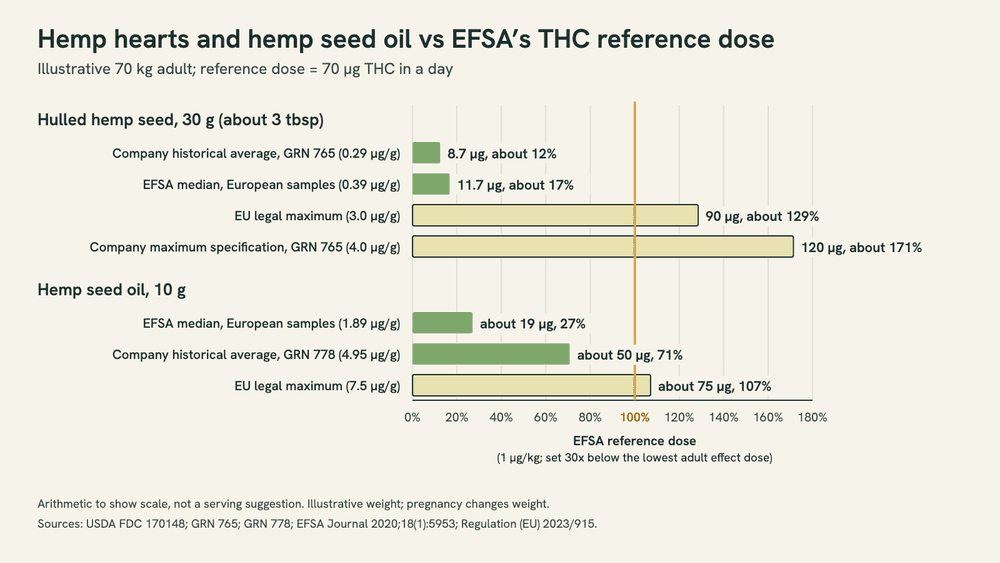
The yardstick is EFSA's acute reference dose, set in 2015 and restated in its 2020 report: 1 microgram of THC per kilogram of body weight in a day. EFSA started from 2.5 mg a day, the lowest dose at which adults showed effects on the central nervous system and heart rate, and divided by 30. Crossing that line is not the same as feeling anything; it means the margin regulators want is used up. No regulator in the documents we read has set a separate THC reference dose for pregnancy. Our guide to babies and hemp seeds uses the same method and inputs for infants and toddlers. Here the weight is 70 kg, EFSA's own reference adult, so the reference dose is 70 micrograms. USDA FoodData Central (entry 170148, hulled hemp seed) lists 3 tablespoons as 30 g.
| THC level in the seed | THC in 10 g (about 1 tbsp) | Share of 70 µg | THC in 30 g (about 3 tbsp) | Share of 70 µg |
|---|---|---|---|---|
| Company's historical average, GRN 765 (0.29 µg/g) | about 2.9 µg | about 4% | about 8.7 µg | about 12% |
| EFSA median, European samples before the EU limit (0.39 µg/g) | about 3.9 µg | about 6% | about 11.7 µg | about 17% |
| EU legal maximum (3.0 µg/g) | about 30 µg | about 43% | about 90 µg | about 129% |
| Company's maximum specification, GRN 765 (4.0 µg/g) | about 40 µg | about 57% | about 120 µg | about 171% |
Read both halves together. At typical measured levels, 30 g of hemp hearts is around a sixth of the reference dose for a 70 kg adult. At Europe's legal maximum, the same 30 g is above it, at about 129%. So the honest answer is "it depends on the batch", and a US bag carries no THC number and no legal ceiling. To rescale for your own weight, multiply the share by 70 and divide by your weight in kg: at 60 kg, 129% becomes about 150%. Because the reference dose has a 30-fold margin built in, reaching it is not the same as an effect. A product whose maker publishes a THC test result for each batch answers the question the bag cannot.
Hemp seed oil runs higher. Per 10 g of oil, the THC comes to about 19 micrograms at EFSA's median oil level (1.89 µg per g), or 27% of a 70 kg reference dose; about 50 micrograms at the company's historical average in GRN 778 (71%); and about 75 micrograms at the EU maximum (107%). The company's own intake table points the same way. At its maximum specification and a 90th-percentile intake of 14.07 g a day, hulled seed alone came to 0.0563 mg of THC, about 0.8 micrograms per kg for a 70 kg adult (our arithmetic). All three hemp ingredients together at maximum came to 0.1938 mg, about 2.8 micrograms per kg; using its historical data, 0.1049 mg, about 1.5. The company measured itself against a 5.4 mg medicine dose. Europe's yardstick is 1 microgram per kg. Both numbers are public, and they answer different questions.
EFSA's own worst case points the same direction. For the heaviest adult seed eaters at the most contaminated end of its samples, estimated intake reached 2.3 to 9 micrograms per kg, and EFSA says its estimates likely overestimate. Germany's Federal Institute for Risk Assessment (BfR), as summarized in the same EFSA report, concluded that eating hemp foods "can lead to an exceedance" of the reference dose, "in particular" for high consumers. Neither looked at pregnancy specifically, and both describe the market before Europe's 2023 ceiling.
Hemp seeds and drug tests at delivery
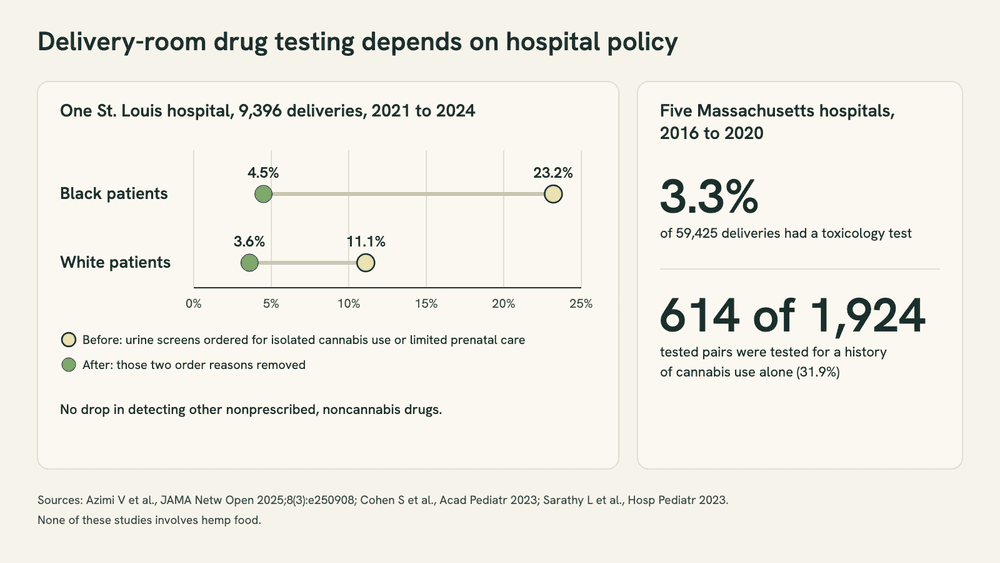
This is the part of the question almost no pregnancy guide mentions. Some hospitals test urine at delivery, and a positive result can lead to a report to child protective services. How often testing happens depends on the hospital. Across five Massachusetts hospitals from 2016 to 2020, toxicology testing was done in 3.3% of 59,425 deliveries, and younger, non-white and publicly insured patients were more likely to be tested. A study of 60,608 births in the same hospital network found that 1,924 parent-newborn pairs were tested, 614 of them (31.9%) for a history of cannabis use alone; 7 pairs (1.1%) had false positive results for unexpected substances, and only 1 result changed clinical care. Policy changes the numbers quickly: when one St. Louis hospital stopped ordering urine screens for isolated cannabis use, screening fell from 23.2% to 4.5% of Black patients and from 11.1% to 3.6% of White patients across 9,396 deliveries, with no drop in finding other drugs.
The clinical guidance has moved too. ACOG's Clinical Consensus No. 10, published in October 2025, replaced the American College of Obstetricians and Gynecologists' 2017 committee opinion on cannabis in pregnancy and lactation. It does not mention hemp foods. On testing, it says:
- "Biologic testing should not be used as a screening assessment for cannabis use." Routine use of urine or hair testing is "strongly discouraged."
- Patients should be counseled about the risks and benefits of drug testing, and "informed consent should be obtained before drug testing of the person or their newborn."
- Any positive screening result should be confirmed with a definitive test (gas or liquid chromatography with mass spectrometry).
- Clinicians should know the "procedural, social, and legal consequences" of a positive screen, including child protective services involvement.
Can hemp seeds themselves cause a positive? We found no published study of hemp foods and a delivery-room test, for the parent or the newborn (PubMed, November 10, 2026). The closest evidence is workplace testing. In a 2001 controlled study of hemp foods and urine drug tests, 15 adults ate set daily THC doses from hemp foods for 10-day stretches. No one was confirmed positive. At the highest dose, 0.6 mg of THC a day, one sample screened positive before confirmation, and the highest THC metabolite level measured by GC-MS in any sample was 5.2 ng/mL, against a 15 ng/mL confirmation cutoff. The authors equate 0.6 mg to about 300 g of hulled seed at 2 micrograms per gram, roughly ten times a 30 g portion at that level. The study is from 2001, the participants were not pregnant, and hospital tests do not all use workplace cutoffs. No one can guarantee a result. The full record is in our hemp seed oil and drug test guide.
Why a result matters: a federal law, the Child Abuse Prevention and Treatment Act (CAPTA), requires states that receive its funding to have health care providers notify child protective services when a newborn is identified as affected by substance exposure, and to develop a "plan of safe care" for the infant. The same law says that notification does not, by itself, establish a federal definition of abuse or neglect or require prosecution. What triggers a report is set by each state and hospital; how custody and child-welfare rules differ by state is covered separately. Put together, the step the documents support is plain: tell your prenatal care team what you eat, hemp foods included, and ask how your hospital handles drug testing at delivery. ACOG's guidance says testing should come with your informed consent and that a positive screen should be confirmed.
Hemp seeds while breastfeeding: what LactMed and MotherToBaby say
Readers search LactMed by name for a reason: it is the federal database clinicians use to check medicines and substances in breast milk. It has no entry for hemp seed or hemp seed oil (searched November 10, 2026). Its Cannabis record, revised October 15, 2026, mentions seeds exactly once: they are "reportedly used orally to increase milk production in Türkiye, but no valid scientific data exist for this use." That is the whole federal lactation record on eating the seed. The rest of the record is about cannabis use, not food: THC in milk has been detected from 6 days to more than 6 weeks, it flags "the possibility of positive urine tests in breastfed infants, which might have legal implications", and it notes that professional guidelines recommend nursing mothers avoid cannabis.
The only estimate we found for hemp food and breast milk is the company's model in its 2018 notices. With a mother eating the maximum of all three hemp products at their maximum inclusion levels, it put THC in milk at 0.17 to 0.34 micrograms per liter and a nursing baby's intake at 0.05 to 0.09 micrograms per kg a day. That is 5% to 9% of EFSA's reference dose (our comparison, not the company's). It is a model, not a measurement, and its milk-to-blood ratio rests on one paired sample from a woman who smoked cannabis about seven times a day. We found no measurement of human breast milk after hemp food.
MotherToBaby's marijuana fact sheet, from the nonprofit teratogen information service and dated May 1, 2025, does not mention hemp seed foods. It does note that CBD products labeled "THC free" "might still contain a measurable amount of THC." For a personal question about your own diet, its specialists answer by phone, text, chat or email at no cost. CBD oil while nursing is a separate question, covered in what FDA and ACOG say about CBD during pregnancy and breastfeeding.
Hemp hearts, hemp seed oil, hemp milk and CBD oil are four different things
| Product | Made from | THC reference point | What pregnancy and lactation documents say |
|---|---|---|---|
| Hemp hearts (hulled seed) | Seed with the hard shell removed | EU ceiling 3.0 mg/kg for hemp seeds; EFSA median 0.39 mg/kg | FDA's 2019 trace-amount sentence; GRN 765 modeled breastfeeding, not pregnancy |
| Hemp seed oil | Whole seed, cold pressed | EU ceiling 7.5 mg/kg; EFSA median oil sample about five times the seed median | GRN 778 has the same scope; no pregnancy model |
| Hemp milk | Seed blended with water, usually with other ingredients | No THC figure in the sources we read; the EU seed ceiling does not carry over to a mixed drink | No document addresses it |
| CBD oil | Extract of the flowers and leaves | Cannabinoids are the point of the product | FDA "strongly advises against" CBD, THC and marijuana in any form |
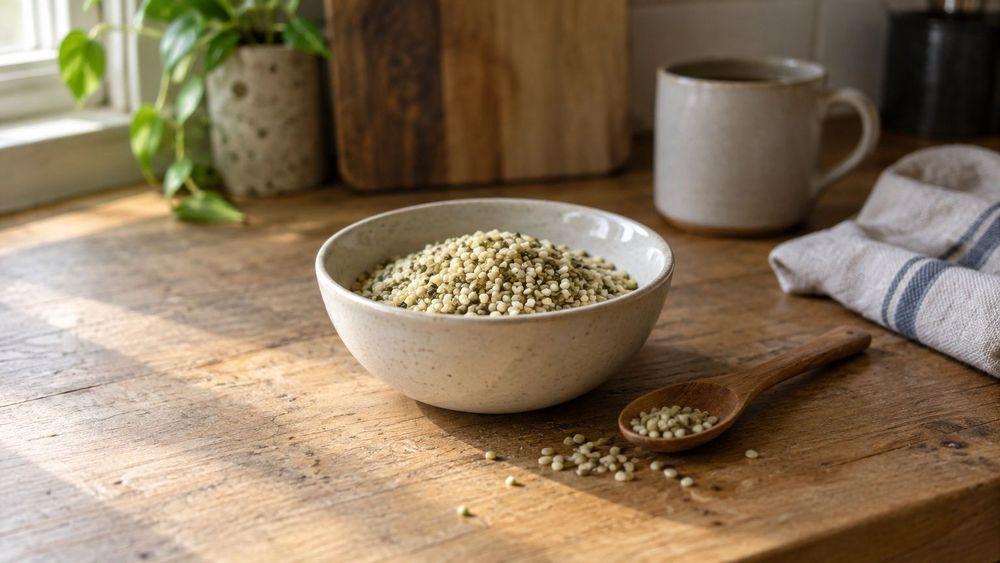
Hemp hearts are the soft inner kernel; composition and the adult allergen list are in our side-by-side guide to hemp hearts and chia. Hemp flour and hemp seed butter are ground seed and sit in the same row. Hemp seed oil is pressed from the seed, like flaxseed oil; FDA's GRN 778 letter, summarizing the company's notice, describes whole seeds that are "cold pressed" and THC that "comes from contact between the seeds and cannabinoid-containing resins from other plant parts". It is not CBD oil, a difference laid out in hemp seed oil vs CBD oil. Hemp milk is a multi-ingredient drink, so Europe's seed ceiling does not carry over to it; how it compares with other plant milks is in our hemp milk and oat milk comparison.
CBD oil is the one with a direct answer. On the same 2019 page, FDA writes that it "strongly advises against the use of cannabidiol (CBD), tetrahydrocannabinol (THC), and marijuana in any form during pregnancy or while breastfeeding." A label that says CBD, "full spectrum" or "hemp extract", or lists milligrams of cannabinoids, belongs in that row, not the seed-food rows, whatever the front of the package suggests.
A checklist built from the documents
None of these is a hemp-specific pregnancy rule, because none exists. Each line traces to a named document above.
- 1Check what kind of product it is. A seed food (hearts, flour, seed butter, seed oil, hemp milk) is a different thing from a CBD or hemp-extract product, which FDA advises against in pregnancy and breastfeeding (FDA consumer update, 2019).
- 2Tell your prenatal care team what you eat, hemp foods included, and ask how your hospital handles drug testing at delivery. ACOG says testing needs informed consent and a positive screen needs confirmation (ACOG, October 2025).
- 3If you are nursing, know that LactMed has no hemp seed entry and finds "no valid scientific data" for seeds and milk supply. For a personal answer, ask MotherToBaby (LactMed, October 2026; MotherToBaby, 2025).
- 4If you buy hemp seed foods, prefer a maker that publishes a THC test result for each batch. In the US it is the only way to see where a bag sits in the arithmetic above (Regulation (EU) 2023/915; EFSA 2020).
What nobody has measured yet
The record is thin, and it should be weighed as thin. We found no human study of hemp seed foods in pregnancy or breastfeeding, the one reproductive study is in rats on an all-hemp-seed diet, and the breast-milk figures are one company's model. We also found no study of hemp food and perinatal drug tests, and the delivery-testing data come from six hospitals in two states. The United States has no THC limit for a hemp seed food and no requirement to print one. None of that shows harm. It means the question is open, and the people best placed to weigh it with you are your prenatal care team.
Frequently asked questions
No study has tested hemp seed foods, hemp hearts included, in pregnant people, so no one can answer that with data. FDA's consumer update, dated October 16, 2019, says the trace THC and CBD in hemp seeds are "low enough to not raise concerns for any group, including pregnant or breastfeeding mothers." That sentence gives no number, and the company file behind it set pregnancy aside. The THC level depends on the batch, so tell your prenatal care team what you eat.
We found no study of hemp food and a delivery-room test. In a 2001 controlled workplace study, no one was confirmed positive at up to 0.6 mg of THC a day from hemp foods, though one sample screened positive at that dose. No one can guarantee a result. ACOG's 2025 guidance says testing needs informed consent and positive screens need a definitive confirmation test.
LactMed has no hemp seed or hemp seed oil entry, and its cannabis record (revised October 15, 2026) says the seed's reported use for milk supply has "no valid scientific data". The only breast-milk estimate is the hemp company's own model, not a measurement. For a personal question, MotherToBaby answers for free.
No. Hemp seed oil is pressed from the seed and carries trace THC from the rest of the plant, more than the seed does (Europe caps the oil at 7.5 mg per kg against 3.0 for seeds). CBD oil is a flower and leaf extract, and FDA strongly advises against CBD in any form during pregnancy or breastfeeding.
No. In December 2018 FDA answered three GRAS notices for hulled hemp seed, hemp seed protein powder and hemp seed oil with "no questions" letters, which state that they are not an affirmation that the ingredient is GRAS. The intake estimates they summarize cover people aged 2 and older, and the letters do not mention pregnancy or breastfeeding.
A trace. According to FDA, hemp seeds do not naturally contain THC but pick it up from other plant parts during harvest and processing. Europe caps hemp seeds at 3.0 mg of THC equivalents per kg; the United States sets no number for a finished hemp seed food.
No document we read addresses hemp milk in pregnancy, and we found no THC figure for it. It is made from the seed, not a flower extract, and Europe's 3.0 mg/kg ceiling covers products made only from hemp seed, so it does not apply to a multi-ingredient hemp milk.
This page covers hemp seed foods in pregnancy and breastfeeding only. For what hulled hemp seed actually contains and how it compares with chia, read our hemp hearts and chia seeds breakdown. If your question is about CBD or THC products rather than food, our CBD pregnancy and breastfeeding guide covers it.
Writing about hemp, wellness and the small rituals that keep us balanced.