How to Eat Hemp Seeds: Whole vs Hulled, Heat and Storage
Hemp hearts eat straight from the bag; whole hemp seeds usually need grinding or toasting. What heat measurably does to hemp seed fat, how to store them, what a label serving means, and simple ways to use both forms.
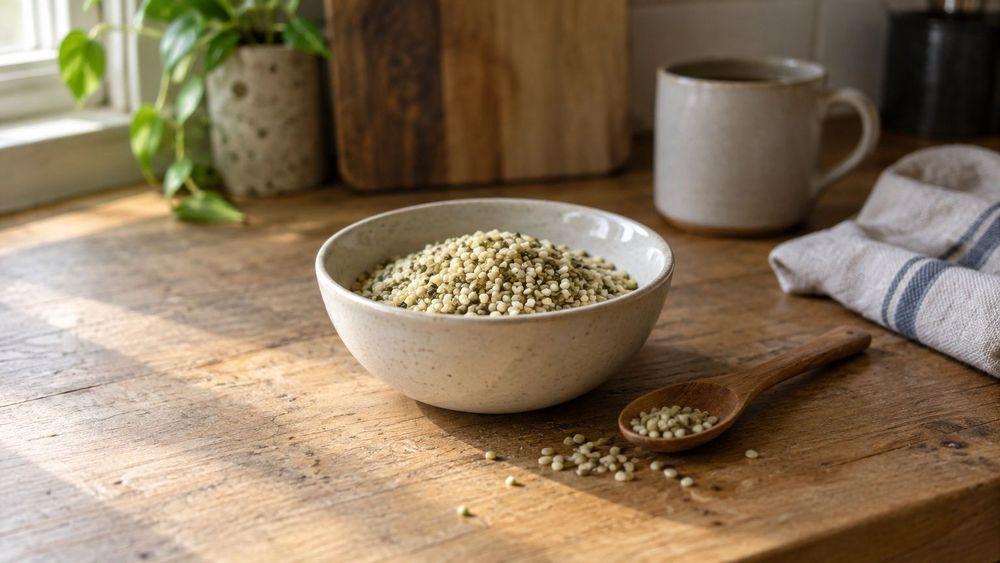
How to eat hemp seeds depends first on which kind you bought. Hulled hemp seeds, sold as hemp hearts, are ready to eat straight from the bag: sprinkle them on food, blend them, or stir them in after cooking. Whole hemp seeds still have a hard shell, so most people grind or toast them first. Either way, the fat inside is the delicate part. Heat, air, light and warmth wear it down, which is why short toasting, adding seeds after cooking and refrigerating an open bag are worth the trouble.
Most guides to this question are recipe lists that repeat the same lines without a source: "no prep needed", "heat-stable", "1 to 3 tablespoons a day". We went the other way. This page starts from the form you have in your hand, gives the measured result of what roasting does to hemp seed, shows what a serving on a label actually means (and why it is not a target), covers the trace of THC and drug tests that most recipe pages skip, and then gives you a set of simple ways to use the seeds. Sources were read on November 17, 2026. For the full nutrition breakdown, nutrient by nutrient, see our comparison of hemp hearts and chia seeds. Nothing here is a health claim or a recommended daily amount.
Whole hemp seeds vs hemp hearts: start with what you bought
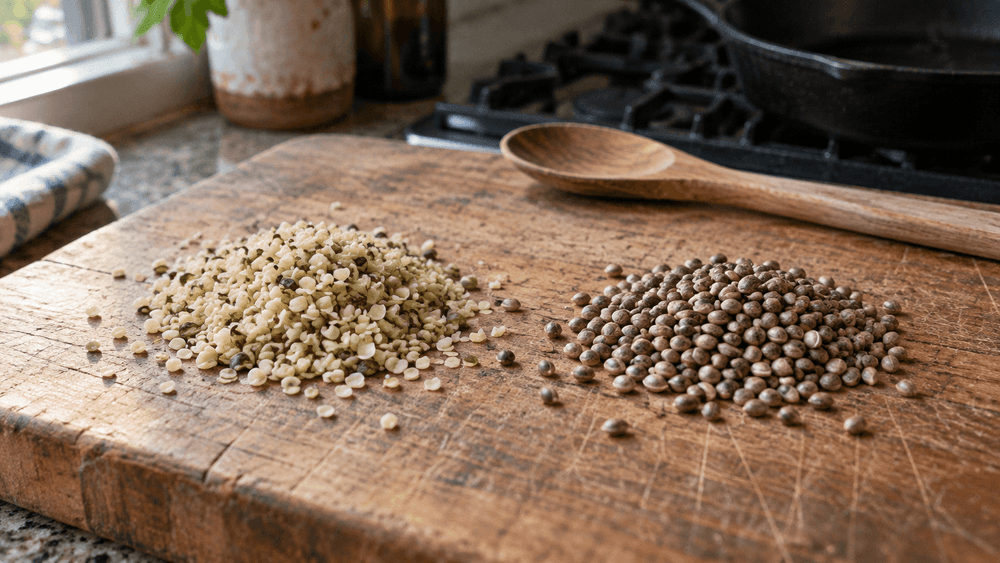
Whole hemp seed and hemp hearts are close to being different foods. The shell is mostly fiber, and it is tough. One analysis compiled in a 2020 review of hemp seed nutrition in Nutrients measured 33.8 g of total fiber per 100 g of whole seed, 30.9 g of it insoluble; a second whole-seed sample in the same table, from the Finola cultivar, came in at 27.6 g. USDA FoodData Central (entry 170148) lists hulled hemp seed at 4.0 g. Take the shell away and what is left is denser in fat and protein: a 2010 analysis of 30 commercial hemp products found whole seed about 24% protein and 30% fat, and dehulled seed about 36% and 47%. In the same paper, a digestibility test in rats found that removing the hull improved how well the protein was digested. That was an animal assay on 2010 Canadian samples, and one co-author worked in the hemp food sector, so read the scores as a comparison between the two forms, not a verdict on either.
| Whole hemp seed | Hulled hemp seed (hemp hearts) | |
|---|---|---|
| What it is | The seed in its hard, glossy grey-brown shell | The soft inner kernel, shell removed |
| Fiber per 100 g | About 34 g, almost all insoluble (one analysis) | 4.0 g (USDA) |
| Protein and fat | About 24% protein, 30% fat | About 36% protein, 47% fat (USDA: 31.6 g and 48.75 g per 100 g) |
| Protein score (PDCAAS, rat assay) | 49-53% | 63-66% |
| Texture raw | Hard and gritty; shell fragments stick in your teeth | Soft, slightly chewy, mild and nutty |
| Prep before eating | Usually ground or toasted | None; ready to eat |
| Best uses | Toasted snack, ground into baking, blended and strained | Toppings, smoothies, dressings, anything no-cook |
Can you eat hemp seeds raw?
Yes. Hemp hearts are sold to be eaten raw, and that is how most people use them. When the FDA reviewed hulled hemp seed as a food ingredient in 2018, the company behind the filing described it as used "in a similar way to" linseed, poppy seed, sesame seed, sunflower seed, chia seed and mustard seed, according to the FDA's response letter on dehulled hemp seed (GRN 765). In other words, treat hemp hearts like any small seed you would scatter on a salad. The FDA said it had "no questions" about that notice, which is not the same as an approval, but it does tell you how the ingredient is meant to be used.
Whole seeds are also edible raw, but the experience is different: the shell is hard, the bits get stuck in your teeth, and you take in a large dose of insoluble fiber. Two easy fixes are grinding them in a spice or coffee grinder, or toasting them so the shell turns crisp. You may read that grinding "improves absorption". We found no human study that tested this for hemp seed, so we do not repeat it. The honest reason to grind whole seeds is texture.
Raw, toasted or roasted hemp seeds: what heat actually does
Start with why heat matters at all. USDA's entry for hulled hemp seed lists 48.75 g of fat per 100 g, and 38.1 g of that is polyunsaturated, mostly linoleic acid (27.4 g) and alpha-linolenic acid (8.7 g). Polyunsaturated fats have several double bonds in their chains, and those are the spots where oxygen attacks. That makes them more prone to oxidation than saturated or monounsaturated fats, and it is why heat, which speeds up oxidation, deserves attention.
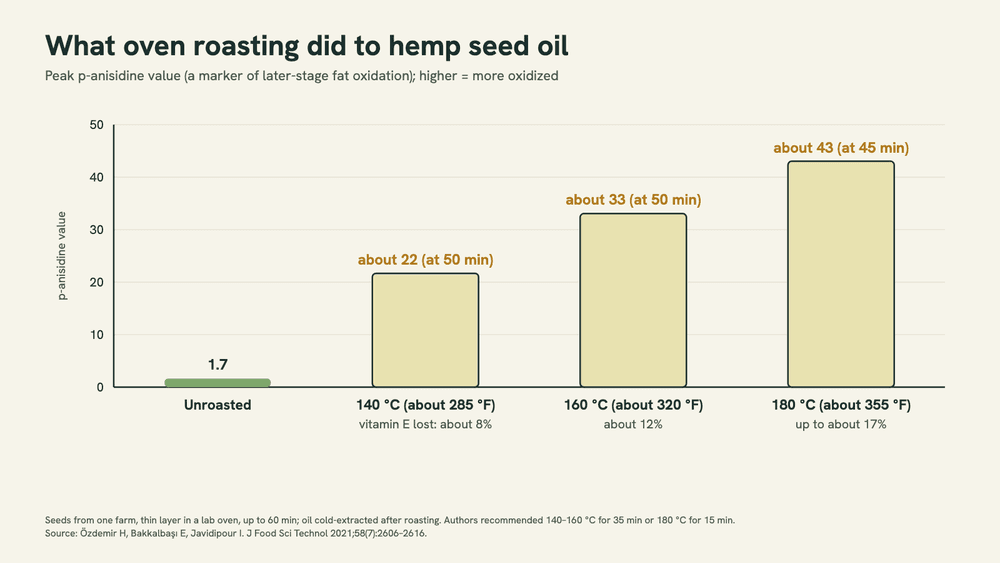
Some pages call hulled hemp seeds "heat-stable". The best measurement we found says otherwise. In a 2021 study of roasting and the oxidative stability of hemp seed oil, food scientists in eastern Turkey, where roasted hemp seed is eaten as a snack, spread seed from one farm in a thin layer and roasted it in a lab oven at 140, 160 and 180 °C (about 285, 320 and 355 °F) for up to an hour. Then they extracted the oil and tested it. The paper does not say whether the seeds were hulled; their measured oil and protein content matches whole seed, so these were probably whole seeds. Here is what moved:
The p-anisidine value counts aldehydes, compounds that form in a later stage of fat oxidation. It peaked at about 22 at 140 °C, about 33 at 160 °C and about 43 at 180 °C, against 1.7 in unroasted seed. A second marker, the peroxide value, stayed low throughout (1.33 to 3.09 meq O2/kg). That does not mean roasting left the fat alone: peroxides are the first products of oxidation, and at roasting temperatures they break down into the aldehydes the first test counts. The same study measured total phenolic compounds rising with heat, by up to 160% at 180 °C. That is a lab reading recorded next to the oxidation and the vitamin E loss, not evidence that roasted seeds are better for you. The authors' own conclusion was practical: "roasting at 140-160 °C for 35 min or at 180 °C for 15 min are recommended to provide good quality roasted hemp seed." One batch of seed in a lab oven is not your skillet, but it answers the heat question with a measurement: heat changes hemp seeds, and more heat for longer changes them more.
Flavor follows the same curve. A 2025 Korean study of oven-roasted hemp seeds roasted 30 g batches at 140, 160 and 180 °C for 3 to 12 minutes and tracked taste and aroma with electronic sensors. The authors report that sweet, roasty compounds (pyrazines) rose with heat, fresh, lemony and herbal terpene notes faded with time, color darkened past about nine minutes, and bitterness "tended to increase sharply when roasted at 180 °C". The authors' best windows for a sweet flavor were 9 to 12 minutes at 140 °C, 6 to 12 minutes at 160 °C, or 6 minutes at 180 °C. These were instruments, not human tasters, and one seed lot, but the pattern matches what a pan tells you: there is a short window between nutty and bitter.
How to toast hemp seeds in a pan
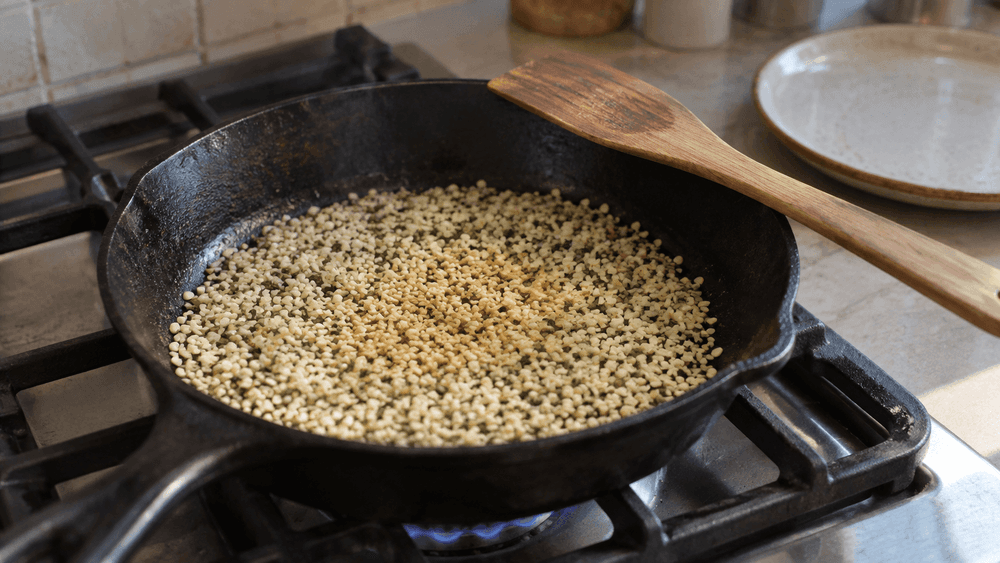
- 1Use a dry, heavy skillet with no oil, over medium-low heat, and let it warm for a minute.
- 2Add the seeds in a single thin layer. A crowded pan toasts unevenly, with some seeds raw and some scorched.
- 3Stir or shake the pan constantly. Hemp hearts are small and soft and go from pale to burnt quickly; whole seeds take a little longer and may pop.
- 4Take them off the heat when they smell nutty and turn a shade darker, usually within a few minutes. If they look brown or smell sharp, they went too far.
- 5Tip them straight into a cool bowl or onto a plate. A hot pan keeps cooking them.
- 6Toast small batches as you need them. Roasting already raised the oxidation marker in the lab study, so there is little reason to give that fat extra days on the shelf.
If you roast a tray of whole seeds in the oven instead, the 2021 authors' own limits for a good-quality roast are a useful ceiling: up to 35 minutes at about 285 to 320 °F, or no more than 15 minutes at about 355 °F. A home oven runs hotter or cooler than its dial, so check the color early. Cooking with hemp seed oil is a separate question with its own studies, covered in our guide to hemp seed oil as food.
How to eat hemp seeds: simple ways and what each one changes
You do not need elaborate hemp seed recipes so much as a sense of what each method does to the seed. The no-heat uses keep the soft texture and mild flavor; the heated ones trade some of the fat's freshness for crunch and a roasted taste. Hemp hearts work for everything below; whole seeds work best toasted, ground or strained out.
| Use | How | What changes |
|---|---|---|
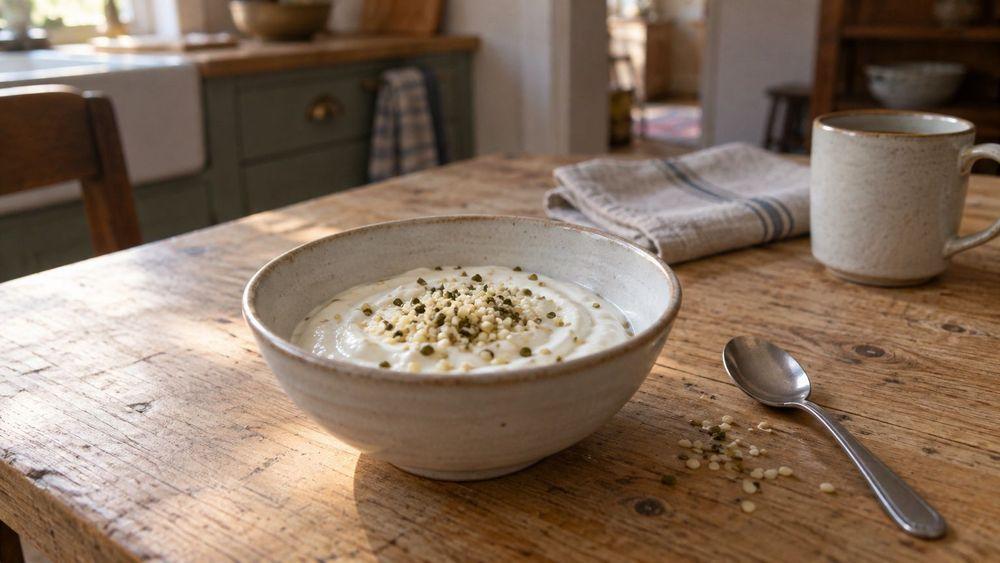
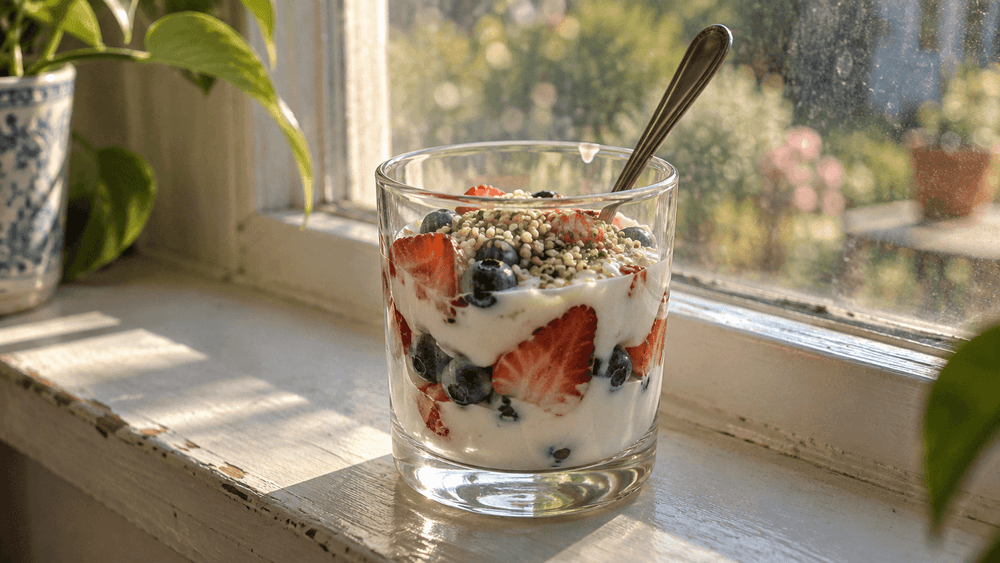
| Topping (yogurt, oatmeal, salad, toast, fruit) | Sprinkle hemp hearts on just before eating | No heat; softest texture, mildest nutty flavor |
| Smoothie | Blend hearts in with the other ingredients | Adds body and a nutty note; whole seeds leave grit, so hearts blend smoother |
| Stirred into hot food (soup, rice, grain bowls, pasta) | Add off the heat or at the table, after cooking | Brief warmth rather than cooking temperatures; keeps the raw texture |
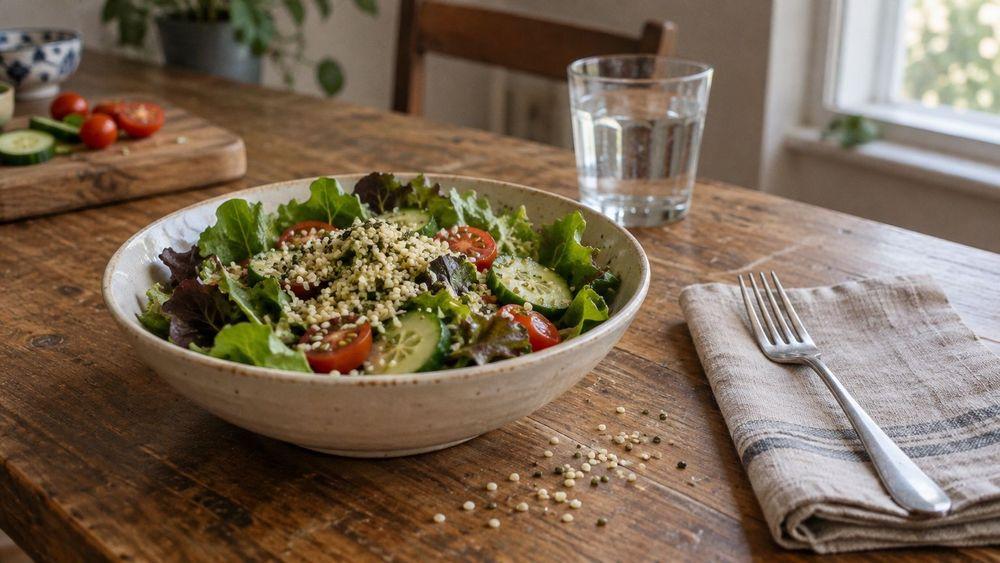
| Dressings and sauces | Blend hearts into a vinaigrette, pesto or tahini-style sauce | No heat; makes a sauce creamier; use within a few days |
| Toasted topping or snack | Dry pan, steps above | Crunchier and nuttier; heat raises fat oxidation and lowers vitamin E with time and temperature |
| Baked (muffins, bread, granola, crackers) | Mix into batter or dough, or press onto the top | Seeds inside a batter stay well below the oven's setting; seeds on top of granola or a crust get the most direct heat |
| Hemp milk | Blend with water; strain if you used whole seeds | Becomes a perishable drink; keep it cold |
| Hemp seed butter | Grind hearts, raw or lightly toasted, into a paste | Grinding exposes more of the fat to air; keep it in the fridge |
| Hemp flour | Ground seed or seed meal used in baking | Denser, higher in fiber; the FDA reference amount for seed flours is 15 g, half that of seeds |
Three of those uses have their own guides. If you want to make or buy a dairy-free drink, see how hemp milk compares with oat milk. For a spread, our hemp seed butter guide covers what it is and how it is made. For baking, what hemp flour is and how it behaves in recipes explains why it acts differently from wheat flour.
How much is a serving? What the label actually says
Pages on this topic often say "1 to 3 tablespoons a day" without a source. We could not find one, so here is what can be checked instead. Under the FDA's reference amounts for Nutrition Facts labels (21 CFR 101.12), the reference amount for "nuts, seeds and mixtures, all types" is 30 g. Seed flours are 15 g and seed butters 2 tablespoons. That is the size a label serving is built around, not a recommendation to eat that much.
Manitoba Harvest, one widely sold US brand, lists a serving of its hemp hearts as 3 tablespoons (30 g), with 180 calories, 15 g of fat (12 g of it polyunsaturated), 10 g of protein and 1 g of fiber, and about 15 servings per bag (the maker's Nutrition Facts panel, read on November 17, 2026). So 1 tablespoon is roughly 10 g. That is how a serving is defined on the bag, not how much anyone should eat. Whole seeds are a different case: in the analysis above, about a third of their weight was fiber. MedlinePlus, the National Library of Medicine's health encyclopedia, notes that eating a lot of fiber in a short time can cause gas, bloating and cramps, and that "adding fiber to the diet slowly, instead of all at one time, can help reduce gas or diarrhea."
How to store hemp seeds so they don't go rancid
Yes, hemp seeds go bad, and the reason is the same polyunsaturated fat that makes heat matter. No one has published a shelf-life study of hulled hearts in a kitchen cupboard (our PubMed search on November 17, 2026 found none), but the oil inside them has been tested. In a 2024 study of cold-pressed hempseed oil stored for 270 days, researchers compared 25 °C (77 °F) under diffused light with 10 °C (50 °F) in the dark, across four kinds of packaging. They describe the oil as "extremely rich in unsaturated fatty acids" with "high sensitivity to oxidative and photo-oxidative degradations that can lead to rancidity", and the cool, dark, light-blocking combination protected it best. Seeds keep their fat inside a kernel, so they are not the same as bottled oil, but the direction is clear: cold, dark and sealed.
- Buy a size you will finish. Check the best-by date and do not stock up far ahead.
- Keep the bag sealed, away from the stove and sunny windows. An opaque, airtight container is better than a clear jar on the counter.
- Refrigerate after opening. The maker of the brand above advises storing its products in the fridge once opened "to extend the freshness".
- For a long hold, the freezer follows the same logic (colder and darker). That is our inference; no study has tested frozen hemp seeds.
- Grind, toast or blend in small batches. Breaking the seed open exposes more of its fat to air.
- Smell before you use them. A sharp, bitter or paint-like smell means the fat has gone rancid, so throw them out. A normal nutty smell is not proof of freshness: the first products of fat oxidation have no smell.
Do hemp seeds have THC, and can they affect a drug test?
Hemp seeds will not get you high. The FDA's page on cannabis and cannabis-derived products says the seeds "do not naturally contain THC or CBD", and in the next sentence that hemp seed ingredients "contain only trace amounts", picked up from the rest of the plant during harvest and processing, and that eating them "is not capable of making consumers 'high.'" So the honest word is trace, not zero. The company behind the 2018 hulled-seed filing set its own ceiling of 4 mg of THC per kg of seed, counting THCA; that is one company's specification, not a federal limit, and the US sets no THC number for a finished hemp seed food. Heat adds one more unknown: heat can turn THCA into THC, and when German researchers heated one hemp seed oil for an hour at 200 °C, its delta-9 THC rose 22%. We found no study measuring the same thing in toasted seeds.
On drug tests, the best-known controlled test is a 2001 study of hemp foods and workplace urine tests. Fifteen adults took set daily THC doses, in blends of hemp and canola oil chosen to match THC levels then found in hemp seed products, for four ten-day stretches. None who took 0.45 mg a day screened positive; at 0.6 mg a day, one sample screened positive at the 50 ng/mL cutoff, and no one was confirmed positive (the highest metabolite level, 5.2 ng/mL, was well below the 15 ng/mL confirmation cutoff). The authors equated 0.6 mg a day to about 300 g of hulled seed at the THC levels then typical, roughly ten label servings. That was 2001 product, the lead author consulted for the hemp sector, and THC in seeds varies by lot, so it describes a small risk, not an absent one. Cutoffs and confirmation testing are explained in our guide to hemp seed oil and drug tests, and the THC arithmetic for hemp hearts is worked out in our review of hemp hearts side effects. Hemp seeds are also a food, not a CBD product; how hemp seed oil differs from CBD oil covers that distinction.
Who should check before eating hemp seeds
A few groups should check before adding hemp seeds to meals. Allergy comes first: hemp is not on the FDA's list of nine major food allergens, so a label does not have to carry an allergen warning for it, yet allergic reactions to hemp seed have been reported, including a published case of anaphylaxis after eating hempseed. We found no published figure for how common that is.
- People with a cannabis or seed allergy. Ask an allergist before trying hemp seeds; our side effects review linked above covers the reported reactions.
- Parents of babies and toddlers. Smaller bodies change the THC arithmetic, and this page offers no serving ideas for them. See whether babies and toddlers can eat hemp seeds.
- Pregnant or breastfeeding readers. Tell your prenatal care team about hemp foods; our guide to hemp seeds during pregnancy covers THC and delivery-room testing.
- Anyone with a sensitive gut, or who has trouble swallowing. Whole seeds are roughly a quarter to a third fiber by weight, in a hard shell. Add them slowly or choose hearts, and ask a clinician if small hard pieces are hard for you to swallow.
What nobody has measured yet
The kitchen advice on hemp seeds rests on a thin record, and it is worth knowing where the gaps are. As of November 17, 2026, we found no published study tracking how long a bag of hulled hearts stays fresh in a home pantry or fridge; the storage advice rests on the chemistry of the oil inside them. Only two studies we found measured roasting of the seed itself, each with a single seed lot in a lab oven, and neither used a home skillet. The flavor study used electronic sensors, not people. We found no study of whether toasting changes the THC in seeds. And we found no human study showing that grinding changes what your body gets from hemp seed. None of that makes hemp seeds risky. It means the confident lines repeated across recipe pages, the "1 to 3 tablespoons", the "heat-stable", the exact THC percentage, sound more certain than the evidence behind them.
Frequently asked questions
Yes. Hulled hemp seeds (hemp hearts) are sold ready to eat and are used like sesame or chia seeds. Whole hemp seeds are edible raw too, but the shell is hard, gritty and high in insoluble fiber, so most people grind or toast them first.
Not hemp hearts; they are already soft. Grinding whole seeds makes the shell easier to eat. We found no human study showing that grinding changes how your body absorbs hemp seed, so the reason to grind is texture. Grind small batches, because breaking the seed open exposes more of its fat to air.
Yes, but heat changes them. In a 2021 roasting study, a marker of fat oxidation rose from 1.7 to about 43 and up to about 17% of vitamin E was lost at the hottest setting (180 °C, about 355 °F). The authors' limits for a good-quality roast were 35 minutes at 140 to 160 °C or 15 minutes at 180 °C. When you want the raw texture and flavor, add the seeds after cooking.
Use a dry, heavy pan over medium-low heat, spread the seeds in one thin layer and stir constantly. Take them off as soon as they smell nutty and turn a shade darker, usually within a few minutes, and tip them onto a cool plate. In lab tests, bitterness rose sharply at 180 °C, so lower heat is the safer bet for flavor.
The FDA's reference amount for seeds on a Nutrition Facts label is 30 g, and one widely sold brand lists a serving of hemp hearts as 3 tablespoons (30 g). That defines a serving for labeling; it is not a recommendation for how much to eat each day.
Yes. About three quarters of their fat is polyunsaturated, which oxidizes and turns rancid with air, light and warmth. Keep the bag sealed and away from heat, refrigerate it after opening as the maker of one major brand advises, and smell before using. A sharp, bitter or paint-like smell means the fat has gone off and the seeds should be thrown out; a normal smell does not prove they are fresh, because the earliest oxidation products have no smell.
They will not make you high; the FDA says hemp seed ingredients are not capable of it. They can carry trace THC, though. In a 2001 controlled study, one urine sample screened positive at a THC dose the authors equated to about 300 g of hulled seed a day, and no one was confirmed positive. THC varies by lot, no bag can guarantee a result, and the US military prohibits hemp foods for service members.
Next step: now that you know how to use them, see what is actually in hemp hearts. Our comparison of hemp hearts and chia seeds puts the protein, fat, fiber, omega-3 and allergen numbers side by side, from USDA data.
Writing about hemp, wellness and the small rituals that keep us balanced.