Hemp Hearts vs Chia Seeds: Protein, Omega-3 and Fiber
Hemp hearts are the protein and mineral seed; chia is the fiber and omega-3 seed. Here is each on the same 30 g serving from USDA data, what the fats really are, how good hemp protein is, and the THC questions other comparisons skip.
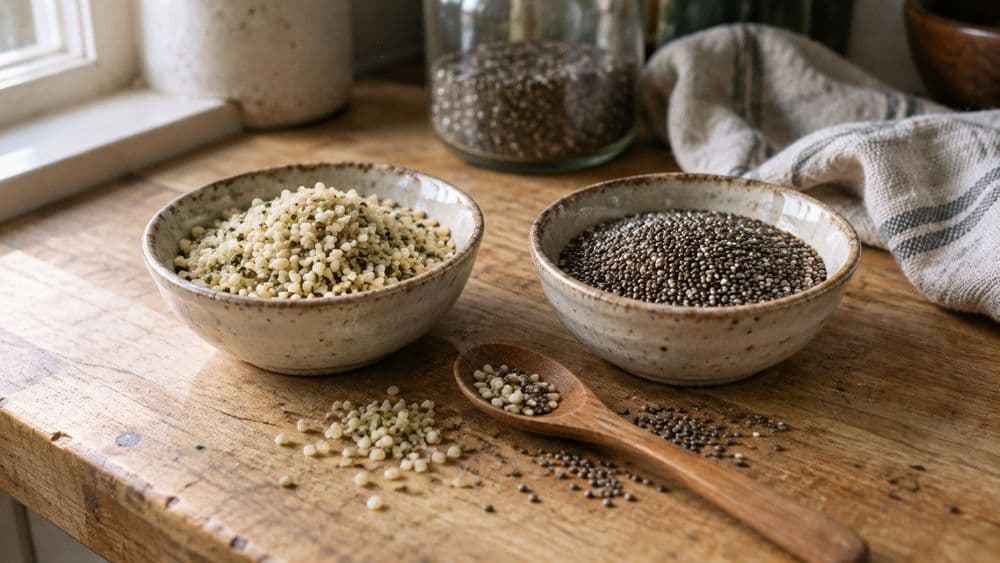
Hemp hearts vs chia seeds is less a contest than a division of labor: the two end up in the same breakfast bowls, but they do different jobs. Per 30 grams (about 3 tablespoons), hemp hearts carry 9.5 grams of protein and half the Daily Value for magnesium. Chia carries 10.3 grams of fiber, more than eight times as much, and about twice the plant omega-3, ALA. Chia gels in liquid; hemp hearts stay soft and separate. Neither one is fish oil, and neither one is a CBD product.
That is the short answer, and every number in it comes from the U.S. Department of Agriculture's own composition data, put on one serving size. That matters more than it sounds. The comparison pages that rank for this question today mix a 28-gram ounce and a 30-gram serving in the same table, and at least one appears to count a fat called GLA, which is an omega-6, toward hemp's omega-3. Below you get the full side-by-side, what the fats actually are, how good hemp protein is by the standard scoring method, why chia turns to gel, and the three questions only hemp raises: THC, drug tests and legality. Nothing here is a health claim. It is food composition, meant to help you pick the right seed for the job.
What are hemp hearts?
A hemp heart is a hemp seed with its hard outer shell removed. The seed comes from Cannabis sativa grown as hemp; once it is cracked and the seed coat is taken off, what is left is the soft, cream-and-green kernel sold as hemp hearts or hulled hemp seed. In December 2018 the FDA responded to three GRAS notices for hemp seed ingredients, and for one of them, hulled hemp seed from a Canadian company, Fresh Hemp Foods, the agency wrote that it had "no questions at this time" about the company's conclusion that the ingredient is generally recognized as safe (GRAS) under its intended uses. That letter is not an approval, and the agency says so in the same paragraph: it "is not an affirmation that dehulled hemp seed is GRAS." One detail in the filing is useful here. The company itself expected hulled hemp seed to be used "in a similar way to linseed, poppy seed, sesame seed, sunflower seed, chia seed, and mustard seed." So hemp hearts versus chia is not an odd pairing. It is the comparison the ingredient was filed for.
Hemp hearts are mostly fat and protein. The company's filing put hulled hemp seed at 48% to 54% fat and 31% to 38% protein, with about 4.6% fiber and 3.4% carbohydrate. USDA's own entry lands inside those ranges: 48.75 grams of fat and 31.56 grams of protein per 100 grams. Taking the hull off changes the seed a lot. In a 2010 study of 30 commercial hemp products from Western Canada, whole hemp seed averaged 24.0% protein and 30.4% fat, while dehulled seed averaged 35.9% protein and 46.7% fat. Most of the fiber leaves with the shell. Hemp hearts are only one of the crop's food uses; our overview of what hemp is used for, from seed to fiber covers the rest.
Hemp hearts vs chia seeds, side by side (per 30 g)
Every number in the table comes from USDA FoodData Central, entry 170148 ("Seeds, hemp seed, hulled") and entry 170554 ("Seeds, chia seeds, dried"), scaled to 30 grams. We used 30 grams because it is the FDA's reference serving for nuts and seeds, the amount nutrition labels are built around. It also happens to be about three level tablespoons of either seed: USDA lists 3 tablespoons of hemp hearts as 30 grams, and its chia portion data (1 cup = 168 grams) works out to about 10.5 grams per tablespoon. The % Daily Value figures use the FDA's current Daily Values for nutrition labels.
| Per 30 g (about 3 tbsp) | Hemp hearts | Chia seeds |
|---|---|---|
| Calories | 166 kcal | 146 kcal |
| Protein | 9.5 g (19% DV) | 5.0 g (10% DV) |
| Total fat | 14.6 g (19% DV) | 9.2 g (12% DV) |
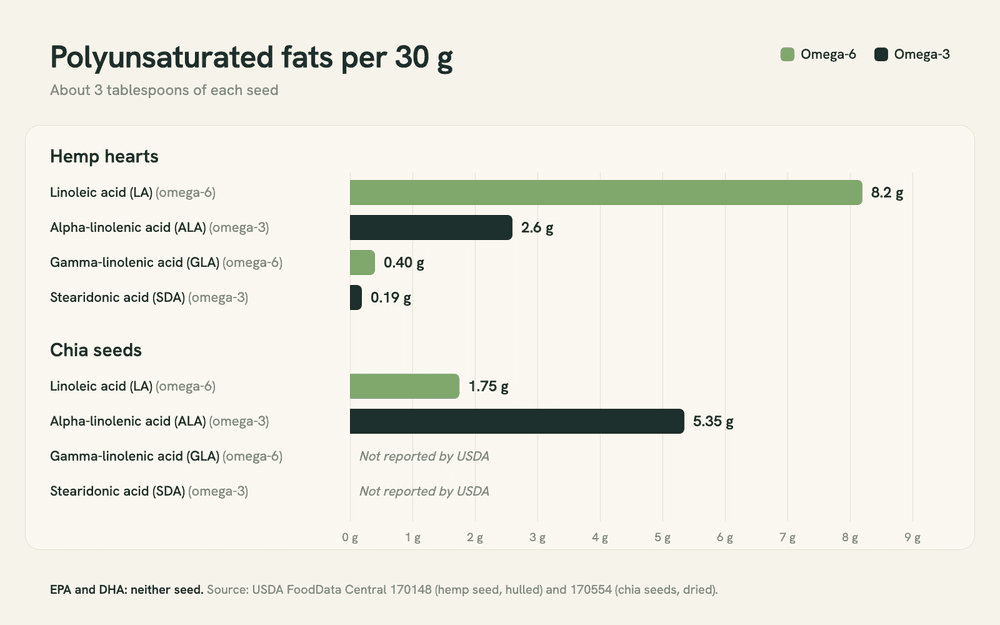
| Linoleic acid (LA, omega-6) | 8.2 g | 1.75 g |
| Alpha-linolenic acid (ALA, omega-3) | 2.6 g | 5.35 g |
| GLA (omega-6) | 0.40 g | Not reported |
| SDA (omega-3, USDA's PUFA 18:4) | 0.19 g | Not reported |
| Omega-6 to omega-3 (LA:ALA) | About 3.2 to 1 | About 1 to 3 |
| Carbohydrate | 2.6 g | 12.6 g |
| Dietary fiber | 1.2 g (4% DV) | 10.3 g (37% DV) |
| Magnesium | 210 mg (50% DV) | 101 mg (24% DV) |
| Phosphorus | 495 mg (40% DV) | 258 mg (21% DV) |
| Zinc | 3.0 mg (27% DV) | 1.4 mg (12% DV) |
| Iron | 2.4 mg (13% DV) | 2.3 mg (13% DV) |
| Calcium | 21 mg (2% DV) | 189 mg (15% DV) |
| Manganese | 2.3 mg (99% DV) | 0.8 mg (36% DV) |
| Potassium | 360 mg (8% DV) | 122 mg (3% DV) |
Three things to know when you read it. First, these are USDA composite values, not your bag. Brands and harvests vary, so the Nutrition Facts panel on your package is the number for that product. Second, "not reported" is not zero: USDA's chia entry simply has no line for GLA or SDA. Third, watch the omega-3 row. USDA's hemp entry lists 10.0 grams of total 18:3 fats per 100 grams, and some comparison pages print that as hemp's omega-3. But 1.34 grams of that total is GLA, an omega-6. The omega-3 part, ALA, is 8.68 grams per 100 grams, or 2.6 grams per 30. The overall pattern is simple: hemp hearts lead on protein, magnesium, phosphorus, zinc and manganese; chia leads on fiber, calcium and ALA; iron is a tie at 13% of the Daily Value each.
Protein: how much, and how good
On amount, hemp hearts win clearly: 9.5 grams of protein per 30 grams against chia's 5.0, nearly double. Quality is a separate question, and it is the one comparison pages skip. The standard measure is PDCAAS, the protein digestibility-corrected amino acid score. It rates a protein from 0 to 1.0 by combining how well it is digested with how well its essential amino acids match a reference pattern, and the score is capped by whichever essential amino acid falls shortest. The 2010 Canadian study measured exactly this for hemp. Hulled hemp seed scored 0.63 to 0.66, with protein digestibility of 83.5% to 92.1%. Whole hemp seed scored 0.49 to 0.53, and hemp meal 0.46 to 0.51. Lysine was the first limiting amino acid in every product, and removing the hull improved digestibility. The authors placed hemp's scores equal to or greater than those of certain grains, nuts and some pulses.
Two caveats about that score, both from the study's own method. Digestibility was measured in rats, the standard bioassay for PDCAAS, and the amino-acid pattern it is scored against is the FAO/WHO requirement for children aged 2 to 5. The samples were Canadian products from 2010, and one of the three authors worked in the hemp industry. As for what the protein is, a 2020 review of industrial hemp seed in Nutrients reports that about 82% of it is edestin, a storage protein. You will also see "complete protein" on hemp packages. The company's GRAS filing uses the phrase, and it means hemp contains all nine essential amino acids. Complete does not mean balanced, though: lysine is the short one. We found no comparable PDCAAS measurement for chia, so we do not print one. If you are adding hemp protein to a training diet, our piece on why hemp protein is not the same thing as weed covers that side of it.
Fats: what each seed's omega-3 story really is
Both seeds are high in polyunsaturated fat, but the mix is close to opposite. Chia's fat is dominated by alpha-linolenic acid (ALA), the plant omega-3. A 2016 review of chia seed composition puts ALA at about 65% of the oil, and per 30 grams chia carries 5.35 grams of ALA against 2.6 grams in hemp hearts. Hemp's fat is mostly linoleic acid (LA), an omega-6. By USDA's numbers that works out to about 3.2 parts omega-6 to 1 part omega-3 in hemp hearts, and about 1 to 3 in chia. Those ratios describe the seeds. They are not a score, and neither one is "better" on its own. Here is what is in each 30-gram serving:
- Linoleic acid (LA, omega-6): hemp hearts 8.2 g; chia 1.75 g.
- Alpha-linolenic acid (ALA, omega-3): hemp hearts 2.6 g; chia 5.35 g.
- Gamma-linolenic acid (GLA, omega-6): hemp hearts 0.40 g; chia not reported by USDA.
- Stearidonic acid (SDA, omega-3, listed by USDA as PUFA 18:4): hemp hearts 0.19 g; chia not reported by USDA.
- EPA and DHA (the long-chain omega-3s in fish): neither seed contains them.
GLA and SDA are the detail most comparisons miss. Hemp carries small amounts of both, and the 2020 Nutrients review collects published analyses that put GLA at roughly 0.6% to 6.2% and SDA at 0.2% to 2% of hemp seed oil, depending on the study and the variety. They are real but minor: at 0.19 grams, the SDA in a serving of hemp hearts adds little to the omega-3 total. The bigger point is the last line of the list. Neither seed contains EPA or DHA. Your body can make some EPA from ALA, but a 2005 review of human tracer studies found that conversion limited in men, with further conversion to DHA very low, and somewhat greater in women. For scale, the dietary reference intakes the National Academies set for the U.S. and Canada, as printed in Health Canada's 2005 table of macronutrient reference values, put the adequate intake for ALA at 1.6 grams a day for adult men and 1.1 grams for adult women. If you are curious how omega-3 fats and cannabinoids meet in the body, our explainer on CBD and omega-3 picks up from here.
Fiber, gel and texture
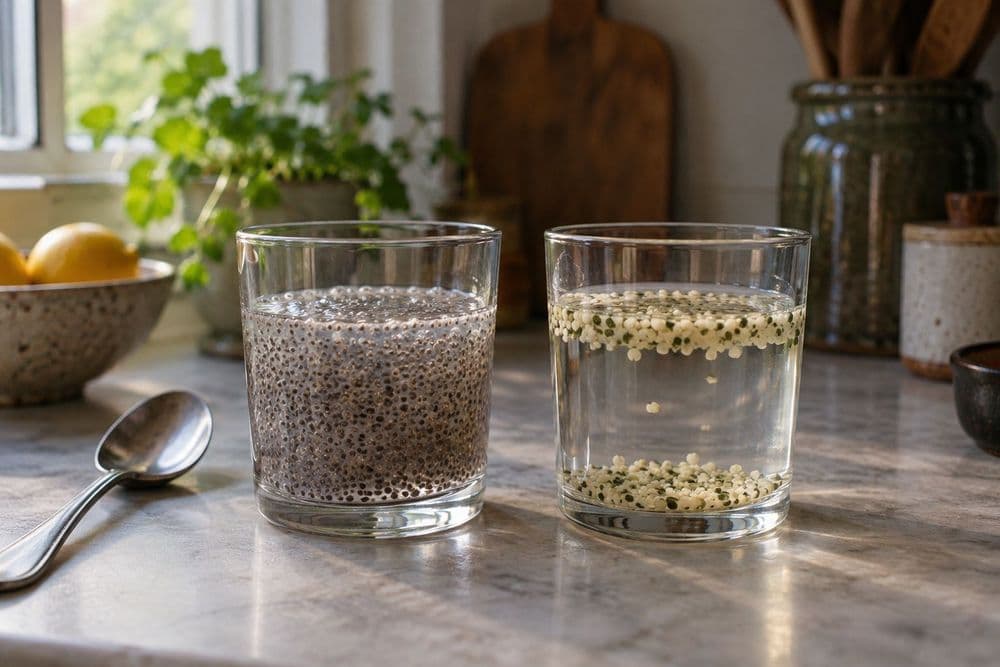
Fiber is chia's biggest lead: 10.3 grams per 30 grams, 37% of the Daily Value, against 1.2 grams for hemp hearts. Most of hemp's fiber was in the shell that dehulling removed. Chia's fiber also explains how it behaves in a glass. Chia gels because of mucilage. As a 2021 review of seed coat mucilages describes it, mucilages are mainly polysaccharides covering the outer layer of seeds to help them take up water, and chia is one of the seeds it covers. The 2016 chia review puts total fiber at 34 to 40 grams per 100 grams, with 5% to 10% of the defatted flour's fiber in the soluble mucilage. How much water chia can hold depends on who measured and how; published estimates run from about 15 to 27 times its weight. A hemp heart is the opposite case. It is the seed with its coat taken off, so it stays a soft, separate kernel in liquid.
Whether to grind chia is the other practical question. In a 2026 laboratory simulation of digestion, ground chia released about 6.33 grams of fat per 100 grams, while whole chia released 0.19 grams, and the authors concluded that grinding mattered more than sprouting the seeds. That is an in-vitro test, not people, so it does not tell you how much you absorb. It is still the most direct evidence that a whole seed with an intact coat holds on to its contents. Hemp hearts were not tested; they are already shelled and soft enough to chew.
Chia's appetite for water has one documented downside. In a 2017 case report titled "Watch it grow", a 39-year-old man with a history of trouble swallowing ate a tablespoon of dry chia seeds and then drank a glass of water. The seeds gelled into a complete blockage of his lower esophagus. Standard adult endoscopy tools could not clear it, and doctors finally pushed it through with a neonatal-size scope. The authors described it as the first reported case of its kind and suspected an underlying condition, eosinophilic esophagitis. This is a single case in a man with a swallowing disorder, not a measure of risk for everyone, but it is enough to change a habit.
Do hemp hearts contain THC or CBD?
This is the question chia never raises. The FDA answers it directly on its page about cannabis and cannabis-derived products, including CBD:
“Hemp seeds are the seeds of the Cannabis sativa plant. The seeds of the plant do not naturally contain THC or CBD. The hemp seed-derived ingredients that are the subject of these GRAS notices contain only trace amounts of THC and CBD, which the seeds may pick up during harvesting and processing when they are in contact with other parts of the plant.”
The same page says eating these ingredients is not capable of making you high. Note the word trace: it is the honest word, not "zero". The company behind the 2018 hulled-seed filing set its own ceiling of 4 milligrams of THC per kilogram of seed, counting THCA too. That is one company's specification, not a federal limit, and not a guarantee for any other brand. Three follow-up questions come up next, and each has its own guide.
Is it CBD? No. The FDA notes that these GRAS conclusions do not affect its position on adding CBD and THC to food, and a seed is not where the CBD is. Our comparison of hemp seed oil and CBD oil explains where cannabinoids actually come from. Can it affect a drug test? Ordinary servings are very unlikely to matter, but no food can guarantee a result; our guide to hemp seed foods and drug tests walks through the controlled studies. Is it legal? Seeds sold as food are a different product from seeds sold for planting, with different rules, covered in whether cannabis seeds are legal.
Allergies: who should be careful
Neither seed is on the FDA's list of nine major food allergens: milk, eggs, fish, crustacean shellfish, tree nuts, peanuts, wheat, soybeans and sesame (added effective January 1, 2023). So neither has to be flagged as a major allergen on a label. That does not mean nobody reacts. For hemp, the record includes a 2003 report of anaphylaxis after eating hempseed, and the company's own GRAS filing acknowledges that allergic reactions to hemp seed ingredients are documented in the scientific literature. For chia, a 2026 review of chia seed allergy found the evidence limited to a small number of case reports, conference reports and one case series, describing immediate IgE-mediated reactions, skin reactions and anaphylaxis. How common chia allergy is remains unknown. The review also notes possible cross-reactivity, particularly with sesame, while cautioning that cross-recognition in the lab does not establish a clinically relevant cross-allergy. If you react to sesame, ask an allergist before adding chia. If your question is about reactions to hemp extracts rather than seeds, see whether you can be allergic to CBD.
How to choose: pick the seed by the job
There is no winner across the board, so choose by what you want the seed to do. The baking row comes from two taste studies. In a cake study with 75 untrained tasters, chia gel replaced up to 25% of the oil or eggs without a detectable difference from the original recipe, and cake volume dropped as substitution went up. In a 2025 brownie study with 120 participants, replacing 50% of the eggs with chia gel scored no differently from the control, while replacing all of them had low acceptance.
| The job | Better pick | Why |
|---|---|---|
| Adding protein to a bowl or smoothie | Hemp hearts | 9.5 g vs 5.0 g protein per 30 g |
| Adding fiber | Chia | 10.3 g vs 1.2 g fiber per 30 g |
| Adding plant omega-3 (ALA) | Chia | 5.35 g vs 2.6 g ALA per 30 g |
| Magnesium, zinc and phosphorus | Hemp hearts | Magnesium 50% vs 24% DV; zinc 27% vs 12% DV |
| Calcium | Chia | 15% vs 2% DV per 30 g |
| Thickening a pudding, jam or smoothie | Chia | Its seed-coat mucilage gels; hemp hearts stay separate |
| Replacing part of the egg in baking | Chia gel | 25% in cake and 50% of eggs in brownies passed taste panels; 100% did not |
| A topping with no prep | Hemp hearts | Soft and ready to eat; no soaking needed |
| Eating straight from the bag | Hemp hearts | Dry chia swells with liquid; soak it first |
| Storage | Both sealed; hemp hearts cold | Hemp hearts are shell-free and about 78% polyunsaturated fat |
Work out your cost per serving
Prices for the same 12-ounce bag vary widely from store to store, so we do not print one. Bag price alone is also misleading when bag sizes differ. Compare the two seeds on cost per 30-gram serving instead:
- 1Find the shelf price and the net weight in grams on the bag (1 ounce = 28.35 g; 12 ounces = 340 g; 1 pound = 454 g).
- 2Divide the price by the grams in the bag. That is your cost per gram.
- 3Multiply by 30. That is your cost per 30-gram serving, about 3 tablespoons.
- 4Worked example with made-up numbers: a hypothetical $10.00 bag of 340 g works out to $10.00 ÷ 340 × 30 = about $0.88 per serving.
- 5If protein is the job, divide the serving cost by 9.5 for hemp hearts or 5.0 for chia to get cost per gram of protein. In the made-up example, $0.88 ÷ 9.5 is about 9 cents per gram of protein.
Storage is the one place hemp hearts need more care. In USDA's entry, 38.1 of their 48.75 grams of fat per 100 grams is polyunsaturated, about 78%, and that is the type of fat that oxidizes fastest. They also have no shell left to protect them. Even the oil pressed from hemp seed changes measurably on the shelf, as a 2024 storage study of hemp seed oil showed. Keep hemp hearts sealed and in the fridge or freezer, and smell them before use: if they smell off or bitter, the fat has likely turned. Keep chia sealed, cool and dry.
What the data does not tell you
Composition tables look precise, so it is worth saying what they leave out. USDA's figures are legacy composite values, and your brand may differ; the label on your bag wins. The protein score comes from a rat digestibility model, scored against young children's amino-acid needs, on 2010 Canadian samples, and there is no matching score for chia to compare it with. The grinding result comes from a lab simulation, not from people. The choking and allergy evidence is case-level: real, but it says nothing about how often these things happen. And by design, this page makes no claims about what either seed does for your heart, weight, blood sugar or digestion. Those are different questions, and the evidence for them would need its own careful treatment. What the numbers do support is a clear, practical choice: hemp hearts for protein and minerals, chia for fiber, ALA and gel. Plenty of people simply use both.
Frequently asked questions
Hemp hearts. Per 30 grams (about 3 tablespoons), hulled hemp seed has 9.5 grams of protein and chia has 5.0, per USDA data. Hemp's protein also has a measured quality score: 0.63 to 0.66 out of 1.0 on PDCAAS in a 2010 study, with lysine as the limiting amino acid. We found no comparable score for chia.
Chia. Per 30 grams it has 5.35 grams of ALA, the plant omega-3, against 2.6 grams in hemp hearts, which also carry about 0.19 grams of SDA. Neither seed contains EPA or DHA, the omega-3s in fish, and the body converts ALA to those only to a limited extent.
Hemp hearts are hemp seeds with the hull removed. Taking the hull off concentrates the protein and fat (in one study, from 24.0% to 35.9% protein and from 30.4% to 46.7% fat), removes most of the fiber, and improved protein digestibility. Whole hemp seeds are crunchy and fibrous; hemp hearts are soft.
They do not get you high. The FDA says hemp seeds do not naturally contain THC or CBD, though hulled seed ingredients can carry trace amounts picked up from the rest of the plant during harvest and processing. One producer's specification caps THC at 4 mg per kilogram of seed. Trace is not zero, so if you are drug tested, read our guide to hemp seed foods and drug tests.
Yes, as foods they combine easily. A 30-gram serving of each adds up to about 14.4 grams of protein, 11.5 grams of fiber and roughly 8 grams of ALA, per USDA figures. Let the chia gel in liquid first, and add the hemp hearts at the end so they keep their texture.
For replacing part of the egg, chia. Chia gel replaced 25% of the eggs or oil in a cake study without a detectable difference, and 50% of the eggs in a brownie study; replacing all of the eggs scored poorly. Hemp hearts work better as a mix-in or topping, where you want a soft, nutty texture rather than binding.
You do not have to, but grinding changes what the seed gives up. In a 2026 lab simulation of digestion, ground chia released far more of its fat than whole chia (6.33 vs 0.19 grams per 100 grams). That was a test-tube model, not people, so it does not tell you how much you absorb. Ground or whole, soak chia before eating it. Hemp hearts are already shelled and do not need grinding.
Looking for CBD instead? A seed is not where it is. Hemp hearts are food, with at most trace cannabinoids picked up from the rest of the plant during harvest and processing. The plant makes its cannabinoids mainly in tiny resin glands called trichomes, concentrated on the flowers, which is why CBD products are made from extracts of the plant and not pressed from its seeds. The hemp seed oil vs CBD oil comparison linked in the THC section above walks through that difference in detail.
Writing about hemp, wellness and the small rituals that keep us balanced.