Hemp Seed Oil for Skin: The Evidence, Pores and the Label
Hemp seed oil is a linoleic-rich cosmetic oil, not CBD and not a treatment. Here is what is in it, where the 'comedogenic 0' rating and the eczema claim really come from, how to read the label, and how to patch-test it.
Shop for hemp seed oil for skin and you will find face oils, lotions and lip balms, usually sold with a list of promises: non-comedogenic, oil-balancing, calming, anti-aging. Here is the short version. It is a cold-pressed seed oil whose fatty acids are more than half linoleic acid, the EU files it as an emollient, and it is not a CBD product. Most of the promises trace to no study at all, to a study of people drinking the oil, or to a different compound.
Is hemp seed oil good for skin? As a cosmetic, it does the job of an emollient, the category of ingredients that soften and smooth the skin's surface. Its fatty-acid profile sits close to sunflower seed oil, which held up well in a small human forearm study, and far from oleic-heavy olive oil, which did not. What the evidence does not show is that hemp seed oil treats acne, eczema or any other skin condition, that it balances oil production, or that it slows aging. It is not a source of CBD. If you want to try it, buy a small fresh bottle, keep it cold and dark, and patch-test it for 7 to 10 days first. Hemp seed oil is one of many things made from the plant; our guide to what hemp is used for maps the seed, fiber and flower to the products each one becomes. Below you get the oil by the numbers, the real evidence on skin, where the "comedogenic 0" rating comes from, a claim-by-claim audit, a label decoder and a storage and patch-test routine.
What hemp seed oil actually is
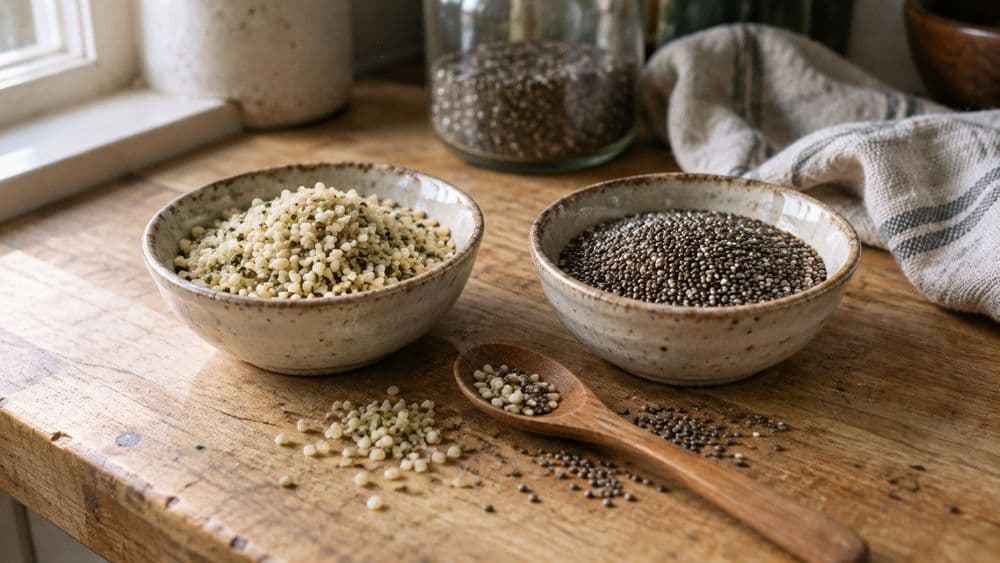
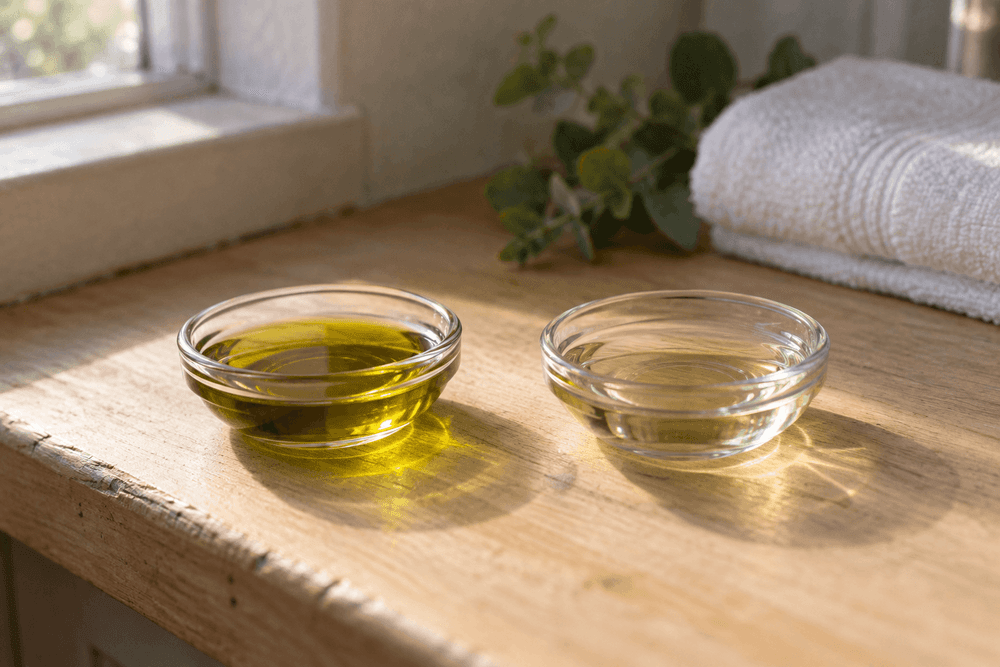
Hemp seed oil is the fixed oil pressed from the seeds of the hemp plant, Cannabis sativa. A fixed oil is a fatty oil, as opposed to a volatile essential oil. In the GRAS notice the FDA reviewed in 2018 for hemp seed oil as a food ingredient, the notifier describes whole seeds that are cold pressed and filtered, yielding an oil that is 77% polyunsaturated fat, 13% monounsaturated fat and 9.8% saturated fat. Those are one company's figures, not FDA measurements, but they line up with the wider literature. On a cosmetic ingredient list, the oil goes by its INCI name (the international naming system for cosmetic ingredients): Cannabis Sativa Seed Oil. The EU's CosIng cosmetic-ingredient database describes it as "the fixed oil expressed from the seeds of Cannabis sativa L." and lists two functions: skin conditioning, and skin conditioning as an emollient. It does not list it as a humectant, whatever some beauty blogs say.
| Component | Share of the oil's fat | What it is |
|---|---|---|
| Polyunsaturated fat (total) | 77% | Fats with two or more double bonds. The reason the oil is light and the reason it goes rancid quickly. |
| Linoleic acid (LA) | 50.9% | An omega-6 fatty acid. The dominant fat in hemp seed oil. |
| Alpha-linolenic acid (ALA) | 16.7% | The plant omega-3. |
| Gamma-linolenic acid (GLA) | 3.6% | A less common omega-6, also found in borage and evening primrose oils. |
| Stearidonic acid (SDA) | 1.2% | A less common omega-3. |
| Monounsaturated fat | 13% | Includes oleic acid, the main fat in olive oil. |
| Saturated fat | 9.8% | Fats with no double bonds. |
That profile is not fixed. Across the cultivars that a 2020 review of hempseed composition in the journal Nutrients compiled, linoleic acid was the most common fatty acid in every genotype analyzed, accounting for more than half of the total, and up to 90% of the oil was unsaturated. Oleic acid ranged from 8.42% in one cultivar to 18.78% in another. Two things follow for skin care. First, hemp seed oil belongs to the linoleic-rich family of plant oils, which matters for the evidence in the next section. Second, an oil that is about three-quarters polyunsaturated oxidizes quickly, so freshness and storage are the main quality issue with a bottle, not some hidden active ingredient.
What putting it on your skin can and cannot do
The reason people reach for linoleic-rich oils comes from skin biology, not from hemp research. A 2017 dermatology review of plant oils applied to the skin covers about twenty oils, among them olive, sunflower, coconut, argan, jojoba and borage. Hemp seed oil is not one of them; the word does not appear in the paper. The review describes linoleic acid as the most abundant polyunsaturated fatty acid in the lipids of the stratum corneum, the skin's outer layer, and treats oils rich in it differently from oleic-heavy oils, noting that oleic acid "may disrupt skin barrier." Its conclusion is that oils may act differently according to their composition. That is a general mechanism, drawn from a mix of laboratory and small human studies. It is not a test of hemp seed oil.
The clearest human illustration of why composition matters also skips hemp. In a 2013 forearm study of 19 adults, volunteers applied six drops of oil twice a day for four to five weeks. Olive oil, which is dominated by oleic acid, "caused a significant reduction in stratum corneum integrity and induced mild erythema" (redness). Sunflower seed oil, which is richer in linoleic acid, "preserved stratum corneum integrity, did not cause erythema, and improved hydration." The authors wrote that their findings "challenge the unfounded belief that all natural oils are beneficial for the skin." Hemp was not tested. Its profile sits on the sunflower side of that line, which is a reasonable basis for choosing it over an oleic-heavy oil, and nothing more.
The closest thing to a direct test is a 2024 Slovenian study of hempseed oil formulations. Twelve healthy women aged 20 to 30 applied cream-like preparations containing 8% to 28% hempseed oil, plus emulsifiers and water, to their forearms twice a day for 14 days. With the 28% formula, transepidermal water loss (TEWL, a standard measure of how much water escapes through the outer layer) fell from baseline by 1.98 g/h/m2 after 8 hours and by 2.39 g/h/m2 after 14 days. The matching flaxseed formula did the same: 1.93 and 2.68. No participant reported an adverse effect from the formulations. The authors name the limits themselves: "the small population (n = 12) of study participants and the lack of a control group." So the study shows that a formulated product containing hempseed oil behaved like one containing flaxseed oil, in 12 people, for two weeks. It does not show what plain hemp seed oil does, or that hemp beats any other linoleic-rich oil.
Is hemp seed oil comedogenic?
Short answer: there is no reliable published comedogenic rating for hemp seed oil. The "0" you see on most beauty pages (a few say 1) is printed without a source, and when we traced the scale back to the paper the ingredient lists descend from, hemp seed oil was not in it. A comedogenic ingredient is one that tends to produce comedones, the clogged follicles that become blackheads and whiteheads. Whether an oil clogs your pores depends on more than a number, and the history of that number explains why.
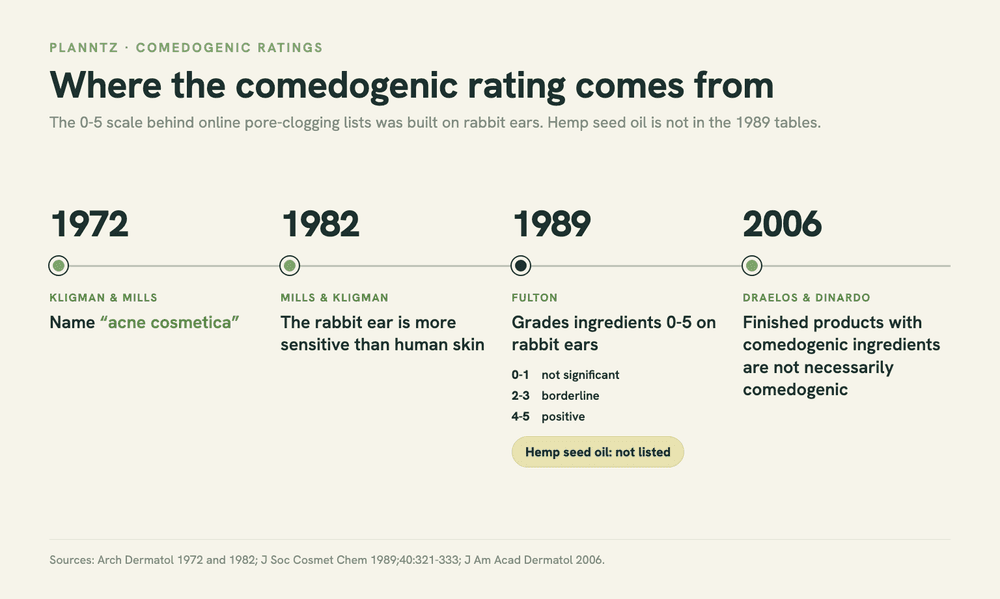
The idea of rating cosmetic ingredients for pore-clogging dates to a 1972 paper by Kligman and Mills that named the problem "acne cosmetica". The 0-to-5 grades that circulate online come from rabbit-ear testing, most often from Fulton's 1989 survey in the Journal of the Society of Cosmetic Chemists, "Comedogenicity and irritancy of commonly used ingredients in skin care products." In it, "a minimal grade of 0 to 1 is not considered significant. Grade 2 to 3 is borderline," and a grade of 4 to 5 is "considered positive." Fulton noted that the rabbit ear "takes only two weeks" to react, while similar reactions on human skin may take six months, and that "the disadvantage of the model is its extreme sensitivity." We read all 13 pages of the paper. Hemp seed oil does not appear in it, and neither does any other cannabis ingredient.
- The rabbit ear overreacts. Fulton called its extreme sensitivity the model's main disadvantage, and a 1982 human study found the rabbit model more sensitive than human skin.
- Hemp seed oil was never on the list. The paper the 0-to-5 scales descend from has no entry for it, so a printed 0 or 1 cannot be traced to that work.
- Raw material changes the result. Fulton's oils section carries the footnote "Results depend on source of raw material," and hemp oil varies by cultivar, press and freshness.
- Finished products behave differently. A 2006 human re-evaluation found that a product with a high-rated ingredient is not necessarily comedogenic, so a low rating is no promise either.
“Finished products using comedogenic ingredients are not necessarily comedogenic.”
That line comes from Draelos and DiNardo's 2006 re-evaluation of the comedogenicity concept, which applied finished products to the backs of six comedone-prone adults three times a week for four weeks. The authors point out that the animal-model era assumed a formulation containing a comedogenic ingredient "would also be comedogenic," and their small study, of a limited set of products, did not bear that out. It builds on Mills and Kligman's 1982 human test method, which concluded: "The rabbit model is more sensitive than the human. Substances that are weakly comedogenic in the rabbit are probably safe for human use with the possible exception of acne-prone persons." For context, Fulton did grade a few familiar fats, including cocoa butter at 4, coconut butter at 4 and jojoba oil at 0 to 2. Hemp seed oil is chemically different from those, a liquid oil that is about three-quarters polyunsaturated, which makes a low number plausible. Plausible is not measured. The test that answers the question for you is your own skin: patch-test first (the method is below), then use it on one small area of your face for a few weeks before going all over.
Where the popular skin claims come from
The pages that rank for this topic repeat the same handful of claims, mostly with no citation at all. We traced each one to its source. The table gives the verdicts; the paragraph after it traces the ones that sound most clinical.
| Claim you will see | What it actually traces to | Verdict |
|---|---|---|
| "Non-comedogenic, rated 0" | No traceable source. Hemp seed oil is not in Fulton's 1989 tables, and ingredient ratings do not predict a finished product (Draelos 2006). | Unsourced |
| "Calms eczema" | A 2005 trial in which 20 adults with atopic dermatitis drank 30 mL of hempseed oil a day. Hemp did not do significantly better than olive oil. | Oral study; does not transfer to skin |
| "Good for acne-prone skin" | A 1998 study of pure linoleic acid, not hemp seed oil, applied in people with mild acne. One small study of one compound. | Overstated |
| "Balances oil production" | No study of the oil itself. One 2015 study of a cream with 3% cannabis seed extract (not seed oil) in healthy men; no sample size in the abstract. | Not studied for the oil |
| "Anti-aging, fewer fine lines, regenerates cells" | We found no human study, only cell-culture work on seed-derived particles, not the oil. The FDA cites claims to regenerate cells as an example of drug claims. | Not studied; drug-claim territory |
| "Contains CBD" | The FDA says hemp seeds do not naturally contain CBD or THC; seed ingredients can carry traces. CBD has its own ingredient name. | Wrong |
| "Won't affect a drug test" | Seed oils can carry trace THC picked up from other plant parts, so no seller can guarantee a result. | Cannot be promised |
The eczema claim is the most repeated, and its source is the most misread. It traces to a 2005 Finnish crossover trial of dietary hempseed oil in which 20 adults with atopic dermatitis took 30 mL of cold-pressed hempseed oil by mouth every day, compared against olive oil, over 20 weeks in total. Nothing was applied to skin. The abstract reports changes within the hemp period, but even there the drop in water loss through the skin was not statistically significant (p = 0.074). A 2023 systematic review in JMIR Dermatology read the full trial, reported that "no significant difference was found between the intervention and control groups in any metric," and concluded there is minimal evidence for hempseed supplementation in this condition. The acne-prone line traces to a 1998 double-blind crossover study of pure topical linoleic acid, which reported roughly a 25% reduction in the size of microcomedones (the tiny precursors of blackheads) over one month in people with mild acne. That was a single purified compound, not hemp seed oil, in one small study. The oil-balancing line comes closest to a source in a 2015 study of a 3% cannabis seed extract cream in healthy men, which reported less cheek sebum on the treated side than on the side that got the plain base cream over 12 weeks. That was an extract of unstated type, not the oil, and the abstract gives no sample size or effect size. None of these papers is evidence about what a bottle of hemp seed oil does on your skin, and a product sold to treat either condition would be a drug. Which brings us to the label.
Cosmetic or drug: how to read the claim on the bottle
Federal law sorts skin products by what they are intended to do, and the claims on the label are the main evidence of that intent. In the FDA's guidance "Is It a Cosmetic, a Drug, or Both?", a cosmetic is a product for "cleansing, beautifying, promoting attractiveness, or altering the appearance," and skin moisturizers are on the agency's list of examples. A drug is a product intended for the "cure, mitigation, treatment, or prevention of disease" or to affect "the structure or any function of the body." The FDA gives claims to regenerate cells as an example of drug claims, and says plainly that "the term 'cosmeceutical' has no meaning under the law." So a jar of hemp seed oil that says it moisturizes is a cosmetic. The same jar that says it treats eczema or acne is making a drug claim.
- Cosmetic wording: moisturizes, softens, smooths, conditions, improves the look or feel of dry skin.
- Drug-claim wording: treats, heals, cures or prevents; names a condition such as eczema, psoriasis, dermatitis, rosacea or acne; promises to regenerate cells or change how skin functions.
- No legal meaning: "cosmeceutical." The FDA says so directly, so treat it as decoration, not a product category.
- A disease promise on a face oil tells you about the seller, not about the oil. It is a reason for more caution, not more confidence.
Two more facts help you read the shelf. First, the FDA says cosmetic products and ingredients, other than color additives, "do not require FDA approval before they go on the market." Nobody at the agency approves a face oil before it reaches you. Second, the Modernization of Cosmetics Regulation Act of 2022 (MoCRA) added duties: manufacturers and processors must register their facilities with the FDA and renew every two years, and the company responsible for a product must list it and its ingredients with the FDA, report serious adverse events within 15 business days, and keep records supporting the product's safety. Some small businesses are exempt from registration and listing. The FDA also notes that "neither the law nor FDA regulations require specific tests to demonstrate the safety of individual products or ingredients." Cannabis ingredients get no special treatment either way. On its page about cannabis and cannabis-derived products, including CBD, the FDA says certain cosmetic ingredients are restricted by regulation, "but currently that is not the case for any cannabis or cannabis-derived ingredients," and that a product intended to "cure, mitigate, treat or prevent disease" is a drug, or possibly both.
Does hemp seed oil have CBD or THC?
Not in any amount that makes it a CBD product, and the reason is botanical. The same FDA page says "the seeds of the plant do not naturally contain THC or CBD," and that seed-derived ingredients "contain only trace amounts of THC and CBD, which the seeds may pick up during harvesting and processing." Those traces are real. When German researchers measured cannabinoids in 30 retail hemp seed food oils, the total (the sum of 16 cannabinoids) ranged from 9 to 279 mg/kg, and delta-9 THC from 0.2 to 6.7 mg/kg. Those were European food oils, not US cosmetics, but they are enough to retire any "zero cannabinoids" promise. They are not enough to make seed oil a source of CBD. Cannabinoid ingredients carry their own names on a label, which makes the ingredient list the fastest way to tell what you are holding.
| Name on the ingredient list | What it is | What it tells you |
|---|---|---|
| Cannabis Sativa Seed Oil | Oil pressed from hemp seeds. Listed as an emollient and skin conditioner. | A cosmetic oil. Not a source of CBD; may carry traces. |
| Cannabis Sativa Seed/Stem Oil | A separate entry: oil from seeds and stems. | Not the same as plain seed oil. Stems are a different plant part. |
| Cannabidiol | CBD itself, either derived from a plant extract or made synthetically (two separate entries). | The ingredient to look for if you want CBD. |
| Cannabis Sativa Leaf Extract, Flower Extract, or Flower/Leaf/Stem Extract | Extracts of the parts of the plant that make cannabinoids. | Can contain cannabinoids. The name does not say how much. |
| "Hemp extract" or "hemp oil" in marketing copy | Not an INCI name. It can mean seed oil or a cannabinoid extract. | Check the ingredient list, not the front of the box. |
If a label says Cannabidiol, or names leaf, flower or stem extract, that is a different ingredient from seed oil, and the name tells you the plant part, not how much cannabinoid is in the jar. Our explainer on what "hemp extract" means on a label untangles that ambiguous phrase, and the same skills for reading the front and back of a bottle are in our guide to reading a CBD label. The confusion runs the other way too. CBD tinctures dissolve their extract in a carrier oil, and that carrier is often not hemp seed oil at all: Planntz tinctures, for example, use coconut MCT oil.
Three boundary questions come up often enough to answer here. Can hemp lotion or shampoo show up on a drug test? Because traces exist, no product can promise a result either way; our page on hemp seed oil and drug tests walks through what is known. If you serve in the military, check your branch's rule before putting any hemp product on your skin. The Navy and Marine Corps directive ALNAV 074/20 says "use" includes "topical products containing hemp, such as shampoos, conditioners, lotions, lip balms, or soaps," and our rundown of CBD and hemp rules for service members covers the other branches. And if what you are really asking about is a THC cream or balm, that is a different product altogether; see whether THC topicals can get you high.
How to choose, store and patch-test it
Choosing a bottle
- Read the ingredient list for Cannabis Sativa Seed Oil. In a blend, note where hemp falls in the order: ingredients are listed from most to least.
- Unrefined (cold-pressed) oil is green to amber with a nutty, grassy smell. Refined oil is pale and close to odorless. Pick by preference; the label name is the same.
- Look for a pressing or best-by date, and buy the smallest size that makes sense. A big bottle can oxidize before you finish it.
- Choose dark glass, ideally amber, over clear glass or plastic.
- Pass on bottles that promise to treat a skin condition or reverse aging. Under FDA rules, those are drug claims.
- Do not expect CBD. If you want it, look for Cannabidiol on the ingredient list.
Freshness matters more than brand. Hemp seed oil is a food fat, and it ages like one. A 2024 shelf-life study of cold-pressed hempseed oil kept the oil for 270 days in four packaging materials, at 25 degrees Celsius under diffused light and at 10 degrees in the dark, tracking oxidation the whole way. The authors describe the oil as "extremely rich in unsaturated fatty acids," which makes it highly sensitive to oxidation and rancidity, and amber glass wrapped in foil at refrigerator temperature protected it best. In practice: close the cap tightly, keep the bottle in the fridge or at least a dark cupboard, and smell it before you use it. Fresh unrefined oil smells nutty or grassy. If it smells sharp, bitter or stale, it has likely oxidized and belongs in the trash, not on your face. The same logic applies to CBD oils, covered in our guide to whether CBD oil expires and how to store it.
A 7-to-10-day patch test
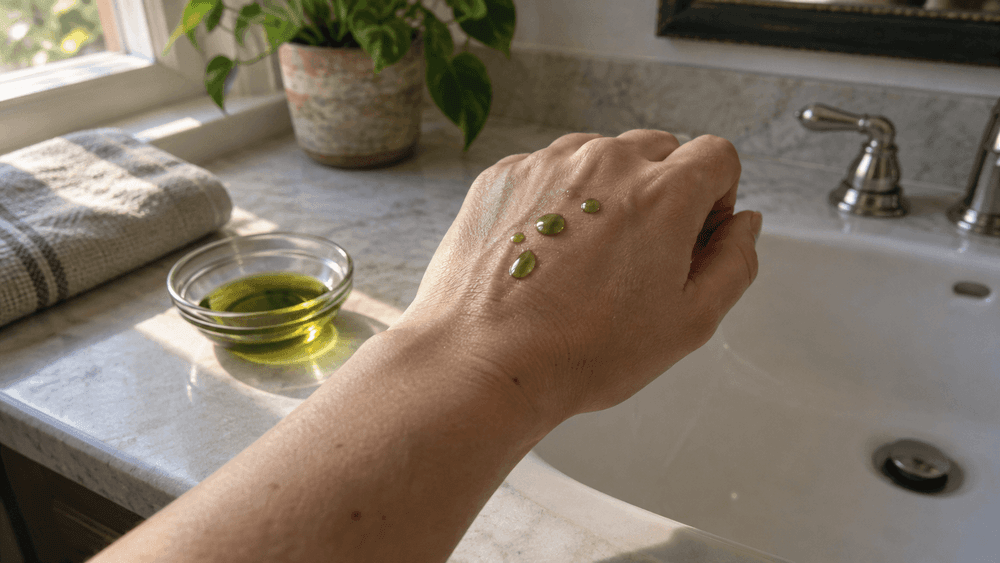
Dermatologists at the American Academy of Dermatology describe a simple at-home test for any new skin care product. It takes a week and a half and costs you a few drops. Applied to hemp seed oil, it looks like this:
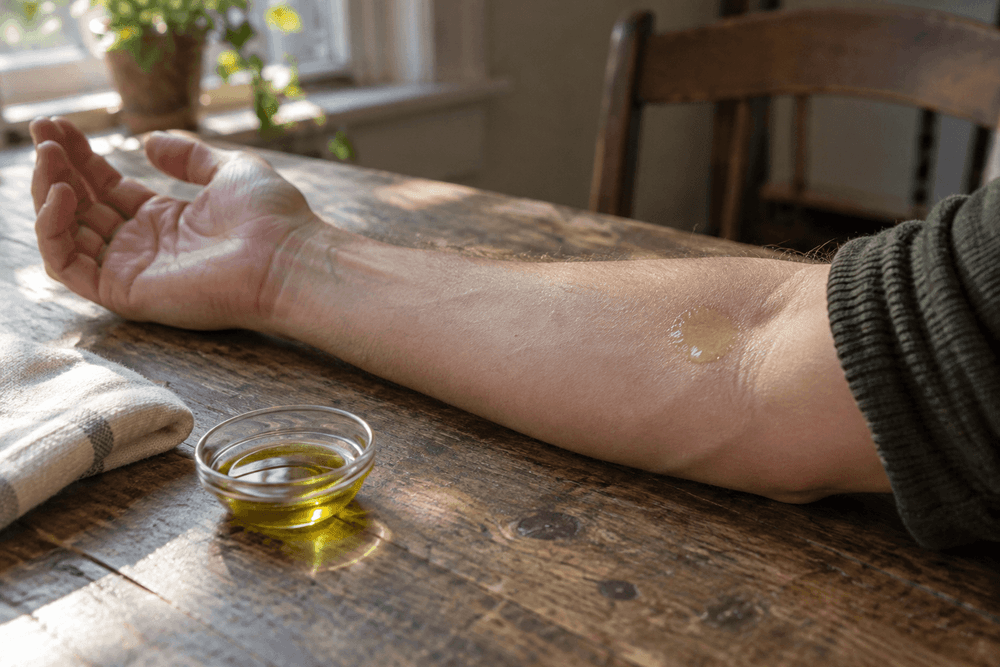
- 1Pick a quarter-sized test spot that you will not wash right away, such as the underside of your arm or the bend of your elbow.
- 2Apply the oil the way you plan to use it, in your normal amount.
- 3Repeat twice a day for 7 to 10 days.
- 4If the spot reacts (redness, itching or swelling), gently wash the oil off as soon as possible and do not use it again.
- 5No reaction after 7 to 10 days? Try it on one small area of your face for a few weeks before using it all over, especially if you break out easily.
Reactions are uncommon but documented. A dermatology team at Montpellier University Hospital published a 2022 case of allergic contact dermatitis from hemp seed oil in the journal Contact Dermatitis. One case report shows that it can happen; it says nothing about how often. If you already react to other cannabis products, our page on whether you can be allergic to CBD and cannabis explains the plant allergens involved.
What is still unknown
Quite a lot. We found no human study that measured what plain hemp seed oil does to skin, no head-to-head comparison with jojoba, sunflower or any other oil, no comedogenicity test of hemp seed oil on rabbit or human skin, and no study of the oil's effect on oil production. The one skin-measurement trial involved 12 women for 14 days, used formulations rather than the oil, had no untreated control, and found flaxseed did as well. The mechanism people cite comes from a review that never mentions hemp, and the most-cited "clinical" evidence comes from people drinking the oil. The composition itself is a moving target, shifting with cultivar, growing conditions, pressing and age. None of that makes hemp seed oil a bad choice for a cosmetic routine. It makes it an ordinary plant oil with a well-described fatty-acid profile, best judged by how your own skin responds, and only as good as it is fresh.
Hemp seed oil for skin: common questions
Many people do, as an everyday cosmetic oil. No study defines a daily amount for skin, so start small: a few drops, after a 7-to-10-day patch test on your inner arm, which is what the American Academy of Dermatology suggests for any new product. Keep the bottle cold and dark, and stop if your skin reacts or you start breaking out where you apply it.
There is no reliable published answer. The comedogenic rating of 0 printed on many sites has no traceable source: hemp seed oil is not in the 1989 rabbit-ear tables the 0-to-5 scale comes from, and a 2006 human study found that ingredient ratings do not predict how a finished product behaves. Its light, mostly polyunsaturated profile makes a low rating plausible, but no one has measured it. The real test is a few weeks on a small area of your own face.
We found no study measuring what hemp seed oil itself does to oil (sebum) production; the nearest is one small 2015 study of a cream with 3% cannabis seed extract, not the oil. So the "balances oil" claim is unstudied for the oil. People with oily skin often choose it because it is a light, linoleic-dominant oil rather than a heavy one. If you try it, patch-test first and use only a few drops.
They are different kinds of material. Hemp seed oil is a triglyceride oil that is about three-quarters polyunsaturated (77% in the notifier's figures in the GRAS notice the FDA reviewed), so it oxidizes quickly. Jojoba is technically a liquid wax ester rather than a true oil, and a 2017 dermatology review describes it as having high oxidative stability. Fulton's 1989 rabbit-ear survey graded jojoba 0 to 2; it did not test hemp seed oil at all. We found no study comparing the two on skin.
According to the FDA, hemp seeds do not naturally contain CBD or THC, but seed ingredients can pick up traces during harvesting and processing. A German survey of 30 retail seed food oils found total cannabinoids of 9 to 279 mg/kg. That does not make it a CBD product. If you want CBD, look for Cannabidiol on the ingredient list.
Yes, and faster than many oils. Its polyunsaturated fats oxidize with light, heat and air; in a 2024 storage study, amber glass wrapped in foil at refrigerator temperature protected it best. Fresh unrefined oil smells nutty or grassy. If yours smells sharp, bitter or stale, replace it. Refrigerate after opening and buy small bottles.
The EU cosmetic-ingredient database lists Cannabis Sativa Seed Oil as an emollient and skin-conditioning agent, not a humectant. Emollients soften and smooth the skin's surface; humectants, such as glycerin, draw water into it. Some blogs call hemp seed oil a humectant, but that is not how the official inventory classifies it. Under US law, a product that says it moisturizes is a cosmetic.
Were you actually looking for CBD? Hemp seed oil is the wrong bottle for that, however the front of the box is worded. Our side-by-side comparison of hemp seed oil and CBD oil shows how each is made, what each contains and how to tell them apart before you buy.
Writing about hemp, wellness and the small rituals that keep us balanced.