Do THC Topicals Get You High? What the Studies Measured
The internet says lotions no, patches yes, usually beside wellness claims and no data. Here is what blood, urine and saliva tests measured after THC and hemp products went on skin, what an engineered transdermal delivered, and why swallowing is the real risk.
Do THC topicals get you high? For ordinary THC creams, salves and lotions on intact skin, the studies that measured blood and urine found no THC at all. Products engineered to cross the skin are a different story: they can put a small amount of THC into your blood, and we found no human study that measured whether a commercial THC patch produces a high. The drug-test answer is not the same as the high answer. And the most serious risk from a THC topical is someone swallowing it.
The short answer. In a forensic experiment, volunteers coated large areas of skin with THC salves every few hours for three days, and none of their 60 blood and urine samples contained THC. In a controlled trial of five hemp skin products, THC stayed below detection in everyone's blood and nobody noticed any effects. One engineered rub-on formulation did reach the blood, peaking at about 0.35 ng/mL, and no one in that study reported feeling high. But in the hemp trial, some people ended up with THC in their saliva at the level a workplace test calls positive. So a high from an ordinary cream is unlikely on the evidence, a clean drug test is not guaranteed, and a THC patch is an open question.
Most pages that rank for this question say "lotions no, patches yes" and move straight on to wellness claims, without a single blood test behind either half of the answer. This page sticks to what was measured: who was in each study, what went on their skin, what turned up in their blood, urine or saliva, and where the evidence runs out. One disclosure first: Planntz does not sell topical or transdermal products, so we have nothing to sell you on this page. THC products are for adults 21 and over, where they are legal.
Topical, transdermal, mucosal: why the word on the label matters
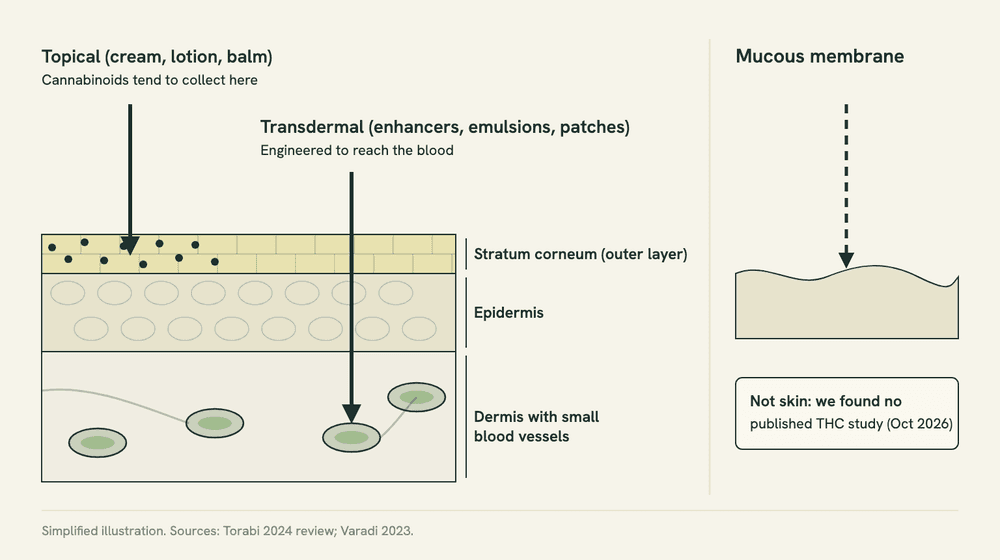
THC dissolves in fat, not water. That sounds like it should slip straight through skin, but the outermost layer of skin, the stratum corneum, behaves more like a sponge than a doorway: cannabinoids tend to collect there instead of passing into the blood. A 2024 review of permeation strategies for cannabinoids by Torabi and colleagues at the Technical University of Denmark puts it plainly: because of the skin's barrier and the fat-loving nature of cannabinoids, getting them into the bloodstream through skin takes help, usually permeation enhancers (ingredients that loosen the skin barrier) and a dedicated delivery design. The same review notes that detailed human trials of these systems are still limited.
THC is also one of the harder cannabinoids to push through. In a 2004 lab study on donated human skin led by Stinchcomb, CBD and CBN crossed about ten times more readily than delta-8-THC, a close chemical cousin of the THC in cannabis, and adding ethanol at 30 to 33% increased how much got through. That was skin tissue in a diffusion chamber, not a living person with circulation, but it explains why the formulation, not just the THC content, decides what reaches the blood. In practice, products fall into three groups:
- Topical: a cream, lotion, balm or salve meant to stay in or on the skin. Most of the THC is expected to remain in the outer layers.
- Transdermal: a product engineered to cross the skin and reach the bloodstream, using permeation enhancers, special emulsions or an adhesive patch that holds the formula against the skin for hours.
- Mucosal: anything applied to a mucous membrane, such as a lubricant or a suppository. Mucous membranes are not skin, so results from lotions do not carry over to them.
The label word is a design intention, not a measurement, and marketing often blurs the line. Words like "nano" or "emulsion" describe how oils are broken into tiny droplets, a vocabulary we unpack in our explainer on water-soluble CBD; on their own they do not tell you how much THC reaches your blood. If you are new to cannabinoids and want the basics of how CBD and THC differ, start with what CBD is and how it works.
Can you get high from THC lotion? What blood and urine tests found
The most direct test started with a traffic case. A German driver had 7.3 ng/mL of THC in his blood and said he had only used THC salves, so researchers at the University of Bonn checked the claim. In their 2017 forensic study of THC-containing topicals, led by Hess, three volunteers aged 25 to 34 applied two salves (one with 1.7 ng and one with 102 ng of THC per mg) to 50 to 100 cm² of skin on the neck, arms or legs and trunk every 2 to 4 hours for three days. Blood and urine were collected every few hours until 15 hours after the last application: 30 blood and 30 urine samples in all. Every one tested negative for THC and its two main metabolites, with a detection limit of 0.40 ng/mL for THC in blood.
Three people and two low-potency products is a small test. The stronger salve was about 0.01% THC, and nobody tried a high-THC product, an enhancer-containing formula, broken skin or saliva. The application schedule was a study condition designed to stress the claim, not a usage pattern. But it is a measurement, not an opinion, and it is the kind of evidence the usual answer to this question leaves out.
Broken skin is the obvious follow-up. When Australian police officers pulled up cannabis plants by hand in grow houses and forest plantations, often getting cuts, abrasions and ruptured blisters along the way, researchers led by Doran swabbed their gloves, hands and skin and collected more than 100 urine samples. All were negative for THC. The authors' own word for the risk when small areas of damaged skin touch THC was "low", not zero, and the exposure was plant material rather than a formulated cream.
The cleanest comparison of routes is recent. In a 2026 University of Utah crossover study led by Jain, 20 healthy adults aged 18 to 50 (18 completed both periods) used the same hemp-extract cosmetic two ways, by mouth and on skin, with a 15-day break in between. CBD exposure over 24 hours was about fifteen times higher by mouth (281 vs 19 h·ng/mL), and blood CBD peaked at about 3 hours by mouth versus 24 hours on skin. THC stayed below the lab's quantification limit either way. Yet 38% of participants had a positive urine strip for the THC metabolite after the oral dose, and no one did after the skin dose. The product was reported as THC-free, and the authors say the cause of those oral positives remains unclear. The study was funded by Young Living Essential Oils, the company that supplied the product, used a single dose of one product and relied on commercial test strips rather than lab confirmation.
The largest controlled trial used hemp CBD products rather than THC products, but it measured blood, urine and saliva. In a 2024 Johns Hopkins trial of five commercial hemp topicals led by Zamarripa, 46 adults used a cream, lotion, patch, balm, gel or placebo, first in a lab session and then twice a day for nine days. THC and its metabolites stayed below detection in everyone's blood, no urine sample met federal workplace criteria for a positive, and no product produced effects people could notice. CBD did get absorbed from three of the five products, most from a lotion that contained vitamin E, which the authors identified as a permeation enhancer. That is the formulation point from the lab, showing up in people. One of the study's 15 authors was affiliated with a CBD company.
Engineered transdermals: THC does get in, and the amount is small
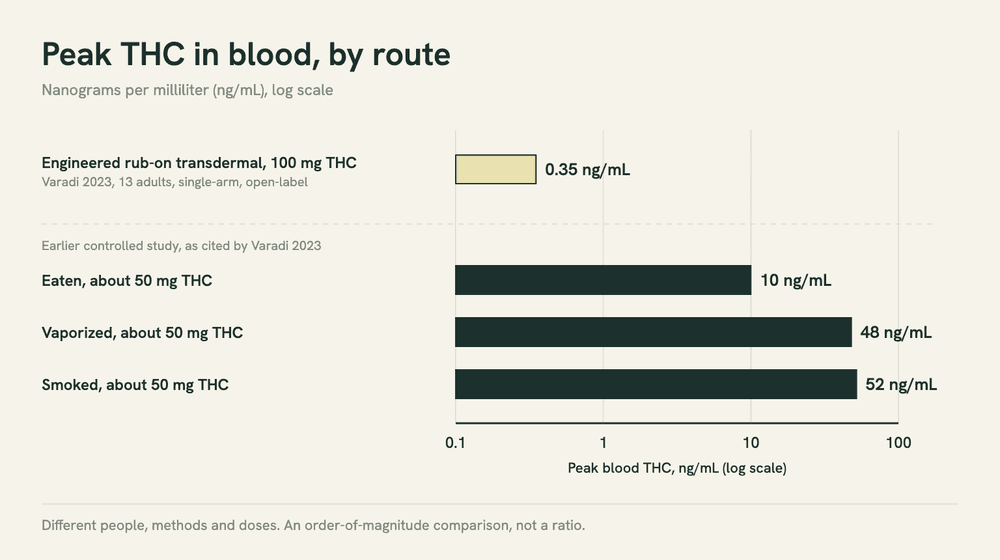
A product built to cross the skin behaves differently, and a human study has measured it. In a 2023 single-arm, open-label study led by Varadi in Canada, study staff rubbed an emulsion formulation containing 100 mg of THC and 100 mg of CBD into each adult's hand, wrist and forearm until it was absorbed, about 90 seconds. This was a rub-on formulation, not a patch, and the dose was a study condition. Of 18 people enrolled, 13 made it into the blood-level analysis. THC did reach the blood, peaking on average at about 0.35 ng/mL (346.57 pg/mL), with a time to peak of 8 hours (ranging from 10 minutes to 12 hours) and a half-life of about 5.4 hours. Before every blood draw, participants were asked whether they were experiencing a high feeling. None of them reported one.
Read that result with its limits. The study was funded by the formulation's maker; two authors were consultants to the company and one was its chief medical officer. There was no control group, the variation between people was enormous (the standard deviation was more than twice the average), and it was a single application. The authors also note that their 12-hour sampling window was too short: 8 of 13 people were still at their highest reading when it ended, so the true peak may have come later.
For scale, the authors placed their number next to an earlier controlled study in which about 50 mg of THC produced blood peaks of roughly 52 ng/mL smoked, 48 ng/mL vaporized and 10 ng/mL eaten. That makes the transdermal peak more than a hundred times lower than smoking, from about twice the dose. Different people and lab methods were involved, so treat it as an order-of-magnitude comparison, not a precise ratio. Route also changes how THC is processed: THC absorbed through skin skips the first pass through the liver that turns swallowed THC into 11-hydroxy-THC, the metabolite that forms when THC is eaten. That is a difference in metabolism, not evidence that skin delivery is stronger. How route shapes the timing of effects is covered in how long a weed high lasts.
Do THC patches get you high? The evidence gap
Patches are the product the internet most confidently says will get you high, and they are the one with the least human data. A patch is transdermal by design: it holds a formula against the skin for hours so the drug crosses into the blood. The clearest patch data come from animals. In a 2004 study of a research delta-8-THC patch led by Valiveti, hairless guinea pigs reached a steady blood level of about 4.4 ng/mL within 1.4 hours and held it for at least 48 hours. That shows a patch can be built to deliver a steady level, but it is an animal study of a prototype with no measure of intoxication, and it says nothing about how a commercial THC patch feels to a person.
The only human patch data we found come from the hemp CBD patch group in the Zamarripa trial: 7 people, a low-THC product, THC below detection in blood and no noticeable effects. Our PubMed searches on October 11, 2026 for transdermal or patch THC with blood or pharmacokinetic measures (23 records in the broadest one) turned up animal studies and reviews, but no human study of a THC patch. Research has lagged the shelf for a long time: a 2003 pharmacology review by Grotenhermen described transdermal THC as used in only a few studies and of little relevance in practice. So the honest answer is that a THC patch is designed to put THC into your body, and no published human study we found tells you whether a commercial one produces a high. If you use one, assume THC is entering your bloodstream, and do not plan driving, work or a drug test around the hope that it is not.
Do THC topicals get you high? The answer by route
| Route or product | Built to reach blood? | What was measured | High reported? | Drug-test signal |
|---|---|---|---|---|
| THC salve on intact skin | No | Hess 2017: 3 volunteers, 2 low-potency salves every 2-4 h for 3 days | Not assessed; no THC found in blood | Blood and urine negative (60 of 60 samples) |
| Cannabis plant contact on cut or blistered skin | No | Doran 2017: police officers removing plants, more than 100 urine samples | Not assessed | Urine all negative; authors call the risk low |
| Hemp CBD cream, lotion, balm, gel or patch | Mostly no (one lotion had an enhancer) | Zamarripa 2024: 46 adults, controlled, twice daily for 9 days | No noticeable effects | Blood THC not detected; no urine positive; 9 of 46 saliva at or above the federal threshold |
| Same hemp cosmetic, skin vs mouth | No (cosmetic) | Jain 2026: 20 adults, randomized crossover, single dose | Not reported | Urine strip positive in 38% after oral use, none after skin use |
| Engineered rub-on transdermal | Yes | Varadi 2023: 13 adults analyzed, single-arm, open-label, 100 mg THC | None reported feeling high | Not tested; blood THC peak about 0.35 ng/mL |
| THC patch | Yes | Valiveti 2004: guinea pigs, research delta-8 patch, about 4.4 ng/mL for 48 h. No human study found | Unknown in people | Unknown |
| Lubricant or bath product (mucosal) | Unknown | No study found in our search (PubMed, Oct 11, 2026) | Unknown | Unknown |
| Eaten (an edible, or a swallowed topical) | Yes | Grotenhermen 2003 review: effects start in 30-90 min, peak at 2-3 h, last about 4-12 h | Yes | Yes; see our urine and saliva guides |
| Smoked | Yes | Grotenhermen 2003: effects within minutes, peak at 15-30 min, taper in 2-3 h. Blood peak about 52 ng/mL after about 50 mg (cited by Varadi) | Yes | Yes; see our urine and saliva guides |
Two patterns stand out. First, every human study on this page that measured blood after ordinary skin products found no THC in it, and the one product that did put THC in blood was engineered to do so and still produced no reported high in 13 people. Second, the last column does not track the high column. A product can be far from intoxicating and still leave a detectable trace in the wrong place, which is the next problem.
The drug-test twist: saliva, not urine
The surprise in the Zamarripa trial was in saliva: nine of the 46 participants (seven on the same lotion, one on the patch and one on the gel) had THC in oral fluid at or above 2 ng/mL, the US federal workplace threshold for a positive test. The researchers called it unexpected, and the abstract does not explain why. Saliva windows, cutoffs and devices are covered in full in our guide to how far back a mouth swab drug test goes.
Urine looked cleaner across these studies, but cleaner is not the same as safe. Hemp products can legally carry some THC, which is why hemp-derived THC turns up in products people assume are THC-free, and urine cutoffs, metabolites and product types are laid out in our CBD drug test guide. If the lotion in question is made with hemp seed oil rather than hemp extract, that is a different myth with its own evidence: see whether hemp seed oil can make you fail a drug test. And keep the two questions apart. Whether a product can make you high and whether it can make you test positive are separate questions, and on this topic their answers differ.
The real acute risk: swallowing it
A THC balm, lotion or lubricant that is licked, chewed or eaten is no longer a skin exposure. It is an oral one, and oral THC runs on a different clock. In the Grotenhermen review, effects after swallowing start after a delay of 30 to 90 minutes, peak after 2 to 3 hours and last about 4 to 12 hours, and swallowed THC passes through the liver, where part of it becomes 11-hydroxy-THC. The delay matters, because a person or a parent may not connect symptoms to something swallowed an hour earlier.
We found no study that counts children who swallowed THC lotions or balms specifically (PubMed and web search, October 2026). The closest data are for edibles. In an analysis of US poison-center cases led by Tweet, centers logged 7,043 cases of children under 6 eating cannabis edibles between 2017 and 2021, rising from 207 cases in 2017 to 3,054 in 2021. Of those edible cases, 97.7% happened at home and 22.7% of the children were admitted. Those are edible numbers, not topical ones, but a THC topical that a child swallows is an oral exposure, and it usually sits in the same home.
Poison Control's guidance on cannabis lists the signs of too much cannabis to watch for:
- Excessive sedation (unusual sleepiness)
- Loss of coordination
- Rapid heart rate
- Dilated pupils
Prevention is simple and unglamorous. Poison Control advises keeping cannabis, especially food forms, locked away and well out of reach of children. A THC topical deserves the same treatment: keep it in its original container, out of reach of children and pets, and never next to food, where a tin of balm could pass for something edible. For what too much THC feels like in an adult and how to handle it, see our guide to greening out.

What is still unknown
- We found no published human study measuring blood THC or intoxication from a commercial THC patch.
- We found no published study measuring THC absorption from lubricants, bath products or other products used on mucous membranes (PubMed, October 11, 2026). That is a gap, not a reassurance.
- We found no controlled study of high-THC dispensary creams over large areas of broken skin.
- Why THC appeared in saliva after hemp skin products is unexplained.
- Most studies are small, test one or a few products, use short or single applications, and some were funded by the company behind the product tested.
- We found no study counting children who swallowed THC topicals specifically, so the risk is inferred from edible data and route pharmacology.
Frequently asked questions
On the evidence, it is unlikely for an ordinary lotion or salve on intact skin. In a 2017 forensic study, three volunteers applied two THC salves every 2 to 4 hours for three days, and all 60 blood and urine samples were negative for THC. We found no human study that measured a high after a THC lotion directly, and enhancer-containing formulas and damaged skin are the unknowns, so this is low risk, not proven zero.
Patches are designed to deliver THC into the blood. The only steady-state patch data come from a 2004 guinea pig study of a research delta-8-THC patch (about 4.4 ng/mL for at least 48 hours), and we found no published human study of a commercial THC patch that measured a high. Assume a THC patch puts THC in your body.
Blood and urine results were negative after skin use in the forensic, police and hemp-topical studies. But in a 2024 Johns Hopkins trial, 9 of 46 people using hemp skin products had saliva THC at or above the federal workplace threshold for a positive, and the cause is unexplained. No topical can be guaranteed not to show up on a test.
No. Topical products are meant to stay in the skin; transdermal products are engineered with permeation enhancers, emulsions or patches to reach the blood. In a human study of an engineered rub-on formulation, THC reached the blood at about 0.35 ng/mL on average and no one reported a high, but that was one product, applied once.
CBD itself is not intoxicating, and in the 2024 Johns Hopkins trial none of five hemp CBD skin products produced effects participants could notice. Hemp products can contain trace THC, which matters more for drug tests than for feeling high.
We found no study that tested formulated THC products on broken skin. Australian police officers who pulled cannabis plants by hand, often with cuts and blisters, gave more than 100 urine samples and all were negative for THC; the authors called the risk from damaged skin low, not zero. That was plant material, not a formulated cream.
Mucous membranes are not skin, and we found no published study measuring THC absorption from lubricants or bath products (PubMed search, October 11, 2026). We cannot tell you they behave like a lotion, so do not assume the lotion results apply.
For a person, call Poison Control at 1-800-222-1222 (free, confidential, 24 hours a day), and call 911 right away if they collapse, have a seizure, have trouble breathing or cannot be woken. For a pet, call your veterinarian or an animal poison control line. A swallowed topical is an oral exposure, and oral THC effects can take 30 to 90 minutes to start.
If you are subject to testing, the topical question ends where the saliva question begins. Read our guide to mouth swab drug tests and THC for windows, cutoffs and devices. If your question is about CBD itself rather than THC, see whether CBD can get you high.
Writing about hemp, wellness and the small rituals that keep us balanced.