Is Alcohol Worse Than Weed? The Evidence, Risk by Risk
Alcohol causes more harm by most population measures. But "worse" is several questions, and on some of them cannabis is not the safer answer. Here is the evidence one risk at a time, from deaths and addiction to driving, cancer, psychosis and pregnancy.
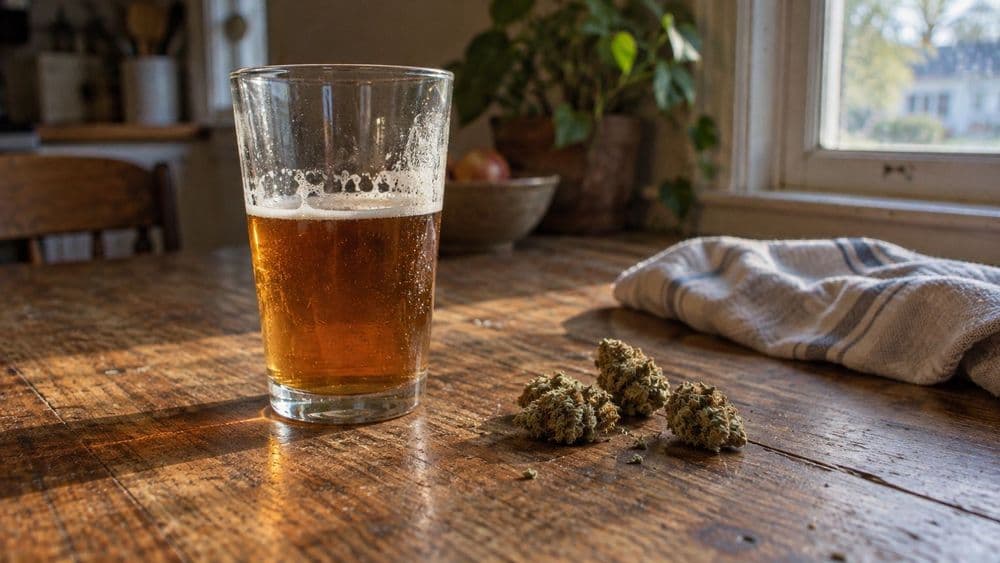
Is alcohol worse than weed? By most of the measures researchers can count across a whole population, yes: alcohol causes far more deaths, it is a known cause of cancer, and its links to car crashes and violence are larger and better measured. But "worse" is really several questions, and on some of them cannabis is not the safer answer. Here is the comparison one risk at a time, with current US data, the two formal attempts to rank drug harms, and what neither can tell you about your own use.
The short answer: by most population measures, alcohol causes more total harm than cannabis. A 2024 CDC analysis of deaths from excessive drinking estimates about 178,000 US deaths a year in 2020 and 2021, and there is no comparable count for cannabis. Both substances cause dependence, though, and among Americans who used each in 2024, a larger share of cannabis users than drinkers met criteria for a use disorder. Cannabis is also not the lower-risk choice in pregnancy, before 21, with a history of psychosis, with heart disease or behind the wheel. None of this makes cannabis safe, and none of it is a reason to switch. This page is written for adults 21 and over and gives no amounts, potency or timing advice.
Is alcohol worse than weed? Why "worse" is several questions
When you ask whether weed is worse than alcohol, you are really asking about a dozen different harms. How close is a typical dose to a fatal one? How many people die each year? How likely is addiction, and how hard is it to stop? What happens to your driving, your liver, your heart, your cancer risk and your mental health? What about a pregnancy, or a 17-year-old brain? The answer is not the same on every row, and for any one person it shifts with amount, frequency, product strength, how the substance is taken, age and health. There is also a difference between harm to one person and harm to a whole country: a substance used by more people produces more total harm even when the risk per user is the same. Keep both views in mind as you read. These are the rows this page compares:
- Fatal dose and deaths: how much margin there is, and how many people die each year.
- Dependence and withdrawal: two different ways to count addiction, and what stopping involves.
- Driving: crash risk, and why a THC test is not an impairment test.
- Violence: experimental evidence for alcohol, observational evidence for cannabis.
- Your body: cancer, liver, lungs and heart.
- Brain and mental health: psychosis, memory and thinking.
- Pregnancy and age: where neither is acceptable.
The two studies that tried to rank them
Most "alcohol is worse" headlines trace back to one of two studies, and they measured very different things. The first is a toxicology study. In a 2015 margin-of-exposure analysis by Lachenmeier and Rehm in Scientific Reports, researchers compared the dose that proved lethal in animal studies with the amount a typical person takes. The smaller that gap, or margin, the higher the risk. For an individual user, alcohol, nicotine, cocaine and heroin all landed in the "high risk" band, with a margin below 10. Across a whole population, only alcohol stayed in the high-risk band, while cannabis had a margin above 10,000, the widest of any substance assessed. The authors were explicit about what that does and does not cover:
“We can assess only in regards to mortality but not carcinogenicity or other long-term effects. The absence of such data is specifically relevant for compounds with low acute toxicity (such as cannabis), the risk of which may therefore be underestimated.”
In other words, it measures the risk of dying from a dose, not cancer, dependence, crashes or long-term damage, and it did not model drug combinations. The second ranking took the opposite approach. In Nutt, King and Phillips's 2010 multicriteria analysis in The Lancet, a UK expert panel met for a one-day workshop and scored 20 drugs on 16 kinds of harm: 9 to the person using and 7 to other people. Alcohol came out most harmful overall at 72 out of 100, ahead of heroin (55) and crack cocaine (54), largely because it scored highest for harm to others (46). In the full score list published by Imperial College London, cannabis scored 20. Policy researchers pushed back. In a 2011 critique in the journal Addiction, Caulkins, Reuter and Coulson called single-score rankings "fundamentally flawed, both conceptually and methodologically", said the Lancet effort "mixes aggregate and individual harms inappropriately" and concluded that "Harm is not usefully reducible to a single dimension." The panel's weights were also a judgment call. That critique is why the rest of this page goes one risk at a time.
Weed vs alcohol, side by side
Read the table across, not down. The fourth column tells you how strong the evidence is, and the fifth tells you what changes the answer for a given person. Where we found no evidence for a comparison, the cell says so instead of guessing. Every figure is explained, with its source, in the sections that follow.
| Risk | Alcohol | Cannabis (THC) | Strength of the evidence | What changes the answer |
|---|---|---|---|---|
| Fatal dose | Narrow margin; the only "high risk" substance at the population level in a 2015 toxicology model | Widest margin of any substance in the same model; no deaths in the emergency department in 2,567 cannabis-related visits at one Colorado hospital | Toxicology model plus one chart review | Using both, existing heart disease, children eating edibles |
| US deaths a year | About 178,000 from excessive drinking (2020-2021) | No comparable CDC estimate; harm shows up as crashes, heart events and emergency visits | Strong for alcohol; not established for cannabis | Binge drinking accounts for about 61,000 of the alcohol deaths |
| Becoming dependent, lifetime | 22.7% of people who ever drank | 8.9% of people who ever used | National survey, 2001-2005 | Era and product strength; cannabis dependence came sooner (half of cases within about 5 years, against about 13) |
| Use disorder among past-year users, 2024 | 18.7% of men and 12.6% of women who drank | 36.2% of men and 26.6% of women who used | National survey, 2024 | How often and how strong; ages 18-20 |
| Withdrawal | Can include seizures and delirium; about 850 deaths a year | Irritability, poor sleep, low appetite, mostly lasting 4-14 days | Strong | Heavy daily use |
| Crash risk | 6.75 times the crash odds at 0.05 breath alcohol or more | THC presence: no added crash odds after adjustment (1.00-1.05); impairment shown in controlled driving studies | Strong for alcohol; a THC test shows use, not impairment | Recent use; using both (fatal-crash odds 25.09 with both) |
| Violence | More aggression in randomized lab experiments | About twice the odds in observational studies; more arguments but not more physical aggression in the 2 hours after use in one diary study | Experimental for alcohol, observational for cannabis | Heavy use, psychiatric illness |
| Cancer | Group 1 carcinogen; about 100,000 US cases and 25,000 deaths in 2019 | 2017 review: moderate evidence of no link to lung or head-and-neck cancer; 2024 records study: head-and-neck signal in cannabis use disorder | Strong for alcohol; emerging for cannabis | Smoking, heavy use |
| Liver | Alcoholic liver disease is a cause of death attributed entirely to alcohol | NIH's LiverTox grades cannabis an unlikely cause of liver injury | Strong for alcohol | Hepatitis C |
| Lungs | Not compared here | Cough, phlegm and wheeze when smoked, which tend to ease after quitting | Moderate | Smoking vs other routes |
| Heart | Ages 15-39: lowest-risk amount is zero or close to it; above 40 it depends on age | Daily use: 25% higher odds of heart attack, 42% of stroke; heart-attack risk 4.8 times higher in the hour after smoking | Modeled for alcohol; survey and case-crossover for cannabis | Daily use, age, existing heart disease |
| Psychosis | Not compared here | Substantial evidence of an association, highest with the most frequent use; daily high-potency use linked to 4.8 times the odds | Strong association | Frequency, product strength, age, personal history |
| Pregnancy | Fetal alcohol spectrum disorders in 1.1%-5.0% of first graders in 4 US communities | FDA strongly advises against; linked to lower birth weight and preterm birth | Strong for alcohol; association for cannabis | Neither is safe |
| Ages 18-20 | Alcohol use disorder in 21.7% of men and 20.5% of women who drank (2024) | Cannabis use disorder in 50.0% of men and 47.2% of women who used (2024) | National survey, 2024 | Age of first use; neither is legal under 21 |
Deaths and overdose: the largest gap
The alcohol figure is a CDC estimate built from 58 causes of death. It rose from about 137,900 deaths a year in 2016-2017 to about 178,300 in 2020-2021, a 29.3% jump that spans the pandemic years, and the authors note that their method might underestimate the true toll. According to CDC's summary of US deaths from excessive alcohol use, about 117,000 of those deaths came from long-term use and about 61,000 from binge drinking. Alcohol can also kill on the way out. NIAAA's clinician guide to alcohol use disorder says withdrawal "can be life threatening if patients who chronically engage in heavy drinking stop drinking suddenly", and counts about 260,000 emergency visits and 850 deaths a year from it. If you drink heavily every day and want to stop, talk to a doctor first rather than stopping abruptly on your own.
Cannabis has no CDC death estimate to set beside that, and in the 2015 toxicology model its margin was the widest assessed. That is not the same as harmless. In a review of 2,567 cannabis-related emergency visits at a Colorado hospital, none ended in death in the emergency department, but heart attacks and dangerous heart rhythms did occur. In a study of 3,882 heart-attack patients, the risk of a heart attack starting was 4.8 times higher in the hour after smoking cannabis, which the authors called a rare trigger. Chest pain after cannabis is a reason to call 911, not a symptom to wait out. Too much THC is its own emergency, especially with edibles: our guide to greening out covers the signs and when to get help.
Is weed or alcohol more addictive? Two right answers
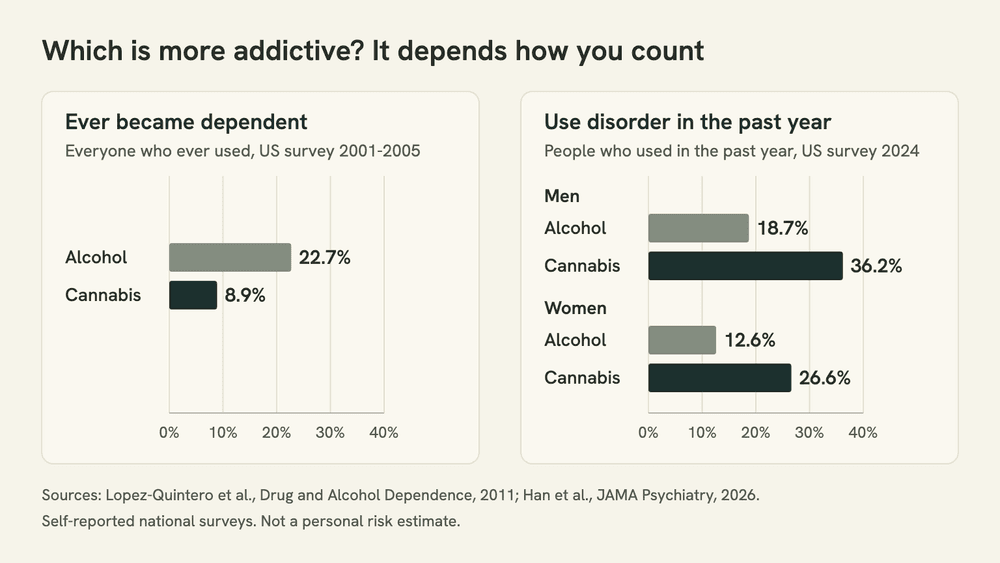
This is where most comparisons go wrong, because there are two correct answers that look as if they contradict each other. The first counts everyone who ever tried each substance. In a national US survey of lifetime users analyzed by Lopez-Quintero and colleagues in 2011, the cumulative chance of ever becoming dependent was 22.7% for alcohol and 8.9% for cannabis. By that measure, alcohol is more addictive. But cannabis dependence, when it came, came sooner: half of the cases appeared within about 5 years of first use, against about 13 years for alcohol. Those data were collected in 2001-2005, under older diagnostic criteria and before today's stronger products.
The second answer counts people who are using now. A 2026 NIDA analysis of the national drug-use survey by Han and colleagues in JAMA Psychiatry looked at adults who had used each substance in the past year. In 2024, 36.2% of men and 26.6% of women who used cannabis met criteria for cannabis use disorder, against 18.7% of men and 12.6% of women who drank for alcohol use disorder. Among 18- to 20-year-olds, the cannabis share was more than twice the alcohol share: 50.0% of young men who used cannabis, against 21.7% of young men who drank. Between 2021 and 2024, the number of US adults with alcohol use disorder fell from 28.8 to 27.1 million, while the number with cannabis use disorder rose from 15.3 to 19.4 million. The NIDA authors wrote that their findings "challenge the notion that cannabis has low addictive potential."
Both numbers are right; they divide by different groups. Most people who drink drink lightly, which pulls the alcohol share down, while people who used cannabis in the past year are more often frequent users of stronger products than the 2001-2005 users were. So if you are asking how likely a first drink or a first joint is to lead to dependence over a lifetime, the older data put alcohol higher. If you are asking how many of the people using today have a problem with it, the 2024 data put cannabis higher. Both surveys rely on self-report, and the 2024 one leaves out people who are incarcerated or unsheltered. Why the dependence answer is different for THC than for CBD is explained, criteria and all, in our addiction guide.
Stopping is different too. In a meta-analysis of 47 studies and 23,518 people, cannabis withdrawal was pooled at 47% among people who used regularly, a figure driven by clinical samples, and 17% in population-based samples. Symptoms are mostly irritability, poor sleep and low appetite, usually starting within 1-3 days and mostly lasting 4-14 days. That is unpleasant, but it is not medically dangerous in the way alcohol withdrawal can be, with seizures and delirium. What stopping cannabis feels like, day by day is covered in our tolerance-break guide. The NIDA authors add one more difference: "Unlike AUD, no US Food and Drug Administration-approved medications exist for CUD."
Driving: the best-measured gap, with a catch
The largest US crash-risk study is NHTSA's research note Drug and Alcohol Crash Risk (DOT HS 812 117, Compton and Berning, February 2015), which compared more than 3,000 crash-involved drivers in Virginia Beach with more than 6,000 drivers who were not in crashes. Drivers at a breath alcohol level of 0.05 or more, with no other drugs, had 6.75 times the crash odds of sober drivers after adjustment, and the risk climbed steeply with dose: roughly 4 times at 0.08 and 12 times or more at 0.15. THC-positive drivers looked 25% riskier at first (an odds ratio of 1.25), but that fell to 1.05 once age, sex and race were accounted for, and to 1.00 when alcohol was added. The catch is in NHTSA's own words. On the test: "Caution should be exercised in assuming that drug presence implies driver impairment." On the drug: "There is evidence that marijuana use impairs psychomotor skills, divided attention, lane tracking, and cognitive functions." A positive THC test shows use, not impairment, which blurs crash statistics. It does not make driving high safe.
Fatal crashes show the same shape. In a 2017 case-control study of 1,944 drivers killed in US crashes, compared with 7,719 drivers at roadside, the adjusted odds of fatal-crash involvement were 16.33 for alcohol only, 1.54 for marijuana only and 25.09 for both. Those are associations based on positive tests. Controlled driving studies, which measure impairment directly, consistently found the combination worse than either alone, and our study-by-study guide to mixing alcohol and THC goes through each one. For the legal side, see how per se THC driving laws work and why there is still no reliable THC breathalyzer. The practical line is the same for both substances: don't drive after either.
Violence: a cause for alcohol, a link for cannabis
Alcohol has something cannabis does not: experimental evidence. In a meta-analysis of 22 laboratory experiments by Crane and colleagues, men who were randomly given alcohol behaved more aggressively toward women in a lab aggression task than men who were not, a small-to-moderate effect (d = 0.36). Because drinking was assigned at random, researchers read that as cause and effect. Outside the lab, a 2008 meta-analysis by Foran and O'Leary found a small-to-moderate link between alcohol and men's violence toward partners, larger in men with more severe drinking problems.
Cannabis is not clean on violence, and articles that say it has no link are out of date. A 2026 Psychological Medicine review of 63 studies and 265,079 people by Trotta and colleagues found people who used cannabis had about twice the odds of committing violence (an odds ratio of 2.05 in the general population). The link was much smaller in studies that followed people over time (1.17) than in snapshot studies (2.37), and these studies cannot rule out other explanations, such as other drugs, alcohol or social circumstances. In the moment, the picture also looks different from alcohol. In a 30-day diary study of 183 couples who used cannabis, arguments and verbal aggression were more likely in the two hours after use, but physical aggression was not. So the honest contrast is not "alcohol causes violence and cannabis doesn't". It is that alcohol's effect has been shown in experiments, while cannabis's link is an association whose cause is not established.
Your body: cancer, liver, lungs and heart
Cancer is one of alcohol's clearest harms. According to the National Cancer Institute's fact sheet on alcohol and cancer, alcohol has been classified as a Group 1 carcinogen, the category for agents known to cause cancer in people, since 1987, and drinking was responsible for about 5% of US cancer cases (nearly 100,000) and about 4% of cancer deaths (nearly 25,000) in 2019. Heavy drinking raises the risk of mouth and throat cancers about 5 times, and even light drinking nudges breast cancer risk up. For cannabis, the National Academies' 2017 review of the cancer evidence found "moderate evidence of no statistical association" between smoking cannabis and lung cancer, and between cannabis use and head and neck cancers, in research dominated by light and moderate users. That answer is getting less certain. In a 2024 health-records study by Gallagher and colleagues, people diagnosed with cannabis use disorder were diagnosed with head and neck cancers about 3.5 times as often as matched patients. It is an association in heavy users, matched only on recorded alcohol and tobacco diagnoses, and the cause is not established.
On the liver, the gap is clear. Alcoholic liver disease is one of the causes of death that the CDC attributes entirely to alcohol, while the NIH's LiverTox reference grades cannabis an unlikely cause of liver injury. Our page on cannabis and the liver covers the exceptions, including hepatitis C. Lungs are where the route matters more than the plant. In a 2018 meta-analysis by Ghasemiesfe and colleagues, smoking cannabis was linked to about twice the risk of cough in prospective studies, along with more phlegm and wheeze; those symptoms tend to ease after quitting, and heavy use is less studied. The full lung data, including tobacco mixing, are in our cough explainer. We did not compare alcohol on this row.
The heart is where neither comes out clean. For alcohol, the 2022 Global Burden of Disease analysis found that for people aged 15 to 39 the amount with the lowest health risk is zero or close to it; only in older adults did small amounts look neutral, mostly because of heart disease. That update refined the same group's 2018 conclusion in The Lancet that "the level of consumption that minimises health loss is zero" into an answer that depends on age. It is not a reason to start drinking at any age. For cannabis, a 2024 survey of 434,104 US adults by Jeffers and colleagues found daily users had about 25% higher odds of having had a heart attack and 42% higher odds of a stroke, even among people who had never smoked tobacco. The survey cannot show which came first. Together with the heart-attack trigger data above, it is why existing heart disease changes the answer.
Brain and mental health
For cannabis, the strongest mental-health signal is psychosis. The National Academies' 2017 review of the mental-health evidence found "substantial evidence of a statistical association between cannabis use and the development of schizophrenia or other psychoses, with the highest risk among the most frequent users." In Di Forti and colleagues' 2019 multicenter study across 11 sites, which compared 901 people with a first episode of psychosis with 1,237 controls, daily use was linked to about 3.2 times the odds of psychosis, and daily use of high-potency cannabis (defined as 10% THC or more, which describes much ordinary modern flower) to about 4.8 times. It is a case-control association, not proof of cause. How potency and frequency relate to paranoia and psychosis is covered in more depth in our paranoia guide. This page gives no potency advice.
Alcohol has its own brain toll. In a UK study that followed 550 adults for 30 years with brain scans, Topiwala and colleagues reported that "Higher alcohol consumption over the 30 year follow-up was associated with increased odds of hippocampal atrophy in a dose dependent fashion", meaning more shrinkage of a key memory region with more drinking. For cannabis and thinking, timing matters: in young people who used often, the measurable gap in thinking skills was no longer statistically detectable after more than 72 hours without cannabis, while in a New Zealand cohort followed from birth, the 41 people with cannabis dependence at three or more assessments scored about 6 IQ points lower over time, a finding later studies have debated. Whether weed actually kills brain cells is a separate myth we take apart elsewhere.
Is weed worse than alcohol for some people? When cannabis is not the lower-risk choice
A table where alcohol loses most rows can read like permission. It isn't. Pregnancy is the clearest case where neither is acceptable. In a JAMA study of 6,639 first graders in four US communities, 1.1% to 5.0% had fetal alcohol spectrum disorders. For cannabis, the FDA strongly advises against the use of THC and marijuana in any form during pregnancy or while breastfeeding, and NIDA's cannabis DrugFacts note research linking it with lower birth weight and preterm birth. The federal position on cannabinoids in pregnancy has its own page. NIDA also links cannabis use at a young age with later psychosis and cannabis use disorder. These are the situations where cannabis is not the safer answer:
- Pregnancy or breastfeeding: neither substance.
- Under 21: neither. About half of 18- to 20-year-olds who used cannabis in 2024 (50.0% of men, 47.2% of women) met criteria for cannabis use disorder.
- A personal history of psychosis, or a close relative with one: the association is strongest with frequent use, and this is a reason to avoid cannabis. A clinician can talk through your own risk.
- Daily use of strong products: that pattern carries the highest psychosis odds in the research above, the highest use-disorder rates and the heart signal.
- Heart disease: daily use is linked to higher odds of heart attack and stroke, and the hour after smoking is a known trigger window.
- Driving or operating machinery: THC impairs driving skills, and a lower crash estimate for THC presence is not a safe level.
- Using both together: the combination is worse than either alone for driving, and fatal-crash odds were highest with both.
- Repeated bouts of severe vomiting with regular use: that pattern can be cannabis hyperemesis syndrome, which resolves when cannabis use stops, so see a doctor.
Should you switch from drinking to weed?
This page does not recommend switching in either direction, and neither does the best evidence. In a Brown University trial published in late 2025, 157 people who drank heavily and already used cannabis at least twice a week drank 19% to 27% less in the lab after smoking THC than after a placebo. They still drank, most used cannabis almost daily, more than three-quarters met criteria for cannabis use disorder, and it was one session. The authors wrote that recommending cannabis as a substitute for alcohol "would be premature and potentially risky." Observational studies do not settle it either: in a study that followed 557 residents of 48 Los Angeles sober living houses for a year, those who used cannabis had nearly four times the odds of having had a drink in the past month, an association rather than proof that cannabis caused the drinking. What the research says about swapping one for the other, including the "California sober" approach, has its own page, and the human studies on CBD with alcohol are a separate question.
To find services near you, the federal FindTreatment.gov locator lists treatment options by location, and NIAAA's Alcohol Treatment Navigator explains how to judge alcohol treatment options and what good care looks like.

What this comparison cannot tell you
- Your personal risk. Population numbers describe groups; amount, frequency, product strength, route, age, health and setting decide what happens to one person.
- A fair head-to-head on deaths. Alcohol has a CDC model that attributes deaths to it; cannabis has no equivalent, so "no count" does not mean "no deaths".
- Today's cannabis market. Much of the dependence data predates current products, and the evidence on potency itself is thin.
- Cause and effect for most cannabis harms. The violence, heart and head-and-neck cancer findings are associations, not proof.
- Long-term harms in the rankings. The toxicology ranking measured only the risk of dying from a dose, and its authors say it may understate cannabis's risks.
- Combined use. Many people use both, and single-substance comparisons miss that the combination is worse than either.
On potency, a 2025 systematic review of THC potency and health outcomes found the link with problem use "suggestive" but rated the certainty of the evidence "very low". None of these gaps changes the practical lines on this page: neither substance in pregnancy or before 21, never drive after either, don't combine them, and get medical support before stopping heavy drinking.
Questions people ask about weed vs alcohol
By most population measures, alcohol causes more harm: far more deaths (about 178,000 a year in the US from excessive drinking), it is a known carcinogen, and its links to crashes and violence are larger and better measured. That is not the same as "safe". Cannabis carries real risks of dependence, psychosis with frequent high-potency use, heart events and harm in pregnancy. Whether it is "better" to smoke than to drink is not something this page recommends either way.
It depends how you count. Over a lifetime, more drinkers than cannabis users became dependent in a national survey from 2001-2005 (22.7% against 8.9%), but cannabis dependence tended to arrive sooner. Among adults who used in 2024, a larger share of cannabis users than drinkers met criteria for a use disorder (36.2% against 18.7% of men), and the number of adults with cannabis use disorder is rising.
Alcohol, clearly. Alcoholic liver disease is one of the causes of death the CDC attributes entirely to alcohol, while the NIH's LiverTox reference grades cannabis an unlikely cause of liver injury. People with hepatitis C are an exception worth discussing with a doctor; our page on cannabis and the liver covers the details.
Alcohol's crash risk is larger and better measured: in NHTSA's 2015 study, drivers at 0.05 breath alcohol or more had 6.75 times the crash odds of sober drivers. THC presence did not add crash odds after adjustment, but NHTSA says marijuana impairs driving skills and that a THC test shows use, not impairment. Don't drive after either.
Yes. Controlled driving studies found the combination worse than either alone, and in a study of drivers killed in US crashes, the adjusted odds of fatal-crash involvement were 25.09 with both, against 16.33 for alcohol only and 1.54 for marijuana only. Our crossfaded guide covers the studies and the emergency signs.
The research behind this page did not measure hangovers, so we can't compare them with numbers. Some people report next-day grogginess after heavy or late-night cannabis use. Our guide to sleeping high covers what THC does to sleep and the next morning.
Both can be hard. Alcohol withdrawal can be medically dangerous, with seizures and delirium, and NIAAA counts about 850 deaths a year from it, so heavy daily drinkers should stop with medical support. Cannabis withdrawal usually means irritability, poor sleep and low appetite, mostly lasting 4-14 days. The SAMHSA National Helpline (1-800-662-4357) is free and confidential for either.
Read next: many people who compare alcohol and weed end up using both on the same night. Our study-by-study guide to being crossfaded covers what alcohol does to blood THC and driving, and the signs that mean you should call 911. For the next-morning question, what THC does to sleep and the morning after has its own guide.
Writing about hemp, wellness and the small rituals that keep us balanced.