Is CBD Addictive? What the Evidence Actually Shows
Is CBD addictive? The World Health Organization's drug-dependence committee reviewed cannabidiol in 2018 and reported no effects indicative of abuse or dependence potential in humans. Here is that finding with its limits, plus the human withdrawal study on the FDA label.

Is CBD addictive? Most people who type that are not asking whether cannabidiol is a drug of abuse. They are asking something quieter: if I take this every night, will I end up needing it to feel normal? That is a fair question, it has a real answer, and the answer has a date on it and a limit around it. Here is what has been measured in people, who measured it, and what still has not been measured.
The short answer first. In 2018 the World Health Organization's Expert Committee on Drug Dependence, the body that advises the United Nations on international drug control, published a critical review of cannabidiol and concluded that "in humans, CBD exhibits no effects indicative of any abuse or dependence potential". That is a review of the evidence that existed in 2018, about pure cannabidiol, and it is not a guarantee about anything sold on a shelf. The same report says plainly that controlled human studies of withdrawal and tolerance had not been carried out at that point. Everything below is what has been reported since, including a human physical dependence study printed on an FDA-approved drug label, plus the one place where the evidence is still genuinely thin.
Is CBD addictive? The short answer, and who actually said it
It matters who produced that sentence. The Expert Committee on Drug Dependence is the WHO body that reviews psychoactive substances and advises on whether they should be controlled internationally. Its entire remit on any given molecule is abuse liability, and it works from the published literature plus data submitted by member states and manufacturers. A committee that exists to find dependence, looking at a molecule and finding none, is a different class of evidence than a wellness blog repeating the same words. The cannabidiol review went to the committee's fortieth meeting in June 2018, and the committee's formal report of that meeting is published separately in the WHO technical report series.
“In humans, CBD exhibits no effects indicative of any abuse or dependence potential. [...] To date, there is no evidence of recreational use of CBD or any public health-related problems associated with the use of pure CBD.”
Two more lines from the same document are worth carrying. Section 13 states that "at present, there are no case reports of abuse or dependence relating to the use of pure CBD", and that there are no published statistics on non-medical use of pure CBD either. We re-ran the equivalent PubMed search on 8 August 2026 (cannabidiol in the title or abstract, with dependence or addiction, filtered to the case-report publication type) and got four indexed records. All four describe cannabidiol being given for something else: one on cannabis and insomnia, one a case series of individualized cannabinoid treatment, and two describing CBD given to people trying to cut down their cannabis use, which is a different question this page does not answer. None of them is a report of dependence on CBD itself. Treat that as weak evidence in both directions: no surveillance system is looking for such a case, and a hemp supplement is not a reportable exposure the way a prescription drug is.
And section 7B of the same report, the section headed dependence potential in human studies, is candid about the hole in its own conclusion: "Controlled, human studies regarding the potential physical dependence effects (e.g. withdrawal and tolerance) of cannabidiol have not been reported." That was 2018. If you want the plain chemistry underneath all of this first, our hub on what cannabidiol actually is covers it. What follows is what has been reported since, in the order it arrived.
Addiction, dependence, tolerance and routine are four different things
Most of the confusion in this topic is vocabulary. Four words get used as if they were one word, and the question people actually have usually sits in the fourth. Start with the narrowest: the National Institute on Drug Abuse defines addiction as "a chronic, relapsing disorder characterized by compulsive drug seeking and use despite adverse consequences". Taking something every day is not on that list. Neither is liking it.
The word dependence is the one that trips everyone, and there is a historical reason. Until 2013 the diagnostic manual carried two separate diagnoses, abuse and dependence. The current manual merged them into a single use disorder, graded mild, moderate or severe by how many of eleven criteria a person meets within a twelve-month period, dropped legal problems from the list and added craving to it. That federal explainer is written about alcohol, and the same eleven-criterion structure is used for other substances. So when a 2018 pharmacology report says no dependence potential, it is answering a narrower question than the one most readers are asking, and the table below separates them.
| Term | What it means | How it is measured | What has been reported for CBD |
|---|---|---|---|
| Addiction (substance use disorder) | Compulsive seeking and use that continues despite adverse consequences | A clinical diagnosis: 2 or more of 11 criteria met within a 12-month period | The WHO's 2018 review found no case reports of abuse or dependence on pure CBD, and no statistics on non-medical use |
| Physical dependence | The body adapts to the drug, so stopping produces withdrawal signs | Stop the drug and watch for signs and symptoms across a defined window | 1,500 mg a day for 28 days produced no signs or symptoms of withdrawal across a 6-week window beginning 3 days after stopping |
| Tolerance | The same dose produces a smaller effect over time | Repeat the dose and remeasure one specific endpoint | Observed in people for resting blood pressure, after 7 days at 600 mg a day in 26 healthy men |
| Routine attachment | A behavior becomes part of your day and you notice when it is missing | Not a clinical category at all. It is a behavior, not a diagnosis | Not studied, and not a disorder. This is the one most people are actually asking about |
One wording note, because it is deliberate. This page says routine for the ordinary behavior and keeps clinical language for clinical situations. NIDA's own guidance for clinicians asks them not to call a substance use disorder a "habit", because habit implies a person is simply choosing to use and could simply choose to stop. The mistake runs the other way too, and that version is all over this search result: calling a bedtime routine an addiction.
What has actually been measured in people
Three human studies carry most of the weight, and they read best in order. In 2012, a randomized, double-blind, placebo-controlled crossover trial gave 16 healthy men 600 mg of oral CBD, 10 mg of oral THC or placebo across three sessions a month apart. THC produced anxiety, dysphoria, sedation, subjective intoxication and a rise in heart rate. The authors reported "no differences between CBD and placebo on any symptomatic, physiological variable". That is also how the WHO committee summarized this literature in section 8B of its review, the human-studies half of its abuse-potential chapter: "While the number of studies is limited, the evidence from well controlled human experimental research indicates that CBD is not associated with abuse potential." Sixteen men, single doses, one site, acute effects only.
In 2017, a multisite, within-subject, double-blind study gave 31 frequent cannabis smokers oral CBD at 200, 400 and 800 mg, alone and alongside smoked cannabis. Active cannabis reliably produced abuse-related subjective effects such as feeling high. The authors reported that "CBD was placebo-like on all measures collected" and concluded that it "did not display any signals of abuse liability at the doses tested". Two things about that one: it was a secondary analysis inside a drug-interaction study, in frequent cannabis users rather than the general public, and it was supported by NIDA rather than by a manufacturer, which is not true of every study on this page.
The study regulators leaned on hardest arrived in 2018. Healthy recreational polydrug users received single oral doses of 750, 1,500 and 4,500 mg of pharmaceutical CBD, against alprazolam 2 mg, dronabinol at 10 and 30 mg, and placebo, in a randomized double-blind double-dummy crossover. Forty-three people were dosed and 35 of them were included in the pharmacodynamic analysis that produced the figures below. Here is the part most summaries drop. At 750 mg, drug-liking was not significantly different from placebo (P = 0.51). At 1,500 mg and 4,500 mg it was significantly different (P = 0.04 and P = 0.002). What rescues that result is the size of the difference: under 10 points on the visual analog scale, against more than 18 points for both comparison drugs. The trial also reported that, unlike alprazolam, CBD had no observable effect on cognitive and psychomotor tests. The author list includes employees of GW Research and Greenwich Biosciences, the developer of the approved CBD medicine, which is worth knowing when you read the conclusion rather than after.
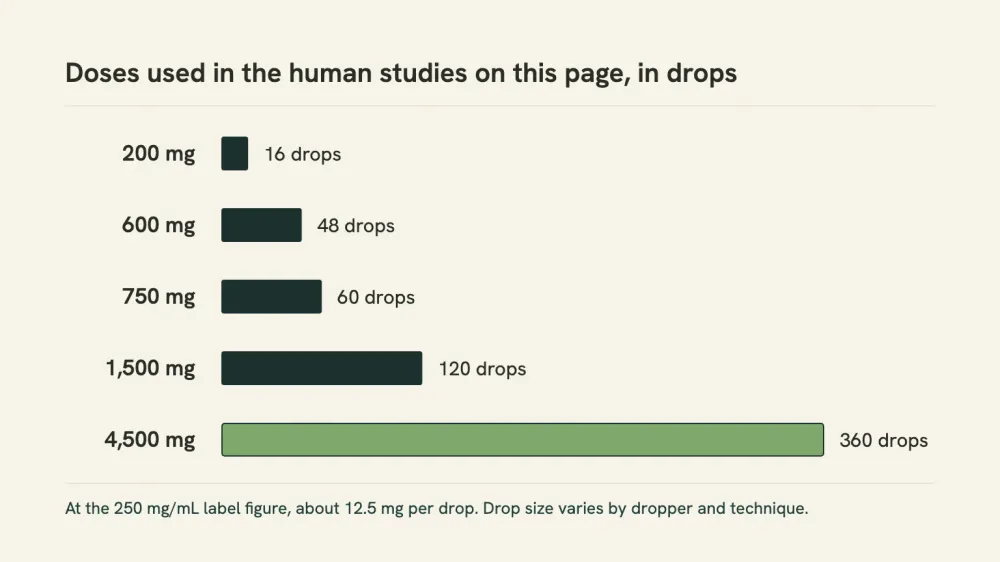
It helps to see what those doses look like in a dropper. At the label figure of 250 mg/mL and roughly 12.5 mg per drop, 200 mg is about 16 drops, 600 mg is about 48, and the 750 mg that behaved like placebo is about 60 drops in a single sitting. The 4,500 mg arm is about 360 drops, 18 mL, close to a third of a 60 mL bottle at once. Drop size varies by dropper and technique, and this arithmetic is for perspective only. It is not a suggestion, and none of these are amounts anyone should be aiming at.
Underneath the human work sits the animal package submitted with the drug approval. In rats and nonhuman primates, monkeys that would self-administer the benzodiazepine midazolam did not self-administer CBD, rats trained to recognize midazolam did not respond to CBD as though it were that drug even at 150 mg/kg by mouth, and discontinuing 20 days of twice-daily oral dosing at 20 or 100 mg/kg "did not reliably produce signs of withdrawal". The asterisk, because this page prints them: in rats that would self-administer heroin, CBD did maintain what the authors called "very modest levels" of self-administration. That work was run in animals by the drug's developer. Animal results are a reason to run the human study, not a substitute for it, and nothing in that package transfers to a person or to a product.
What happens when you stop
The most direct answer to the withdrawal question is not in a journal. It is printed in section 9.3 of the prescribing information for EPIDIOLEX, the FDA-approved cannabidiol oral solution: "In a human physical dependence study, administration of cannabidiol 1500 mg/day (750 mg twice daily) to adults for 28 days did not produce signs or symptoms of withdrawal over a 6-week assessment period beginning three days after drug discontinuation. This suggests that cannabidiol likely does not produce physical dependence." That is a regulator-reviewed dossier reporting a deliberate cessation experiment in people, which is exactly the thing the WHO said in the same year had not been reported.
Two things about that paragraph, in both directions. It describes a prescription 100 mg/mL oral solution taken under medical supervision with mandatory liver bloodwork, not a hemp tincture, and the dose is enormous by consumer standards. At the label figure of 250 mg/mL, 1,500 mg a day works out to about 120 drops a day, roughly 6 mL, which would be a 60 mL bottle every ten days and close to three bottles across the 28 days. Almost nobody takes CBD like that. The finding is reassuring partly because the dose was so far above a normal serving and the result was still nothing. What it cannot tell you is what five years of a small nightly serving does, because 28 days is not five years.
For contrast, here is what a documented withdrawal syndrome looks like in numbers. A systematic review and meta-analysis of 47 studies covering 23,518 people pooled the prevalence of cannabis withdrawal syndrome at 47% among people with regular or dependent cannabinoid use. Read the spread rather than the headline: it was 17% in population-based samples, 54% in outpatient samples and 87% among inpatients, and the variation between studies was extreme. NIDA's cannabis summary lists what those symptoms are, including irritability, anxiety, restlessness, decreased appetite, insomnia, headaches, sweating, abdominal pain and tremor. Every one of those figures describes cannabis products containing THC. They are the comparison here, not the subject. If your actual question is how long the molecule sticks around, how long it takes CBD to leave your system covers the clearance timeline.
Tolerance: the one place the evidence is genuinely thin
Tolerance means the same dose produces a smaller effect over time. It is a separate question from dependence, and it is where the honest answer is least satisfying. The WHO committee's 2018 position was that controlled human studies of tolerance had not been reported. Since then a human trial has used that word about CBD in its own conclusion, and it is worth reading precisely rather than in summary, because the summary version is what gets repeated wrong in both directions.
A randomized controlled trial gave 26 healthy men either 600 mg of CBD or placebo daily for seven days, 13 per arm. A single dose lowered resting blood pressure by a small amount, about 2 mmHg of mean arterial pressure. After seven days of dosing that resting effect was gone, and the authors used the word tolerance for it in their own conclusion, while the blood-pressure reduction measured during stress persisted. So tolerance to one measured physiological effect of CBD has been observed in people, and that is worth stating plainly rather than skipping. Note the boundaries: 26 healthy men, seven days, 600 mg a day (about 48 drops at the label figure), and tolerance to a blood-pressure endpoint, not to whatever you are personally taking CBD for.
The claim pointing the other way is everywhere in CBD retail content: "reverse tolerance", the idea that CBD works better the longer you take it. Searching PubMed on 8 August 2026 for that phrase alongside cannabidiol in titles and abstracts returns two records, PMIDs 6690168 and 6975285: a 1984 paper on the bronchial effects of oral cannabinoids and a 1981 paper on cannabinoids as potential antiepileptics. Neither is a study of CBD becoming more effective with use. A null search does not prove a thing is false, but it does show there is no human trial behind a claim that is repeated as though there were one. The mechanism story that usually travels with it, that CBD cannot cause tolerance because it does not bind CB1 at all, is wrong on its own terms: CBD is catalogued at that receptor, as a negative allosteric modulator rather than an agonist.
- Known: one seven-day randomized trial in 26 healthy men found tolerance to CBD's resting blood-pressure effect at 600 mg a day, while the effect measured during stress persisted.
- Known: in rats and monkeys, stopping 20 days of twice-daily oral CBD did not reliably produce withdrawal signs. That is animal data, and it stays animal data.
- Not known: whether tolerance develops at consumer servings taken nightly for months or years. The human exposures described here run one day, seven days and 28 days.
- Not known: whether tolerance to one measured endpoint predicts anything at all about another endpoint. Blood pressure is not sleep and is not stress.
- Not supported: reverse tolerance. A dated PubMed search returns no human trial of CBD becoming more effective with continued use, only two unrelated 1980s cannabinoid papers.
- If the effect fades: not a bigger dropper on your own. Look at what else changed first, and raise it with a clinician who knows your medications.
That last item is the one this page will not soften. If what you noticed at first fades, escalating on your own is the move to avoid, because the thing that changed may not be the CBD at all. Our practical dosage guide covers how servings are usually thought about, and what the first two weeks tend to feel like covers the adverse-effect side of the same question, including the ordinary early effects people mistake for something else. Neither replaces the conversation with a clinician, especially if you take prescription medication.

Why the answer is different for THC
The dependence risk of cannabis is not mysterious, and the reason it does not transfer to CBD is pharmacological. THC is a partial agonist at the CB1 and CB2 cannabinoid receptors, meaning it switches CB1 on, and CB1 is the receptor behind intoxication and, under repeated heavy activation, behind the adaptations that produce tolerance and withdrawal. Cannabidiol is catalogued at human CB1 as a negative allosteric modulator, which means it can change how that receptor responds to other molecules rather than activating it directly. That is in-vitro pharmacology, and a receptor label is not a felt effect: it does not mean CBD blocks anything for you. For the wider comparison, CBD and THC compared side by side goes into the chemistry, and why CBD is not intoxicating handles the high question that usually travels with this one.
| Substance | Cumulative probability of dependence among lifetime users | Half of dependence cases had appeared by |
|---|---|---|
| Nicotine | 67.5% | About 27 years after first use |
| Alcohol | 22.7% | About 13 years after first use |
| Cocaine | 20.9% | About 4 years after first use |
| Cannabis | 8.9% | About 5 years after first use |
| Cannabidiol (CBD) | Not measured | Not measured |
Those figures come from a prospective national survey that followed lifetime users of four substances, with samples of 15,918 for nicotine, 28,907 for alcohol, 7,389 for cannabis and 2,259 for cocaine, and they need their limits attached: US survey data collected between 2001 and 2005, self-reported, scored against the older DSM-IV dependence criteria, and cannabis potency has changed a great deal since. NIDA's current summary puts cannabis use disorder at 22% to 30% of people who use cannabis, and cites an estimate that 12.1% of people who use it frequently experience cannabis withdrawal. The empty row is the honest one. There is no CBD dependence rate to print, not because it came back as zero, but because the study that would produce a rate has not been run.
Which leaves the fair version of the question for full-spectrum products, since they are not THC-free: how much THC is actually in a serving? On our Full Spectrum CBD Mango and Peach, batch 260310, the certificate prints delta-9 THC at 2.27 mg/mL against CBD at 267 mg/mL. At about 0.05 mL per drop that is roughly 0.11 mg of THC and about 13.4 mg of CBD per drop, a ratio near 118 to 1. Reaching the 10 mg oral THC dose used in that 2012 comparison trial would take about 88 drops in one sitting, roughly 4.4 mL, carrying around 1,180 mg of CBD with it. Certificates are batch-specific, which is why the certificate is the number that counts rather than the category name on the front of a box, and every batch we sell has one on our third-party lab results page. On the broad-spectrum side, our mango and natural batches report delta-9 THC as non-detected against a stated detection limit, which is a ceiling rather than a proven zero, while the lemon and raspberry batch of the same product reports a small figure just above its own quantitation limit. Same line, three flavors, three different answers, which is the reason to read the batch rather than the category.
Routine, or something else? A self-check
This is the part that usually gets either skipped or moralized, and it is where the real question lives. A nightly routine can become genuinely important to a person even when the molecule is not the thing doing the holding. That is not a disorder, and calling it one helps nobody. But there are patterns worth raising with a clinician, and none of them is simply "I take it every day". Read the list as prompts for a conversation, not as a checklist you score yourself against.
- You have increased the amount more than once without a reason you can name, and the increases are getting closer together.
- Running out causes real distress, or you rearrange your day and your plans to make sure it does not happen.
- You have started hiding how much you use, or you shade the number down when someone asks.
- Use continues even though something has clearly gone wrong: a side effect you dislike, a cost you cannot carry, a conflict at home.
- You are using it to avoid a problem that is getting worse rather than better, which is worth saying out loud to someone.
- You have a history of a substance use disorder, in which case any daily-use decision belongs with someone who knows that history.
What this evidence does not cover
Every finding above has an edge, and the edges matter more here than usual, because this is a topic that invites absolute statements in both directions. Five of them are worth stating plainly.
- 1Duration. The longest human exposure described here is 28 days. The rest are single doses, seven days, or short crossover sessions. Nothing on this page speaks to what years of use does.
- 2Sample size and makeup. Sixteen, 26, 31 and 43 people dosed, and only 35 analyzed in the largest of them, mostly male, mostly healthy or deliberately selected. These are pharmacology studies, not population studies.
- 3Dose and formulation. Every study used purified or pharmaceutical CBD at amounts several times a typical tincture serving. A hemp extract carrying trace THC and minor cannabinoids is not the same input.
- 4Sponsorship. Two of the key datasets, the 2018 abuse-potential trial and the animal package, were produced by the developer of the approved CBD medicine.
- 5Species. The self-administration and drug-discrimination results come from rats and monkeys, and they do not transfer to people or to any product.
One more boundary, stated once. This page is about whether CBD itself creates dependence. Whether cannabidiol has any role in treating a substance use disorder is a separate clinical question, it is where a large share of the published literature actually sits, and it is outside what we cover. More broadly, the NIH's National Center for Complementary and Integrative Health walks through the conditions people take cannabinoids for and calls the human evidence limited, inadequate or, for most of the list, still "in its early stages". That is the right frame for everything above. If your question is really about one large amount rather than long-term use, what taking too much actually looks like covers that, and interactions worth checking before daily use covers the risk that daily use genuinely does raise.
Common questions about CBD, dependence and withdrawal
The most direct human evidence on record is printed in section 9.3 of the FDA-approved cannabidiol label: 1,500 mg a day for 28 days produced no signs or symptoms of withdrawal across a six-week assessment period that began three days after the last dose. Two caveats travel with that. It is a prescription drug at roughly 120 drops a day of a 250 mg/mL oil, far above a normal serving, and 28 days is not years. If something gets worse after you stop, the likelier explanations are that your baseline is returning or that you expected it to be rough. No withdrawal syndrome has been described for cannabidiol in the human studies covered here, and the longest exposure among them is one month.
It depends what you mean by the phrase. NIDA defines addiction as compulsive drug seeking and use despite adverse consequences, and taking something daily does not meet that definition. But a routine can become psychologically important even when the molecule is not doing the holding, and that is a real thing worth noticing rather than a diagnosis. The self-check earlier on this page lists what actually warrants a clinician conversation: escalation you cannot explain, distress when you run out, hiding your use, or use that continues despite a clear harm.
To at least one measured effect, yes, and it has been observed in people. A randomized trial in 26 healthy men found that a single 600 mg dose lowered resting blood pressure by about 2 mmHg of mean arterial pressure, and that the resting effect was gone after seven days of daily dosing, which the authors described as tolerance. The blood-pressure reduction measured during stress persisted. Whether tolerance develops to anything else, at consumer servings, over months, has not been tested. And if the effect you noticed at first fades, the answer is not to escalate on your own.
The label of the FDA-approved cannabidiol medicine states, in section 9.1, that it is not a controlled substance. That is a legal classification of one prescription product, not a safety verdict and not a statement about every hemp product on a shelf. Legal status is a separate topic with its own moving parts, including the 0.3% THC threshold and the state-by-state complications, and our article on the legal status of CBD covers it properly.
None of the human abuse-potential studies described here tested gummies or inhaled CBD. All of them used oral pharmaceutical CBD. How fast a substance reaches the brain is a known driver of abuse liability in general, which is exactly why the absence of inhaled-CBD data should be stated rather than filled in with a guess. What differs between formats is how much reaches your blood and how quickly, not a documented dependence signal that one format carries and another does not.
Full-spectrum products are not THC-free, so the useful version of that question is arithmetic. On our Full Spectrum CBD Mango and Peach, batch 260310, the certificate prints delta-9 THC at 2.27 mg/mL against CBD at 267 mg/mL, which is about 0.11 mg of THC and 13.4 mg of CBD per drop, a ratio near 118 to 1. Reaching the 10 mg oral THC dose used in the 2012 comparison trial would take roughly 88 drops in one sitting. Certificates are batch-specific, so the certificate is the number that counts, and no product can guarantee an individual outcome.
Daily use is not itself a dependence criterion, and this page will not hand you a blanket yes. The questions that actually matter for daily use are interactions with medications you already take and, at higher amounts, what happens to liver enzymes. Those live on our pages about CBD and medications and about what the liver research measured. If you take prescription medication, that conversation belongs with a pharmacist or a doctor before it belongs with an article.
If this page did its job, you leave with four separate words instead of one blurred one, a dated finding with its limits attached, and a clear line between an ordinary routine and a reason to ask for help. Two places to go next, depending on which half of the question brought you here: the legal status of CBD in the US covers the controlled-substance side properly, and the difference between oils and gummies covers the format question the FAQ above only half answers.
Writing about hemp, wellness and the small rituals that keep us balanced.