Can Weed Cause Headaches? The 4 Kinds and the Red Flag
Weed can cause headaches, but the phrase covers four different situations: during use, the morning after, a few days after quitting, and frequent use in people with migraine. Here is what the studies behind each show, and the one sudden headache that needs 911.

Can weed cause headaches? Yes, it can, but "weed headache" is really four different things. There is the headache during or right after using, the one the next morning, the one that shows up a few days after a regular user stops, and a pattern of near-daily headaches in some people with migraine who use cannabis often. Each has a different likely cause and a very different amount of evidence behind it. And one rare headache linked to cannabis, a sudden, explosive one, is a medical emergency.
Most pages that rank for this question are written by dispensaries and medical-card services, and they tend to slide from "does it cause headaches" into "can it treat them". This page stays on the first question. For each of the four situations, it gives what the studies actually measured, how many people were in them, and what they cannot tell you. It also covers the red flag those pages skip, and a quick check to help you work out which headache you are dealing with. It is general information for adults 21 and over, not medical advice, and it is not a guide to using cannabis for headaches or migraine.
The four weed headaches at a glance
Timing is the best clue. The table sorts the four situations by when the headache starts, what is most likely going on, how good the evidence is and what is reasonable to do. The last row is not a fifth type so much as a warning that applies to all of them. Each row gets its own section below, with the studies behind it.
| When it starts | What is likely going on | How strong the evidence is | What to do |
|---|---|---|---|
| During or within hours of using | Too much THC at once, smoke and carbon monoxide, alcohol the same night; some of it is ordinary background headache | Low to moderate: small controlled trials, with headache on placebo too | Stop for the day, rest, drink water if you are thirsty, skip alcohol, note how and how much you used |
| The next morning | Unclear; alcohol, a late session and a short night are all candidates | Very low: never measured as a headache outcome | Check what else happened the night before |
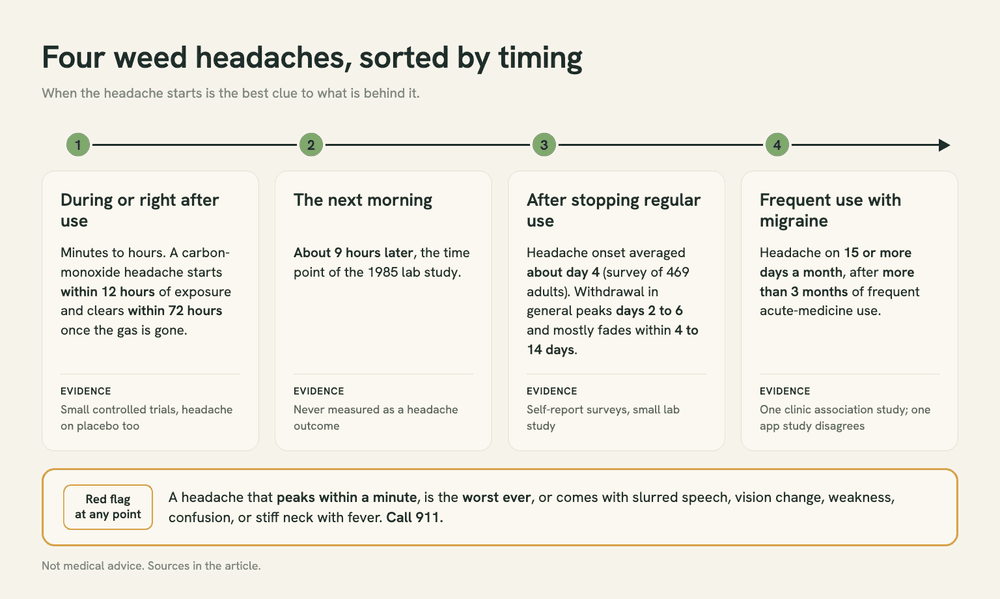
| A few days after a regular user stops (average onset about day 4) | Cannabis withdrawal, a recognized syndrome that includes headache | Moderate for withdrawal overall; the headache data come from self-report surveys | Usually temporary; see a clinician if it is severe, keeps worsening or does not settle |
| Headache on 15 or more days a month, in someone with migraine who uses cannabis often | Possible medication-overuse headache, or cannabis tracking with other overused headache medicines | Low: one clinic association study, and one app study that found no such signal | Raise the pattern with a clinician; do not change prescribed migraine medicine on your own |
| Red flag: sudden, explosive, worst ever, peaks within a minute | Possible reversible cerebral vasoconstriction syndrome (RCVS) or bleeding in the brain | Case series and report databases; no known rate per user | Call 911 |
Headache during or right after using
The cleanest data come from controlled trials, where some people unknowingly get a placebo. In a 2010 randomized trial of 23 adults with chronic nerve pain, participants smoked a 25 mg dose of cannabis from a pipe three times a day for five days, at four strengths: 0%, 2.5%, 6% and 9.4% THC. Headache was among the most common side effects at the strongest strength. It also showed up on the 0% THC placebo: the trial recorded 3 headache reports on placebo, and 3, 7 and 4 on the three active strengths. A week-long trial of THC capsules in 41 healthy adults found a similar picture. Five people reported a headache, including 1 of the 8 on placebo, and the highest dose (20 mg a day) produced none. Most side effects in that trial bunched on the first day. And the FDA label for dronabinol, a prescription synthetic THC capsule, lists headache among its less common side effects, reported in 1% of trial patients or fewer.
Two lessons come out of those numbers. First, headache is common background noise. People get headaches on placebo, and on ordinary days, for reasons that have nothing to do with cannabis, which is why a study without a placebo group cannot tell you much. Second, none of these trials showed a neat dose ladder where more THC meant more headaches. They are small, used specific products in specific groups of people, and cannot give you a personal risk. What they do show is that headache during or soon after THC is a recognized side effect, and that in the capsule trial, side effects clustered on day one. Beyond THC itself, four things are the usual suspects:
- Smoke and carbon monoxide. Burning plant material produces carbon monoxide, and headache is the classic sign of carbon-monoxide exposure.
- Alcohol the same night. When cannabis and alcohol are combined, the next-day misery seems to track the alcohol more than the cannabis.
- Too much at once. Edibles take longer to kick in, which makes it easy to take a second dose before the first has landed.
- Dehydration. It is the most repeated explanation online, and the least supported for cannabis specifically.
On smoke: in a 1988 study of 15 men, smoking a marijuana cigarette raised blood carboxyhemoglobin, the share of hemoglobin carrying carbon monoxide instead of oxygen, nearly five times more than a similar amount of tobacco. The International Headache Society's classification, the standard neurologists use to define headache types, defines a carbon-monoxide headache as one that starts within 12 hours of exposure and clears within 72 hours once the gas is gone, and notes that carboxyhemoglobin levels of 10 to 20% typically cause a mild headache. Nobody has measured whether ordinary cannabis smoking reaches that range, so treat smoke as a plausible contributor, not a proven cause. Blunts add more carbon monoxide than joints, as our blunt vs joint comparison explains, and our guide to dry-herb vaporizers vs smoking covers what vapor does and does not remove.
On dehydration: dehydration alone can cause headaches, and cottonmouth feels like thirst. But cottonmouth is THC turning down the nerve signal to your salivary glands, a mechanism shown in a 2022 study in mice, not your body running out of water. Our cottonmouth explainer has the details. No study we found shows that cannabis dehydrates you. Water is harmless, so drink it if you are thirsty; just do not assume dehydration is the explanation.
On alcohol: a daily-survey study of 341 college students who used both substances, tracked five times a day for 56 days, found hangovers were least likely on cannabis-only days. The authors concluded that most of the negative consequences of combining the two they looked at "appear to be driven by alcohol consumption rather than cannabis use." That study measured hangover in general, not headache specifically, but it is a good reason to look at the drinks first. Our guide to being crossfaded covers what happens when the two are mixed.
On amount: edibles take smoke out of the picture, but they make stacking easy, because edibles take longer to kick in than smoking and a second dose can land on top of the first. No study compares headache rates between edibles and smoking. If too much THC brings on more than a headache, such as vomiting, a racing heart or panic, our guide to greening out covers what to do.
The morning after: what the "weed hangover" studies measured
The idea of a weed hangover comes mainly from two lab studies from the 1980s. In the 1985 study, 13 men smoked cannabis with 2.9% THC, and about 9 hours later showed small changes on two questionnaires about how they felt and on a task that asked them to estimate time intervals. In a 1990 follow-up, the same researcher had 12 regular smokers take 40 puffs of 2.1% THC cannabis across five late-afternoon and evening sessions, and concluded that marijuana smoking "was not associated with a 'hangover' syndrome similar to those reported after use of alcohol or long-acting sedative-hypnotics." Neither study reported headache as an outcome. Both were tiny, involved all or mostly men, and used cannabis a fraction as strong as much of what is sold today.
The broader evidence points the same way. A 2023 systematic review of 20 studies with 458 participants looked at 345 next-day performance tests after THC. In 209 of them there was no next-day effect. The 12 that showed impairment came from five studies, none of them randomized, double-blind and placebo-controlled, and all published more than 18 years earlier. The review did not include a single headache measurement: when we searched its full text on 28 September 2026, the word "headache" did not appear. So the morning-after headache is something people report, not something researchers have measured. Before blaming the cannabis, it is worth checking what else was going on that night, such as drinking, a late session or a short night. Our guide to whether it is bad to sleep high covers what THC does to sleep.
Headaches when you stop using
This is the best-documented cannabis headache. Psychiatry's diagnostic manual, the DSM-5, lists headache among the physical symptoms that can count toward cannabis withdrawal, which is diagnosed when at least three symptoms appear within about a week of stopping heavy, prolonged use. The headache numbers come from a survey of 469 adults who described their most difficult attempt to quit. Headache was reported by 23.2% (109 people), making it one of the two most common physical symptoms, alongside weight gain. It started on average 4.2 days after stopping, with an average peak intensity of 3.3 on a 5-point scale, and three in four of those who had it (75.2%) did something to relieve it. Withdrawal symptoms turned up even in people who had used less than weekly, and physical symptoms in general came on faster and faded sooner than sleep or mood changes. The limits: it was a convenience sample of people recalling a past quit, not a clinical study.
How common is withdrawal in the first place? A 2020 meta-analysis of 47 studies and 23,518 people put it at 47% of regular users overall but 17% in general-population samples; clinical samples push the number up. For timing, a 50-day study that tracked 18 people after they stopped found that withdrawal symptoms in general usually began within 1 to 3 days, peaked between days 2 and 6 and mostly faded within 4 to 14 days. That study did not track headache specifically, so read it as the general withdrawal clock, not a headache timeline. NIDA's public summary on cannabis also lists headaches among withdrawal symptoms.
If this is your headache, the reassuring part is that withdrawal symptoms are usually temporary. Our tolerance break guide covers the whole withdrawal picture, from sleep to mood, and what to expect when you pause. Talk to a clinician if the headache is severe, keeps getting worse or has not settled after a couple of weeks, or if stopping is hard enough that you keep going back to cannabis just to feel normal.
When frequent use and migraine collide: medication-overuse headache
Medication-overuse headache is a formal diagnosis, not a slang term for a rebound. Under the International Headache Society's criteria, it means headache on 15 or more days a month in someone with an existing headache disorder who has regularly overused acute headache medicine for more than three months. It usually, though not always, resolves once the overuse stops. The subtypes the classification names are ergotamine, triptans, non-opioid painkillers, opioids and combination painkillers, plus a catch-all for other medicines taken to treat headache. Cannabis is not named in any of them, so whether it belongs there is an open question.
The study behind the "cannabis causes rebound headaches" headlines is a 2021 chart review from Stanford's headache clinics. Among 368 adults with chronic migraine seen between 2015 and 2019, 81% of current cannabis users (122 of 150) also had medication-overuse headache, against 41% of non-users (90 of 218). After adjustment, the odds were 6.3 times higher (95% confidence interval 3.56 to 11.1). That is a strong association, but the design cannot show which came first. People with worse, more frequent headaches may reach for cannabis along with everything else, and in this sample, cannabis use went hand in hand with opioid use.
A different study points the other way. An analysis of app data from people who logged their own cannabis use for headache (12,293 headache sessions and 7,441 migraine sessions) found signs of tolerance: over time, people used larger doses. But Washington State University's November 2019 announcement of the study said the team "saw no evidence that cannabis caused 'overuse headache'". That sample was self-selected and self-reported, with no placebo group, so it has its own blind spots. Two populations, two designs, no settled answer.
What this means for you: if you have migraine and use cannabis, or acute headache medicine, on many days a month, and your headache days are climbing, raise the pattern with a clinician. That matters even more if you also take triptans, opioids or other acute migraine drugs. Do not stop or change prescribed migraine medicine on your own, and do not read either study as a reason to start or stop cannabis for migraine.
The headache that is an emergency
Those warning signs follow the headache guidance from MedlinePlus, the National Library of Medicine's health encyclopedia. Doctors call a headache that hits its peak almost instantly a thunderclap headache. The headache classification defines it as severe pain that reaches maximum intensity in under one minute and lasts at least five minutes, and notes that it is frequently linked to serious problems with blood vessels in the brain, particularly bleeding around the brain (subarachnoid hemorrhage). One of the causes it says doctors must rule out, and the one where cannabis comes up, is reversible cerebral vasoconstriction syndrome, or RCVS: arteries in the brain narrow suddenly and then, as the name says, usually return to normal.
Cannabis appears in one of the first large studies of the syndrome. In a prospective series of 67 patients at a Paris emergency headache center, most cases (63%) had an identifiable trigger, and 37 patients had been exposed to vasoactive substances, "mainly cannabis, selective serotonin-recapture inhibitors and nasal decongestants." Nearly all patients (94%) had repeated thunderclap headaches over about a week. Complications included bleeding on the surface of the brain in 22%, bleeding inside the brain in 6%, transient stroke-like episodes (TIAs) in 16% and stroke in 4%.
Later work keeps finding the same signal. A 2021 systematic review of drug-linked cases (15 papers, 43 cases) found the evidence "most abundant for cannabis". In the Paris series alone, 9 patients had used cannabis only and 8 more had combined it with alcohol binges, decongestants or antidepressants. At a Colorado stroke center, 6 of 40 patients with RCVS had used cannabis beforehand, and they were younger and more often male than the other patients. And a 2026 analysis of the World Health Organization's global adverse-event database, covering 1,553 RCVS reports, again found cannabis among the substances most associated with the syndrome, next to triptans, ergot drugs and SSRI antidepressants.
Keep the scale in view. RCVS is uncommon, and every source here is a case series or a report database, so no one knows the rate per cannabis user. It is not a reason to think every headache after cannabis is dangerous. Two practical points follow. SSRIs, nasal decongestants and triptans turn up as triggers in the same case series, so if you combine any of them with cannabis, know the warning signs; do not stop a prescribed medicine on your own because of this. And the warning is not always a thunderclap: a French study of 159 stroke patients under 45 found 21 with reversible artery narrowing, 14 of them after using cannabis resin. Most of the 21 (74%) had an unusual, severe headache, but none had the thunderclap kind. Sudden weakness, trouble speaking or vision loss is a 911 call on its own, with or without a headache.
Is it the strain or the product?
Page one's favorite fix is to switch from sativa to indica. There is no controlled evidence behind it. A 2021 genetic study of 297 cannabis samples found that the sativa and indica labels are "genetically indistinct on a genome-wide scale", so a label switch may not change much about what you are actually consuming. And a PubMed search we ran on 28 September 2026 for studies mentioning indica, sativa and headache returned a single record: a self-report survey, not a comparison of headache rates by strain type.
The same goes for contaminants. Some sites blame weed headaches on pesticides or leftover extraction solvents, and no study we found has tested that link. What you can do is rule them out for a given product: a lab report (certificate of analysis, or COA) with pesticide and residual-solvent panels shows what was tested and against which limits. Our guide to reading a COA shows where those panels sit, and how to tell if weed is laced covers the contamination fears people ask about most.
Which headache is yours? A quick check
You can usually narrow it down with a few questions, asked in this order. Write the answers down. A simple headache diary (date, time, what you used and how, what else you drank or took, how you slept and how bad the headache was) is also the most useful thing to bring to a clinician.
- 1How fast did it reach its peak? Under a minute, or the worst headache of your life: stop here and call 911.
- 2Did it come with slurred speech, vision changes, weakness, confusion, or a stiff neck with fever? Call 911.
- 3Did it start during or within a few hours of using? Think about how much you used, whether you smoked, vaped or ate it, and whether you drank.
- 4Did you smoke, especially a blunt? Smoke and carbon monoxide are plausible contributors.
- 5Did it show up the next morning? Check alcohol, how late you used and how long you slept before blaming the cannabis.
- 6Did you stop after regular use in the last week or two? A withdrawal headache fits, often a few days in.
- 7Do you have migraine, and are you now getting headaches on 15 or more days a month? Count the days you used cannabis or acute headache medicine, and take that count to a clinician.
- 8None of these fit, or the headaches are new, changing or getting worse? See a clinician. Cannabis may not be the cause at all.

What about CBD?
CBD is a different compound, and it is not intoxicating the way THC is. For CBD, a 2026 pooled analysis of four placebo-controlled trials in 269 healthy adults could not separate headache on CBD from headache on placebo (risk ratio 1.56, 95% confidence interval 0.40 to 6.14, a range wide enough to include no difference at all). Our article on whether CBD causes headaches breaks down those trials and what to check on a CBD label. Nothing on this page suggests CBD relieves a weed headache; that question has not been tested.
What nobody knows yet
Several gaps are worth knowing about before you trust any confident answer, including ours. The International Headache Society's chapter on substance-related headaches has specific codes for headaches from alcohol, cocaine and carbon monoxide, and for caffeine and opioid withdrawal. It has no cannabis code, so a cannabis headache could only go under its catch-all codes for "other" substances. The chapter's reference list does cite a 1987 paper titled "Marijuana and migraine", but the classification itself defines no cannabis headache (we read the 2018 edition on 28 September 2026). Cannabis headaches show up in trials, surveys and case reports; they have not been pinned down well enough to earn a definition of their own.
Beyond that, no study has measured the morning-after headache. No study has measured whether ordinary cannabis smoke reaches headache-level carbon monoxide. No one knows the rate of RCVS per cannabis user. No study compares headache by strain type or by route, smoked versus eaten. The Stanford and app studies disagree on overuse headache, and neither was a trial. Most of the older lab studies used cannabis far weaker than much of what is sold today, and the controlled trials each tested one product at fixed doses. None of them was designed around the most common real situation: an adult who gets an occasional headache after using and wants to know why.
Can weed cause headaches? Questions people ask
There is no single answer, and none is proven for any one person. The usual suspects are smoke and the carbon monoxide it carries, alcohol the same night, and too much THC at once. Controlled trials show headache on THC, but also on placebo, so some headaches after cannabis would have happened anyway. The quick check above can help you narrow it down, and a sudden, explosive headache is a 911 call.
People report it, but it has not been measured. The two 1980s lab studies behind the idea, of 13 and 12 people, did not report headache, and the second one found no hangover syndrome like alcohol's. A 2023 review of 20 next-day studies did not include any headache data. Alcohol, a late session and a short night are worth checking first.
In a survey of 469 adults describing their hardest attempt to quit, 23% reported headaches, which started on average about four days after stopping. Withdrawal symptoms in general usually peak between days 2 and 6 and mostly fade within 4 to 14 days. There is no reliable headache-specific duration figure. If a headache is severe, keeps worsening or has not settled after a couple of weeks, see a clinician.
Headache has been reported with THC taken by mouth. In a week-long trial of THC capsules in 41 healthy adults, 5 reported a headache, including 1 of the 8 on placebo, and the FDA label for prescription THC capsules lists headache as a less common side effect. No study compares headache rates between edibles and smoking. Edibles take smoke out of the picture, but because they take longer to kick in, it is easier to take a second dose on top of the first.
Case series link cannabis to reversible cerebral vasoconstriction syndrome (RCVS), in which arteries in the brain narrow suddenly and cause repeated thunderclap headaches, sometimes with bleeding or stroke. In a 67-patient Paris series, one of the first large studies of the syndrome, cannabis was the first substance named among the ones patients had been exposed to. RCVS is uncommon, and no one knows the rate per user. A headache that is sudden and explosive, peaks within a minute or is the worst of your life is a 911 call.
This page covers the cause side. Studies show headache as a side effect of THC and as a withdrawal symptom, and one clinic study linked frequent cannabis use to medication-overuse headache in people with chronic migraine. Whether cannabis treats headache or migraine is a separate question this page does not answer, and nothing here is advice to use or stop cannabis for migraine. A clinician is the right person for that conversation.
A 2026 pooled analysis of four placebo-controlled trials in 269 healthy adults could not separate headache on CBD from placebo (risk ratio 1.56, 95% confidence interval 0.40 to 6.14). Our article on whether CBD causes headaches has the full breakdown.
If headaches are one of several side effects you are trying to make sense of, the next useful read is our guide to CBD side effects: what the research records about them, and when one is worth raising with a doctor.
Writing about hemp, wellness and the small rituals that keep us balanced.