
How to Tell If Weed Is Laced (and Why You Usually Can't)
Color, smell and sparkle cannot tell you if weed is laced. Here is what lab tests of 118 seized samples actually found, what the fentanyl-in-weed reports do and do not show, and what to do if a high ever feels wrong.
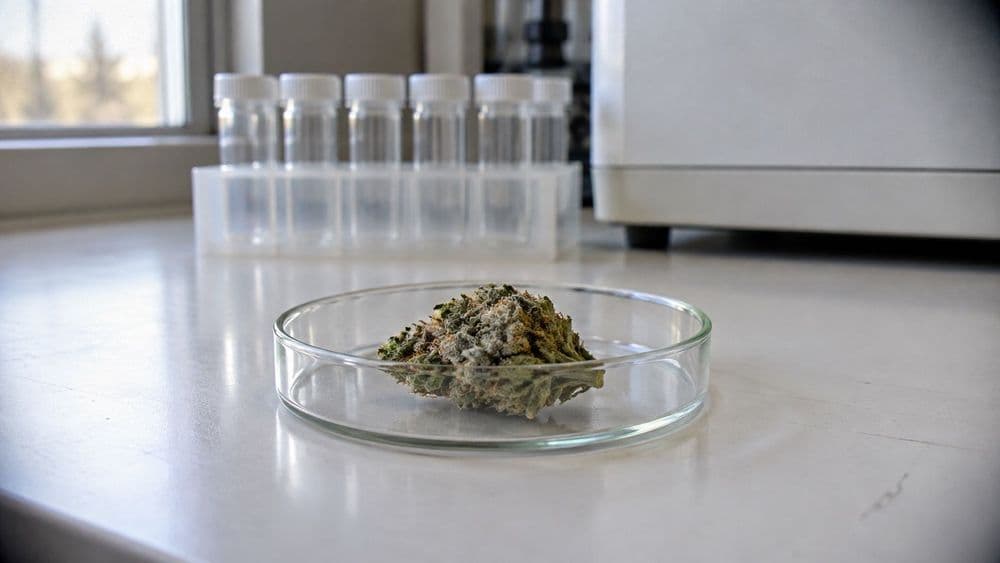
If you are trying to work out how to tell if weed is laced, the honest answer is that you usually cannot, not by looking at it, smelling it or smoking it. Even some of the checklists that top the search results admit this after listing their "signs". What you can know is what lab tests of real samples have found, what the fentanyl stories do and do not show, and what to do if a high ever feels wrong.
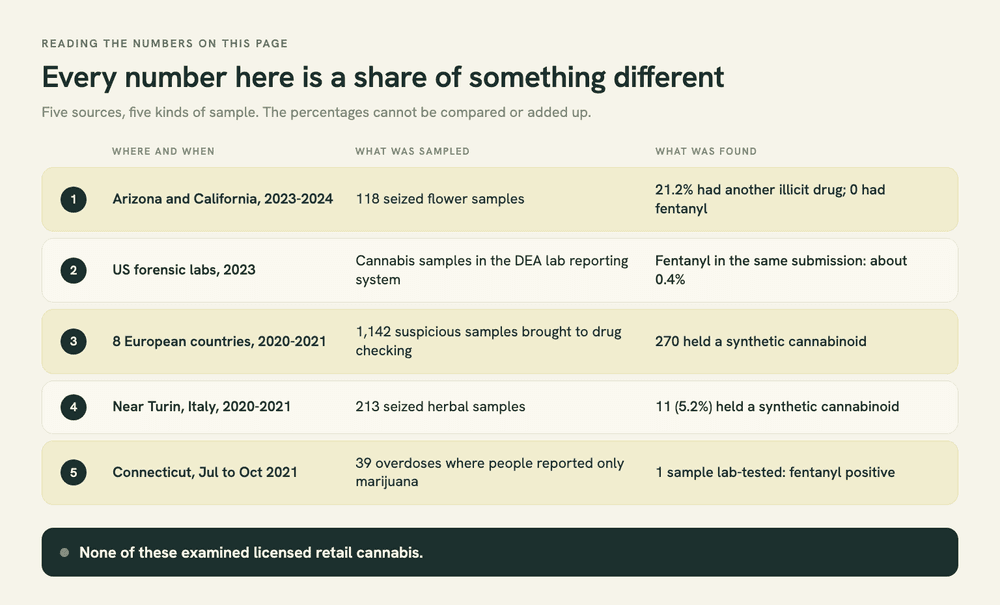
The short answer: appearance, smell and taste cannot confirm or rule out lacing. When Arizona State University researchers tested 118 samples of seized black- and gray-market cannabis flower from Arizona and California, 25 of them, about one in five, carried traces of another illegal drug, almost always cocaine, and none had detectable fentanyl. The adulteration with the strongest record is something else: synthetic cannabinoids sprayed onto low-THC hemp. And if someone has trouble breathing, will not wake up or has a seizure, call 911 now, whatever you think they used.
If someone feels wrong right now
Start here, because the rest of this page can wait. Many bad cannabis experiences are simply too much THC: a racing heart, anxiety, nausea, feeling stuck. Those are frightening but usually pass. Some signs are different, and cannabis alone does not usually cause them. Call 911 right away if the person has any of the following.
- Slow, shallow or stopped breathing, or trouble breathing
- Collapses, will not wake up, or cannot speak
- Very small, pinpoint pupils
- Purple lips and fingernails, pale skin, a faint heartbeat, limp arms and legs
- A seizure
- Chest pain or discomfort lasting two minutes or more
- Vomiting while drowsy or hard to wake, or a sudden change in mental state such as confusion or unusual behavior
The opioid overdose signs and the naloxone guidance come from the National Institute on Drug Abuse's naloxone fact sheet. Poison Control tells people to call 911 right away for trouble breathing, a collapse or a seizure, and MedlinePlus lists chest pain lasting two minutes or more and a change in mental status among the warning signs of a medical emergency. Since the FDA approved the first over-the-counter naloxone nasal spray in March 2023, the 4 mg spray can be sold without a prescription in drug stores, grocery stores and other retailers, so it is worth knowing where one is. For a reaction that is not an emergency, Poison Control answers at 1-800-222-1222, free and 24 hours a day. And if the problem is simply too much THC, our guide to greening out and what to do when a high is too strong covers the safety steps that help while it passes.
What "laced" actually means
"Laced" gets used for three different things, and they carry different risks and very different evidence. Separating them is the first step to reading any headline about it.
- Cross-contamination: residue from another drug gets onto cannabis because the same scales, benches or bags were used. Nobody meant to add anything, and the amounts are usually tiny.
- Deliberate spiking: someone adds a drug on purpose, for example to make weak product feel stronger. This is what most people picture, and it is the hardest to document.
- Substitution: the product is not what it claims. The clearest case is low-THC hemp sprayed with a synthetic cannabinoid and sold as ordinary cannabis, or a product sold as CBD that contains a synthetic instead.
The US lab data mostly show the first kind. The European data mostly show the third. The fentanyl stories sit somewhere in between, and as you will see, the Connecticut case that started most of them was assessed as likely the first kind, not the second.
What lab tests of seized weed actually found
The 2026 study in the Journal of Forensic Sciences is the closest thing to a direct answer. The 118 dried-flower samples were seized between November 2023 and June 2024: 79 from 37 seizures by a sheriff's task force in Maricopa County, Arizona, and 39 from 24 US Postal Inspection Service inspections in California and Arizona. Each was run through liquid chromatography with tandem mass spectrometry (LC-MS-MS), a lab method that identifies specific molecules, against a panel of 16 illicit and prescription drugs, including fentanyl, PCP, LSD, psilocybin, cocaine, methamphetamine, MDMA and several opioids.
| Drug on the panel | Samples positive (of 118) | Amount detected |
|---|---|---|
| Cocaine | 24 (20.3%) | 3.38 to 12,000 ppm; median 133 ppm |
| Methamphetamine | 4 (3.4%) | 4.48 to 131 ppm; median 20.77 ppm |
| MDMA | 1 (0.9%) | 4.75 ppm |
| Fentanyl | 0 | Not detected |
| PCP, LSD, psilocybin | 0 | Not detected |
| Prescription opioids (oxycodone, hydrocodone, morphine and others) | 0 | Not detected |
The authors traced most of the contamination to shared equipment. In their words, the cocaine "most likely arose from poorly cleaned preparation areas and equipment used to weigh and package the cannabis products." Their abstract concludes: "Intentional spiking appears to be rare, but the level of spiked cocaine can pose a health risk to consumers of unregulated products." One sample shows why. It held cocaine at 12,000 ppm, or 1.2% by weight, which the authors said was difficult to envision as the result of cross-contamination, so it might have been spiked on purpose.
How much does that amount to? The authors ran a worst-case estimate, assuming a 0.5 g portion, a 60 kg adult and no drug destroyed by burning. At the median level, that portion would carry about 0.065 mg of cocaine, or 0.0011 mg per kg of body weight, which the authors describe as over two orders of magnitude below the lowest observed effect level for cocaine, 0.5 mg per kg. The spiked sample was a different story: about 6 mg in the same portion, roughly 0.1 mg per kg, which the authors described as approaching the biological effect level. So most of what they found was trace residue, and one sample in 118 was not.
Can weed be laced with fentanyl?
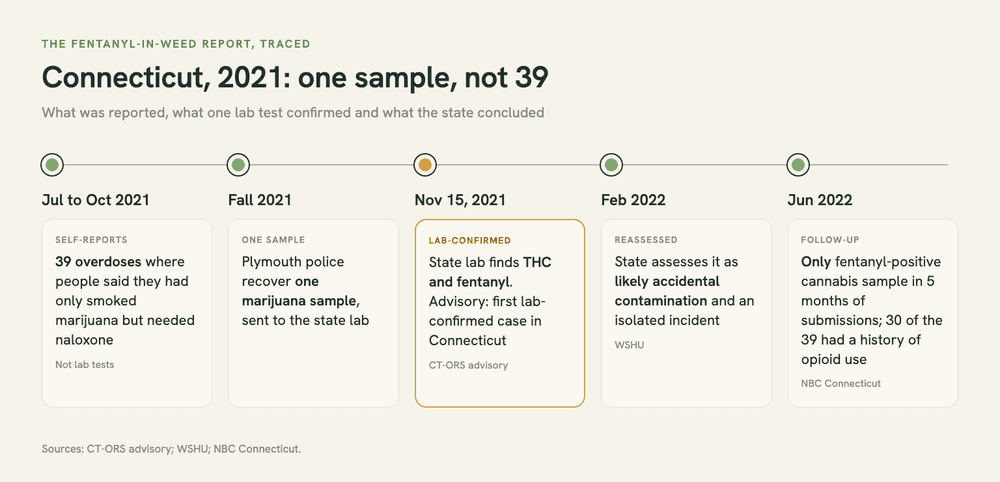
It is possible, and it has been documented, but the lab record is much thinner than the headlines. Most of what circulates traces back to one state. In November 2021, Connecticut's overdose response team and state emergency medical services office issued an advisory describing 39 overdoses between July and October in which people said they had only smoked marijuana yet needed naloxone. Those 39 were self-reports, not lab tests. One sample, recovered by police in Plymouth, was tested at the state lab and came back positive for THC and fentanyl, which the advisory called the first lab-confirmed case in Connecticut and possibly in the United States.
By February 2022, the state had scaled it back. A state health department spokesperson told WSHU that Connecticut's overdose response team assessed the Plymouth result as likely accidental contamination and an isolated incident, and that it remained the only confirmed case among the 39. He added that not every seized drug had gone to the state lab, so other instances were possible. In June 2022, an NBC Connecticut investigation reported that it was the only cannabis sample positive for fentanyl in five months of lab submissions and that 30 of the 39 overdoses involved people with a history of opioid use. A regional drug intelligence officer told NBC that dealers were using the same equipment to bag marijuana and fentanyl, which can cause cross-contamination: the pattern from the Arizona study, not deliberate lacing. The state's updated document itself is not online, and the 2026 study describes the Connecticut sample as a standalone case of unintentional contamination.
“The [Connecticut Overdose Response Strategy] assesses that the positive confirmation of marijuana with fentanyl was likely accidental contamination and an isolated incident.”
The national picture points the same way. The largest dataset available, nearly 12 million drug samples analyzed by US forensic labs from 2013 to 2023 through the DEA's reporting system, found fentanyl alongside cannabis in about 0.4% of cannabis samples in 2023, and below 0.3% as a running average across the whole period. The authors wrote that their results show "no evidence of widespread fentanyl co-occurrence with cannabis", while noting occasional spikes in some northeastern and Appalachian states. "Co-occurrence" means both drugs were reported in the same lab submission, which can be a seizure that contained both, not necessarily a laced bud.
There is also a clinical clue. One published case report describes a 50-year-old man in opioid-addiction treatment whose urine kept testing positive for fentanyl while he abstained from opioids, until he changed where he bought cannabis. The cannabis was never tested, so the link is an inference, and the authors themselves note there is "no systematic monitoring or reliable data" on how often this happens.
Expect to see one more number quoted as proof of laced weed. A September 2026 CDC report found cannabis in 43,880 of 209,166 US overdose deaths (21.0%) from 2021 to mid-2025, but it was the only drug involved in nine of them, and illegally made fentanyl was involved in 73.5% of the deaths where cannabis was detected. That shows many people who died had used both, not that the cannabis was laced, and the report does not claim it was. THC can also be detected days after use. The CDC authors' own summary is that cannabis alone rarely causes fatal overdoses.
Put together: fentanyl in cannabis is rare in the lab record, and the Connecticut case, the one most often cited, was assessed as likely accidental. Rare is not zero, and contamination from shared equipment can happen wherever both drugs are handled. That is why the response to opioid overdose signs stays the same no matter what someone believes they used.
Synthetic cannabinoids: the adulterant with the strongest record
If you want the adulteration that is actually well documented in cannabis flower, it is not fentanyl. It is synthetic cannabinoids, lab-made chemicals that act on the same receptors as THC but can be far more potent and unpredictable. According to NIDA's fact sheet on synthetic cannabinoids, they are added to dried plant material so they can be smoked, and their use is associated with severe health problems that can be life-threatening.
Europe has the clearest data. Between 2020 and 2021, drug-checking services in eight European countries tested 1,142 suspicious samples sold as cannabis, as flower, resin and vape liquid, and found a synthetic cannabinoid called MDMB-4en-PINACA in 270 of them. Every cannabis sample involved was low in THC (under 1%), and three serious incidents requiring hospitalization were reported. These were samples people were already worried about, so 270 of 1,142 is not a market rate. Routine police data give a different angle: an Italian forensic lab near Turin found the same synthetic in 11 of 213 seized herbal samples (5.2%) over four months in 2020 and 2021, at 0.4 to 6.3 mg per gram, and the positive samples were CBD-dominant rather than high-THC cannabis.
Why hemp? The EU drugs agency's 2021 review suggests one possible explanation: low-THC industrial hemp is cheap, widely available and has a similar look, smell and flavor to ordinary cannabis, while only a small amount of synthetic cannabinoid is needed to produce a strong high. The agency noted that at least six countries had reported this kind of adulteration, that its prevalence is unknown, and that reported effects of synthetic cannabinoids include paranoia, confusion, fear, anxiety, a fast heartbeat, nausea and vomiting. A 2025 review describes synthetic cannabinoids resurfacing as hidden adulterants as legal markets grow, with unpredictable effects when people do not know they took them.
The US has its own version on the CBD side. In Utah in 2017 and 2018, a product sold as CBD turned out to contain a synthetic cannabinoid and no CBD at all; we break down that case and what its label was missing in our guide to spotting fake CBD oil. If you want the difference between plant cannabinoids and synthetic ones, see our explainer on what cannabinoids are, and for a semi-synthetic made from hemp, what THC-O is. Whether hemp flower itself is legal where you live is a separate question, covered in is CBD flower legal.
How to tell if weed is laced: why the "signs" checklists fail
Most pages on this topic list the same signs: an odd color, white or blue specks, a sparkly or powdery look, a chemical smell like paint thinner, a harsh burn. The ones we read cite no source showing these signs identify laced weed. The EU drugs agency put the opposite plainly: in look, smell and flavor, cannabis products adulterated with synthetic cannabinoids "would be very difficult to distinguish" from ordinary cannabis. And the cocaine found in the Arizona samples was mostly measured in parts per million, far too little to see. Here is why each common sign falls short.
| Sign the checklists give | Why it does not prove lacing | Does it tell you it is laced? |
|---|---|---|
| Sparkle, frost or white specks | Normal flower is frosted with trichomes, the plant's own resin glands. The cocaine traces in the Arizona study were in parts per million, too little to see. | No |
| Chemical, gasoline or ammonia smell | Cannabis smell varies a lot from plant to plant, and a smell cannot tell you which chemical, if any, was added. | No |
| Harsh smoke, black ash, crackling | Often blamed on how flower was dried or stored. The checklists we read link it to no specific adulterant. | No |
| Unusual color | Color can vary between plants. Hemp sprayed with a synthetic cannabinoid is described as looking like ordinary cannabis. | No |
| Much stronger high than expected | It can also come from higher potency than you are used to, a larger amount, low tolerance or an edible taking effect late. | Rarely, and not by itself |
| Effects cannabis does not usually cause: seizure, very slow breathing, pinpoint pupils, unresponsiveness | It may be another drug, or a medical problem unrelated to the product. Either way it needs care, not a product test. | Call 911. Treat the person, not the sample |
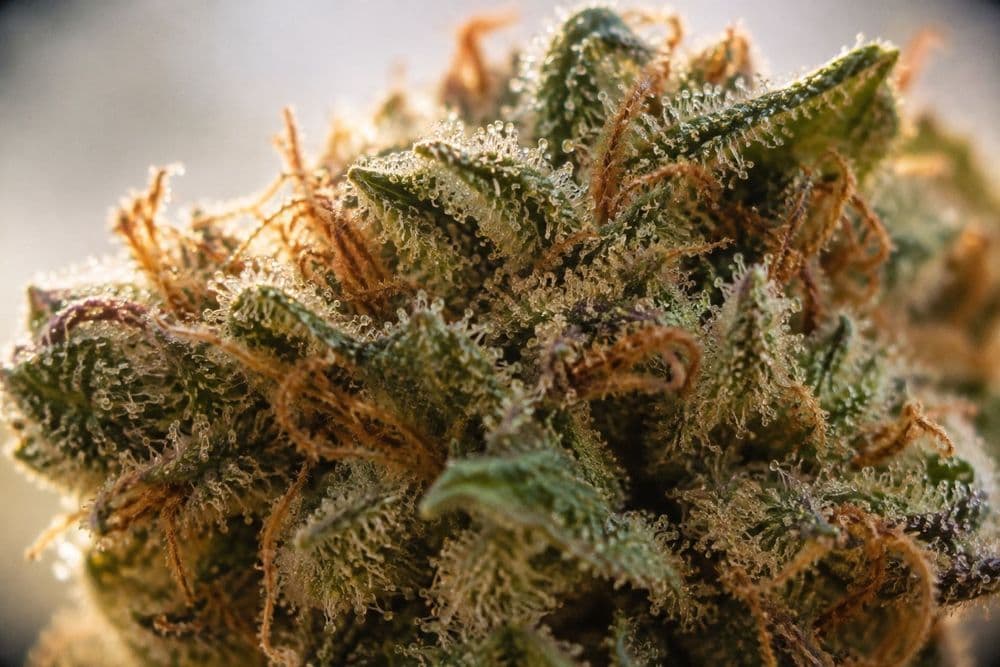
The problem with the checklist is not only that it misses laced weed. It can also reassure you about product that looks fine. The only sign on that list worth acting on is a person having effects cannabis does not normally produce, and the right response then is medical help, not an inspection of the bag.
Can you test weed for fentanyl or other drugs?
Several of the top-ranking pages call fentanyl test strips the most reliable way to check weed. The record does not support that. Test strips were originally designed for urine, and the first over-the-counter fentanyl test the FDA cleared, in 2023, is a urine test. When strips are used on drugs rather than urine, the FDA generally does not regulate them, and few studies have evaluated how they perform, according to a 2023 commentary by NIH and FDA leaders.
The lab studies behind them did not use cannabis flower. A 2023 validation study tested strips against fentanyl, 18 related compounds and 72 other drugs and cutting agents prepared as powders, e-liquids and infused papers and textiles; the strips missed some fentanyl-related compounds, including carfentanil. A 2021 study found that concentrated samples of methamphetamine, MDMA and diphenhydramine could turn a strip falsely positive. The 2026 Arizona study's authors add that strips were not validated for plant material and were unreliable for cannabis flower.
New York's Office of Addiction Services and Supports, which makes the strips available through its provider network, says in its fentanyl test strip guidance (revised March 2023) that "it is not recommended to use FTS to test cannabis". It gives as its reason that fentanyl is not found in the cannabis supply, a flatter statement than the lab data above support, and it describes the Connecticut sample as the first and only lab-confirmed case it knew of. Home cannabis test kits do not fill the gap either: they estimate cannabinoids such as THC and CBD, and none is sold to screen for contaminants, as explained in our guide to what CBD test kits can and cannot measure. Identifying a specific contaminant takes a lab with mass spectrometry, the LC-MS-MS or GC-MS methods used in the studies above.
What actually lowers the risk
Since you cannot inspect your way to safety, the protection has to come from where the product comes from and what paperwork comes with it. Every sample in the studies above came from outside the regulated market: seized product, drug-checking submissions or a counterfeit with no maker on the label. A practical checklist before you use any cannabis or hemp product:
- 1Buy from a licensed or clearly identifiable source, not from an unknown seller or a package with no maker named on it.
- 2Look for a certificate of analysis (COA) from an independent lab, and check that its batch number matches the one on your package.
- 3Read what the COA actually tested. The usual panels cover cannabinoids, pesticides, heavy metals, microbes and residual solvents, not illicit drugs, so a clean COA speaks to those categories only.
- 4Put down anything with no manufacturer, no ingredient list and no batch number. In the Utah case, eight of the nine samples tested gave no information about the manufacturer or the ingredients.
- 5Avoid mixing product from an unknown source with alcohol, opioids or other drugs, which makes any reaction harder to read and more dangerous.
- 6If you are unsure what you have, do not use alone, and know where the nearest naloxone is.
If you have never read one, our step-by-step guide to reading a COA walks through what to check: a batch number that matches your package, an accredited independent lab, and the contaminant panels. What "third-party tested" really means explains why a report covers one batch on one date and nothing more. If you combine cannabis with other substances, our look at kratom and weed together shows why, when effects overlap, you cannot tell which one caused a reaction.
What is still unknown
- How common adulteration is nationally. A 2020 case report noted there is no systematic US monitoring of it, and the 2026 study above is a pilot of 118 seized samples from two states.
- Whether the Arizona and California results hold elsewhere, or for product bought on the street rather than seized in bulk.
- How often fentanyl reaches cannabis by contamination. The national figure (about 0.4% of cannabis samples in 2023) counts drugs reported in the same lab submission, not laced buds.
- How widespread synthetic-sprayed hemp is in the US. The strongest data are European, and the largest figure comes from samples people were already suspicious of.
- Whether licensed, retail cannabis is ever affected. None of the studies here examined it.
Frequently asked questions
It is possible, but the lab record is thin. Connecticut had one lab-confirmed sample in 2021, which the state later assessed as likely accidental contamination. A 2026 study found no fentanyl in any of 118 seized samples from Arizona and California, and national forensic lab data show fentanyl in about 0.4% of cannabis samples in 2023, meaning both drugs were reported in the same lab submission. If someone shows signs of an opioid overdose, treat it as one anyway: call 911 and give naloxone.
Usually like ordinary weed. The EU drugs agency says cannabis adulterated with synthetic cannabinoids would be very difficult to distinguish by look, smell or flavor, and the cocaine found in US seized samples was mostly in parts per million, far too little to see. The sparkle or white frost people worry about is normally trichomes, the plant's own resin glands.
In the 2026 US lab study of seized flower, traces of cocaine were most common (24 of 118 samples), followed by methamphetamine (4) and MDMA (1), most likely from contaminated equipment. Fentanyl, PCP and LSD were tested for and not found. In Europe, the documented adulterant is a synthetic cannabinoid sprayed onto low-THC hemp.
Watch for effects cannabis does not usually cause: seizures, very slow or stopped breathing, pinpoint pupils, unresponsiveness, chest pain or sudden confusion. Those need 911. Anxiety, a racing heart and nausea can also simply mean too much THC, which usually passes; see our guide to greening out. Synthetic cannabinoids have been linked to paranoia, confusion, fast heartbeat, nausea, vomiting and, in severe cases, seizures.
Not reliably. Fentanyl test strips were designed for urine, the FDA generally does not regulate them for use on drugs, and their validation studies used powders, liquids and papers, not cannabis flower. New York's state addiction agency advises against using them on cannabis. Home cannabis kits estimate cannabinoids, not contaminants. Confirming a contaminant takes a lab using mass spectrometry.
Yes, and that is where the record is strongest. European drug-checking services found a synthetic cannabinoid in 270 of 1,142 suspicious cannabis samples, all low in THC, and an Italian police lab found it in 5.2% of seized herbal samples, all CBD-dominant. In Utah, a product sold as CBD contained a synthetic cannabinoid and no CBD. A batch-matched COA from an identifiable maker is the practical check.
No. Naloxone only reverses opioids, so it will not undo synthetic cannabinoids, stimulants or too much THC. NIDA notes it has no effect on someone who does not have opioids in their system. It is an addition to the 911 call, never a replacement for it.
The one check that works before you use anything is on paper, not in the bag. Learn to read a certificate of analysis in a few minutes, so you know what a lab actually tested, which batch it covers and what it leaves out.
Writing about hemp, wellness and the small rituals that keep us balanced.