Chest Pain After Smoking Weed: Causes and When to Get Help
Chest pain after cannabis can come from the smoke, a coughing fit, a racing heart or panic, and rarely from a collapsed lung or a heart attack. How the causes compare, what the research actually measured, the signs that mean 911, and what to tell the ER.
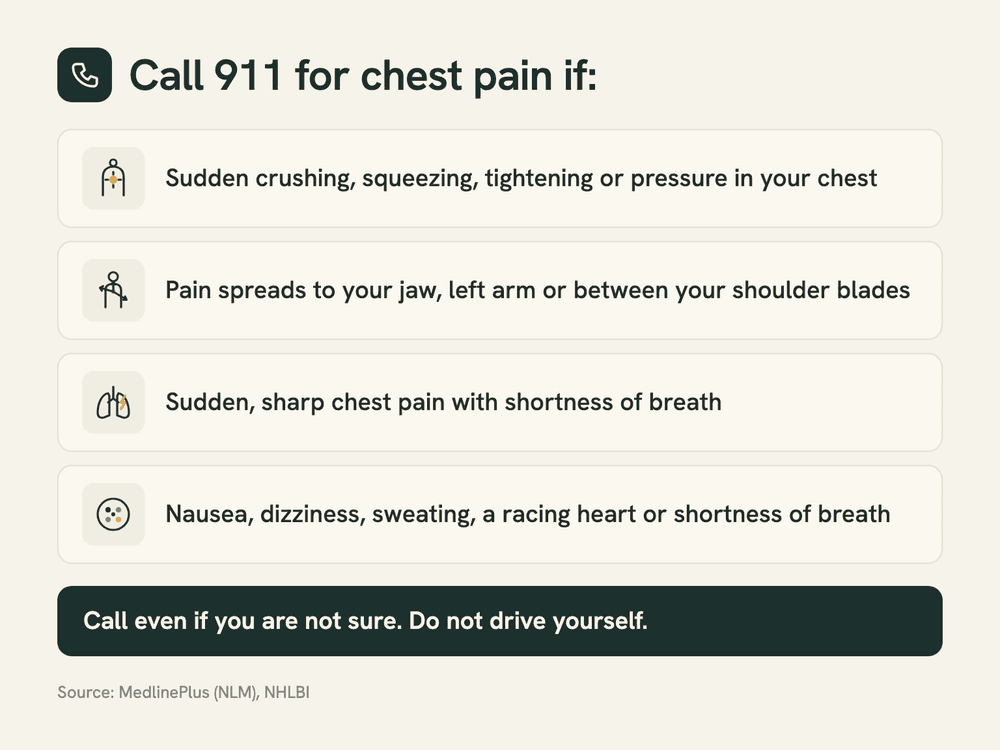
Yes, weed can be linked to chest pain. The common explanations for chest pain after smoking weed are the smoke, a hard coughing fit, a racing heart or a wave of panic. The rare but urgent ones are a collapsed lung and a heart attack, and you cannot tell them apart at home. So start with this: if the pain is crushing, squeezing or pressure-like, spreads to your jaw, arm, back or between your shoulder blades, or comes with shortness of breath, sweating, nausea, dizziness or fainting, call 911 now. Do not wait to see whether the high wears off.
That list comes from the one MedlinePlus, the National Library of Medicine's consumer reference, gives for chest pain, and it is not cannabis-specific on purpose: a heart attack does not care what you smoked. The National Heart, Lung, and Blood Institute's page on heart-attack symptoms adds two points worth holding onto: "Not all heart attacks begin with the sudden and crushing chest pain," and you should call 911 "even if you are not sure that you're having a heart attack." When cannabis is involved, we treat chest pain with any of these signs as a 911 call, even though chest pain is not on Poison Control's own list of reasons to call. Our guide to greening out explains that judgment and covers the rest of the too-much-THC triage.
Can weed cause chest pain? The short answer
Cannabis can be linked to chest pain, but "weed" is not one cause. Chest pain is a symptom with many possible sources: the heart, the lungs, the muscles and tendons between your ribs, the esophagus and your nervous system. MedlinePlus lists, among others, strain of the muscles and tendons between the ribs, a panic attack "which often occurs with fast breathing", a collapsed lung (pneumothorax) and pericarditis, an inflammation of the sac around the heart. Cannabis touches several of these at once. Smoking it irritates the airways and makes people cough. THC can push your heart rate and blood pressure up right after use. A strong high can tip into panic. And a deep pull held in the lungs puts pressure on lung tissue.
Here is the honest part most pages skip: no study has counted how often each of these causes explains chest pain in people who use cannabis. So the table below does not invent percentages. For each cause it prints the signal the research actually gives, and it sorts the causes by how dangerous they are. The danger column, not the frequency column, is what decides what you do.
Causes of chest pain after smoking weed, sorted by danger
Read across each row: how it tends to feel, when it shows up, what the research says about how often, and what to do. One rule overrides the whole table. Any red flag from the 911 list above means 911, whichever row you think you are in. Several of these causes feel alike in the first minutes, and the rows are not a self-diagnosis tool.
| Cause | How it tends to feel | When | What the research says about how often | How dangerous | What to do |
|---|---|---|---|---|---|
| Coughing strain (muscles and tendons between the ribs) | Sore or achy along the ribs, worse when you cough or twist | During a coughing fit, or the next day | Cough is common: a 2018 review of 22 studies found cannabis smokers about twice as likely to report it. No study counts the chest strain that follows | Lower on its own, but it can feel like other causes | Stop. Call 911 for any red flag; get checked if it lingers or keeps coming back |
| Smoke irritation and breath-hold tightness | Raw, burning or tight feeling in the center of the chest or throat, often with coughing | During or right after inhaling | In machine tests, the inhaled stream of cannabis smoke carried irritants, including up to 20 times the ammonia of tobacco smoke. No count of how often it causes chest pain | Lower on its own; tightness with wheezing or breathlessness that does not settle needs care | Stop. Call 911 for any red flag; get checked if it lingers or keeps coming back |
| Anxiety or panic with fast breathing | Tight chest, pounding heart, fast breathing, a sense of dread | During the high | Anxiety was a first symptom in 42.5% of drug-related chest-pain ER visits in one Spanish registry, where cocaine was present in 70% and many had mixed drugs. Not a cannabis-only figure | Can only be called panic after the heart has been checked | Stop. Call 911 for any red flag; get checked if it lingers or keeps coming back |
| THC-driven rise in heart rate | Pounding, racing or fluttering heartbeat, sometimes with chest discomfort | Right after use | NIDA: cannabis can raise heart rate and blood pressure right after use. Palpitations led the same Spanish registry's first symptoms (45.5%, mixed drugs, mostly cocaine) | Depends on your heart; higher with heart disease. A racing heart with chest pain is on the 911 list | Stop. Call 911 for any red flag; get checked if it lingers or keeps coming back |
| Collapsed lung or air leaking into the chest (pneumothorax, pneumomediastinum) | Sudden sharp pain, often on one side or behind the breastbone, worse on a deep breath or cough, with shortness of breath | After a deep pull, a long breath-hold, hard coughing or vomiting | Rare; known from case series. At one US hospital, 14 of 21 cases of air in the chest without injury in a year involved marijuana users | High | Emergency room now; call 911 if breathing is hard |
| Air blisters in the lungs (bullous disease) in heavy long-term smokers | Often no pain until a blister bursts, then the collapsed-lung pain above | After years of heavy smoking | Seen in surgical series, such as 112 patients operated on in Italy. These are associations, not rates | High when it causes a collapsed lung | Same as the row above; tell the doctor how long and how much you have smoked |
| Heart attack (acute coronary syndrome) | Pressure, squeezing or crushing, may spread to the jaw, left arm or back, with sweating, nausea or breathlessness; can also be mild or come and go | In the 2001 study, risk was highest in the hour after smoking and fell quickly | A rare trigger: 9 of 3,882 heart-attack patients had smoked cannabis in the hour before it began | Highest | Call 911. Do not drive yourself |
| Something else in the product, or another drug | Any of the above | Any time | Cocaine was present in 70% of drug-related chest-pain ER visits in the Spanish registry and cannabis in about a third, often together | High; cocaine use is a listed heart-attack risk factor | Call 911 for any red flag; tell responders everything you took |
Chest tightness after smoking weed: the smoke, the cough or the THC?
Tightness and pain are not quite the same complaint, and tightness during a session has a twist most pages miss. THC itself briefly widens the airways, which UCLA researchers measured in the 1970s. In a 1975 lab study of smoked marijuana in experimentally narrowed airways, researchers tightened the airways of 8 adults with stable asthma on purpose, and a single dose of marijuana smoke with 2% THC reopened them promptly, while placebo smoke did not. That was a one-dose test of airway mechanics, not a treatment finding, and it is not a reason to smoke with asthma: the National Academies found no adequate evidence either way on asthma, and the widening does not persist with chronic use. What it does suggest is that a tight, raw chest in the middle of a session points more at the smoke, the cough and the breath-hold than at the cannabinoid. That is our reading of how these pieces fit, not something a study has tested directly.
The smoke is the irritant. When Health Canada machine-smoked cannabis and tobacco the same way, the mainstream cannabis smoke, the stream the smoker inhales, carried up to 20 times the ammonia of tobacco smoke, and cannabis smoke carried 3 to 5 times the hydrogen cyanide and nitrogen oxides. In people, a 2018 review of 22 studies on cannabis and lung symptoms found cannabis smokers were about twice as likely to report cough. Hard, repeated coughing strains the muscles and tendons between the ribs, which MedlinePlus lists as a cause of chest pain in its own right, and that kind of strain can still ache the next day. Our page on why weed makes you cough covers the cough reflex and what long-term smoking does to the lungs.
- Smoke-and-cough tightness tends to start during or right after inhaling, often with coughing or a scratchy throat.
- It tends to feel raw, burning or tight, rather than the crushing, squeezing pressure on the 911 list.
- Wheezing or breathlessness that does not settle after you stop is its own reason to get help.
- None of these features rules out the heart or a collapsed lung. A red flag from the 911 list still means 911.
Racing heart and panic: when the drug itself is the trigger
Here the cannabinoid, not the smoke, is the likely driver. The National Institute on Drug Abuse's cannabis research page says that "cannabis can increase heart rate and blood pressure right after use," and adds that some research links long-term use to stroke, heart attack and arrhythmias, while "more research is needed". We covered the measured size of that heart-rate rise in our write-up of a controlled THC and CBD heart-rate trial, and the blood-pressure side in whether weed raises blood pressure. A pounding heart is something you feel in your chest. If you were also exercising, our page on working out high covers why stacking exertion on top of THC deserves care.
A strong high can also tip into panic. MedlinePlus lists a panic attack, "which often occurs with fast breathing", as a cause of chest pain, and our explainer on why weed can make you paranoid covers why THC sets this off in some people. Emergency-room data line up with the pattern. In a registry study of chest pain after recreational drugs in 11 Spanish emergency departments, palpitations (45.5%) and anxiety (42.5%) were the commonest first symptoms. Read those numbers carefully: cocaine was present in 70% of those visits and cannabis in 35.7%, often together, so they are not cannabis-only figures.
One order matters here. Panic is what a clinician concludes after the heart has been checked, not before. A panic attack and a heart problem can feel alike from the inside, and you cannot run that check yourself. If your chest hurts and your heart is racing, the 911 list still applies.
Sharp pain on one side and short of breath: the collapsed-lung sign
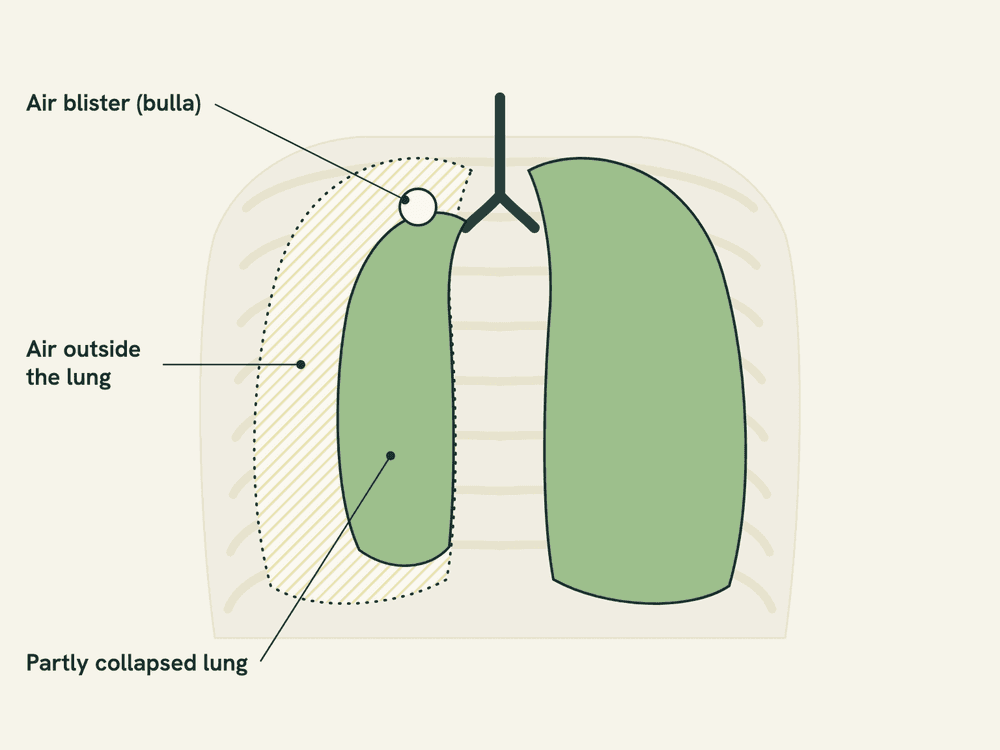
This is the one sign worth memorizing. MedlinePlus describes a collapsed lung as "sharp chest or shoulder pain, made worse by a deep breath or a cough" together with shortness of breath; a larger one can bring chest tightness, a rapid heart rate, lightheadedness and near fainting. It notes that "tall, thin people and smokers are more at risk." A pneumothorax is air that has leaked out of the lung into the space between the lung and the chest wall. Pneumomediastinum is air that has leaked into the middle of the chest, around the heart and the main airways.
Cannabis enters this picture through how people inhale. In a chart review of air in the chest at one US hospital, 14 of 21 cases of spontaneous pneumomediastinum over 12 months involved marijuana users, mostly young men, and chest pain was the commonest symptom (11 of the 14). Vomiting and coughing were common too. The authors' proposed mechanism is pressure injury: deep inhalation, sometimes through high-resistance devices, then holding the breath or pushing out against a closed throat. One of the two charts that recorded a device named a large bong. It is a case series, so it says nothing about how often this happens to people who smoke.
The collapsed-lung data point the same way, with a catch. In a Danish case-control study of 416 young people with a first collapsed lung, men who smoked both cannabis and tobacco had a markedly higher risk (odds ratio 8.74, 95% CI 4.30 to 19.51), while women's cannabis habits did not differ from the general population. A 2018 systematic review of 20 studies on cannabis and pneumothorax found the risk raised in people who smoke cannabis with tobacco, but not shown in people who smoke cannabis only. So the clearest signal is in people who also smoke tobacco, which includes many spliff and blunt smokers.
Heavy, long-term smoking adds a second route. Among 112 people operated on for a collapsed lung in Italy, the 39 cannabis smokers (a median of 28 dose-years, where one dose-year is 1 gram a week for a year) had more severe bullous disease, meaning large air blisters in the lung that can burst. More of them had the dangerous tension type (39%, against 8% of non-smokers), and complete collapse was more common than in non-smokers. It is a surgical, retrospective series, so it describes people sick enough to need an operation, not smokers in general. A 2018 review of marijuana and lung disease in the journal Chest puts all of this in its place: several case series show these problems in marijuana smokers, but "these associations require epidemiologic studies for firmer evidence of possible causality."
What the heart-attack research actually measured
The line that circulates online is that the risk of a heart attack "nearly quintuples" in the hour after smoking. It comes from a 2001 Circulation study by Mittleman and colleagues on marijuana as a heart-attack trigger, and the number is real. What usually goes missing is the denominator.
The researchers interviewed 3,882 people about four days after a heart attack and compared each person's cannabis use in the hour before symptoms began with their own use at other times, a design called case-crossover. 124 of them (3.2%) had used cannabis in the past year, 37 in the previous 24 hours, and 9 in the hour before. The risk of a heart attack starting was 4.8 times higher in the hour after smoking marijuana (95% confidence interval 2.4 to 9.5), the raised risk fell quickly after that hour, and the authors still called it "a rare trigger". Because only nine of the 3,882 had used in that hour, 4.8 times is a relative figure built on a small number. The users were mostly men (94%), most were current cigarette smokers (68%), and the cannabis was smoked, self-reported, and from 1989 to 1996.
A 2024 Journal of the American Heart Association survey analysis of 434,104 US adults took the longer view. Daily cannabis users had about 25% higher odds of having had a heart attack (adjusted odds ratio 1.25), and among people who had never used tobacco the figure was 1.49. The survey is cross-sectional: it asked about use and past heart attacks at the same moment, did not separate smoking from edibles, and cannot show which came first.
Put together, the research supports a narrow statement. Cannabis use has been linked to heart attacks, as a rare short-term trigger and as a long-term association, and federal researchers say more research is needed. This page is not a heart-health review, and none of these numbers changes what you do tonight. Chest pain with any red flag means 911, whether your personal risk is high or low.
Edibles, vapes and bongs: does how you used it change the answer?
The route changes which explanations are on the table. It does not change the 911 list.
Edibles. There is no smoke, so smoke irritation, coughing strain and breath-hold injury largely drop away (hard vomiting, which was common in the hospital case series, can still strain the chest). That leaves a racing heart, anxiety and the heart itself higher on the list, which is a reason to take chest pain after an edible more seriously, not less. This is our reasoning from how the causes work; no study we found has compared chest pain by route.
Vapes. A vaporizer heats rather than burns, but you are still inhaling, often deeply, and still taking in THC. Our comparison of dry herb vaporizers and smoking covers what heating instead of burning does and does not change. We found no study showing that vaping removes chest-pain risk.
Bongs and water pipes. A big bong pull, held in and then pushed out, is the kind of deep, held inhalation the pneumomediastinum case-series authors put at the center of their proposed mechanism. If you use a water pipe, our page on smoking weed out of a hookah explains what the water changes and what it does not.
No format is a fix for chest pain. Switching from a joint to an edible removes the smoke, not the THC. The only advice that fits every row of the table is to stop and get assessed.
What else was in it, and what else did you take?
Emergency doctors ask this for a reason. In the Spanish emergency-department registry, chest pain made up about 9% (8.97%) of drug-related visits. Cocaine was present in 70% of those chest-pain visits, cannabis in about a third and amphetamines in about a fifth (21.4%), and many people had taken more than one, so none of these is a cannabis-only number. MedlinePlus names cocaine use, alongside smoking, among the things that raise your risk when chest pain could be your heart. Tobacco matters too: spliffs and blunts carry nicotine, and the collapsed-lung signal above is clearest in people who smoke both.
Then there is what was in the product. Synthetic cannabinoids sold as "weed" or "K2" are different drugs with a different safety record, and our K2 vs weed comparison lays out how. If something about the product seemed off, our guide on how to tell if weed is laced covers what you can and cannot check. Either way, tell the people treating you, and bring the package if you have it.

What to tell the ER or your doctor
You can make the workup faster and more accurate by being specific. These are the details that change what clinicians look for:
- What you used: flower, concentrate, vape cartridge or edible, and the product name if you know it.
- How you used it: joint, blunt or spliff, bong, pipe, vape or edible, and whether you took deep pulls or held your breath.
- How much and when: a rough amount, and the time you started and stopped.
- Everything else: alcohol, nicotine, cocaine, other stimulants, and any medicines, including cold and decongestant products.
- Your history: heart or lung conditions, a previous collapsed lung, high blood pressure, and heart disease in close family.
- The pain itself: when it started, where it is, whether it spreads, and what makes it worse, such as breathing in, pressing or moving.
Honesty about cannabis is not a confession; it changes the workup. A 2015 emergency-medicine review of marijuana intoxication tells clinicians to screen for co-ingestion, meaning other substances taken at the same time, and notes that complications are primarily cardiovascular and respiratory. The Italian surgeons concluded that a history of cannabis use should always be taken in patients with a collapsed lung. And in the US hospital case series, how the person smoked was recorded in only 2 of the 14 marijuana-associated charts. You can fill that gap.
As for what to expect: for a possible heart attack, the NHLBI's page on how heart attacks are diagnosed says an electrocardiogram (EKG) "is the most common initial test and may be given within minutes of your arrival," and that troponin blood tests are often repeated to check for changes over time. For a possible collapsed lung, MedlinePlus lists a chest X-ray among the tests. We stop there: an EKG and blood tests are standard for chest pain, and the rest is up to the team examining you.
What the evidence can't tell you
Four limits shape everything above. First, no study counts how often each cause explains chest pain in people who use cannabis, which is why the table gives signals instead of percentages. Second, the collapsed-lung evidence is case series, one surgical series and one case-control study, and its clearest signal is in people who also smoke tobacco. Third, the heart-attack trigger figure rests on 9 exposed people and cannabis smoked between 1989 and 1996, and the 2024 survey shows an association at one point in time, not a cause. Fourth, the emergency-room figures come from Spain and from people who often took several drugs, most often cocaine. None of this lets us, or any page, tell you that your chest pain is safe. Only an assessment can.
A note on CBD, since this is a CBD company's blog. CBD oil is taken by mouth, not smoked, so the smoke-related causes in this article do not apply to it. CBD is also not a treatment for chest pain, and it is not something to take to calm a racing heart. If you want to know what the research says about CBD and heart rate, read does CBD affect heart rate, and for the basics, start with what CBD is and how it differs from THC.
Chest pain and weed: common questions
The common explanations are the smoke irritating your airways, the strain of coughing on the muscles between your ribs, a THC-driven rise in heart rate, and anxiety or panic with fast breathing. Less often, a deep pull or a long breath-hold can push air out of the lung, and rarely the cause is the heart. No study ranks these by frequency, and they can feel alike. Pain that is crushing or pressure-like, spreads to your arm, jaw or back, or comes with breathlessness, sweating, nausea, dizziness or fainting means call 911.
It can be, and you cannot sort the serious from the minor at home. Some causes, such as coughing strain, are less dangerous on their own; others, such as a collapsed lung or a heart attack, are emergencies, and the early feel can overlap. In the best-known study, cannabis was a rare heart-attack trigger: 9 of 3,882 heart-attack patients had smoked in the hour before. Rare is not zero. Treat any red-flag symptom as a 911 call, and get any chest pain that lingers or keeps coming back checked.
They can be linked to it. An edible involves no smoke, so smoke irritation and coughing strain largely drop out. By our reasoning (no study we found has compared chest pain by route), that leaves a racing heart, anxiety or the heart itself higher on the list. That is a reason to take chest pain after an edible seriously, not to dismiss it. The same 911 list applies.
A hard coughing session can strain the muscles and tendons between your ribs, and that kind of strain can still ache the next day. But a next-day pain that is sharp, worse when you breathe in or cough, and comes with shortness of breath is the collapsed-lung sign, and it needs the ER the same day. Any red flag from the 911 list means 911, whatever day it is. Do not assume it is fine because it came late.
It could be strain from coughing, but a sudden sharp pain after a big pull is also the pattern described in case series of air leaking into the chest: deep inhalation through a high-resistance device, a breath-hold, then a forced push out. If the pain is sharp, worse when you breathe in, and you are short of breath, go to the ER now, or call 911 if breathing is hard.
It can be linked to it. A vaporizer removes combustion but not inhalation or THC, so coughing, deep breath-holds, a racing heart and panic are all still possible. We found no study showing that vaping removes chest-pain risk. The same red flags apply.
Yes. It changes what they look for: emergency-medicine guidance tells clinicians to screen for other substances taken at the same time, and surgeons who treat collapsed lungs recommend always asking about cannabis. Tell them what you used, how, how much, when, and anything else you took. They are asking so they can treat you.
What people call lung pain after smoking often describes the same chest symptoms covered here: airway irritation, coughing strain or, rarely, a collapsed lung. Long-term lung effects of smoking are a separate topic, covered in our article on why weed makes you cough. Sharp pain with breathlessness needs the ER.
If you are not sure whether what you feel is an emergency, our walkthrough of when to call 911 or Poison Help after too much THC takes it step by step. Poison Help is 1-800-222-1222, free, confidential and answered 24/7 in the US. For chest pain with any red flag, skip the reading and call 911.
Writing about hemp, wellness and the small rituals that keep us balanced.