Why Does Weed Make You Cough? The Reflex and the Lung Data
The cough comes from smoke, not THC. Here is what is in cannabis smoke, why holding it in did not make people higher in controlled studies, what 20 years of lung data found, and which cough symptoms need a doctor.

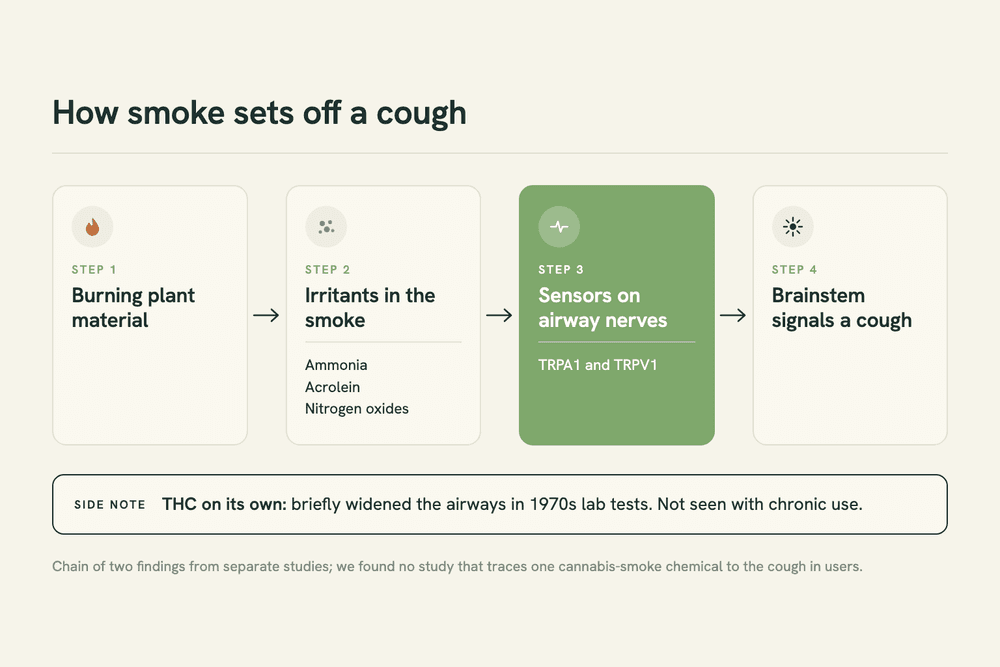
Why does weed make you cough? Because you are inhaling smoke. Burning plant material releases irritants such as ammonia and acrolein, and the nerves lining your airway carry sensors that respond to those chemicals. When they fire, you cough to clear the airway. THC is not the trigger: in short-term lab tests, it briefly widened the airways. We found no study showing that coughing makes you higher, and in controlled studies, holding the smoke in longer did not make people feel higher either. In one of them, a longer hold raised the carbon monoxide people absorbed instead.
Most pages that rank for this question stop at "hot smoke irritates your throat" and move on to tips for making it feel smoother. This one goes further: how the cough reflex actually works, what the smoke contains, what the controlled breath-hold experiments found, and what long-term studies show about cough, phlegm and lung function, with the limits of each. It is part of our series on everyday THC effects, alongside why weed turns your eyes red and why cannabis can make you paranoid. This is general information for adults 21 and over, not medical advice, and nothing on this page makes any way of smoking safe.
Why weed makes you cough: what triggers the reflex
A cough is a protective reflex, not a malfunction. It starts in sensory nerve endings under the lining of your airways, fibers of the vagus nerve that report to the brainstem. According to a 2010 review of airway irritant receptors in the journal Lung, two sensors on those nerves, called TRPV1 and TRPA1, respond to chemical irritants and help start the cough. A 2008 review in the journal Physiology describes TRPA1 as activated by chlorine, reactive oxygen species and "noxious constituents of smoke and smog". Much of this mapping comes from animal and cell studies, but there is a human test too. In a 2009 study in the American Journal of Respiratory and Critical Care Medicine, inhaled chemicals that switch on TRPA1 made healthy volunteers cough, and TRPA1 activators such as acrolein, a by-product of burning organic material, activated human vagal nerve tissue in the lab.
Now the other half of the chain: what is in the smoke. When Health Canada machine-smoked cannabis and tobacco cigarettes prepared the same way, cannabis smoke carried up to 20 times the ammonia of tobacco smoke, and 3 to 5 times the hydrogen cyanide, nitric oxide, nitrogen oxides and some aromatic amines. Some cancer-linked compounds called polycyclic aromatic hydrocarbons (PAHs) were lower in the smoke drawn through the cannabis cigarette and higher in the smoke drifting off its tip. Known carcinogens were present in both. The American Lung Association sums it up: marijuana smoke contains many of the same toxins, irritants and carcinogens as tobacco smoke.
- Ammonia: up to 20 times tobacco levels in machine-smoked cannabis (Health Canada, 2008).
- Hydrogen cyanide, nitric oxide and nitrogen oxides: 3 to 5 times tobacco levels in the same tests.
- Acrolein: an irritant formed when plant material burns, and a known trigger of the TRPA1 cough sensor.
- Tar: the sticky particulate residue of smoke. A 1988 study measured about three times more inhaled per cannabis cigarette than per tobacco cigarette.
- Carbon monoxide: a combustion gas that passes into your blood, and rises further the longer you hold the smoke in.
Put the two findings together and you have the most likely explanation: smoke from any burning plant carries irritants such as acrolein and ammonia, and the nerves that fire the cough reflex carry sensors for exactly those irritants. The heat and dryness of the smoke probably add to it. One honest caveat: we found no study that traces a specific cannabis-smoke chemical to the cough in a cannabis user. This is a chain of two established findings, not one measured pathway. The parched, sticky mouth that often comes along is a different mechanism entirely, THC turning down your saliva, which our explainer on cottonmouth covers.
The paradox: THC widens your airways
Here is the part almost nobody mentions. THC itself does not tighten the airways; in short-term tests it did the opposite. Tashkin's UCLA group reported in 1973 that smoked marijuana and oral THC both widened the airways of healthy young men. A 1975 follow-up studied 8 people with stable asthma whose airways had been narrowed on purpose in the lab, either with the drug methacholine or with exercise. Smoking marijuana with 2.0% THC reversed the narrowing promptly, comparable to a standard airway-opening drug, while placebo marijuana did not.
The point is narrower than it sounds: the cough is not a THC effect. It comes from the smoke. The National Academies' 2017 review of cannabis health effects put the airway finding in its place. It found moderate evidence that smoking cannabis is associated with improved airway dynamics with acute use, but not with chronic use. The same review found no or insufficient evidence on whether cannabis affects the development or worsening of asthma.
Does coughing or holding it in get you higher?
We found no study showing that coughing gets you higher, and the controlled studies on the related habit, holding the smoke in, point the other way. The idea is intuitive: if the smoke stays in longer, more THC should get through. Researchers tested it by fixing everything except the breath-hold. In a 1989 study by Zacny and Chait, 8 regular smokers held each puff for 0, 10 or 20 seconds, with the number and size of puffs kept the same. They got the typical effects under every condition, and the authors found "little evidence that response to marijuana was a function of breathhold duration". A 1991 follow-up with 10 regular smokers compared 0 and 20 seconds using 2.3% THC marijuana and a placebo. The long hold raised the carbon monoxide people absorbed (a rise of 6.9 vs 4.4 parts per million), while mood effects were not consistently affected. The authors' conclusion: prolonged breath-holding does not substantially enhance the effects of inhaled marijuana smoke.
A 1995 Johns Hopkins study adds a nuance worth keeping. Holding for 10 or 20 seconds did raise the THC measured in the blood a little, but it did not raise carbon monoxide or how high people said they felt. What moved blood THC, carbon monoxide and the reported high together, in step with the dose, was puff size: 30, 60 or 90 mL of smoke. In other words, what changed the high was how much smoke went in, not how long it stayed. More smoke in also means more of everything else the smoke carries.
| Study | Who | What was varied | What changed | What did not change |
|---|---|---|---|---|
| Zacny and Chait, 1989 | 8 regular smokers | Breath-hold of 0, 10 or 20 seconds | Little evidence of any change by hold length | The high |
| Zacny and Chait, 1991 | 10 regular smokers | Breath-hold of 0 vs 20 seconds; 2.3% THC vs placebo | Carbon monoxide absorbed (6.9 vs 4.4 ppm) | Mood effects (not consistently affected) |
| Azorlosa et al., 1995 | 7 people per experiment | Breath-hold of 0, 10 or 20 seconds; puff size of 30, 60 or 90 mL | Longer hold: a little more THC in blood. Bigger puff: more THC, carbon monoxide and high | Longer hold: carbon monoxide and the high |
| Wu et al., 1988 | 15 men who smoked both | Marijuana vs tobacco cigarette | About 3x the tar inhaled; breath-hold about 4x longer | Tar delivery: only slightly influenced by THC (0.004% vs 1.24%) |
And the coughing fit itself? The lightheaded rush that can follow a hard cough is easy to mistake for a stronger high, but it is not evidence of more THC. We found no study that measured THC delivery after coughing. Keep the limits in view: these experiments enrolled 7 to 15 people each and used the lower-potency cannabis of their time (1.24% to 3.55% THC in the studies that report it), so they cannot say whether higher-potency flower changes the picture.
Why weed smoke is harder on your airways than a cigarette puff
The breath-hold habit has a cost that shows up in the numbers. In a 1988 New England Journal of Medicine study of 15 men who habitually smoked both, a marijuana cigarette delivered about three times the tar of a similar amount of tobacco, and a third more of that tar stayed in the airways. Blood carbon monoxide (measured as carboxyhemoglobin) rose nearly five times as much. The reason was mostly how it was smoked: puffs about two-thirds larger, inhalation about a third deeper, and a breath-hold about four times longer.
The most useful detail sits further down the abstract. The researchers used marijuana with almost no THC (0.004%) and with 1.24% THC, and smoking dynamics and tar delivery were "only slightly influenced" by the THC content. The tar comes from burning the plant and the way people inhale it, not from the cannabinoid. The limits are real: 15 men, single sessions, and cannabis with no more than 1.24% THC. But the direction answers a question people rarely ask: the cough and the tar belong to the smoke.

Joint, bong, vape or edible: what the route changes
Every route that burns the plant produces smoke, so the useful question is not "which one is safe" but "what has actually been measured". The short answer: less than the marketing suggests. Water cools the smoke in a bong, which may make it feel smoother, but we found no study showing that a bong reduces the tar that reaches the lungs. Smoother is not the same as safer. A PubMed search we ran on September 25, 2026, for bongs or water pipes and cannabis smoke, returned 68 records; judging by their titles, none measured how much tar reaches a person's lungs through water. One recent study adds a hygiene finding: in a Thai case-control study of 148 people with active tuberculosis and 117 controls, smoking from a shared bong was linked to higher odds of TB (odds ratio 4.22), in a region where TB is common. A shared mouthpiece is a risk of its own.
Blunts and spliffs add tobacco smoke to cannabis smoke, and the long-term data below suggest that combination is worse for the lungs than either alone. Our comparison of blunts, joints and spliffs covers what each wrapper adds to the smoke.
| Route | What reaches your airway | What has been measured | What has not been shown |
|---|---|---|---|
| Joint or pipe | Smoke from burning plant material | Irritants in machine-smoked cannabis; cough and phlegm linked to regular smoking | A safe amount of smoke |
| Water pipe (bong) | Smoke, cooled by water | Shared bong linked to TB in one Thai study | That water lowers the tar reaching your lungs |
| Blunt or spliff | Cannabis smoke plus tobacco smoke | Tobacco plus cannabis linked to higher COPD odds than either alone (Vancouver study) | That the cannabis part is harmless |
| Dry-herb vaporizer | Heated vapor, no flame | Fewer self-reported symptoms in two small, uncontrolled studies | Any randomized trial or long-term lung data |
| Vape cartridge | Aerosol from an oil, plus anything it was cut with | EVALI outbreak in 2019-2020; vitamin E acetate strongly linked | That any cartridge is safe to inhale |
| Edible or oil | No smoke or vapor | Swallowing means no smoke reaches the airway | Anything about THC's other effects, which still apply |
Dry-herb vaporizers heat the plant without burning it, and the human data are thin. An online survey and a small study with no control group (20 people enrolled, 12 completed it) both reported fewer self-reported respiratory symptoms among vaporizer users. Neither was randomized, and neither applies to vape cartridges. Cartridges are a different product with a different risk. In 2019 and 2020, an outbreak of lung injury linked to vaping, called EVALI, reached 2,807 hospitalized cases or deaths by February 18, 2020, including 68 deaths, according to the CDC's archived outbreak page, which described vitamin E acetate, an additive, as strongly linked to it. Our guide to THC distillate and cartridge adulterants covers that in detail. Finally, edibles and oils are swallowed, so they do not put smoke in your airway at all. That is a fact about the route, not a claim that any product is good for your lungs.
Is weed bad for your lungs? What the long-term studies found
The best evidence supports a three-part answer. Regular smoking is consistently linked to cough, phlegm and wheeze, and those symptoms tend to ease after quitting. Whether light use damages lung function over time has not been shown. Heavy use, and smoking cannabis with tobacco, are where the open risk lies. The American Lung Association takes a firm line: it says smoking marijuana causes chronic bronchitis and strongly cautions the public against smoking it.
A 2018 meta-analysis in the Annals of Internal Medicine pooled 22 studies. In prospective studies, which follow people over time, those who smoked cannabis were about twice as likely to report a cough (risk ratio 2.04) and nearly four times as likely to report sputum, or phlegm (3.84). Cross-sectional studies, which take a single snapshot, showed larger gaps: cough 4.37, sputum 3.40, wheeze 2.83 and shortness of breath 1.56. The authors graded that evidence low-strength, and found too little data to say whether lung function declines or COPD develops. The National Academies reached a firmer verdict on symptoms: substantial evidence that long-term cannabis smoking is associated with worse respiratory symptoms and more frequent chronic bronchitis episodes, and moderate evidence that quitting is associated with improvement.
The longest look at lung function comes from CARDIA, a JAMA study that followed 5,115 young adults in four US cities for 20 years, from 1985 to 2006. Most people who used cannabis used it lightly, a median of 2 to 3 times a month, and at that level occasional and low cumulative use was not associated with worse lung function. Low exposure was even linked to slightly higher readings on two standard breathing tests: FEV1 (the air you can blow out in one second) and FVC (the total you can blow out). That is not a sign of healthier lungs; one possible explanation is the deep-inhalation habit itself. Above 10 joint-years, the FEV1 trend turned downward by 2.2 mL per joint-year, a result that did not reach statistical significance. Among people smoking more than 20 times a month, FEV1 fell significantly with each additional monthly session. There were few heavy smokers in the cohort, so the picture at high exposure is less clear.
A 2013 review by Tashkin, whose lab ran several of the studies above, concludes that regular smoking causes visible and microscopic injury to the large airways and chronic bronchitis symptoms that subside after cessation. It also describes loss of the tiny hair-like cilia that sweep the airways clean and weaker function of the immune cells that patrol the air sacs. It found no clear link to COPD. On cancer, it reports that light-to-moderate use has not been shown to raise the risk of lung or upper-airway cancer, while findings for heavy long-term use are mixed. It is a single-author review, so read it as one expert's synthesis.
Tobacco changes the picture. In a Vancouver study of 878 adults over 40, people who smoked tobacco and more than 50 lifetime joints had nearly three times the odds of COPD (odds ratio 2.90) and more than twice the odds of respiratory symptoms (2.39). People who smoked only cannabis did not show the same excess. The authors described the combination as synergistic. It was a cross-sectional study with self-reported use, so it shows association, not cause. You may read elsewhere that weed causes COPD, emphysema or asthma as a general rule. The reviews cited here do not support that as a blanket statement.
- Cough, phlegm and wheeze: consistently linked to regular smoking (low-strength in the 2018 meta-analysis; substantial evidence per the National Academies).
- Lung function at light use: not linked to worse lung function over 20 years in CARDIA.
- Heavy use: fewer people studied, and lung-function trends pointed down.
- Cannabis plus tobacco: higher odds of COPD than either alone in one population study.
- Quitting: symptoms tend to improve (moderate evidence per the National Academies).
- Cancer: not shown for light-to-moderate use; mixed findings for heavy long-term use.

When a cough is not just the smoke: red flags
A cough right after you inhale smoke is expected. A cough that stays is a different matter. MedlinePlus, the National Library of Medicine's health encyclopedia, says an acute cough usually goes away within 3 weeks, and a cough lasting longer than 8 weeks counts as chronic. If you have a cough, it says to contact your provider right away for any of the following, among others:
- A cough that lasts longer than 10 to 14 days
- A cough that produces blood
- A fever
- Unintentional weight loss or night sweats
- Thick, foul-smelling, yellowish-green phlegm
- A high-pitched sound when you breathe in (stridor)
- Contact with someone who has tuberculosis
- Heart disease, swelling in your legs, or a cough that gets worse when you lie down
- A violent cough that begins rapidly
Two cannabis-specific causes are worth ruling out. Flower that has gone moldy can carry fungal spores into your lungs, and our guide to whether weed goes bad covers the signs and who is most at risk. If you have used a vape cartridge recently and have new breathing symptoms, tell your clinician about the cartridge specifically; the EVALI symptoms are described in the distillate guide linked above. In general, being open about cannabis use helps a clinician read your symptoms.
Does CBD make you cough?
The evidence on this page points at the smoke, not the cannabinoid. Smoked hemp flower is still burning plant material. In the 1988 study, tar delivery barely changed between marijuana with 1.24% THC and marijuana with almost none, so nothing in the data suggests a different cannabinoid makes the smoke easier on your airway. A CBD cartridge is still an inhaled aerosol, with the same open questions as any cartridge. If you want the bigger picture of how CBD and THC differ, that comparison is the hub for this series.
What is still unknown
The evidence on this page has real gaps, and several of them matter for how people use cannabis today.
- High-potency flower. The breath-hold and tar studies that report potency used cannabis with at most 3.55% THC.
- Concentrates and dabbing. None of the studies on this page tested them, so none of their numbers apply.
- Long-term vaping of dry herb or oil. The vaporizer data here are two small, non-randomized studies.
- Heavy users. CARDIA followed few of them, so lung function at high exposure is unsettled.
- Who was studied. The 1988 tar study enrolled only men, and the breath-hold studies had 7 to 10 people each.
- Bongs. We found no study measuring, in people, whether water changes how much tar reaches the lungs.
- Coughing and THC. We found no study measuring whether coughing changes how much THC you absorb.
Questions people ask about weed and coughing
We found no study showing it does. In controlled experiments, holding the smoke in longer did not make people feel more high, and in one of them a 20-second hold raised the carbon monoxide they absorbed. The head rush after a coughing fit is not a sign of more THC. What changed the high in the lab was how much smoke went in.
A cough right after you inhale smoke is your airway's irritant reflex doing its job. A cough that lasts beyond 10 to 14 days, brings up blood, or comes with fever or shortness of breath is different: MedlinePlus says to contact a provider, and to call 911 for difficulty breathing.
Part of it is how it is smoked. In a 1988 study of men who smoked both, marijuana puffs were about two-thirds larger, inhaled a third deeper and held about four times longer, and they delivered about three times the tar. Part may be the smoke itself: machine-smoked cannabis carried up to 20 times the ammonia of tobacco smoke.
A bong may feel smoother because water cools the smoke, but we found no study showing it lowers the tar reaching your lungs. Smoother is not the same as safer. Data on dry-herb vaporizers come from small, uncontrolled studies. Vape cartridges carry a separate risk, tied to the 2019-2020 EVALI outbreak.
No. Swallowed edibles do not put smoke or vapor in your airway, so there is nothing to trip the irritant reflex. THC's other effects still apply, on a slower and longer clock.
Usually, according to the evidence so far. A 2013 review describes chronic bronchitis symptoms from cannabis smoking that subside after cessation, and the National Academies found moderate evidence that quitting is associated with fewer symptoms. If a cough persists after you stop, get it checked.
The research is unsettled. A 2013 review found light-to-moderate use has not been shown to raise lung or upper-airway cancer risk, and findings for heavy long-term use are mixed. The smoke does contain known carcinogens, so a lack of proof is not proof of safety.
The cough is one of the most visible effects of smoking cannabis, but not the only one worth understanding; the rest of this series covers things like why weed makes you laugh. And if you use CBD or are considering it, the next honest read is our guide to CBD side effects: what the research reports, and when to talk to your doctor.
Writing about hemp, wellness and the small rituals that keep us balanced.