Does Weed Go Bad? What Storage Studies Actually Measured
Weed does not spoil like food. It slowly loses THC and aroma, and it can grow mold, which is the real reason to throw it out. Here is what storage studies measured, where the famous 16% figure comes from, and how to store and check an old bag.
Does weed go bad? Not the way food does. Dried cannabis fails in two separate ways. Chemistry slowly makes it weaker and changes how it smells, and microbiology, meaning mold, can make it unsafe. Only the second is a reason to throw it out. Your nose is a poor gauge of potency, and a clean look does not rule out mold.
The most-quoted numbers online, a THC loss of 16.6% after one year rising to 41.4% after four, are real. But they come from a forensic study of low-THC 1990s cannabis kept in a dark vault, not from anyone's kitchen drawer. Below, we trace those numbers to the original paper, add what newer storage studies measured, explain what labs check before cannabis is sold, and give you a storage routine and a two-minute check for an old bag, with each figure tied to its source. This is general information for adults 21 and over, not medical advice. Planntz does not sell cannabis flower; we cover this because product condition and lab testing sit at the center of how we think about quality.
Does weed go bad? Two separate ways it fails
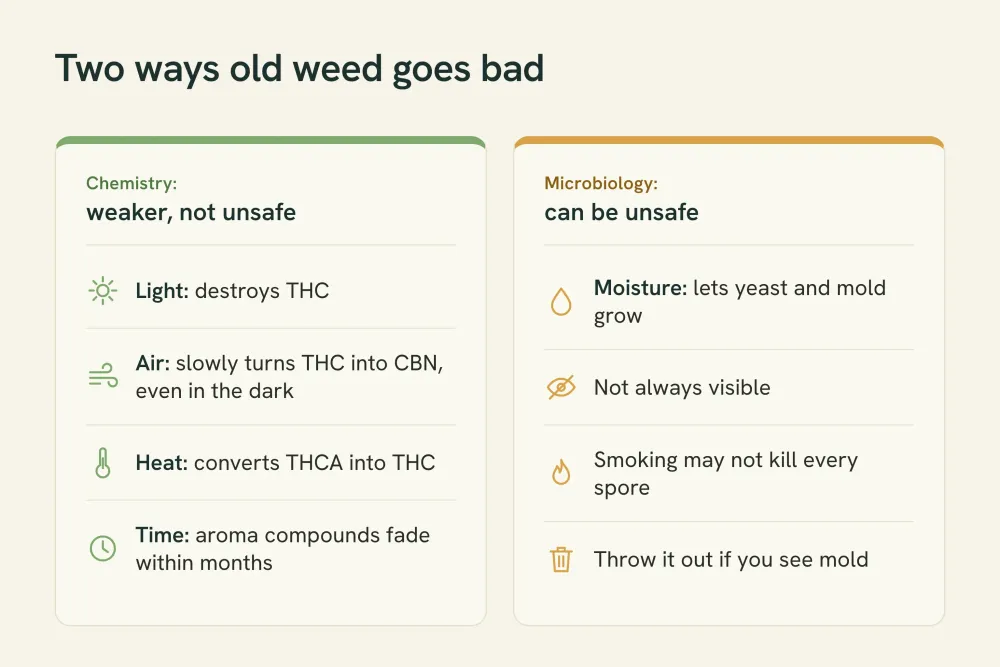
Most advice online blends two different problems. The first is chemical: cannabinoids and aroma compounds break down or change form over time, faster with light, air and heat. That makes weed weaker and less fragrant, but not dangerous. The second is microbial: yeast and mold that survived drying, or moisture that got in later, can grow on the plant. That is a safety problem, and it depends more on moisture than on age. The table sorts out which is which.
| What changes | What drives it | Can you see or smell it? | Safety issue? | What to do |
|---|---|---|---|---|
| THC breaks down; air oxidation turns some of it into CBN | Light, air, heat and time | No, not reliably by eye or nose | No. It makes weed weaker | Store it better and expect lower potency |
| THCA converts into THC | Heat and time | No | No. It shifts the cannabinoid mix | Keep it cool |
| Terpenes (aroma compounds) fade | Time and grinding, even in cold storage | Yes, the smell weakens | No | Store buds whole; do not read faded smell as lost potency |
| Yeast and mold grow | Moisture from poor drying or humid storage | Sometimes, often not | Yes | Throw it out if you see mold; do not smoke, vape or cook it |
Where the "16% a year" number comes from
Most pages that put a number on old weed trace back to one paper: a 1997 University of Mississippi study in the UN's *Bulletin on Narcotics*. Its authors, Ross and ElSohly, were not writing a shelf-life guide. They wanted a way to estimate how long seized cannabis had been stored, using the ratio of CBN to THC, for forensic work. The plant material was dried in a barn, packed in closed barrels and kept in the dark in an air-conditioned vault at 20-22°C (68-72°F). That is close to best-case storage. Here is what it lost, as a share of the THC it started with:
Those are averages with wide spread between samples, and online they are usually trimmed to 16, 26, 34 and 41, or rounded up to 17% for the first year. Three details matter more than the decimals. First, the loss was steepest in year one, and the authors wrote that it levels off after two years to about 7% a year. Second, most of the missing THC did not show up as CBN: in the four-year group, mean THC fell from 2.75% to 1.61% of the plant while CBN reached only 0.23%, and freshly, carefully dried material had no CBN at all. Third, the starting material was weak by today's standards. By our reading of the paper's tables, mean starting THC in the four groups was 2.66%, 2.88%, 3.04% and 2.75%, from Colombian, Jamaican, Mexican and hybrid crops harvested in 1991 and 1993.
The authors believed that stronger material loses THC faster in its first year or two, but they did not test it. For scale, the same Mississippi monitoring program later measured THC in seized plant material rising from about 4% in 1995 to about 12% in 2014. So the 1997 percentages are a rough guide to direction, not a schedule for your jar, and nobody has shown whether today's flower follows them. The paper also summarizes earlier Mississippi work that found THC disappearing faster the warmer the storage, and almost completely at 37°C (98.6°F) and 50°C (122°F).
What aging does to the molecules
Three processes run side by side, and each responds to different conditions. The first is light. A 1976 storage study of nine herbal and two resin samples found that light, even without direct sunlight, was the single greatest factor in cannabinoid loss, while temperatures up to 20°C (68°F) made an insignificant difference. It also found something that is easy to get wrong: THC lost to light did not turn into CBN. It was slow oxidation by air, even in the dark, that produced CBN. Keeping the plant's resin glands intact reduced that air loss, and the authors compared the glands to "well filled, well closed containers". That is one reason to store buds whole and grind just before use.
CBN is a distinct cannabinoid with its own research record. For what it is and where the evidence stands, see our guide to what CBN is and what research shows about it and how CBN compares with the THC it comes from.
The second process is heat. Fresh cannabis holds most of its THC as THCA, an acid form that converts to THC with heat and time, a step called decarboxylation that our THCA explainer walks through. In an Austrian study of 29 seized cannabis samples, storage in a warm drying cabinet drove a faster and more complete conversion of THCA into THC, while freezer storage produced only slight or no change. The published summary does not give the exact temperatures or storage times.
The third process is the one you notice first: aroma. In a year-long Technion study of stored medical cannabis, terpenoids, the compounds behind smell and flavor, dropped rapidly under every storage condition tested in the dark. Alpha-pinene and beta-caryophyllene were significantly down by four months. Cold did not protect everything: storage at -30°C and -80°C was worse for alpha-pinene than 4°C or 25°C. Ground cannabis lost more than whole buds. The study came from one lab with three samples per condition. Because aroma fades on a different timeline from THC, smell is a poor gauge of potency, a point our breakdown of cannabinoids versus terpenes explains in more depth.
What newer studies measured
The most-shared modern number is a "2,700% increase" in CBN. It comes from a two-year stability test published in 2022, written by employees of Syqe Medical, the company that makes the inhaler the cannabis was packed for, and an outside consultant it hired. Ground medical cannabis was sealed in dose cartridges, vacuum-packed in foil that keeps out light and oxygen, and kept at 25°C (77°F) and 60% relative humidity. After two years, total THC per dose chip, which counts THCA and THC together, fell 21%, from 2.80 mg to 2.20 mg. THCA fell 44% while THC itself doubled, the THCA-to-THC conversion described above. CBN rose from 0.005 mg to 0.14 mg per chip. That is the 2,700%: a large percentage of a very small starting amount. At 30°C (86°F) and 65% humidity, the authors reported a steeper change within an even shorter period. Nine samples were tested at the start and four at 24 months, in pharmaceutical packaging rather than a jar or a bag, and a correction to the paper was published in 2025, so treat the figures as the indexed abstract reports them.
A 2026 University of Mississippi stability study compared room temperature, a refrigerator and a freezer across high-THC, high-CBD and balanced plant material, extracts, isolates and a CBD oil formulation. For most of the cannabis-derived items, room temperature sped up THC's conversion to CBN, and -20°C (-4°F) preserved the cannabinoids best. CBD-only items held up even at room temperature. The authors concluded that THC-rich material needs cold storage, ideally a freezer at -20°C. The published summary gives no storage length, sample counts or percentages, so we do not put numbers on it.
Resin points the same direction. A 2025 forensic study of seized hashish stored for up to eight years also found THC falling and CBN rising, though some of its figures are hard to reconcile, so we do not quote them. Hashish is resin, not flower, and its results should not be read onto buds.
Does old weed still get you high?
Usually yes, just less. Aged flower is weaker by roughly the share of THC it has lost, and how much it loses depends on storage: an average 16.6% after a cool, dark year in the 1997 vault study, and about a fifth of total THC over two years in the sealed, foil-wrapped cartridges. CBN builds up, but in small absolute amounts, 0.23% of the plant after four years in the vault study. We found no study showing that old weed gets stronger. You may also hear that old weed makes you sleepy because of that CBN. The evidence for that is thin: human studies of CBN and sleep gave it as an oral supplement, not as aged flower, and their results are mixed. The CBN guide linked above walks through them, so we do not re-argue them here.
Mold is the real stop sign
Mold is a different failure, and it is the one that matters for your health. A Canadian team that tested more than 2,000 fresh and dried cannabis samples from one licensed greenhouse between 2019 and 2022 found the most common fungi were Penicillium, Aspergillus, Cladosporium and Fusarium. Drying buds to about 12-14% moisture or lower, which corresponds to a water activity of 0.65-0.7, kept counts down. Water activity is a 0-to-1 measure of how much water in a material is free for microbes to use. The authors warned that microbes surviving poor drying can multiply later, during curing, storage and shipping. They also noted that a few of these fungi could threaten human health while many do not, and that the standard plate count cannot tell the two groups apart.
A study often cited online for mold on weed is a 2017 UC Davis research letter that used genetic sequencing on dispensary cannabis. Genetic tests find DNA, and DNA from dead organisms stays detectable, so a positive result does not by itself show living fungi.
Two findings explain why a quick look is not enough. A 2023 review of fungi and mold toxins on cannabis and hemp flowers notes that some fungi live inside plant tissue without causing visible symptoms, and that buds dried poorly or stored under humid conditions raise concern for mycotoxins, the toxins some molds produce. The heat of smoking or vaping should kill fungal spores, the authors write, but it "may be insufficient to render all spores nonviable". Some mycotoxins, such as those made by Fusarium molds, are generally considered heat-stable, and the authors say they know of no studies on what burning does to these toxins. An older experiment points the same way. In a 1983 study of 28 people who smoked cannabis, fungi grew from 13 of 14 cannabis samples, and Aspergillus fumigatus spores passed easily through contaminated joints smoked into an air sampler. One patient had a systemic Aspergillus infection, and seven reported a history of bronchospasm, a tightening of the airways, after smoking cannabis. That was 1983 street cannabis, not today's tested flower.
Who is most at risk? According to the CDC, most people breathe in Aspergillus spores every day without getting sick, but people with weakened immune systems or lung diseases are at higher risk, and cough and shortness of breath are common symptoms across forms of aspergillosis. An analysis of 2016 insurance claims led by CDC researchers fits that picture. Fungal infections were rare, 40 cases among 53,217 people with a cannabis-use diagnosis code (0.08%) against 0.03% of people without one, but the odds were about 3.5 times higher after adjusting for age and immune status. Of the patients with both, 43% already had a weakened immune system and 40% had tobacco-use codes. The data could not show where the infections came from or whether any cannabis was contaminated, so this is an association, not proof of cause.
What testing checks before cannabis is sold
Licensed markets test cannabis before sale, but the rules differ by state. California is one dated example. Under the Department of Cannabis Control regulations revised January 1, 2026, a batch of inhalable cannabis must clear these checks before it can be sold, and its label must follow these rules:
- Disease-causing Aspergillus: none of A. fumigatus, A. flavus, A. niger or A. terreus detected in a 1-gram sample.
- Bacteria: Shiga toxin-producing E. coli and Salmonella not detected in 1 gram.
- Mold toxins: total aflatoxins (B1, B2, G1, G2) and ochratoxin A each at or below 20 micrograms per kilogram.
- Visible mold: a foreign-material inspection fails the sample only if mold covers more than a quarter of its area.
- Water activity: dried flower at or below 0.65. Solid edibles have their own limit of 0.85.
- Labels: flower must show the date it was packaged for retail sale. A best-by, sell-by or expiration date appears only if the company adds one.
Notice what the list does not include: a total yeast-and-mold count. California's microbial standard for inhalable cannabis names four Aspergillus species instead, and its visual check tolerates some mold before a sample fails. Some other jurisdictions do set total counts, and the 2023 Canadian study reported those limits ranging from 1,000-10,000 to 50,000-100,000 colony-forming units per gram, depending on the country and jurisdiction. For how these panels appear on a certificate, see what "third-party tested" actually covers. One inference of ours, not a finding: a passing result describes the batch on the day it was tested. It says nothing about what happened in a hot car or a damp drawer afterward, which is why it helps to read a COA's test date against the packaging date.
How to store weed, based on what was measured
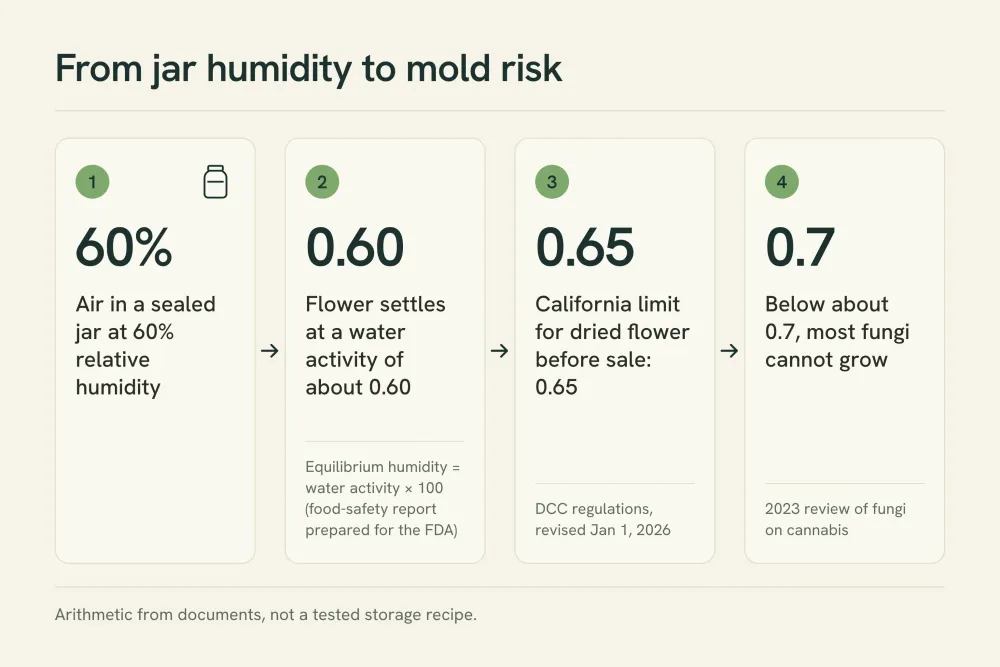
Humidity is where storage advice is weakest. The popular 59-63% humidity range comes from retailers and humidity-pack makers; in a PubMed search in September 2026, we found no published study testing that range, or testing humidity packs, on stored flower. What can be said rests on physics. At equilibrium, water activity and relative humidity are the same scale: a food-safety report prepared for the FDA gives equilibrium relative humidity as water activity times 100. So flower sealed in a jar with air at 60% humidity settles at a water activity of about 0.60. Keeping the air in a closed container below roughly 65% relative humidity keeps flower inside the 0.65 limit California applies before sale, and under the roughly 0.7 level the 2023 review says prevents most fungal growth. That is arithmetic from two documents, not a tested storage recipe, and you do not need any particular brand of anything to apply it.
| Factor | What the evidence says | How solid it is | Practical move |
|---|---|---|---|
| Light | The single greatest factor in cannabinoid loss; THC lost to light did not become CBN (1976) | One small, older lab study | Opaque container, or a clear one kept in a dark cupboard |
| Air | Air oxidation, even in the dark, turns THC into CBN; intact resin glands slowed it (1976). Ground cannabis lost more aroma compounds than whole buds (2020) | Two lab studies | Airtight container, whole buds, grind just before use |
| Heat | Warmer storage sped THC loss (earlier Mississippi work) and THCA conversion (2015); 30°C changed faster than 25°C (2022) | Consistent direction across several studies | A cool spot away from stoves, sunny windows and parked cars |
| Humidity | Water activity below about 0.7 prevents most fungal growth; 0.65 is California's pre-sale flower limit; humidity times 0.01 equals water activity at equilibrium | Physics plus regulation; no consumer storage test found | Seal only dry flower; keep the air inside below about 65% relative humidity |
| Freezer | -20°C preserved cannabinoids best (2026), but -30°C and -80°C were worse than 4°C or 25°C for alpha-pinene (2020). Frozen trichomes breaking off: not measured | A trade-off; the cannabinoid finding is from a published summary only | An option for long-term potency; expect some aroma loss |
Put together, a storage routine that follows the evidence looks like this:
- 1Store buds whole and grind only what you are about to use.
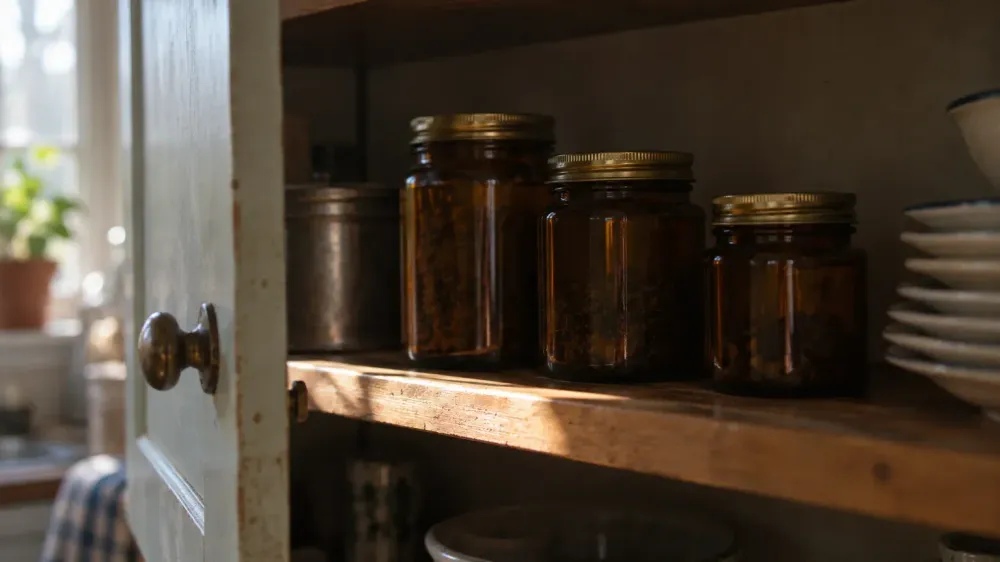
- 2Use an airtight container that blocks light, or keep a clear one inside a dark cupboard.
- 3Keep it cool and away from heat sources such as stoves, sunny windows and parked cars.
- 4Make sure flower is dry before sealing it, and keep the air in the container below about 65% relative humidity.
- 5Keep the original label, or note the packaging date, so you always know how old it is.
- 6For long-term storage, freezer temperature (-20°C) preserved cannabinoids best in a 2026 study, but freezing did not protect some aroma compounds in a 2020 study.
- 7Store it where children and pets cannot reach it.
Do edibles and vape carts expire?
Edibles and vape cartridges are formulated goods, not dried flower, so let the package guide you. In California, their labels must show the date they were packaged for retail sale, a best-by or expiration date appears only if the company chooses to add one, and solid edibles must test at or below a water activity of 0.85 before sale. Perishable items must also carry a "keep refrigerated" or "refrigerate after opening" statement. The 2026 Mississippi study found THC-rich extracts also degraded at room temperature while CBD-only items held up. Beyond that, the evidence is thin: PubMed searches in September 2026 turned up no shelf-life study for consumer edibles or vape cartridges, so we will not give you a number of months. Follow the date and any storage line on the label, and throw out an edible with visible mold or spoilage as you would any food. For the oil-in-a-bottle version of the question, see how long CBD oil lasts and how to store it.
A two-minute check for an old bag
Your senses can flag some problems, but they cannot confirm that weed is safe or tell you how potent it is. Use the table to read what you notice, then the list below it for when to throw it out.
| What you notice | What it can tell you | What it cannot tell you |
|---|---|---|
| Faint or flat smell | Aroma compounds have faded, which happened within months in storage studies | How much THC is left |
| Dry, crumbly, duller-looking buds | It has probably dried out further with age | That it is unsafe, or how potent it is |
| The packaging date on the label | How long ago it was packed for sale | How it was stored since |
| No visible mold | Nothing you can see is growing on the surface | That it is mold-free; some fungi cause no visible signs |
| A certificate showing passed microbial tests | The batch passed on the day it was tested | What happened in storage afterward |
Throw it out if you notice any of the following. These are common warning signs, not a diagnostic test, and not seeing them does not prove weed is clean:
- White, gray or greenish fuzz, or cobweb-like strands on or between buds.
- Dark or black spots, or powdery patches that do not look like the plant's glittering resin glands.
- A musty, mildewy or damp smell.
- Buds that feel damp or spongy instead of dry.
- Moisture or condensation inside the container.
What is still unknown
- How fast modern high-THC flower loses potency in ordinary conditions, such as an often-opened jar or a plastic bag.
- Whether stronger material degrades faster early on, as the 1997 authors believed but did not test.
- Whether humidity packs change potency, aroma or mold risk in stored flower; we found no published test.
- Whether freezing makes trichomes break off, a common claim we found no study measuring.
- What burning or vaporizing does to mold toxins; a 2023 review's authors knew of no studies on it.
- How long edibles and vape cartridges keep their potency after purchase.
Questions people ask about old weed
Not the way food does. Dried cannabis has no fixed expiry: it slowly loses THC and aroma, and it can grow mold if it gets damp. In California, labels must show the date it was packaged for sale, while an expiration date appears only if the company adds one.
It depends on storage, and no study gives a consumer shelf life. In a dark, cool vault, 1990s flower lost an average 16.6% of its THC in the first year. In sealed, foil-wrapped inhaler cartridges at 25°C, a 2022 study by the inhaler maker's staff and a consultant it hired measured a 21% drop in total THC over two years. Neither is a schedule for a jar in a kitchen.
Usually, just less. Potency falls by roughly the share of THC lost, and CBN builds up only in small amounts. We found no study showing old weed becomes stronger.
Age alone is not the danger; mold is. According to the CDC, most people breathe in Aspergillus spores every day without getting sick, but people with weakened immune systems or lung diseases are at higher risk. If you get a cough, wheezing or shortness of breath after using cannabis you suspect, contact a clinician.
Fuzz, cobweb-like strands, gray or black spots, a musty smell or a damp feel are reasons to throw it out. A clean look does not prove it is mold-free, because some fungi live inside plant tissue without visible signs.
It is a trade-off. A 2026 University of Mississippi study found -20°C best for preserving cannabinoids, while a 2020 study found -30°C and -80°C storage worse than a fridge or room temperature for the aroma compound alpha-pinene. The common claim that frozen trichomes snap off has not been measured in any study we found.
We found no published study testing a consumer figure. The popular 59-63% range comes from retailers and humidity-pack makers. The physics is simpler: air below about 65% relative humidity keeps flower under the 0.65 water activity limit California applies to dried flower before sale.
The evidence for that is thin. CBN builds up only in small amounts as weed ages, 0.23% of the plant after four years in the 1997 vault study, and human studies of CBN and sleep tested it as an oral supplement, not as aged flower, with mixed results. Our CBN guide covers them in detail.
To put that into practice, start with a step-by-step guide to reading a certificate of analysis, then see which contaminant panels a real third-party test includes. If you use CBD oil, our guide to choosing a CBD oil covers the rest of the buying checklist.
Writing about hemp, wellness and the small rituals that keep us balanced.