How Long Does a Cart Last? The Puff Math the Box Leaves Out
The puff counts on page one have no source. A cart's life is its fill weight divided by the oil each puff vaporizes, and lab tests measured 4 to 15 mg. Here is the math from the box, the THC it implies, and why the label may be off.
How long does a cart last? There is no fixed answer, and the puff counts repeated across the first page of search results (100 to 300, 150 to 320, even 500) come with no source. A cart's life is one division: the oil in it divided by the oil each puff vaporizes. Lab studies have measured that second number, and it moves severalfold with puff length and coil heat. That is why the same 1 gram cart can be gone in a few days for one person and last several weeks for another.
The short answer. At the averages measured in two lab studies, a 1 gram cart holds roughly 66 to 250 puffs: about 250 at 4 mg of oil per short, low-power machine puff, and about 66 at 15 mg per long, hot one. How many days that covers depends on the person, which is why nobody can give you a universal figure. One disclosure up front: Planntz does not sell vape cartridges or any vape product. We make CBD tinctures, and this page is label math, written for adults 21 and over in states where cannabis is legal. Nothing here is a guide to how much to use.
How long does a cart last? The formula and the measured range
Every estimate of a cart's life, including the ones on vendor blogs, is the same calculation, whether or not it is shown: puffs ≈ oil in the cart (mg) ÷ oil vaporized per puff (mg). The first number is printed on the box. The second is the one nobody prints, and it has been measured. In a 2021 lab study of ceramic cartridge vaping, funded by the NIH and FDA, researchers fitted a CCELL ceramic atomizer to a battery, drew standardized 3-second, 50 mL machine puffs, and weighed the atomizer before and after each puff. It lost an average of about 4 mg of oil per puff at 8 watts and about 7 mg at 10 and 12 watts, with a wide spread between individual puffs. The oil was purified synthetic THC, with and without an added terpene, not a market product.
At the high end, an FDA forensic lab running six ceramic-coil cartridges at 12.7 to 16 watts, with 4-second puffs every 30 seconds, measured 9.04 to 15.1 mg of oil leaving each cartridge per puff, and attributed part of that spread to differences in cartridge geometry. That was a deliberate stress test: the oil was cut 50:50 with vitamin E acetate, the additive tied to the 2019 lung-injury outbreak, so it says nothing about what legal carts contain (our guide to THC distillate and what labs found in carts covers that outbreak). What it does show is how far the per-puff number can stretch. Together, the two studies bracket the arithmetic on this page.
To turn puffs into days, divide by the number of puffs you take in a day. That last number varies more between people than anything about the cart, which is why the rest of this page sticks to the parts printed on the box or measured in a lab.
What is actually in a "1 gram" cart
A cart's box carries the two numbers the arithmetic needs. In California, under cannabis regulations as revised January 1, 2026, a vape cartridge is legally a cannabis concentrate, and the rules spell out what its package must say. The primary panel has to show the net weight of the contents in both metric and US units, and for a concentrate without serving sizes the label has to state THC and CBD content in milligrams per package. Other states write their own labeling rules; California's are used here because they are specific and public. Look for three things:
- 1Fill weight (net weight): usually 0.5 g or 1 g for a cartridge. This is the oil in the tank and the first half of the puff math.
- 2Potency: a THC percentage, a THC amount in milligrams per package, or both.
- 3Total THC in the container: fill weight times the THC percentage. If the box also prints milligrams per package, the two should roughly agree.
The arithmetic is the same kind you do for how many grams are in an eighth of flower, just with oil. A 1 g cart (1,000 mg of oil) labeled 85% THC holds about 850 mg of THC. A half-gram cart with the same label holds about 425 mg. A 2 g disposable at 85% would hold about 1,700 mg, which matters in California: the state caps an adult-use cannabis concentrate at 1,000 mg of THC per package, with up to 2,000 mg allowed only on products labeled for medical use. So a 2 g device at that potency, sold as a single adult-use package, would be over the line. We use 85% as the example because it sits inside the range real carts print, not because it describes any brand.
Real carts do not always print what they should. When California's public health laboratory analyzed 12 unused cartridges, ten of them collected during the 2019 outbreak and two from late 2018, the fill weights ranged from 0.5 to 1.1 g. Only six printed a THC percentage at all, from 65.21% to 92.23%, and one appeared to have been adulterated with synthetic delta-8 THC. Those were investigation samples, not a random draw from licensed shelves, but they show why the box is where the arithmetic starts, not where the checking ends.
How many hits are in a cart? Auditing the 100-300 claim
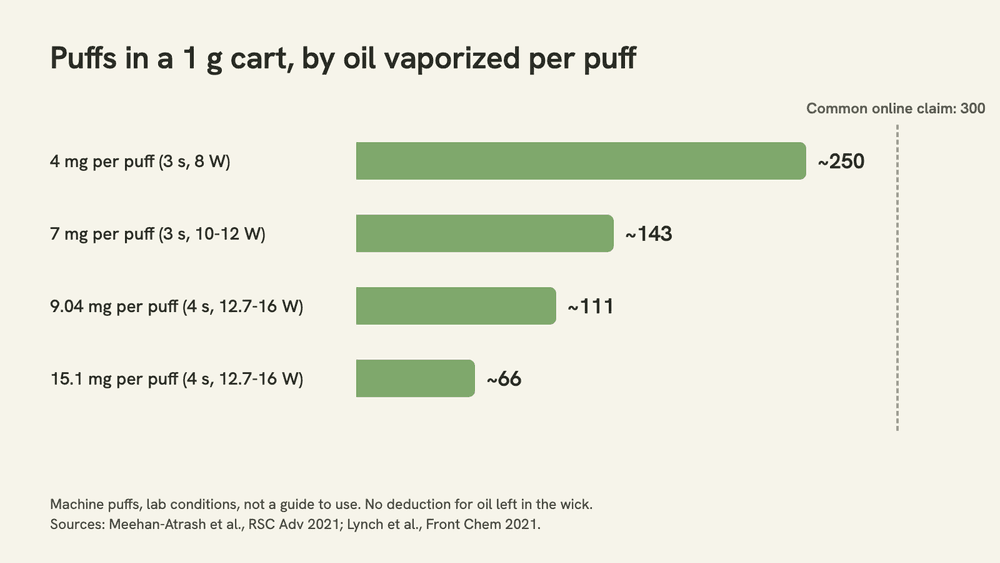
The puff counts on page one usually fall between 100 and 300 for a 1 g cart, with some pages going to 400 or 500. We could not find a source behind any of them. One page that did state a per-puff figure, 2 to 5 mg of oil per three-second draw, gave no source for that either. Here is what the measured rates actually imply. The 4 and 7 mg columns are 3-second machine puffs at 8 W and at 10-12 W; the 9.04 and 15.1 mg columns are the lowest and highest cartridge averages from 4-second puffs at 12.7-16 W.
| Fill on the box | THC at an 85% label | At 4 mg per puff | At 7 mg per puff | At 9.04 mg per puff | At 15.1 mg per puff |
|---|---|---|---|---|---|
| 0.5 g (500 mg of oil) | 425 mg | ~125 | ~71 | ~55 | ~33 |
| 1 g (1,000 mg of oil) | 850 mg | ~250 | ~143 | ~111 | ~66 |
| 2 g (2,000 mg of oil) | 1,700 mg (over California's 1,000 mg adult-use cap) | ~500 | ~286 | ~221 | ~132 |
Read the table two ways. First, the familiar 100 to 300 range is the right order of magnitude. Second, its top end is optimistic: 300 puffs from 1 g requires about 3.3 mg of oil per puff, below the lowest average in either study (4 mg). A claim of 500 requires 2 mg. A real cart will also come in under its column, because some oil stays in the wick and tank when the cart stops producing vapor. We could not find a study that measured how much (our PubMed searches for it on October 8, 2026 returned no records), so the table makes no deduction for it, and every number in it is a ceiling for those conditions rather than a promise.
There is one rough check from real people. In a 2024 Colorado study of 29 adults using legal products, ten daily concentrate users (vape pens and dabs, pooled) went through an average of 50.0 mg of product in about 6.4 inhalations over roughly four minutes. Dividing those averages gives about 8 mg per inhalation, which lands inside the lab range. That is our division, not a per-puff measurement, and the spread between people was large: the standard deviation on the 50 mg was 34.8 mg. That describes what ten people did in one study session, not a pace anyone should match.
Why the same cart lasts days for one person and weeks for another
The per-puff number moved from 4 mg to 15 mg across two studies because the conditions changed. Four variables do most of the work, and only one of them belongs to the cart.
- Puff length. A longer puff keeps the coil heating for longer, so more oil leaves per puff. Real vaping puffs tend to run longer than the 3 or 4 seconds machines use.
- Coil heat. More power heats the coil more. In the 2021 ceramic-cart study, oil per puff rose from 8 to 10 watts and then levelled off at 12.
- Oil thickness. Terpenes thin the oil. In the same study, adding more terpene tended to raise both the oil and the THC carried into each puff.
- The person. How long, how often and how deeply someone puffs. A 2026 review judged this likely to matter more than anything about the cartridge.
On puff length, a 2026 review of vaping THC in liquid form puts the typical vaped cannabis puff at about 5 to 6 seconds, against about 1.3 seconds for a puff of smoked cannabis, citing an online survey of 557 people who vape cannabis. Machine studies use 3 or 4 seconds, so a real puff can run longer than any column in the table. Devices also cut puffs off on their own: in a 2022 thermal-camera study of cartridge coils, funded by PAX Labs and carried out by its employees (the company makes one of the three devices tested), the automatic cutoff ranged from 4 seconds to 15 seconds across the devices.
On heat, the same study found that the voltage number on a battery says little about how hot the coil actually gets. A 1 g cart on a variable-voltage battery averaged 443 °C at a 2.4-volt setting and 543 °C at 4.0 volts, with a standard deviation of almost 96 degrees at the higher setting; a single-voltage battery at 3.2 volts averaged 450 °C. The authors' conclusion: "Voltage alone was a poor indicator of coil temperature." The same sentence goes on to report that only the temperature-controlled system, the company's own, stayed under 400 °C for the full puff, so weigh that half against who paid for the study. These are test conditions reported to explain why carts empty at different rates, not settings to copy. Why an overheated coil tastes burnt is a separate question about coil chemistry.
On the person, the Colorado study found that daily users' estimated inhaled THC was about five times that of occasional users, which the authors describe as "an approximate 5-fold difference in inhaled THC consumption". The 2026 review's plain-language summary lands in the same place: "the way a consumer uses the product will be the most significant factor". So a cart that empties quickly is often telling you as much about the sessions as about the hardware.
Oil in the cart vs THC in your blood
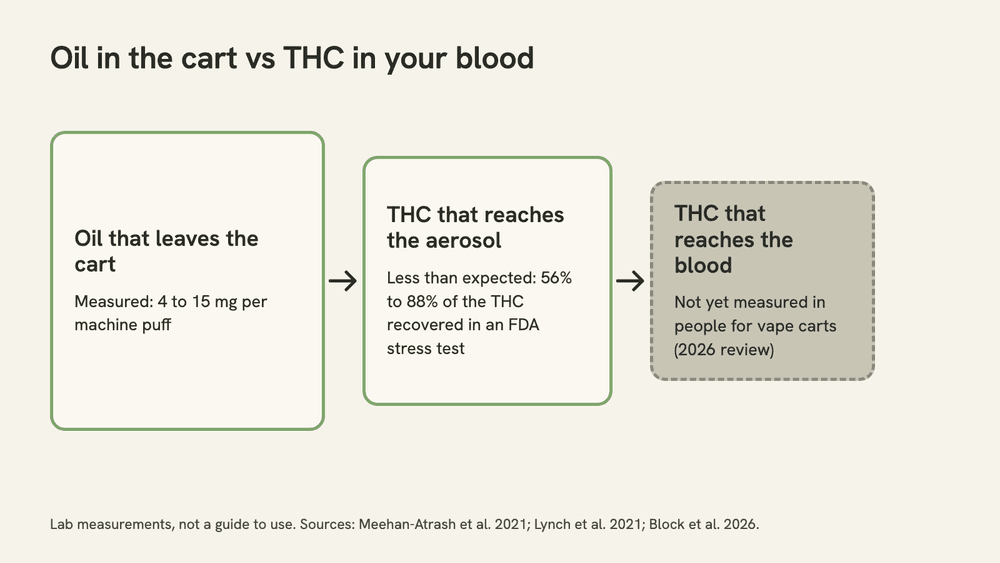
Three different numbers get blurred together when people talk about how much is in a cart. The first is the oil that leaves the cartridge, the 4 to 15 mg above. The second is the THC that actually ends up in the aerosol. In the 2021 ceramic-cart study that was about 1.6 to 5 mg per machine puff, rising as added terpene thinned the oil and as power rose to 10 watts, then levelling off. In the FDA stress test, the aerosol the lab collected held only 56.4% to 88.0% of the THC expected from the oil each cartridge had vaporized, judged against the unvaped oil. The third number is the THC that reaches your bloodstream, and for vape carts it has not been measured.
“Currently, no human studies have elucidated the PK/PD profile of Δ9-THC from vaped liquids, as confirmed by searches of PubMed and Embase.”
PK/PD means how the body absorbs and responds to a drug. What exists instead is data from smoking. The same review summarizes smoked-cannabis studies as showing bioavailability (the share of THC that reaches the blood) of roughly 10% to 27%: about 10% to 14% for light users and 23% to 27% for heavy users. The authors hypothesize that aerosol from vaped liquids will likely deliver more than 80%, but that is their hypothesis, not a measurement, and smoking numbers cannot simply be carried over to carts.
The Colorado study shows the gap in practice. Across all 29 adults, who used flower or concentrates in a single session of up to 15 minutes, the THC that disappeared from their products averaged 53.0 mg, while the amount their blood levels pointed to averaged 11.1 mg, roughly a fifth (our ratio of the two averages). The paper's title calls weighing what was used a poor predictor of THC exposure. That is the opposite of an edible, where the milligrams on a 10 mg edible's label are what you actually swallow, even though absorption still varies from person to person. If you are comparing concentrates with flower, what changes between dabs and flower covers the blood-level studies.
Is the number on the label right?
The arithmetic above assumes the label is accurate, and the law allows some slack. California regulations say a THC figure on a label is not considered inaccurate if it is within plus or minus 10% of the certificate of analysis. Colorado's tolerance is 15%, as a 2026 PLOS ONE study of Colorado products notes. On licensed Colorado shelves, a 2025 audit of products from 52 dispensaries found 95 of 99 concentrates within that 15% window, though on average they came in a little under the label (73.0% labeled, 70.7% measured). That audit did not break carts out from other concentrates. The full record on potency labels, including the products that missed, is in our review of whether THC percentage matters.
Whether a label exists at all is a different question. In New York in late 2023, a research team bought 88 flower and vape products from licensed and unlicensed stores and coded what the packaging said. Every licensed product printed its THC potency (28 of 28); fewer than half of the unlicensed ones did (25 of 60). A QR code linking to a lab certificate appeared on 54% of licensed products and 8% of unlicensed ones. That study read labels; it did not test what was inside, so it says nothing about whether the printed numbers were right. A correct label is also not a safety guarantee. When you read a cart's box, these gaps make the puff and milligram arithmetic impossible or suspect:
- No net weight, so you cannot know how much oil the puff math starts from.
- No THC figure at all, neither a percentage nor milligrams per package.
- A milligram total that does not match the fill weight times the percentage.
- No batch or lot number, so there is no way to match the box to a lab certificate.
- No certificate of analysis or QR code to one, or a certificate whose batch number differs from the box.
- No packaging or use-by date, which leaves the storage question open.
If a box does link a certificate, reading a lab report (COA) takes about five minutes once you know which lines matter. The same label habits apply to any cannabinoid product, as our buyer's checklist for CBD oil lays out: a stated amount, a batch number, and a certificate that matches both.
Carts vs disposables: what changes and what does not
A disposable is a cartridge and battery sold as one sealed unit. The puff arithmetic does not change: fill weight divided by oil per puff. A disposable with more oil in it holds more puffs at the same rate, and one with less holds fewer, so whether it outlasts a cart depends on the number on the box, not on the format. The same 1,000 mg California cap on THC per adult-use package applies to whatever is inside. What changes is that the battery is fixed, so you cannot change its power. That fixes the heating behavior; it does not tell you whether that behavior is hot or cool. In the 2022 thermal-camera study, the single-voltage battery tested averaged 450 °C at its 3.2-volt setting, with a standard deviation of about 61 degrees, close to the variable battery's low setting.
Beyond the arithmetic, a 2024 review of cannabis vaporization products and devices sorts devices into nine types and notes that not all vaping products and device types carry the same level of safety. This page does not rank them. How vaporizing whole flower differs again is covered in our comparison of dry herb vaporizers and smoking.
Empty, expired or worn off: three questions people mix up
"How long does a cart last" can mean three different things, and each has its own answer and its own evidence.
| The question | What it measures | Where it is answered |
|---|---|---|
| How long until it is empty? | Puffs: fill weight divided by oil vaporized per puff | This page |
| How long until it expires? | Shelf life: how the oil and its THC change in storage | Our guide to whether weed goes bad |
| How long does a hit last? | Duration of effect after inhaling | Our guide to how long a high lasts |
Shelf life is a storage question, covered in what storage studies found about whether weed goes bad, carts included. How long the effects of a hit last is a pharmacology question, covered in how long a weed high lasts. This page answers only the first: how many puffs before the tank runs dry.

What is still unknown
The arithmetic is simple. The inputs are thinner than the confident numbers on page one suggest.
- No human study had measured how much THC reaches the blood from vaped liquids, according to the 2026 review's searches of PubMed and Embase.
- We found no study that counted the puffs a person actually gets from a real cart, from full to empty.
- We found no study that measured how much oil is left in a cart once it stops producing vapor (PubMed searches, October 8, 2026).
- The per-puff numbers come from machines, with only a few puffs per condition and wide spreads. One study used synthetic THC; the other used an oil cut with vitamin E acetate.
- The thermal-camera study was funded and carried out by a company that makes one of the devices it tested.
- The label rules and audits cited here cover California, Colorado and New York. Other states set their own rules.
None of that makes the formula wrong. It means the honest answer to "how many hits in a cart" is a range with its conditions attached, not a single number, and anyone quoting one number without the conditions is guessing.
Frequently asked questions
Divide the oil by the oil vaporized per puff. At the averages measured in two lab studies, 4 to 15.1 mg per machine puff, a 1 g cart works out to roughly 66 to 250 puffs. Real carts come in lower, because some oil stays in the wick and real puffs often run longer than the 3 to 4 seconds machines use. Claims of 300 or more need under 3.3 mg per puff, below the lowest average either study reported.
Half as many puffs as a 1 g cart at the same rate: roughly 33 to 125 at the measured lab averages. How many days that covers depends on how many puffs you take in a day, which varies far more between people than between carts.
Multiply the fill weight by the THC percentage on the label. A 1 g cart at 85% holds about 850 mg of THC, and a 0.5 g cart about 425 mg. In California the label must state THC in milligrams per package, and adult-use concentrates, carts included, are capped at 1,000 mg of THC per package (regulations as revised January 1, 2026). Only a fraction of the THC in the cart reaches your blood, and for carts nobody has measured how much in people.
The usual reasons sit on the oil-per-puff side of the division: longer puffs, a hotter coil, thinner oil, and more puffs per day. In lab tests, oil per puff ran from about 4 mg on short, low-power puffs to about 15 mg on long puffs with a hot coil, close to a fourfold difference. A cart that runs out quickly is often reflecting how it is used rather than a short fill, though checking the net weight on the box rules that out.
Not by design. The same arithmetic applies: fill weight divided by oil per puff, so a disposable with more oil holds more puffs at the same rate and one with less holds fewer. Its fixed battery means you cannot change the power, but fixed is not the same as controlled: in a 2022 thermal-camera study, a single-voltage battery averaged about 450 °C with a spread of about 61 degrees.
That is shelf life, a separate question from how long a cart lasts in use. Our guide to whether weed goes bad covers what storage studies found, including for vape carts.
No. The lab numbers describe oil leaving a cartridge under machine conditions. The THC in that aerosol was only part of the oil, and how much of it reaches your blood from a cart has not been measured in people. In a Colorado study, the THC weighed out of products averaged about five times what participants' blood levels pointed to. Treat per-puff figures as a way to understand the arithmetic, never as a dose.
Where to go next. A cart's life starts from two printed numbers, and the second one, the potency, is only as good as the lab and the label behind it. For what audits found when THC percentages were tested against the label, read what the potency audits and studies found about THC percentage.
Writing about hemp, wellness and the small rituals that keep us balanced.