Why Does My Cart Taste Burnt? What's Happening at the Coil
A burnt hit means the coil got ahead of the wick: part of it ran dry and much hotter. Here is what labs measured at cannabis-cart coils, what a burnt hit adds to the vapor, and what the taste does and does not tell you.
Why does my cart taste burnt? Because, for at least part of that puff, the coil got hotter than the oil could keep up with. A cart's heating element stays in its normal range only while oil keeps soaking back into the wick around it. When the wick runs dry, even in one spot, that part of the element heats much further, and the oil and wick material it touches break down into compounds that were not in the cart. The scorched taste is usually the first sign you get.
The short answer. A burnt hit is a dry hit: the heating element outran the wick. Lab studies on cannabis cartridges have measured how far coil temperature swings from one battery to another and how much hotter a cart runs once its liquid is gone. E-cigarette labs have shown that the puffs people taste as burnt are the ones where aldehyde output jumps. Treat the taste as a signal to stop, not something to push through. One disclosure up front: Planntz does not make or sell vape cartridges or any vape product. We make hemp CBD tinctures that you take by mouth. This page is about chemistry, written for adults 21 and over, and it gives no device settings.
What happens inside a cart when you inhale
A cartridge is a small oil tank sitting on top of a heater. When you draw on it (or press a button, depending on the battery), current runs through a metal heating element. Around that element sits a wick, a porous material that pulls oil out of the tank and holds a thin film of it against the heat. The film turns into aerosol, you inhale it, and fresh oil soaks into the wick to replace it. The cartridges examined in the FDA and California lab studies cited on this page used ceramic cores: a porous ceramic block that does the wicking, with the heating element inside or around it.
- Battery: supplies the power. Different batteries can push the same kind of cart to very different temperatures.
- Heating element: a metal coil that turns electricity into heat.
- Wick: in the THC carts labs have studied, usually a porous ceramic core that carries oil from the tank to the heat.
- Oil reservoir: the visible tank, holding cannabis oil, often with terpenes in the mix.
- Mouthpiece and airflow path: where the aerosol travels on its way to you.
The whole system depends on that refill. A 2021 review of cannabis vaping chemistry makes the point directly: a "sufficiently low viscosity of the vape liquid/oil is necessary" for these devices to work, because they rely "on wicking to deliver the vape liquid/oil to the atomizer from the cartridge reservoir." In plain terms, the oil has to be thin enough to soak back into the wick between puffs. What that oil actually is, from distillate and added terpenes to the cutting agents that caused trouble in 2019, is covered in our guide to THC distillate and what labs have found in carts.
Why a cart tastes burnt: the coil outruns the wick
Most explanations online stop at "the voltage is too high." The measurements say more than that, and they also show why a voltage number tells you less than you might think. In a 2022 infrared-camera study of cartridge heating coils, written by PAX Labs employees and funded by the company, which makes one of the devices tested, 1 g ceramic cartridges filled with an 87% THC dispensary extract averaged about 443 °C on one battery setup, 450 °C on a second and 543 °C on a third, with a standard deviation of about 96 °C at the hottest. The company's own temperature-controlled pod held about 420 °C, a result to weigh against who paid for the work. The authors wrote that "voltage alone was a poor indicator of coil temperature," and noted that temperature varied along the length of the coil, including from wick desaturation during a puff.
An FDA forensic laboratory pushed this further. In its 2021 study measuring coil temperature while collecting the aerosol, five ceramic cartridges were stepped up through increasing power. Maximum coil temperatures climbed in every one, from roughly 220-300 °C at the lowest setting tested to 550-630 °C at the highest that still produced vapor. Above that, some heating elements simply failed. The readings were "very sensitive to the position of the probe," which is another way of saying the coil has hot spots. These were stress-test conditions (three of the five oils were THC cut 50:50 with vitamin E acetate), and none of them is a setting to copy.
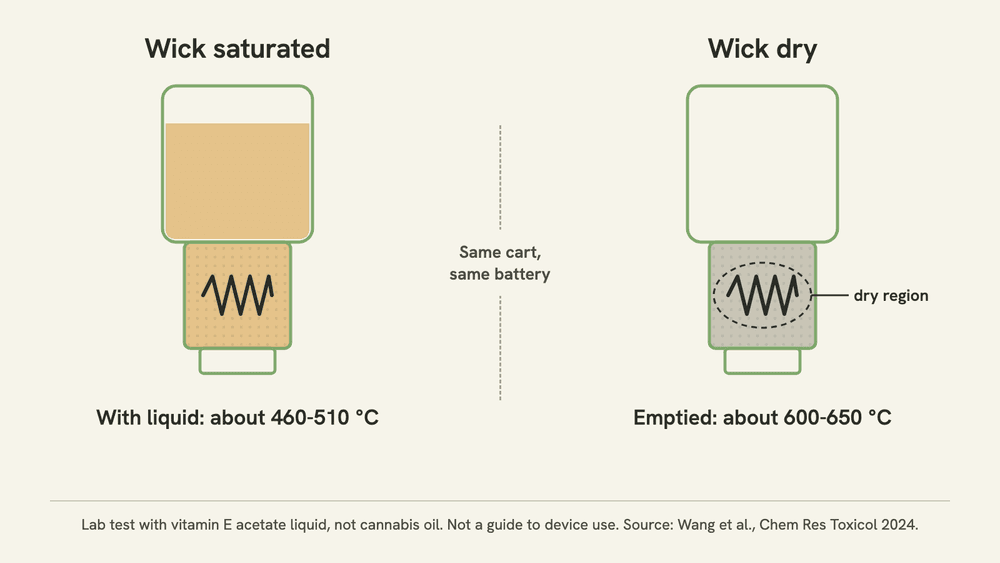
The most direct look at a dry hit comes from California's public-health laboratory. In a 2024 study of ketene formation in vaping devices, the team measured the same cartridge on the same battery twice: the heating filament ran about 460-510 °C while vaping liquid, and about 600-650 °C once the cart was emptied to simulate a dry puff. The carts had been collected from California high school students in 2019 and refilled with vitamin E acetate for the test, so the liquid was not cannabis oil. What carries over is the physics: take the liquid away from the heat and the element runs well over 100 degrees hotter.
A 2025 review of cannabis concentrate vaping chemistry connects the temperature to the chemistry in one sentence: "Inefficient wicking is a major cause of toxicant formation during vaping since it can result in exposure of a sample to excessive temperatures via contact with a dry region of a heating element." The same review notes that "sample viscosity can have a deleterious effect on wicking efficiency." Put the studies together and a burnt hit has four common routes, each tied to something that has been measured or described in the literature:
- 1Low oil. As the tank empties, parts of the element lose their supply. An emptied cart ran well over 100 degrees hotter than the same cart with liquid.
- 2Oil that wicks too slowly. Thicker oil refills the wick less efficiently, so a dry region can form even when the tank looks full.
- 3A coil running hot. The same cart type averaged about 100 degrees apart on different batteries, and the voltage number did not predict it.
- 4A worn or charred element. Teardowns of used THC carts have found the ceramic around the coil charred black (more on that below).
Why does my cart taste burnt when it's full?
This is the most common version of the question, and the answer is that the tank and the wick are two different places. The oil you can see in the tank is not the oil touching the coil. What matters is the thin film inside the ceramic, right next to the heat, and that film can run short mid-puff while the tank is still full. The PAX Labs team named this when they listed wick desaturation during a puff as one reason coil temperature varied along its length. The 2025 review explains why it happens more with some oils than others: thicker oil wicks less efficiently, so it refills the dry spot more slowly. No study gives a viscosity number that separates a cart that works from one that dry-hits, so treat any figure you see online with suspicion.
A brand-new cart that tastes burnt on the first hit has another possible explanation. When California's public-health lab took apart THC cartridges used by patients in the 2019 lung-injury outbreak, the two used carts showed "extensive charred, blackened material on the inside and outside of the oil-soaked ceramics," which the authors read as burned THC liquid and very high temperatures at the filaments. An unused cart from the same brand of hardware also had minor burn marks, "perhaps as the result of manufacturer testing." So a first-puff burnt taste does not necessarily mean you did anything wrong. How many puffs a cart holds before it runs low is a separate question, worked out from lab measurements in our breakdown of how long a cart lasts.
What a burnt hit actually is, chemically
This is the part none of the top search results explain. The best-measured link between a burnt taste and what is in the vapor comes from nicotine e-cigarettes, not cannabis carts, and that caveat applies to everything in the next four paragraphs. E-liquid (mostly propylene glycol and glycerin) is a different material from cannabis oil, so these numbers describe the mechanism, not your cart.
In a 2015 Greek study of dry puffs in e-cigarettes, seven experienced vapers tasted puffs from a single-wick atomizer at rising power while a machine collected the same aerosol. All seven identified dry puffs at the two highest settings. Under those dry-puff conditions, aldehydes "increased by 30 to 250 times," reaching up to 344.6 µg of formaldehyde, 206.3 µg of acetaldehyde and 210.4 µg of acrolein per 10 puffs, and acetone was detected only in dry-puff conditions.
The same group repeated the design with more people. In a 2017 study of 26 experienced e-cigarette users, 88% of participants detected a dry puff before the harshest setting tested, and formaldehyde ranged from 3.4 to 718.2 µg per 10 puffs between the gentlest and harshest settings, roughly a 200-fold spread. The authors concluded that very high formaldehyde levels appeared only in conditions users find aversive. That is nicotine e-liquid, one older device and the same research group as the 2015 study.
A 2021 study from the Dutch national public-health institute asked whether the taste can be matched to specific chemicals. Thirteen experienced e-cigarette users scored the "dry puff flavor" of different set-ups, which the authors define as "an adverse burnt off-taste" that appears when power is too high, "or when the heating element runs dry for other reasons." The researchers then machine-vaped the same set-ups and measured the emissions. Eleven carbonyl compounds tracked what the tasters reported, and one of them, lactaldehyde, was the best single indicator. The dry-puff flavor showed up at different power levels with different liquids, so the point where a puff turns burnt is not a fixed setting. Within the nicotine-liquid limit, the burnt taste is the chemistry, noticed by your tongue first.
“Eleven carbonyl compounds were found to agree with the human assessments.”
How often does it happen? In a European survey of adult smokers who also vaped nicotine, 14 of 110 (about one in eight) reported a dry puff or burnt taste in the previous six months. It is a small, self-reported sample from 2016, but it shows the experience is not rare.
What changes when the oil is cannabis
Cannabis oil brings its own chemistry to the coil, and here the studies are cannabis-specific, though none of them measured a real person's puff. Terpenes, the aromatic compounds behind a strain's smell, are among the more volatile, heat-sensitive ingredients in many cart oils (how cannabinoids and terpenes differ explains what they are). Lawrence Berkeley National Laboratory scientists heated the terpene blends used in cannabis concentrates to 100-500 °C inside a room-sized chamber and quantified eleven breakdown products, including acrolein (1.3-3.9 µg/m³) and methacrolein (2.0 µg/m³), along with a large release of ultrafine particles. Adding just 0.5% of other plant compounds, such as flavonoids, tripled the rate of particle formation. Those are room-air readings from heated mixtures, not a dose from a cart.
A 2021 bench study of THC and terpene breakdown in a ceramic cartridge found that heated THC and the terpene beta-myrcene break down through a shared pathway into the same four small volatile compounds, isoprene among them, which made up 18 to 30 percent of the aerosol's gas phase. The oil was synthetic THC with and without myrcene, no people were exposed, and one of the authors is a founder of an Oregon hemp company, a conflict of interest worth knowing about.
The cannabinoids are not inert either. In a 2022 UC Davis study of THC oil and vitamin E acetate on a heated coil, even purified THC oil with nothing added broke down at coil temperatures of 100 to 300 °C, through radical oxidation and direct thermal decomposition, into a range of smaller carbonyl compounds, and the team also saw evidence of terpene degradation. THC oil had a stronger tendency to aerosolize and degrade than vitamin E acetate at a given temperature. That is bench chemistry; it does not tell you how much of any carbonyl a person inhales.
Heat also rearranges cannabinoids into other cannabinoids. Chemists who vaped pure CBD, CBDA and THC in a high-powered e-cigarette and analyzed the vapor (2025) found CBDA turning into CBD and then into THC isomers (delta-8-iso and delta-9 forms), along with CBC and an oxidation product called CBD quinone. THC turned into CBN and HHC-type compounds. Most of these products rose with more power, but CBD quinone, which the authors flagged as potentially harmful, was highest at the lowest power tested. So the chemistry does not reduce to a single "too hot" line, and the device was a high-powered e-cigarette, not a standard cart. If CBN and HHC are unfamiliar names, our overview of what cannabinoids are is a good place to start.
Is it bad to hit a burnt cart?
Here is what the evidence supports. Under-fed coils run hotter, and hotter coils make more breakdown chemistry. The temperature jump has been measured on cannabis-cart hardware, the carbonyl rise during dry puffs in nicotine e-cigarettes, and heat-driven terpene and cannabinoid breakdown in cannabis-oil bench studies. A burnt taste tells you the coil is in that dry, hot condition. That is the honest reason to treat the taste as a stop signal.
What the evidence does not support is the reverse. When the 2015 dry-puff study concluded that aldehydes appear in significant quantities only when users notice a bad taste, other researchers objected in the same journal that establishing this "would require a far greater evidence base than provided in this study," and called the conclusion "a near-textbook example of the fallacy of composition." The original authors replied, and the dispute stands. For you, the practical meaning is simple: the taste is a useful alarm, not a guarantee that a smooth puff is clean.
The closest thing to a toxicity test of dry-hit vapor is a cell study. In a 2024 Baylor experiment on dry-hit aerosol and lung cells, lung cells grown in a dish were exposed to e-cigarette aerosol made from a flavored propylene glycol liquid, with and without dry hits. The dry-hit aerosol produced a "highly significant increase in cytotoxicity" (cell death), and electron microscopy showed thermal breakdown of the cotton wick itself. That is cell-culture evidence, on a nicotine-free flavored e-liquid and a cotton wick, not a measurement in people or in a cannabis cart.
Ketene is the one place where a dry hit stops being a taste problem and becomes a specific hypothesis about lung injury. A 2020 computer model from the University of Melbourne predicted that vitamin E acetate is unlikely to make harmful ketene under typical vaping, but that the hotter conditions of a dry hit could push ketene to acutely toxic levels in the lungs. California's lab later confirmed that ketene forms from the acetate group and rises with temperature; plain vitamin E, without the acetate, made none. That is a modeled risk for acetate compounds, which is why it matters for THC-O acetate (see our THC-O explainer) and for the vitamin E acetate behind the 2019 EVALI outbreak, covered in our distillate guide. It is not a finding about ordinary cart oil.
And here is the limit that matters most. We found no study, as of October 2026, that measured what burnt hits from a cannabis cart do to the health of the people who take them. Everything above is lab chemistry, machine puffing, cell culture, a computer model or nicotine e-cigarette work. It points in one direction, but it is not a measurement of harm in cannabis users, and it does not mean a cart that never tastes burnt is risk-free.
If you have shortness of breath, chest pain or a cough that is getting worse after vaping, CDC's clinical guidance from the 2019 lung-injury response is to seek medical care promptly. Breathing problems and chest pain lasting two minutes or more are among the warning signs of a medical emergency that MedlinePlus lists; for those, call 911.

What a burnt taste can mean: causes, evidence and limits
No page on the first page of search results lines up the causes with the evidence, so here is that table. Read the last column as carefully as the third: every row has a limit, and the limits are where most online advice goes wrong.
| Possible cause | What happens at the coil | What has been measured (study, type) | What it does not tell you |
|---|---|---|---|
| Low oil | Parts of the element lose their oil supply and heat further | Emptied cart about 600-650 °C vs 460-510 °C with liquid, same battery (Wang 2024, lab test, vitamin E acetate liquid) | What you inhaled, or any dose |
| Thick or slow-wicking oil | A dry region forms next to the coil even with a full tank | "Inefficient wicking is a major cause of toxicant formation" (Munger 2025, review) | No viscosity cutoff exists for your cart |
| Coil running hot | Temperature varies widely by battery and along the coil | 443 vs 543 °C average on the same cart type (Oar 2022, lab, PAX Labs-funded) | A voltage number does not tell you coil temperature |
| The burnt flavor itself | Dry-puff conditions; carbonyl compounds spike | Aldehydes up 30-250 times; 11 carbonyls matched tasters' reports (Farsalinos 2015, Visser 2021, nicotine e-liquid) | Not measured for cannabis oil; a smooth puff is not an all-clear |
| An acetate additive in the oil | The acetate group can release ketene as heat rises | Ketene rose with temperature and needed the acetate group (Wang 2024, lab); toxic levels predicted under dry hits (Narimani 2020, computer model) | Anything about ordinary cart oil without acetates |
| Charred wick or element | Burned residue on the wick and around the coil | Charred ceramic in used carts (Wagner 2020, teardown); charred cotton wick and more cell death (Beard 2024, cells in a dish) | A health outcome in people |
What a burnt taste is not
It is not proof a cart is fake. Overheating comes from the coil and the wick, and California's lab found burn marks even on a cart that had never been used. A burnt taste is not an authenticity test in either direction; our guide to telling whether a cart is fake covers the checks that actually tell you something.
It is not the same as a cough. Coughing after a hit is a reflex with its own causes, explained in why weed makes you cough. A burnt taste can come with a cough, but one does not diagnose the other.
It is not a potency reading. We found no study that measured how much potency a burnt hit loses, so any percentage you see online is a guess. What has been measured is that heat converts cannabinoids into other compounds, as the 2025 vaping study showed.
Oil color is not a test. Cart oil can darken with age as THC oxidizes toward CBN, a storage question covered in what studies found about whether weed goes bad. No study we found ties darker oil to a burnt taste or to specific emissions.
It is not the dry-herb story. Heating whole flower in a dry herb vaporizer is a different device with its own temperature studies, covered in our comparison of dry herb vaporizers and smoking. The flower version of reading a sign from the burn is ash color, and our look at white ash vs black ash examines what that tell can and cannot show. The oils we make are taken by mouth and never heated; how to choose a CBD oil covers how to read that kind of label.
What is still unknown
- We found no study, as of October 2026, that measured what burnt hits from a cannabis cart do to the health of the people who take them.
- The link between a burnt taste and aldehyde spikes was measured in nicotine e-liquid, not cannabis oil.
- Whether people detect a dry puff at the same point with cannabis oil, which has its own terpenes and thickness, has not been tested.
- Cart oils vary in thickness and recipe, and real puffs differ from machine puffs; no study gives a viscosity or temperature line for your cart.
- The coil-temperature studies used a handful of devices, and one was funded by a company that makes one of the devices it tested.
- Nothing a consumer can do at home tells you a coil's temperature or what is in the vapor.
None of that makes the chemistry wrong. It means the honest answer to "is it bad to hit a burnt cart" is a list of mechanisms with their limits attached, and anyone giving you a confident yes or no without them is guessing.

Frequently asked questions
Lab work shows that when a coil runs dry and overheats, more breakdown chemistry forms: an emptied cart ran well over 100 degrees hotter than the same cart with liquid, and in nicotine e-cigarette studies the puffs people tasted as burnt carried 30 to 250 times more aldehydes. What has not been studied is the health effect of burnt hits from cannabis carts in people; we found no such study as of October 2026. The sensible response to the taste is to stop, not push through.
Because the oil you see in the tank is not the oil touching the coil. Only the film inside the porous core next to the heat is vaporized, and if thicker oil cannot refill it fast enough, part of the element runs dry mid-puff. A 2025 review names inefficient wicking as a major cause of toxicant formation and notes that viscosity hurts wicking.
The core may not be fully soaked yet, or the cart may have been heated before it reached you. California's public-health lab found minor burn marks on an unused cartridge, which the authors suggested could come from manufacturer testing. We do not give priming or battery instructions; if the taste keeps coming back, that cart has a problem.
No study we found has measured how much potency a burnt hit loses, so any figure you see online is a guess. What has been measured is that vaping heat converts cannabinoids into other compounds: THC into CBN and HHC-type compounds, and CBD into THC isomers and an oxidation product, in a 2025 bench study using a high-powered e-cigarette.
No. Overheating comes from the coil and the wick, and charring has been found even on an unused cartridge in a state lab. A burnt taste is not an authenticity test in either direction. Our guide to spotting a fake cart covers the checks that actually tell you something.
It has not been measured in cannabis users. The nearest evidence is a cell study in which dry-hit e-cigarette aerosol killed significantly more lung cells in a dish, and a computer model predicting that acetate additives could form toxic ketene under dry-hit conditions. If you have shortness of breath, chest pain or a cough that is getting worse after vaping, CDC's guidance is to seek medical care promptly.
Charred material on the core does not un-burn, and we do not give device technique. A burnt taste is the reason to stop using that cart, not a problem to work around.
A puff taken when the wick next to the coil has run short of liquid, so the element heats with little or nothing to vaporize. Dutch public-health researchers define the dry puff as an adverse burnt off-taste, and in their nicotine e-cigarette tests that taste tracked a set of eleven carbonyl compounds in the aerosol.
Where to go next. A burnt taste tells you what happened at the coil. The other half of the story is what the oil was before it got there, from distillate and added terpenes to the cutting agents behind the 2019 outbreak: read what labs have found inside THC distillate and carts.
Writing about hemp, wellness and the small rituals that keep us balanced.