How to Tell If a Cart Is Fake: Why the Bubble Test Fails
The 2019 outbreak additive matched real THC oil in thickness, color and taste, so the bubble test passes it. Here is where fake carts came from, what each popular tell checks, and the only checks that are not cosmetic.
If you want to know how to tell if a cart is fake, start here: you cannot do it by looking. The tests repeated across the first page of search results (bubble speed, color, smell, packaging typos) check things a counterfeiter can copy, and the additive most strongly linked to the 2019-2020 lung-injury outbreak was used because it matched real THC oil on almost all of them. What separates a verified cart from an unverified one is paperwork you can check against records the seller does not control: a batch number, a lab certificate for that exact batch, and a license or tracking record.
Before you read on. Planntz does not sell vape or cartridge products; we make CBD tinctures. This page is for adults 21 and over. It is general information, not medical or legal advice, and it gives no instructions for using any product. Nothing on it is a test that makes a cart safe to inhale. Every outbreak report, lab study and regulation it draws on is linked where it first appears.
What "fake" actually means: five different problems
"Fake cart" gets used for several different things, and they call for different checks. A counterfeit can copy a real brand's packaging perfectly and still hold something else, while a product from a real company can still be mislabeled. When people ask whether a cart is fake, they usually mean one of these five problems:
- 1A counterfeit of a real, licensed brand: the box and cartridge copy a company that exists, while the oil inside comes from someone else.
- 2A "brand" that was only ever a box: a name sold as empty packaging, with no manufacturer behind it. Dank Vapes is the documented example.
- 3An unlicensed fill in real-looking hardware: oil of unknown origin in an empty cartridge bought separately.
- 4Cut oil: THC oil thinned or thickened with something else to stretch it or make it look purer than it is.
- 5A different drug entirely: a product sold as cannabis or CBD that contains a synthetic cannabinoid instead.
The first three are about who made the product. The last two are about what is inside it, and that is where the documented harm sits. The fifth is the hardest to see. In 2025, UK researchers analyzed seven disposable vapes one person had bought as cannabis: all seven contained the synthetic cannabinoid 5F-MDMB-PICA and no other active drug. The authors noted that the devices "closely resembled regulated vaping products" and that the synthetic cannabinoid "was not identifiable by any labelling or packaging." That was seven devices from one buyer in another country, not a market survey. The US has a precedent too: in Utah in 2017 and 2018, a product sold as CBD, which most of the people affected had vaped, turned out to contain a synthetic cannabinoid and no CBD at all. How the same substitution shows up in flower is covered in our guide to telling if weed is laced, and counterfeit tinctures are covered in our guide to spotting fake CBD oil.
Where fake carts came from: what the 2019 investigations found
The best record of the counterfeit cart market exists because of a public-health emergency. When people began arriving at hospitals with severe lung injuries in the summer of 2019, a condition later named EVALI (e-cigarette, or vaping, product use-associated lung injury), state health departments and CDC interviewed patients about exactly what they had used and where they had gotten it. In a CDC MMWR report by Illinois and Wisconsin health officials and CDC investigators, 75 of 86 interviewed patients (87%) reported using THC products. Of the THC products they described, 96% were prefilled cartridges, 89% had come mainly from informal sources such as friends, family members or dealers, and 57 patients (66%) named the same brand: Dank Vapes.
“Dank Vapes appears to be the most prominent in a class of largely counterfeit brands, with common packaging that is easily available online and that is used by distributors to market THC-containing cartridges with no obvious centralized production or distribution.”
That sentence is the key to this whole page. Dank Vapes was not a company with a factory and a recipe. It was packaging that distributors could buy and fill with whatever oil they had. Later reports filled in the pattern. In an Illinois comparison by the state health department and CDC, 66 patients aged 18 to 44 were compared with 519 adults of the same age who vaped THC and answered an online survey. Patients had 9.2 times the adjusted odds of getting their cartridges mainly from informal sources (95% CI 2.2-39.4) and 8.5 times the odds of having used Dank Vapes (95% CI 3.8-19.0). The comparison group was self-selected and the intervals are wide, so this shows an association, not a cause.
In Wisconsin, an investigation of three social clusters by the state health department and CDC found that every patient had bought cartridges from local illicit dealers and every one had used cartridges labeled Dank Vapes, among an average of 2.6 brand names each. The investigators noted that law enforcement activity at the time showed counterfeit cartridges "being packaged and sold under the same brand names as those shared by EVALI patients."
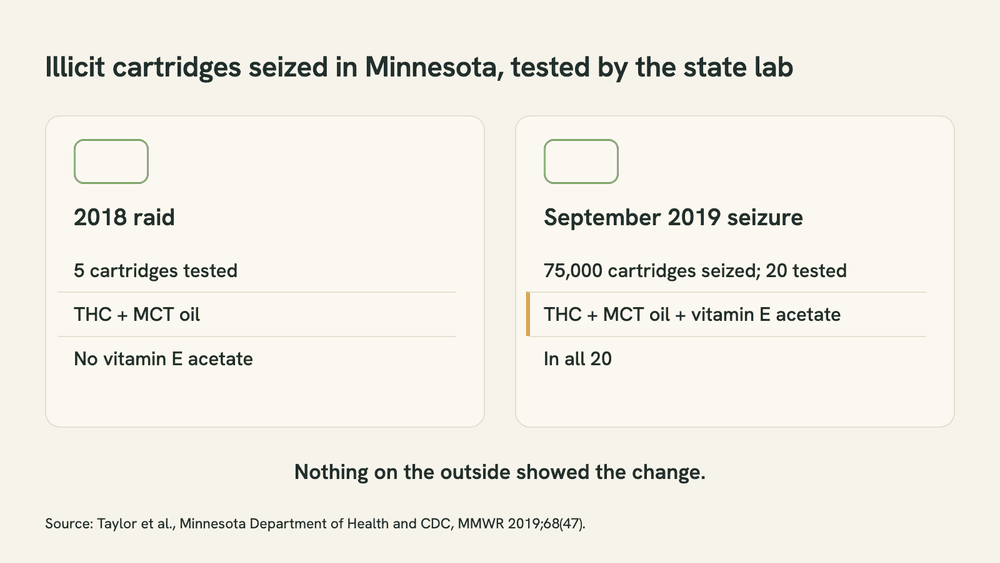
The most revealing comparison came from Minnesota. In a report by Minnesota Department of Health scientists and CDC, the state public-health lab tested illicit products seized by police. Five cartridges from a 2018 raid, sold under a different street label, contained THC cut with MCT oil but no vitamin E acetate. In September 2019, police seized 75,000 cartridges "packaged inside boxes bearing two market labels: 'Dank Vapes' and '31 Flavors'." All 20 of those cartridges the lab tested contained THC, MCT and vitamin E acetate. The illicit supply changed its recipe within about a year, and nothing on the outside would have told you. Notice, too, that the 2018 cartridges were already cut: "no vitamin E acetate" never meant "pure".
Nationally, the picture was messier than one bad brand. In CDC's December 2019 national report, Dank Vapes was the most common name, used by 56% of hospitalized patients, but the 482 patients with complete brand data named 152 different products between them, and CDC concluded that "it is unlikely that one brand is responsible for the outbreak." The name also outlived the news. In a CDC survey of 3,980 adults who vaped THC, run in late February 2020 across 18 states, 47.7% still named Dank Vapes as a brand they used. A name printed on a box anyone can buy does not disappear when the headlines do.
CDC's archived outbreak page adds the source breakdown. Of the patients who said where their THC products came from (about half did, as of January 7, 2020), 78% named only informal sources and 16% only commercial ones, a category CDC defined broadly enough to include vape shops and pop-up shops; 6% named both. CDC counted 2,807 hospitalized cases or deaths, including 68 deaths, by February 18, 2020. It called vitamin E acetate "strongly linked" to the outbreak while saying the evidence was not sufficient to rule out other chemicals, and its recommendation with FDA was that people not use THC-containing vaping products, "particularly from informal sources like friends, family, or in-person or online dealers."
People suspected the boxes before anyone knew about the additive. Researchers at RTI International who read two years of Reddit posts found almost no discussion of vitamin E acetate before the outbreak, but regular arguments about whether Dank Vapes were legitimate, with "are fake" and "the packaging" among the phrases that came up most. The packaging was the thing people could argue about. The additive was invisible.
How to tell if a cart is fake: the popular tells, tested one by one
When we read the first page of results for this question in October 2026, most results about carts came from companies selling vape products, hardware or packaging, and none we could read cited a study or a regulator. They teach the same checklist: bubble speed, color, smell and taste, packaging quality, hardware markings and price. Several describe vitamin E acetate as a thinning agent that a fast bubble would expose. The outbreak laboratories say the opposite.
A CDC-led study in the New England Journal of Medicine described vitamin E acetate as "a chemical that is sometimes used as a thickening agent in illicit THC-containing products" and put the problem in one line: "Pure THC oil has a viscosity like that of vitamin E acetate." New York's public-health laboratory explained why that mattered to the people cutting oil. Cheaper thinners such as propylene glycol, glycerin and MCT oil "do not provide enough viscosity, such that the savvy consumer knows that the product is not pure cannabis oil." The vitamin E acetate thickeners were sold as tasteless and odorless, and the lab concluded that by eye it was "nearly impossible" to tell a high-grade cartridge from one heavily cut with them. The same lab later added that the additive was "nearly tasteless, odorless, and has very similar viscosity and color to undiluted cannabis oil, even when mixed at high ratios."
Color, flow, taste and smell: the four tells page one leans on hardest all pass it. That does not make the bubble test useless, but it makes it one-sided. A bubble that races through the oil means the oil is thin, which can point to a cheap thinner: a reason for suspicion, not proof. A slow bubble proves nothing, because the outbreak additive was chosen to move like the real thing. Here is what each tell actually measures.
| The tell | What it actually measures | Would it catch vitamin E acetate? | Would it catch a synthetic cannabinoid? | Verdict |
|---|---|---|---|---|
| Bubble speed, how thick the oil runs | Viscosity at room temperature | No. Pure THC oil has a viscosity like that of vitamin E acetate (CDC-led NEJM study, 2020) | No | A fast bubble can flag a thin cut (propylene glycol, glycerin, MCT). A slow bubble proves nothing |
| Color (gold, dark, clear) | Pigment, oxidation, plant compounds left in the oil | No. Very similar color to undiluted cannabis oil (New York lab, 2021) | No | Not evidence either way; clear oil can be legitimate distillate |
| Smell and taste | Terpenes and flavorings | No. Nearly tasteless and odorless (New York lab, 2021) | No | Added terpenes can make any oil smell right |
| Packaging quality, typos, holograms | The printer | No | No. Not identifiable by any labeling or packaging (UK study, 2025) | Branded boxes were sold empty; a perfect box proves nothing. Missing information is a red flag |
| Hardware brand or etching | Who made the empty shell | No | No | The shell and the oil come from different places; no study has tested this tell |
| Price | The seller's margin | No | No | Untested; not evidence either way |
| QR code printed on the box | Whatever page the box printer chose | No | No | Only as good as what it opens; a brand page or certificate file can be copied |
| Batch-matched certificate from a lab you can look up, plus a license or tag record | The batch, the lab and the license | Only if the panel tested for it | Only if the panel tested for it | The only check here that is not cosmetic, and still not a safety verdict |
That is as far into the chemistry as this page goes. The rest of what the outbreak laboratories found inside the cartridges, including diluents, isomers and metals, is in our explainer on THC distillate.
What a box, a shell and a QR code can and cannot prove
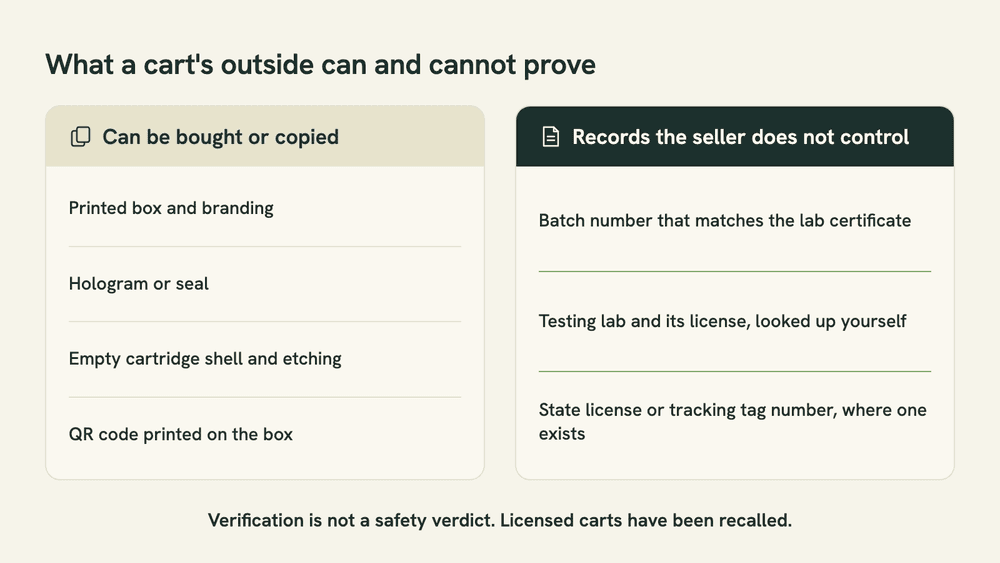
The investigators' description of Dank Vapes, "common packaging that is easily available online," explains why none of the visual tells work. The box, the empty cartridge and the oil reach the person filling them through separate channels. A perfectly printed box with a hologram proves the printer was good. An etched cartridge proves who made the empty shell. Neither tells you who filled it. No study has tested hardware markings as a tell, so treat this as reasoning from how the counterfeit supply worked, not as a measured finding.
Missing information is a different matter. When a Columbia University team coded 88 cannabis labels in New York in late 2023, 54% of licensed products carried a QR code linking to a lab certificate, against 8% of unlicensed ones, and every licensed product printed its THC potency (28 of 28) compared with 25 of 60 unlicensed ones. The study read labels; it did not test what was inside. So a box with no batch number and no certificate is a real red flag, while a box that has both still has to be checked. For what a licensed cart label has to print, and the arithmetic behind it, see our cart label guide.
A QR code is the most misunderstood part of the box. It is a link, and whoever printed the box chose where it goes. A counterfeit can print a code that opens a copied certificate or the real brand's own website. Compare that with codes a regulator issues. In California, regulations as revised January 1, 2026 require every licensed retailer open to the public to display a QR code certificate issued by the state, scannable from outside and posted within 3 feet of a public entrance. In New York, the Office of Cannabis Management issues each licensed dispensary a Dispensary Verification Tool whose QR code opens the agency's own list of licensees (page retrieved October 11, 2026). The difference is not the pattern of squares. It is who controls the page the code opens. Note what those codes verify, though: a storefront's license, not the cart in your hand.
The checks that are not cosmetic: batch, lab, license
None of these checks needs equipment. They are about matching the product in your hand to records that someone other than the seller keeps. California writes the logic into its regulations: a retailer may not sell cannabis goods unless the batch number on the package matches the batch number on the certificate of analysis, and the certificate must print the testing lab's name, address and license number, which the lab uploads to the state's track-and-trace system while sending a copy to the regulator. Those are three handles a counterfeiter cannot easily borrow at the same time. Other states write their own rules, but the same checklist applies to any cart you are holding wherever records exist:
- 1Find a batch or lot number printed on the package. No batch number means nothing can be matched.
- 2Get the certificate of analysis for that exact batch and compare the numbers character by character. A certificate for another batch, or with no batch number, verifies nothing about this one.
- 3Look up the testing lab yourself, on its own website or a regulator's or accreditation body's list, instead of trusting contact details printed on the PDF.
- 4Read what the panel tested. A potency-only certificate says nothing about additives, pesticides, solvents or metals, and a contaminant panel only covers what it was set up to find.
- 5Where your state runs a tracking system, note the package's license and tag numbers. Recalls are matched on those numbers, and they are what investigators trace.
If certificates are new to you, this walkthrough of reading a COA line by line covers the batch, the lab and the panel, and our explainer on what third-party tested really means covers how to tell whether a lab is independent and accredited. The same habits apply to any cannabinoid product, which is why our checklist for choosing a CBD oil starts with the COA and the same batch-number match.
Licensed shelves are not immune, and Michigan's record shows both the risk and the reason tracking matters. In December 2019, Michigan's cannabis regulator recalled vape cartridges sold at licensed medical provisioning centers since May, after laboratory testing found vitamin E acetate, many at more than 500 times the lab's limit of quantitation of 100 parts per million. The products had come in from registered caregivers; emergency rules dated November 22, 2019 then barred licensees from adding inactive ingredients not approved by FDA for inhalation. The recall worked the way verification is supposed to: every affected cartridge carried the packager's license number and a tag number from the state's monitoring system.
Home test kits do not close this gap. The consumer kits in our review of CBD test kits estimate cannabinoid content; none is sold to test for additives, pesticides or other contaminants, so a kit cannot tell you what else is in an oil.
Delta-8 and hemp-THC carts sit outside this system
Much of what is sold as a cart today never passes through a state cannabis system at all. When researchers called 520 vape shops across the US in late 2023, 74% sold intoxicating cannabis products, including 43% of shops in states that had banned delta-8. A product on a shelf is not evidence that anything about it was checked. Labels on these products have their own record: a 2022 analysis of 27 delta-8 vape products from 10 brands found none labeled accurately for delta-8 and 11 with unlabeled cutting agents. Our comparison of delta-8 and CBD covers the byproducts that come with converting CBD into delta-8.
Hemp-derived products sold outside licensed cannabis stores do not go through a state cannabis tracking system, so the tag check in the list above usually has nothing to match. A batch number and a certificate for that batch are still the minimum paperwork to look for. The federal rules are also about to change. Congress rewrote the federal definition of hemp in 2025, and a law signed on September 2, 2026 split its start into two steps, both still ahead as of this writing: November 12, 2026 for hemp products containing cannabinoids the plant cannot produce naturally, and December 11, 2026 for the rest. Why the start date moved to December 11 and what the 2026 hemp redefinition covers are explained in our policy coverage.
If you already used a cart and feel unwell
In CDC's 2019 interim clinical guidance, almost every EVALI patient had respiratory symptoms such as cough, chest pain or shortness of breath, and most also had stomach symptoms or fever, chills and weight loss. The instruction to patients was to seek medical care promptly if breathing symptoms worsen. Those shares describe patients already diagnosed in 2019; they are not a self-diagnosis checklist. MedlinePlus lists breathing problems and chest pain lasting two minutes or more among the signs of a medical emergency.
What is still unknown
The 2019 records are detailed, but they are a snapshot. An honest answer to "how do I know" has gaps in it:
- We could not find any study that measures what share of carts sold in the US are counterfeit (PubMed search, October 11, 2026).
- The vitamin E acetate findings date from 2019 and 2020. New York's lab reported that the thickener products were no longer available after a public health alert and subpoenas.
- What today's illicit carts contain has not been measured nationally, and nothing in the record suggests the visual tells are better at finding it than they were in 2019.
- The outbreak data rest on patient interviews, recall and a few states. They show where cases clustered, not how common fakes are.
- A matched certificate verifies a batch's paperwork. It is not a verdict that anything is safe to inhale.
That last point is not ours alone. Even in CDC's first national report on the outbreak, in September 2019, the authors wrote that both THC-containing and nicotine-containing vaping products "purchased legally within states might also contain harmful substances" and that "it is difficult for consumers to know what is in these products." Verification narrows who made a cart; it does not answer whether inhaling it is safe.
Questions people ask about fake carts
A fast bubble means the oil is thin, which can point to a cheap thinner such as propylene glycol, glycerin or MCT oil, though it is not proof. A slow bubble proves nothing: the vitamin E acetate used in 2019 had a viscosity like pure THC oil, so it passes the test.
The 2019-2020 outbreak (2,807 hospitalized cases or deaths, including 68 deaths, counted by CDC as of February 18, 2020) was tied mostly to THC cartridges from informal sources, and CDC called vitamin E acetate strongly linked to it without ruling out other chemicals. Some fakes contain a different drug entirely, such as a synthetic cannabinoid. No test you can do by eye tells you which you have.
Not a company. Illinois and Wisconsin health officials working with CDC described it as the most prominent in a class of largely counterfeit brands, sold in common packaging easily available online. It was the most common name in the 2019 outbreak, and 47.7% of adults in a February 2020 CDC survey still named it.
Only if it opens a record the counterfeiter does not control, such as a lab's own report for the same batch number or a state license record. A QR code printed on a box can point anywhere, including to a copied certificate. In a 2023 New York label study, unlicensed products carried a lab-certificate QR code far less often (8%) than licensed ones (54%), but having one is a starting point, not proof.
No. Licensed products are tested and traceable, which is what makes recalls possible, but in December 2019 Michigan's regulator recalled vitamin E acetate carts that had been sold at licensed medical stores. CDC also wrote that legally purchased products might contain harmful substances. A verified product is one whose paperwork checks out, not one that is guaranteed safe.
Many are not counterfeits of a brand, but accuracy is a problem of its own. A 2022 analysis of 27 delta-8 vape products from 10 brands found none labeled accurately for delta-8 and 11 with unlabeled cutting agents. Hemp-derived products sold outside licensed cannabis stores also do not go through a state cannabis tracking system, so there is less to check them against.
Not for what matters most here. Consumer kits estimate cannabinoid content. The ones in our review are not sold to test for additives, pesticides, metals or synthetic cannabinoids, so a kit cannot tell you whether an oil was cut or substituted.
Where to go next. The same logic, matching a batch number to a certificate from a lab you can look up yourself, is how you check any cannabinoid product. For the tincture version, with each check in order, read how to spot fake CBD oil with a 60-second verification check.
Writing about hemp, wellness and the small rituals that keep us balanced.