THC Syrup: Label Math, Real Onset and the Teaspoon Problem
THC syrup is swallowed, so it runs on the edible clock, and no study shows it works faster under the tongue. How to turn the label's mg and mL into a measured dose, why kitchen spoons fail, and how to keep it from children.
You have a bottle of THC syrup, or you are looking at one, and you want to know three things: what it is, how fast it works and how much THC is in a pour. Several pages that rank for this question say it works within 10 to 15 minutes under your tongue and hand out a starting amount. None of the ones we read on October 9, 2026 cites a source for either. Here is what the research and the label actually tell you.
The short answer. THC syrup is a THC extract blended into a sweet liquid that you swallow, so it behaves like any other edible: slow to start, slow to peak and slow to fade. No study we could find shows it works faster held under the tongue. The number that matters is the THC per milliliter on the label, and the reliable way to measure it is in milliliters, ideally with an oral syringe, not a kitchen spoon. Planntz does not sell THC syrup; this is a guide to the format, not a product page.
What is THC syrup, and what is "THC lean"?
THC syrup is a liquid edible: a concentrated THC extract, such as a distillate or a water-dispersible emulsion, blended into a thick base of sugar syrup or vegetable glycerin, plus flavoring. It comes from two supply chains. State-licensed dispensaries sell syrups made from marijuana under state cannabis rules, while hemp shops and websites sell syrups made with hemp-derived THC under federal hemp law, which is set to change (more on that below). Some bottles list delta-9 THC, others delta-8 or a blend. Whatever the source, you are buying a fixed amount of THC dissolved in a sweet liquid, and how much of it you take depends entirely on how much you pour. Pages selling these syrups also list pain relief, deeper sleep and appetite as uses. Those are therapeutic claims, they are theirs, and this page does not make them.
"THC lean" is a marketing name with a history. In a 2024 analysis of US survey data on lean use, Johns Hopkins researchers describe lean, also called purple drank or sizzurp, as prescription cough syrup containing codeine, an opioid, and promethazine, a sedating antihistamine, mixed into soda. The federal survey item they analyzed describes it the same way: promethazine with codeine mixed with Sprite. A 2020 systematic review describes how the mix became popular among rap artists. THC syrup borrowed the name and the habit, not the ingredients: a THC syrup contains no codeine and no promethazine. What it did borrow, pouring the syrup into soda and sipping it over an hour or two, matters for how much THC you end up taking, and we come back to it below.
How fast does THC syrup kick in, and how long does it last?
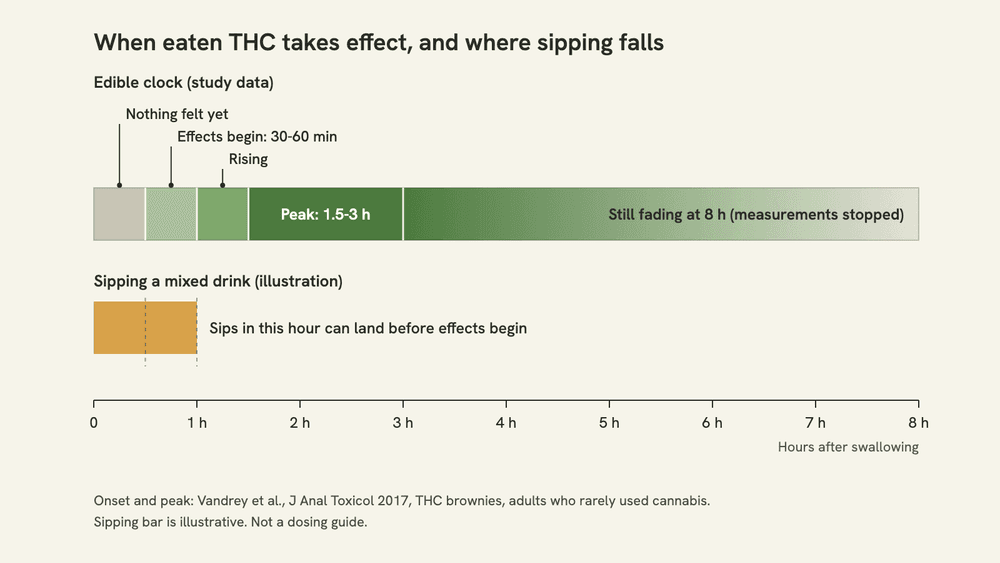
Syrup is swallowed, so it runs on the edible clock. No study we could find (PubMed, October 9, 2026) has timed a THC syrup itself, so the best guide is research on other THC you eat. In a Johns Hopkins study of THC brownies at 10, 25 and 50 mg, adults who rarely used cannabis (six per dose) began to feel effects 30 to 60 minutes after eating, effects peaked between 1.5 and 3 hours, and they were still fading at 8 hours, when measurements stopped. In the same study, blood levels of 11-hydroxy-THC, the active compound the liver makes from swallowed THC, rose about as high as THC itself; our guide to 11-hydroxy-THC explains why that liver step makes eaten THC feel different from smoked. A widely cited 2003 review of cannabinoid pharmacokinetics gives a similar picture for oral THC: effects set in after 30 to 90 minutes, peak after 2 to 3 hours and last about 4 to 12 hours, depending on dose and the effect measured.
That delay is the classic way people end up taking more than they meant to. A 2016 RTI International review of cannabis edibles notes that with oral products, consumers may take a greater than intended amount before the drug has taken effect. Health Canada's consumer sheet on edibles says it can take up to 4 hours to feel the full effects of eaten or drunk cannabis, and that consuming more within that window can lead to effects that need medical attention. Why edibles take so long to kick in covers the digestion side, how long a weed high lasts covers the other end, and our guide to greening out covers what too much feels like and what helps while it passes.
Does THC syrup work faster under your tongue? The 15-minute claim, checked
Several top-ranking pages say that holding THC syrup under your tongue makes it work within 10 to 15 minutes. It sounds plausible because some medicines are designed to dissolve under the tongue. The fair test for THC is research on products made to be held in the mouth, and that research does not support a speed advantage. When NIDA researchers ran a double-blind comparison of a THC mouth spray and swallowed THC, nine cannabis smokers received 5 or 15 mg of oral THC on some days and a pharmaceutical oromucosal spray (5.4 or 16.2 mg THC) on others. Peak blood THC, the time it took to reach that peak and total exposure did not differ significantly between similar doses. A 2025 Columbia pilot study in 12 occasional users went the other way: a THC and CBD oil that was swallowed reached higher blood THC levels, sooner, than a spray held in the mouth. Two of its authors work for a cannabis company, and it is twelve people.
“We hypothesize that these cannabinoids are ingested and absorbed in the gastrointestinal tract.”
That line comes from a 2019 expert opinion by Hebrew University pharmacologists, who argued that much of the THC in a mouth spray is washed down by saliva and absorbed in the gut, which is why a meal changes its absorption the way it does for swallowed drugs. It is a hypothesis built on published data, not a trial. The same pattern was measured for CBD: in a 2024 crossover study of 8 healthy men, the same oil taken as drops under the tongue or in a capsule gave near-identical blood curves, with peak levels of 24.0 and 28.0 ng/mL, both reached at about 4 hours. The authors concluded the oil is swallowed before absorption through the mouth happens. A thick, sweet syrup has not been tested at all: a PubMed search we ran on October 9, 2026 found no human study measuring whether a THC syrup or drink absorbs faster held in the mouth.
What about water-soluble or emulsified syrups marketed as fast-acting? The data are thin. In a 2021 crossover study of five commercial 10 mg edibles in seven regular users, time to peak blood THC ranged from 35 to 90 minutes across products. A 2024 review of 29 studies on cannabis drinks called the evidence sparse and inconsistent; its fastest onset figure, about 19 minutes, came from 35 people describing their own experience in a survey. Until better data exist, the safe planning assumption is the edible clock, whatever the bottle says.
How to read a THC syrup label: mg per bottle, mg per mL and the serving
A syrup label gives you the pieces of the calculation but rarely the answer. Look for three numbers before you open the bottle.
- 1Total THC in the bottle, in milligrams (for example, 100 mg or 1,000 mg). Check whether it says THC, delta-9 THC, delta-8 THC or a blend.
- 2The volume of the bottle, in milliliters or fluid ounces. If it only gives fluid ounces, multiply by 30 to get milliliters, the convention used on US food labels.
- 3The serving size and the volume it refers to. A serving stated as 1 mL is precise. A serving stated as a teaspoon, a capful or a sip depends on what you pour it with.
Divide the first number by the bottle's milliliters and you have the concentration in mg per mL, the one figure that turns any pour into milligrams. A 100 mg bottle holding 1 fl oz (30 mL) is 3.33 mg/mL; a 1,000 mg bottle holding 4 fl oz (120 mL) is 8.33 mg/mL. Kitchen units on a label are conventions. Under the federal nutrition labeling rule, 21 CFR 101.9, a teaspoon means 5 mL and a fluid ounce means 30 mL; the exact US customary values in NIST's conversion table are 4.93 mL and 29.57 mL. Those are label conventions; the spoon in your drawer is not. The math also assumes the label is right, and audits of cannabis and hemp drinks have found many that are not; our guide to hemp drinks covers those label-accuracy tests. The same mg-per-mL arithmetic works for any liquid, including a hemp tincture, and our per-drop calculator walks through it step by step. For the full label-reading checklist on liquids, see how to choose a CBD oil.
The teaspoon problem: from bottle to dose
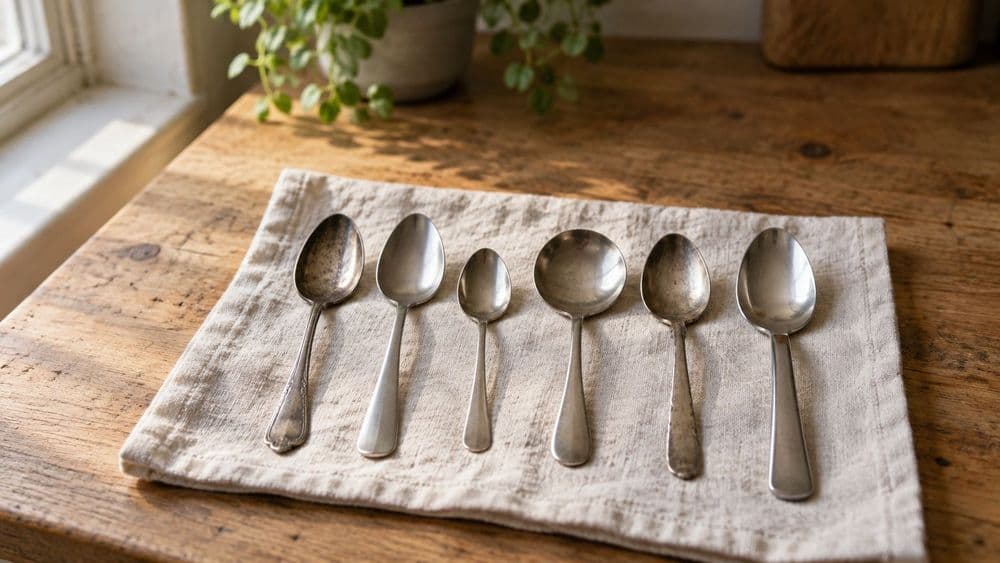
A teaspoon sounds like a measurement. In a kitchen drawer, it is not. When researchers in Greece collected the spoons from 25 households and filled them with water, the 71 teaspoons and 49 tablespoons held anywhere from 2.5 to 7.3 mL, with a mean of 4.4 mL. Even when all 25 people used the same standard teaspoon, what they poured ranged from 3.9 to 4.9 mL. The authors' conclusion: teaspoons and tablespoons are unreliable dosing devices. Research from US pediatrics points the same way. In a study of 287 parents measuring their children's liquid medicine, 39.4% made a measuring error, and those working in teaspoons or tablespoons had more than twice the odds of an error as those working in milliliters (42.5% vs 27.6%). In a randomized experiment with 2,110 parents, each measuring nine doses, 84.4% got at least one dose wrong by more than 20%, one in five made at least one error of more than double, and dosing cups produced far more errors than oral syringes, especially for small amounts. Those studies are about children's medicine, not cannabis; the lesson that carries over is about measuring, not pharmacology. Here is what it means for two illustrative syrup labels.
| What you pour | Volume | Label A: 100 mg THC in 1 fl oz (30 mL) = 3.33 mg/mL | Label B: 1,000 mg THC in 4 fl oz (120 mL) = 8.33 mg/mL |
|---|---|---|---|
| 1 mL, measured with an oral syringe | 1.0 mL | 3.3 mg | 8.3 mg |
| Smallest household spoon in the Greek study | 2.5 mL | 8.3 mg | 20.8 mg |
| Average household spoon in the Greek study | 4.4 mL | 14.7 mg | 36.7 mg |
| A measured teaspoon (label convention) | 5.0 mL | 16.7 mg | 41.7 mg |
| Largest household spoon in the Greek study | 7.3 mL | 24.3 mg | 60.8 mg |
| A measured tablespoon (label convention) | 15 mL | 50.0 mg | 125 mg |
| Volume that holds 10 mg (a reference unit, not a recommendation) | Varies | 3.0 mL | 1.2 mL |
| Whole bottle compared with the 0.4 mg per-container federal hemp figure | Whole bottle | 250 times | 2,500 times |
The key line is the spread: 7.3 divided by 2.5 is about 2.9, so the same "spoonful" from the same bottle can differ roughly threefold before anyone asks whether the label itself is accurate. Concentration multiplies the problem. One average household spoon of Label B holds about 37 mg, more than three times the 10 mg per-serving cap in California's and Colorado's edible rules. What a 10 mg edible actually means explains where that number comes from and what a controlled study saw at that amount. We do not give a personal starting amount; the table shows how to turn your own label into milligrams, not how much to take.
Mixing THC syrup into drinks: what changes and what does not
Pouring syrup into soda or juice is the habit THC lean borrowed from the original drink. Dilution changes the taste and the volume. It does not change how many milligrams you swallow.
- What does not change: the THC in the glass is exactly the THC you poured in. Twelve ounces of soda with 2 mL of syrup holds the same milligrams as 2 mL taken straight.
- What does change: how you measure. Once syrup is mixed, you can no longer see how much is left in the glass in milligrams, so measure the syrup before it goes in, not the drink after.
- What changes the timing: sipping a mixed drink over an hour spreads your intake across the window when the first sips have not yet taken effect. That is our reasoning from the onset data above, not a measured result.
- What adds risk: a mixed drink can be topped up, shared or left where someone else picks it up, and it looks like any other glass of soda.
Alcohol is the mix that has been measured, and the result is a risk, not a pairing. In a 2026 Johns Hopkins driving-simulator trial of 25 healthy adults, a 10 mg THC brownie combined with a 0.05% breath alcohol level impaired simulated driving about as much as 0.08% alcohol alone, and a 25 mg brownie plus 0.05% impaired it more. Our page on being crossfaded covers what combining the two does. The original lean ingredients, codeine and promethazine, and other sedating medicines are a separate and serious risk: do not combine THC syrup with them, and if you take a prescription that causes drowsiness, ask your pharmacist before using any THC product.
Hemp THC syrup vs dispensary syrup, and the December 11, 2026 line
A dispensary syrup is regulated by the state that licensed it, including its testing and labeling rules. A hemp-derived syrup is sold under the federal definition of hemp, which today measures delta-9 THC by dry weight; that is how hemp-derived THC products reached shelves far beyond licensed markets. That is set to change. Section 781 of Public Law 119-37, federal law already on the books, excludes from hemp any finished product with more than 0.4 milligrams of combined total THC per container, and it defines a container as the innermost vessel holding the product, such as a bottle. The timing is set by Public Law 119-103: from November 12, 2026, Section 781 will reach only products containing cannabinoids the plant cannot naturally produce, and the 0.4 mg per-container ceiling for everything else does not apply until after December 11, 2026. The arithmetic is a comparison, not a prediction: a bottle labeled 100 mg THC carries 250 times that figure, and a 1,000 mg bottle 2,500 times. Our update on the delay to December 11 explains what the law leaves undefined, and whether THC drinks are legal covers state rules for drinkable products.
Hemp-derived or not, THC syrup contains THC, and a hemp label is not a drug-test shield. Standard workplace screens look for THC metabolites, whatever the source. What a 10-panel drug test screens for explains what those screens look for, and our guide to CBD and drug tests covers why hemp products can still lead to a positive result.
Children, lookalikes and what to do if a child drinks it
Edible exposures in young children have climbed sharply. In an analysis of US poison-center reports, cases of children under 6 eating cannabis edibles rose from 207 in 2017 to 3,054 in 2021, an increase of 1,375%. Of those exposures, 97.7% happened at home, and 22.7% of the children were admitted to the hospital. The data do not separate syrups from gummies or brownies. In a 2022 consumer warning, FDA reported 10,448 single-substance poison-center cases involving THC edibles from January 2021 through May 2022, with 77% of patients aged 19 or younger, and warned about copycat edibles that mimic well-known foods. Federal regulators have since kept acting on lookalike packaging: in July 2024, FDA and the FTC announced another round of joint warning letters against delta-8 edibles sold in packaging almost indistinguishable from popular snacks. Our own reasoning adds one point: a sweet liquid in a bottle needs no copycat label to be mistaken for juice, soda or a cough medicine, and once it is poured into a glass it looks like any other drink.
- Keep it in its original labeled, child-resistant bottle. Never decant syrup into a water bottle, a juice bottle or an unmarked container.
- Store it locked and out of reach and sight of children and pets, away from food, drinks and medicines.
- Do not leave a mixed drink unattended, and pour out what you do not finish.
- Keep the bottle's label so you can tell a poison center the product, the THC per mL and how much may be missing.
That wording follows FDA's edibles warning and the national poison-center network's guidance on when to call 911, which also explains what happens when you call. For an adult who simply took too much, our greening-out guide covers what it feels like, what helps and when it becomes an emergency.
What is still unknown
THC syrup is sold widely and studied barely at all. Here is where the evidence runs out.
- No human study we could find (PubMed, October 9, 2026) has measured how THC from a syrup is absorbed. Every measured onset figure here comes from brownies, other edibles, capsules, oils or sprays.
- The mouth-vs-swallowed THC studies are small (9 and 12 people) and used pharmaceutical sprays, not sweet syrups.
- Label-accuracy audits of cannabis and hemp drinks are few and small, and none we found tested THC syrups specifically.
- Poison-center data do not separate syrups and drinks from other edibles, so no one can say whether liquids are more or less often involved in child exposures.
- How the federal 0.4 mg per-container ceiling will be enforced after December 11, 2026 is not yet settled.
Frequently asked questions
THC lean is a marketing name for THC syrup, usually mixed into soda. It borrows the name of lean, the street drink made from prescription cough syrup containing codeine (an opioid) and promethazine (a sedating antihistamine) mixed with soda. A THC syrup contains no codeine or promethazine. If a product sold as lean might contain them, it is a different, opioid-containing product, and combining it with THC is a serious risk.
Plan for the edible clock. No study we could find has timed a THC syrup itself, but in a controlled study of adults who rarely used cannabis, effects of eaten THC began 30 to 60 minutes after eating, peaked at 1.5 to 3 hours and were still fading at 8 hours. Health Canada says it can take up to 4 hours to feel the full effects of eaten or drunk cannabis.
No study we could find shows that. When NIDA researchers compared a THC mouth spray with swallowed THC in nine people, the time to peak blood THC did not differ significantly. A 2025 pilot study of 12 people found a swallowed THC oil reached higher levels sooner than a mouth spray. A PubMed search on October 9, 2026 found no human study of a syrup held under the tongue.
We do not give personal doses. What we can give you is the arithmetic: divide the bottle's total mg of THC by its mL to get mg per mL, then measure the volume in mL with an oral syringe. For context only, the Johns Hopkins study cited here gave adults who rarely used cannabis 10, 25 or 50 mg of THC in a brownie, and 10 mg is the per-serving cap in California and Colorado edible rules. That cap is a label convention, not a recommendation.
Not inherently. A milligram of THC is a milligram whether it is in a gummy or a syrup, and both are swallowed. What differs is measurement: a gummy is a fixed piece, while syrup depends on how much you pour. Household spoons in one study held 2.5 to 7.3 mL, so the same spoonful can differ about threefold, and sipping a mixed drink makes it easy to take more before the first sips take effect.
Treat it as a risk, not a pairing. In a 2026 driving-simulator trial of 25 adults, a 10 mg THC brownie combined with a 0.05% breath alcohol level impaired driving about as much as 0.08% alcohol alone, and a 25 mg brownie plus 0.05% impaired it more. Do not combine THC syrup with codeine, promethazine or other sedating medicines, and do not drive after using it.
It can. THC syrup contains THC, and standard drug tests look for THC metabolites, whether the THC came from hemp or marijuana. How long it stays detectable depends on how much and how often you use it and on the test's cutoff. No product label can guarantee a negative result.
As of October 9, 2026, hemp THC syrups are sold under a federal definition that measures delta-9 THC by dry weight, and state rules vary. Under Section 781 of Public Law 119-37, with timing set by Public Law 119-103, a finished product with more than 0.4 mg of total THC per container falls outside federal hemp once that ceiling applies, after December 11, 2026. This is not legal advice.
Where to go next. Once you have turned your syrup's label into milligrams, the next question is what that number means. Read what a 10 mg edible actually means: where the figure comes from, what a placebo-controlled study saw at that amount and how often edible labels match what is inside.
Writing about hemp, wellness and the small rituals that keep us balanced.