Hemp Drinks: Four Different Products, One Word on the Can
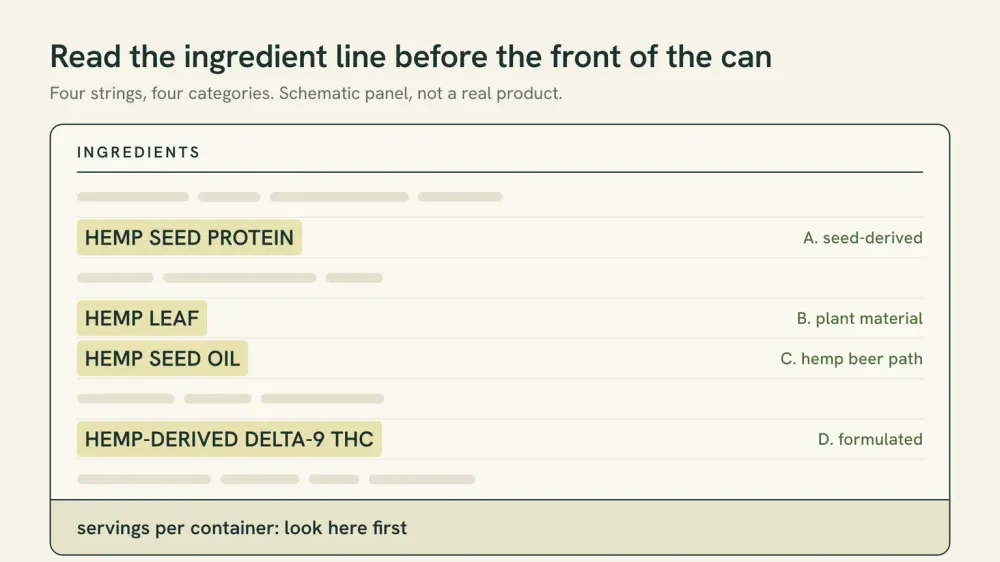
One word, four unrelated drinks: seed-derived, plant-material, hemp beer and formulated cannabinoid beverages. The ingredient line sorts them in seconds, and the only number that settles what is in the can is milligrams per container, not per serving.
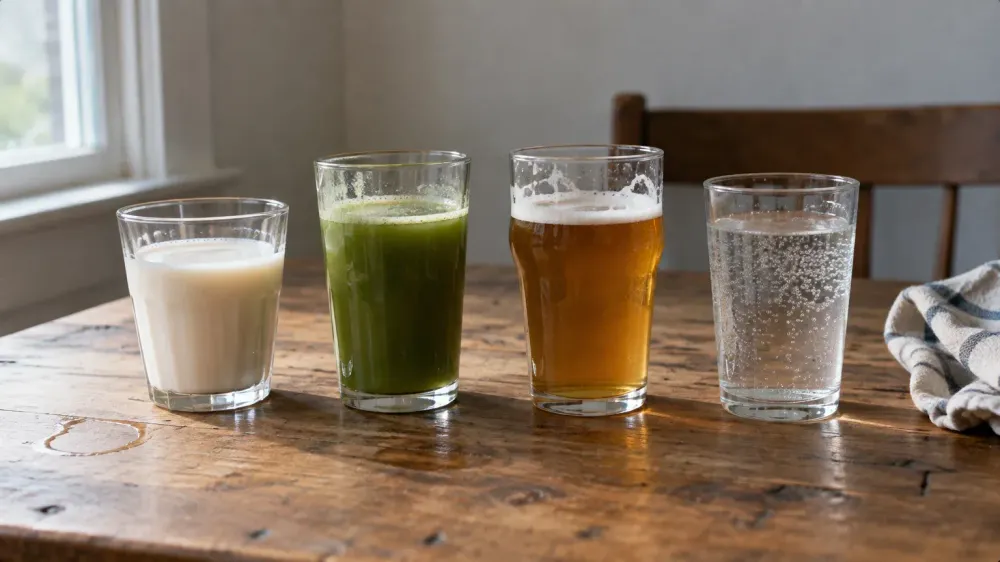
You are standing at a cooler and four unrelated products are wearing the same word. A carton of hemp seed milk, a bottle of cold-pressed hemp juice, a six-pack of hemp beer and a can of hemp-derived THC seltzer are all, correctly, hemp drinks. What separates them is which part of the plant the liquid was made from, and the only number that settles what is in your glass is milligrams per container: not a percentage, and not milligrams per serving.
This page is a sorting tool, not a shopping list. Planntz makes tinctures and no beverage, so nothing here recommends a drink, ranks one or names a brand. It applies the label-reading skill from the buyer's checklist for choosing a CBD oil to a container that is not a bottle.
Hemp drinks are four different products, not one
Most explainers sort hemp drinks by taste or by where they are sold. Sort them by which part of the plant the liquid came from instead: the seed and the flower are different organs with different chemistry, and every real distinction in this category falls out of that one fact.
| What it is called | Which part of the plant | Cannabinoids by design? | What shows on the ingredient panel | The number to look for |
|---|---|---|---|---|
| A. Hemp seed milk, hemp protein shakes | The seed only | No | Hemp seed, hulled hemp seed, hemp seed protein, hemp seed oil | Grams of protein and fat. No cannabinoid line is expected |
| B. Hemp juice, hemp tea, leaf infusions | Leaves and the upper plant | Not added, but present in the material | Hemp juice, hemp leaf, hemp tea, hemp herbal infusion | Usually nothing. What is known about this group comes from food-control laboratories, not labels |
| C. Hemp beer, hemp-flavored spirits | Seed or seed oil, as a flavoring | No, on the federally approved formula path | Hemp seed or hemp seed oil, alongside malt, hops, water | Alcohol by volume. The hemp ingredient is covered by formula approval |
| D. CBD seltzers and sodas, hemp-derived THC drinks | Flower and leaf extract | Yes, deliberately | Hemp extract, broad spectrum hemp extract or hemp-derived delta-9 THC, plus an emulsifier | Milligrams per serving AND servings per container |
Category A starts and ends at the seed. In a December 2018 constituent update the FDA said it had no questions about three hemp seed ingredients being generally recognized as safe for the uses described: hulled hemp seed (GRN765), hemp seed protein powder (GRN771) and hemp seed oil (GRN778), whose listed uses include "beverages (juices, smoothies, protein drinks, plant-based alternatives to dairy products)". The same update says the seeds "do not naturally contain tetrahydrocannabinol (THC)", that the ingredients "contain only trace amounts of THC and CBD, which the seeds may pick up during harvesting and processing", and that consuming them "is not capable of making consumers 'high.'" Those three sentences travel together. It also requires the ingredients to be declared by name on the ingredient list, which is why that line is the fastest sort; the seed and the flower as two different raw materials works the distinction through.
Category B is where the usual assumption breaks. Hemp juice is not a seed product: it is cold-pressed from the leaves and upper plant, exactly where cannabinoids are made, so nothing was added and it is not a cannabinoid-free drink either. Germany's official food-control laboratory measured 511 hemp food products between 2008 and 2021: among 61 nonalcoholic hemp beverages, 57 percent were below the limit of detection and 31 percent carried quantifiable THC, the highest 0.529 mg per liter, while 88 percent of 89 hemp teas carried quantifiable THC. Its authors' summary is that "hemp beverages and seeds typically do not contain amounts of THC that can exceed toxicological thresholds", while supplements can and flower-based tea is a problem group. That is a German sample under European limits, not a statement about any American product.
A drink you steep yourself has no fixed amount in it at all. When a Danish laboratory brewed prescribed cannabis and measured what came out of the pot, a recommended 0.2 liter serving held between 0.46 and 11.3 mg of THC depending on the product, and adding creamer before boiling raised the THC in the cup by 2.3 to 4.4 times. That is prescribed medical cannabis in Denmark, so carry the mechanism and not the numbers: cannabinoids are poorly water-soluble, so the cup follows the fat and the recipe.
Category C is a beer with hemp in it, and the federal alcohol regulator is specific about which hemp. The Alcohol and Tobacco Tax and Trade Bureau's Industry Circular 2019-1, issued April 25, 2019, says TTB "will return for correction any applications for formulas containing 'hemp' ingredients (other than ingredients derived from hemp seeds or hemp seed oil)", that such beverages "continue to require formula approval" even when sold only inside one state, and that it requires "laboratory analyses of 'hemp' ingredients to ensure that the ingredients are not controlled substances". A hemp beer that cleared that path is a seed-flavored beer, and TTB calls the guidance interim in its own text. A non-alcoholic THC drink is not on that path at all: two products, two regulators, one shelf.
Category D is what most people mean when they type the phrase. It is the only one where a cannabinoid is an intended ingredient rather than a passenger, and it holds both the CBD seltzers and the hemp-derived delta-9 THC drinks, which sit side by side in coolers and are not the same product. "Hemp-derived" describes a test result about a plant, not the contents of your drink: what hemp-derived actually names is a threshold a crop passed, and one plant, one legal line explains the rest.
Why 0.3 percent of dry weight tells you almost nothing about a can
The number every seller's guide reaches for is the federal one: 7 U.S.C. 1639o defines hemp as the plant and its derivatives "with a delta-9 tetrahydrocannabinol concentration of not more than 0.3 percent on a dry weight basis", and retail guides were still printing that sentence about a can when we read them on September 10, 2026. Look at what that test was built for. USDA's hemp program defines total THC at 7 CFR 990.1 as (0.877 x THCA) + THC, and an acceptable level as one where "the application of the measurement of uncertainty" to a result reported on a dry weight basis "produces a distribution or range that includes 0.3 percent or less". That is a laboratory drying out a piece of a crop and reporting a percentage with an error bar. Nothing in it describes a beverage, a serving or a container.
That arithmetic is ours, not a regulator's. A 12 fl oz can is 354.88 mL, so a mostly-water drink in it weighs about 355 g, and three tenths of one percent of 355 g is 1,065 mg of THC, which exists nowhere on any shelf. Run it the other way, and the statute's last two words decide the answer: dry weight means the water comes out first, so the recipe rules. USDA FoodData Central's record for regular cola (FDC ID 174852, SR Legacy, published April 1, 2019) reports 89.36 g of water per 100 g, so a 355 g can holds about 37.8 g of dry matter and the same 10 mg reads as 0.026 percent. In a zero-sugar seltzer whose non-water content is on the order of a gram, an assumption we are stating rather than measuring, that 10 mg is near 1 percent. Same THC, a roughly 38-fold swing, decided by sugar.
Measured values sit in the same territory. A laboratory validating a potency method for hemp-infused edibles across 20 products needed a separate calibration range for the drinks, 0.0008 to 1 percent by weight against 0.008 to 10 percent for solids, and a 2024 critical review of cannabis-infused beverages tabulates its measured CBD at 0.0058 percent in a sparkling coconut water and 0.033 percent in a coffee. A beverage lives three or four decimal places away from the number a crop rule was written in.
The number that settles it: milligrams per container
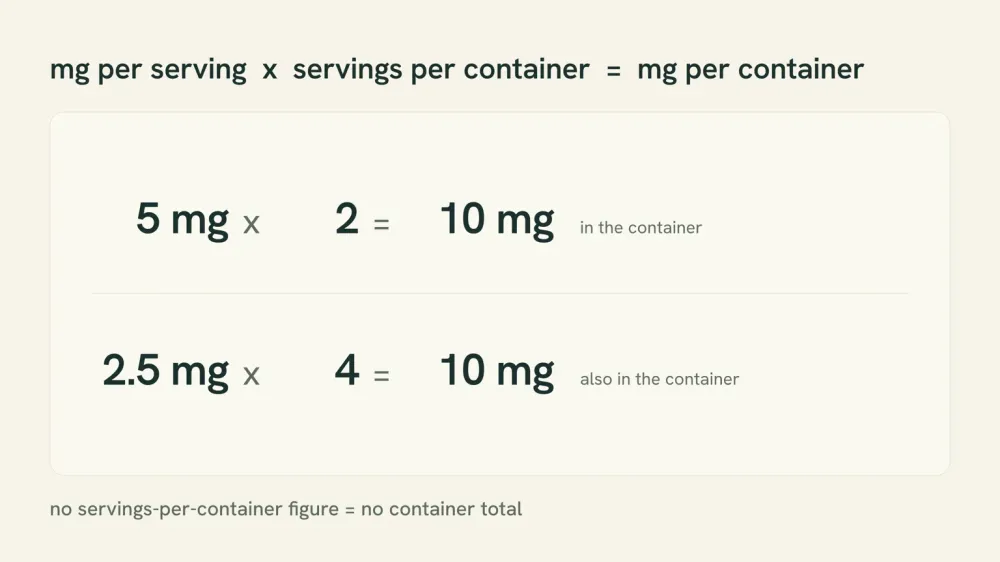
The usable number is a multiplication, and it is the whole skill. Retail guides for this category were printing a 2 to 10 mg per serving range when we read them on September 10, 2026: that is what sellers print, not a measurement and not a recommendation. Two worked pairs from that range:
- 15 mg per serving, 2 servings per container. The container holds 10 mg.
- 22.5 mg per serving, 4 servings per container. The container also holds 10 mg, and the front of the can looks half as strong as the first one.
- 3No servings-per-container figure means no container total at all. That absence is a finding about the label rather than about the liquid.
A serving cannot carry the meaning, because nobody has defined one. The 2024 review puts it plainly: there is "no government-determined standard size for cannabis beverages, which range from 30 mL 'shots' to over 500 mL". A serving is whatever the maker says it is; a container is a physical object you are holding. One regulator has already drawn that conclusion: Minn. Stat. 342.01, subdivision 50 caps a product "intended to be consumed as a beverage" at "ten milligrams of delta-9 tetrahydrocannabinol in a single container", against five milligrams per serving for non-beverage edibles. That is one state, read on September 10, 2026, an illustration of the unit and not legal advice or a guide to where you live.
The federal picture, in one paragraph, because the law is a different article's job. Public Law 119-37, section 781 does not measure a finished product as a percentage at all: at 7 U.S.C. 1639o(1)(C)(iv)(III) it would exclude final hemp-derived cannabinoid products containing "greater than 0.4 milligrams combined total per container", and its definition of container reaches "the innermost wrapping, packaging, or vessel in direct contact with a final hemp-derived cannabinoid product", naming a can among its examples. That ceiling is not in force today: a continuing resolution signed on September 2, 2026 provides at Section 2019 that until December 11, 2026 the section 781 amendments "shall only apply with respect to products described in paragraphs (1)(C)(ii)(I) and (1)(C)(iv)(I)", the two synthetic-cannabinoid clauses, and (1)(C)(iv)(III) is not among them. What that means for a specific drink is a legal question this page does not answer: the December 11 calendar and what changes on November 12 work through the dates.
Beverage labels have been measured against their contents
One vocabulary note before the table, because reversing it inverts the finding. In this literature over-labeled means the product contains LESS than the label claims, measured at under 90 percent of the claim; under-labeled means it contains more. The 10 percent band is the papers' own choice, not a regulator's rule.
A 2022 analysis of nonprescription CBD products ran 21 water-based products through high-performance liquid chromatography, and only 14 printed a specific CBD amount at all. Mean measured CBD came to 59.93 percent of the label claim, with a 95 percent confidence interval of 38.24 to 81.63, and THC was detected in 5 of the 21 at up to 0.0005 percent w/v. The authors' conclusion names the format: commercial CBD products, "especially aqueous beverages", can vary largely from their label claims where they make them. The table has the split.
| Dataset | What was tested | Beverages measured | Accurate within 10 percent | Direction of the miss |
|---|---|---|---|---|
| Miller 2022, US retail, HPLC | Water-based CBD products, measured for CBD | 21 products, 14 of which printed a CBD amount | 1 of the 14 that printed an amount | 11 contained less than claimed, 2 contained more |
| Vandrey 2015 beverage subgroup, re-tabulated in the 2024 review | Cannabis-market beverages, measured for THC | 13 of that study's 75 products | 23.1 percent, which is 3 of the 13 | 61.5 percent contained less than claimed, 15.4 percent contained more |
Read the limits with the numbers. Both samples are small and single points in time, neither names a brand, the 2022 products were US retail purchases around 2021 measured for CBD rather than THC, and the 2015 beverages were dispensary products rather than hemp-derived cans from a cooler. The 2024 review found only 29 eligible studies on cannabis-infused beverages in the entire literature, which is the more useful finding: far more products than papers. The same gap has been measured in tinctures, worked through in how to tell a real certificate from a decorative one.
The five-question test, holding the can
This is the store version, and it takes about a minute. It is the sequence our certificate guide runs on a tincture, moved onto a container that is not a bottle.
- 1Which of the four is this? Read the ingredient line before the front of the can: hemp seed or hemp seed protein puts you in the seed category, hemp extract or hemp-derived delta-9 THC in the formulated one.
- 2Does it print an amount per container, or only per serving? If only per serving, find servings per container and multiply. If that figure is missing, you have your answer about the label.
- 3Total THC, or delta-9 only? The 0.877 conversion that turns THCA into its delta-9 equivalent lives in the crop rule, not on a can, so a low delta-9 line can say nothing about the acid form that converts to it.
- 4Is there a batch or lot number, and does the QR code reach a report carrying that same lot, a date, and a per-container line rather than only a per-serving one?
- 5Does the ingredient line name an emulsifier, such as gum acacia, quillaja extract or sunflower lecithin? In the formulated category it usually will, and its absence on a drink claiming cannabinoids is worth asking about.
The fifth question is the only chemistry on the list. Cannabidiol is insoluble in water, so a drink carrying it has been emulsified, and the emulsion is a variable of its own: one laboratory stress test of a CBD nanoemulsion survived heat, cold, dilution and carbonation but broke below pH 2 and above 100 millimolar salt, with measured potency falling whenever the emulsion did. That is one laboratory formulation, not a retail product. How a cannabinoid is put into water is a subject of its own, and what "hemp extract" guarantees is a short list.
The skill already exists on this blog: reading a certificate of analysis covers the header, the lot line, the total-cannabinoid row and the difference between a percentage column and a milligram column, and none of it changes because the vessel is aluminum. The advisory above is the FDA's warning about accidental ingestion by children.
What a drink does not change
A hemp-derived THC beverage in the formulated category is built to be intoxicating at the amounts sellers print. That is the product, and nothing here softens it. The human evidence is thin: the 2024 review reported that human studies describe "aversive acute subjective and physiological effects" induced by cannabis beverages in healthy, infrequent users, and in a survey of 35 beverage consumers inside that review, onset was self-reported at about 19 minutes on average with a standard deviation of 15. That is self-reported survey data, not measured pharmacokinetics. This page gives no dose guidance of any kind, in any direction.
Three consequences travel with the category, each with a page of its own. Impairment and the per se THC limits that decide a traffic stop are covered in driving after a cannabinoid product. A workplace test looks for THC metabolites and does not care whether the source plant was called hemp, which is what a drug test actually looks for. And if alcohol is in the same evening, the co-ingestion evidence sits in what happens when the two are combined. This article makes no substitution argument in either direction.
FDA's position on this shelf is public and dated, in the agency's own verbs: it "has therefore concluded that it is a prohibited act" to introduce into interstate commerce any food to which THC or CBD has been added, it said on January 26, 2023 that it does not intend to pursue rulemaking allowing CBD in foods or supplements, and in November 2022 it posted warning letters to five companies over CBD food and beverage products, naming products people "may confuse for traditional foods or beverages". Those are stated agency positions and one enforcement action, not a verdict on any product. Whether a given drink is lawful where you live is a federal layer plus a state layer plus two 2026 dates: that belongs to the federal rule and the state exceptions and the hemp-ban pages above. Nothing here is legal advice.
It depends which of the four you are holding. The FDA wrote in December 2018 that consuming the hemp seed ingredients it reviewed is not capable of making consumers high and that the seeds do not naturally contain THC, while noting those ingredients carry trace amounts picked up in harvesting. Hemp beer on the federal alcohol path uses seed or seed oil, so the same logic covers its hemp part. Formulated hemp-derived THC drinks are built to be intoxicating at the amounts sellers print, and plant-material drinks sit in between, depending on the material.
There is no general answer: read the container total rather than the serving. Take the milligrams per serving printed on the label, find the servings per container and multiply, so 5 mg across 2 servings is 10 mg in the container, and so is 2.5 mg across 4 servings. If servings per container is not printed, the multiplication cannot be done, and that absence is your finding. For scale, Minnesota caps a hemp beverage at ten milligrams of delta-9 THC in a single container. That is a state rule and not a recommendation, and this page gives no dose guidance.
Not on the federal path it has to clear. The Alcohol and Tobacco Tax and Trade Bureau's Industry Circular 2019-1, issued April 25, 2019, returns for correction any formula application containing hemp ingredients other than those from hemp seeds or hemp seed oil, and requires a laboratory analysis confirming the ingredient is not a controlled substance. So a hemp beer that cleared that process is a seed-flavored beer, and a non-alcoholic drink marketed with THC in it is a different product on a different path.
A urine screen looks for THC metabolites and has no way of knowing whether the plant was legally called hemp. For seed-derived drinks the exposure is trace at most, since the FDA describes those ingredients as carrying only trace THC and CBD picked up in harvesting and processing, but trace is not zero and no product can guarantee a test outcome: it depends on the amount, the frequency, the test and its cutoff. For a formulated hemp-derived THC drink, THC is the point of the product.
One last contrast, and it is why this article exists in this shape rather than as a list of drinks. A Planntz tincture prints two numbers that fit together, 250 mg/mL of CBD and 15,000 mg per bottle, and its batch certificate carries the same structure, with a header reading Package Size: 56.7 g and a milligrams-per-package column beside every percentage. That is the two-number structure this article has been asking a can for, and every batch report sits in the lab results archive.
What a container total looks like when it is published
Planntz does not make a beverage and has no stake in this category. What it does publish, for every batch, is the document this article has been asking a can for: a lot number, a date, and a milligrams-per-package column beside every percentage. The archive is linked in the paragraph above; the tincture line it documents is here.
See the Planntz tincture lineWriting about hemp, wellness and the small rituals that keep us balanced.