CBD Instead of Alcohol: What Actually Changes, and What Does Not
You have decided to drink less, and you are weighing CBD instead of alcohol. We searched PubMed on September 20, 2026 and found no study that has asked what a tincture replaces. Here is what the alcohol research, the label and the arithmetic can honestly tell you.
You have already decided to drink less in the evening, and now you are wondering about CBD instead of alcohol. Maybe you are holding a bottle of CBD oil, or thinking about buying one, and you want to know whether it does the job the glass of wine was doing. That is a fair question and it deserves a real answer, so here is the first piece of one. On September 20, 2026 we searched PubMed for a study in which somebody gave CBD to a person who was drinking less on purpose and then measured what happened. There is no such study. Everything below is mechanism, measurement and arithmetic, not efficacy.
A drink does two separate jobs and only one of them is chemistry. The chemistry is sedation, impaired attention and a shorter time to fall asleep followed by a more broken second half of the night. The rest is behavior: a cue at a fixed hour, something cold in your hand for twenty minutes, a signal to everyone else that the working part of the day is over. CBD is not intoxicating, so the chemistry job does not transfer to it. The behavioral job never belonged to the liquid in the first place, and that is where an honest swap actually lives.
Nobody has run this study, and that is the first honest thing to say
We ran five searches against PubMed on September 20, 2026, and we are printing the parameters so you can re-run them. The broad query, cannabidiol AND alcohol, returns 598 records: that is the whole field, and it is mostly co-administration work, liver research and trials in alcohol use disorder. Narrow it to records that use substitution or replacement vocabulary and you get 10, none of which is the study people think exists. Those 10 are cannabis substitution surveys, a chemistry paper on a Friedel-Crafts synthesis, a hospital readmissions analysis, two reviews and a trial of a pharmaceutical cannabis extract for cannabis dependence. The most direct query of all, cannabidiol paired with sober curious, dry january, alcohol-free and non-alcoholic, returns 34 records, and every single one is a false positive generated by the phrase non-alcoholic fatty liver disease. Counts drift as records are indexed, so treat those numbers as a dated reading rather than a constant.
What would have to exist for this question to be answered properly: people who drink but are not dependent, randomly assigned to swap the evening drink for CBD or for a placebo, with an outcome defined before the study started and measured rather than recalled. That design does not exist in the literature we can find. A separate body of research does exist in alcohol use disorder, which is a medical condition and a different population asking a different question, and it is handled on our article about what happens when CBD and alcohol are studied together. This page is about a behavior, not a treatment, and nothing on it should be read as a claim that CBD does anything to drinking.
What the 7pm drink is actually doing, split in two
Start with the unit, because the conversation gets vague fast without one. The National Institute on Alcohol Abuse and Alcoholism defines a US standard drink as about 14 grams, or roughly 0.6 fluid ounces, of pure alcohol: a 12 oz beer at 5%, a 5 oz glass of wine at 12%, or a 1.5 oz shot of spirits at 40%. That is a measuring unit, not a safe amount, and the same agency notes that a 12 oz beer at 10% is two standard drinks rather than one. When this article says the evening drink, that is the object it means.
What that unit does to a night has been studied for decades. A qualitative review of alcohol and sleep in healthy volunteers reports that at all doses alcohol reduces the time it takes to fall asleep, consolidates the first half of the night, and increases disruption in the second half, with the first REM period significantly delayed at every dose studied. That is a narrative review rather than a meta-analysis, so it carries no pooled effect size and no confidence interval, and it says nothing at all about CBD. What CBD does to sleep is a separate question with its own page, our read of the sleep evidence, and the human evidence there is limited and mixed. We are not going to bridge those two paragraphs, because the research does not.
| What a drink does in the evening | Which half it belongs to | What sits behind it |
|---|---|---|
| Shortens the time it takes to fall asleep | Pharmacology | A qualitative review of sleep studies in healthy volunteers reports shorter sleep onset at all doses |
| Breaks up the second half of the night | Pharmacology | The same review reports more disruption after the first half and a delayed first REM period at all doses |
| Loosens people up in company | Pharmacology | In a 720-person study the effect tracked the alcohol, not the belief that alcohol had been served |
| Marks the hour the working day ends | Behavior | A cue-triggered action, in the standard behavioral account of how habits work |
| Puts something in your hand for twenty minutes | Behavior | A container and a duration, neither of which has anything to do with the contents |
| Tells the people around you that you are off duty | Behavior | A social signal carried by the glass. We found no study that has tested it, and we are not claiming one |
The right-hand column has a name in behavior research. Habits, in the account summarized for clinicians in a 2012 analysis in the British Journal of General Practice, are actions triggered automatically in response to contextual cues that have been associated with their performance. The same piece reports that daily automaticity ratings rise and then plateau after an average of about 66 days, a figure that comes from a separate 96-person study (Lally et al. 2010, doi 10.1002/ejsp.674) with a wide individual range, and that missing the occasional opportunity to perform the behavior does not seriously impair the process. None of that is about alcohol and none of it is about CBD. It is simply the reason the 7pm drink is hard to move: it is a cue as much as it is a drink.
The 720-person study that shows which half was doing the work
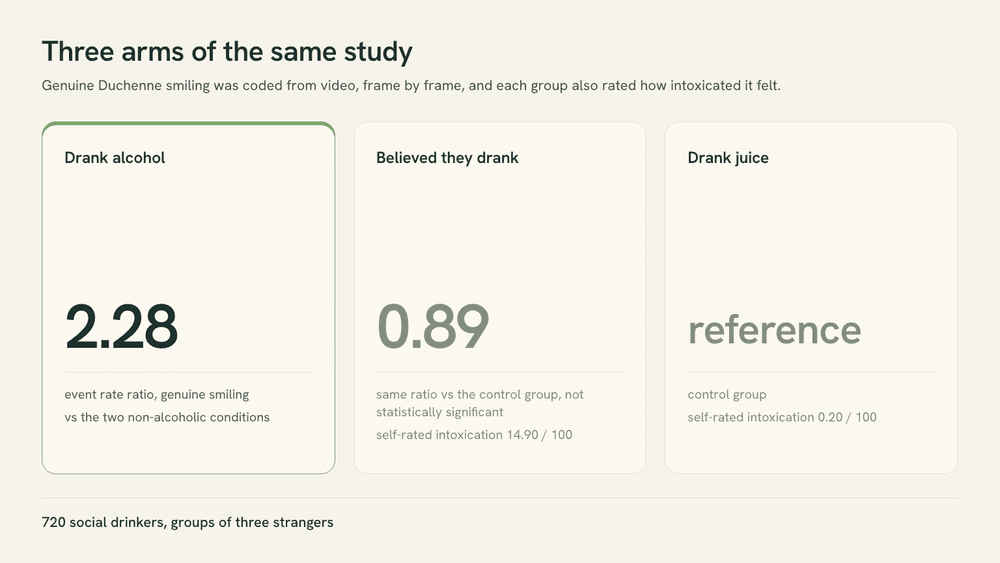
In one of the largest alcohol administration studies ever run, 720 social drinkers, 360 men and 360 women, were put into groups of three strangers and given one of three things: an alcoholic drink, a placebo they were told was vodka, or a non-alcoholic control drink. The alcohol groups received 0.82 g/kg for men and 0.74 g/kg for women over 36 minutes, reaching a mean blood alcohol concentration of 0.055 after drinking and 0.062 forty minutes later. Researchers then coded the video frame by frame, counting genuine Duchenne smiles rather than asking people how they felt. Against the two non-alcoholic conditions, the groups that actually drank showed genuine smiling at an event rate ratio of 2.28, hit the three-way golden moments of simultaneous Duchenne smiling 1.81 times as often, produced 1.48 times as much three-way sequential speech, and scored 0.62 on a composite of negative affect. The social effect of a drink is real, it is large, and it is measurable.
The important arm is the middle one. The placebo group drank flattened tonic poured from a vodka bottle with a smeared rim, and the deception worked: they rated themselves 14.90 out of 100 on intoxication, against 0.20 for the control group. In the coded behavior they were indistinguishable from the people drinking juice, with three-way Duchenne smiling at an event rate ratio of 0.89 and three-way speech at 1.04, neither statistically significant. Belief did not produce the effect. The glass in the hand did not produce it. The alcohol did. This was a laboratory first meeting between strangers at a moderate dose, not a Friday at home with people you know, and the measure was coded facial behavior rather than happiness, so do not stretch it further than it goes. It is the most direct measurement we could find of whether belief and a glass reproduce the effect on their own, and it points one way: the part of the evening that a product with no alcohol in it cannot supply is the part the alcohol was supplying.
What CBD is not, stated plainly
The other half of the comparison has also been measured, in a way that is unusually clean. In a randomized, double-blind, placebo-controlled study of 31 adults, each person went through eight weekly sessions of about 7.5 hours and received oral CBD at 0, 200, 400 and 800 mg, alongside active cannabis. The researchers' summary is that active cannabis reliably produced abuse-related subjective effects including feeling high, while CBD was placebo-like on all measures collected. The doses in that sentence are the amounts the study administered, not a recommendation, and this article prints no recommended amount at all. The participants were 31 frequent cannabis users in a laboratory across single sessions, which limits how far the result travels. But within those limits it answers the question a lot of people are quietly asking: there is no buzz to trade.
There is also a reason to expect that, and it comes from the alcohol side rather than the cannabinoid side. The best-known account of why a drink loosens people up, the alcohol myopia model published in American Psychologist in 1990, argues that alcohol makes social responses more extreme through its impairment of perception and thought rather than through any direct relaxing action, by blocking a form of response conflict. That is a theory paper and an explanatory framework, not an experiment, and it should not be treated as settled mechanism. If it is right, though, the implication is unavoidable: an effect that is a by-product of impairment cannot be produced by something that does not impair you, and CBD does not impair you.
- The intoxication, and the disinhibition that follows it. There is no buzz to trade, and on the account above the loosening is a by-product of impaired attention, so a product that does not impair attention does not deliver it.
- The enforced stop. Alcohol ends an evening for you, eventually. Nothing in a dropper bottle does that, so the boundary has to come from the routine you build rather than from the bottle.
- A promise about the next morning. The pages selling drinks under this search offer one, usually the absence of a hangover. No study has compared next-day outcomes in people who made this change, so we are not offering it.
- A sleep result or a stress result. Both are separate research questions with their own pages, the human evidence on both is limited and mixed, and neither belongs in an argument about swapping a drink.
If you want the subjective side in more detail, what people actually report feeling goes through it honestly, including how often the answer is nothing much. What shows up in the first weeks of a daily routine, mostly drowsiness, appetite changes and loose stools, is listed in the side effects article. And if the reason you reached for a drink was stress rather than taste or habit, read what human stress research has and has not shown before you decide anything.
A tincture is not a drink, and that matters more than people expect
Almost every page that ranks for this search is selling a beverage, written for what the market calls the sober curious reader, and several of the beverages recommended are THC seltzers rather than CBD at all. It is worth being literal about what we actually sell, because the format is half the question. A Planntz Full Spectrum tincture is a 60 mL glass bottle at 250 mg/mL, which is 15,000 mg of CBD per bottle in a coconut MCT oil carrier, at $80, with a per-batch third-party certificate published for every flavor. It has no alcohol by volume, no serving volume worth speaking of, no glass, no ice and no ritual duration. Taking it occupies about a minute. Then it is still 7pm and the evening is still there, which is exactly the problem nobody selling this category writes down.
| Attribute | One standard drink of wine (5 oz at 12%) | The 60 mL Planntz tincture |
|---|---|---|
| Alcohol | About 14 g of pure alcohol | None |
| Intoxication | Yes, and it scales with how much you drink | No. CBD is not intoxicating. Full spectrum carries trace THC below the 0.3% limit, so effects and test outcomes can vary |
| What you hold, and for how long | A full glass, usually over many minutes | A dropper, for about a minute |
| The social signal | Understood by everyone at the table without a word | Understood by nobody |
The honest conclusion from that table is that the container problem and the cannabinoid question are two different purchases. If what you miss at 7pm is holding something cold for twenty minutes, the fix is a drink you actually like that happens to contain no alcohol, and it does not need to contain anything active. If you also want to take a tincture, treat that as a separate decision. We do not sell a beverage, so we have no stake in that half. What is actually inside the cans sold as hemp drinks is worth reading before you buy one, and if the can carries a milligram figure for a THC isomer rather than for CBD, the legal position of those drinks is a different article again.
The one study behind the "CBD replaces alcohol" headlines is about something else
If you have seen a headline claiming that research shows these drinks replace alcohol, it almost certainly traces to a survey published online in the Journal of Psychoactive Drugs on January 14, 2026. It is an anonymous cross-sectional survey of 438 adults who had used cannabis in the past year. Of those, 33.6% used cannabis beverages, typically one per session. Beverage users were more likely than non-users to report substituting cannabis for alcohol, 58.6% against 47.2%. They also reported fewer weekly alcoholic drinks after starting cannabis beverages, a mean of 3.35 against 7.02 before, and 80.7% reported binge drinking less than monthly or never, against 47.2% of non-users.
Read the design before the numbers. Those are THC beverages, not CBD, in people who already used cannabis. The before and after figures were recalled from memory in a single sitting rather than recorded as they happened. There was no comparison group, nothing was verified, and the sample selected itself. The authors' own verb about what their data does is may support. A survey like that can describe what a self-selected group reports; it cannot establish that a beverage caused a change in anyone's drinking, and it says nothing about CBD in any form. When a seller cites a study for substitution, this is usually the paper, and the mismatch between what it studied and what it is used to prove is worth knowing before you read the next headline.
How to test CBD instead of alcohol on yourself, in four weeks
Since the trial does not exist, the only evidence you can get is about you, and it is worth collecting properly. The method belongs to our guide on telling whether CBD is doing anything, and the short version is three rules: define the outcome before you start, write the stop rule at the same time, and change one thing at a time. Two warnings before the steps. First, the behavior change side of this has been measured, and it had nothing to do with any supplement: 857 British adults who took on a one-month abstinence challenge reported lower consumption and greater confidence in refusing a drink six months later, whether or not they completed the month. That was self-selected, self-reported, had no control group and studied a decision rather than a product, which is precisely why it is here: the early improvement you are about to see is probably yours, not a bottle's. Second, this article prints no amount and no timing on purpose. How much is a question with its own page, and so is when in the day to take it.
- 1Write down one outcome before you start, in a form you can answer yes or no to the next morning. Not feel better. Something like whether you were in bed by the hour you meant to be, or whether you drank anything at all.
- 2Write the stop rule at the same time: the date you will decide, and the result that would make you stop. A test you cannot fail tells you nothing, and a routine nobody is allowed to abandon is not an experiment.
- 3Change one thing at a time. For the first two weeks, change what is in the glass and nothing else. If you start a tincture in the same week, you have two variables and you will never know which one moved the number.
- 4Log the evening, not the feeling. One line a night: what time, what you had, what you did afterwards, what time you went to bed. Feelings are easy to rewrite later, which is why the log records events.
- 5Expect the first two weeks to look good for reasons that have nothing to do with any product. People who decide to change something often report improving early. That is why the decision date is four weeks out and not one.
- 6Decide on the date you wrote down, reading the log rather than your memory of it. If the outcome did not move, stopping is a legitimate result and it is cheaper than a habit that does nothing.
What changes about safety when it becomes an every-evening thing
One occasional bottle and a nightly routine are not the same exposure, and three things change when the swap becomes daily. The first is the combination. The FDA states, in its consumer guidance on cannabis-derived products, that use of CBD with alcohol or other drugs that slow brain activity increases the risk of sedation and drowsiness, which can lead to injuries. That is a risk statement with no dose and no magnitude attached, and it is enough to justify one rule: do not treat the two as interchangeable within the same evening, and do not stack them. The entire co-ingestion question, including what the human studies did and did not find and what happens to a blood alcohol reading, lives on the page about taking both.
The second is trace THC, and this is the part page one never mentions. A full spectrum product is whole-plant, so it carries THC below the federal 0.3% limit rather than none. Planntz's published Full Spectrum certificates report 136 mg total THC in the Mango and Peach bottle at 0.238%, 138 mg in Lemon and Raspberry at 0.242%, and 143 mg in Natural at 0.251%, which works out at roughly 0.11 to 0.12 mg per drop, with drop size varying by dropper and technique. Broad Spectrum reports non-detected on the mango and natural batches and 10.7 mg, or 0.019%, on the lemon one. Those are trace amounts below the federal limit rather than an intoxicating dose, but a person taking a full spectrum product every evening is taking repeated small amounts of THC, and no product can guarantee a test outcome. What that actually means for a screen is covered on the drug testing page; this page supplies the milligrams and that one supplies the interpretation. The third change is the simplest: if you take any prescription medication, the interaction question comes before everything else in this article, and it is handled in the medications guide.
The arithmetic, since nobody else will print it
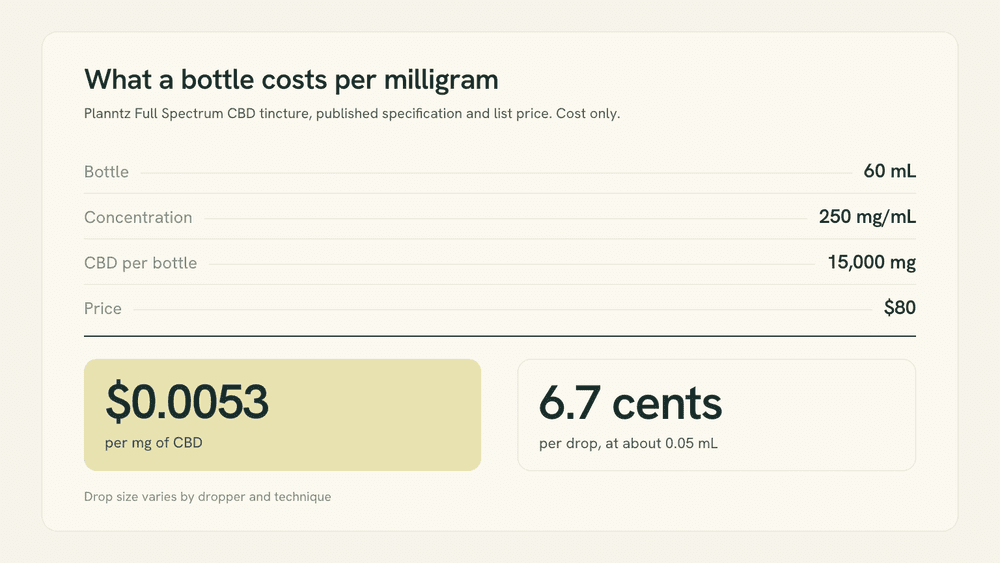
Here is the division, with the assumptions stated so you can substitute your own. A Planntz Full Spectrum bottle is $80 for 15,000 mg of CBD, which is $0.0053 per mg. At 60 mL and about 0.05 mL per drop, the bottle holds roughly 1,200 drops, so each drop costs about 6.7 cents and carries about 12.5 mg of CBD. Drop size varies by dropper and by how you squeeze it, so treat both figures as close rather than exact. On the other side, NIAAA's standard drink for wine is 5 oz at 12%, a 750 mL bottle is about 25 oz, so a bottle is about five standard glasses. At a $15 retail price, which is our assumption and not a sourced figure, that is about $3.00 a glass.
| What you are buying | Price as sold | What the container holds | Cost per unit as sold |
|---|---|---|---|
| Planntz Full Spectrum CBD tincture | $80 | 60 mL at 250 mg/mL, so 15,000 mg of CBD, about 1,200 drops | $0.0053 per mg of CBD, about 6.7 cents per drop |
| A 750 mL bottle of 12% wine | $15, our assumption rather than a source | About five 5 oz standard drinks, roughly 14 g of pure alcohol each | About $3.00 per standard drink |
Now the caveat that makes the table honest. A drop and a standard drink are not the same kind of unit, and nothing in this arithmetic says that some number of one is worth some number of the other. We are not printing a drops-per-evening figure, because that is a dosage question with its own page. What the table is good for is the household calculation people actually do before they change anything: what does this cost me per month, and does the answer change my mind. If you want the same arithmetic applied across the whole category, including why price per bottle is close to meaningless, the cost per milligram breakdown does it properly.
If the real question is whether you are drinking too much
Some people arrive at a search like this one because they are worried, not because they are optimizing an evening routine. If that is you, this page is not the answer, and we would rather say so than sell you something. For reference, NIAAA's definitions of drinking patterns describe binge drinking as a pattern bringing blood alcohol to 0.08%, typically five or more drinks for men or four or more for women in about two hours, and heavy drinking as five or more on any day or 15 or more per week for men, four or more on any day or eight or more per week for women. The same agency notes that harms may be associated with any amount of drinking, and that alcohol use disorder is a medical condition characterized by an impaired ability to stop or control alcohol use. Those are population definitions and not a diagnosis: nothing on this page can tell you whether you have one, and nothing Planntz sells treats it. The SAMHSA National Helpline is free, confidential and open 24 hours a day, every day, at 1-800-662-HELP (4357), and NIAAA publishes a plain guide to finding treatment that lists it alongside its treatment navigator. A conversation with a clinician is the right next step, and it is a more useful one than anything in a bottle.
What is still unknown
- Whether swapping the evening drink for CBD changes anything at all. As of September 20, 2026 no trial has tested it in people who drink but are not dependent, so there is no effect size to quote, in either direction.
- Whether a non-intoxicating evening routine holds up socially over months. The 720-person study covers one laboratory meeting between strangers, not a year of Fridays with people you know.
- Whether any of this affects how much anyone drinks. Not measured here, not claimed here, and the research that exists in alcohol use disorder is a different population answering a different question.
- What CBD does to sleep or to stress. Both are live research questions with their own pages, the human evidence on both is limited and mixed, and neither is settled by anything on this page.
- How much of the early improvement is the decision rather than the product. The abstinence-challenge research suggests the decision does real work on its own, which is why the four-week log matters.
It depends which half of the drink you mean. We searched PubMed on September 20, 2026 and found no study that gave CBD to a person who was drinking less on purpose. On the pharmacological half the answer is no: there is no intoxication to trade, and in the 720-person study described above the social loosening tracked the alcohol rather than the glass or the belief. On the behavioral half it is a routine question rather than a chemistry one, and the hour, the container and the signal to other people can be occupied by something else that does not have to contain anything active.
No. In a randomized, double-blind, placebo-controlled study of 31 adults, oral CBD at the 200, 400 and 800 mg the researchers administered was placebo-like on all measures collected, while active cannabis in the same people reliably produced a high. Those were frequent cannabis users in single laboratory sessions, which limits how far the finding travels, but nothing in it suggests a buzz. Our article on what CBD feels like goes through the subjective reports in more detail.
We are not going to answer yes to that. The research does not support it and it is a health claim we are not entitled to make. What has been measured is the other side of it: in a 720-person study, the people who believed they were drinking vodka, and rated themselves as intoxicated at 14.90 out of 100, were indistinguishable in coded social behavior from the people drinking juice. For what human stress research has and has not shown about CBD, see our article on CBD and stress, which states the limits of that evidence plainly.
Nothing on this page is about treating drinking, and we make no claim that CBD reduces, replaces or helps with alcohol use of any kind. Research in alcohol use disorder is a different question in a different population, and it is covered on our article about CBD and alcohol rather than here. If you are asking because you are worried about your own drinking, talk to a clinician, and know that the SAMHSA National Helpline is free, confidential and open 24 hours a day at 1-800-662-HELP (4357).
The FDA says that using CBD with alcohol or other drugs that slow brain activity increases the risk of sedation and drowsiness, which can lead to injuries, so the short answer is not to stack them. The whole co-ingestion question, including what the human studies measured, what happens to a blood alcohol reading and where the widely repeated waiting rules came from, is handled on our CBD and alcohol article.
No. Different molecule, different effects and a different legal position. Many of the beverages marketed as alcohol replacements under CBD searches are THC drinks, which are intoxicating in a way CBD is not, and the one survey most often cited for substitution studied cannabis beverages rather than CBD. Planntz sells a 60 mL tincture and no beverage at all. Our article on hemp drinks covers what is actually inside the cans.
If you take one thing from this page, make it the split: the chemistry of a drink does not transfer to a product that contains no alcohol, and the routine around it was never chemistry to begin with. That is a smaller claim than page one is making, and it is the only one the evidence supports. For the wider picture of what human research has and has not shown about this molecule, start with our overview of the CBD evidence. And if you do decide to buy anything, from us or anyone else, read the batch certificate first: ours are published in full at the lab results page, flavor by flavor, including the total THC figures quoted above.
Writing about hemp, wellness and the small rituals that keep us balanced.