How to Tell if CBD Is Working: A Method, Not a Feeling
Page one answers this with lists of signs that cannot fail. Here is the method instead: define one outcome before you start, take a baseline, change one thing at a time, fix the length, and write down now what result would make you stop.
You bought a bottle, you have been taking it for a few weeks, and now you want an honest answer to a hard question. Search for how to tell if CBD is working and you will be handed a list of signs: food tastes better, your jaw unclenches, your shoulders drop. Every one of those is exactly what a person who just spent money and expects a result would report on a good day. None of them can come out negative. This page does the other thing. It gives you a method, and an honest method is just as likely to tell you to stop.
“There is no single, reliable feeling that proves CBD is working.”
That sentence is where our page on what CBD feels like stops. This is the next paragraph. The short answer is that "is it working" is a measurement question, not a sensation question, and it is answerable, just not by introspection. Pick one outcome you can write down as a number. Measure it for a week before you change anything. Change one thing at a time. Fix the length of the trial in advance. Then write down, today, the result that would make you stop buying. Everything below is the detail, the evidence for why the shortcuts fail, and the four things worth checking before you conclude that CBD does nothing for you. If you are earlier than this and still working out the basics, start with what CBD actually is.
Why "I feel better" is not the answer
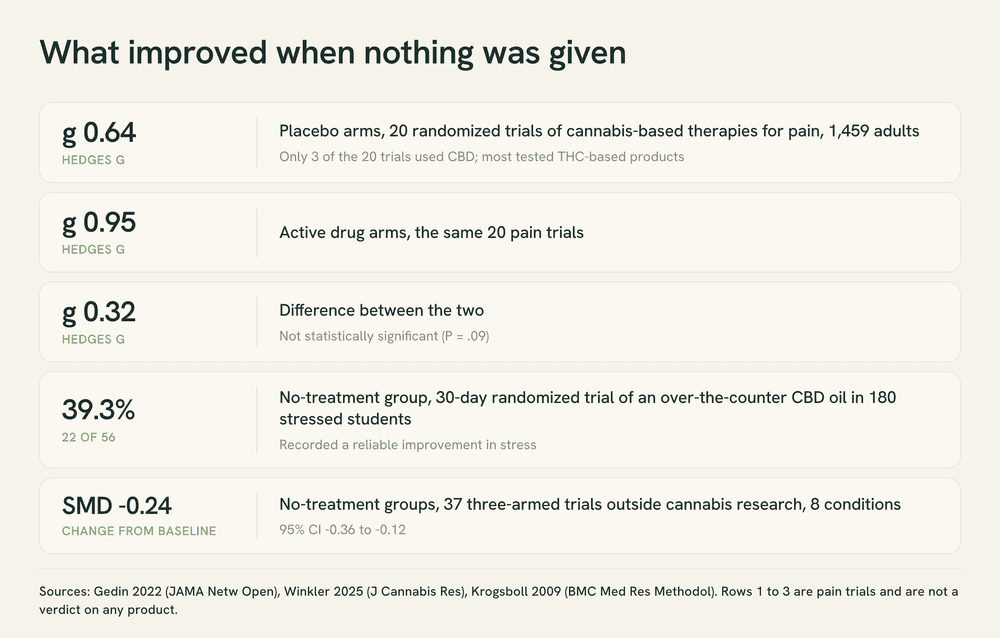
The best evidence that a felt improvement is not proof of anything comes from a 2022 systematic review and meta-analysis in JAMA Network Open, which pooled 20 randomized trials of cannabis-based therapies for pain covering 1,459 adults with clinical pain. In the placebo arms, pain intensity fell with a moderate to large effect (Hedges g 0.64, P less than .001). In the arms that received the real drug it fell with a large effect (g 0.95, P less than .001). The difference between the two, g 0.32, was not statistically significant (P = .09). Read the scope before you read anything into that. These were pain trials, only 3 of the 20 used CBD as the active substance and most tested THC-based products, trial length ran from 45 minutes to 16 weeks, and heterogeneity was high. It is a statement about how much people in trials report improving when they are given something, not a verdict on any product.
Two details from that same analysis are worth keeping, and both are about the machinery rather than about cannabis. First, the better-blinded trials produced bigger placebo responses, not smaller (poor blinding was associated with a lower placebo response, q1 = 4.26, P = .04), and the trials at low risk of bias had the higher placebo responses (q1 = 5.47, P = .02). Second, and this is the one that matters for you: the length of the trial had no relationship at all to the size of the placebo response (q1 = 0.54, P = .54), across durations from 45 minutes to 16 weeks. Waiting longer does not make the noise go away. That is a meta-regression over 20 pain trials, exploratory rather than causal, with only 2 trials at low risk of bias and 4 at high. Blinding is a known weak point in this field: a 2018 commentary in JAMA Internal Medicine called inadequate blinding the Achilles heel of medical cannabis research, because participants can often work out which arm they are in. It is a commentary, not new data, and it is the reference the meta-analysis itself leans on for that point.
The same paper also measured how those trials were talked about. They carried a mean Altmetric score of 89 (SD 115) and ranked in the top 88% of all publications tracked in the same six-month window, and across 136 news items the count of positive coverage showed no statistically detectable relationship with the size of the effect reported, whether the cannabinoid effect (rho = 0.22, P = .46) or the placebo effect (rho = 0.10, P = .74). The authors are careful to say the study was not powered to test whether the coverage shaped anyone's expectations. The usable point is simpler and does not need their hypothesis: how loudly a result is reported carries no information about the result. If you want the population-level version of this problem, we work through what the human research on CBD does and does not show claim by claim.
Three things that get better without any product
In 2025 a three-arm randomized trial did the thing almost nobody does: it added a group that took nothing at all. A trial published in the Journal of Cannabis Research randomized 180 highly stressed university students to 30 consecutive days of a commercial 10% full-spectrum CBD oil, an identical-looking placebo oil (pure hemp seed oil, in the manufacturer's own packaging), or no treatment at all; 52, 58 and 56 were analyzed. The CBD oil and the placebo oil did not differ on stress (d = 0.16, 95% CI -0.21 to 0.54, P = .403), or on any other outcome measured. All three groups improved. Mean stress scores fell from 26.25 to 18.71 on the CBD oil, from 24.67 to 18.12 on the placebo oil, and from 24.80 to 21.05 on nothing. Both oil groups improved more than the group taking nothing on stress (CBD oil d = 0.65, placebo oil d = 0.44). And 39.3% of the people who took nothing at all, 22 of 56, still crossed the trial's threshold for a reliable individual improvement. The limits are real: one trial, one country, healthy stressed students rather than patients, low over-the-counter-scale amounts, self-report questionnaires, and 180 randomized against 166 analyzed. A null result in a single trial is not proof that CBD does nothing. What it does show is that if you had been one of those 22 people, you would have had a genuine improvement to explain and nothing to credit it to.
That 39.3% is not a cannabis phenomenon. Outside cannabis research entirely, a 2009 meta-analysis of 37 three-armed trials covering 2,900 patients across 8 clinical conditions compared no treatment, placebo and active treatment side by side in the same studies. Change from baseline was -0.24 in the no-treatment groups (95% CI -0.36 to -0.12), -0.44 with placebo and -1.01 with the active intervention. The authors put spontaneous improvement at roughly 24% of the change seen in the actively treated groups, and placebo at roughly 20%. Those were psychological, physical and pharmacological interventions across mixed conditions, it is not a cannabis study and it must not be chained to any claim about CBD. Its general point is the one you need: a change from your own baseline is not an effect.
Then there is arithmetic, which is the part nobody warns you about. People do not start a supplement on an average week. They start on a bad one. A 2005 methods paper in the International Journal of Epidemiology describes the consequence plainly: regression to the mean is "a statistical phenomenon that can make natural variation in repeated data look like real change", and "it happens when unusually large or small measurements tend to be followed by measurements that are closer to the mean". The same paper notes it gets worse with increasing measurement error and when the follow-up is examined on a sample selected using a baseline value, which is a technical description of buying something on your worst week and then watching what happens. That is a statistics paper, not evidence about CBD, and nobody has applied it to cannabidiol: a PubMed search for cannabidiol and the phrase "regression to the mean" returned exactly 1 record on August 14, 2026, and it is an epilepsy paper where cannabidiol is a concomitant medication.
- Spontaneous improvement. In three-armed trials outside cannabis research, the groups given nothing still improved, by about a quarter of the change seen in the actively treated groups.
- Expectation. You know what you took, what it cost and what you hoped for. In the cannabis-based pain trials above, only 3 of 20 of which used CBD, the placebo arms improved with a moderate to large effect.
- Regression to the mean. You started on a bad week. Bad weeks are usually followed by better ones, as arithmetic, whatever else you do or do not change.
The method: how to tell if CBD is working
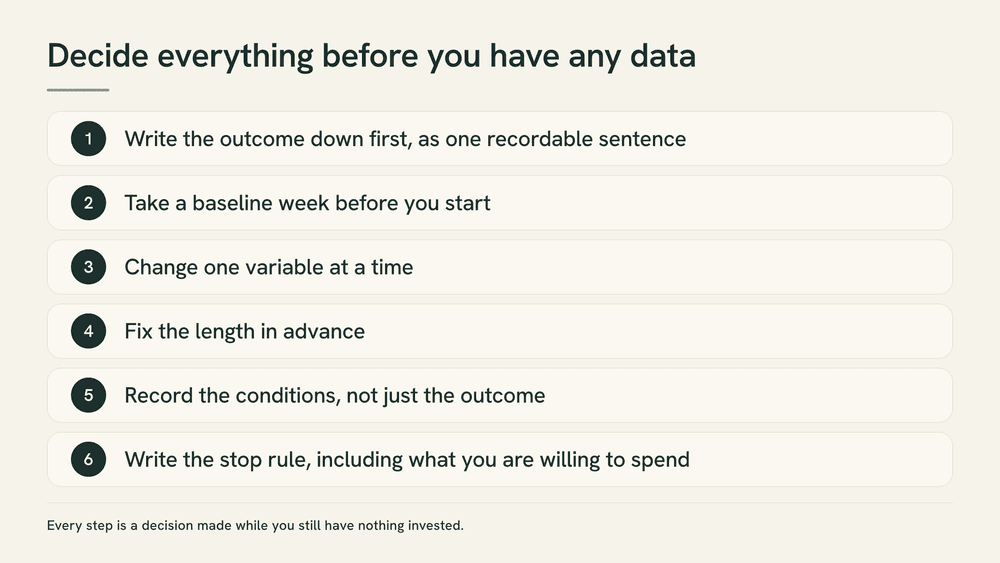
Running a formal experiment on a single person is a real clinical-research design, not something a blog invented. It is called an N-of-1 trial, and it has a published reporting standard: the CONSORT extension for N-of-1 trials, which adds guidance for 14 of the 25 items on the CONSORT 2010 checklist. Real N-of-1 trials randomize the order of the treatment periods, repeat them, cross the patient back and forth between them, usually blind the participant and are usually run by a clinician. You are not going to do that at home, and this article is not going to dress a kitchen-table log up as a validated protocol. What you can copy for free is the part that costs nothing but discipline: making every decision before you have any data to be pleased about.
- 1Write the outcome down first, in one sentence, as something you can record: minutes to fall asleep, number of nights woken, a 0-10 note taken at a fixed hour. If you cannot write it in advance, you cannot judge it afterwards.
- 2Take a baseline before you start. Record that same measurement for at least a week without changing anything. This is the step the signs lists skip, and it is the reason they mean nothing.
- 3Change one variable at a time. Not a new product, a new bedtime and a new gym schedule in the same week. Whatever else changed is the first explanation anyone should reach for, including you.
- 4Fix the length in advance and hold your routine steady inside it. A length chosen after you have seen the data is not a test, it is a search for the point that agrees with you.
- 5Record the conditions, not just the outcome. Alcohol, deadlines, travel, illness, an argument, a heatwave. Much of the variation in your week lives in that column rather than in the bottle.
- 6Decide now what would make you stop, in the same recordable form as your outcome, and include what you are willing to spend. Write it down before day one, while you have nothing invested.
Two practical notes on step 1 and step 5. A pre-defined measurement does not have to be sophisticated, and the standardized ones deliberately are not: the Consensus Sleep Diary, built by an expert panel of 25 as a standardized prospective self-monitoring form, was written so its instructions read at a sixth-grade level and the diary itself at a third-grade level. Its authors describe it as a living document still to be tested, refined and validated. Simple and identical every day beats detailed and improvised. We use it here only as a model of what a pre-defined measure looks like; sleep as a subject belongs in our sleep guide. Second: keeping the record is itself one of the things you changed. This also comes from outside cannabis research, in a systematic review of 19 purpose-built studies of the Hawthorne effect, which concluded that consequences of research participation for the behaviors being investigated "do exist", while stating that "little can be securely known about the conditions under which they operate, their mechanisms of effects, or their magnitudes". It refuses to put a number on it, so no number is quoted here. That is not an argument for skipping the record. It is an argument for counting it in the column of things that changed.
What counts as an outcome, and what does not
Here is the genre this article is arguing with. The phrases in the left column are quoted from consumer CBD pages that were on the first page of results for this exact search when we read it, on August 9 and again on August 14, 2026. No site is named here, because the problem is the format rather than any one seller. The problem is not that these phrases are dishonest. The problem is that they cannot fail: nothing in them was recorded, nothing can be compared against a week ago, and every one is something you would notice on a good day if you were looking for it. The right-hand column is not a list of things CBD does, and nothing here should be read as an outcome anyone expects it to move. It is a list of things a person might already be counting, stated formally enough that they could come out either way.
| What page one calls a sign | Why it cannot be evaluated | A version you could actually record |
|---|---|---|
| "Food tastes better, colours look brighter" | Nothing was measured before, so there is nothing to compare it against. Both are things people report on a good day | A single 0-10 note written at the same fixed hour every day, entered before you look at yesterday's |
| "Your shoulders drop away from your ears" | An observation available only to someone already looking for it, and impossible to reconstruct a week later | Minutes from lights out to sleep, estimated the next morning and written down once, every day |
| "Your jaw unclenches" | Same problem, plus it is momentary: one relaxed minute becomes the memory of a relaxed week | A count: the number of nights in the week you woke and stayed awake for more than a few minutes |
| "Improved focus and mental clarity" | Focus moves with sleep, deadlines, caffeine and mood, and none of those were being tracked either | The number of days in the week you did the specific thing you planned, at the hour you planned it |
| "Finishing tasks without getting distracted" | Nothing was counted before, so "more of them" has no denominator, and an ordinary good work week fits the description perfectly | Any of the above, recorded for a week before you start, so that the after has a before to be measured against |
Notice what the right column has in common: a number, a time, and a fixed hour. It says nothing about which direction the number should go, and that is the whole point. A measurement that can only move one way is not a measurement, and an outcome you would accept only if it improved is not an outcome. It is a hope with a spreadsheet attached.
Before you decide CBD is not working: four checks
"CBD is not working for me" is a conclusion, and it is usually reached before four cheaper explanations have been ruled out. Run them in this order, because the first three are about the product and the routine and only the fourth is about you. Three of the four can be settled in an afternoon.
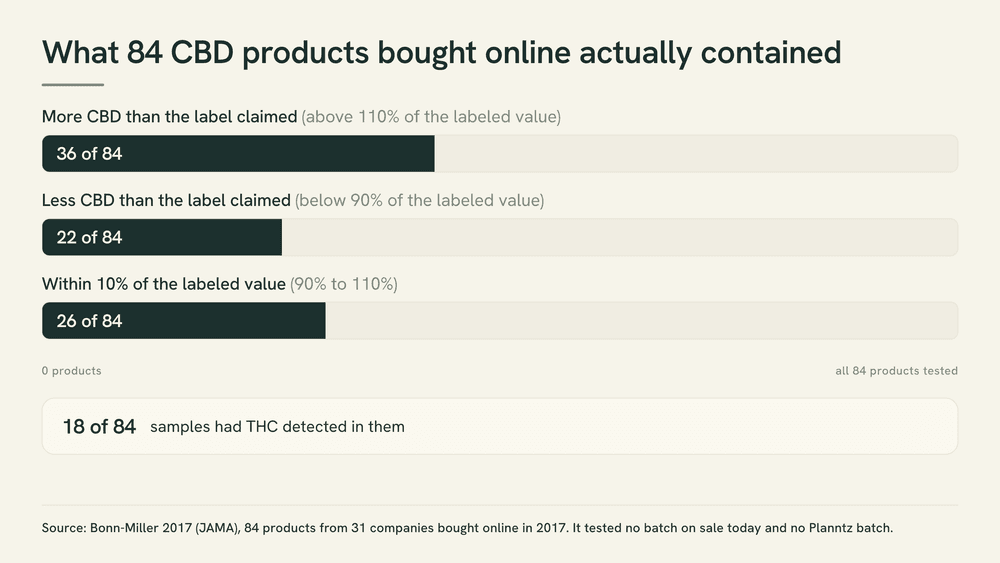
One: is the product what it says it is. When researchers bought 84 CBD products online from 31 companies and analyzed them, only 26 of the 84 came back within 10% of the CBD stated on the label. Thirty-six contained more CBD than the label claimed and 22 contained less, and THC was detected in 18 of the 84. That was a 2017 online sample, it predates much of today's market, and it tested no batch that you own, so treat it as a reason to check rather than as a verdict on anything on a shelf now. The federal regulator says something similar in its own words: the FDA's consumer update on cannabis-derived products states that it has tested the chemical content of some products and "many were found to not contain the levels of CBD they claimed". That page was reread on August 14, 2026 and the sentence was still there; the agency gives no prevalence rate and describes no sample, so it is a characterization of a category, not a percentage. The document that settles the question for your specific bottle is the batch certificate, and we cover how to read a batch certificate, what third-party tested actually means and the sixty-second version of the same check separately.
Two: is the amount what you think it is. A dropper is not a unit. The same physical drop carries a very different amount of CBD depending on the concentration of the bottle it came from, and concentrations vary within a single brand's own range: a 250 mg/mL oil and a 133 mg/mL oil are both ordinary tinctures and they are not interchangeable by the drop. If you have never done that arithmetic for your own bottle, run the per-drop math and read what each number on a CBD label means. The amount itself is not something this page will set for you. That is what our dosage guide is for, and a clinician for your situation.
Three: has enough time passed, and was it consistent. Two loose claims live here. The first is that CBD is cumulative and works better the longer you take it. A phase 1 trial that measured repeated dosing found plasma levels settle in about two days, and we cover that in our first-time guide. The second is a number: page one will tell you to allow four to six weeks, or four to five months, and neither figure is sourced to anything. In the pain meta-analysis above, trial length ran from 45 minutes to 16 weeks and had no relationship to the size of the placebo response, so a longer wait is not a cleaner signal. Onset and duration belong to how long CBD takes to work, and consistency belongs with when in the day you take it. What matters for your own test is narrower: did you take it the same way, at the same time, for the length you fixed in advance, and do you know that or are you reconstructing it?
Four: were you measuring anything at all. If "is it working" is being answered by comparing today against your memory of a month ago, there is nothing to evaluate. Memory edits itself toward whatever you expected, and the edit is invisible from the inside, which is exactly why the first three sections of this article exist. With no baseline, the honest conclusion is not "it does not work", it is "I do not know yet", and the fix is a week of measurement before you change anything else.
- Does a batch certificate exist for the lot number printed on your bottle, and does it match what the label claims?
- Do you know, in milligrams, what one dropper of your specific bottle contains, or are you counting drops and hoping?
- Did you take it the same way, at the same time, for a length you decided on before you started?
- Do you have a baseline you wrote down, or are you comparing today against a memory of a month ago?
Write the stop rule before you start
A stop rule is a sentence you write before day one that states what result, by what date, would make you stop buying. It exists because once you have paid, the cheapest explanation for a disappointing week is that you need more time, and that explanation is always available, forever. A workable rule has three parts: the measurement, the date, and the price. "If my seven-day average has not moved by the end of the period I fixed, I stop" is a rule. "I will see how it goes" is not a rule, it is a subscription. The price part matters because even a real effect can be a bad deal at some prices, and comparing what you pay against what you get is arithmetic anyone can do: our cost per milligram guide shows how.
We should be plain about our own position here, because it is obvious and pretending otherwise would be worse. Planntz sells CBD. A page that teaches you how to find out whether ours is doing anything for you, and that asks you to write down in advance the result that would end the purchase, works against our commercial interest. We would still rather publish it than publish a list of signs that cannot fail. Read the rest of this site with that on the table, and read anyone else's advice about evaluating CBD with the same question in mind: what happens to them if your honest answer is no?
One boundary is not negotiable. A personal experiment is never a reason to change, pause or delay anything a clinician prescribed, and it is not a reason to put off getting a symptom looked at. The NCCIH's consumer overview of cannabis and cannabinoids states it directly: "Don't use cannabis or cannabinoids to postpone seeing a health care provider about a medical problem." The same page notes that over-the-counter CBD products may contain more or less CBD than their labels state, unlike the purified prescription cannabidiol medicine the FDA has approved. If the thing you want to evaluate sits anywhere near a diagnosis or a prescription, the person to design that comparison with is the person who wrote the prescription.

What a test on one person can and cannot tell you
An honest personal test has a ceiling, and you should know where it is before you start trusting the result. A finding from one person on one occasion is not evidence about CBD. It is not even strong evidence about you: it is about you, in that month, with that sleep, that workload and that season. It cannot be generalized to anybody else, and it cannot be assumed to repeat for you next year. The features that a real N-of-1 trial uses to guard against exactly the errors described above, randomizing the order of the treatment periods, repeating them, crossing back and forth, blinding the participant, are precisely the ones a home version does not have. That is why the strongest output an honest personal test can produce is a decision rather than a finding: keep going, or stop.
It is also worth saying plainly that this method is borrowed rather than validated for this use. On August 14, 2026, a PubMed search for cannabidiol and the phrase "self-monitoring" returned 0 records: nobody has published on self-monitoring of cannabidiol use at all. Cannabidiol and "n-of-1" returned 5 records on the same day, and not one of them is a person evaluating an over-the-counter product at home. They are clinical trials and trial protocols in patients: two protocols for placebo-controlled N-of-1 trials of cannabidiol, one in intractable epilepsy and one in rare genetic disorders; a protocol for aggregated N-of-1 trials of cannabidiol for sleep in multiple sclerosis; a randomized trial of a cannabidiol chewing gum; and a 2004 report of results pooled from 34 single-patient studies of medicinal cannabis extracts in chronic pain. The wider N-of-1 literature is substantial and sits almost entirely outside cannabinoids: a search for "single patient" and "n-of-1" and design returned 71 records on the same day. So the method above is taken from clinical research, it has not been tested as a self-administered consumer protocol for CBD, and anyone who tells you otherwise, ourselves included, is describing a good habit rather than citing evidence.
Frequently asked questions
There is no evidence-based number, and the two figures the first page of results offers, four to six weeks and four to five months, are not sourced to anything. What matters more than the number is that you choose it before you start, because a length picked after you have seen your data is not a test, it is a search for the point that agrees with you. In the meta-analysis of cannabis-based pain trials described above, trial length ran from 45 minutes to 16 weeks and had no relationship to the size of the placebo response. Onset and duration are covered in our guide to how long CBD takes to work.
Possibly, and the reverse is documented too: people have reported clear sedation from an oil that contained no CBD at all. That is the whole reason this page is about measurement rather than sensation. Our article on what CBD feels like describes what people report, and our guide to taking CBD for the first time covers what happened when researchers told participants that an inactive oil contained CBD.
It proves you felt better, which is real and worth having. On its own it does not say what caused it. In 20 randomized trials of cannabis-based therapies for pain, mostly THC-based and only 3 of which used CBD, the placebo groups reported a moderate to large drop in pain intensity. In a 30-day trial of an over-the-counter CBD oil, 39.3% of the group taking nothing at all still recorded a reliable improvement in stress. A single unblinded observation cannot separate a drug effect from those explanations. A baseline and a fixed trial length narrow the field a little; nothing you can do at home settles it completely, and it is more honest to say so.
That claim is common on seller pages and it is not what the pharmacokinetic evidence shows: a phase 1 trial that measured repeated dosing found plasma levels settled in about two days. The detail is in our guide to taking CBD for the first time. "Give it longer" should be a decision measured against a rule you wrote in advance, not against the feeling that you have not yet given it long enough, because that feeling never expires.
Amounts are not something this page sets. Our dosage guide plus a clinician is the right pair for that question. What is worth saying here is methodological: increasing the amount until you feel something is the opposite of a controlled test, because it changes the variable you are measuring halfway through, which leaves you unable to attribute the result to anything. If you do change the amount, that is a new test with a new baseline, not a continuation of the old one.
Both, and it is worth saying plainly. Taking part in research appears to change the behavior being studied: a systematic review of the Hawthorne effect, from outside cannabis research, reported evidence that this happens while explicitly declining to put a size on it, which is why no percentage is quoted here. A written record is still better than a memory, because memory edits itself toward what you expected and you cannot feel that happening. Just count the record itself as one of the things that changed during the trial, alongside the bottle.
If you take one thing from this page, make it the sentence you write before day one: the outcome, the length, and the result that would make you stop. That sentence is what turns "I think it is working" into a question you can actually answer, in either direction, which is more than any list of signs will ever give you. For the descriptive side of the question, what people actually report feeling is a separate page, and for the population-level version, our evidence guide goes through the human research claim by claim.
Writing about hemp, wellness and the small rituals that keep us balanced.