Taking CBD for the First Time: A 14-Day Starter Guide
Every beginner guide opens at how much to take. That is the third question. This one starts two steps earlier: verify the batch certificate, settle the medication question with your prescriber, learn what one drop of your bottle actually is in milligrams, then log fourteen days.
Every beginner's guide to taking CBD for the first time opens in the same place: how much to take. That is the third question, not the first. Before an amount means anything, you need to know whether the bottle holds what the label claims, and whether CBD belongs anywhere near the medications already in your cabinet. What follows is a fourteen-day starter protocol built on those two gates and one record-keeping habit, and it deliberately prints no starting number.
The short version, in order. Verify the batch certificate before you pay. Settle the medication question with whoever writes your prescriptions. Learn what one drop of your specific bottle is in milligrams, because a dropper is not a unit. Then keep a plain fourteen-day log with the conditions held steady. Fourteen days is not how long CBD takes to accumulate, since the phase 1 trial that measured repeat dosing found plasma levels settle in about two days. Fourteen days is how long it takes to see a routine, a side-effect window and a few ordinary bad nights. What is realistic in a fortnight is a record, not a verdict. The amount itself is not something a web page can set for you: that conversation belongs in our dosage guide and with a clinician.
Day 0: what to verify before taking CBD for the first time
The label on a CBD bottle is a claim, not a measurement, and the published attempts to check that claim keep landing in the same place. A 2017 analysis in JAMA of 84 CBD products bought online from 31 companies found only 26 of them within 10% of the CBD printed on the label. Thirty-six contained more CBD than the label said and 22 contained less, and THC was detected in 18 of the 84. Oils were the best-labeled format in that basket and were still accurate only 45% of the time. That was a 2017 online sample with one unit tested per product, and no Planntz batch was in it, so read it as a snapshot of a market rather than a safety verdict about anything on a shelf today.
Two later measurements point the same way. A 2024 survey of 202 US products purchased between October and December 2021 found 149 of them, 74%, more than 10% away from their label; of the 100 tinctures in that set, 53 measured above 110% of what they claimed, and 26% of the 202 did not match the spectrum type printed on the package. Its funding statement reads that "the study was sponsored by Jazz Pharmaceuticals, Inc.", the company that makes the prescription CBD medicine the FDA has approved, and its conflict statement records that two authors are employees of that company and several others have consulted for it. Worth knowing, and it does not make the study a verdict on any single brand. A 2022 analysis of 80 hemp-derived products measured by LC-MS/MS found 37 at least 10% away from the labeled concentration, 25 of them above 110% and 12 below 90%. That one covered 80 products at a single time point in one region and did not break its results out by format, so it says nothing tincture-specific.
The regulator says the same thing in its own words. The FDA's consumer update on products containing cannabis states that "the agency has tested the chemical content of cannabinoid compounds in some of the products, and many were found to not contain the levels of CBD they claimed". We reread that page on August 10, 2026 and the sentence was still there. The agency gives no prevalence rate and describes no sample, so treat it as a regulator's characterization of a category, not as a percentage you can quote.
None of that means you should distrust every bottle. It means the label alone cannot settle the question, and the document that can is the batch certificate of analysis: an independent lab's report on the specific lot in your hand. Three checks, before money changes hands.
| The check | What good looks like | Where it goes wrong |
|---|---|---|
| The batch certificate | A certificate from an independent lab whose batch or lot number matches the number printed on the bottle you are buying, with a report date on it | One certificate linked site-wide for every product and every batch, a report with no lot number, or a PDF you can only get by emailing support |
| Potency, in two units | Total CBD stated per bottle in mg and per mL, and the two reconcile against the bottle volume when you multiply them out | "Hemp extract 1500 mg" on the front, no cannabinoid breakdown, and no mg/mL figure anywhere on the package or the report |
| Spectrum and THC | The spectrum claimed on the package (full spectrum, broad spectrum, isolate) matches the cannabinoid profile on the report, and the THC figure is printed as a number | A "THC-free" claim with no THC row on the certificate, or a package that says broad spectrum over a report showing a full-spectrum profile |
Each of those checks has a page of its own, and running them takes less time than reading the reviews. Start with how to read a batch report in five minutes, then what third-party tested actually means, which is where most of the marketing language falls apart. If the milligrams on the front and the mg/mL on the back refuse to reconcile, what every number on a CBD label means walks the arithmetic. The spectrum decision, full spectrum, broad spectrum or isolate, is where the THC question gets settled, and if a drug test is part of your job or your sport, read what a drug test actually looks for before you choose rather than after. When you are short on time, there is a sixty-second verification check that catches the worst listings.
The question to settle before the first drop
This section sits before any instruction about taking anything, on purpose. In a nationally representative US survey fielded in late 2023 using the Ipsos KnowledgePanel, 35.2% of 1,523 qualified adults said they had used CBD at some point. Among the 1,008 who had, 32.0% said they had used it alongside or instead of at least one medication (24.2% as an addition, 11.0% as a substitute), and only 2.4% ever reported a health problem they attributed to CBD. It is a self-reported, cross-sectional snapshot with no product and no amount verified, and "ever use" covers a lifetime, so it says nothing about safety or outcomes. What it does establish is that combining CBD with a prescription is not an edge case. It is roughly a third of users.
The interactions that have actually been documented cluster in one place: medicines with a narrow therapeutic index, meaning the gap between a dose that works and a dose that causes harm is small enough that a modest shift in blood level matters. A 2024 Penn State systematic review screened about 4,600 reports and read 151 in full, finding 31 in which cannabinoids changed a drug's pharmacokinetics or produced an adverse event, spread across 16 narrow-therapeutic-index medications. Warfarin, valproate, tacrolimus and sirolimus came up most often, and in 18 of the 31 a clinician found an unexpected serum drug level. A review of published reports measures what got written up, not how often it happens in the world, so read it as a map of where the risk has been seen rather than as a rate.
The mechanism is printed on a label anyone can read. The prescribing information for the prescription CBD medicine the FDA has approved, a cannabidiol oral solution, in the label version dated May 29, 2026, states in section 12.3 that "cannabidiol is metabolized in the liver and the gut (primarily in the liver) by CYP2C19 and CYP3A4 enzymes, and UGT1A7, UGT1A9, and UGT2B7 isoforms". Those are the same enzyme families behind the grapefruit warning on a lot of prescriptions. That product is dosed by body weight for seizure disorders and is not a hemp tincture, so nothing about its dosing transfers here; what transfers is which enzymes are involved. The drug-by-drug detail lives in how CBD can change the way a medicine behaves.
Ask a clinician before day 1, not after day 14, if any of the following describes you.
- You take any prescription medication, and especially one where a small change in blood level matters: warfarin and other anticoagulants, valproate and other antiseizure drugs, tacrolimus or sirolimus after a transplant.
- A medicine you take carries a grapefruit warning, since that warning is usually about the same liver enzymes named on the prescription cannabidiol label.
- You are pregnant, trying to become pregnant, or breastfeeding.
- You have a diagnosed liver condition, or liver enzymes have come back abnormal on a blood panel.
- You are under 21. This site and this guidance are written for adults.
There is no version of this page that can answer the question for you, and there is nothing to buy that changes the answer. Photograph the label and the batch certificate, take them to the person who writes your prescriptions, and ask directly. If you are pregnant, trying to conceive or breastfeeding, what the evidence says about pregnancy and breastfeeding is the honest starting point. If liver enzymes are the concern, read what is actually known about CBD and the liver first, and take it with you.
Set up your measurement before you set a routine
"One dropper" is the unit almost every beginner page uses, and it is not a unit of anything. A dropper is a container. What it holds depends on how far you squeeze the bulb and how full the bottle is, and what that volume contains depends entirely on the concentration of the oil inside it. The number that transfers between bottles, between brands and to a clinician is milligrams, and getting there needs two inputs: the concentration in mg/mL, and roughly how much volume one drop is.
Here is the arithmetic on one real product line, as a lesson in units rather than a suggestion. A standard dropper delivers about 0.05 mL per drop. The Planntz Broad Spectrum and Full Spectrum oils are 250 mg/mL of CBD in a 60 mL bottle, which is 15,000 mg of CBD in the bottle. At 0.05 mL a drop, that bottle holds about 1,200 drops, and 12.5 mg multiplied by 1,200 comes back to 15,000 mg, which is the check that the numbers reconcile rather than a coincidence.
Now change bottles and watch the unit move underneath you. The CBD plus CBG oil is 150 mg/mL of CBD and 100 mg/mL of CBG, so the same 0.05 mL drop carries about 7.5 mg of CBD and about 5 mg of CBG. The CBD plus CBN oil is 133 mg/mL and 67 mg/mL, so that drop is about 6.7 mg of CBD and about 3.3 mg of CBN. The same physical drop is 12.5 mg on one bottle and 6.7 mg on another, close to half, which is exactly why "one dropper" communicates nothing and why the log further down has a milligrams column instead of a drops column. You can work the milligrams out for your own bottle in about thirty seconds, and if you want to compare what you are paying for those milligrams, cost per milligram is the comparison that survives across different bottle sizes. Where the amount question itself gets answered, carefully, is how much to take.
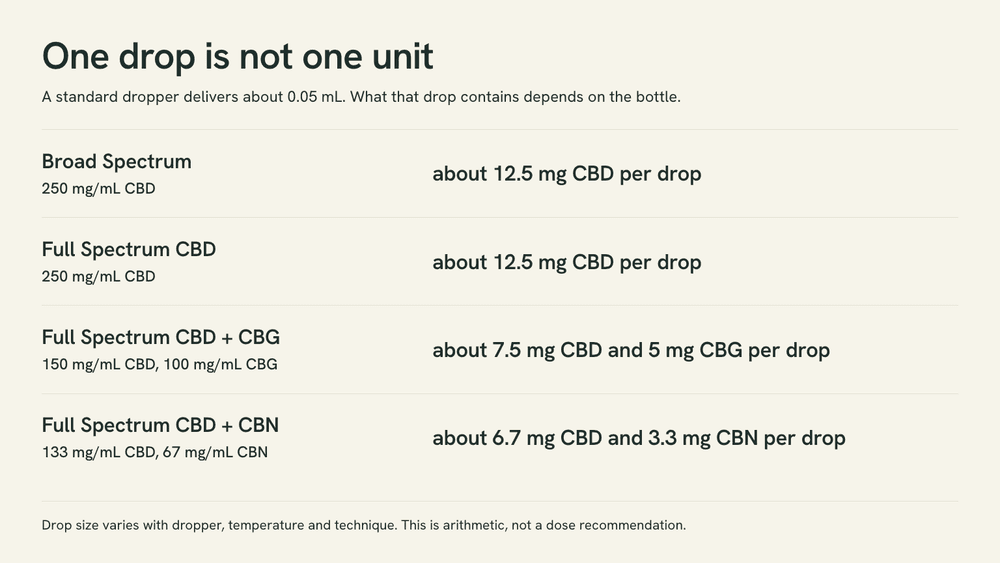
Technique and timing, in one pass
Technique matters less than the internet implies, and this page is not the place for it. In a participant-blinded randomized crossover, eight healthy men took the same 69 mg/mL hemp oil either as drops under the tongue or in capsules; peak plasma CBD came out at 24.0 against 28.0 ng/mL, time to peak was 4 hours both ways, and no comparison reached significance, with all p values at 0.25 or higher. With eight participants and a single product that is a small result, and the authors' own reading is that the oil is "swallowed before oral mucosal CBD absorption occurs". For the method itself, the technique that decides how much you absorb is the page that owns it.
Timing and food are the same story: pick one and hold it. A 2024 systematic review and meta-regression across 112 trial arms from 39 studies reported that fed status was associated with higher peak concentrations and higher total exposure, which points the opposite way from the familiar advice to take it on an empty stomach so it works faster. Because that is an association across very different studies rather than a controlled head-to-head, the useful move for a first fortnight is not to optimize it but to hold it constant and write it down, and the actual numbers from the individual trials are in taking it with or without food. If your question is when anything is expected to start and how long it lasts, that belongs to when it starts and how long it lasts.
Why fourteen days, and not thirty
Nearly every first-timer guide on page one says the same thing: hold the same amount for thirty days, because the CBD gradually builds in your system until it reaches a balance. That claim has been measured, and it does not hold.
A phase 1 randomized, double-blind, placebo-controlled trial included a multiple-dose arm: nine healthy adults per group taking 750 mg or 1500 mg of a pharmaceutical CBD oral solution twice a day. Its finding on accumulation is one sentence long.
“CBD reached steady state after approximately 2 days, with moderate accumulation (1.8- to 2.6-fold).”
Read the limits honestly. That was highly purified pharmaceutical CBD at amounts far above what consumers report taking, in nine people per arm, authored largely by the company developing the drug, and it is not a hemp tincture. It is still a direct measurement of what repeat dosing does, and it does not support the idea that blood levels keep climbing for a month.
The number usually quoted against this is the long half-life. The prescription cannabidiol label reports that the half-life of cannabidiol in plasma was 56 to 61 hours after twice-daily dosing for 7 days in healthy subjects, which sounds like slow accumulation until you notice that the same phase 1 trial reports an effective half-life of 10 to 17 hours. Terminal half-life describes the long tail of elimination, the part that matters once you stop. The effective half-life is what governs how fast levels stack up while you keep going. They are two numbers answering two different questions, and only the second one is about build-up. If clearance is your actual question, how long CBD stays in your system covers it.
So the case for fourteen days is not pharmacological. It is practical. A fortnight is long enough to contain a working week and a weekend, a couple of nights of bad sleep, at least one day you forget entirely, and the window in which the side effects a regulator actually names would be expected to appear. It is short enough that you will finish it. It is not long enough to settle anything about safety, which is the subject of the stop rules further down this page.
What is realistic to notice, and what your notebook cannot tell you
The single most useful thing a person about to keep a CBD diary can know comes from a study in which nobody received any CBD. In a randomized crossover with 43 healthy adults, participants put the same CBD-free hempseed oil under their tongue in two separate sessions. In one they were told it contained CBD; in the other they were told it did not. When they believed they had taken CBD, they reported more sedation, and their heart-rate variability shifted in a way the authors read as heightened anticipatory stress regulation.
The rest of that result is worth carrying too, because it is less tidy than the headline. Expectancy did not produce a systematic change in subjective stress or anxiety across the whole group; the participants who already believed CBD reduces anxiety were the ones who reported significantly less anxiety in the expectancy session. A 2024 replication in 48 healthy adults, this time randomly assigned between groups rather than crossed over, gave everyone the same CBD-free oil and told half of them it contained CBD; it found the same increase in reported sedation (p < 0.01), while its stress result was a trend that did not reach significance (p = 0.053), which means it is not a result. Both were single laboratory sessions with an acute stressor in healthy adults, and neither says anything about what CBD does, because neither administered any. How expectation shows up in stress research goes further into what that means.
For your fortnight this has a concrete consequence. Your notebook cannot separate the oil from the expectation, and you are not blinded, so the honest reading of any entry is "this is what I noticed under these conditions", never "this is what the oil did". That is a reason to record the conditions carefully, not a reason to stop recording. Some people notice nothing at all in two weeks, which is an ordinary outcome rather than a sign that something went wrong, and what people actually report feeling sets out the range people describe. Human evidence for most of the reasons people buy CBD is limited, and no honest starter guide can promise you a change by any particular day.
The side effects a regulator names, and why day 1 is not a driving day
The most common sentence on the beginner SERP is that CBD has no major side effects. The FDA names three, in the same consumer update quoted above, and introduces them as "side effects that you might notice".
- Changes in alertness, most commonly experienced as somnolence (drowsiness or sleepiness).
- Gastrointestinal distress, most commonly experienced as diarrhea and/or decreased appetite.
- Changes in mood, most commonly experienced as irritability and agitation.
- The agency adds that these side effects should improve when CBD is stopped or when the amount used is reduced. It attaches no rate and no denominator to any of the three.
That is an agency statement rather than a trial, and it does not separate a prescription product from a tincture. An NIH center's overview of cannabis and cannabinoids, which we reread on August 10, 2026, lists the same categories independently: "decreases in alertness, changes in mood, decreased appetite, and gastrointestinal symptoms such as diarrhea". The same page notes that over-the-counter CBD products may contain more or less CBD than stated on their labels, which is the day-0 gate arriving from a second direction. The full treatment of adverse effects is what to expect in the first two weeks, and the gut question has a page of its own: why CBD can loosen your stomach.
One practical consequence for day 1: do not plan to drive on it. The on-road trial usually cited is a double-blind randomized crossover in which 26 healthy occasional cannabis users drove 100 km on public roads after vaporized cannabis; lane weaving after a CBD-dominant preparation did not differ significantly from placebo at 40 to 100 minutes, a difference of -0.05 cm with a 95% confidence interval of -1.49 to 1.39. The authors wrote that the effect size "may not have excluded clinically important impairment, and the doses tested may not represent common usage", and the study used vaporized cannabis rather than an oral tincture in a small group of young occasional users, so it clears nothing. Separately, the prescription cannabidiol label instructs clinicians to monitor for somnolence and sedation and to advise patients not to drive or operate machinery until they have gained sufficient experience with it. Take the first one on an evening when you are not going anywhere.
The 14-day log
This is the part of the protocol that is actually yours. Seven columns, one row per day, on paper or in a note on your phone. The first four are conditions you are holding steady so that the last three mean something, and the design is the point: most first-timer diaries record only the outcome, which is precisely the column that cannot be interpreted on its own.
| Column | What goes in it | Why it is there |
|---|---|---|
| Date and time | Day 1 through day 14, and the clock time each time you take it | Timing is the variable people change without noticing. A routine is only a routine if the clock agrees |
| Product and batch | Which bottle, which flavor, and the lot number printed on the label | Switch bottles mid-fortnight and you have started a new trial. The certificate you verified covered one batch |
| Amount, in mg | Milligrams, converted from drops using your bottle's mg/mL figure. Not "one dropper" | Drops are not a unit. Milligrams is the number that transfers between bottles, between brands and to a clinician |
| With or without food | Fed, fasted, or roughly how long since you last ate | Fed status is associated with how much reaches your blood, which makes it a condition and not a detail |
| What you noticed within 2 hours | A short factual note, or the word nothing | "Nothing" is data. A blank row is not, and blanks are what make a log unreadable on day 15 |
| Sleep last night | Rough hours, plus wake-ups if you know them | Sleep drives how most people feel the next day. It is the confound first-timers most often miss |
| Anything else that changed | Caffeine, alcohol, travel, illness, deadlines, a new medication, a missed meal | This column is what stops you attributing an ordinary Tuesday to the oil |

On day 15, read it backwards. Start by counting the days you actually took it, because adherence is usually the first surprise. Then read the conditions columns before the outcome column: if the amount, the timing or the food status moved around, you ran several short experiments rather than one fortnight, and the honest conclusion is about your routine rather than about the oil. Look at the sleep column beside anything you noticed, since a run of short nights explains more day-to-day variation than most people expect. Anything that only shows up on days when something else also changed is not attributable to the CBD. And keep the milligrams column honest by converting from your bottle's concentration rather than counting droppers, which is what the per-drop math is for.
Stop rules, and the limits of a fortnight
A fortnight is a starting protocol, and it is worth being exact about what it does not establish. In 2025 the FDA's own Division of Applied Regulatory Science published a randomized, double-blind, placebo-controlled trial in 201 healthy adults, median age 36, who took a pharmaceutical CBD oral solution or placebo for 28 days. The registry for that trial records 151 people started on CBD and 50 on placebo. Eight participants in the CBD group had alanine aminotransferase or aspartate aminotransferase, two liver enzymes, above three times the upper limit of normal, against none in the placebo group. The paper puts that at 5.6% (95% CI, 1.8% to 9.3%), computed on a per-protocol analysis rather than on everyone who started, which is why the eight and the percentage do not divide into each other neatly. Seven met the study's withdrawal criteria for potential drug-induced liver injury, and they were picked up at day 21 in two cases and at day 28 in the other five.
The limits matter as much as the finding, and this page is not the place that settles them. The study drug was pharmaceutical CBD at 5 mg/kg per day, roughly 350 mg a day for a 70 kg adult, given to healthy volunteers taking nothing else, for 28 days. None of that transfers to a hemp tincture in either direction, and nobody should read it as either a warning about one or a reassurance about one. The hepatic question in full, including what the mouse headlines did and did not show, is handled in what the liver trials actually measured. The point for a fourteen-day plan is narrower, and it is the calendar. Every one of those signals appeared after a fortnight would have ended.
So the fourteen days come with two sets of rules, and they are different kinds of rule. The first set pauses the trial and starts a conversation. Pause and speak to a clinician if any of these is true.
- You take a prescription medication and you started without asking. Stop and ask now, before day 2, rather than at the end of the fortnight.
- Any of the three side-effect categories is bothering you: persistent drowsiness, diarrhea or loss of appetite, or a change in mood such as irritability or agitation.
- You are considering changing, skipping or replacing a prescribed medicine. That decision belongs to your prescriber and never to a log.
- You cannot tell what you took, because the amount, the product or the timing changed more than once. That is a reason to restart cleanly, not to push on.
The second set is not about the trial at all. The label of the prescription CBD medicine the FDA has approved tells prescribers to act on a specific short list of symptoms. That label covers a prescription antiseizure medicine dosed by body weight, usually in patients taking other antiseizure drugs, so it is not a claim about tinctures and the rates in it do not transfer. The list itself is a reasonable thing for any adult to know. Stop and seek medical attention if you notice:
- Unexplained nausea or vomiting.
- Pain in the upper right side of your abdomen.
- Unusual fatigue.
- Loss of appetite (the label's word is anorexia).
- Yellowing of the skin or eyes (jaundice), or dark urine.
If you took more than you meant to at some point in the fortnight, what happens if you take too much sets out what is and is not known about that. For the effects themselves rather than the decision rules, the fuller account of CBD's adverse effects is the page to read next.
Day 15: storage, restock and what to change
Whatever is left in the bottle, storage is what decides whether your next fortnight uses the same product you verified. Cool, dark, cap tight, upright, away from the stove and out of a hot car. A 60 mL bottle holds roughly 1,200 drops, so for most first-timers the question after two weeks is how to keep it well rather than where to buy another, and shelf life and storage covers what actually degrades in a tincture and how fast.
If you change something on day 15, change one thing. Switching the product, the flavor or the spectrum puts you back at day 0, because the certificate you checked belonged to one batch of one product, and the verification gate applies again. Changing the amount is a conversation to have with a clinician rather than with a search box, using your log as the evidence. If you are switching products, how to choose a CBD oil is the buying checklist, and if you want the ground-level explanation of what this compound is and is not, the full guide to cannabidiol is the hub this page sits under. Planntz publishes a per-batch certificate for every flavor at lab results, which is the document the day-0 gate asks for.
This page does not print a starting number, and the single-figure answers you will find on beginner pages, usually a milligram figure or a fraction of a dropper, are not answers to your question. A quarter of a dropper is not a unit of anything: it is a fraction of a container, and what that container holds in milligrams depends entirely on the concentration of the oil in it. The honest answer is that the right amount depends on your product's mg/mL figure and on everything else in your medicine cabinet, which makes it a conversation for a clinician rather than for a web page. What this page can give you is the measurement literacy that makes the conversation useful: convert your bottle's concentration into milligrams per drop, record milligrams rather than droppers, and take that number with you. Our CBD dosage guide is where the amount question itself is handled.
Not in the way that advice implies. The phase 1 trial that measured repeat dosing, a randomized, double-blind, placebo-controlled study with nine healthy adults per group taking 750 mg or 1500 mg of a pharmaceutical CBD oral solution twice daily, reported that CBD reached steady state after approximately 2 days, with accumulation of 1.8 to 2.6-fold. Those are amounts far above consumer use, in a pharmaceutical formulation, with nine people per arm, so treat the figure as the best available measurement rather than a precise prediction for a tincture. It is still enough to retire the idea that levels keep climbing for a month. The reason to run fourteen days is to observe a routine, not to wait for accumulation.
The common advice says empty stomach for faster effects, and the pooled evidence points the other way: a 2024 systematic review and meta-regression across 112 trial arms from 39 studies found fed status associated with higher peak concentrations and higher total exposure. Because that is an association across heterogeneous studies rather than a controlled head-to-head, it is not a reason to switch to taking it with meals, and it is a good reason not to treat "empty stomach" as an optimization. For a first fortnight, pick one condition, keep it the same, and record it in the log's food column so that it is a variable you know rather than one you guess at. Our article on taking CBD with or without food carries the actual exposure figures from the individual trials.
Some people report noticing something, some report nothing, and both are ordinary. Two randomized studies are worth knowing about before you interpret your own first evening. In the first, 43 healthy adults took CBD-free hempseed oil under the tongue in two sessions and reported more sedation in the session where they were told it contained CBD. A 2024 replication in 48 adults, this time randomly assigned between groups, found the same sedation effect. Nobody in either study received any CBD. That does not mean what you notice is imaginary; it means a single unblinded evening is weak evidence about a product, and it is why the log has a conditions column. Our article on what CBD feels like sets out the range of things people actually describe.
Plan not to on day 1. The on-road trial usually cited is a double-blind randomized crossover in which 26 healthy occasional cannabis users drove 100 km on public roads after vaporized cannabis: lane weaving after a CBD-dominant preparation did not differ significantly from placebo, and the authors wrote explicitly that the result may not have excluded clinically important impairment and that the doses tested may not represent common usage. It used vaporized cannabis rather than an oral tincture, in a small group of young occasional users. Separately, the prescription cannabidiol label tells clinicians to advise patients not to drive or operate machinery until they have gained sufficient experience with it, and drowsiness is one of the three side-effect categories the FDA names. Take the first one on an evening when you are not going anywhere. Laws on driving and cannabinoids vary by state and are not settled by a study.
Ask the person who prescribed it, before day 1. According to the prescribing information for the prescription CBD medicine the FDA has approved, cannabidiol is metabolized in the liver and the gut by CYP2C19 and CYP3A4 and by several UGT isoforms, which is the same enzyme machinery behind a lot of grapefruit warnings. A 2024 systematic review that screened about 4,600 reports found 31 in which cannabinoids changed a drug's levels or produced an adverse event, across 16 medications with a narrow therapeutic index, with warfarin, valproate, tacrolimus and sirolimus most represented. That is a count of what has been published, not a rate, and it is not a list of the only medicines that could matter. Bring the label and the batch certificate to your prescriber and let them decide. Our CBD and medications article is background reading, not the decision.
Then you have fourteen days of records about your own routine, which is information, and no verdict about CBD, which a fortnight was never going to produce. Human evidence for most of the reasons people buy CBD is limited, responses vary between people, and "nothing noticeable" is a common entry in an honest log. The reasonable options are to keep the record going without changing anything, to change exactly one variable and start a fresh fortnight, or to stop. The one thing not to do is escalate the amount because a web page told you to. If amount is the variable you want to change, that is a conversation with a clinician, and your log is the evidence you bring to it.
No product can guarantee a drug-test result. Standard workplace panels look for THC metabolites rather than for CBD, and full-spectrum products contain trace THC below the 0.3% federal limit, so residual risk exists whatever a label claims. Broad-spectrum batches can report non-detected THC on their certificate, which is a statement about that batch at that lab's detection limit, not a guarantee about a test on a given day. If a test matters to your job or your sport, settle the question before day 0 rather than during the fortnight, and read our article on what a drug test actually looks for first.
Start at the certificate, not the dropper
Every Planntz batch is tested by an independent lab and the certificate is published per flavor, with the full cannabinoid profile and the THC figure printed on it. That is the document the day-0 gate asks for, and it is the number your milligrams column depends on.
See the batch lab resultsWriting about hemp, wellness and the small rituals that keep us balanced.