The Best Time to Take CBD Oil: Morning, Night, and What Nobody Has Measured
Every page answers this with an hour and an outcome: morning for focus, night for sleep. Nobody has run that trial. Here is what is actually measured about CBD and timing, and a two-block test you can run.
Ask the internet what the best time to take CBD oil is and you get an hour with an outcome stapled to it: morning for focus, evening for sleep, afternoon for calm. There is a problem with that answer. Nobody has run the study. We searched PubMed on August 10, 2026 for cannabidiol together with terms for time of day, circadian timing and morning or evening dosing. The two searches returned 26 and 10 records, and none of them is a trial that gave people CBD in the morning and in the evening and compared the results.
So the honest answer to "what is the best time to take CBD oil" is a scheduling answer rather than a pharmacological one: take it at the time you can actually repeat, keep everything else about the serving the same, and judge a slot by whether you keep it. What has actually been measured about timing is narrower than the search results suggest, and more useful. The short version is directly below, and the rest of this page unpacks it section by section: what the approved label prints, what the one trial that dosed people twice in a day found, and why drowsiness and disturbed sleep sit in the same regulator-reviewed adverse-reaction table. If you want to compare two slots anyway, there is a two-block test further down, along with the rule about ignoring the first few days of each block.
The best time to take CBD oil, and why every page tells you something different
Start with why the advice is so confident and so contradictory. Two searches of the published literature, run on August 10, 2026, pair cannabidiol with the vocabulary a chronobiologist would use: time of day, chronopharmacology, circadian, morning versus evening, diurnal, dosing time, administration time, evening dose, morning dose. Between them they return 36 records. The human ones are about sleep architecture and about hormones, not about when to swallow a dose. The circadian-clock entries are cells, mice, rats and fruit flies. Not one is a trial that gave the same people CBD in the morning and in the evening and compared them. That is a search, not proof that no such data will ever exist, and it is the reason every page you read gives a different answer with the same confidence: when there is no measurement to disagree with, nothing constrains the guess.
Meanwhile the one document in this whole category that was reviewed by a regulator does print a schedule, and it is not an hour. The prescribing information for the cannabidiol oral solution the FDA has approved, in the label version dated May 29, 2026, instructs twice-daily dosing at every single step: 2.5 mg/kg twice daily to start in Lennox-Gastaut syndrome and Dravet syndrome, 5 mg/kg twice daily as maintenance, a maximum of 10 mg/kg twice daily, and up to 12.5 mg/kg twice daily in tuberous sclerosis complex. The hepatic-impairment table is twice daily at every tier. What that label never says, anywhere in the document, is morning, evening or bedtime. It is a prescription antiseizure medicine dosed by body weight for three seizure disorders, usually alongside other antiseizure drugs, and none of its amounts transfer to a hemp tincture. What does transfer is the shape of the instruction: the regulated version of this question is answered as how many times a day, not as which hour.
What a schedule actually changes, and what it does not
A schedule sits on top of two facts that most timing articles never mention. The first is that daily use settles fast. In the phase 1 trial that measured repeat dosing, nine healthy adults per group took a pharmaceutical CBD oral solution twice a day for six days, and plasma CBD reached steady state in about two days with moderate accumulation of 1.8 to 2.6-fold. That was highly purified pharmaceutical CBD at 1,500 to 3,000 mg a day, in nine people per arm, in a trial sponsored by the company developing the drug and written mostly by its employees, so it is the best available measurement of repeat dosing rather than a prediction about a tincture. For this page it establishes one premise, which the article's protocol depends on: after the first couple of days you are not dosing an empty tank, and the 14-day starter protocol covers what that means when you are beginning.
The number usually quoted against that premise is the long half-life: the approved label reports 56 to 61 hours after twice-daily dosing in healthy subjects, which sounds like something that would take a week to settle. It does not, because that figure describes the long tail of elimination, while the same trial's abstract reports effective half-life estimates of 10 to 17 hours, and it is the second number that governs how quickly levels stack up while you keep taking it. Clearance and detection are a separate subject, treated properly at how long CBD stays in your system.
The second fact is that the peak does not arrive when you take it. Section 12.3 of the approved label reports a time to maximum plasma concentration of 2.5 to 5 hours at steady state, and the phase 1 trial's day 7 median was 3 hours in both of its dose arms. Both figures describe a pharmaceutical oral solution that is swallowed, not an oil held under the tongue, and a sublingual product's absorption profile can differ, so read them as the shape of a curve rather than as your curve. As a scheduling fact it is still worth having. Whatever the day's highest blood concentration is doing, it is doing it a few hours after the serving, which makes "take it right before bed" a scheduling assumption rather than a plan. What that means for when anything is felt and how long it lasts is a separate question, answered at how long it takes to feel anything.
There is one timing instruction a regulator does print, and it is not about the clock. Section 2.4 of the label, the administration instructions, opens on food: "Food may affect EPIDIOLEX levels", followed by the sentence that does the work, "Consistent dosing of EPIDIOLEX with respect to meals is recommended to reduce variability in cannabidiol plasma exposure." Consistency, not maximization, and consistency relative to meals rather than to an hour. That is an instruction for a prescription medicine rather than advice for a supplement, and the actual exposure figures behind it belong to what a meal does to absorption, which carries every multiplier this page deliberately does not print.
| The variable | What has actually been measured | What it means for your schedule |
|---|---|---|
| The hour itself | Nothing. Two PubMed searches on August 10, 2026 returned 26 and 10 records and none compared morning with evening administration in people | Choose the hour on grounds other than pharmacology, because there are none available |
| Repeat daily use | In the phase 1 multiple-dose arm, nine healthy adults per group on a pharmaceutical oral solution twice daily reached steady state in about 2 days, accumulating 1.8 to 2.6-fold | After the first couple of days, a serving lands on top of what is already there |
| When the peak arrives | The approved label reports a time to maximum plasma concentration of 2.5 to 5 hours at steady state, for a swallowed oral solution | The peak of that product is hours away from the moment of the serving, not at it |
| Food, relative to the serving | The label instructs consistent dosing with respect to meals to reduce variability in exposure. It does not instruct you to maximize absorption | Pick fed or fasted and keep it. The numbers live on the food article, not here |
| How many servings a day | Across 76 electronically monitored studies of prescription medicines, dose-taking compliance fell from 79% at once a day to 51% at four, with no significant difference between once and twice | The count is the part of a schedule with real data behind it. The hour is not |
| Whether the routine survives | In one randomized study of 48 students performing a daily stretch, the morning group's behavior became automatic sooner than the evening group's | A cue you already have beats an hour you have to remember. That is a habit finding, not a CBD finding |
The one time an evening dose was measured against a morning dose
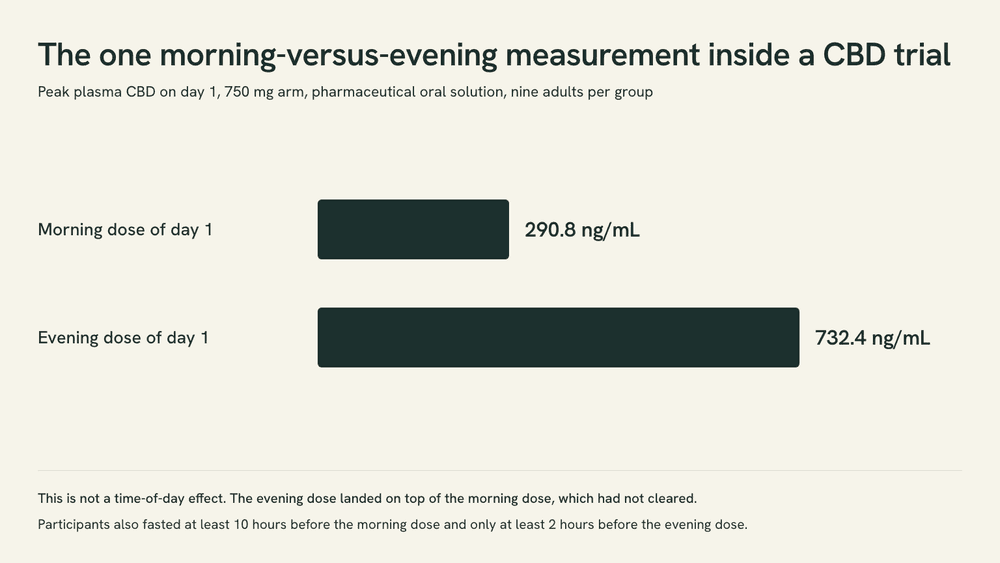
The closest thing anyone has to a morning-versus-evening measurement of CBD comes from a trial that was not asking the question. In the multiple-dose arm of that same phase 1 study, healthy adults took 750 mg or 1500 mg of the pharmaceutical oral solution twice a day, and the morning and evening doses of day 1 were sampled separately, so the same people took the same amount at two times of day and somebody measured the blood. If a time-of-day effect were going to show up anywhere, it would show up here. It looks enormous, and the paper tells you why it is not what it appears to be.
“There was also accumulation between the initial morning and evening CBD doses; on the evening of day 1, versus the morning of day 1, Rac increased by 2.9- and 6.3-fold after 750 and 1500 mg CBD, respectively.”
Rac is the accumulation ratio, a measure of how much more of the drug is around at a later dose than at the first one. In the 750 mg arm the numbers underneath it are equally stark: peak plasma concentration of 290.8 ng/mL after the morning dose of day 1 against 732.4 ng/mL after the evening dose of the same day, and a median time to peak of 5.00 hours in the morning against 2.50 hours in the evening. Same people, same amount, same day, roughly twelve hours apart, and the evening serving looks like a different drug. Every vendor page that tells you evening is stronger could, in principle, point at this. None of them do, and they should not.
Two things are wrong with reading that as a time-of-day effect, and both are in the paper. First, the authors attribute it to accumulation: the evening dose landed on top of the morning dose, which had not cleared, so the evening measurement includes the morning one. That is not the hour doing something, it is arithmetic. Second, the protocol fasted participants for at least 10 hours before the morning dose and only at least 2 hours before the evening dose, so the two conditions differed in fast length as well as in clock time, and food is the one variable in this whole area with well-documented effects on CBD exposure. A phase 1 unit with continuous sampling, a fixed protocol and a pharmaceutical formulation could not cleanly separate the hour from everything else in a single day. That is the real lesson, and it is the reason the test at the end of this article runs in blocks of a week instead of comparing a morning day against an evening day.
"Morning for focus, night for sleep" is a marketing split, not a finding
The split is everywhere in this category and it always has the same two halves. Morning CBD is described as clearing brain fog and setting you up for the day. Evening CBD is described as sedating, usually with a rider that higher amounts are more sedating, which conveniently explains why you should take more of it at night. Neither half is sourced on the pages that print it, and the SERP result with the most medical authority opens by stating that current evidence does not suggest there is a best time and then spends four sections assigning outcomes to hours anyway. You can retire both halves with a single table that a regulator has already reviewed.
The approved label's pooled safety table covers three controlled trials in Lennox-Gastaut syndrome and Dravet syndrome: 75 patients at 10 mg/kg/day, 238 at 20 mg/kg/day and 227 on placebo, most of them taking other antiseizure medicines. Somnolence appears in 23% of the 10 mg/kg/day arm, 25% of the 20 mg/kg/day arm and 8% of placebo. In the same table, from the same patients, a cluster reported as insomnia, sleep disorder and poor quality sleep appears in 11% of the 10 mg/kg/day arm, 5% of the 20 mg/kg/day arm and 4% of placebo. Both directions, one table. Notice too that the sleep-disturbance cluster does not rise with the amount given, which is one more reason not to read an adverse-reaction table as a dose-response curve for sedation. Section 5.2 of the same label pools somnolence and sedation including lethargy into a different composite from that table row, and reports that composite in 46% of patients also taking clobazam, a benzodiazepine, against 16% of those not taking it. The two figures are not comparable to the 23% and 25% above and should not be read as the same measure. The modifier the label itself singles out there is another drug, not an hour.
None of this means an evening routine is a bad idea. Plenty of people schedule a serving as part of a wind-down, and there is nothing wrong with that as a routine choice. It does mean the schedule is not doing the work the marketing claims. Whether CBD changes sleep at all is a separate question with its own evidence base and its own limits, set out in what the sleep evidence does and does not show, and the drowsiness question in general belongs to the side effects worth knowing about. The same applies to blends: a CBD and CBN oil is commonly scheduled in the evening because CBN is the cannabinoid people associate with night-time, but human evidence on CBN is limited, so treat that as a routine convention rather than a mechanism. What CBN actually is covers what is and is not known.
Once a day or twice? The scheduling question that has real data
This is the version of the timing question that can actually be answered, partly because the regulated product answers it. Every dosing line in the approved cannabidiol label is twice daily, and the phase 1 trial that measured the pharmacokinetics concluded, in its abstract, that "the safety and PK profile support twice-daily administration of CBD". Read that with its limits attached: it is a conclusion about a pharmaceutical oral solution at 1,500 to 3,000 mg a day in an epilepsy development programme, and the paper's discussion adds that twice-daily dosing was also consistent with the schedules of the other antiseizure drugs those patients were taking. It is not experts recommending that you take a tincture twice a day, and it is not a finding about hemp products at all.
The other half of the answer comes from a literature nobody in this category cites: adherence research. A systematic review of 76 studies that used electronically monitored pill bottles, published in 2001 and covering trials from 1986 to 2000, found mean dose-taking compliance of 71%, and it fell as the schedule got busier: 79% for once-daily regimens, 69% for twice-daily, 65% for three times a day and 51% for four, a difference that was significant across schedules. The comparison people actually face is the first one, and there the review found no significant difference between once daily and twice daily. Worth knowing about that review: none of those studies involved CBD, they measured prescription medicines, the technology is bottle-cap monitoring from the 1990s, and the first author worked in health outcomes research at Eli Lilly. It is also the closest thing to real data that this question has, and it points somewhere sensible. Dose-timing compliance, meaning taking it inside the prescribed window rather than merely taking it, averaged 59% across the 14 studies that reported it.
- What splitting changes: how many chances a day you have to forget. In the adherence review, once-daily and twice-daily regimens were close, and everything above twice daily was noticeably worse.
- What splitting changes: the size of each serving. Half an amount produces a smaller peak than the whole amount, in principle. What that difference does for anything a person would notice has not been measured for a consumer CBD product.
- What splitting changes: how many conditions you have to hold steady if you ever want to test something, since each serving carries its own clock time, food state and technique.
- What splitting does not change: your total for the day, as long as you divide the same amount rather than adding a second serving on top of the first one.
- What splitting does not change: which hour is better, because nobody has compared them.
- What splitting does not change: whether CBD does anything for the reason you bought it. That question has its own limited and mixed evidence, and a schedule cannot answer it.
One boundary, deliberately: this page never tells you how much. Splitting the same daily amount into two servings is a scheduling choice, and the size of that amount is a different decision that depends on your product's concentration and on everything else you take, which is why it belongs in how much to take and in a conversation with a clinician. If you are converting drops into milligrams so that "the same amount" means something you can write down, what one drop of your bottle actually holds does the arithmetic, and the technique itself is a page of its own.
Anchor to a cue, not to an hour
If a schedule's real job is to be repeatable, then the interesting question is not which hour works but which slot survives contact with your life. There, one randomized morning-versus-evening comparison does exist, and it is not about CBD. In a 90-day randomized study of 48 students, participants were assigned to perform the same daily stretching exercise either on waking or just before bed, and rated the automaticity of the behavior every day. The morning group's behavior became automatic sooner: extrapolating the learning curves put automaticity at 105.95 days for the morning group against 154.01 days for the evening group, with salivary cortisol at the time of performance acting as a significant mediator. The limits are large and they matter. It is 48 students, one stretching exercise, nothing to do with cannabidiol, and both headline figures are extrapolations beyond the 90-day window the study actually observed. Read it as a finding about habit formation, not as a reason to take anything in the morning.
What survives from it is a practical idea that costs nothing to test: attach the serving to something you already do without deciding to do it, rather than to a number on a clock. An hour is a reminder you have to keep responding to. A cue is a thing that happens anyway. This also happens to satisfy the one instruction a regulator prints, because most existing daily cues are already fixed relative to meals, which is what the label asks for. Here are the anchors worth considering, none of which come with a promised outcome.
- Brushing your teeth. It already happens, it already happens in the same place, and it already happens twice a day if you are splitting a daily amount.
- Your first meal of the day, whichever meal that actually is. Anchoring to the meal instead of the hour also keeps the food state consistent, which is the label's own instruction.
- Closing the laptop at the end of the working day, or putting your keys down when you get home, if the slot you are testing is an evening one.
- Alongside a medicine you already take at a fixed time, but only after the person who prescribes it has told you the combination is fine. That is a clinical question, not a scheduling one.
- Not "in the morning". An hour is not a cue, and a schedule you have to remember is the one that quietly drifts by ninety minutes over a fortnight.
The 7-day timing test: change one thing, wait out the carryover
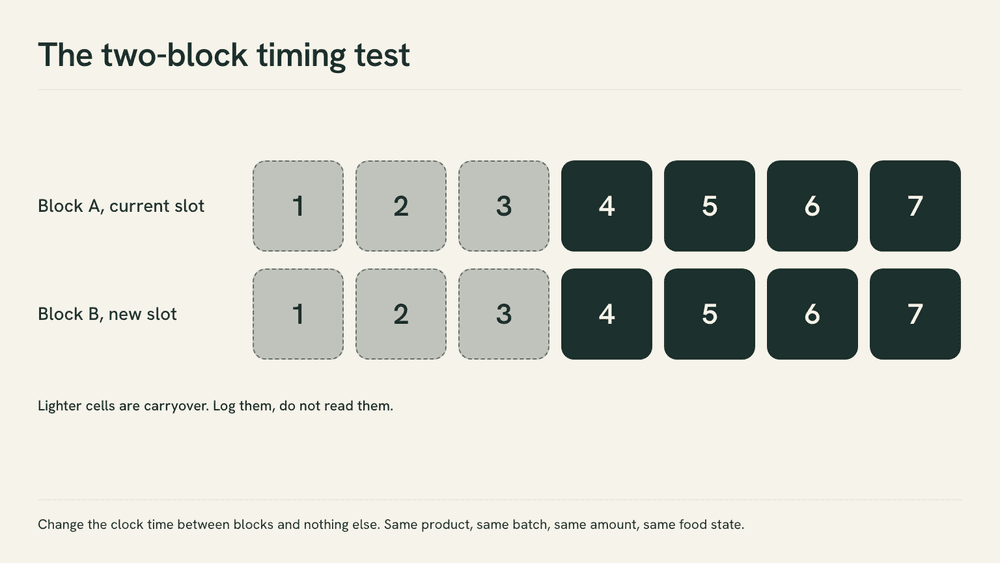
If you still want to know whether a morning slot or an evening slot suits you better, you can find out. Not by trying one on Tuesday and the other on Wednesday, which is the design every timing article implies and the one thing the pharmacokinetics rules out. Two facts from earlier decide the shape of this test. Plasma levels reach steady state in about two days on repeat dosing, so a schedule needs a few days before it is the schedule you are testing rather than the one you left. And a dose given later in the day sits on top of the earlier one, which is precisely what made the only morning-versus-evening measurement in the literature unreadable. So the test runs in two blocks of seven days, and the first two or three days of each block are carryover you do not read.
| Column in your log | What goes in it | Why it is there |
|---|---|---|
| Day and block | Day 1 to 7 of block A (your current slot), then day 1 to 7 of block B (the new slot) | Days 1 to 3 of each block are carryover from the previous schedule and are recorded but not read |
| Clock time | The actual time you took it, to the nearest 15 minutes | This is the variable under test. If it drifts by an hour, there is no test, only two similar weeks |
| Food state | How long since you last ate, or which meal it was and roughly how heavy | The label's own instruction is consistency with respect to meals. Fast length was one of the two confounds in the trial data |
| Same amount? | Yes or no. If no, write what changed | If this moved, the block is void. How large the amount should be is not decided here |
| Same product and batch? | Yes or no, plus the lot number if you switched | A different bottle is a different trial. Concentration and cannabinoid profile vary between products and between batches |
| Sleep, caffeine and alcohol | Rough hours slept the night before, and whether you had caffeine or alcohol that day and roughly when | These are the three alternative explanations for a good day or a bad one, and two of them have documented interactions with CBD |
| What you noticed, and when | Free text, with the hour attached to it. The word nothing is a valid entry | An hour stamp is what makes a timing log a timing log. A note with no time in it cannot answer a timing question |
- 1Run block A for seven days at your current time, logging every column even though nothing has changed yet. This is the comparison, and it is worthless if you only start writing when things get interesting.
- 2Move to the new slot and run block B for seven days. Change the clock time and nothing else: same product, same batch, same amount, same technique, same food state relative to the serving.
- 3Do not read days 1 to 3 of either block. Levels from the previous schedule are still in the picture, and the first days of any change are also the days you are most likely to be paying unusual attention.
- 4If something unplanned happens (a new medicine, a new bottle, a week of broken sleep, a stomach bug), the block is void. Note it and restart the block rather than reasoning around it.
- 5If you miss a serving, write it down instead of correcting for it. A missed day is direct data about whether the schedule is one you can keep, which is the actual question.
- 6At the end, read the two blocks side by side, days 4 to 7 against days 4 to 7. You are comparing eight logged days, which is enough to see a pattern in your routine and nowhere near enough to establish a fact about a compound.
Be clear about what this can and cannot tell you. It answers a preference: which slot you can keep, and what you noticed under conditions you actually wrote down. It cannot tell you whether CBD is doing anything, because one person, unblinded, is not a trial, and expectation is measurable in exactly this kind of setting: in a randomized crossover in which 43 healthy adults were given CBD-free hempseed oil in both sessions, being told it contained CBD was associated with increased sedation, and nobody in that study received any CBD. That is not a reason to skip the log, it is the reason the conditions columns exist. If you are still in your first fortnight, start from the fourteen-day log this test is modelled on rather than from this one, and if caffeine is one of your daily variables, CBD and caffeine explains why it is worth a column of its own.
When timing stops being a preference and becomes a medical question
Most of this article is about preference, because most of the question is preference. Two situations are not. The first is drowsiness around anything that requires attention: section 5.2 of the approved cannabidiol label tells prescribers to "monitor patients for somnolence and sedation" and to "advise patients not to drive or operate machinery until they have gained sufficient experience on EPIDIOLEX". That instruction covers a prescription medicine rather than a tincture, and it is neither a finding that CBD impairs driving nor a reassurance that it does not. It is a reasonable thing to know before you move a serving to a new part of the day. The federal health agency's consumer page on cannabis and cannabinoids, which we reread on August 10, 2026, names the same category in its own words: "CBD may have side effects, including decreases in alertness, changes in mood, decreased appetite, and gastrointestinal symptoms such as diarrhea." Decreases in alertness is the one timing-relevant item a regulator actually lists, and it is listed without an hour attached.
- You take a prescription medicine and you are moving CBD closer to it, or further from it. Timing around a prescription is a question for the person who writes it, not for a schedule you found online.
- You are unusually drowsy the day after a change, or the drowsiness has not lifted by the afternoon. Stop changing variables and talk to a clinician.
- The day you are testing includes driving, machinery, or safety-critical work. Move the test, not the shift.
- You are adding an evening serving on a night you will also be drinking. That combination has its own limited evidence and is not a scheduling detail.
- Your sleep gets worse rather than better after moving a serving. Disturbed sleep sits in the same adverse-reaction table as drowsiness, so it is a documented direction, not a sign you are imagining things.
- You are under 21, pregnant, trying to conceive, or breastfeeding. None of those are scheduling questions and none of them are answered on this page.
The background reading for that conversation, which is background reading and not the decision, is CBD and prescription medicines. If the evening question involves alcohol, what is known about CBD and alcohol is honest about how little has been measured. And for the effects themselves rather than the scheduling of them, what people actually report is the fuller account.
What is still unknown
The largest unknown is the question this article is named after. No trial has compared morning with evening administration of CBD in people, and our searches on August 10, 2026 are a search rather than a proof: a study could exist under vocabulary we did not use, or could be published next month. What can be said is that the comparison is not sitting in the literature waiting to be quoted, which means every confident answer you have read was assembled from something else. The nearest measurement inside a CBD trial is confounded by carryover and by fast length, in nine people per arm, on a pharmaceutical oral solution at amounts far above consumer use. The nearest randomized morning-versus-evening comparison of any kind is about 48 students and a stretching exercise, with its two headline figures extrapolated past the window that was observed. The adherence data is from prescription medicines monitored between 1986 and 2000. Every one of those is a load-bearing borrowing, and it is worth knowing which parts of the answer are borrowed.
Two smaller unknowns matter for how you read your own results. The time-to-peak figures on this page describe a swallowed pharmaceutical oral solution, and how a sublingual tincture's curve compares has not been settled by anything we would print here. And individual variation in CBD exposure is wide enough that group averages are a poor guide to one person, which is the honest reason a self-test is worth running even though it can never be conclusive. Human evidence for most of the reasons people take CBD is limited and mixed, and no schedule changes that. If you want the ground-level version of what this compound is and is not, the full guide to cannabidiol is the hub this page sits under.
Nobody has measured it. We searched PubMed on August 10, 2026 for cannabidiol together with terms for time of day, circadian timing and morning or evening dosing; the two searches returned 26 and 10 records, and none of them gave people CBD in the morning and in the evening and compared the results. The closest randomized morning-versus-evening comparison in the literature is not about CBD at all: 48 students performing the same daily stretch, where the morning group's behavior became automatic sooner, at an extrapolated 105.95 days against 154.01 days. Both of those figures are extrapolated beyond the study's 90-day observation window, and it is a finding about habit formation rather than about cannabidiol. The practical answer: choose the slot you can repeat, keep the rest of the routine steady, and do not expect an hour to produce an outcome.
Twice daily is the only schedule the FDA-approved cannabidiol medicine uses. Every dosing instruction in that label, from the starting step to the maximum and through the hepatic-impairment table, is twice daily, and the phase 1 trial behind it concluded that its safety and pharmacokinetic profile support twice-daily administration. Those are statements about a prescription oral solution dosed by body weight for seizure disorders at amounts far above consumer use, and the trial's discussion notes that twice daily also matched the other antiseizure drugs those patients took, so it is not a recommendation for a tincture. Separately, a systematic review of 76 electronically monitored studies of prescription medicines found no significant difference in dose-taking compliance between once-daily and twice-daily regimens, while three and four times a day were clearly worse. None of those studies involved CBD. How large the daily amount should be is a different question, answered in our CBD dosage guide.
There is no honest way to promise either answer. In the pooled controlled trials behind the approved cannabidiol label, somnolence was reported by 23% of patients at 10 mg/kg/day (75 patients), 25% at 20 mg/kg/day (238 patients) and 8% on placebo (227 patients), while a cluster of insomnia, sleep disorder and poor quality sleep was reported by 11%, 5% and 4% of those same arms. Both directions appear in one dataset, at weight-based doses in patients with severe seizure disorders who were mostly taking other antiseizure medicines, which is not a hemp tincture. The federal health agency's consumer page separately lists decreases in alertness among CBD's possible side effects. The reasonable precaution is the one on the prescription label: do not plan a schedule change for a day when you have to drive or operate machinery.
For the product itself, the instruction that exists concerns meals rather than the clock. The approved cannabidiol label states that food may affect its levels and that consistent dosing with respect to meals is recommended to reduce variability in plasma exposure. For you, inconsistency has a second cost: it makes your own observations unreadable. In the one CBD trial that dosed people twice in a day, the evening dose measured far higher than the morning dose, and the paper attributes that to accumulation from the earlier dose plus a shorter fast before the evening one. If your timing wanders, those same confounds are running loose in your own log. Pick a slot, hold it for a week at a time, and write down the food state. Our article on taking CBD with or without food carries the exposure numbers.
There is no evidence-based interval, and the pharmacokinetics make the usual assumption worth questioning. The approved label reports a time to maximum plasma concentration of 2.5 to 5 hours at steady state, and the phase 1 trial's day 7 median was 3 hours in both of its dose arms. If that curve applied to your product, a serving taken at bedtime would peak in the middle of the night rather than as you fall asleep. Two caveats, both important: those figures describe a pharmaceutical oral solution that is swallowed rather than an oil held under the tongue, and a blood concentration is not a feeling. For when effects are reported to start and how long they last, see our article on how long CBD takes to work, and for what the sleep research does and does not show, see our CBD and sleep article.
It is commonly scheduled that way, and that is a convention rather than a mechanism. CBN is the cannabinoid people associate with night-time, but human evidence on CBN is limited, and no trial has compared taking a CBN blend in the evening against taking it in the morning any more than one has for CBD. If an evening slot suits your routine, taking a blend then is a reasonable scheduling choice; what it is not is a reason to expect a specific outcome from the hour. Our article on what CBN is covers the current state of the evidence, and our CBD and sleep article covers the efficacy question those blends are usually bought for.
Nothing in the literature supports swapping one for the other. There is no trial comparing morning CBD with morning caffeine, no trial comparing morning CBD with evening CBD, and the claim that CBD is energizing in the morning is not attached to a source on the pages that make it. What is documented points the other way if anything: somnolence appears in the approved label's adverse-reaction table, and decreases in alertness are listed by the federal health agency. Worth knowing separately: there is a measured pharmacokinetic interaction between CBD and caffeine in people, so the two are not independent if you take both. Our CBD and caffeine article covers what that interaction is and what it is not.
One bottle, one batch, for both blocks
A timing test only works if everything except the clock stays still, and that includes what is in the bottle. Every Planntz batch is tested by an independent lab and the certificate is published per flavor, with the full cannabinoid profile and the THC figure printed on it, so you can confirm that the lot you started block A with is the lot you are still using in block B.
See the batch lab resultsWriting about hemp, wellness and the small rituals that keep us balanced.