How Long Do the Effects of CBD Last? Nobody Has Measured It
The 2 to 6 hour range on page one has no study behind it. No controlled trial reports how long a subjective CBD effect lasts at consumer amounts, and the two trials that sampled out to four and eight hours found nothing to time at oral doses.
You took something an hour ago and you want to know when the window closes, so you can plan the rest of the day. Ask how long do the effects of CBD last and you will be handed a number within seconds: 2 to 6 hours, or 6 to 8 for a gummy. We went looking for the study behind those numbers and could not find one. As far as we can tell, no controlled trial has ever reported how long a subjective CBD effect lasts at the amounts people actually take.
This page answers one clock and hands the others away. It is about how long you notice anything after a single serving. It is not about onset, not about how long CBD is measurable in your blood, and not about drug tests. Every source and every count here is dated to our own reading on September 12, 2026. There are no Planntz milligrams on this page and no timing instructions, and there is a callout further down explaining why.
Four clocks get called "how long does CBD last"
The question sounds like one question and it is four, which is most of why the answers on the internet contradict each other. How long before you notice anything is onset. How long you keep noticing it is duration of subjective effect. How long the molecule is in your plasma is a half-life. How long a laboratory could find it is detectability, and that one depends on the assay rather than on you. Three of those four have a real literature. Our page on how long CBD stays in your system carries the third and fourth, and its own table names the first row and then declines to answer it, in these words: "Effects can fade before every molecule or metabolite is eliminated." This page picks that row up.
| The question | What it measures | Where it is answered |
|---|---|---|
| When do I stop noticing anything? | A subjective experience after a single serving | This page. The honest answer is that nobody has measured it. |
| How long before I notice anything? | Onset, from taking it to the first change | Our onset guide, which keeps the by-format short answer. |
| How long is CBD in my blood? | Plasma concentration and terminal half-life, in ng/mL | Our page on how long CBD stays in your system. |
| Would a drug test pick it up? | Detectability in a specific assay, at a specific cut-off | The same page. No detection window is published here. |
What page one prints, and where it disagrees with itself
We read the five results at the top of this search on September 12, 2026 and pulled out every duration figure and every citation attached to it. Not one duration-of-effect figure on any of the five traces to a study. Two of them attach the range to the word relief, which is a therapeutic claim about a product. And two of them contradict themselves inside a single article, which is the tell. Both of those self-contradictions are in the table below, in the middle column. Nobody notices the collision, because nobody is checking a figure against anything.
| Page | What it prints | Source given for it |
|---|---|---|
| Medterra | Tinctures 4 to 8 hours, edibles 8 hours or more, a general 4 to 8 hours | None for the effect ranges. Pharmacokinetic figures from a review sit beside them. |
| Orange County CBD | Vaping 2 to 4 h, sublingual 6 to 8 h, capsules and edibles 6 to 12 h, topicals 2 to 6 h | One citation, to a clinic blog, not to a study. |
| Supanaturals | Tinctures 12 to 25 hours and CBD oil 2 to 4 hours, in the same article | A 4 to 8 hour figure attributed to an unnamed trial of 24 volunteers. |
| MDBioWellness | Oils and tinctures 4 to 6 hours and tinctures 12 to 25 hours, in the same article | General links to Harvard Health, FDA and NCBI. None validates a duration. |
| Healthline cluster | Two to six hours for most people | No study attached to the range. |
Now the part we owe you. That range is so standard that it is on retailer pages, on health portals, and, until this article, in the duration column of our own guide to how long CBD takes to work. We could not source it either, which is why we went looking. That page keeps onset, where it does have evidence, and we have logged a correction to its duration column so the two pages stop disagreeing. We are telling you this rather than quietly editing it, because a page that audits everyone else's unsourced number and hides its own is worth nothing.
How long do the effects of CBD last? What has been measured in people
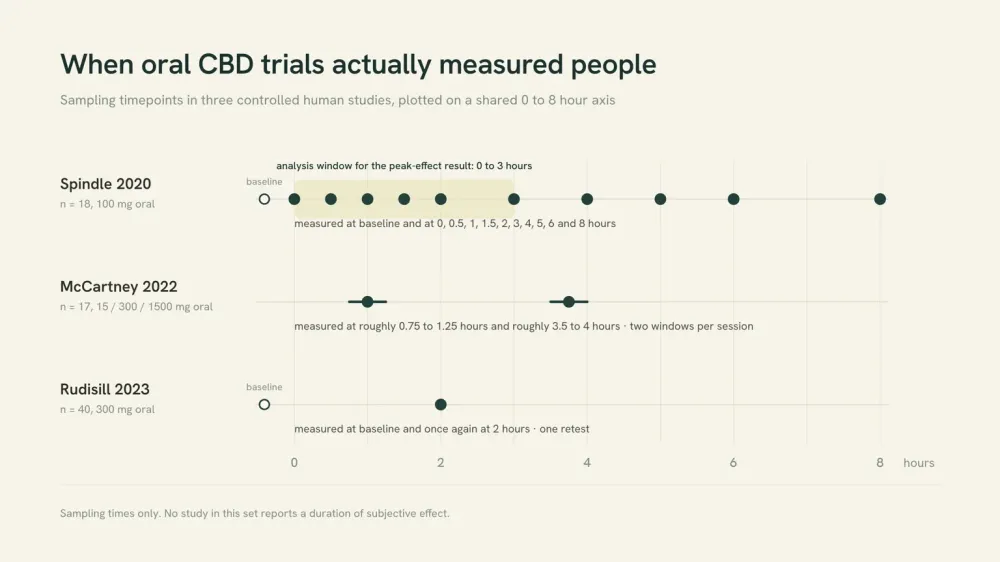
The best-designed look at what CBD feels like is a 2020 crossover trial run at the Johns Hopkins Behavioral Pharmacology Research Unit. Eighteen healthy adults, nine men and nine women, infrequent cannabis users, came in for four sessions at least a week apart. In each session they got one of the following: 100 mg of oral CBD, 100 mg of vaporized CBD, vaporized CBD-dominant cannabis containing 100 mg CBD and 3.7 mg THC, or a placebo. It was randomized, double-blind and double-dummy. Outcomes were collected at baseline and at 0, 0.5, 1, 1.5, 2, 3, 4, 5, 6 and 8 hours after dosing. The finding, in the authors' words: "Subjective effects did not differ between oral CBD and placebo." The two vaporized conditions did raise ratings on several subjective items relative to placebo. So at eight hours of sampling, the oral arm gave the researchers nothing to time.
Read that boundary carefully before you read anything into it. The endpoint was acute subjective drug effect, in 18 people, in a laboratory, at 100 mg, once, in participants who rarely used cannabis and were often taking CBD for the first time. That is not a test of whether a daily routine does anything for anyone, and the authors do not claim it is. It does mean that if you swallowed something and felt no clear change, you are describing the same result the trial got, which is worth knowing before you decide your bottle is defective. What CBD actually feels like is a longer conversation than this page can hold.
A second trial sampled late and used a genuinely consumer-sized amount. In a 2022 randomized, double-blind, placebo-controlled crossover study in the Journal of Psychopharmacology, 17 healthy adults took oral placebo or 15, 300 or 1500 mg of CBD, each dose given in oil inside a high-fat drink, and were assessed twice per session: at roughly 45 to 75 minutes and again at roughly 210 to 240 minutes. Across all three doses and both windows, in the authors' words, "No dose of CBD impaired cognition or induced feelings of intoxication." Fifteen milligrams is a realistic consumer amount, four hours is deep into the window everyone claims to know about, and there was still nothing to time. The endpoints there were impairment and intoxication, so this is not a finding about wellbeing, and it is not a finding about a Planntz product.
Why even those trials do not hand you a duration
Here is the part that explains the whole hole in the literature. The Johns Hopkins team collected data out to eight hours, and then, when calculating their result, threw most of it away on purpose. Their methods section says so plainly.
“When calculating peak effects, values occurring > 3 h after drug administration were excluded, as data beyond this period would likely be influenced by participant fatigue, boredom, or other factors.”
That is not sloppiness. It is a sound design choice for the question they asked, which was how strong, not how long. Ratings collected at hour six in a laboratory are contaminated by sitting in a laboratory for six hours, and if your endpoint is peak intensity you are right to cut them. The consequence is just that the best subjective-effects data we have is structurally incapable of producing a duration.
The shape of the rest of the field is the same. In a 2023 randomized feasibility trial in Fundamental and Clinical Pharmacology, 40 healthy college students, 21 on CBD and 19 on placebo, took a single 300 mg dose of CBD oil, completed a battery of sleepiness, mood, reaction-time and attention tests, and then retook them once, 120 minutes later. Self-reported anxiety did not change. Both groups scored higher on sleepiness and on physical and mental sedation afterwards, and tranquility scores did not move for either group. Whatever was happening at hour four was not on the protocol, because the protocol ended at hour two. Multiply that design across a literature and you get a field that has never had the chance to observe an ending.
Where the 2 to 6 hour number probably came from
We cannot prove the origin of a figure nobody cites. We can show you the three things that most plausibly got mistaken for it, because all three are sitting in plain view on the same pages that print the range.
- 1A plasma curve read as a feelings curve. A blood level rises, peaks and falls, and that shape is very easy to read a sensation off, even though it is a milligram-per-litre measurement in a tube.
- 2Elimination data relabelled. Two of the five page-one articles lift plasma persistence figures out of a pharmacokinetics review and print them inside a table headed how long the effects last. Those are different quantities.
- 3An onset figure read backwards. Where a page states how long a format takes to start working, a duration figure usually sits beside it with no separate origin, as though the second followed from the first.
Take the first one literally for a moment. In the phase 1 trial behind the prescription CBD oral solution, the median time to peak plasma concentration in the 750 mg twice-daily arm was 5.00 hours on the first morning. There are nine people in that arm, they were fasted, and the product is a pharmaceutical formulation dosed far above anything sold as a supplement. Nothing about that figure transfers to a tincture, and it is a concentration measurement in any case: it tells you when the blood level was highest, not when anybody stopped noticing anything. Read a five next to the word hours often enough and it becomes a folk fact.
The second one is a description of the whole field. The 2018 systematic review of human CBD pharmacokinetics in Frontiers in Pharmacology pulled together 24 human studies and reported bioavailability of 31 percent following smoking, noting that no other study had attempted to report absolute bioavailability by any other route in humans, and highlighting what the authors call the paucity of data. One of its co-authors was at Artelo Biosciences, a cannabinoid drug developer, at the time, which is worth knowing. A pharmacokinetics review has no reason to report a felt duration, so its silence is context rather than proof. But the endpoints in this field are Cmax, Tmax and AUC, and a duration of experience is simply not among them. Search the literature for the words how long and cannabidiol together and you get exactly one paper title, from 2023, pooling three clinical trials and 32 participants, and its question is how long a single oral dose persists in plasma. Not one of those 32 people was asked when they stopped noticing anything. Its numbers belong to the sibling page linked above, not to this one.
Three things that genuinely move your window
Refusing to invent a number is not the same as having nothing to say. Three variables demonstrably change your exposure, and exposure is the only part of this that has actually been measured. Two of the three have their own pages here, and that is where their numbers live: taking CBD with food carries the controlled food-effect trial, and when in the day to take it carries a single serving against a standing routine. If what you want is the format comparison rather than the pharmacokinetics, oil against gummies is the page for that.
- Route, the largest measured difference of the three. The same 100 mg produced a peak whole-blood CBD concentration of 104.6 ng/mL vaporized and 11.1 ng/mL swallowed.
- Food, which changes how much of an oral dose is absorbed. It is one of the few things in CBD pharmacokinetics with a clean controlled answer, and the figures live on the food page rather than here.
- One serving and a repeated routine are different exposures. The accumulation data comes from pharmaceutical doses in phase 1 volunteers, so it does not convert into a statement about a daily supplement routine.
Why "it lasted about four hours for me" is not a measurement
You may be certain it lasted four hours, and that certainty is real data about you. It is just not data about CBD, and there is a clean experiment showing why. In a 2021 randomized crossover study in Psychopharmacology, 43 healthy adults came in for two sessions and received the same CBD-free hempseed oil sublingually both times. In one session they were told it contained CBD. The CBD expectancy condition was associated with increased sedation. Overall there were no systematic changes in subjective stress or anxiety by expectancy condition, though participants who already believed strongly that CBD reduces anxiety reported less anxiety when they thought they had taken it. A 2024 between-subjects replication in 48 adults, again with CBD-free oil throughout, again found increased subjective sedation.
Nobody in either study received any CBD. That is the point and also the limit: these trials say nothing about what CBD does, and they are not evidence that it does nothing. They describe what a self-report records when a person is expecting something. Your afternoon has no placebo condition and no blinding in it, which means a sincere memory of a four-hour window is not a measurement of a four-hour window. Neither is ours.
A record worth keeping, instead of a number worth repeating
What you can do is keep a record. Not a protocol and not an experiment, because a real experiment needs a condition you cannot run at home, but a record is still better than a remembered impression, and it is the only instrument in this article that produces information about you rather than about a literature. Five lines a day, on a paper page or a note on your phone.
- 1Write the clock time you took it and what you had eaten in the two hours before. Nothing else about the serving, because changing the serving mid-record destroys the record.
- 2Pick three checkpoints across the rest of the day and fix the times in advance, before you know how you feel. Checkpoints chosen after the fact land wherever your attention already went.
- 3At each checkpoint, rate on a 0 to 10 scale how different you feel from your ordinary baseline for that time of day. Not how good you feel. How different.
- 4Add one line about the day itself: sleep, caffeine, workload, anything unusual. Most of what you will later attribute to the window will be in that line.
- 5Repeat on at least five separate days before you take any pattern seriously, and read it as a record of your experience rather than a measurement of the compound. Five consistent days is still not a controlled comparison.

What is still unknown, and what would settle it
We went and looked on September 12, 2026, and here are the searches, so you can rerun them. A PubMed title-and-abstract search for cannabidiol together with "wear off", "wears off" or "wore off" returns zero records. Cannabidiol with "duration of effect", restricted to human studies, returns zero. Broadening it to cannabidiol with "duration of effect" or "duration of action" anywhere returns ten, and we opened all ten: four are formulation or delivery papers, four are reviews, one is an in-vitro ion-channel study and one is an animal pain and locomotor study. Not one is a person being asked how long anything lasted. On ClinicalTrials.gov the free-text terms match 181 studies, and the top records are epilepsy, chronic pain, topical recovery and food-effect trials; we did not find a registered trial with duration of subjective effect as a primary outcome, which is not the same as saying none exists. A title-and-abstract search can also miss a figure sitting inside a results table without being named in the abstract. Rerun them before you trust the absence.
The regulator says a milder version of the same thing. The FDA's consumer update on cannabis-derived products, content current since March 5, 2020, states that "there are many unanswered questions about the science, safety, and quality" of these products, and lists what happens with daily use over sustained periods among the questions still open. There is also a reason a trial figure would not transfer cleanly even if one existed: NCCIH notes that unlike the approved prescription product, over-the-counter CBD products "may contain more or less CBD than stated on their labels", and may contain contaminants including THC. A duration measured on a characterized study drug is not automatically a duration for the bottle on your shelf.
- An oral dose in the range people actually buy, not a pharmaceutical one.
- A placebo arm and blinding, so the expectancy effect above is subtracted rather than assumed away.
- Repeated subjective measures out to at least eight hours, analyzed across the whole window instead of truncated at the peak.
- A duration endpoint written into the protocol before enrollment, so "when did it stop" is a planned result and not a leftover in a spreadsheet.
- Enough participants that the spread between people can be reported as a range rather than dismissed as noise.
Nobody has published a measurement, so any specific number you are given is not coming from a trial. The two controlled studies that sampled late enough to see a duration found nothing to time at oral doses: 18 adults rated at eleven points across eight hours showed no difference from placebo on subjective effects, and 17 adults retested at roughly four hours showed no intoxication or cognitive impairment at 15, 300 or 1500 mg. The ranges printed elsewhere are not derived from those trials or from any other we could find on September 12, 2026.
There is no measured answer for gummies specifically, and no head-to-head trial of formats. What has been measured is how much reaches your blood by route: in the Johns Hopkins study the same 100 mg produced a peak whole-blood concentration of 104.6 ng/mL when vaporized and 11.1 ng/mL when swallowed. Swallowing it was the lower-peak route in that comparison. That is a difference in exposure, not a duration, and it does not convert into hours. The format comparison is linked above.
Nobody has run that comparison. Only one controlled study tested two routes side by side, and what it reported is that vaporized CBD and CBD-dominant cannabis raised subjective ratings relative to placebo while the same 100 mg taken orally did not. That is a difference in whether an effect was detectable at all in 18 people in a laboratory, not a ranking of how long each one lasted. Any list ordering formats by hours is filling in the ranking by hand.
Several possibilities, none of them a measurement. Expectancy fades, and expectancy alone produced measurable sedation in two studies where nobody received CBD. The day changes around you, and by hour three you are attributing an ordinary afternoon to a bottle. The product may not contain what the label says, which NCCIH lists as a known problem with over-the-counter CBD. Or nothing detectable happened at all, which is exactly what the oral arm of the 2020 crossover trial looked like.
Repeated dosing changes your exposure, which is not the same as changing your experience, and the accumulation data we have comes from phase 1 volunteers on pharmaceutical doses rather than from people on a supplement routine. There is no evidence we could find that a daily routine extends a duration nobody has measured in the first place. Our timing guide, linked above, covers morning against night and what steady state does and does not mean.
That is a different clock and a different literature, and it has real numbers behind it, unlike this one. Plasma persistence, half-life and detectability depend on the dose, the route, how often you take it and which assay is used. Our page on how long CBD stays in your system, linked above, handles all of it. We publish no detection window here, because a duration of experience and a detection window are not related closely enough for one to answer the other.
If you came here to plan the afternoon, the useful next step is not a number but the question underneath it, which is almost always how much and how often. That has real evidence behind it and a page that treats it carefully: our CBD dosage guide walks through what the human trials actually used, how to read a label so you know what a serving contains, and where the evidence stops. Read it, keep the five-line record above for a couple of weeks, and you will know more about your own window than any page that prints a range it cannot source.
Writing about hemp, wellness and the small rituals that keep us balanced.