Hemp Hearts Side Effects: What the Evidence Actually Shows
Most hemp hearts warnings come without a source. We checked each one: fiber and your stomach, allergy case reports, the THC trace worked out, cadmium limits, and what human studies show about the blood pressure and blood-thinning warnings.
Hemp hearts side effects are mostly ordinary ones. For most people who eat hulled hemp seed, the realistic problems are digestive: gas, bloating or loose stools when fiber and fat go up quickly. Allergy, including anaphylaxis, is documented in case reports. The trace of THC matters mainly if you are drug tested. And the two warnings almost every page repeats, that hemp seeds lower your blood pressure and thin your blood, are not supported as side effects by the human studies we read.
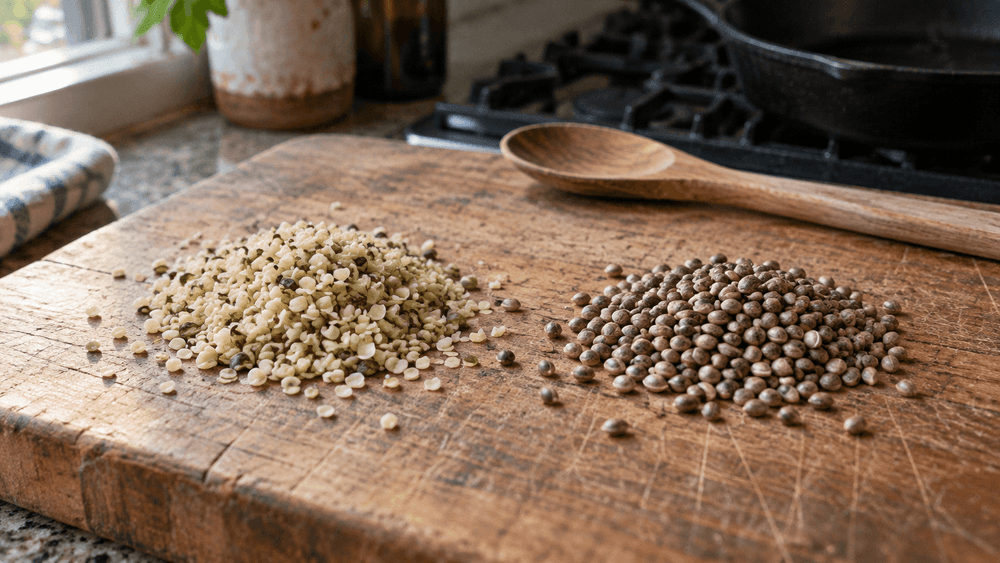
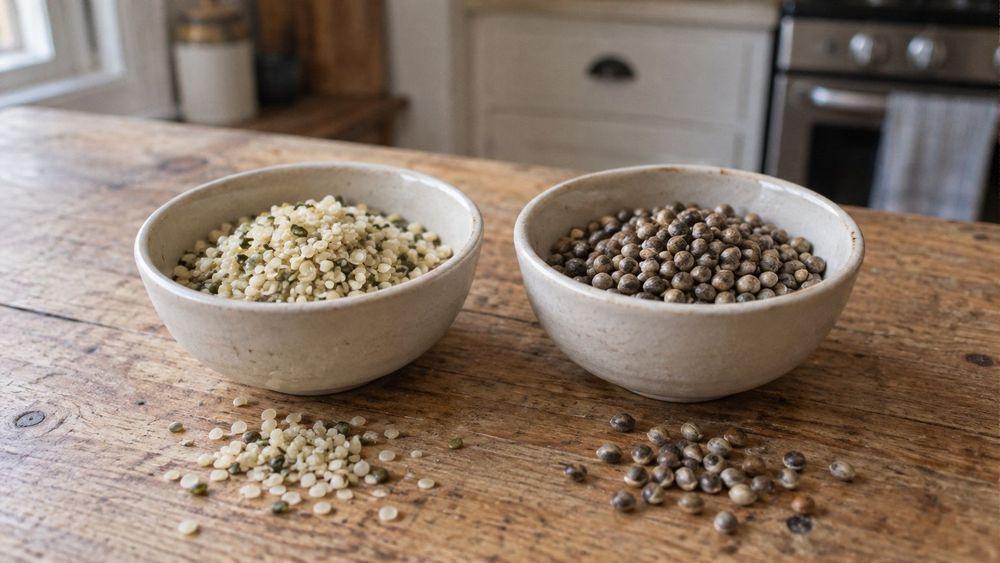
Hemp hearts are hemp seeds with the hard shell removed: soft, cream-green kernels that are about half fat by weight. Whole hemp seeds keep the shell, and that changes the fiber picture a lot, so this page covers hemp seeds side effects and hemp hearts side effects together and flags where they differ. The top search results for this question are a Q&A site, a reposted health article, a hemp ingredient seller and content farms, and they repeat the same list without links. We went back to the studies, agency pages and regulations behind each item (read November 14, 2026). For what hemp hearts contain, nutrient by nutrient, see our hemp hearts and chia seeds comparison. Nothing here is a serving suggestion, and this page makes no health claim for hemp seed in either direction.
Hemp hearts side effects at a glance: what the evidence shows
Here is the whole picture in one place. The last column is not a list of people who must avoid hemp seed; it is who has a specific reason to ask a clinician or check further. Each row is unpacked in its own section below, with the sources linked.
| Side effect | What the evidence shows | Strength of evidence | Who should ask first |
|---|---|---|---|
| Gas, bloating, loose stools | Fast fiber increases cause gas, bloating and cramps (MedlinePlus). 6 of 31 people had mild, short-lived gas or discomfort in a 50 g/day hemp protein trial. Hulled seed has 4 g of fiber per 100 g; whole seed about 34 g | General nutrition guidance plus one trial's tally | People with a sensitive gut or IBS: increase slowly |
| Allergic reaction, including anaphylaxis | Case reports (a 2003 anaphylaxis letter; a 2024 hemp flour cake case). Can s 3 links it to cannabis and LTP food allergy. Not a US major allergen. No rate measured | Case reports and lab studies | Anyone with a cannabis allergy or an LTP food allergy |
| Positive drug test | One urine screen positive at 0.6 mg THC a day (about 300 g of hulled seed at 2 µg/g) in a 2001 controlled study. THC varies by lot. Federal reviewers may not accept hemp as an explanation | One controlled human study plus policy | Anyone tested for work, the military, probation or at delivery |
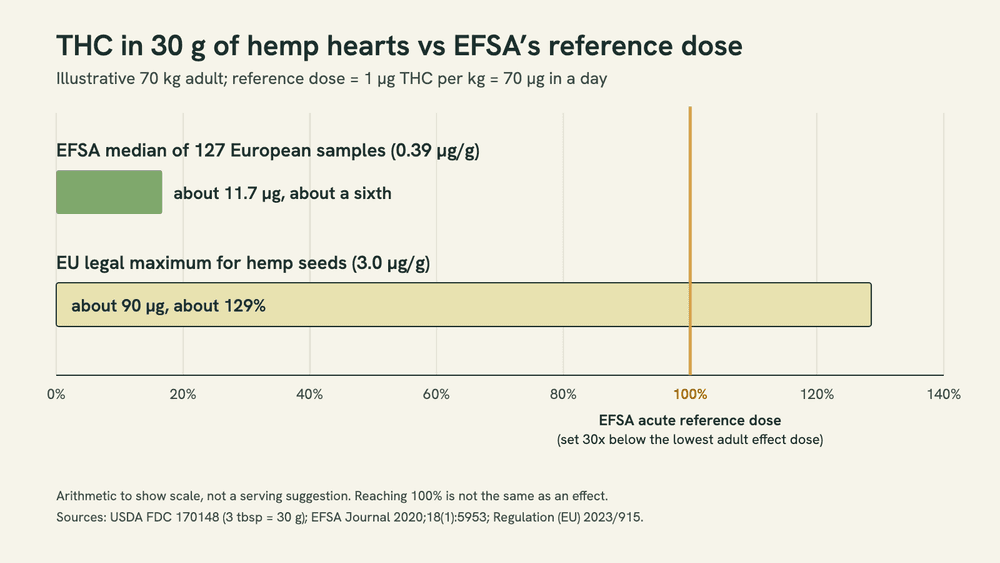
| THC above Europe's reference dose | 30 g at the EFSA median is about a sixth of the reference dose for a 70 kg adult; at the EU legal maximum, about 129% | Exposure arithmetic, not an observed effect | Children and pregnancy: see the dedicated guides |
| "Lowers blood pressure" | Hemp protein powder at 50 g/day: 3.5 mmHg lower systolic than casein in mild hypertension. Hulled seed plus oil for 4 weeks: no difference | Two small trials of different products | No supported reason; mention big diet changes to your prescriber |
| "Thins your blood" | Rabbits on a 10% hempseed diet: platelet clumping normalized. People on hempseed oil: no change in platelet aggregation or clotting factors | Animal finding; human trials null | No supported reason; mention big diet changes at your next INR check |
| Cadmium and other metals | EU limit for oilseeds without their own entry 0.10 mg/kg (covers hemp, on our reading). Five retail hemp samples in Poland: below the method's 0.83 mg/kg quantification limit. Hemp grown on high-cadmium plots: 1.3 to 4.0 mg/kg | One small retail survey with a coarse method, one worst-case field study | No specific group; eat a variety of foods (FDA) |
Can hemp hearts upset your stomach?
Yes, and it is the most common complaint. Two things in hemp seed can do it: fiber and fat. How much fiber you get depends on whether the shell is on. USDA FoodData Central (entry 170148) lists hulled hemp seed at 4.0 g of fiber per 100 g, which is about 1.2 g in 3 tablespoons (30 g). Whole seed is a different food. One analysis compiled in a 2020 review of hemp seed nutrition in *Nutrients* measured 33.8 g of total fiber per 100 g of whole seed, 30.9 g of it insoluble. So a spoonful of whole seeds, or a product made from them such as ground hemp flour, can carry several times the fiber of the same spoonful of hearts. Fat is the other half: hulled hemp seed is about 49 g of fat per 100 g, roughly 14.6 g in 30 g. Those are composition figures to show scale, not a portion to aim for.
Why fiber causes trouble is well understood, and it is not specific to hemp. MedlinePlus, the National Library of Medicine's consumer health encyclopedia, puts it this way:
“Eating a large amount of fiber in a short period of time can cause intestinal gas (flatulence), bloating, and abdominal cramps. This problem often goes away once the natural bacteria in the digestive system get used to the increase in fiber. Adding fiber to the diet slowly, instead of all at one time, can help reduce gas or diarrhea.”
The one hemp trial we found that tracked stomach symptoms week by week shows the same pattern. In a 2024 randomized crossover trial of hemp seed protein powder in 31 adults, 29 reported no stomach symptoms; 6 reported mild gas and abdominal discomfort during the first two weeks, and it subsided within two weeks. That was 50 g of protein powder a day in smoothies, not hemp hearts, so it tells you about the pattern rather than your bowl. On fat, the most specific line we found is in a PeaceHealth consumer monograph on shelled hemp seed, last reviewed in 2015: for most people there are no side effects "except sometimes loosening of the stool." A food that is half fat is a big fat load in a big portion, and some people notice that first.
- Go gradually: add hemp seed foods a little at a time rather than all at once, as MedlinePlus advises for any fiber increase.
- Check which form you are eating: hulled hearts carry about 4 g of fiber per 100 g; whole seed and products ground from whole seed carry many times more, almost all insoluble.
- Count the fat as well as the fiber: loose stools after a large portion of a half-fat food are a common, ordinary reaction.
- Know when it is not about the seeds: symptoms that persist, blood in the stool, severe pain or unexplained weight loss are reasons to see a clinician, whatever you have been eating.
Hemp seed allergy: documented, with no measured rate
Allergic reactions to hemp seed are real. A 2003 letter in the Journal of Allergy and Clinical Immunology is titled, plainly, "Anaphylaxis to ingestion of hempseed (Cannabis sativa)". In a 2024 Italian case series, a 45-year-old woman had anaphylaxis five minutes after eating a homemade cake made with hemp flour, her first hemp food. She had smoked cannabis, her strongest antibody response was to a protein called Can s 3, and the authors hypothesize that her sensitization started there. The company whose hulled hemp seed notice FDA reviewed in 2018, Fresh Hemp Foods, acknowledged the same thing. As summarized in FDA's response letter on hulled hemp seed (GRN 765), "Instances of allergic reactions to hemp seed-derived ingredients have been documented in the scientific literature," though the company added that it did not see hemp seed as a concern for the general population. What nobody has measured is how often it happens. We found no published rate (PubMed, November 14, 2026), so any page that puts a frequency on hemp seed allergy is guessing.
Can s 3 is cannabis's lipid transfer protein (LTP), part of a protein family also found in many fruits, nuts and vegetables. In a Belgian study of 120 people with cannabis allergy, up to 72% of those who had likely anaphylaxis were sensitized to Can s 3. That is a cannabis-allergy group, not hemp seed eaters, but it explains who has the most reason to be careful. In the lab, hemp seed proteins partly blocked hazelnut antibodies in blood samples from hazelnut-allergic people, by about 25-30%; the authors say whether that matters at the table still needs study. And the common line that hemp foods are "less allergenic" is, in one research team's words, a statement that "has never been experimentally verified." How cannabis allergy and LTPs work is covered in our guide to cannabis and CBD allergy; the seed allergens to compare side by side are in the hemp hearts vs chia breakdown.
One practical gap: hemp is not one of the nine allergens that FDA requires US food labels to declare, which are milk, eggs, fish, crustacean shellfish, tree nuts, peanuts, wheat, soybeans and sesame. A packaged food can contain hemp seed without an allergen warning, so the ingredient list is the only place you will see it.
Do hemp hearts have THC? The trace, worked out
Yes, a trace. In its 2019 consumer update on cannabis in pregnancy and breastfeeding, FDA explains: "THC and CBD are found mainly in hemp flowers, leaves, and stems, not in hemp seeds. Hemp seeds can pick up miniscule amounts of THC and CBD from contact with other plant parts, but these amounts are low enough to not raise concerns for any group." That was FDA's view in 2019, and it gave no number. So the honest word is trace, not zero, and how much depends on how cleanly a batch was harvested and hulled. Hemp seed food is also not a cannabinoid extract; how hemp seed oil differs from CBD oil is its own topic.
The US sets no THC number for a finished hemp seed food. Europe does: Commission Regulation (EU) 2023/915 caps hemp seeds at 3.0 mg per kg of THC equivalents (THC plus 0.877 times its acid form, THCA), and hemp seed oil at 7.5 mg per kg. Canada capped hemp grain foods at 10 µg per gram until an amendment published March 12, 2025; it now sets no number, so pages quoting the old Canadian limit are out of date.
The yardstick regulators use is the European Food Safety Authority's acute reference dose, restated in its 2020 THC exposure assessment: 1 microgram of THC per kg of body weight in a day, set 30 times below the lowest dose at which adults showed effects. EFSA's 127 hemp seed samples had a median of 390 µg per kg. For an illustrative 70 kg adult (a 70 µg reference dose) and 30 g of hulled seed, that median works out to about 11.7 µg, about a sixth of the reference dose. At the EU legal maximum, the same 30 g carries about 90 µg, about 129%. This is arithmetic to show scale, not a serving suggestion, and reaching the reference dose is not the same as feeling anything: it means the safety margin regulators want is used up. The same method, with a full table by weight, is in our hemp seeds in pregnancy guide, and smaller bodies are covered in whether babies and toddlers can eat hemp seeds.
Real-world testing leans toward the low end. A German official survey of 511 hemp food samples from 2008 to 2021 concluded that "hemp beverages and seeds typically do not contain amounts of THC that can exceed toxicological thresholds." That is a European market under European rules, and "typically" is not "always".
Can hemp hearts make you fail a drug test?
Unlikely at ordinary amounts, but nobody can promise a result. The controlled study most testing articles rely on is a 2001 study of hemp foods and urine drug tests. Fifteen volunteers ate set daily THC doses from hemp foods for 10-day periods. None of the people taking 0.45 mg of THC a day screened positive at the 50 ng/mL cutoff. At 0.6 mg a day, one urine specimen screened positive, and the highest THC metabolite level measured by GC-MS was 5.2 ng/mL. The authors equated 0.6 mg a day to about 300 g of hulled seed at 2 µg of THC per gram. That is 2001 product, and THC in seeds varies by lot, so the numbers describe a risk that is small, not one that is absent. The full mechanics, including cutoffs and confirmation testing, are in our guide to hemp seed oil and drug tests.
Policy matters as much as chemistry. SAMHSA's Medical Review Officer guidance for federal workplace testing says a reviewer may not accept hemp food as an explanation for a positive result. The Department of Defense bans service members from using hemp products regardless of the product's THC concentration (DoD memo, February 26, 2020). If you are tested at work, in the military, on probation or around a delivery, those rules decide the outcome, not the label. Older warnings about feeling high from hemp seed date to the 1990s: in a 1997 Swiss study of hemp seed oils with THC levels as high as 1,500 µg per gram, all six volunteers on the strongest oil reported effects. That is far above today's EU ceiling of 7.5 µg per gram for oil, which is why the warning survives mainly as history.
Do hemp seeds lower blood pressure?
Many pages list "may lower blood pressure" as a side effect, implying it could drop too far. The only trial that measured hemp and blood pressure in people with high readings is the 2024 protein powder trial above, and it used hemp protein powder, 50 g a day, not hemp hearts. Against a casein control, 24-hour systolic pressure came out 3.5 mmHg lower and diastolic 2.9 mmHg lower. Eleven of the 31 participants were already on blood pressure medication and showed the same pattern; the paper does not report anyone's pressure dropping too far, but the trial was not designed to look for that. It was small, used casein rather than a placebo food, and the powder was supplied by a hemp company (the funding came from the Heart and Stroke Foundation of Canada).
When people ate the actual food, nothing moved. In a 2026 randomized crossover trial, 30 adults ate about 60 g of hulled hemp seed plus 30 g of hemp oil a day for four weeks, and their blood pressure did not differ from a sesame seed and soybean oil control. They were not hypertensive and the trial was short. Behind most other "lowers blood pressure" lines are studies of processed hemp protein fragments in rats, an industrial ingredient tested in animals, not a food you buy.
So there is no study showing hemp hearts push blood pressure too low. If you take blood pressure medication and plan to add large amounts of any new protein food, your prescriber is the right person to tell. Hemp seed is not a reason to change a medication, in either direction.
Do hemp seeds thin your blood?
The "inhibits platelets" warning, which the 2015 PeaceHealth monograph repeats without a source, traces back to rabbits. In a 2008 study in male rabbits, a cholesterol-rich diet increased platelet clumping, and adding hempseed at 10% of the diet for eight weeks brought it back to normal. A 2007 letter from the same Canadian group is titled "Dietary hempseed reduces platelet aggregation." Both are animal work, at a share of the diet no person eats.
In people, the two trials that checked found nothing. In a 12-week trial of 86 healthy adults taking hempseed oil, flaxseed oil, fish oil or placebo capsules, hempseed oil did not change platelet aggregation. In a four-week crossover trial of 14 healthy adults taking 30 mL of hempseed oil a day, clotting (hemostatic) factors did not differ from flaxseed oil. Both were small, used oil rather than hearts, and did not include anyone on anticoagulants.
The bleeding question for omega-3s in general comes from fish-oil EPA and DHA taken at several grams a day, and even there the record is mostly reassuring: in a post hoc analysis of 1,516 cardiac surgery patients given 8 to 10 g of EPA and DHA before surgery, major bleeding was not increased. Hemp's omega-3 is ALA, a different molecule, and 30 g of hemp hearts carries about 2.6 g of it (USDA FDC 170148). The NIH complementary health center's omega-3 page describes omega-3 supplement side effects as "usually mild": unpleasant taste, bad breath, bad-smelling sweat, headache, heartburn, nausea and diarrhea.
If you take warfarin or another anticoagulant, the hemp-specific evidence does not show a clotting effect, but no study has tested hemp hearts in people on these drugs. Any big diet change is worth mentioning at your next INR check. The clinician cautions for the oil are in our review of hemp seed oil trials. If you also use a CBD product, that is a separate question with its own evidence: CBD itself can interact with some anticoagulants, as explained in our guide to CBD and blood thinners. This page is about the seed as a food, not about a CBD extract.
Heavy metals and mold toxins in hemp seeds: what has been measured
No page in the top results asks this, and it is a fair question. Hemp can take up metals from soil, which is why it is studied for cleaning up contaminated land (one of the industrial uses of hemp). A 2026 review of hemp as a food names lead and cadmium as the two metals "of particular concern", and warns that much of the alarming data come from plants grown on purpose in contaminated or spiked soil, which it says should not be used for risk assessment. First, the limits that exist:
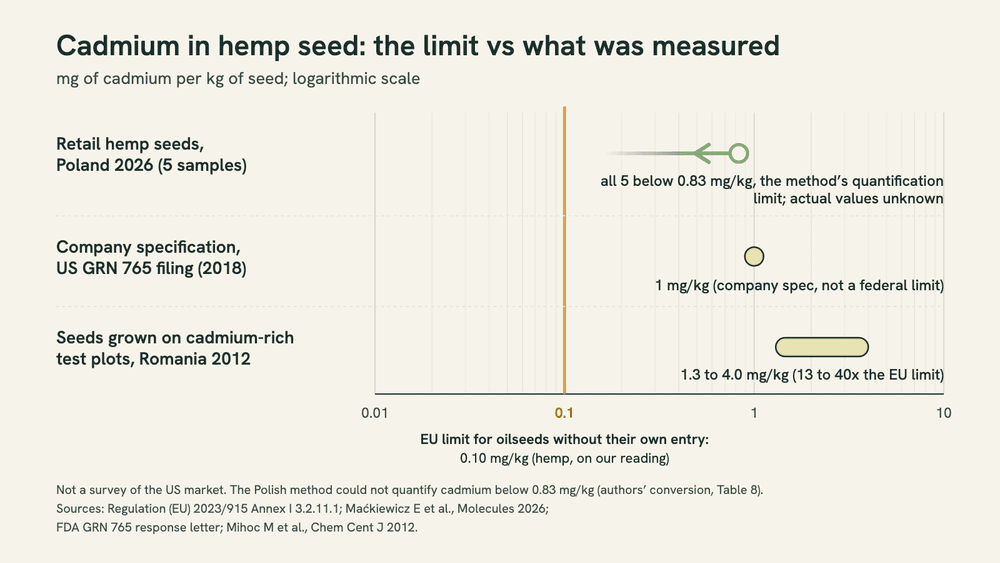
- EU cadmium limit: Regulation (EU) 2023/915 caps oilseeds without their own entry at 0.10 mg per kg. Hemp is not named; on our reading this entry covers it, as the regulation treats hemp as an oilseed elsewhere.
- EU mold toxin limit: the same regulation names hempseeds, with sunflower, pumpkin, melon seeds and soybeans, in its ochratoxin A limit of 5.0 µg per kg. Ochratoxin A is a toxin made by some molds on stored crops.
- US company specification: Fresh Hemp Foods, the company behind the 2018 GRN 765 notice, set its own limit for dehulled seed at no more than 1 mg of cadmium and 3 mg of lead per kg. That is not a federal limit.
What has actually been measured is thin. A 2026 Polish survey of 43 packaged seeds and grains bought in stores and online reported cadmium below the limit of quantification in all five hemp samples; flax was the seed that raised the cadmium flag. That result is less reassuring than it sounds. The authors' own conversion puts their cadmium quantification limit at 0.83 mg per kg of seed, more than eight times the EU limit, so the survey shows the hemp samples were under 0.83, not that they were under 0.10. Five samples from one country is also a small sample. At the other end, when Romanian researchers grew five hemp varieties on cadmium-rich test plots, the seeds carried 1.3 to 4.0 mg of cadmium per kg, 13 to 40 times the EU oilseed limit. That shows what a bad field can do, not what a typical bag contains.
FDA's page on cadmium in food gives the practical frame: "Testing results that detect cadmium do not necessarily mean the food should be avoided. Because many of the most nutritious foods can also contain contaminants, consumers should eat a variety of nutrient-dense foods." In practice, that means rotating your seeds rather than relying on one, and preferring brands that publish contaminant test results. One more compound worth knowing: hemp seeds carry phytic acid, which binds minerals such as iron and zinc; the 2020 review lists 4.5 to 7.6 g per 100 g of defatted seed meal, and the 2026 review lists dehulling, soaking, germination and cooking among the methods used to lower it. What that means for a person eating a mixed diet has not been studied.
Who should check with someone first
For most people, the side effects above are the ordinary digestive kind. These are the groups the evidence gives a specific reason to pause, and who to ask:
- 1Cannabis or LTP food allergy: if you react to cannabis, or to LTP-rich foods such as peach or hazelnut, ask an allergist before trying hemp seed foods (Can s 3 cross-reactivity, case reports above).
- 2Drug testing: if you are tested at work, in the military or on probation, weigh the trace THC, lot-to-lot variation and the fact that hemp food may not be accepted as an explanation.
- 3Pregnancy and breastfeeding: tell your prenatal care team what you eat, hemp foods included. Our pregnancy guide, linked in the THC section, covers the THC arithmetic and delivery-room testing.
- 4Babies and toddlers: a smaller body changes the THC arithmetic, and FDA's 2018 files covered ages 2 and up. Our infants and toddlers guide is linked in the THC section.
- 5Anticoagulants or blood pressure medication: the evidence does not show an interaction, but no study tested hemp hearts in people on these drugs. Mention big diet changes to your prescriber or at your next INR check.
- 6Sensitive gut or IBS: start small and increase slowly, as MedlinePlus advises for fiber, and remember that whole seed carries far more fiber than hearts.
What nobody has studied yet
The record has real holes, and they cut both ways. As of November 14, 2026, we found no trial of hemp hearts in people taking anticoagulants or blood pressure drugs, no human study that measured clotting after eating hemp hearts, no published rate of hemp seed allergy, no survey of metals in hemp seed foods sold in the US, and no US limit for THC in a finished hemp seed food. The human trials that exist are small, short and mostly about hemp oil or protein powder. None of that shows harm. It means the honest answer to "are hemp seeds bad for you?" is that the common problems are digestive, the serious one (allergy) is documented but unmeasured, and the dramatic ones on page one are not backed by the studies they imply.
Frequently asked questions
They can. The usual causes are fiber and fat going up quickly, which can bring gas, bloating, cramps or loose stools. MedlinePlus advises adding fiber slowly rather than all at once, and notes the problem often settles as your gut bacteria adjust. In the one hemp trial that tracked it, 6 of 31 people had mild gas or discomfort in the first two weeks, and it passed. Hulled hearts have far less fiber than whole seeds.
Yes. Allergic reactions, including anaphylaxis, are documented in case reports, and the company file FDA reviewed in 2018 acknowledges them. No one has measured how often it happens. People already allergic to cannabis, or to LTP-rich foods such as peach or hazelnut, have the most reason to ask an allergist first. Hemp is not one of the nine allergens US labels must declare, so check the ingredient list.
A trace. FDA said in 2019 that THC is found mainly in hemp flowers, leaves and stems, not seeds, and that seeds pick up small amounts from contact with other plant parts, amounts it called low enough not to raise concerns. It gave no number. Europe caps hemp seeds at 3.0 mg of THC equivalents per kg. The US sets no number for a finished hemp seed food, so a US bag does not tell you where a batch falls.
It is unlikely at ordinary amounts but cannot be ruled out. In a 2001 controlled study, one urine sample screened positive when volunteers took 0.6 mg of THC a day from hemp foods, which the authors equated to about 300 g of hulled seed at 2 µg per gram. THC varies by lot, federal reviewers may not accept hemp as an explanation, and the military bans hemp products outright.
No study has tested hemp hearts in people on anticoagulants, so no one can promise either way. The "thins your blood" warning traces to rabbit studies; in people, two hempseed oil trials found no change in platelet aggregation or clotting factors. Hemp's omega-3 is ALA, not the fish-oil EPA and DHA behind most bleeding questions. Mention any big diet change at your next INR check.
Not in a way any study has shown to be a side effect. A 2024 trial of hemp protein powder, 50 g a day, found systolic pressure 3.5 mmHg lower than with casein in adults with mildly high readings. A 2026 trial of hulled hemp seed plus hemp oil found no difference from a control. Neither is a reason to adjust blood pressure medication.
Hemp can take up cadmium from contaminated soil: seeds grown on cadmium-rich Romanian test plots carried 1.3 to 4.0 mg per kg. A 2026 Polish retail survey could not quantify cadmium in any of its five hemp samples, but its method could only measure down to 0.83 mg per kg. Europe caps oilseeds without their own entry, which on our reading includes hemp, at 0.10 mg per kg. FDA's advice on cadmium is to eat a variety of nutrient-dense foods.
They carry much more fiber. USDA lists hulled hemp seed at 4.0 g of fiber per 100 g, while one analysis of whole seed measured 33.8 g, almost all insoluble. If your stomach reacts to whole seeds or products ground from them, the shell is the likely difference, and hulled hearts are a much lower-fiber food.
Side effects are only half of the decision. For what hemp hearts actually contain (protein, fat, fiber, omega-3s and the allergen list, set against chia seeds with USDA data), see our side-by-side look at hemp hearts and chia seeds.
Writing about hemp, wellness and the small rituals that keep us balanced.