What Is Hemp Used For? The Real Markets, Niches and Myths
Hemp is grown for four harvests a farmer can sell: flower, grain, planting seed and stalk. See what each becomes, what USDA says each earned in 2025, where hempcrete is allowed and which famous hemp claims fail the record.
What is hemp used for? It is one plant grown for several different harvests. The top-ranking pages we read in October 2026 list long runs of things it could become, up to the famous "25,000 uses", without saying which ones anyone actually pays for. This page sorts the real markets from the niche ones and the myths, using USDA's own count of what American growers sold in 2025.
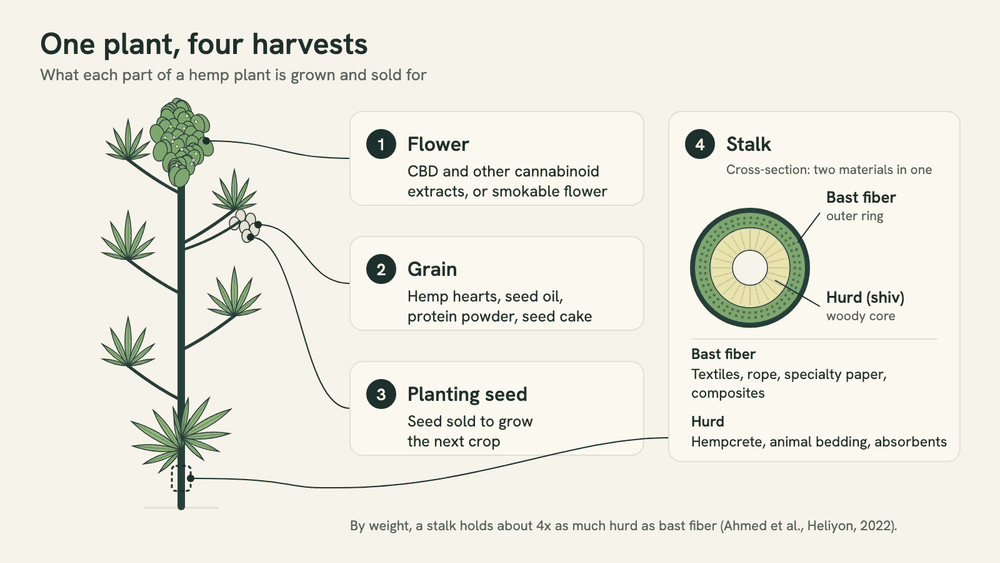
The short answer: hemp is used for four harvests a farmer can sell. The flower becomes CBD and other cannabinoid products. The grain becomes hemp hearts, seed oil and protein powder. Planting seed grows next year's crop. The stalk splits into bast fiber (textiles, rope, specialty paper, composites) and the woody hurd (hempcrete, animal bedding, absorbents). By value, the US crop is mostly flower: of the $739 million of hemp USDA counted for 2025, close to nine of every ten dollars came from floral hemp.
What is hemp used for? One plant, four harvests
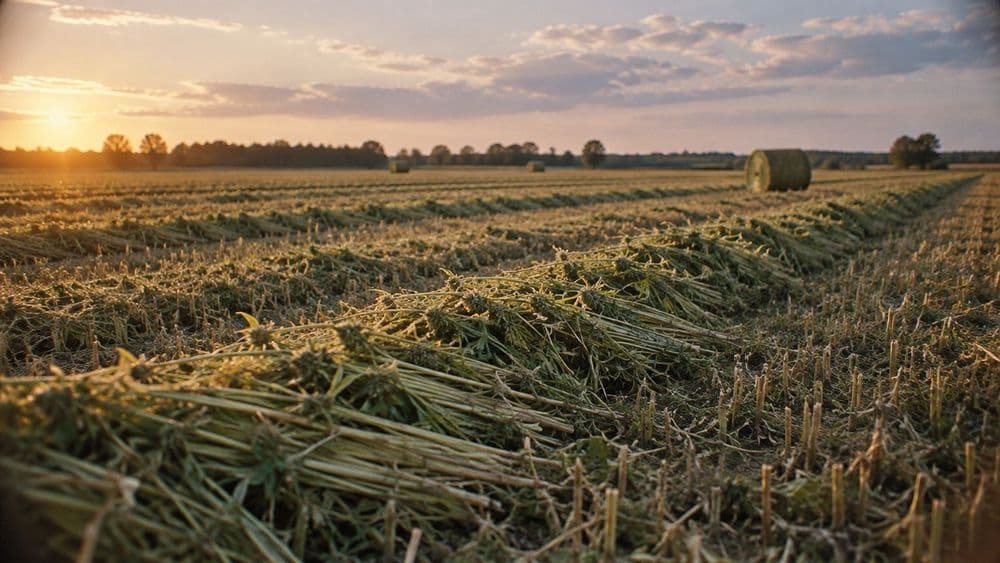
Hemp is Cannabis sativa grown under the federal THC limit, and almost every part of it has a buyer somewhere. If you want the full tour, our map of every part of the cannabis plant, root to resin gland covers the botany. For uses, what matters is how the harvest gets split. The flowers carry the resin glands where cannabinoids such as CBD are made. The seeds are a grain crop. The stalk is two materials in one: a ring of long outer fibers called bast, wrapped around a woody core called the hurd or shiv. USDA describes the step that separates them, retting, as "a process involving the use of moisture and microbes to break down the chemical bonds (pectin) holding the hemp stem together, enabling easier separation of the bast from the woody core (the hurd or shiv)."
The two stalk materials are not equal in size or makeup. A 2022 review of hemp as a raw material puts the hurd at about four times the weight of the fiber in a stalk. The same review reports that bast fiber is about 72% cellulose and 4% lignin, while the woody core is about 36% cellulose and 27% lignin. That difference is why fiber goes into textiles and twine, and hurd goes into walls, bedding and absorbents.
- Flower (floral hemp): extracted for CBD, CBG, CBN and other cannabinoids, or sold as smokable hemp flower.
- Grain: seed grown to eat or press, which becomes hemp hearts, hemp seed oil, protein powder and seed cake.
- Planting seed: seed sold to grow the next crop. Small in acres, high in price per pound.
- Stalk: bast fiber for textiles, rope, specialty paper and composites; hurd for hempcrete, animal bedding and absorbents.
What American farmers were actually paid for in 2025
USDA's National Agricultural Statistics Service (NASS) surveys hemp growers every year, and its National Hemp Report released April 16, 2026 is the cleanest answer to "used for" you will find. Floral hemp grown in the open covered 16,880 harvested acres and was worth $574 million; floral hemp grown under protection (greenhouses and similar) added $81.6 million. Together that is about $656 million, our sum of two printed numbers. Fiber covered more ground, 21,693 acres producing 67.3 million pounds, and was worth $13.5 million, down 13% from 2024. Grain covered 7,515 acres, produced 7.26 million pounds and was worth $8.09 million. Seed for planting covered 3,537 acres and was worth $49.7 million in the open plus $9.75 million under protection. The legal and botanical reasons why the flower outearns the fiber by that much are a story of their own; here, the point is simply which uses are a real market.
| Plant part | What it becomes | Real US market in 2025? | Source / notes |
|---|---|---|---|
| Flower (floral hemp) | CBD, CBG and CBN extracts; smokable hemp flower | Yes, the big one: $574M open plus $81.6M protected; average $19.30/lb | NASS; its definition says floral hemp includes smokable hemp |
| Seed grown as grain | Hemp hearts, seed oil, protein powder; seed cake | Small: 7,515 acres, $8.09M, $1.14/lb | FDA GRAS letters GRN 765, 771, 778 (2018); feed: laying hens only, trade-reported |
| Seed for planting | Next season's crop | Yes, niche but valuable: $49.7M open plus $9.75M protected; $26.30/lb | NASS seed category |
| Bast fiber (outer stalk) | Textiles, rope, specialty paper, nonwovens, composites | Most acres, least money: 21,693 acres, $13.5M, $0.21/lb | NASS; paper limits per Ahmed et al. 2022 |
| Hurd or shiv (woody core) | Hempcrete, animal bedding, absorbents | Not tracked separately (part of the fiber stalk) | 2024 IRC Appendix BL; Arango et al. 2023; CRS 2018 |
| Whole biomass | Biofuel, bioplastic composites, soil cleanup | Research or niche; no NASS category | Rutkaite et al. 2026; Vandenhove and Van Hees 2005 |
The per-acre picture makes the gap easier to feel. Dividing NASS's value by its harvested acres (our arithmetic, open fields only), floral hemp brought in about $34,000 an acre, planting seed about $14,000, grain about $1,080 and fiber about $620. Per pound, NASS lists average prices of $19.30 for floral hemp, $26.30 for seed, $1.14 for grain and $0.21 for fiber. NASS also prints medians that differ a lot from those averages (floral $80.90, fiber $0.14), which tells you prices vary widely from farm to farm. So when a page tells you hemp is "used for" rope, paper and plastic, it is describing real uses. It is just not describing where most of the money goes.
Flower: CBD and the other cannabinoid products
NASS defines floral hemp in its own words: "Hemp used for the extraction of essential oils from plant resin, such as cannabidiol (CBD), cannabigerol (CBG), cannabinol (CBN), or other phytocannabinoids. Floral hemp includes smokable hemp." ("Essential oils" is loose wording; the resin compounds it lists are cannabinoids.) NASS also breaks floral hemp into types by the form it was sold in. The single biggest slice in 2025 was flower sold already extracted: 9.49 million pounds worth $259.1 million. NASS also lists dried, bucked and hand-trimmed flower. Those type rows do not add up to the $574 million total, so we do not compute shares from them.
Extract is the raw material behind CBD oils, gummies, capsules, topicals and drinks. If you want to know how CBD is pulled from the flower, or what "hemp extract" on a label guarantees and what it does not, those guides take it from here. Smokable flower is the other floral market, and the legal status of smokable hemp flower is its own question. This page does not make any claim about what cannabinoid products do in the body; it only tracks what the crop becomes.
Seed: hemp hearts, oil, protein and the feed question
Hemp grain has a federal food paper trail you can read yourself. On December 20, 2018, FDA responded to three GRAS notices for hemp seed ingredients with "no questions" letters. GRAS means "generally recognized as safe"; a "no questions" letter means FDA did not object to the company's safety conclusion for the intended use. It is not an approval. All three notices came from one company, Fresh Hemp Foods Ltd.
- GRN 765: hulled hemp seed, the soft inner kernel sold as hemp hearts.
- GRN 771: hemp seed protein powder.
- GRN 778: hemp seed oil, pressed from the seed.
That trace-amount line is why the details live elsewhere. Our side-by-side on why hemp seed oil is not CBD oil covers what is in each bottle, and our guide to what hemp seed foods do on a drug test covers testing. Seed for planting is a different product with different rules; see the rules for cannabis seeds you plant. Animal feed has been the slowest door: as trade press reported, a 2024 feed-ingredient definition covers hemp seed meal for laying hens only, at up to 20% of the diet, and each state still decides whether to accept it. Nutrition is outside the scope of this page.
Fiber: textiles, rope, paper and composites
Fiber is the use most people picture, and in the US it is real but small, at about 21 cents a pound. The long bast fibers are rich in cellulose (about 72%, per the 2022 review), and they go into textiles, rope and twine, nonwoven mats and fiber-reinforced composite panels. What the evidence does not support is the common line that hemp clothing is simply "better" than cotton. We did not find a primary head-to-head study that settles it, so we are not making that claim. If a hemp garment is sold as organic, our guide to what "organic hemp" certifies explains what that label covers.
- Real: textiles and blends, rope and twine, nonwoven mats, composite panels, and thin specialty papers.
- Real but small: US fiber stalk was worth $13.5 million in 2025, about 1.8% of the crop value.
- Not established: that hemp cloth outperforms cotton overall, or that hemp paper can replace wood pulp at scale.
- Marketing to read carefully: "hemp plastic" and "hemp fabric" often mean a blend. Check the label for the other materials.
Paper is a good example of a real use that gets oversold. The 2022 review lists the specialty grades where hemp is used: "currency paper, art paper, cigarette paper, tea bags, specialty nonwovens." It is also blunt about the limit: "Existing paper-making technology is not well capable of handling non-woody crops, and it significantly decreases productivity." In short, hemp is good at thin, strong specialty papers. It is not a drop-in replacement for wood pulp in the mills that exist today.
Hempcrete: what it is and where it is allowed
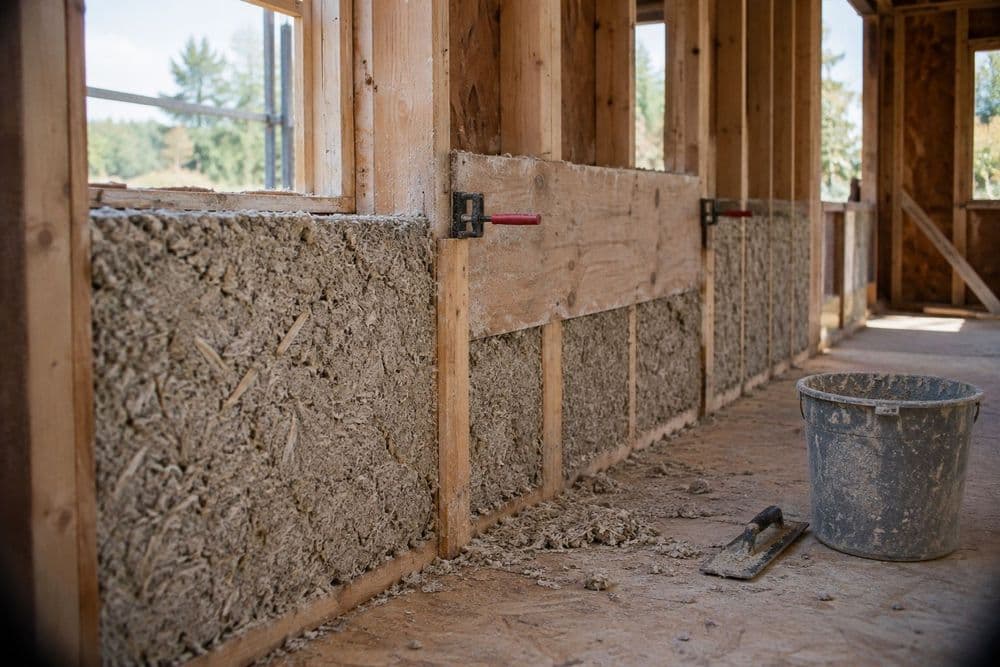
Hempcrete, also called hemp-lime, is the hurd use with its own building code. In 2024 the International Residential Code added Appendix BL, Hemp-Lime (Hempcrete) Construction. The IRC is a model code for houses that states and cities can adopt. ICC's online text could not be read as plain text, so we quote the appendix as reprinted in California's 2025 residential code, effective January 1, 2026. There, hempcrete is defined as "a nonstructural, bio-composite insulation infill material composed of hemp hurd and a lime-based binder." Nonstructural is the key word: hempcrete fills a wall built around a frame; it does not hold the roof up. The appendix covers infill densities from 12.5 to 25 pounds per cubic foot and gives an insulation value for each.
| Infill density (lb/ft3) | R-value per inch | 12-inch wall (our arithmetic) |
|---|---|---|
| 12.5 | R-2.10 | About R-25 |
| 15 | R-1.86 | About R-22 |
| 20 | R-1.54 | About R-18 |
| 25 | R-1.20 | About R-14 |
Here is how to read that table. R-value measures resistance to heat flow, and a wall's R-value is roughly the per-inch value times the thickness. A 12-inch hempcrete wall at 15 lb/ft3 is 12 x 1.86, about R-22; the same wall at 25 lb/ft3 is about R-14, before counting plaster or framing. The table allows interpolation between densities, not values outside the range. Lab data land in the same neighborhood. A 2025 lab study of Slovak commercial hemp concrete measured a thermal conductivity of 0.099 W/m-K at a density of 322 kg/m3, which is about 20.1 lb/ft3. Converting (0.0254 m per inch / 0.099 = 0.257, times 5.678) gives about R-1.46 per inch, close to the code table's R-1.54 at 20 lb/ft3. The honest takeaway: hempcrete insulates modestly per inch, which is why hempcrete walls are thick.
What the appendix limits
- Nonstructural infill only. The frame carries the loads; the hempcrete insulates and fills.
- Buildings "not more than one story above grade plane", no taller than 25 feet, with an average wall weight of no more than 65 lb per square foot.
- Walls at least 3 inches thick.
- Engineered design is required in higher seismic design categories.
- "Hemp-lime walls do not have a fire-resistance rating." A rating has to come from testing a specific wall assembly (ASTM E119 or UL 263).
- Optional: the appendix is not enforceable unless a state agency or local ordinance adopts it.
That last point decides whether you can actually use it. The California reprint states it plainly: "The provisions contained in this appendix are not mandatory unless specifically adopted by a state agency or referenced in the adopting ordinance." Where Appendix BL is not adopted, a builder can still bring it to the local building official, but as a proposal, not as a right. Adoption is moving state by state: a proposal to Washington's State Building Code Council to adopt the appendix statewide, filed in 2024 and posted in revised form in February 2026, reproduces the same sections. You may see trade coverage describe a two-story limit; both code reprints we read say one story above grade plane, so that is what we print. You may also see hempcrete called "legal in 48 states". We found no source that supports that count.
Hurd beyond walls: bedding and absorbents
Before hempcrete had a code appendix, the hurd's everyday job was the barn. The Congressional Research Service's 2018 report on hemp lists hurds as "used in animal bedding, material inputs, papermaking, and oil absorbents." The lab numbers back the bedding use. In a 2023 study of shives from 10 hemp varieties grown in Italy, ground to 8 mm, the material absorbed on average 251.9% of its weight in water (about 2.5 times) and 50.0% of ammonia. The authors call that similar to commercial bedding such as wood shavings, and add that on-farm trials are still needed.
Bedding comes with one twist, and it is specific to horses. In a 2025 equine anti-doping study, French researchers found that horses bedded on hemp straw could show CBDA (the raw acid form of CBD) in their urine. Their advice: "hemp straw should not be used as bedding for equine competition except if a delay of at least 48 h is respected." That finding is about competition horses and equine rules. It says nothing about people.
Myths and maybes: what page one repeats
Five claims kept recurring across the top search results we read in October 2026. Here is what the primary record says about each, followed by the details.
| Claim | What the record says | Verdict |
|---|---|---|
| The Declaration of Independence was written on hemp paper | The signed copy is on parchment (National Archives). The drafts-on-hemp story traces to an activist book with no footnotes. | False for the signed copy; not supported for the drafts |
| Hemp has 25,000 uses | A Popular Mechanics estimate from February 1938, later repeated by CRS beside an industry chart | A 1938 estimate, never an inventory |
| Henry Ford built a car from hemp | The Henry Ford museum: "no record of the formula exists today"; the engineer described soybean fiber in resin | Not supported as stated |
| Hemp cleaned up Chernobyl | The review that repeats it cites a 1998 web article; peer-reviewed caesium work is a Belgian greenhouse study | Real research, not a documented cleanup |
| Hemp plastic is a plastic made of hemp | Research products are mostly composites: hemp fiber or hull particles in another polymer | Usually a blend |
The Declaration. According to the National Archives' history of the Declaration, on July 19, 1776 Congress ordered the text "fairly engrossed on parchment," and the journal for August 2 records the signing of that engrossed copy. Parchment is prepared animal skin, not paper. The drafts are a separate claim. PolitiFact traced it in 2016 to Jack Herer's activist book, which says the drafts were "written on Dutch (hemp) paper" and gives no footnote. PolitiFact also quotes Monticello: "the Dutch were much more likely to use flax or linen rags." We found no fiber test of the drafts, so the fair word for that version is unsupported, not impossible.
“The declaration of independence being engrossed and compared at the table was signed.”
The 25,000 uses. The number comes from a February 1938 Popular Mechanics article, "New Billion-Dollar Crop", which said hurds "can be used to produce more than 25,000 products, ranging from dynamite to Cellophane." It was a magazine's estimate, not a count. The Congressional Research Service repeated "more than 25,000 products in nine submarkets" in 2018 next to a chart credited to an industry association, and in the same report said "No official estimates are available of the value of U.S. sales of hemp-based products." Ford's car. The Henry Ford museum's page on the 1941 soybean car says the car was unveiled on August 13, 1941, with 14 plastic panels on a tubular steel frame, and that "no record of the formula exists today." One article listed hemp among several ingredients; the engineer who worked on it described "soybean fiber in a phenolic resin with formaldehyde." Hemp may or may not have been in it. It was never documented as a hemp car.
Chernobyl and soil cleanup. Using plants to pull contaminants out of soil is called phytoremediation, and hemp is a genuine research crop for it. A 2022 review of hemp for phytoremediation calls it "a promising candidate" with "deep roots" that is "tolerant to the accumulation of different metals." But the review's Chernobyl sentence cites a 1998 web article, not a field trial report. The closest peer-reviewed evidence on radioactive land is a 2005 Belgian greenhouse and lysimeter study of fiber crops on caesium-contaminated soil. It found transfer to the usable parts "low enough to allow for the production of clean end-products (fibre, seed oil, biofuel) even on heavily contaminated land," with hemp fiber use limited to soils below 740 kBq/m2 of caesium. It also warned that because of high transfer to hemp seed, "consumption of hemp seed products should be considered with care."
Hemp plastic. In research, "hemp plastic" usually means a composite. In a 2026 lab study of extruded biocomposites, hemp hull particles added as filler to a cellulose-acetate bioplastic raised tensile strength by 21-23% and stiffness by 17-24%, and an alkali treatment sped biodegradation in a standard lab test. The base polymer there is cellulose acetate, not hemp. We found no sourced figure for how much hemp is in retail "hemp plastic" products, and whether a given item biodegrades depends on the other polymer, so check the label. Biofuel sits in the same research bucket: CRS described hemp in 2018 as "promoted as a potential biodiesel feedstock," and NASS has no fuel category at all.
What the late-2026 federal change touches, and what it does not
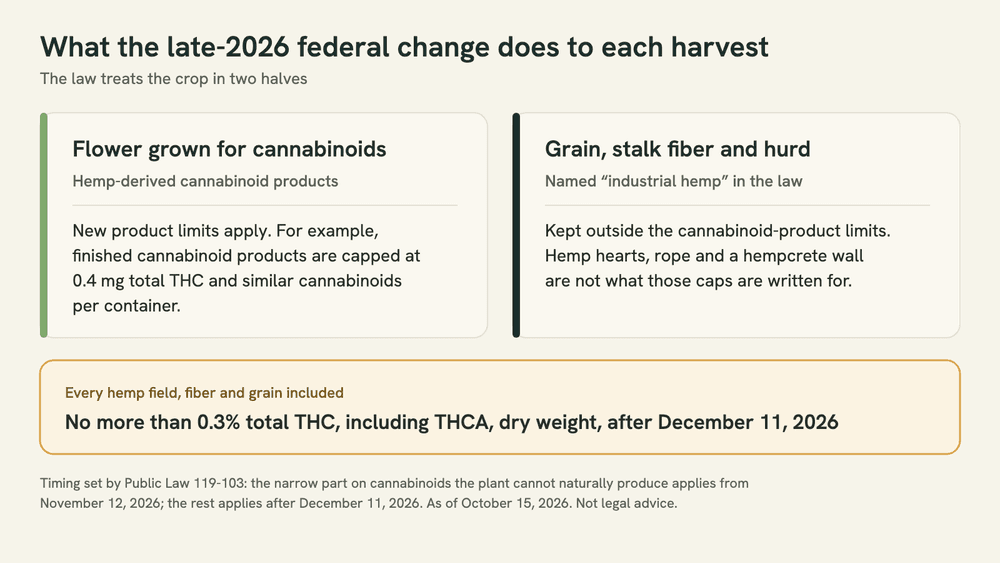
As of October 15, 2026, the federal hemp definition is set to change, and the change treats the crop in two halves. Public Law 119-37, enacted November 12, 2025, writes a new term into federal law: "industrial hemp," meaning hemp grown for "the stalk of the plant, fiber produced from such a stalk," or for "the whole grain, oil, cake, nut, hull" of the seeds, among other non-cannabinoid uses. The same section defines a "hemp-derived cannabinoid product" as one derived from hemp "other than industrial hemp." So the new product limits, including a 0.4 milligram per container limit on total THC and similar cannabinoids in finished cannabinoid products, are aimed at cannabinoid products. Hemp hearts, rope and a hempcrete wall are not what those caps are written for.
The other half matters just as much: every hemp field, fiber and grain included, still has to pass a THC test to count as hemp at all. USDA's current rule already counts THCA in that field test, with total THC calculated as (0.877 x THCA) + THC. The new statute writes "total tetrahydrocannabinols" (including THCA, no more than 0.3% on a dry weight basis) into the definition itself, for the whole crop. Timing is set by Public Law 119-103. A narrow part aimed at cannabinoids the plant cannot naturally produce applies from November 12, 2026, and the rest, including the total-THC definition and the industrial-hemp term, applies only after December 11, 2026, as the Congressional Research Service's hemp summary updated September 28, 2026 describes. For the dates in detail, see our explainers on the 2026 federal hemp ban and why most of it waits until after December 11. For how this sits with state law, our hub on the federal and state rules for CBD is the place to start.
What is still unknown
Even the research that catalogs hemp's uses admits the gaps. A 2026 review of hemp's industrial applications says the industry "still faces difficulties in the form of laws, lack of infrastructure, unequal product standardization, and lack of scientific proof in certain areas of application." Here is what we could not pin down.
- What the hurd market is worth. NASS reports stalk as one fiber category and does not split out hurd.
- How much hemp is in retail "hemp plastic". No sourced share exists; the research is on composites.
- Whether hemp biofuel has any US market. There is no NASS category and no market number.
- Where Appendix BL is in force. Adoption is state by state and city by city, and we found no reliable national count.
- Whether hemp clothing beats cotton overall. We found no primary head-to-head study.
- How USDA will run the total-THC field test after December 11, 2026. No implementing guidance had been published as of October 15, 2026.
Frequently asked questions
By value, US hemp is mainly used for flower that becomes CBD and other cannabinoid products: about $656 million of the $739 million crop in 2025, per USDA. By acreage, fiber leads, with 21,693 acres. Planting seed, grain for seed foods, and hurd for building and bedding make up the rest.
The long outer bast fibers go into textiles and blends, rope and twine, nonwoven mats, composite panels and thin specialty papers such as cigarette paper and tea bags. It is a small market in the US: fiber stalk sold for an average of about 21 cents a pound in 2025.
Hempcrete is hemp hurd mixed with a lime-based binder and used as non-load-bearing insulating infill. The 2024 International Residential Code has an optional appendix for it (Appendix BL), limited to one story above grade and 25 feet tall. It is enforceable only where a state or city adopts it; elsewhere, ask your local building official.
Yes, mostly as a composite: hemp fiber or hull particles mixed into another polymer to make it stronger or stiffer. There is no single "hemp plastic", and whether a product biodegrades depends on the other material it contains. Check the label for what it is made of.
Hemp is a studied phytoremediation crop, and a 2005 Belgian study on caesium-contaminated soil found its fiber could come out usable. The same study urged care with hemp seed from that land. The famous Chernobyl story is not documented by a field trial. A cleanup field is not a source of food or CBD.
No. FDA says hemp seeds do not naturally contain THC, and that seed ingredients carry only trace THC and CBD picked up during harvesting and processing. CBD is extracted from the flower. Hemp seed oil and CBD oil are different products.
The signed Declaration is on parchment, which is animal skin, according to the National Archives. The claim that the drafts were on hemp paper comes from an activist book with no footnotes, and Monticello notes Dutch paper of the time more often used flax or linen rags.
Only with a license. US hemp is grown under USDA, state or tribal plans, and every crop must test as hemp for THC. This page does not give growing instructions; check your state's hemp program before planting anything.
See what the flower half of the crop becomes
Planntz tinctures are made from whole-plant hemp extract in 60 mL of coconut MCT oil, and every batch has a public third-party certificate of analysis you can read before you buy.
Browse Planntz productsWriting about hemp, wellness and the small rituals that keep us balanced.