CBD and Driving: What the Research Shows, and What Per Se THC Laws Actually Punish
CBD and driving is really three questions: whether CBD impairs driving, whether a hemp product can put measurable THC in your blood, and what a DUI statute actually punishes. The answers do not line up. Here is the research and the statutory text.
CBD and driving is not one question. It is three, and they have three different answers. The first is whether cannabidiol itself makes you a worse driver. The second is whether a hemp product can put enough THC into your blood or your saliva to matter to a test. The third is what the statute where you are actually punishes, which is a separate thing again. Most pages on this subject answer one of the three and leave you believing you have the whole picture. This one takes them in order. Information current as of August 26, 2026.
Here is the short version, up front. In controlled human trials, CBD on its own has mostly not changed lane keeping, and the strongest of those trials used vaporized cannabis, not a tincture you swallow. Driving statutes, meanwhile, do not measure cannabidiol at all: they measure THC, or a THC metabolite, or your behavior. And two of the trials described below found that a CBD-rich product containing under 1% THC put measurable THC into people's blood while their driving battery came back clean. Everything below describes published research and quoted statutory text. It is general information, not legal advice, and only a lawyer licensed where you are can tell you how any of it applies to you.
CBD and driving is three questions, not one
Almost every page on this topic collapses three separate problems into one yes-or-no answer. Keeping them apart is the whole trick, because each one is decided by a different kind of evidence: a driving trial, a blood assay, and a statute.
- 1Does cannabidiol itself degrade driving performance? This is a pharmacology question, answered by controlled trials that put people behind a wheel and measure how much the car wanders.
- 2Can a hemp product put measurable THC into your blood or saliva? This is a chemistry and product question, answered by what is actually in the bottle and by what shows up in a tube afterward.
- 3What does the law in front of you punish? This is a statutory question, answered by the exact words of your state's code, which may not mention impairment at all.
The answers do not line up, and that is the useful part. You can pass question one and fail question two. You can pass questions one and two and still be exposed on question three, because some statutes are written about a number and some are written about your behavior. The confusion is not the reader's fault, either. The only government page answering this exact query is Colorado's transport department page on using CBD and driving, and its response to its own headline begins: "Short answer, yes. Long answer, not necessarily." The same page then warns that some products "labeled and sold as 'hemp' products contain substances like 'delta-8 THC,' 'THCP,' or 'HHC'" which "can cause impairment similar to or greater than the THC found in marijuana," and that "CBN, a substance that is sometimes found in many CBD products, can cause drowsiness." That is one agency, on one page, saying yes and then listing the reasons the yes does not hold. We are not going to restate any agency's short answer as ours, and by section 6 you will see the same department's drugged-driving FAQ confirming that a driver can be arrested and cited below the state's THC number on observed impairment alone.
What driving trials have actually measured with CBD
Four controlled human trials sit at the center of this question, and they are four more studies than the legal pages on this topic cite. Two further trials gave people CBD-rich cannabis products containing under 1% THC and also measured driving ability; those appear in section 5 instead, because their most important result showed up in the blood rather than in the car. The main endpoint in most of them is standard deviation of lateral position, or SDLP: how much the car wanders inside the lane, in centimeters. It is the standard measure in driving research because it is sensitive, it is continuous, and it has been calibrated against alcohol, which gives it a scale everyone understands. The single most important thing to carry through this section is the route. Vaporizing cannabis, smoking a joint and swallowing oil are three different pharmacokinetic events, and a result from one does not transfer to another.
| Trial | Route and dose | Design and n | What was measured | Result |
|---|---|---|---|---|
| Arkell 2020, JAMA | Vaporized cannabis, 13.75 mg CBD-dominant (also THC-dominant and THC/CBD-equivalent arms) | Double-blind, within-participants, on-road, n=26 healthy occasional cannabis users; 22 completed all 8 drives | SDLP over 100 km of real-road driving, at 40-100 min and 240-300 min | CBD-dominant SDLP -0.05 cm vs placebo (95% CI -1.49 to 1.39, P > .99). THC-dominant +2.33 cm; THC/CBD-equivalent +2.83 cm |
| McCartney 2022, J Psychopharmacol | Oral. Synthetic CBD at 100 mg/mL in medium-chain triglyceride oil, 15 mg, 300 mg and 1500 mg, in a high-fat drink | Double-blind crossover, driving simulator, n=17 healthy adults | SDLP at about 45-75 min and about 210-240 min, against a non-inferiority margin set at the equivalent of 0.05% blood alcohol | Non-inferiority established on some drives at some doses. The remaining comparisons were inconclusive: the confidence intervals included both no effect and the margin |
| Ortiz-Peregrina 2025, Addiction | Vaporized CBD, 16 mg (15% product) or 32 mg (30% product) | Double-blind crossover, driving simulator, n=30, mean age 26.2 | Overall driving performance score, SDLP, reaction time, collisions, visual function | No significant change in driving score (P=0.787), SDLP (P=0.966), reaction time or collisions. One exception: motion detection decreased significantly (P=0.018) |
| Rudisill 2023, AJPM Focus | Oral CBD, 300 mg | Double-blind parallel-group pilot, sex-stratified, placebo n=19 and CBD n=21 college students, about 40 min of simulated driving | Collisions, SDLP, brake reaction time | Nothing statistically significant. Collisions 0.90 vs 0.68 (P=0.57) and brake reaction 0.60 vs 0.58 s (P=0.61), both in the direction of worse. The authors state the study was underpowered |
The headline result belongs to Arkell and colleagues in JAMA in 2020, the only one of the four conducted on a real road rather than in a simulator. Twenty-six people drove 100 km on public roads after vaporizing 13.75 mg of one of three cannabis types or a placebo. The CBD-dominant condition moved SDLP by -0.05 cm against placebo, which is nothing; the two THC-containing conditions moved it by about +2.33 cm and +2.83 cm. The paper prints its own alcohol calibration so you can read those numbers: in comparable studies a blood alcohol concentration of 0.02% produces about +1.12 cm and 0.05% about +2.4 cm. It is also worth knowing that 16 of the 188 drives, about 8.5%, were terminated for safety reasons. And the authors did not round their own result up into a reassurance. They wrote that the effect size for CBD-dominant cannabis may not have excluded clinically important impairment, and that the doses tested may not represent common usage.
The trial closest to what most readers actually take is McCartney and colleagues' 2022 dose-ranging study of oral CBD, which used synthetic CBD at 100 mg/mL in medium-chain triglyceride oil. That carrier is the same class of oil that most tinctures use, so the delivery is a fair analogue even though the composition, a pure synthetic isolate with no THC in it at all, is not. Seventeen people drove a simulator after 15 mg, 300 mg or 1500 mg. The design deserves attention: the researchers set a non-inferiority margin at the equivalent of 0.05% blood alcohol, meaning they asked whether CBD's effect was smaller than that, not whether it was zero. On some drives at some doses non-inferiority was established. On the rest the answer was inconclusive, because the confidence intervals contained both no effect and the whole margin. Inconclusive is not the same as safe. One incidental finding is worth carrying with you: CBD persisted in plasma far longer than expected, still detectable in some participants more than four weeks after the 1500 mg dose.
The two simulator studies fill in the picture without settling it. Ortiz-Peregrina and colleagues, in Addiction in 2025, vaporized 16 mg or 32 mg of CBD in 30 people and found no significant change in the overall driving score or in SDLP, with a single exception: motion detection got significantly worse. A page that reports only the null and drops that line is doing exactly what the vendor pages do. And Rudisill and colleagues' 2023 pilot of 300 mg oral CBD found nothing statistically significant, with the small differences it did see, more collisions and slower braking, pointing the wrong way. Those differences are not effects and must not be read as effects: the P values are 0.57 and 0.61, and the authors say plainly that the study was underpowered and that larger trials may be warranted. That is what a null looks like when the study cannot answer the question.
CBD does not cancel out THC
There is a folk belief that CBD buffers THC, so a product with both is somehow safer to drive on than one with THC alone. It has been tested. Arkell and colleagues, in Psychopharmacology in 2019, had 14 light cannabis users vaporize 125 mg of THC-dominant cannabis (11% THC, under 1% CBD), THC/CBD-equivalent cannabis (11% THC, 11% CBD) or placebo, then drive a simulator and complete cognitive tasks. Both active conditions increased lane weaving in a car-following task. On two cognitive measures, impairment was worse with the equivalent-CBD cannabis, and peak plasma THC was higher after it, which the authors read as a possible pharmacokinetic interaction. Participants' own ratings of how stoned they felt and how confident they were about driving did not vary with CBD content at all. The authors concluded that cannabis with equivalent CBD appears no less impairing, and that in some circumstances CBD may actually exacerbate THC-induced impairment. Note what that study is: 14 people, vaporized cannabis flower at 11% THC. It is not a study of hemp products, and the CBD-to-THC ratio is nothing like a hemp tincture's. It kills the folk belief; it says nothing about CBD alone. For how long inhaled THC impairment actually lasts, a 2021 systematic review and meta-analysis of 80 publications and 1,534 outcomes modeled the recovery curve, and the note below explains why that figure is not a CBD waiting time.
The risk both camps skip: drowsiness needs no THC
The legal pages talk about THC thresholds. The vendor pages talk about non-intoxication. Neither talks about the effect that is actually best documented for CBD, which is sedation. The clearest statement of it is on the label of the only cannabidiol medicine the FDA has approved, and that label says it twice. The prescribing information for EPIDIOLEX, on the version dated May 2026, carries this in the highlights that summarize its warnings and precautions: "Monitor for somnolence and sedation and advise patients not to drive or operate machinery until they have gained sufficient experience on EPIDIOLEX." Section 5.2 then spells the same thing out at length, telling prescribers to advise patients not to drive or operate machinery "until they have gained sufficient experience on EPIDIOLEX to gauge whether it adversely affects their ability to drive or operate machinery."
Read the structure of that instruction, because it is smarter than either camp's version. It is not a prohibition and it is not a permission. It is wait-and-see: find out what this does to you before you take a two-ton machine into traffic. Section 5.2 also notes that somnolence and sedation showed up more often early in treatment and often eased with continued dosing, and that other central nervous system depressants, alcohol among them, could add to the effect. That label describes a prescription oral solution dosed by body weight for three seizure disorders, usually alongside other antiepileptic drugs. A hemp tincture is a different product at a different exposure, and the drug's numbers do not transfer to it. The shape of the instruction transfers perfectly.
Two federal health sources say the same thing in consumer language. The FDA's consumer update on cannabis-derived products lists "Changes in alertness, most commonly experienced as somnolence (drowsiness or sleepiness)" among CBD's potential harms, on a page marked content current as of 03/05/2020, and adds this: "Use of CBD with alcohol or other drugs that slow brain activity, such as those used to treat anxiety, panic, stress, or sleep disorders, increases the risk of sedation and drowsiness, which can lead to injuries." You can read that FDA consumer update on products containing cannabis and CBD in full. The NIH's National Center for Complementary and Integrative Health, on a page last updated in November 2019, puts it as "CBD may have side effects, including decreases in alertness, changes in mood, decreased appetite, and gastrointestinal symptoms such as diarrhea." If you want the fuller picture of what people report and when, we cover the side effects people actually report separately, and the specific question of CBD and alcohol together has its own page.

Now put that next to the law, because this is where drowsiness stops being a wellness footnote. Arizona's DUI statute, A.R.S. 28-1381(A)(1), makes it unlawful to drive or be in actual physical control of a vehicle "While under the influence of intoxicating liquor, any drug" and so on "if the person is impaired to the slightest degree." That is an impairment-based offense, and an impairment-based offense does not need any THC in your sample. It needs impairment. A cannabinoid product that makes you sleepy is a driving risk with no analyte attached to it.
Can a hemp product put measurable THC in you?
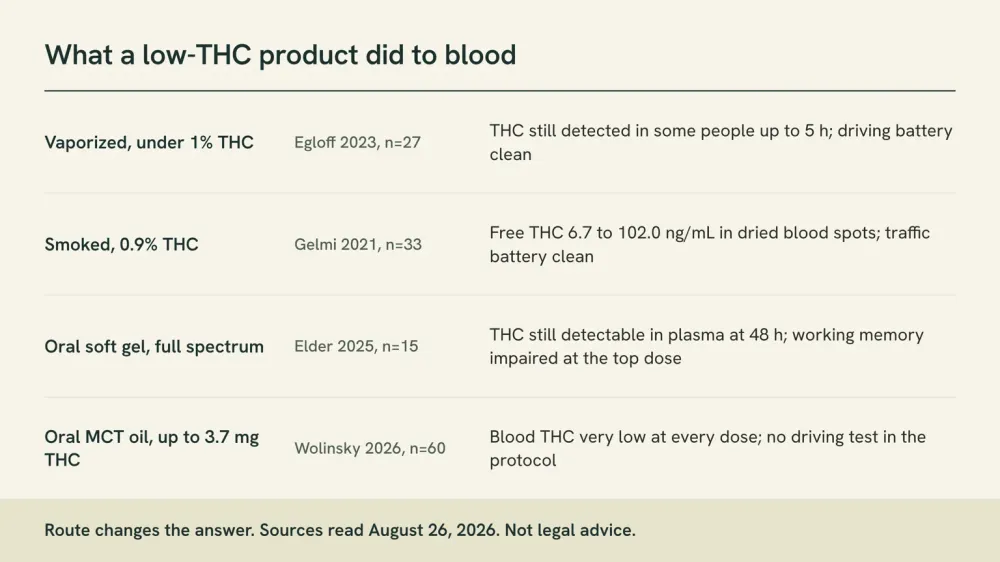
This is the hinge of the whole topic, and it is the part neither half of the search results covers. Egloff and colleagues, in the International Journal of Legal Medicine in 2023, ran a placebo-controlled, double-blind crossover trial whose single-dose arm had 27 people vaporize one of two CBD-rich products, both containing under 1% THC: one delivering 38 mg of CBD with 1.8 mg of THC, the other 39 mg of CBD with 0.6 mg of THC. They measured whole-blood cannabinoids and a computerized driving-ability battery. Both halves of the result matter and they point in opposite directions. The driving battery showed no significant difference from placebo. The blood did. After a single dose, THC fell below the Swiss legal threshold of 1.5 micrograms per liter of whole blood after about 1.5 hours, but was still detected in some participants up to 5 hours later. The authors wrote it plainly: "Detection of THC after consumption of low-THC/CBD-rich cannabis might have legal consequences for drivers." They recommended that consumers with usage similar to their study abstain from driving for at least 2 hours, specifically to avoid exceeding the Swiss limit. That is a Swiss number attached to a Swiss statute. Do not port it onto an American one.
A second trial found the same shape with a different route. Gelmi and colleagues, in Forensic Sciences Research in 2021, had 33 people smoke a joint containing 500 mg of tobacco and 500 mg of CBD-rich marijuana at 16.6% total CBD and 0.9% total THC, then ran a validated traffic test battery plus balance and vital signs. Reaction time, motor time, behavior under stress and concentration performance showed no significant differences against placebo. Free THC in capillary dried blood spots ran from 6.7 to 102.0 ng/mL shortly after smoking, and was still 0.9 to 38.0 ng/mL at 45 minutes. Two caveats travel with those numbers and both are load-bearing: the route was smoking, not swallowing, and dried capillary blood spots are not directly interchangeable with the venous whole-blood figure a statute names. The authors' own recommendation was that consumers refrain from driving for several hours after smoking CBD-rich marijuana, because legal THC concentration limits may be exceeded.
Both of those trials used products whose contents were known to the researchers. Yours are known to you only through a label, and labels have been measured. Bonn-Miller and colleagues, in JAMA in 2017, bought 84 CBD products from 31 companies online and analyzed them: "THC was detected (up to 6.43 mg/mL) in 18 of the 84 samples tested (21.43% [95% CI, 14.01%-31.35%])." Their comment on that finding is the sentence this page exists for: "the THC content observed may be sufficient to produce intoxication or impairment, especially among children." That was an online sample from 2017 and it tested nobody's current batch, including ours. A more recent survey found the same class of problem with spectrum labels specifically: Gidal and colleagues, in Frontiers in Pharmacology in 2024, in work sponsored by Jazz Pharmaceuticals with several authors compensated by the sponsor, analyzed 202 US CBD products and reported that 26% did not meet the definition of the spectrum type claimed on the package, and that three broad-spectrum products contained THC, two of them above 0.3%. A spectrum word is a marketing category. The only thing that reports THC is a batch certificate.
Two more pieces, because oral products are the ones most readers actually use, and both of them measured what reached the blood after swallowing. Elder and colleagues, in Cannabis and Cannabinoid Research in 2025, gave 15 healthy adults ascending doses of a hemp-derived full-spectrum oral soft gel in a double-blind, placebo-controlled, within-subjects design. At the lowest dose there was little to separate it from placebo. At the highest, the product impaired working memory and, in the authors' words, "produced moderate cognitive impairment and subjective intoxication, despite containing a relatively low dose of THC." Effects peaked 3 to 5 hours after dosing and returned to baseline by 8 hours, and THC and its metabolites were often still detectable in plasma 48 hours later. That was a specific patented product with an unusual acid profile, not a description of every tincture, and it is not a claim about any particular brand. It is a demonstration that "low THC content" and "no measurable effect" are two different statements. If the intoxication question is what brought you here, whether CBD itself is intoxicating is treated in full on its own page.
The second piece is the closest anyone has come to testing a tincture. Wolinsky and colleagues, in the Journal of Analytical Toxicology in 2026, gave 60 healthy adults 1.5 mL of medium-chain triglyceride oil containing 100 mg of CBD and either no delta-9 THC or 0.5, 1, 2, 2.8 or 3.7 mg of it, ten people to a dose, across an eight-hour laboratory session, a 14-day stretch of twice-daily dosing at home and a week of washout. That is the same carrier and the same order of THC that a full spectrum tincture delivers, which makes its blood result the most transferable number on this page: concentrations of delta-9 THC were very low in every dose condition, and no cognitive, subjective or psychomotor measure separated the CBD-only group from any of the THC-containing groups. The urine result went the other way. Positives appeared, and the authors' conclusion is that people subject to drug testing should recognize that hemp products contain detectable amounts of delta-9 THC. That half of the story is workplace testing, a different specimen answering a different question, and section 8 below keeps the two apart. Note also what this trial did not do: nobody drove.
So what does a real hemp tincture carry? On our Full Spectrum CBD batch 260310, the certificate reports 2.27 mg/mL of delta-9 THC against 267 mg/mL of CBD, a ratio of roughly 118 parts CBD to 1 part THC, which at a nominal 0.05 mL drop works out to about 0.11 mg of THC alongside about 13 mg of CBD (drop size varies by dropper and technique, and the bottle's label figure of 250 mg/mL is a rounder number than the batch actually measured). We do that arithmetic in full, from the certificate, in our side-by-side of CBD and THC. Broad spectrum is a different answer, and it is not one answer: on our Broad Spectrum Mango and Peach the THC row reads non-detected against a stated limit of detection of 0.0460 mg/mL, which caps the amount rather than proving zero, while Broad Spectrum Lemon and Raspberry reports 0.179 mg/mL. Same product line, two different batch results, which is the entire argument for reading the batch instead of the category. Nothing here tells you what your blood would read, and no product can guarantee a test outcome. If you want to think this through before buying rather than after, start with the spectrum choice explained end to end and with how long cannabinoids stay in your system.
What the statute in front of you actually punishes
Here is where the vendor pages go silent. Impairment is not the only thing a driving statute can prohibit, and in several states it is not the thing being measured at all. Below are three offense shapes, one state's stricter wording of the second, and one hybrid, with the actual text from the state servers we read on August 26, 2026. This is not a 50-state table and it is not advice about your state. It is a set of shapes so you know which question to ask about the code where you drive.
| Offense shape | What is measured | What the state has to establish | Text we read |
|---|---|---|---|
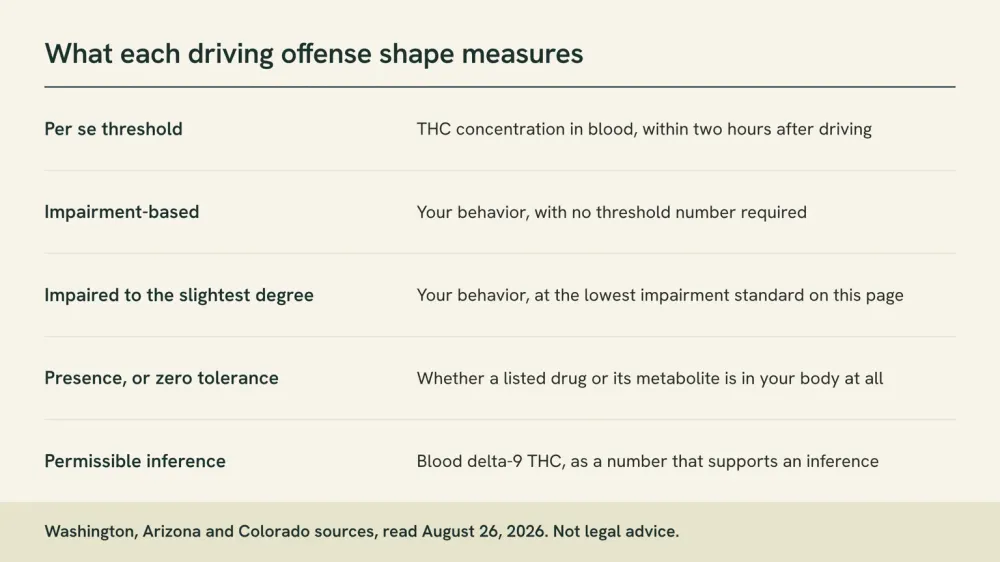
| Per se threshold | THC concentration in blood, within two hours after driving | The number. No officer's opinion, no field sobriety result, no observed behavior required | Wash. Rev. Code 46.61.502(1)(b): the person "has, within two hours after driving, a THC concentration of 5.00 or higher as shown by analysis of the person's blood" |
| Impairment-based | Your behavior, observations, and sometimes a chemical test as supporting evidence | That you were under the influence of or affected by the substance. No threshold number is needed | Wash. Rev. Code 46.61.502(1)(c): "While the person is under the influence of or affected by intoxicating liquor, cannabis, or any drug" |
| Impaired to the slightest degree | Your behavior, at the lowest impairment standard on this page | Impairment to the slightest degree, which is a lower bar than most people assume the phrase 'under the influence' implies | Ariz. Rev. Stat. 28-1381(A)(1): under the influence of intoxicating liquor or any drug "if the person is impaired to the slightest degree" |
| Presence, or zero tolerance | Whether a listed drug or its metabolite is in your body at all | Presence, not amount and not effect. A prescription exception applies to this paragraph in Arizona | Ariz. Rev. Stat. 28-1381(A)(3): "While there is any drug defined in section 13-3401 or its metabolite in the person's body" |
| Permissible inference (hybrid) | Blood delta-9 THC, with a number that supports an inference rather than defining the offense | Either the number, which gives rise to an inference of being under the influence, or observed impairment, which can be charged below the number | Colorado DOT: 5 ng/mL or more "gives rise to a 'permissible inference'", and drivers can be arrested "even with a blood level below 5 ng of Delta 9 THC" |
Two of those shapes live in the same section of the same statute. Washington's driving-under-the-influence statute, RCW 46.61.502, contains the per se THC threshold at subsection (1)(b) and the impairment-based offense at (1)(c), and its subsection (2) adds the sentence most readers need to see: "The fact that a person charged with a violation of this section is or has been entitled to use a drug under the laws of this state shall not constitute a defense against a charge of violating this section." Legality of the substance is not the question the statute is asking.
Arizona's own presence offense, at A.R.S. 28-1381(A)(3), reaches any drug defined in A.R.S. 13-3401 or its metabolite, and that definition of cannabis reaches, in the statute's own words, "Every compound, manufacture, salt, derivative, mixture or preparation of such resin or tetrahydrocannabinol." Subsection (D) exempts a person using a drug as prescribed by a medical practitioner from that particular paragraph. We are not going to tell you whether a given hemp CBD product falls inside or outside those definitions, because whether a substance sits inside a statutory definition is precisely the question a lawyer answers on a specific case, on specific facts. Worth noting in passing and nothing more: Arizona's Supreme Court held in State ex rel. Montgomery v. Harris, 234 Ariz. 343 (2014), No. CV-13-0056-PR, that the metabolite reference in that paragraph is limited to metabolites capable of causing impairment. Case law varies by state, and only a lawyer licensed where you are can tell you what applies to you.
The hybrid is worth understanding because it is the most common source of false comfort. Colorado's drugged-driving FAQs state it directly: "The limit in Colorado of active Delta 9 THC in a driver's blood, which gives rise to a 'permissible inference' that the person is under the influence of cannabis, is five nanograms or more per milliliter in the whole blood. Drivers can be arrested and cited for impaired driving if law enforcement observes and documents driver impairment to any degree, even with a blood level below 5 ng of Delta 9 THC." Read the second sentence twice. The number is a floor for an inference, not a ceiling on liability.
Now the sentence that ties the whole page together. The analyte named in every one of these statutes is THC or its metabolite. Cannabidiol is not named in any of them. What gets measured is not what you bought. That is why questions one and two above are not academic: the only route from a CBD product to a per se or presence statute runs through THC that came along with it. Two more things belong here, briefly. Every state has an implied-consent statute and they are not the same statute: Washington's, RCW 46.20.308, is written about breath, and blood testing follows a different route there. What happens after a stop, including refusal, is state law and a question for a lawyer. And the federal definition of hemp itself is scheduled to change on November 12, 2026, which we cover in the 2026 change to the federal hemp definition. For the wider federal, state and FDA layers, our hub on where CBD sits in federal and state law is the place to start.
Why the blood number is a weak proxy, and why that does not help you
There is a well-documented problem sitting underneath the per se model, and it is worth knowing about even though it changes nothing about your exposure. McCartney and colleagues published a meta-regression in 2022 across 28 publications and 822 driving-related outcomes, asking how well blood and oral-fluid cannabinoid concentrations actually predict measured impairment. The correlations were small. Blood THC after ingestion came out at -0.08 and after inhalation at -0.10, both described as only very weak; oral-fluid THC after inhalation reached -0.36, described as weak; the strongest relationship in the analysis, blood 11-COOH-THC after inhalation at -0.43, was described as moderate. In regular users there were no significant biomarker-performance relationships at all.
“Blood and oral fluid THC concentrations are relatively poor indicators of cannabis/THC-induced impairment.”
Now the hard turn, and it is the most important paragraph on this page. That is a fact about the science, not a defense. In a per se state, the number is the offense. The statute does not require the number to predict your driving, and telling a court that the correlation is weak is not a strategy anyone here is qualified to discuss. The practical use of that finding is upstream, not downstream: it tells you that you cannot reason your way from "I feel fine" to "my sample will be fine," because the relationship between the two runs in neither direction reliably.
The same asymmetry shows up at the roadside screen. Arkell and colleagues evaluated two point-of-collection oral-fluid devices in 2019 against laboratory confirmation, after vaporized cannabis in 14 people: oral-fluid THC peaked at about 10 minutes and fell quickly, and the trajectory did not differ with the CBD content of the cannabis. One device produced 5% false positives and 16% false negatives; the other 10% and 9%. Neither cleared the recommended 80% mark on all three of sensitivity, specificity and accuracy, and it is worth knowing which axis failed: specificity was the strong one, at 92% and 86%, while sensitivity came in at 45% and 67%. In other words, these devices missed real positives more often than they invented them. Accuracy was lowest around 60 minutes, when oral-fluid concentrations sat near the cutoff. That is a description of what a screening device is: a screen, with a confirmation step behind it, in a 2019 Australian trial on two specific devices. It is not a statement about any US roadside program and it is not a suggestion that a result can be talked out of.
Roadside testing is not workplace testing
These two get blended constantly, including by pages that ought to know better, and blending them produces wrong conclusions in both directions. They differ in what is collected, what is looked for, how long it stays findable and what happens next. This page owns the roadside half. The workplace half, including the actual screening and confirmation numbers, lives on our page on CBD and drug testing.
| Roadside and DUI (this page) | Workplace testing (covered separately) | |
|---|---|---|
| What is collected | Blood, or oral fluid at the roadside | Usually a urine specimen |
| What is looked for | Active delta-9 THC, and under a presence statute its metabolite as well | The delta-9 THC carboxy metabolite, which is inactive |
| Where the number comes from | State statute. In a per se state the number is the offense itself | A testing program's screening cutoff, followed by a mass-spectrometry confirmation |
| How long it stays findable | Blood THC falls within hours of use; oral fluid peaks within minutes | Days, and longer with regular use |
| What happens next | A criminal charge and licensing consequences | An employment consequence |
A checklist to run before you drive
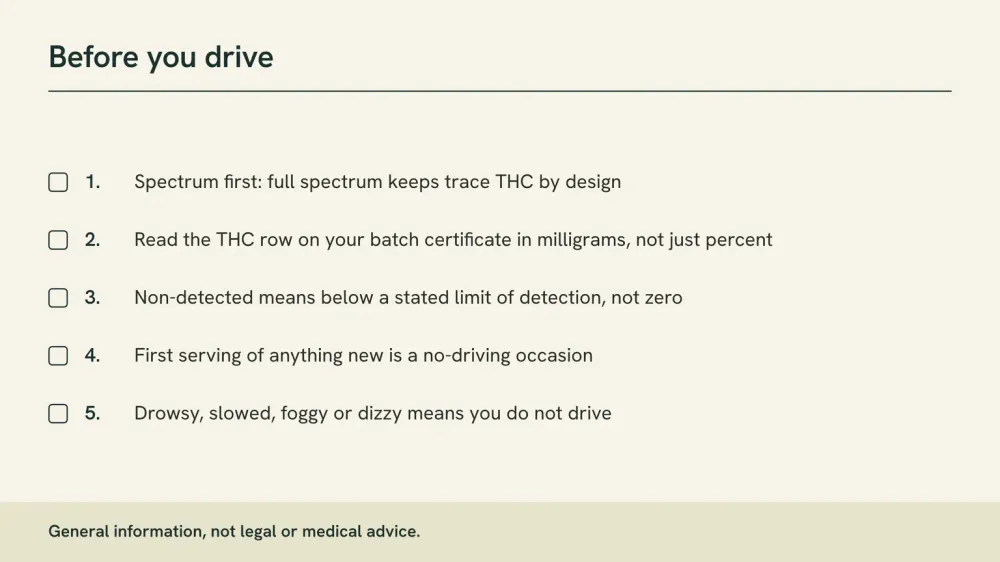
- 1Decide the spectrum question before you buy, not after. Full spectrum keeps trace THC by design, broad spectrum has had THC removed, and isolate is CBD alone. The word on the front of the box is a category, not a measurement.
- 2Open the batch certificate for the exact batch code printed on your bottle and find the THC row. Read it in milligrams per container, not only as a percentage, because a small percentage of a large container is not a small number.
- 3If that row says non-detected, look for the limit of detection printed beside it. Non-detected means the lab did not see it above that limit. It does not mean zero, and no honest report claims it does.
- 4Treat the first serving of any new product as an occasion when you are not driving. That is the shape of the instruction on the label of the only cannabidiol medicine the FDA has approved.
- 5Treat any product containing CBN the same way, every time. A state transport department names CBN as a drowsiness risk in CBD products, and that is an agency's statement rather than a trial result.
- 6Do not drive if you feel drowsy, slowed, foggy or dizzy, whatever the label says and whatever you took. An impairment-based offense does not need a drug concentration in your sample.
- 7Do not stack CBD with alcohol or a sedating medicine and then drive. The FDA's consumer guidance names that combination specifically and names injuries as the risk.
- 8If you take a full spectrum product, be clear with yourself that you are consuming trace THC on purpose, and that nobody can tell you in advance what a blood or oral-fluid sample would read.
- 9Know that implied-consent statutes exist in every state and are not the same statute. What happens after a stop, including refusal, is state law, and a lawyer licensed where you are is the only source of advice on your situation.
What nobody has measured
The honest limits of this page are as important as its findings, and they are specific, and the biggest one is not where this topic usually puts it. The missing experiment is not the blood measurement. It is the driving measurement that would have to sit next to it. A PubMed search run on August 26, 2026 for oral, hemp-derived or full-spectrum cannabidiol with blood or plasma THC measured returns five records: two are studies in dogs, one tested topical products on skin, and the two that put an oral hemp product into a person and drew blood are the two described in section 5, fifteen adults on full-spectrum soft gels and sixty adults on CBD in MCT oil carrying up to 3.7 mg of THC. Both measured what reached the blood. Neither put anyone behind a wheel. The two trials that did measure driving alongside blood used inhaled routes, one vaporized and one smoked, and inhalation delivers cannabinoids to the blood far faster and at higher peaks than swallowing oil does. So nobody has yet run the study this page would most like to cite: an oral hemp tincture at a label serving, a blood draw, and a driving test in the same session.
The other limits are about size and about time. The CBD driving trials are all small and short: the four rows of the trials table in section 2 run from 17 to 40 participants, they test single doses, and none of them followed anyone across weeks of daily use. Regular and occasional users differ, and they differed in the meta-analytic work too, which means results from occasional-user samples may not describe someone who takes a tincture every night. And the CBN caution on this page rests on a state agency's statement rather than on a trial, which is why it is worded as a caution and not as a finding.
The legal side has its own moving parts. Statutes are amended, thresholds are revisited, case law shifts, and the federal definition of hemp is itself scheduled to change. Everything quoted here was read on the state servers on August 26, 2026, and the right way to use it is as a set of shapes to check your own state's code against, not as a description of your state. If your question is about a real stop, a real test or a real charge, the answer does not live on any blog. It lives with a lawyer licensed where you are. If you want the reading that helps you ask better questions first, the most useful skill is how to read a certificate of analysis, because that document is the only one that tells you what is actually in the bottle.
Questions people actually ask
We are not going to answer that with permission or a prohibition, because the honest answer is a description of what has been measured. Four controlled human trials sit at the center of the question. In the only on-road trial, lane weaving after vaporized CBD-dominant cannabis was not statistically different from placebo, and the authors wrote that the result may not have excluded clinically important impairment. In the trial closest to a tincture, oral synthetic CBD in medium-chain triglyceride oil, some comparisons showed non-inferiority against a margin set at the equivalent of 0.05 percent blood alcohol and the rest were inconclusive. Two simulator trials found essentially nothing, with one exception for motion detection, and one of them was explicitly underpowered. None of the four used a hemp tincture at a label serving, and none tested a full spectrum product with trace THC in it. A 2026 trial did give 60 adults CBD in the kind of oil a tincture uses, with up to 3.7 mg of THC in it, but it measured blood and cognition rather than driving. Separately, sedation is a documented CBD effect, and the legal question is a different question again, answered by your own state's statute rather than by any of these trials.
The analyte named in the driving statutes quoted on this page is THC or its metabolite. Cannabidiol is not named in any of them. But that does not make the question academic, for two reasons. First, an impairment-based offense does not require any drug to be measured at a threshold at all: Arizona's version prohibits driving while impaired to the slightest degree, so drowsiness from any source is inside the statute's reach. Second, a full spectrum hemp product carries trace THC by design, and two trials have shown that a product under 1 percent THC can put measurable THC into blood after inhaled use. Whether a specific product falls inside or outside a specific state's definitions is exactly the question a lawyer answers on specific facts. Nothing here predicts any outcome in any case.
Roadside oral-fluid devices are not looking for cannabidiol. They screen for THC, and a screen is followed by laboratory confirmation. In a 2019 evaluation of two point-of-collection devices after vaporized cannabis in 14 people, oral-fluid THC peaked around 10 minutes and declined quickly, and the trajectory did not change with the CBD content of the cannabis. One device produced 5 percent false positives and 16 percent false negatives, the other 10 percent and 9 percent, and neither cleared the recommended 80 percent mark on all three of sensitivity, specificity and accuracy: specificity was the strong axis at 92 and 86 percent, sensitivity the weak one at 45 and 67 percent. As for blood, in a 2023 Swiss trial THC from a vaporized CBD-rich product containing under 1 percent THC was still detected in some participants up to 5 hours after a single dose. Those are specific devices, a specific route and a specific study. They are not a prediction about your sample.
Every waiting time you will see quoted for CBD comes from a study of a different route, and none of them is a rule for an oral CBD tincture. What does exist, each attached to a different route and a different question: the 2023 Swiss vaporized trial recommended abstaining from driving for at least 2 hours after use similar to its own, specifically to avoid exceeding the Swiss blood-THC limit; the 2021 smoked trial recommended refraining for several hours because legal THC limits may be exceeded; a 2021 meta-analysis estimated most driving-related cognitive skills recover within about five hours of inhaling 20 milligrams of THC, which is a THC figure and not a CBD figure; and the FDA-approved cannabidiol drug label instructs prescribers to advise patients not to drive until they have gained sufficient experience with it. That last one is a regulator-reviewed instruction written about cannabidiol itself, and note its shape: it is about knowing your own response before you drive, not about counting hours.
No, and no product of any kind can guarantee a test result. Non-detected on a certificate is a measurement against a limit of detection: it means the lab did not see THC above that limit, which caps the possible amount rather than proving zero, and the limit is printed on the report so you can see what the cap is. Two of our own broad spectrum flavors illustrate the point, since one reports non-detected against a stated limit and another reports a small measured amount. Beyond any one brand, a 2024 analysis of 202 US CBD products, sponsored by Jazz Pharmaceuticals, found that 26 percent did not meet the definition of the spectrum type claimed on the package, and that three broad-spectrum products contained THC, two of them above 0.3 percent. The spectrum word is a category. The batch certificate is the measurement.
No, and the differences matter in both directions. Roadside testing takes blood or oral fluid and looks for active delta-9 THC, with the threshold set by state statute and the consequence being criminal. Workplace testing usually takes a urine specimen and screens by immunoassay for the inactive delta-9 THC carboxy metabolite, with a confirmation step by mass spectrometry and an employment consequence at the end. The detection windows are different too: blood THC falls within hours of use, while the urinary metabolite is findable for days and longer in regular users. Passing one tells you very little about the other. Our article on CBD and drug testing covers the workplace side, including the actual cutoffs, and our article on how long CBD stays in your system covers the detection windows.
If you came here for a yes or a no, the useful thing this page can give you instead is the right three questions and the evidence attached to each one. The next step is not a product. It is reading the layer of law that sits above this one, which is where CBD stands federally and state by state, and, if testing is your real concern, the workplace testing picture in detail.
Writing about hemp, wellness and the small rituals that keep us balanced.