Cannabis Plant Anatomy: Every Part, From Root to Resin Gland
A map of the cannabis plant from root to resin gland, with the botany sourced: why the grow-guide "calyx" is really a bract, measured cannabinoid levels part by part, which part becomes which product, and how federal law treats stalks and seeds.
Every cannabis product starts as one specific part of the plant. Most cannabis plant anatomy guides list the parts, but few tell you which one actually holds the chemistry, and many give the most important part the wrong name. Here is the plant from the root to the resin gland, with the botany sourced and the numbers measured.
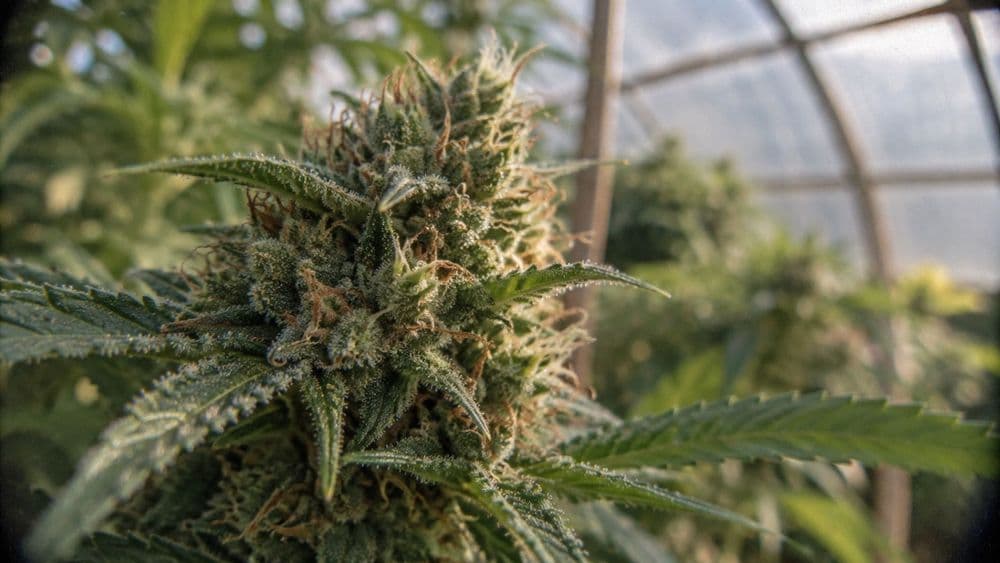
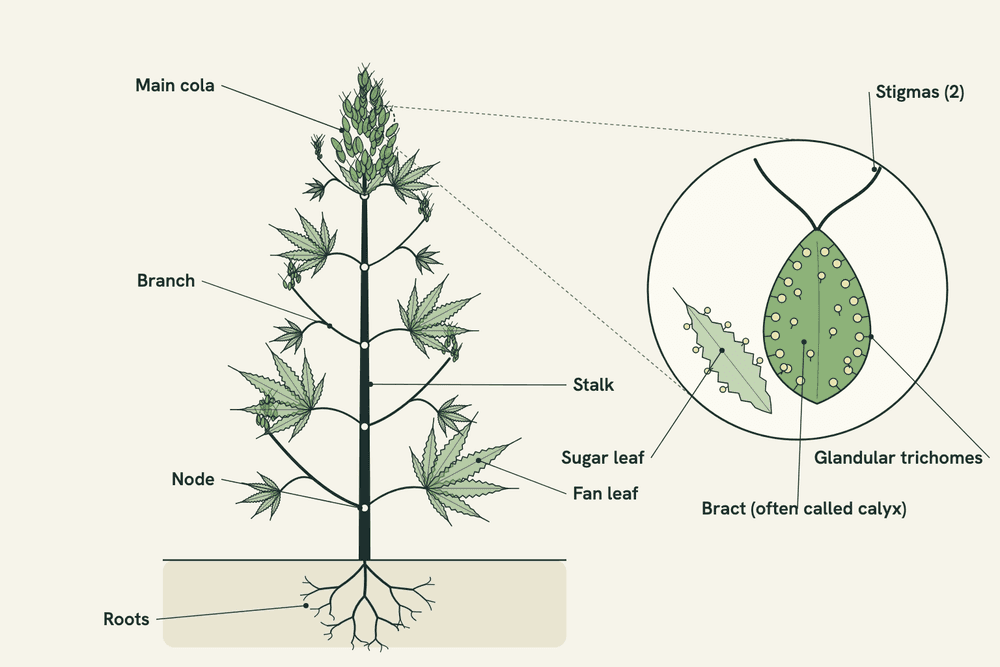
The short answer. The main parts of a weed plant are the roots, the stalk, the nodes where leaves and branches attach, the large fan leaves and, on a female plant, the flowers: leaf-like bracts, hair-like stigmas and small sugar leaves, packed together into colas and coated in resin glands called glandular trichomes. Those glands are where the plant makes and stores its cannabinoids, and on a flowering female plant they crowd onto the bracts, not the iconic fan leaf. One more thing most guides miss: the green teardrop that growers call a "calyx" is, in the language of the botanists who classify the plant, a bract. Knowing that tells you where the resin is.
Cannabis plant anatomy from the ground up: roots, stalk, nodes and fan leaves
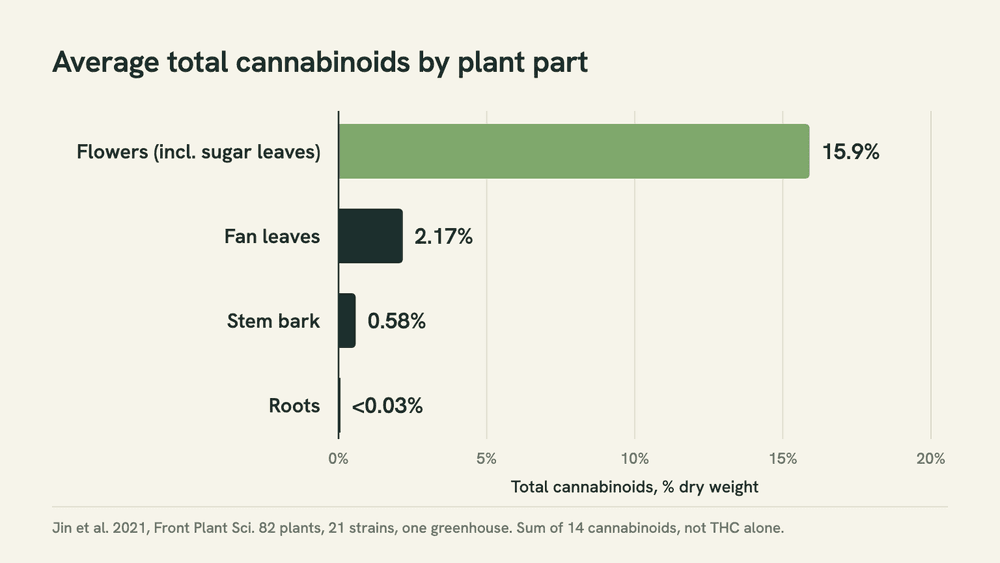
Start underground. Roots anchor the plant and take up water and nutrients, and they carry almost none of its chemistry. In a 2021 Canadian analysis of 82 plants from 21 strains, roots held less than 0.03% total cannabinoids (the sum of the 14 cannabinoids the lab measured, not THC alone). Above ground, the stalk is really two materials in one. A 2022 review of hemp as a textile fiber describes a thin green skin over bundles of long bast fibers, wrapped around a large woody layer of xylem, pith and cambium that makes up roughly 75% of the stalk's mass. The bast fibers become rope and textiles; the woody core, called hurd, goes into building and bedding materials. The stem bark in the 2021 analysis averaged 0.58% total cannabinoids, with a range of 0.06% to 2.33%.
A node is the point on the stem where a leaf attaches, and it turns out to be the key to the whole plant's design. A 2019 developmental study of female cannabis plants, which followed three medical cultivars under the microscope, describes the plant as a stack of repeating units called phytomers. In the authors' words, each one "consists of reduced leaves, bracts, one or two solitary flowers, and an axillary shoot (or inflorescence)". Leaf, bracts, flower, side shoot: that is the unit, repeated node after node up the stem. Keep it in mind, because it explains what a bud is.
Fan leaves are the plant's solar panels and its logo, and they change shape as the plant grows. A 2023 University of Guelph study that followed 25 plants of one variety from seed to senescence counted leaflets climbing from one to nine (every leaf from node 6 to node 13 had nine serrated leaflets), then falling back to a single leaflet by node 25. Leaf area peaked at the 12th leaf, and from node 12 onward the leaves switched from opposite pairs to alternating sides of the stem. Some retail guides say fan leaves contain no cannabinoids. They do, just not much: the 2021 analysis measured 0.95% to 4.28%, an average of 2.17%, which is about one-seventh of the flowers' average. Part of the reason is the type of gland. A 1981 study of developing vegetative leaves by Turner, Hemphill and Mahlberg found small capitate-sessile and bulbous glands on them, but not the tall capitate-stalked glands that cover the flowers.
- Roots: anchor and water uptake; under 0.03% total cannabinoids.
- Stalk: bast fiber under the skin, woody hurd inside; stem bark averaged 0.58%.
- Node: where a leaf, its bracts and a side shoot meet; the plant's repeating unit starts here.
- Fan leaf: the big leaf with up to nine leaflets; about 2% total cannabinoids, and none of the tall stalked glands found on the flowers.
The flower up close: bract, not "calyx"
Look closely at a bud and you see small green teardrops, each with a pair of fine hairs coming out of its tip and a coat of glittering resin. Growers, most grow guides and even some research papers call that teardrop a calyx. The botanists who classify cannabis call it a bract, and they have a reason worth knowing.
“The perigonal bract (also called bracteole, perigonium, or inappropriately 'calyx') is the floral bract enclosing the female flower and later the achene.”
That line comes from a 2020 classification of cannabis by the taxonomists John McPartland and Ernest Small. A bract is a modified leaf that grows around a flower. In the female cannabis flower it wraps the ovary and, if the flower is pollinated, the seed (botanically an achene, a small dry fruit). A calyx is a different structure: the ring of sepals that forms the outer layer of a flower's perianth, its petal-and-sepal envelope. In female cannabis that envelope barely forms. Under the electron microscope, the 2019 study saw the developing perianth, which "later degenerated, lost its identity and looked like a thin membrane". A 2026 study of cannabis flower development that included one of the same researchers describes each ovary as "enclosed by a cup-like membranous structure considered to be a reduced perianth". So the true calyx of a female cannabis flower is a film hidden inside, and the teardrop you can see is the bract.
Why does the name matter? Because the bract is where the resin is. The 2019 study watched "numerous glandular trichomes" develop on the bract that envelops the ovary, and the Guelph study found trichomes densest on the underside (abaxial) surface of the bracts. A companion 1981 paper on developing bracts, by the same team and in three clones, found that the more capitate glands a bract carried, the higher its total cannabinoid content. When breeders praise a high "calyx-to-leaf ratio", they mean more bract and less leaf in the bud, which McPartland and Small call the "perigonal bract-to-leaf index". Same idea, accurate name. If you say "calyx" at a shop, everyone will know what you mean; just know it is a bract you are looking at. For what happens inside the glands, our guide to what trichomes are and how they make cannabinoids goes deeper.
Stigmas, pistils, sugar leaves and colas: the rest of the bud
Once the bract is clear, the rest of a bud's vocabulary falls into place. The 2019 study saw two stigmas grow from each flower, "usually unevenly", and push out of the bract. Those are the hairs.
- Pistil: the female reproductive organ, made of the ovary (hidden inside the bract) and its stigmas. People often say "pistils" for the hairs, but the visible hairs are only the stigmas.
- Stigmas (the "hairs"): the pollen-catching tips, usually two per flower. In the Guelph study they shifted from "a whitish-yellow hue to a reddish-brown shade" as the flowers aged.
- Sugar leaves: in McPartland and Small's definition, "relatively small leaves with few leaflets occurring in the inflorescence". Resin frosts them, but unevenly (more below).
- Cola: a dense, elongated cluster of flowers at the end of a branch. The main cola is the top one, which researchers call the apical inflorescence.
- Bud: the everyday word for a flower cluster. In phytomer terms, it is the plant's repeating unit compressed (more on that below).
Sugar leaves carry resin, but not evenly: a 2025 review of trichome measurement methods notes that they have a less uniform trichome distribution than bracts, with higher densities at the margins and tips. Hair color, meanwhile, tracks age, not strength. In a 2025 study of 25 genotypes grown indoors in research grow tents, 22 peaked in total cannabinoids when their stigmas were mostly or fully amber. That ties color to maturity in living plants; it is not a potency reading for a dried bud, and visual buying cues of that kind are covered in our guide to what good weed looks like. Position on the plant can matter more. In a greenhouse trial on one CBD-dominant medical cultivar, cannabinoid concentrations in buds from the bottom of the plant were up to 90% lower than in the apical inflorescence at the top. That is one cultivar, and "up to" is the largest gap, not the typical one.
Where the cannabinoids are, part by part
Grow-shop guides often print figures such as "1 to 5 percent THC" for sugar leaves with no source behind them. Here is what has actually been measured, and where nobody has measured anything. Most numbers below come from the 2021 analysis: 82 plants of 21 strains grown in one commercial greenhouse in Canada under a Health Canada research licence, dried for 7 days after about two months of flowering. Two of its authors were employed by PBG BioPharma and one by Egret Bioscience, so read it as industry-linked work. It counted sugar leaves as part of the flower ("Sugar leaves ... were treated as a part of the inflorescences"), so it gives no separate sugar-leaf figure, and we found none anywhere else.
| Part | What it is | Total cannabinoids, measured | What it becomes | Federal note (as of October 2026) |
|---|---|---|---|---|
| Roots | Anchor; takes up water and nutrients | Under 0.03% | Not a cannabinoid source | Covered by hemp's "any part of that plant" |
| Stalk and stem | Bast fiber under the skin, woody core about 75% of stalk mass | Stem bark 0.06-2.33%, average 0.58% | Fiber, rope, textiles; hurd for building and bedding materials | Mature stalks and their fiber are excluded from "marijuana" |
| Nodes | Where a leaf, its bracts and a side shoot attach; first single flowers form here | Not measured | Nothing on its own | No part-specific rule |
| Fan leaves | Large leaves with up to 9 leaflets; photosynthesis | 0.95-4.28%, average 2.17% | Mostly removed as plant waste | Same THC test as any other part |
| Sugar leaves | Small, few-leaflet leaves inside the bud | Not measured separately (counted as flower) | Trim for shake, pre-rolls or extracts | Same THC test as any other part |
| Bracts | Leaf-like wrapper around each female flower; the main resin site | Not measured on their own; content rises with capitate-gland count (Turner 1981, three clones) | The bulk of a bud | Same THC test as any other part |
| Stigmas ("hairs") | Pollen-catching tips of the pistil | Not measured | Part of the bud | Same THC test as any other part |
| Trichomes | Glandular resin heads, 40-110 micrometers across (Punja 2023) | Where cannabinoids are made and stored; sifted heads 36.7-60.7% in one facility | Kief, hash, extracts | Same THC test as any other part |
| Colas (flowers) | Dense flower clusters; the main cola is the top one | Flowers 7.06-24.42%, average 15.90%; bottom buds up to 90% lower than the top in one cultivar (Danziger 2022) | Smokable flower; extracts | Same THC test as any other part |
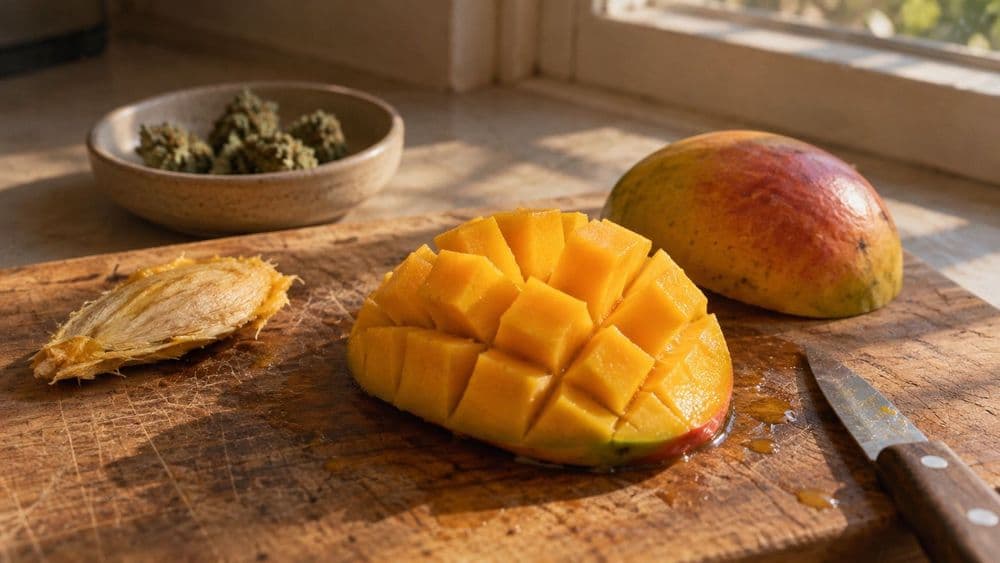
| Seeds | The fruit (an achene) | No natural THC or CBD (FDA); traces come from contact with other parts | Hemp hearts, seed oil, protein | Seed oil, cake and sterilized seed are excluded from "marijuana" |
The order (flower far ahead, then leaf, then stem, then root) also showed up in an earlier three-chemovar study from the same lab, and our explainer on whether shake is weaker than bud walks through what that means for trim and small buds. Two short notes on the glands themselves. They store terpenes as well as cannabinoids, which is why cannabinoids and terpenes so often travel together. And the resin heads are tiny, 40 to 110 micrometers across in a 2023 microscopy study that also saw many of them come loose after harvest and during drying. Collected, those heads are kief: in a 2021 report from one Oregon facility, whose lead author had filed a patent application on the method, sifted heads ran 36.7% to 60.7% total cannabinoids, against 11.5% to 29.6% in the flower they came from (four chemovars, one run each).
Male and female plants
Cannabis is usually dioecious: individual plants are male or female, and cytogenetic work published in 2014 describes 18 autosomes plus XX in females and XY in males. Everything above about bracts, stigmas and colas describes the female plant, because that is where the resin-rich flowers form. In a 2026 comparison within one hemp cultivar, with three plants per sex, female flowers had cannabinoid levels 16.88 times those of male flowers. Pollination changes the female flower too: a 2021 study of two chemovars found that fertilization lowered the concentration of most of the phytocannabinoids measured. How to tell the sexes apart, what a hermaphrodite plant is and how feminized seed works are all in our guide to male vs female weed plants.
Which part becomes which product, and how the law splits the plant
Anatomy is the easiest way to understand why cannabis products differ so much. Each one starts from a different part of the plant.
- Flower (bracts, stigmas, sugar leaves): sold as smokable flower and used as the main input for extracts.
- Trim (sugar leaves and small buds): shake, pre-rolls and extracts.
- Trichome heads: kief and hash.
- Seeds: hemp hearts, seed oil and protein, with no natural THC or CBD (more below).
- Stalk: bast fiber for textiles and rope; hurd for building and bedding materials.
- Fan leaves and roots: mostly plant waste, given how little they hold.
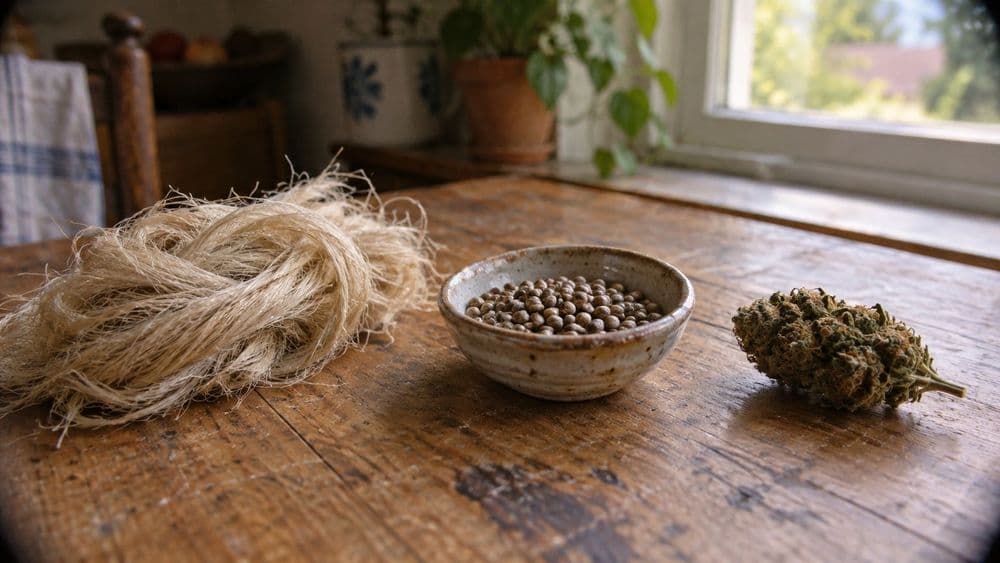
Seeds are the part most often misunderstood. The FDA states that "the seeds of the plant do not naturally contain THC or CBD", and that trace amounts can be picked up during harvesting and processing through contact with other parts of the plant. A 2000 analysis of drug-type and fiber-type seeds found most of the delta-9 THC sat on the seed surface. That is why hemp seed oil and CBD oil are different products.
The law draws its lines differently. Federal law does not sort hemp from marijuana by plant part. The current federal hemp definition covers "the plant Cannabis sativa L. and any part of that plant" with a delta-9 THC concentration of not more than 0.3 percent on a dry weight basis, and the rewrite Congress enacted in November 2025 keeps "any part of that plant" while changing the test to total THC later in 2026. What decides the label is THC concentration. The part-based carve-out sits on the other side: the federal definition of marijuana excludes "the mature stalks of such plant, fiber produced from such stalks, oil or cake made from the seeds of such plant" and "the sterilized seed of such plant which is incapable of germination". That is federal law as of October 2026, and states add their own rules. The dates and details live in our explainers on hemp vs marijuana and whether weed seeds are legal.
One practical consequence: a certificate of analysis tests the finished product, not a plant part, which is why a flower and an oil from the same plant can read so differently. Planntz tinctures, for example, are whole-plant hemp extracts in MCT oil, and every batch has a public third-party COA on our lab results page. If you have never read one, our guide to reading a COA shows what to check first.
"Vegetative" and "flowering": what the botany shows
Most guides split a cannabis plant's life into a vegetative stage and a flowering stage, as if flowers appear only when days shorten. The 2019 study found something less tidy. Single flowers formed at the nodes even under long days, and the authors concluded that the plant "cannot be defined as vegetative or non-inductive in the classical sense". They judged that this solitary-flower stage is "probably age-dependent and is controlled by internal signals, but not by photoperiod" ("probably" is their word). What short days do, in their account, is cause "a dramatic change in shoot apex architecture to form a compound racemose inflorescence": the same phytomers, packed tighter and tighter at the tip. That is what a bud is. The Guelph study saw the same pattern in a different variety: bracts and solitary flowers at nodes 7 to 12 before the switch to short days, and an apical inflorescence at node 15 ten days after it. So "vegetative" is a useful grower convention, not a strict botanical stage. This is a description of the plant, not growing advice; growing method has its own page on indoor vs outdoor weed.
What is still unknown
- How much is in sugar leaves on their own. The best data counts them as flower, and we found no study that measured them separately.
- Cannabinoid levels in stigmas and nodes. No source we reviewed measured either.
- How far the part-level numbers generalize. They come from a few greenhouse studies with 21 strains at most, and the largest has industry-employed authors.
- Whether the terminology will settle. Taxonomists call the teardrop a bract, but "calyx" still appears in grow guides and in some research papers.
- Whether anything you can see (frost, hair color, cola size) predicts how cannabis affects people. No study we found ties visible anatomy to effects.
Frequently asked questions
Roots, stalk, nodes and fan leaves, and on a female plant the flowers: bracts, stigmas and sugar leaves packed into colas and coated in glandular trichomes. Seeds form only if a flower is pollinated.
A dense, elongated cluster of flowers at the end of a branch. The main cola is the one at the top of the plant, which researchers call the apical inflorescence. In one greenhouse trial on a single cultivar, buds from the bottom of the plant had up to 90% lower cannabinoid concentrations than the top one.
Size, position and resin. Fan leaves are the large leaves with up to nine leaflets, and they averaged about 2% total cannabinoids in a 2021 analysis of 82 plants. Sugar leaves are small, few-leaflet leaves inside the bud, frosted unevenly with resin at their margins and tips. They have not been measured separately; studies count them as flower.
In growing talk, the "calyx" is the bract. Botanically, a calyx is part of the flower's perianth, and in the female cannabis flower the perianth shrinks to a thin membrane around the ovary. The visible green teardrop that carries most of the resin glands is a bract, a modified leaf that wraps the flower.
Not exactly. The hairs are the stigmas, the pollen-catching tips of the pistil. The rest of the pistil, the ovary, sits hidden inside the bract. Stigmas turn from whitish-yellow to reddish-brown as the flower ages, which marks maturity rather than potency.
The female flower, and within it the resin glands on the bracts. Measured total cannabinoids averaged 15.9% in flowers, 2.17% in fan leaves, 0.58% in stem bark and under 0.03% in roots. Those are totals of 14 cannabinoids, not THC alone, and the THC share depends on the strain.
The same place: the glandular trichomes on the flowers, which in CBD-type hemp make mostly CBDA, the acid form that becomes CBD when heated. Hemp seeds do not naturally contain CBD or THC, according to the FDA, so hemp seed oil is a food oil, not a CBD oil.
Next: the chemistry inside the glands. Now that you know where the cannabinoids sit on the plant, our guide to what cannabinoids are and how they work in the body picks up from the resin gland. And if you want to see what those compounds look like in a finished product, start with how to read a COA.
Writing about hemp, wellness and the small rituals that keep us balanced.