What Is Shake Weed? A Mix, Not a Grade (and What Mids Means)
Shake is the loose material at the bottom of a bag of flower: broken bud, leaf and fallen resin glands. Is it as strong as bud? Here is what plant-part studies measured, what state rules say about trim, what "mids" means, and how to check any tier.
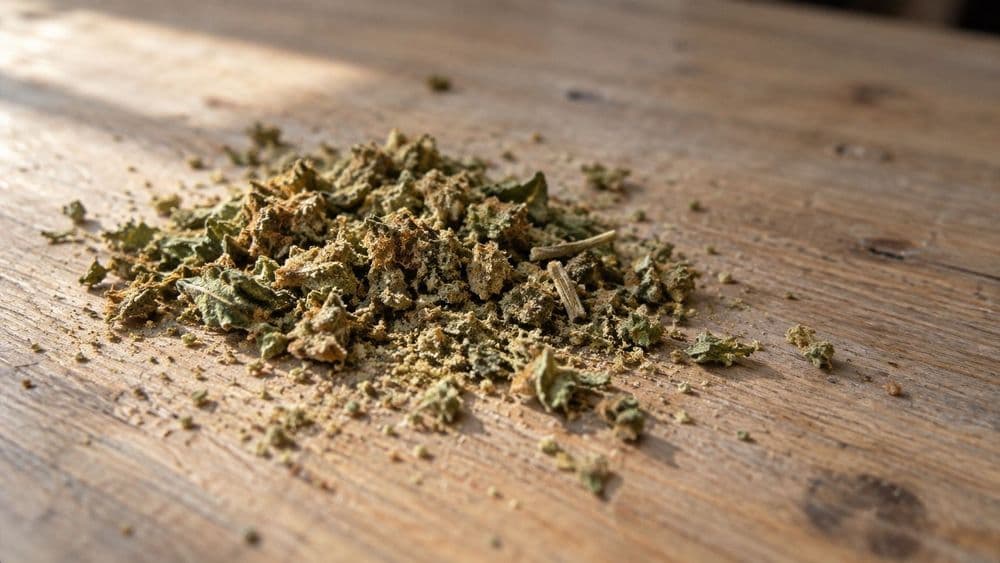
Shake is the loose material at the bottom of a bag or jar of cannabis flower: broken bits of bud, pieces of leaf, a little stem and resin glands that fell off in handling. It sells for less, and sellers usually say it is just as strong as the bud it came from. Sometimes that is true. This guide shows what plant-part measurements actually found, what regulators say about trim, and what words like "mids" and "top shelf" can and cannot tell you.
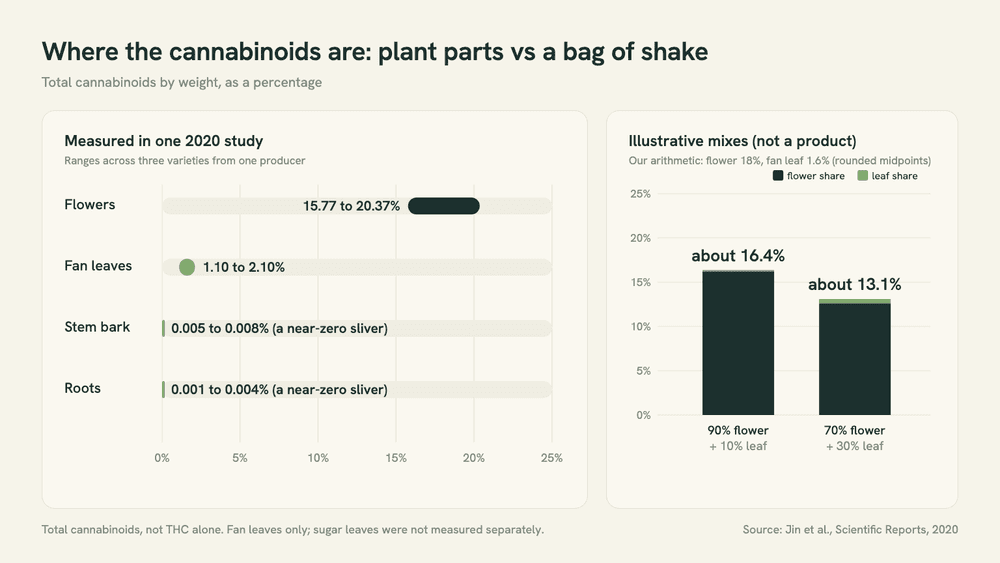
What is shake weed, in short: shake is a mixture, not a grade. It is whatever breaks off finished buds as they are trimmed, packed, moved and scooped, so it holds flower fragments, some leaf, bits of stem and loose resin heads. Its potency depends on that mix. In a 2020 analysis of three cannabis varieties, the flowers measured 15.77 to 20.37 percent cannabinoids by weight and the big fan leaves 1.10 to 2.10 percent, roughly a tenth. So shake can sit close to the bud or well below it, and only a test of that material settles which.
What is shake weed? Shake vs trim vs smalls vs whole bud
| Shake | Trim | Smalls / popcorn | Whole bud | |
|---|---|---|---|---|
| What it is | Loose fragments: bud pieces, sugar leaf, stem bits, fallen resin heads | Leaves cut away from buds during manicuring | Whole buds that are small, often from lower branches | Intact, trimmed flower |
| Where it comes from | The bottom of bags, jars and bins after handling | The trimming table, before packaging | Sorted out by size after trimming | The flower lot itself |
| What is measured about potency | Nothing at retail: we found no published study comparing it with bud from the same lot | Fan leaf measured about a tenth of flower in one study; sugar leaf not measured on its own | Lower buds up to 90% lower than the top bud in one greenhouse trial | Whatever the lot test reports; flower labels run high in independent audits |
| Tested as its own lot? | Depends on the seller; ask | Yes in Washington: its own lot of "trim, leaves, or other plant matter", up to 15 lb | Not on its own: sold as flower, it carries the flower lot's result | Yes: in Washington a flower lot is up to 5 lb of one strain |
The last row is the one most shake guides skip. Washington's cannabis rules do not treat trim as flower. A lot of flower is capped at five pounds of one strain; a lot of "trim, leaves, or other plant matter" can be 15 pounds and can come from more than one plant. Shake falls between the two. It started as flower, but by the time it reaches a bag it may carry more leaf and resin dust than the sample that was tested. That gap between what was tested and what is in your bag is the whole story of this page.
What shake physically is, and what trim is
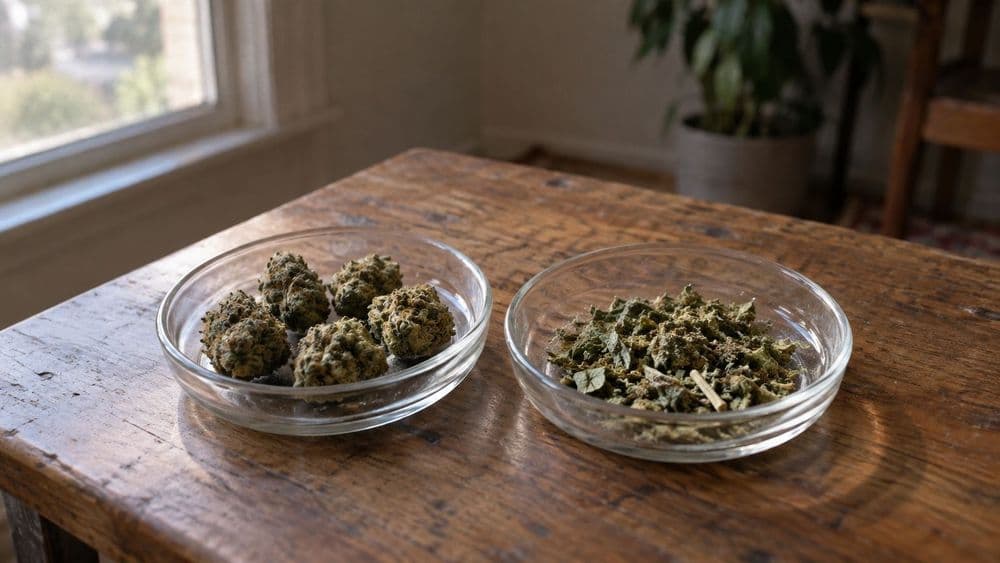
Picture a finished bud. It is mostly bracts (the small leaf-like structures that wrap each flower and carry most of the resin), plus a few small "sugar leaves" poking out, all attached to a stem. Every time buds are trimmed, dried, jarred, weighed or poured, pieces break off. Collect those pieces and you have shake. A typical handful contains four things in proportions nobody writes down:
- Flower fragments: broken pieces of bud, the most potent part of the mix.
- Sugar-leaf pieces: the small leaves inside the bud, frosty but uneven.
- Stem bits: woody material with almost no cannabinoids.
- Loose resin heads: the tiny glands that snapped off buds and settled at the bottom, the most concentrated part of all.
Trim is different. It is the leaf cut away from buds when they are manicured, before anything is packed, and it is mostly sugar leaf with some larger leaves. Stem is limited too, at least for flower sold as flower: Washington fails a flower sample if more than 5 percent of it is stems 3 mm or thicker, or more than 2 percent is seeds or other foreign matter. Sugar leaves themselves are hard to pin down. A 2025 review of trichome counting studies describes them as frosty but uneven, denser at their tips and edges, and bracts as the most consistent part of the flower. No study we found gives a single potency figure for sugar leaves.
Is shake weaker than bud? What the plant-part measurements show
The best direct comparison of plant parts is the 2020 study in Scientific Reports mentioned above. Researchers took three varieties from a Canadian licensed producer (two THC-dominant, one with about twice as much CBD as THC) and measured cannabinoids and terpenes in the dried flowers, the fan leaves (air-dried for 24 hours), the stem bark and the roots of the same plants. The flowers measured 15.77 to 20.37 percent total cannabinoids, the fan leaves 1.10 to 2.10 percent, stem bark 0.005 to 0.008 percent and roots 0.001 to 0.004 percent. Aroma compounds split the same way: about 1.3 to 2.1 percent in the flowers and 0.13 to 0.28 percent in the leaves. If terpenes are new to you, our explainer on cannabinoids vs terpenes covers what they are.
Three limits matter here. Those were fan leaves, the big leaves on the plant; the small sugar leaves that end up in trim and shake were not measured separately, and they carry more resin. The figures are total cannabinoids, not THC alone. And it is three varieties from one producer, and three of the four authors are affiliated with a testing lab. Older botany explains why the gap exists. Botanists at Indiana University counted resin glands on developing flower bracts in 1981 and found the cannabinoid content rose with the gland count; their estimate was that the glands may hold most of a bract's cannabinoids. The same group then studied ordinary leaves and noted they carry small sessile resin glands but not the tall stalked glands that cover flower bracts. More recently, a University of British Columbia study published in 2020 found the stalked glands on flowers have 12 to 16 secretory cells and a signature linked to high cannabinoid levels, while the smaller sessile glands found on leaves have eight.
Now the mixture arithmetic, which is ours and purely illustrative. Take round midpoints from the 2020 study: flower at about 18 percent total cannabinoids, fan leaf at about 1.6 percent. A bag that is 90 percent flower fragments and 10 percent leaf by weight works out to 0.9 x 18 + 0.1 x 1.6, or about 16.4 percent. At 70 percent flower and 30 percent leaf it drops to about 13.1 percent. Loose resin heads push the other way, because they are the most concentrated material in the bag. That is why shake's potency is a range, not a property. These numbers use fan-leaf figures and describe no real product.
So why do sellers say shake has the "same potency" as bud? Sometimes it does. If a bag is mostly broken flower from one strain, it can sit close to the flower's number, and if it caught a lot of fallen resin it can even test higher. The claim becomes shaky when the bag carries a lot of leaf or stem, or when the number on it belongs to a different sample. And the flower's own number is not always reliable to start with, as our guide to whether THC percentage matters explains.
Why the bottom of the bag looks frosty
The pale dust in the corner of a bag is resin glands. Under an electron microscope, a 2023 Simon Fraser University study showed a narrow neck forming at the top of the stalk that holds each resin head as the flower matures, and many heads breaking off there during trimming and drying. Machine-trimmed buds had lost many heads; hand-trimmed ones had mostly kept them. The authors concluded that post-harvest handling affected the glands more than the drying process itself and can potentially affect THC or CBD levels. The heads are 40 to 110 micrometers across, fine enough to sift to the bottom of a bag. The study took images and compared handling methods; it did not measure the potency of the loose material.
Regulators recognize the same material. Colorado's rules define kief, in the version in force from December 2024, as the resinous trichomes "physically separated from" flower, shake or trim, resulting in a higher concentration of cannabinoids. The dust at the bottom of a bag is that same material, which is why a scoop from the bottom can test stronger than the leaf in it, and why two scoops from the same bin can differ.
Shake goes stale faster: surface area and air
Small, broken pieces expose more surface to air and light than a whole bud does. When a Technion group stored flower whole or ground for a year, testing two medical varieties in the dark at four temperatures, aroma compounds fell under every condition, and grinding was one of the two worst treatments (the other was freezing below -20 C). Cannabinoids in the ground samples trended lower too, though that difference was not statistically significant, and grinding led to more of the breakdown products, especially at room temperature. Ground flower is not shake, but broken material behaves more like it than a whole bud does. For what happens to THC as it ages and how storage changes it, see what storage studies found about weed going bad. The practical point for buying: a test result from the day the flower was packed says less about loose material sold weeks later.
What are mids? Top shelf, exotic, smalls and popcorn
"Mids" means middle-tier flower: priced below a store's top shelf and above its bargain bin. "Top shelf", "premium" and "exotic" sit at the top of the same ladder. The ladder belongs to the seller. We found no federal grading standard for cannabis flower, and the state rules we read do not define these words either. A Washington flower label must show a lot number, net weight, total THC and total CBD, and must not be false or misleading. It has no field for "top shelf", "mids" or "exotic"; when we searched Washington's lot, testing and labeling rules on September 25, 2026, none of those words appeared. Colorado's rules say something even more direct about shake itself:
“...selecting only a part of the Harvest Batch(es) that is not representative of the entire Harvest Batch each time they produce a certain type of Pre-Rolled Marijuana (e.g. using only the shake/trim out of a Harvest Batch).”
In plain terms, Colorado's testing rule, in the version in force from December 2024, required potency tests on every production batch of pre-rolls made by "using only the shake/trim out of a Harvest Batch", and gave that as its example of a part of the harvest that is not representative of the whole. That is the thesis of this page, in a regulator's words. Size words have the same problem. In a greenhouse trial on one medical cultivar, buds from the bottom of the plant had up to 90 percent lower cannabinoid concentrations than the top bud; the authors linked it to lower branches getting less light. That is the worst case in one CBD-dominant cultivar, not a rule, but it is why "smalls" is a size word, not a potency promise. You will also see THC ranges quoted for mids online. We could not find a source for them, so we do not repeat them.
- Top shelf, premium, exotic: tells you the seller's price and pitch. Does not tell you potency, freshness or test results.
- Mids: tells you the middle of that seller's price range. Does not tell you anything that transfers to another store.
- Smalls, popcorn: tells you the buds are small, often from lower branches. Does not tell you they match the lot's top buds.
- Shake: tells you the material is loose fragments. Does not tell you the leaf-to-flower ratio or whether it was tested as itself.
- Trim: tells you it is mostly leaf cut from buds. Does not tell you which plants it came from; in Washington a trim lot can combine more than one plant.
How to judge any tier in 60 seconds
Since the tier word carries no measurement, the check is the same for top shelf and for shake: find the test and ask what it describes. In Washington, for example, the lab result for a harvest of up to ten pounds comes from at least eight samples of one gram or more, and flower sold as flower carries that result. Loose material scooped later may or may not look like that sample. If you have not read a certificate of analysis before, our line-by-line guide to reading a COA shows where each field sits, and the trust signals in our fake-product guide show how to tell whether a lot number leads to a real report.
- 1Find the lot number on the label. In Washington it is required, next to net weight, total THC and total CBD. No lot number means no way to match the bag to a test.
- 2Ask whether this material was tested as itself or carries the result of the flower lot it came from. Colorado's rules in force from December 2024 required potency tests on pre-rolls made only from shake/trim.
- 3Read total THC, not only THC or THCA. Federal hemp rules compute it as THC plus 0.877 x THCA, because THCA turns into THC when heated.
- 4Compare the test date with the packaging date. Broken material ages faster, so an old result says less about a bag packed later.
- 5Check that moisture (water activity), foreign matter and microbial results passed. Washington fails flower above 0.65 water activity, 5% thick stems or 2% seeds and other foreign matter.
- 6If it is a blend of strains, look for its own test. Washington treats a ground multi-strain mix as a new lot that needs a new cannabinoid test.
- 7Do the per-milligram math with the tested number, not the tier word (next section).
Is shake worth it? The price-per-milligram check
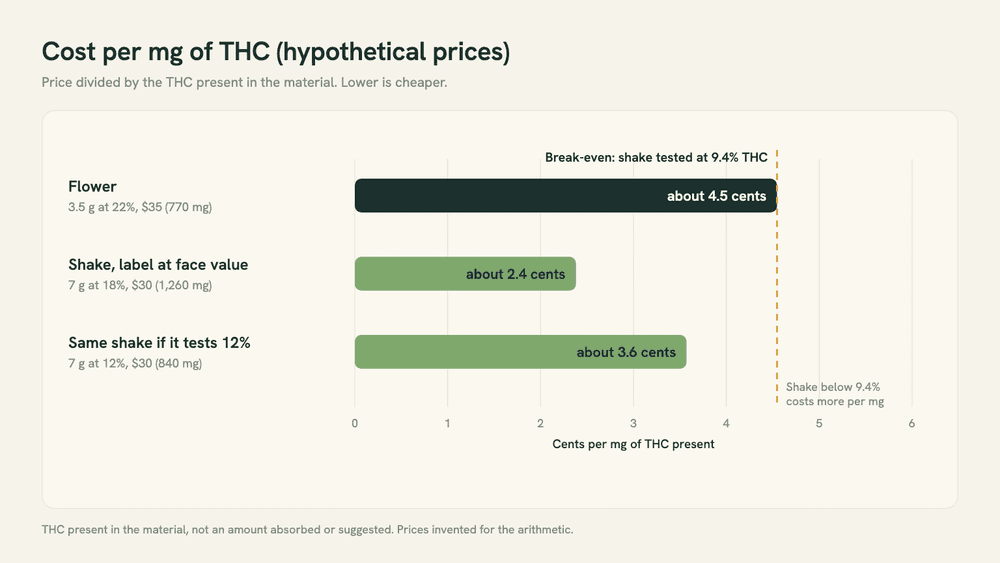
Shake is sold on price, so compare it on price per milligram of THC, not per gram. The method: grams x 1,000 x the percentage gives milligrams of THC in the material; divide the price by that. The prices below are invented to show the arithmetic, and "THC present" is what the material contains, not what a person absorbs and not a suggested amount.
| Item | Weight | Label total THC | THC present | Price | Cost per mg |
|---|---|---|---|---|---|
| Eighth of flower | 3.5 g (3,500 mg) | 22% | 770 mg | $35 | About 4.5 cents |
| Bag of shake, label taken at face value | 7 g (7,000 mg) | 18% | 1,260 mg | $30 | About 2.4 cents |
| Same shake if the mix really tests 12% | 7 g | 12% | 840 mg | $30 | About 3.6 cents |
| Break-even: shake stops being cheaper below | 7 g | 9.4% | 660 mg | $30 | About 4.5 cents |
The flower gives 22 mg of THC per dollar (770 divided by 35). The shake matches that at 7,000 x p / 30 = 22, which means p is about 9.4 percent. Above that, at these prices, shake is cheaper per milligram; below it, the flower is. Even the 12 percent case, a mix heavy with leaf, stays cheaper. The catch is the input: the arithmetic is only as good as the percentage you plug in. Labels on whole flower already run high in independent audits. In a 2023 study that bought flower in Colorado and retested it, about 70 percent of 23 samples came in more than 15 percent below their labels. The full label-inflation picture and the percent-to-milligram method are on our THC percentage guide, so we do not repeat them here. If you are weighing formats rather than tiers, our blunt vs joint comparison covers what the wrapper adds.
Hemp and CBD shake: same logic, different test
Everything above applies to hemp flower too. CBD shake is still a mix of fragments, leaf and loose resin, and its potency still depends on that mix. The testing is different, though. Under the federal hemp rules, hemp is sampled in the field within 30 days before harvest and tested for total delta-9 THC at a DEA-registered lab. That test describes the crop, not a bag of loose material packed months later. Whether a given hemp flower product is legal where you live, and how the federal hemp definition changes in late 2026, is covered in our guide to whether CBD flower is legal, and intoxicating hemp products are explained in how hemp-derived THC reached store shelves. For transparency: Planntz sells no flower, shake or THC product, so nothing on this page is a pitch.
What is still unknown
- How retail shake compares with bud from the same lot. We searched PubMed on September 25, 2026: two records mention cannabis and "shake" in the title or abstract, and neither is about this. We found no published test of it.
- How potent sugar leaves are. The 2020 plant-part study measured fan leaves, and a 2025 review found no single potency figure for sugar leaves.
- How big the gap between top buds and smalls usually is. The "up to 90 percent" figure is the maximum in one CBD-dominant cultivar in one greenhouse.
- How much resin a bag of shake loses or gains in handling. The 2023 microscope study showed heads breaking off but did not weigh them.
- Whether Colorado's current rules still match the December 2024 version quoted here. We read that version through Cornell's Legal Information Institute and could not confirm the state's current text.
Frequently asked questions
No. Trim is leaf cut away from buds during manicuring, before packaging, and Washington treats it as its own lot of "trim, leaves, or other plant matter" (up to 15 lb). Shake is what breaks off finished buds later, in drying, jarring and handling, so it usually holds more flower fragments and loose resin than trim does.
It depends on the mix. In a 2020 analysis of three varieties, flowers measured 15.77 to 20.37 percent total cannabinoids and fan leaves 1.10 to 2.10 percent. Shake that is mostly broken flower can sit close to the bud; shake heavy with leaf or stem will not; fallen resin can push it higher. Only a test of that material settles it, and we found no published study comparing retail shake with bud from the same lot.
Mids is slang for middle-tier flower, priced between a store's top shelf and its cheapest options. It is a price tier set by the seller. We found no grading standard behind it: Washington's flower label rules require lot number, net weight, total THC and total CBD, with no grade field.
Not by definition. "Top shelf" is the seller's label for its highest price tier. The only potency number that travels with the product is total THC from its lot test, and independent audits of flower have found labels running high. Compare tested numbers, not shelf names.
No. Popcorn buds and smalls are whole small buds, often from lower branches; shake is loose fragments. Small size does not guarantee the same potency as top buds: in one greenhouse trial on a CBD-dominant cultivar, buds from the bottom of the plant had up to 90 percent lower cannabinoid concentrations than the top bud. That is one study's maximum, not a typical gap.
Broken material exposes more surface to air. In a 12-month storage study, ground flower lost aroma compounds faster than whole flower and built up more breakdown products, while its lower cannabinoid levels were a trend, not a significant difference. Ground flower is a stand-in for shake, not shake itself.
Compare it per milligram of THC, not per gram. In our hypothetical example ($35 for 3.5 g of flower at 22 percent, $30 for 7 g of shake), the shake stays cheaper per milligram unless it tests below about 9.4 percent THC. The answer depends on the tested percentage of the shake itself, so ask whether it has one.
No. Moon rocks is a name for buds coated in cannabis concentrate and rolled in kief, a concentrate-heavy product that is different from shake. Like any tier or product name, it does not replace the lot test.
Every tier on the shelf comes back to the same question: what does the test for this lot say, and does it describe what is in your bag? If you want to answer that yourself, read a certificate of analysis line by line before your next purchase, whatever the price tier.
Writing about hemp, wellness and the small rituals that keep us balanced.