Myclobutanil: The Farm Fungicide Cannabis Labs Keep Finding
Myclobutanil is a farm fungicide with no US residue limit for cannabis, yet Health Canada's survey found it more often than any other pesticide in seized cannabis. We read the recall notices, safety data sheets and state rules, and show the COA line that answers the question.
Myclobutanil is a farm fungicide. US regulators have set food residue limits for it on about 70 food and feed commodities and none for cannabis or hemp. Even so, it was at the center of Canada's 2016-2017 medical cannabis recalls, and in the agency's 2026 market survey it was the pesticide found most often in seized cannabis. If you typed the word into a search bar, you probably want three answers: is it in what I buy, does it matter, and how would I know? We went to the recall notices, the safety data sheets and the state rules to answer all three from the documents, not the lore.
The short version. Myclobutanil has no US residue limit on cannabis or hemp, and Canada does not authorize it on cannabis plants. The residues measured today cluster in the illicit market, including illicit vape cartridges. California fails a smokable or vaped batch above 0.10 micrograms per gram (µg/g, the same as parts per million, or ppm) and an edible or tincture above 9.0. The popular claim that it "turns into cyanide at 401 °F" is not a measurement: that number matches a boiling point taken near vacuum, and the current Eagle 20EW safety data sheet does not name hydrogen cyanide among its combustion products. The only way to know whether a product contains myclobutanil is a certificate of analysis (COA) whose pesticide panel names it and reports a result. Further down, we say plainly which of our own certificates do that and which do not.
What is myclobutanil?
The FAO/WHO Joint Meeting on Pesticide Residues (JMPR), the expert panel two United Nations agencies run to evaluate pesticide residues in food, describes myclobutanil in its 2014 evaluation as "a systemic protectant fungicide used to control brown rot, powdery mildew and leaf spot in stone fruit crops" that belongs to the sterol demethylation inhibitor (DMI) class. In plain terms, the plant absorbs it and moves it through its tissue, where it blocks fungi from making the sterols their cell membranes need. It is a triazole compound (CAS number 88671-89-0) that melts at 70.9 °C. "Systemic" is the word to remember: a residue that sits inside the plant is not something you can rinse off the surface.
If you have heard of Eagle 20, that is a brand, not a different chemical. The current Eagle 20EW safety data sheet, revised in December 2025, lists the product as 19.7% myclobutanil, about one-fifth by weight; the rest of the formula includes solvents. That distinction matters when we get to the hazard labels, because some of them belong to the mixture, not to myclobutanil.
In the US, the federal tolerance rule for myclobutanil, 40 CFR 180.443, sets the most residue legally allowed on about 70 food and feed commodities, from fruit and nuts to livestock tissues, milk and processing leftovers such as grape pomace. Here is a sample, as read on November 11, 2026.
| Commodity | EPA tolerance (ppm) |
|---|---|
| Grape | 1.0 |
| Raisin | 10 |
| Strawberry | 0.50 |
| Almond | 0.1 |
| Hop, dried cones | 10 |
| Cilantro, leaves | 9.0 |
| Peppermint, tops | 3.0 |
| Cannabis or hemp | None set |
A tolerance is a residue limit for food. It is not, on its own, a statement that the chemical is sprayed on that crop in the US, and it says nothing about smoking or vaping. The row that matters here is the last one: there is no federal number for how much myclobutanil is acceptable on cannabis or hemp, so the limits you will see on a cannabis COA come from states and other countries.
Why does a farm fungicide end up in cannabis?
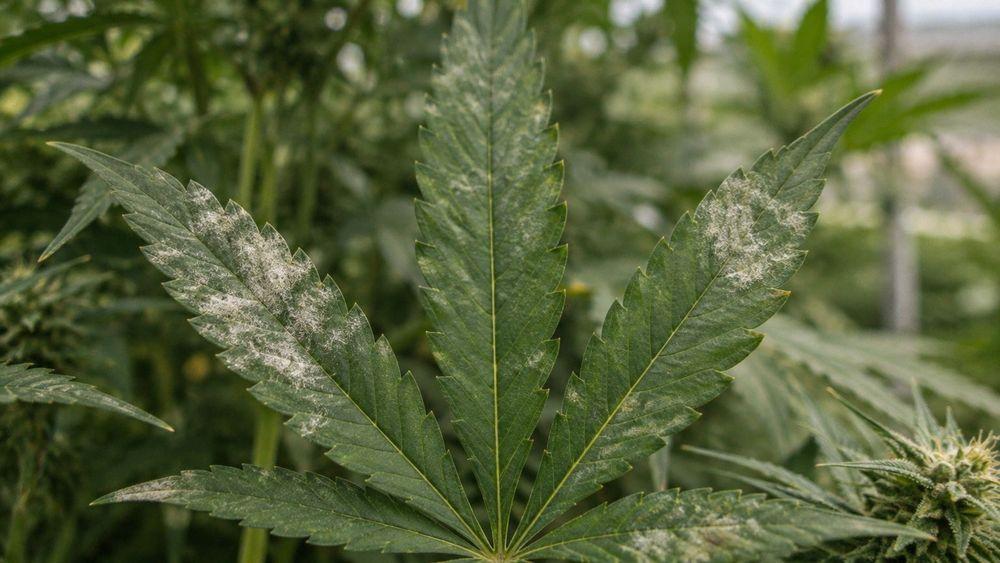
Because cannabis gets the same fungal problems other crops do. Powdery mildew, the white, flour-like coating that myclobutanil was built to stop, is a familiar threat in cannabis grow rooms, as our comparison of indoor and outdoor weed covers. A systemic fungicide is tempting to a grower facing a crop loss, and that same systemic quality means the residue travels into the leaves and flowers rather than staying on the surface.
What is supposed to keep it off legal cannabis is that it has no approval for that crop. In Canada, Health Canada's recall notices from 2016-2017 state that myclobutanil was "not found in the thirteen pesticides that are authorized for use on cannabis plants" under the Pest Control Products Act. In the US there is no residue tolerance for cannabis or hemp, so state cannabis regulators set their own action levels instead. The residue can also outlast the grow: a 2025 US Geological Survey study of abandoned illegal grow sites on federal land found myclobutanil among the fungicides still in the topsoil, at up to 8.1 ng/g for that group, at sites that had been inactive for 8 months to 2 years. It belongs to the same family of problem as the growth regulators in our guide to PGR weed: a chemical applied during growing that nobody can see on the finished flower.
Does myclobutanil turn into hydrogen cyanide?
This is the line most cannabis pages repeat, usually as "myclobutanil turns into hydrogen cyanide when heated above 401 °F." We went to the documents behind it. A generic myclobutanil 20 EW safety data sheet from 2015 says that "during a fire", irritating and highly toxic gases may be generated, and lists hydrogen chloride, hydrogen cyanide, oxides of nitrogen and carbon monoxide. The current Eagle 20EW sheet lists nitrogen oxides, hydrogen chloride gas and carbon oxides as combustion products, in a list it introduces with "may include and are not limited to", and does not name hydrogen cyanide. It adds that "during a fire, smoke may contain the original material in addition to combustion products." A safety data sheet for the pure compound names carbon oxides, nitrogen oxides and hydrogen chloride gas as fire hazards, and gives "no data available" for other decomposition products. These are firefighting warnings for a drum of concentrated product, not measurements of what a residue does in a joint or a vape.
Then there is the 401 °F (205 °C) figure. It matches a boiling point, not a breakdown point: the pure-compound sheet gives an initial boiling point of "202 - 208 °C at 1 hPa", which is about one-thousandth of normal air pressure. At near-normal pressure, the FAO/WHO evaluation puts the boiling point at about 391 °C (736 °F). Neither number is a temperature at which the molecule gives off cyanide, and we found no source that measured one. We also searched PubMed on November 11, 2026, for myclobutanil together with pyrolysis, smoke, combustion, thermal or cannabis. Thirteen records came back, and none measured hydrogen cyanide, or myclobutanil itself, in the smoke or vapor of cannabis containing it.
Two more facts put the claim in context. First, cannabis smoke contains hydrogen cyanide with no pesticide involved. When Health Canada machine-smoked cannabis and tobacco cigarettes prepared the same way, hydrogen cyanide was among the compounds found in the cannabis smoke at 3 to 5 times the tobacco level. So a lab finding cyanide in cannabis smoke does not, on its own, point to a fungicide. Second, pesticide residues can survive the flame. A 2013 Journal of Toxicology study found that up to 69.5% of four other pesticides applied to cannabis came through in glass-pipe smoke; myclobutanil was not one of them. And researchers developing fungicide smoke generators reported that myclobutanil's smoke formation rate stayed above 90%. That is a purpose-built formulation, not cannabis, but it suggests heat can carry the molecule into the air intact. We apply the same standard to combustion claims elsewhere on this blog, from hemp wicks to one-hitter pipes: a safety data sheet tells you what a fire can release, not what you inhale.
The recall record, with dates
The best-documented myclobutanil recalls come from Canada's licensed medical cannabis market, and Health Canada's own notices give the dates. Mettrum Ltd. According to Health Canada's Mettrum recall notice, a Type III recall (the class for products "not likely to cause any adverse health consequences") started on November 2, 2016, after an October 2016 inspection found pyrethrins. On December 5, 2016, and again on January 7 and January 28, 2017, the company expanded the voluntary recall to lots containing low levels of myclobutanil: 185 lots in all for that fungicide. The notice states that all tested lots "did not exceed any of the levels permitted in food production." Health Canada recorded 10 adverse reaction reports for the recall period.
Organigram Inc. Health Canada's Organigram recall notice records a voluntary Type III recall that began on December 28, 2016, after 5 lots tested positive for low levels of myclobutanil and/or bifenazate. On January 9, 2017, it became a Type II recall, the class for products that "may cause temporary adverse health consequences, or where the probability of serious adverse health consequences is remote", after further lots carried myclobutanil or bifenazate above the levels permitted in food. The recall covered product made between February 1 and December 16, 2016. Health Canada logged one adverse reaction report.
Adverse reaction reports are reports, not proof that a product caused the reaction. What these records do show is that the problem turned up at licensed, regulated producers, and that it was found because someone tested. When Health Canada inspectors made unannounced visits to licensed producers, 26 of 144 samples carried pest control products not authorized for cannabis. A later paper from Health Canada's pesticide lab summarized that inspection work as finding myclobutanil, bifenazate, boscalid and fludioxonil most often. Canada now requires licensed cannabis to be tested for 96 pesticide active ingredients.
Those numbers point to where myclobutanil turns up today: the illicit channel. In Health Canada's 2026 survey of 50 legal and 50 seized illegal flower samples, myclobutanil was "the most prevalent pesticide", found in 72% of the illegal samples at up to 130 µg/g; paclobutrazol, a growth regulator, turned up in 60%. One legal sample in 50 (2%) showed myclobutanil at 0.01 µg/g, the lowest level the method was calibrated to measure, and the authors attribute such legal-sample traces to environmental or accidental contamination rather than intentional use. The agency's 2023 paper found it in 17 of 24 illicit flower samples, at 0.02 to 70 µg/g, and once in 36 licensed samples, at 0.01 µg/g.
Vapes show the same pattern. New York State's public health laboratory tested cannabis oil cartridges recovered from patients with vaping lung injury between 2019 and 2021, apparently bought from unauthorized or black-market dealers. In 202 illicit cartridges from New York patients, 79% carried pesticide residues, and myclobutanil turned up in half. Our explainer on THC distillate covers what goes into those cartridges, and our guide to spotting a counterfeit cart covers how to avoid them. For scale, 70 µg/g is 700 times and 130 µg/g is 1,300 times California's limit for inhalable products. That is arithmetic against a regulatory line, not a measure of harm, and these are Canadian and New York samples, not a survey of every market.
Myclobutanil limits by state and product type
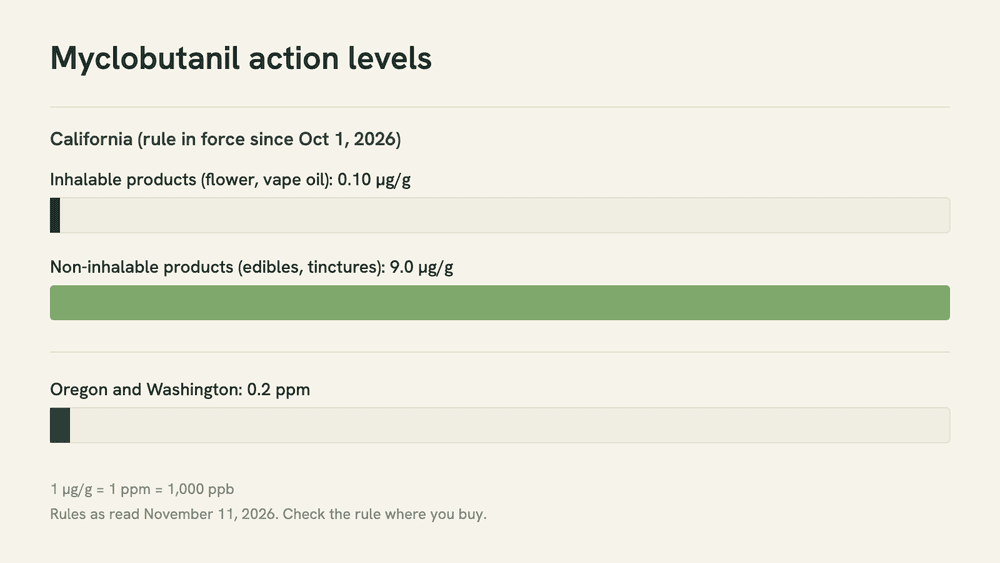
Every market draws its own line, and the line depends on how the product is used. California rewrote its pesticide rule this year: the final text of rulemaking DCC-2025-03-R, approved on July 27, 2026, and effective October 1, 2026, keeps myclobutanil at 0.10 µg/g for inhalable products and 9.0 µg/g for non-inhalable ones, the same values the old table carried, in both the table that runs until April 1, 2028, and the one that starts that day. Oregon's testing table fails a sample above 0.2 ppm, and Washington's rule, WAC 314-55-108, uses the same 0.20 line. Health Canada's pesticide list requires labs to be able to measure myclobutanil down to 0.02 ppm; that is a minimum lab sensitivity, not a pass or fail limit, and because myclobutanil is not authorized on cannabis there, any confirmed residue is a problem.
| Jurisdiction | Products covered | Myclobutanil limit | Rule and status |
|---|---|---|---|
| California | Inhalable (flower, vape oil) | 0.10 µg/g | DCC-2025-03-R, effective Oct 1, 2026; same value from Apr 1, 2028 |
| California | Non-inhalable (edibles, tinctures) | 9.0 µg/g | DCC-2025-03-R, effective Oct 1, 2026; same value from Apr 1, 2028 |
| Oregon | Marijuana items tested for pesticides | 0.2 ppm | OHA Exhibit A, Table 3, effective Mar 31, 2022 |
| Washington | Cannabis tested for pesticides | 0.20 ppm | WAC 314-55-108 |
| Canada | Licensed cannabis | Labs must measure to 0.02 ppm; not an authorized cannabis pesticide | Health Canada list of 96 active ingredients |
| US federal hemp | Hemp crop | No pesticide test required; crop sampled for total THC | 7 CFR 990.3 |
A note on units, because COAs mix them: 1 µg/g = 1 mg/kg = 1 ppm = 1,000 ppb, so California's 0.10 µg/g is 100 ppb. California's smokable limit is 90 times tighter than its edible limit, and as the safety section below explains, we found no study of inhaling this residue to set a number from. Hemp is the gap. The federal hemp rule samples the crop for THC within 30 days before harvest. It does not require a pesticide test on the bottle you buy; whether one exists depends on your state and on the seller. These limits change, so check the rule where you buy.
Pesticides in weed: what else labs look for
Myclobutanil is one row on a long panel. A California-style pesticide panel, such as the one on our gummy's certificate, lists 66 compounds, each with its own limit. The ones that keep coming up in the records above are worth knowing by name: bifenazate (a miticide, in the Organigram recall), pyrethrins (the first finding in the Mettrum recall), boscalid and fludioxonil (two more fungicides from the Canadian inspections), and paclobutrazol, the growth regulator found in 60% of seized samples in the 2026 Canadian survey. In the 2023 Health Canada study, illicit samples carried an average of 3.7 pesticide actives each, with chlorpyrifos and imidacloprid measured at up to 30 and 60 µg/g. A full COA also tests separately for heavy metals, microbes, mycotoxins and residual solvents; pesticides are their own section.
None of this shows up to your eyes or nose. Ash color, harshness and smell are not pesticide tests; our piece on white ash vs black ash explains why the ash myth falls apart. The only reliable signal is a lab report that names the compound.
Is myclobutanil safe? What the agencies actually concluded
Agencies classify hazards: what a chemical can do at some dose, usually in animals. Here is what each one concluded about myclobutanil, and where its evidence came from. EPA's 2008 tolerance rule summarizes the toxicology. California's 1999 Proposition 65 listing notice records the reproductive listing. The WHO JMPR database gives the international dietary limits.
- EPA (2008): in rat studies, the primary target organs were the liver and testes. EPA found myclobutanil "not carcinogenic in two acceptable animal studies", with "no concern for mutagenic activity" and no sign the young were more susceptible.
- California Proposition 65: listed since April 16, 1999, as a chemical known to cause developmental and male reproductive toxicity, based on a formal identification by an authoritative body.
- Safety data sheets: Eagle 20EW carries the hazard statement H361, "suspected of damaging fertility or the unborn child"; the pure-compound sheet uses H361d, "suspected of damaging the unborn child".
- FAO/WHO JMPR (2014): an acceptable daily intake of up to 0.03 mg per kg of body weight, and an acute reference dose of 0.3 mg/kg that applies to women of child-bearing age only. Both numbers are for eating it.
- The cancer label you may see quoted: the Eagle 20EW mixture carries H351, "suspected of causing cancer", but the same sheet says myclobutanil "did not cause cancer in laboratory animals" and ties the concern to naphthalene in the formula.
Notice what is missing. None of that work involved smoking or vaping. The acceptable daily intake is an oral number, and we found no agency that has set an inhalation equivalent for a cannabis residue, so dividing a vape result by it gives you a meaningless figure. A Prop 65 listing says what a chemical can do at some dose; it does not say what a trace residue does. That gap is exactly why the limits for smokable products are so strict, and why a clean panel is worth asking for. The reproductive listings are one more reason to avoid untested inhaled products if you are pregnant or trying to conceive, and to talk with your clinician about any cannabis use.
How to check a COA for myclobutanil
You need the batch's certificate of analysis and about a minute. Our step-by-step guide to reading a certificate of analysis covers the whole document; here is the pesticide part, in order.
- 1Find the pesticide section. Check the summary box first: if it lists only potency, metals and microbial results, the batch was not tested for pesticides and the COA cannot answer this question.
- 2Look for "Myclobutanil" by name. A panel that prints each compound with its own result tells you more than a single "pesticides: pass" line.
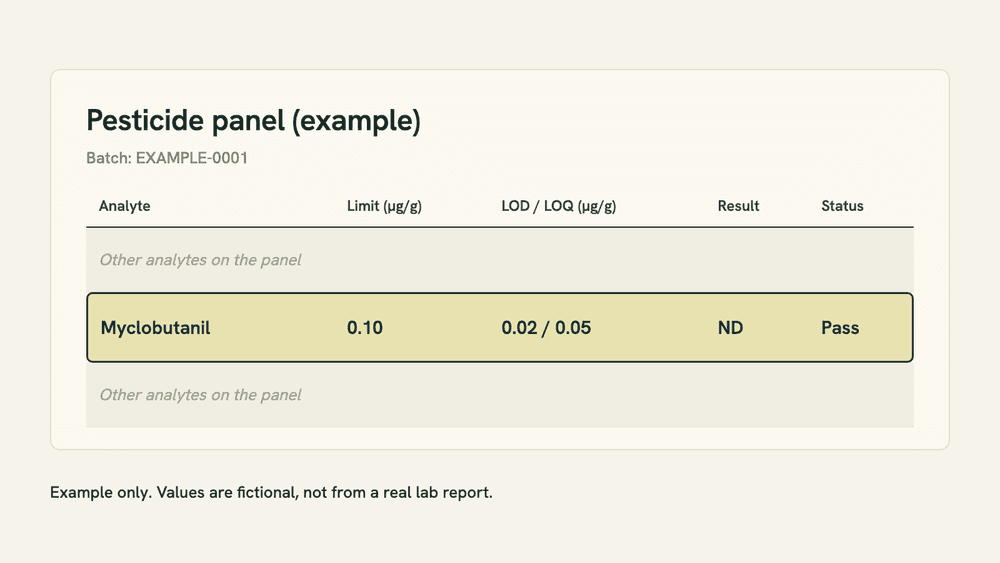
- 3Read the row across: limit (action level), result, LOD/LOQ and pass or fail. ND means not detected, below the limit of detection (LOD); "<LOQ" usually means detected but below the limit of quantitation (LOQ), too low to put a number on.
- 4Check that the LOQ sits well below the limit. On our gummy's certificate, the myclobutanil LOQ is 0.0546 µg/g against a 9 µg/g limit, about 1/165 of it.
- 5Match the limit to how you use the product. A 9 µg/g limit is California's edible line; for flower or a vape, California's line is 0.10 µg/g.
- 6Match the batch or lot number and the test date to the package in your hand.
- 7Check who ran the test: a named, independent lab with a license or accreditation number you can look up.
- 8No pesticide section at all? Ask the seller for one before you buy.
Two more checks protect you from the most common misreads. A COA is only as good as the lab behind it; our explainer on what "third-party tested" really means covers how to judge lab independence. And words like "organic" or "clean" describe how something was grown or marketed, not a lab result; our guide to what organic hemp means explains the difference between a certification and a measurement.
What our own COAs test
We re-read every certificate on our lab-results page on November 11, 2026. Our gummy's certificate includes a 66-compound pesticide panel, run by two mass-spectrometry methods (LC-MS/MS and GC-MS/MS), and its myclobutanil line reads "ND" (not detected) against a 9 µg/g limit, with a quantitation limit of 0.0546 µg/g. That 9 µg/g matches California's non-inhalable action level, which fits an edible. Our oil certificates report potency, four heavy metals and microbial tests; they do not include a pesticide test. So for our oils, our own paperwork cannot tell you whether myclobutanil is present, and you should hold us to the same checklist above.
What we still don't know
We found no measurement of hydrogen cyanide from cannabis that contains myclobutanil, and no study of what inhaling the residue does to people; the agency toxicology comes from animals that ate or touched it. The state limits are precautionary lines, not measured thresholds of harm. Most of the prevalence data come from Canada and from one New York lab, with sample sizes in the dozens to low hundreds, so they cannot tell you how often legal US products carry it. The Canadian recall notices describe residue levels relative to food limits, not health outcomes. We read four jurisdictions' rules, not every state's, and rules change: everything here is as read on November 11, 2026. Finally, we could not find a peer-reviewed study of washing or flushing myclobutanil out of flower.
Myclobutanil questions, answered
Agencies have classified its hazards, not your exposure. In rat studies, EPA found effects on the liver and testes and no evidence of cancer in two acceptable animal studies. California has listed it under Proposition 65 since 1999 for developmental and male reproductive toxicity, and the FAO/WHO panel set an oral acceptable daily intake of up to 0.03 mg/kg. We found no study of inhaling it as a cannabis residue, which is why smokable limits are so strict.
Eagle 20EW is a brand-name product; myclobutanil is its active ingredient. The current safety data sheet lists it at 19.7% myclobutanil, plus other ingredients that include solvents. Some hazard labels on the product, including its cancer statement, belong to the mixture rather than to myclobutanil.
We found no study that measured it. Some safety data sheets list hydrogen cyanide among the gases a fire can release; the current Eagle 20EW sheet does not. The often-quoted 401 °F is a boiling point measured near vacuum, not a breakdown temperature. Plain cannabis smoke already contains hydrogen cyanide, so the practical question is whether the residue is there at all.
It has no US residue tolerance for cannabis or hemp, and Canada does not authorize it on cannabis plants. So state cannabis regulators set action levels, and they are tightest for smokable products: California fails inhalable batches above 0.10 µg/g, and Oregon and Washington use 0.2 ppm.
We found no study that tests washing or flushing it off flower. It is systemic, so it sits inside the plant tissue rather than on the surface. Separating it from extracts has been studied as a lab chromatography step: in a 2023 Colorado State University bench study, myclobutanil came off the column in the first 3.6 minutes of a 19-minute run, ahead of 25 of 26 cannabinoids. That is industrial lab work, not something you can do at home.
Only if the COA includes a pesticide panel. The federal hemp rule tests the crop for THC, not finished products for pesticides, so it depends on your state and the seller. Our gummy's certificate includes a myclobutanil result; our oil certificates do not include a pesticide test.
It depends on where you are and how the product is used. As read on November 11, 2026: California 0.10 µg/g for inhalable products and 9.0 µg/g for non-inhalable ones (under the rule in force since October 1, 2026, which kept the earlier values), Oregon 0.2 ppm, and Washington 0.20 ppm. One µg/g equals one ppm, or 1,000 ppb.
A residue you cannot see is only answered by a document. If you want to check exactly what each of our certificates covers, line by line, the certificates for our products are on our lab results page; read them with the checklist above. And if you are comparing oils from any brand, our guide to choosing a CBD oil covers what else to look for.
Writing about hemp, wellness and the small rituals that keep us balanced.