What Is PGR Weed? What Tests Find It, What Your Eyes Can't
PGR weed is cannabis grown with plant growth regulators such as paclobutrazol and daminozide. We read the state testing rules, the EPA files and the lab studies: what PGRs do, what the hazard data actually tested, and the COA line that can find them.
PGR weed is cannabis grown with synthetic plant growth regulators, chemicals that keep plants short and push them to put more of their effort into flowers. Three names come up again and again: paclobutrazol, daminozide and chlormequat chloride. Almost every guide to PGR weed tells you how to spot it by sight. We read the state testing rules, the EPA files and the lab studies instead, and the honest answer is less comfortable: you cannot see a PGR residue, and only a lab panel that names the compound can find one.
The short version. Since October 1, 2026, a licensed California batch fails if it carries more than 0.10 micrograms per gram (µg/g, the same as parts per million or ppm) of paclobutrazol or daminozide; Oregon and Washington set looser limits. The hazard data behind those rules come from animals fed the chemicals, and we found no study of what inhaling real-world residues does to people. The visual checklist you see everywhere is untested, and the one controlled study we found that measured potency and trichomes moved both in the opposite direction from what it predicts. What works is a certificate of analysis (COA) whose pesticide panel lists these compounds by name.
What is PGR weed?
PGR stands for plant growth regulator: any substance, natural or synthetic, that changes how a plant grows. Plants make their own, such as gibberellins, the hormones that make stems stretch. When people say "PGR weed", though, they mean flower grown with synthetic regulators. The ones in the cannabis conversation slow the plant's production of gibberellins, so the plant stays shorter and more compact and puts more of its effort into flowers. That is attractive to anyone paid by the gram, and it is why the term usually comes with a warning attached.
None of the three is registered for use on cannabis in the US. Daminozide is the old apple spray sold as Alar. According to EPA's 1993 reregistration fact sheet on daminozide, its first food use, on apples, was registered in 1968; the registrant voluntarily cancelled all of its US food use registrations on November 14, 1989, and EPA revoked its food tolerances in March 1990. The same fact sheet lists its remaining uses as greenhouse ornamentals such as potted chrysanthemums and poinsettias. Paclobutrazol is, in the US, a lawn and ornamental chemical: EPA's 2007 registration-review summary for paclobutrazol lists "no food uses or tolerances" and describes turf use "to reduce lawn mowing and to increase turf density." Chlormequat chloride is the odd one out, because US rules allow its residue on some food: EPA's 2018 final rule on chlormequat chloride set tolerances for barley, oat and wheat grain, while noting that none of those crops had a US registration for it at the time.
Why growers use them, and how anyone knows they do
The reasons are yield and timing. In a 2024 Heliyon study of cannabis plantlets grown in tissue culture, paclobutrazol shortened the spaces between leaves, produced more flowers, and brought those flowers 7 to 15 days sooner. That was lab-dish plant science, not a finding about any product, and the authors themselves note that, for health reasons, the chemical's use is prohibited in cannabis production. A controlled whole-plant study published in 2026 in Plant and Cell Physiology, the only one we found that measured potency and trichomes, treated clones of one CBD-dominant landrace with paclobutrazol. The treated plants were semi-dwarf and carried a larger share of their dry weight as flowers (a harvest index of 53.5% against 31.3% in untreated plants). We describe what the studies found, not how they did it, because this page is not a growing guide.
How do we know growers actually use them? Less firmly than most pages imply. A 2018 survey of 1,722 small-scale growers in Australia, Denmark and the UK, run in 2012-13, found that 44% used some chemical fertilizer, supplement or insecticide. Hydroponic growers had about 12 times the odds of using chemical fertilizers compared with people growing in soil under the sun, and soil growers under lamps about 3 times the odds. The answers were self-reported, and the researchers could not tell which products contained growth regulators, because the labels did not say. The line repeated across the web, that PGRs have been "found unlisted" in nutrients sold to cannabis growers, is sourced in that paper to a 2011 web post by an advocacy group, not to a lab study. A larger 2020-21 follow-up of 11,479 growers in 18 countries put chemical use at 26% and called for stricter regulation of the cannabis fertilizer market. For how growing setups differ more broadly, see our comparison of indoor and outdoor weed.
Can you tell PGR weed by looking at it?
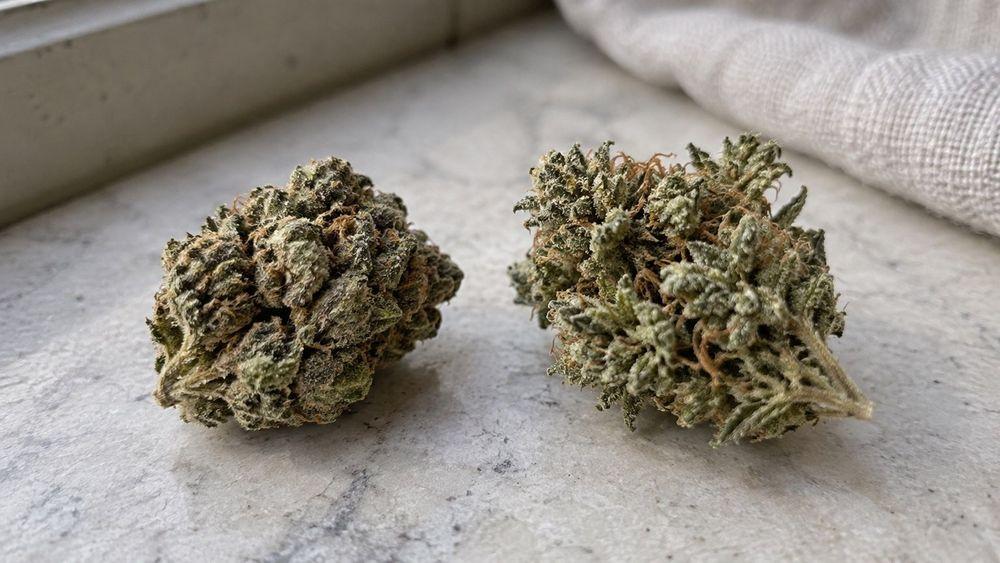
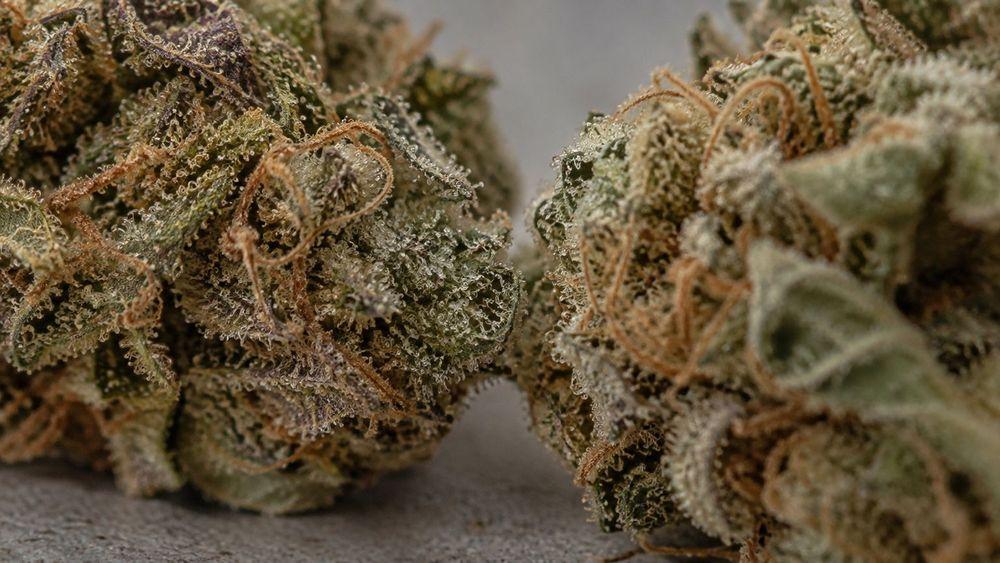
No. Every popular guide publishes a list of tells: rock-hard buds, red or brown hairs, little frost, weak smell, low potency, harsh smoke. We could not find a single study that checks any of them against a lab result. Each one has ordinary causes that have nothing to do with growth regulators, and in the one controlled study that measured these traits, three of them moved the wrong way or did not move at all.
| The tell | What it more often reflects | Validated as a PGR test? |
|---|---|---|
| Dense, rock-hard buds | Genetics, light and trimming. In the 2026 study, treated plants made more flowers, not bigger ones | No published study |
| Orange, red or brown hairs | How mature the flower was at harvest | No published study |
| Few trichomes, little frost | Genetics, handling and age. Treated buds in the 2026 study had slightly larger trichome heads | No; the one study went the other way |
| Weak smell | Storage, curing and age, which let terpenes fade. Terpenes did not change in the 2026 study | No; the one study found no change |
| Low potency | Genetics, harvest timing and storage. Treated buds in the 2026 study had about 79% more cannabinoids | No; the one study went the other way |
| Harsh smoke or dark ash | Moisture, cure and how the flower burns | No published study |
The 2026 whole-plant study is the one piece of evidence that speaks directly to the checklist. Compared with untreated plants, the paclobutrazol-treated buds held 84.9 mg/g of total cannabinoids against 47.5 mg/g, a 78.6% increase. Their trichome heads were 5.1% larger, total terpene levels did not significantly change, and individual flowers were no bigger; there were simply more of them. The dried flowers also carried 0.25 ppm of paclobutrazol, two and a half times California's current limit. The study used six plants per group of one CBD-dominant variety, not a THC cultivar, and the authors say other varieties may respond differently. So it does not prove PGR weed is stronger. It does show the popular list is not a test.
If you want to know what those cues do tell you, our guide to what good weed looks like walks through them, including the study showing hair color mostly tracks how mature the flower was at harvest. Our explainer on what trichomes are covers why frost is a weak guide to strength, the piece on whether weed goes bad covers the aroma you lose to storage, and the white ash vs black ash myth has a page of its own.
Where PGRs are regulated, compound by compound
California changed its rule this year. Rulemaking DCC-2025-03-R was approved and filed with the Secretary of State on July 27, 2026, and took effect on October 1, 2026. Until then, daminozide and paclobutrazol sat on California's 21-compound Category I list, where any detection above the lab's limit of detection failed the batch. The final text of the new rule drops the Category I and II split and gives both compounds a numeric action level of 0.10 µg/g in inhalable and non-inhalable products alike, both in the table that applies until April 1, 2028 and in the one that starts that day. A batch that fails "may not be released for retail sale." The agency's final statement of reasons says paclobutrazol's limit for edibles and other non-inhalables was set at 0.10 rather than a proposed 5.0 µg/g because "laboratories can already test to the lowered action level." Chlormequat chloride is not on California's list at all.
| Compound | Where it is regulated and how | What the agency toxicology tested |
|---|---|---|
| Paclobutrazol | CA 0.10 µg/g, all product types (since Oct 1, 2026); OR 0.4 ppm; WA 0.40 ppm; MT 0.4 ppm; Canada lab sensitivity 0.02 ppm. US: turf and ornamentals only, no food use | EPA Group D, not classifiable for cancer, because the cancer studies dosed too low; liver weight and fatty changes in animal feeding studies; no inhalation study on file (EPA, 2007) |
| Daminozide (Alar) | CA 0.10 µg/g (since Oct 1, 2026); OR 1 ppm; WA 1.0 ppm; MT 1.0 ppm; Canada lab sensitivity 0.1 ppm. US: food uses cancelled 1989; greenhouse ornamentals remained (EPA, 1993) | EPA Group B2, probable human carcinogen, via breakdown product UDMH (tumors in mice and rats fed it); low acute toxicity; not shown mutagenic (EPA, 1993). IARC rates UDMH Group 2B |
| Chlormequat chloride | Not on the CA, OR, WA or Canada lists; MT listed it at 1.0 ppm in flower until Feb 23, 2025, then dropped it. US: residue tolerances on barley, oat and wheat grain (2018), with no US registration on those crops | EPA: not likely to be a carcinogen; unsteady gait, drooling and lower body temperature in repeat-dose oral studies in rats, mice and dogs (EPA, 2018) |
Every hazard entry in that table comes from animal feeding studies. None of these agencies tested smoking or vaping a residue. Other markets also draw the line in different places. Oregon's testing table fails a batch above 1 ppm daminozide or 0.4 ppm paclobutrazol, and Washington's rule, WAC 314-55-108, uses 1.0 and 0.40 ppm. Montana's testing appendix sets 1.0 ppm daminozide and 0.4 ppm paclobutrazol. It also listed chlormequat chloride at 1.0 ppm until February 23, 2025, then dropped it, which makes Montana the only list among the five jurisdictions we read that ever named chlormequat. Health Canada's pesticide list covers 96 active ingredients and requires labs to be able to measure paclobutrazol down to 0.02 ppm and daminozide down to 0.1 ppm; those are minimum lab sensitivities, not pass or fail limits.
Here is what those differences mean in practice. A flower batch that tests at 0.3 ppm paclobutrazol passes in Oregon and Washington, where the limit is 0.4, and fails in California, where it is 0.10. A 2026 review of US cannabis contaminant rules describes "wide variability in allowable limits, analyte lists, and method validation requirements" across states. The five jurisdictions here are a sample, not the whole map, so check the rule where you buy.
Is PGR weed bad for you? What the agency files actually say
Page-one articles call PGRs carcinogens and neurotoxins. Here is what the agency documents say, compound by compound, and the evidence each label rests on. Daminozide. EPA classified daminozide as a Group B2 "probable human carcinogen." The label rests on its breakdown product, UDMH, which in feeding studies "caused a slight increase in liver tumors in rats, and produced liver vascular tumors and lung tumors in mice," according to the same 1993 fact sheet. That document also puts daminozide's acute toxicity in the lowest category for oral and inhalation exposure, reports that neither daminozide nor UDMH has been shown to cause mutagenic effects, and notes, in its assessment of greenhouse workers, that daminozide is converted to UDMH when it is absorbed through the skin or lungs. The WHO's cancer agency, IARC, lists UDMH as "possibly carcinogenic to humans" (Group 2B), based on animal evidence. We found no IARC evaluation of daminozide itself. B2 is a hazard classification from animal feeding studies, not a measured risk from smoking cannabis.
Paclobutrazol. As of EPA's 2007 registration-review summary, the agency lists paclobutrazol as Group D, not classifiable as to human cancer, because in the existing cancer studies "the highest dose was insufficient to adequately evaluate carcinogenicity." Its key effects in animal feeding studies were on the liver: heavier livers and fatty changes in females at 12.5 mg/kg of body weight per day. A 1994 EPA committee found no evidence of developmental or reproductive effects, and the summary states that "a short-term inhalation study is not available." EPA has issued later registration-review documents that we could not access, so 2007 is the latest text we quote. Chlormequat chloride. EPA's 2018 rule rates it "Not Likely to be a Carcinogen to Humans." In repeat-dose oral studies, rats, mice and dogs consistently showed what EPA calls signs of neurotoxicity, such as ataxia (unsteady gait), drooling and lower body temperature. That finding, in animals that swallowed the chemical, is the closest agency basis for the "neurotoxin" label on other sites.
What about smoking it? A 2013 Journal of Toxicology study deliberately dosed cannabis with paclobutrazol at 4,120 µg/g, about 41,000 times California's limit, and smoked it through a glass pipe: about two thirds of it (67.4%) came through in the smoke, intact enough to measure. That shows the chemical survives the flame, not how much a smoker would inhale from a real residue. California's own toxicologists ran the numbers for edibles in a 2025 Department of Pesticide Regulation memo. Their health-based level for daminozide in an edible came out at 3,636 µg/g, high enough that they capped it at the European food limit of 0.10, and for paclobutrazol they proposed 93 µg/g. In other words, for edibles the 0.10 line sits far below the state's own calculated health-based levels: it is a cautious ceiling, not a measured threshold of harm. For smoked and vaped products, the state borrows tobacco residue guidance and, where none exists, a default of 0.1 µg/g, the tobacco residue level at which EPA requires pyrolysis (burn) testing. None of the documents we read sets a limit for these compounds derived from inhalation data.
How often does PGR residue actually turn up?
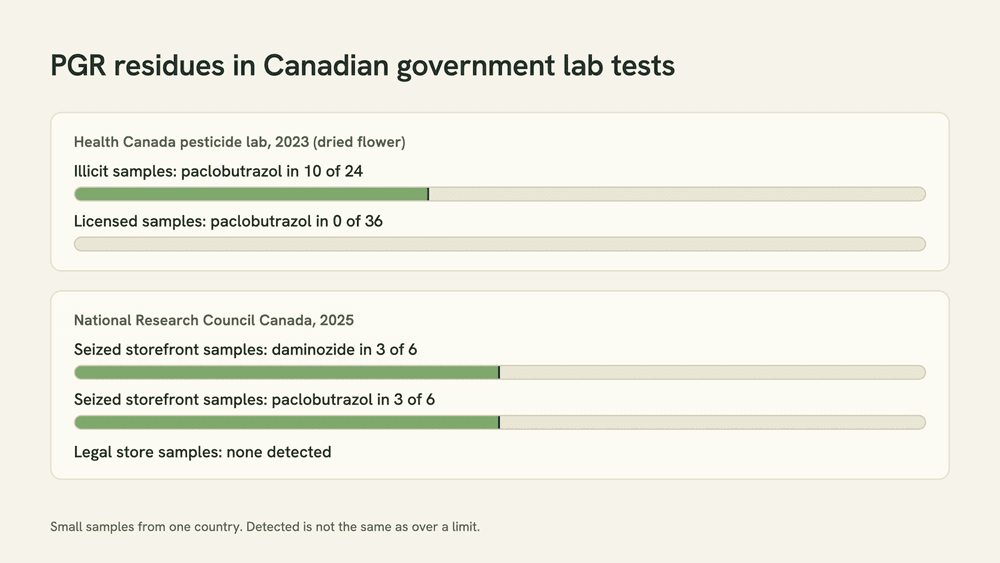
The best measured data come from Canada. Health Canada's own pesticide lab tested 24 illicit and 36 licensed flower samples. Of the illicit samples, 92% carried at least one pesticide, and paclobutrazol turned up in 10 of the 24, at 0.009 to 1 µg/g. Among the licensed samples, 6% tested positive, for two other pesticides at 0.01 µg/g, and none for paclobutrazol. Chemists at Canada's National Research Council tested six packages seized by police from illegal Ontario storefronts and found daminozide in three (one at an estimated 4.9 ppm, above the method's calibrated range) and paclobutrazol in three (255 to 629 parts per billion). Samples from the legal Ontario Cannabis Store showed none. The same paper names daminozide as one of the residues at the edge of what traditional LC-MS/MS testing handles well, one reason to check that a panel names both compounds. These are small samples from one country, not a guarantee about any store.
In the US, a 2015 screen of 57 California concentrates submitted by medical users in 2012-13, before California's licensed testing rules existed, detected paclobutrazol in 22.8% of them; it recorded presence, not amount. Today the clearest public signal is the state's cannabis recall portal, which, when we read it on November 10, 2026, listed at least four recalls for paclobutrazol or daminozide since September 2024. All four were infused pre-rolls or vape cartridges, none plain flower. Recalls show that testing catches failures, not how common those failures are. Farming residue is also a different problem from deliberate tampering, which our guide to how to tell if weed is laced covers.
Hemp and CBD flower: who tests for PGRs?
Federal hemp rules test the growing crop for THC, using samples taken within 30 days before harvest. They do not require a pesticide panel, so whether a hemp or CBD flower COA shows one depends on the state and the seller. Labels such as "PGR-free" or "organic" are claims about how something was grown, not lab results; our explainer on what organic hemp means covers what that word does and does not certify, and our guide on whether CBD flower is legal covers the rules around buying it. Planntz does not sell flower, but the habit carries over to any hemp product, including when you choose a CBD oil: ask for the full COA and look for the pesticide section, not just potency.
The 60-second COA check for PGRs
You do not need a chemistry degree for this, just the batch's certificate of analysis and a minute. If the report comes from a lab with no stake in the sale, you are already ahead; our explainer on what "third-party tested" really means covers what to look for in the lab itself.
- 1Find the pesticide section. If the COA lists only potency, heavy metals and microbes, it cannot answer the PGR question at all.
- 2Search the analyte names: paclobutrazol and daminozide. Chlormequat chloride rarely appears, because few state panels include it.
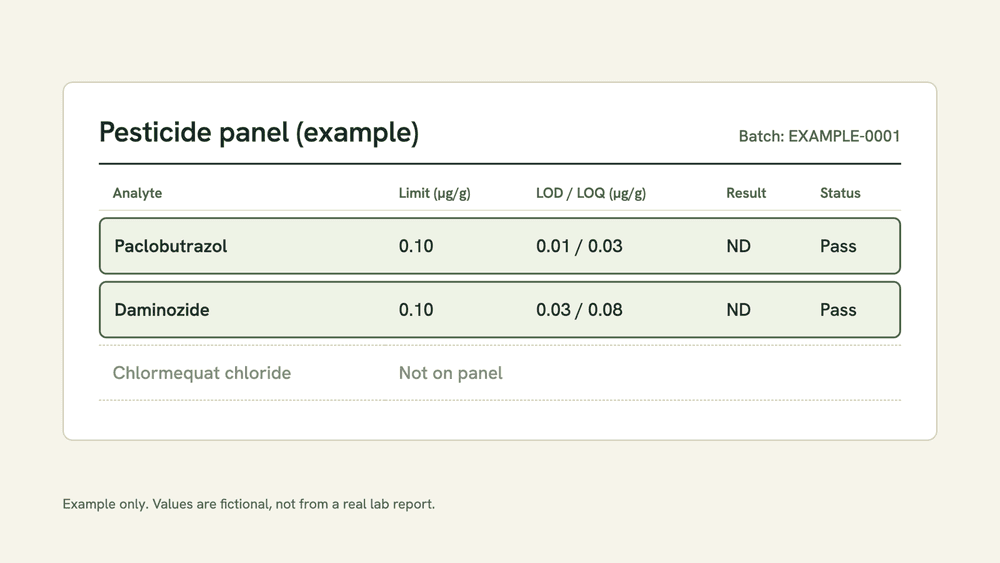
- 3Read each row across: the limit (action level), the result, the lab's LOD and LOQ, and pass or fail. ND means not detected, below the LOD.
- 4Check that the LOQ sits at or below the limit you care about. A panel that only quantifies down to 0.5 ppm says little about a 0.10 limit.
- 5If paclobutrazol is listed but daminozide is not, ask the seller whether the lab tests for it. Daminozide is harder to measure with standard methods.
- 6Match the batch or lot number and the test date to the package in your hand.
- 7Check who ran the test: a named, independent lab with a license or accreditation number you can look up.
- 8On a California COA dated before October 1, 2026, a limit of "Any amt" for these two is the old Category I rule, not an error.
What this page can't tell you
We found no study of what inhaled PGR residues do to people; every hazard label rests on animals fed the chemical. The one whole-plant study we found that measured potency used six plants per group of one CBD variety. The residue data come mostly from Canada and from small samples. We read the rules of five jurisdictions (California, Oregon, Washington, Montana and Canada), not every state, and rules change: everything here is as read on November 10, 2026, and California's next limits table starts on April 1, 2028. We found no published study of whether flushing changes PGR residue. And there is no reliable public list of brands, strains or shops that use PGRs, so we will not make one.
PGR weed questions, answered
Plant growth regulator: a natural or synthetic chemical that changes how a plant grows. In cannabis talk it usually means one of three synthetics: paclobutrazol, daminozide (once sold as Alar) or chlormequat chloride. Of the three, only chlormequat has US residue tolerances on food, set in 2018 for some grains.
Not by looking at it. We found no study that validates any visual tell, and in the one controlled cannabis study we found that measured these traits, treated buds had more cannabinoids, slightly larger trichome heads and unchanged terpenes. The real check is a lab pesticide panel that names paclobutrazol and daminozide and reports a result for each.
The hazard data come from animal feeding studies. EPA has classified daminozide as a probable human carcinogen through its breakdown product UDMH, lists paclobutrazol as not classifiable for cancer, and rates chlormequat not likely to cause cancer. We found no agency study of inhaling these residues, and regulators keep the allowed amount very low as a precaution.
In licensed markets, a batch with residue above the limit fails testing and cannot be sold. Since October 1, 2026, California's limit is 0.10 µg/g for paclobutrazol and daminozide; Oregon and Washington use 0.4 ppm paclobutrazol and 1 ppm daminozide. In the US, neither compound has an approved food use.
Not necessarily. We found no study testing the claim against lab results, and the one controlled plant study we found that measured potency found the opposite: paclobutrazol-treated buds held about 79% more cannabinoids. That was one small study of one CBD variety, so potency tells you nothing either way about PGRs.
We found no measurement either way. The one peer-reviewed mention we found is a personal communication cited in a 2018 grower survey, which is not a test. No published study we found has measured whether flushing changes PGR residue.
It can. Federal hemp rules test the crop for THC before harvest, not for pesticides, so whether a hemp flower COA includes a pesticide panel depends on the state and the seller. Ask for a COA that shows one, with paclobutrazol and daminozide listed by name.
We found no regulator that defines it. It is a claim about how a crop was grown, not a test. What backs it up is a pesticide panel on the batch COA that lists the compounds and shows a result for each.
A bud's looks cannot tell you whether it was grown with a growth regulator. A COA can, if it has the right section. Our step-by-step guide to reading a certificate of analysis shows where the pesticide panel sits, what LOD and LOQ mean, and how to check that the report belongs to the product you are holding.
Writing about hemp, wellness and the small rituals that keep us balanced.