Indoor vs Outdoor Weed: What the Studies Show (and Don't)
Is indoor weed stronger, and is outdoor weed dirtier? What the few head-to-head studies measured, why the THC gap on labels is partly the lab, where each method's contamination risks come from, and what "sun-grown" legally means.
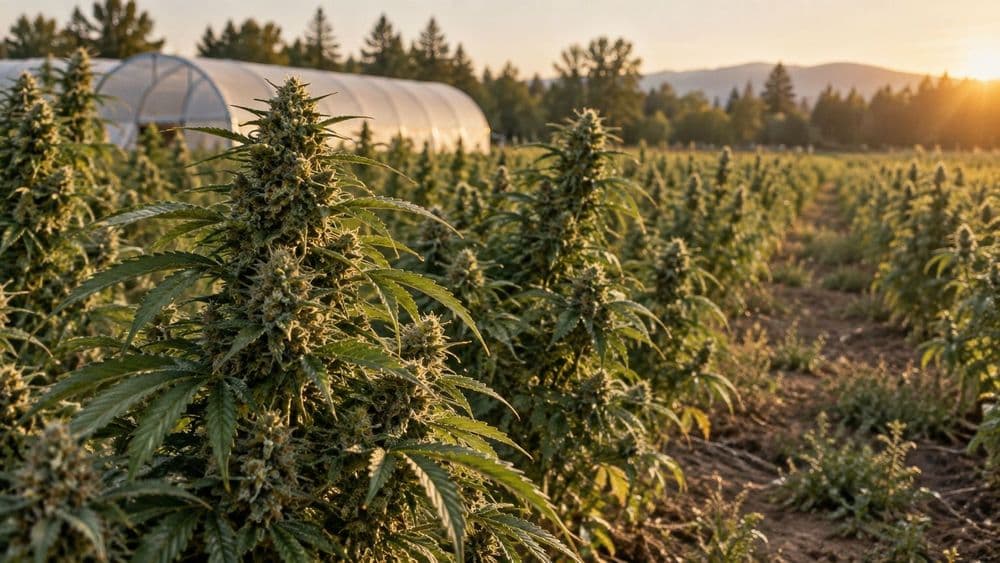
In the indoor vs outdoor weed debate, indoor flower usually costs more and sellers say it is stronger, while outdoor growers say sunlight makes richer, more aromatic weed. Both sides are selling a method. This guide looks at what the few head-to-head studies actually measured, why the THC gap you see on labels is partly the lab, where each method's contamination risks come from, and which single document settles the question for any one jar.
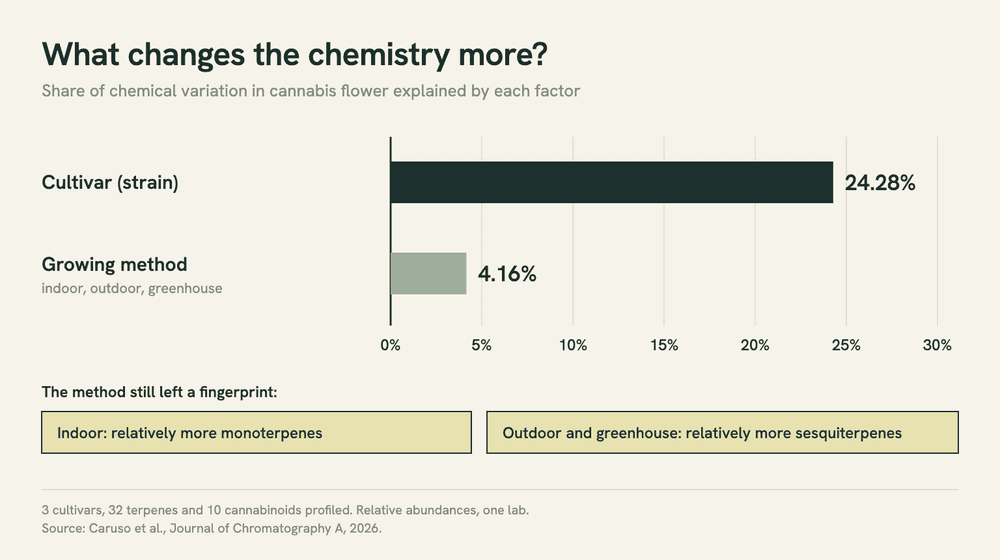
The short answer: neither indoor nor outdoor weed is automatically stronger, cleaner or better. In a 2026 study that grew three cultivars indoors, outdoors and in a greenhouse, the cultivar explained about 24% of the chemical variation in the flower and the growing method about 4%. The method still leaves a fingerprint, mostly in the balance of terpenes, and it changes the carbon footprint by a wide margin. What it cannot tell you is how potent or how clean a particular jar is. The batch lab report can.
Indoor vs outdoor weed at a glance
Most comparisons online give you a list of claims with no sources. The table below gives each common claim, what the published evidence actually shows, and how much weight that evidence can carry. "Weak" means one small study or a finding that describes a risk route rather than a measured rate. "None" means we could not find a study at all.
| Question | Indoor | Outdoor | What the evidence shows | Strength |
|---|---|---|---|---|
| THC potency | Averaged about 19% in one small sample | Averaged about 15% in the same study | Heavy overlap, not statistically significant (26 samples, 2013) | Weak |
| What drives the chemistry | Method explains about 4% | Method explains about 4% | Cultivar explains about 24% of variation (3 cultivars, 2026) | Moderate |
| Terpene balance | Leans to monoterpenes | Leans to sesquiterpenes (caryophyllene, humulene) | Two studies agree on the direction; relative amounts, not totals | Moderate |
| Breakdown products (CBN and similar) | Higher in one study | Lower in the same study | 3 samples per group, different farms (2023) | Weak |
| Looks (color, density) | Grower lore | Grower lore | No study found | None |
| Mold | Powdery mildew, Penicillium in room air | Weather molds such as Cladosporium | One research program describes routes, not rates | Weak |
| Pesticides | No drift from neighbors, but growers can still spray | Drift from neighboring fields is possible | General agriculture guidance; no cannabis drift study | Weak |
| Carbon per kg of flower | About 4,500 kg CO2e | About 700 kg CO2e (greenhouse 2,500) | Several life-cycle models agree on the direction | Strong on direction |
| Retail price | About twice outdoor | Lower | National estimate in a 2025 analysis | Moderate |
| What settles it for one jar | The batch lab report | The batch lab report | Method is rarely printed; the test panel is | n/a |
What indoor, outdoor and greenhouse actually mean
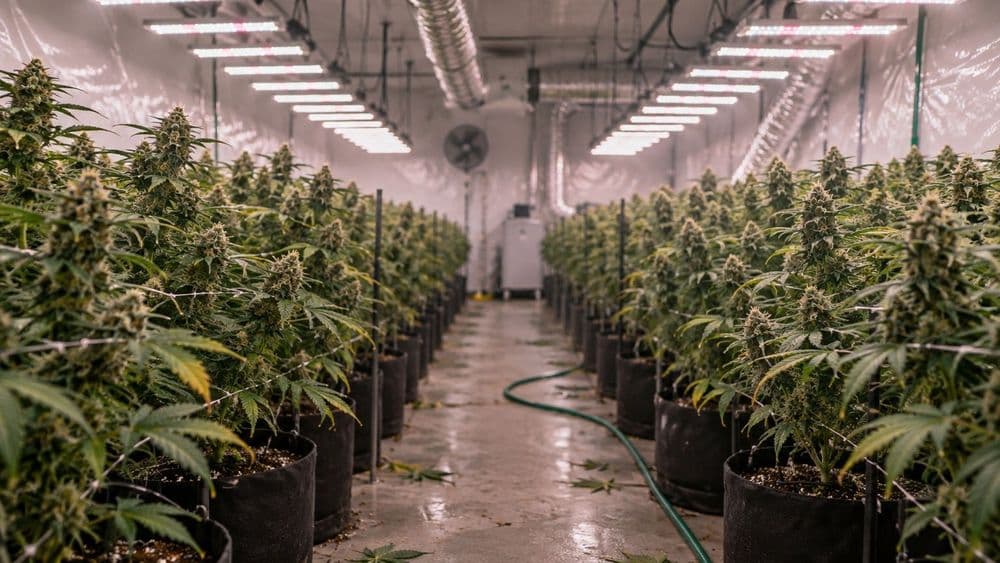
The words sound obvious, but the line between them is a matter of light, and at least one state draws it precisely. California's cannabis regulations, in the version revised January 1, 2026, define the three methods by how much artificial light reaches the plants' canopy (the leafy top layer of the crop):
- Outdoor: "the cultivation of mature cannabis without the use of artificial lighting in the canopy area at any point in time." Plants grow under the sun only, usually in the ground or in large pots.
- Indoor: grown "within a permanent structure using exclusively artificial light," or in any structure using artificial light above 25 watts per square foot.
- Mixed-light: the legal term for greenhouses, hoop houses and similar structures that use sunlight plus some added light. Tier 1 allows up to 6 watts per square foot of artificial light; Tier 2 allows more than 6 and up to 25.
- Light deprivation ("light dep"): not a legal category, but a term you will see on menus. It describes greenhouse or outdoor growers covering plants for part of the day so they flower on a schedule instead of waiting for autumn.
Two things follow. First, "greenhouse" is not a halfway point you can ignore: it is a separate method with its own chemistry, and in the 2026 study above, greenhouse flower resembled outdoor flower more than indoor. Second, these are licensing definitions. They tell a regulator how a farm operates. Most retail labels do not tell you which of the three produced the jar in front of you.
Is indoor weed stronger? What the potency data shows
You will often see indoor flower described as 22-30% THC and outdoor as 15-25%. We could not find a source for those ranges, so we do not use them. The only direct field comparison we found is a 2013 Australian analysis of police-seized cannabis from grows whose method was known: 13 indoor samples from Sydney and 13 outdoor samples from the northern New South Wales coast, tested for nine cannabinoids. Indoor averaged 19.16% total THC (95% confidence interval 14.76-23.57) and outdoor 15.47% (11.28-19.66). The authors found "much cross-over" between the two, a trend toward higher indoor values, and no statistically significant difference, and they note the sample "may have had insufficient power" to detect one. In plain terms: indoor may run a little higher on average, but plenty of outdoor flower beats plenty of indoor flower.
Light quality does change the plant, just not in the simple "more light, more THC" way sellers imply. In a 2018 growth-chamber trial, clones of one drug-type cultivar (16 plants per lamp type) grew under high-pressure sodium lamps or under two LED spectra. In the first run, THC reached about 15.4% under one LED spectrum versus 9.5% under sodium lamps, and CBG 3.4% versus 1.8%. But the sodium-lamp plants grew taller and produced more flower, so total cannabinoid yield per plant came out the same. The research was funded by Valoya, the company that makes both LED lamps tested, and one author was employed there. And note what it compared: two kinds of indoor lamp, not a room versus the sun.
Then there is the idea that the sun's ultraviolet light "makes more THC." When a University of Guelph team added UV-B light to two modern cultivars in 2021, for 3.5 hours a day through nine weeks of flowering, THC did not go up. In one cultivar, total THC, total CBD and yield all fell as the UV dose rose, and total terpenes fell in both. The authors concluded UV-B "did not lead to any commercially relevant benefits." In their discussion they trace the belief to a 1987 study on older plants that reported about a 28% relative rise in THC, which they point out was only about 7 milligrams per gram, small next to modern flower that can exceed 200 mg per gram.
The bigger source of the gap you see on shelves may be the lab, not the room. In an analysis of Washington's state testing data, the median THC a lab reported for the same kind of flower ranged from 17.6% to 23.1% depending on which lab did the test, a spread wider than the indoor-outdoor difference above. And when Health Canada's labs retested 50 legal flower products bought across provinces, 48% had THC more than 20% away from the label. We cover lab shopping and label accuracy in depth in our guide to whether THC percentage matters, so we will not repeat it here. The point for this comparison: a higher number on an indoor jar may reflect where it was tested as much as how it was grown.
Terpenes and smell: where the sun seems to matter
If growing method makes a real difference anywhere, it is in the aroma chemistry. A 2023 Columbia University analysis compared flower from two cultivars, Red Velvet and Cheetah Piss, grown in California in 2021 from clones of the same genetic stock: outdoors in living soil by one farm, and indoors under artificial light in a proprietary growing medium by two other commercial growers. Outdoor flower carried more of the heavier terpenes called sesquiterpenes, including beta-caryophyllene, alpha-humulene and alpha-bergamotene (about three times as much alpha-bergamotene in outdoor Red Velvet). Indoor flower carried significantly more oxidized and degraded cannabinoids, such as CBN, which forms as THC breaks down. The main acid cannabinoids differed little overall.
Read that study with its limits in view. There were three samples per group. It measured relative signal in a mass spectrometer, not THC percent by weight, so it cannot tell you which side was stronger. Different farms grew each side, so growing method is tangled up with the grower, the soil or medium, and how the flower was dried and cured. Three of the six authors list California cannabis-farm affiliations; the paper declares no conflicts of interest and no external funding. It is a useful signal, not a controlled experiment.
“Cultivar emerged as the primary factor influencing chemical composition (24.28% of variability), whereas cultivation method also had a significant, although smaller, effect (4.16% of variability).”
That 2026 study, from Argentina, is the stronger design: three cultivars, each grown indoors, outdoors and in a greenhouse, profiled for 32 terpenes and 10 cannabinoids. Its headline is the quote above. Its second finding lines up with the 2023 samples: indoor flower had relatively more monoterpenes (the lighter, more volatile aroma compounds), while outdoor and greenhouse flower had relatively more sesquiterpenes, regardless of cultivar. The studies do not agree on every compound, though. In the 2023 samples, indoor Cheetah Piss lacked beta-myrcene, a monoterpene, entirely. And both measured relative amounts, so neither supports the blanket claim that outdoor weed has "more terpenes." It has a different mix. For what terpenes are and how they differ from cannabinoids, see our explainer on cannabinoids vs terpenes. Smell is not only terpenes either: the classic skunky note comes largely from sulfur compounds, as our piece on why weed smells like skunk explains.
Can you tell indoor from outdoor weed by looking at it?
Not reliably. You will read that indoor buds are brighter green, denser and frostier, and that outdoor buds are darker and looser. We found no study that tested whether shoppers or experts can sort flower by method from appearance, so treat those descriptions as grower lore. Looks mostly reflect the strain, how the plant was trimmed and handled, and how fresh the flower is. What separated indoor from outdoor samples in the 2023 study was lab chemistry: compounds such as alpha-guaiene, alpha-bergamotene, CBN and a few minor cannabinoids, which a statistical model used to sort the samples almost perfectly. With three samples per group, even that sorting says more about those farms than about indoor and outdoor in general.
Even within one plant, appearance can mislead. Bud position alone moves potency a lot: in one greenhouse trial covered in our guide to shake, smalls and grade words, buds from the bottom of the plant had up to 90% lower cannabinoid concentrations than the top bud. Two jars of the same strain from the same room can look and test differently.
Is outdoor weed dirtier? Contaminants by growing method
This is the question with the least direct evidence. When we searched PubMed on September 30, 2026 for cannabis studies comparing indoor and outdoor contamination (pesticides, microbes, molds or metals), we found none. What exists describes where each method's risks come from, not how often they end up in a retail jar. So the honest answer is that each method has different contamination routes, and neither is cleaner by default.
- Outdoor, soil: cannabis and hemp pull metals up from the ground, so a field's history matters. Hemp has even been studied as a plant for cleaning contaminated soil.
- Outdoor, neighbors: fields share air. Pesticides sprayed on a nearby farm can drift onto a cannabis crop that was never sprayed.
- Outdoor, weather: rain and humidity bring field molds. On dried field-grown buds in one Canadian program, Cladosporium made up 75% of fungal isolates and Alternaria 20%.
- Indoor, the room: powdery mildew was common in most production facilities studied, and Penicillium was the most common mold in indoor air. Unpasteurized coco fiber growing medium was one mold source.
- Indoor, inputs: growing media and fertilizers can carry metals too, so indoor is not metal-free by definition.
- Greenhouse: its own profile, not a cleaner version of either. In the same Canadian program, airborne mold counts in a greenhouse reached 30 colonies per plate, against a maximum of 1 in an indoor room.
The drift point comes from the EPA's guidance on pesticide drift, which defines drift as movement "to any site other than the area intended" and notes that "crops on nearby farms can become unsellable if the drifting pesticide is not registered for use on the crop." That guidance covers agriculture in general; we found no cannabis-specific drift study. The mold findings come from a multi-year Canadian plant-pathology program that sampled indoor rooms, greenhouses and field plants in British Columbia. It also found that machine trimming raised how often Penicillium turned up on buds. Plate counts in a research facility are not a measure of what a consumer is exposed to, and they are not a ranking of which method is safer. On metals, we covered the greenhouse study on where cadmium and lead end up in the plant in our guide to CBD distillate.
What does predict contamination is the channel and the test panel. The same Health Canada study that found THC labels off also compared its 50 legal samples with 50 seized illegal ones: 94% of the illegal samples carried pesticides (3.4 on average) and 73% exceeded yeast-and-mold limits, against trace pesticide findings in 2 legal samples. Legal flower was not perfect either: 20% of it exceeded the European Pharmacopoeia microbial limits the study applied. The study did not record how any of the flower was grown. For how to read the microbial, metals and pesticide sections of a report, see our line-by-line guide to reading a COA. Mold that grows after harvest, in storage, is a separate problem covered in our guide to whether weed goes bad.
Energy and emissions: the one difference that is not close
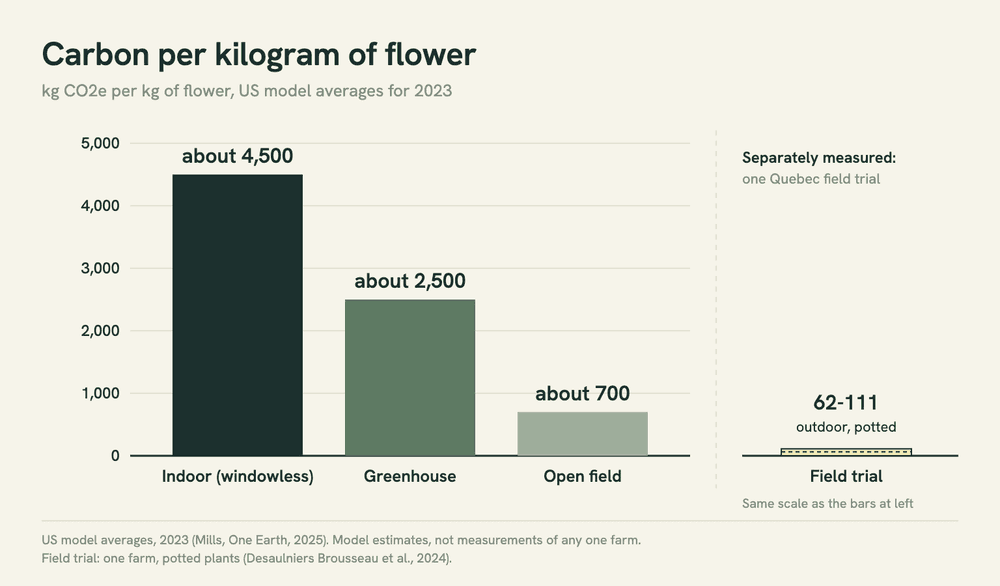
On carbon, the studies agree on direction and the gap is large. A 2025 life-cycle model by energy analyst Evan Mills, the only source we found that compares all three methods on the same basis, put 2023 US averages at about 4,500 kg of CO2-equivalent per kilogram of flower from windowless indoor facilities, 2,500 from greenhouses and 700 from open fields. It estimates US cannabis cultivation at about 1% of national emissions, "equaling those of 10 million cars or 6 million homes," and says a shift to outdoor growing could cut that by up to 76%. An earlier Colorado State University life-cycle study found indoor flower carries 2,283 to 5,184 kg CO2e per kilogram, depending mostly on local climate and the power grid, driven by electricity, natural gas for climate control, grow lights and added CO2.
| Source | Method | kg CO2e per kg of flower | Scope |
|---|---|---|---|
| Mills, One Earth, 2025 | Indoor (plant factory) | About 4,500 | US national model, 2023 averages, legal and illicit |
| Mills, One Earth, 2025 | Greenhouse | About 2,500 | Same model |
| Mills, One Earth, 2025 | Open field | About 700 | Same model |
| Summers, Sproul and Quinn, Nature Sustainability, 2021 | Indoor | 2,283-5,184 | Cradle-to-gate model across US locations |
| Desaulniers Brousseau et al., 2024 | Outdoor | 62-111 | One Quebec farm, potted plants, 2020-2022 |
| Mills, Energy Policy, 2012 | Indoor | About 4,600 | Early US estimate of CO2 for indoor, illicit-era assumptions |
Why is "outdoor" 700 in one row and 62 to 111 in another? Scope. A Quebec field trial measured one farm's potted plants over three seasons, and most of its footprint (65-75%) came from the peat potting mix. It still came in about 50 times lower than typical indoor figures. The national model counts everything around the average open field, including transport and illicit operations. Both are real; they answer different questions. The indoor numbers have been high for a long time: a 2012 estimate had already put indoor cannabis at about 1% of US electricity use.
This also answers a common shopper question: why is indoor weed more expensive? Mostly energy and facilities. The 2025 analysis reports that energy is often about 40% of an indoor operation's operating expenses and that indoor flower sells at retail for about twice the price of outdoor. Part of what you pay for indoor is control over light, temperature and humidity. Based on the evidence above, you are not reliably paying for more THC.
What "sun-grown" and appellation labels actually mean
"Sun-grown" sounds like a certification, but in the rules we checked it is not one. When we searched the full text of California's cannabis regulations on September 30, 2026, the terms "sun-grown," "sungrown" and "sun grown" did not appear. What California does define is "outdoor" (no artificial light in the canopy at any point) and appellations of origin, the cannabis version of a wine region. Under California Business and Professions Code section 26063, an appellation cannot be approved unless it "requires the practice of planting in the ground in the canopy area" and excludes greenhouses, hoop houses and similar structures, and "any artificial light in the canopy area." The state's rules bar appellation statements, and statements about OCal (California's organic-equivalent cannabis program), on labels unless the product actually meets those programs. OCal and organic claims are covered in our guide to what organic hemp means.
So a California appellation name on a label is a strong method claim; "sun-grown" by itself is a marketing word. We did not check every state, so we are not saying no state defines it. Hemp is different again: the federal hemp program regulates THC testing, not cultivation-method labels. Most US hemp grown for flower is grown in the open. USDA's 2025 hemp survey counted 16,880 acres of floral hemp harvested in the open, against about 3.99 million square feet (roughly 92 acres, our conversion) of hemp of all types grown under protection. For how hemp and marijuana differ legally, see our explainer on hemp vs marijuana.
How to choose, whatever the method: a 5-point checklist
Since the method label is often missing and never settles potency or cleanliness, check the product the same way whether it was grown under LEDs, plastic or open sky. The same logic runs through our guide to choosing a CBD oil: the document beats the story.
- 1Find a batch lab report that matches the lot number on the package, with the testing lab's name and a test date. No lot number means no way to match the jar to a test.
- 2Read the potency panel beyond one headline number. Look at total THC (THC plus 0.877 x THCA) and the minor cannabinoids. A relatively high CBN reading can signal older or more oxidized flower, since CBN forms as THC breaks down.
- 3Check which safety panels were run: microbial (including yeast and mold), heavy metals, and for flower a pesticide panel. Each method has its own risk routes, so you want all three, not just a "pass" banner.
- 4Look for the cultivar name, then treat the method as a clue, not proof. In California, "outdoor" and appellation claims are defined; "sun-grown" alone is not in the state's cannabis rules.
- 5Compare price per milligram of total cannabinoids, not price per percentage point. Remember that the same flower can read several points higher or lower depending on the lab.
What we still don't know
- How indoor and outdoor compare in a large, controlled trial. The best design so far used three cultivars in one lab in one country, and reported relative amounts.
- Whether indoor flower really is more potent. The one field comparison had 26 samples and may have been too small to detect a real gap.
- How contamination rates compare by method at retail. We found no study, and the largest recent market survey did not record growing method.
- How much of any difference is the method itself. In commercial samples, method is tangled up with grower, soil or medium, drying, curing and the testing lab.
- Exact carbon for any one farm. The figures above are models with different boundaries; a well-run farm can sit far from its category average.
Frequently asked questions
Not reliably. In the one field comparison we found, 26 police-seized Australian samples, indoor averaged about 19% total THC and outdoor about 15%, but the ranges overlapped heavily and the difference was not statistically significant. The printed number also depends on the lab: in Washington state data, the median THC reported for the same kind of flower ranged from 17.6% to 23.1% between labs. The cultivar matters more than the method.
No study we found compares retail contamination by growing method. Outdoor flower has its own routes (soil metals, pesticide drift from neighbors, weather molds) and indoor flower has others (powdery mildew, molds in room air, metals in growing media). A batch lab report with microbial, heavy-metal and pesticide panels is what answers it for a given jar.
Usually it is used to mean outdoor, but it is a marketing term: it does not appear in California's cannabis regulations. California's legal "outdoor" means no artificial light in the canopy at any time, and its appellation labels additionally require plants in the ground with no greenhouse or hoop house.
Neither. California calls it mixed-light: sunlight plus up to 25 watts per square foot of artificial light, split into two tiers. In a 2026 study of three cultivars, greenhouse flower's chemistry was closer to outdoor flower than to indoor.
Mostly energy and facilities. A 2025 analysis reports that energy is often about 40% of an indoor operation's operating costs and that indoor flower sells for about twice the price of outdoor. The same model puts indoor at about 4,500 kg CO2e per kg of flower versus 700 for open fields.
It has a different mix, not necessarily more. Two studies found outdoor (and greenhouse) flower relatively richer in heavier sesquiterpenes such as beta-caryophyllene and humulene, while indoor flower leaned toward lighter monoterpenes. Both measured relative amounts, not total terpene content.
Not in the best recent test. A 2021 University of Guelph trial added UV-B to two cultivars through flowering; THC did not rise, and in one cultivar THC, CBD and yield fell. The belief traces to a 1987 study on older plants that reported a rise of about 7 mg per gram.
Mostly outdoors in the US. USDA's 2025 survey counted 16,880 acres of floral hemp harvested in the open, against about 3.99 million square feet (roughly 92 acres) of hemp of all types grown under protection. Federal hemp rules do not require a label to state the method.
Planntz makes hemp tinctures and tablets, not flower, and our product records do not state a growing method for our hemp, so we do not claim one. What we can show you is the document this guide keeps coming back to. Each tincture batch has a public lab report with a 16-cannabinoid potency panel, four heavy metals and six microbial tests; there is no pesticide or terpene panel on them, and we say so. Our tablet certificate reports potency only. See the Planntz batch lab results and read them with the same checklist you would use on any jar.
Writing about hemp, wellness and the small rituals that keep us balanced.