Why Does Weed Smell Like Skunk? It's Not the Terpenes
Most pages blame terpenes. The skunk note in cannabis is a trace sulfur compound, a chemical cousin of skunk spray and the same molecule that skunks a beer. Here is what the chemistry shows, why the smell fades, and why it tells you nothing about potency.
Why does weed smell like skunk? Not because of terpenes. The skunk note comes from a sulfur compound called 3-methyl-2-butene-1-thiol, first pinned down in cannabis in 2021. It is present only in trace amounts, but your nose is exquisitely sensitive to it. It belongs to the same chemical family as the compounds a skunk sprays, and it is the very same molecule that makes a beer taste "skunked".
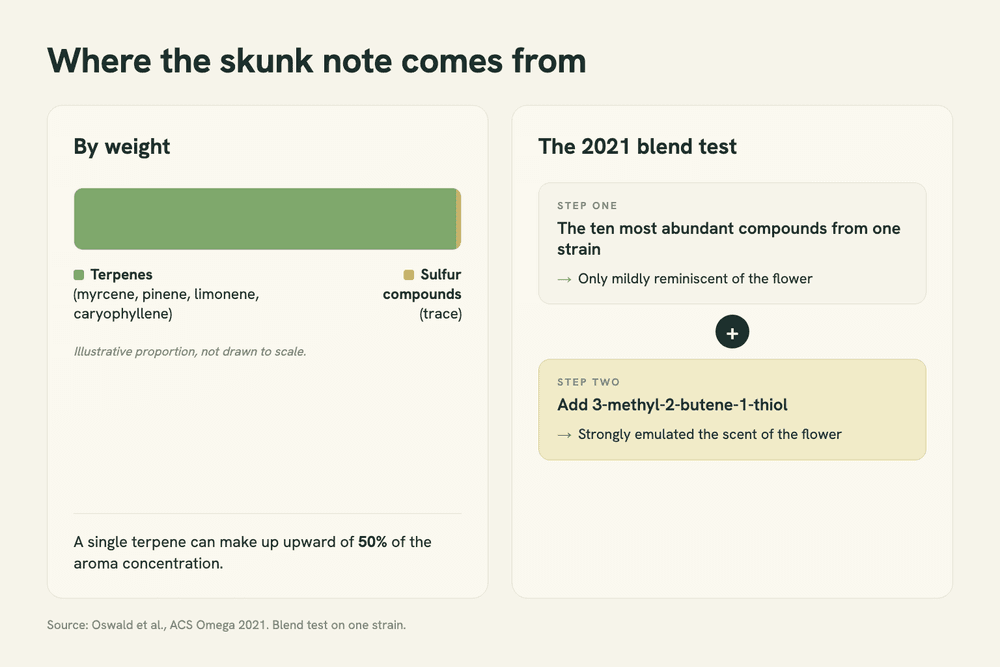
Here is the short version. Terpenes such as myrcene, limonene and pinene make up most of the aroma fraction of cannabis by weight, and they shape much of what a strain smells like. But when chemists at a California flavor company analyzed 13 dispensary cultivars in 2021, they noted there is "little evidence" that terpenes provide the characteristic skunk note, and traced it instead to a family of sulfur compounds they called prenylated volatile sulfur compounds, led by 3-methyl-2-butene-1-thiol. By weight, terpenes dominate. By impact, a trace of sulfur carries the skunk.
Most pages that rank for this question still credit myrcene, or "terpenes" in general, and some claim that a stronger smell means stronger weed. This page puts the research together instead: the 2021 discovery and two follow-up studies from the same lab, a 2025 check by an Oregon State team outside that lab, a direct test of whether smell predicts THC, and what a lab report can and cannot tell you about aroma. It is chemistry, not buying advice, and it applies to hemp as much as to marijuana. It is part of our series on everyday cannabis questions, alongside why weed leaves your mouth so dry.
What actually makes weed smell like skunk
For decades the skunk smell of cannabis was an open question hiding in plain sight. Terpenes were easy to measure and there were a lot of them, so they got the credit. The 2021 team, from a cannabis flavor company called Abstrax Tech, went looking for something else. Their reasoning: other famously pungent things, a skunk's spray among them, get their punch from volatile sulfur compounds, and sulfur compounds can matter to the nose at trace amounts that standard terpene testing is not set up to find. So they ran their samples through two-dimensional gas chromatography, a separation method that pulls apart hundreds of compounds at once, paired with a detector that responds only to sulfur. A small panel of four people rated each cultivar's pungency from 0 to 10.
The pattern was clear. The sample sold as Bacio Gelato scored 10 out of 10 for pungency. The two samples labelled Black Jack and Gouda Berry scored 0, and the instruments found no volatile sulfur compounds in them at all. Across the 13 cultivars, 3-methyl-2-butene-1-thiol, which the authors called VSC3, tracked pungency more closely than anything else. Then came the reconstitution test. When the team mixed the ten most abundant aroma compounds from one strain, the blend smelled only "mildly reminiscent" of the flower. Adding the sulfur compound "resulted in an immediate olfactory change that strongly emulated the scent of the flower." The terpenes were the background. The thiol was the skunk.
Your nose, a skunk and a skunked beer
Why can a trace compound overpower hundreds of others? Because humans are unusually sensitive to this class of molecule. None of the cannabis papers here measured how little of 3-methyl-2-butene-1-thiol a person can smell, but a 2012 study of Spanish red wine measured it at 0.5 to 1 nanogram per liter, which is parts-per-trillion territory. As Pamela Dalton of the Monell Chemical Senses Center told NPR in 2025, "We are extremely sensitive to sulfur compounds."
You may already know the molecule from beer. The 2021 cannabis paper notes that the same compound is the main cause of "skunked" beer. When light hits beer, for example through a clear bottle, it breaks down the bitter acids that come from hops through a free-radical reaction, and the fragments go on to form the thiol. A skunk's spray, on the other hand, uses different molecules. A 1990 analysis of striped skunk secretion identified seven major components, including two thiols, (E)-2-butene-1-thiol and 3-methyl-1-butanethiol, along with thioacetates and quinoline compounds.
The aroma families in cannabis, in one table
| Family | Example compound | How people describe it | What the research found |
|---|---|---|---|
| Terpenes | Myrcene, limonene, pinene, caryophyllene | Earthy, citrus, pine, spice | One terpene alone can reach upward of 50% of the aroma concentration, yet little evidence ties them to the skunk note (2021) |
| Prenylated thiols | 3-methyl-2-butene-1-thiol (VSC3) | Skunk, gas | Primary skunk odorant; tracked pungency across 13 cultivars (2021) |
| Tropical thiols | 3-mercaptohexyl acetate and relatives | Sulfurous citrus, petroleum | Gave some strains a petroleum or sulfuric citrus edge (2023) |
| Indoles | Skatole (3-methylindole), indole | Savory, chemical; indole floral | Skatole tracked savory strains; indole was common across samples (2023) |
| Fatty acids | Octanoic acid, decanoic acid | Cheese-like | The two acids were linked to cheese-like notes in sibling plants (2024) |
Read the table as volume versus impact. Terpenes are the bulk of what evaporates off a flower, which is why so many labs, labels and websites describe aroma in terpene terms. The other four families are present in far smaller amounts, but several of them are smelled at far lower concentrations, so they can shape what the flower actually smells like. Flavonoids, the plant's pigment compounds, are not in this table: this list covers only the volatile compounds that reach your nose, and flavonoids are a separate class that our flavonoids explainer covers.
Why garlic, gas and cheese strains smell so different
If terpenes drove aroma, strains that smell completely different should have very different terpene profiles. They mostly do not. In a 2023 follow-up from the same lab, researchers analyzed 31 samples of ice-water hash rosin (a solventless concentrate) and had 7 untrained cannabis users describe them. Terpene expression stayed "remarkably similar" across samples with very different aromas: the sesquiterpene profiles correlated at r of 0.86 or higher between every pair of samples. What differed were minor compounds that are not terpenes at all. The share of these "flavorant" compounds correlated with how exotic the panel rated a sample (r = 0.58). The authors concluded that the importance of terpenes in cannabis aroma "has been overemphasized."
- Skatole, an extremely pungent indole compound, trended strongly with the savory, "chemical" samples, sold under names such as GMO, Garlic Cookies and 710 Chem.
- Indole, its close relative, turned up in many samples regardless of style and reads as floral or mothball-like. It is not the savory marker.
- A second sulfur family the authors called tropical thiols (3-mercaptohexyl compounds, including one also found in hops) gave samples labelled Garlic Cocktail #7 and Gorilla Glue a petroleum or sulfuric citrus aroma.
- The one terpinolene-heavy sample, labelled Trainwreck and low in the skunk thiols, was the one the panel did not call "gas".
None of these studies pins the word "garlic" on a single molecule. The garlic in those names is a strain name, not a chemical finding, and the link in the research is only that savory strains, some with garlic in their names, carried skatole. A 2024 study from the same group pushed the idea further with five sibling plants from a single cross. An 11-person panel found their aromas distinct, and the differences traced to trace compounds, including a newly identified sulfur compound, 3-mercaptohexyl hexanoate, and two fatty acids, octanoic and decanoic acid, linked to cheese-like notes. As a check from outside that lab, a 2025 Oregon State study built a 25-term aroma vocabulary and had 21 to 24 trained panelists smell 91 samples. It found that neither terpene nor sulfur profiles strongly predicted how the hemp samples smelled. Chemistry explains the skunk note. It does not yet predict a whole bouquet.
Why the skunk smell shows up late and fades fast
The first three numbers come from the 2021 paper's greenhouse trial, which followed four clones of one OG-type plant for 14 weeks. The skunk compounds were undetectable until the seventh week of flowering, rose quickly to week 10, and reached their maximum at the end of an 11-day cure at about 22°C (72°F) and 45% humidity. Ten days after the flowers went into mason jars, the main skunk compounds had dropped substantially (one held steady), and the panel's odor ratings followed the same curve. Retail product pointed the same way: the same Gelato batch carried nearly three times more of the skunk compound four days after packaging than at 46 days. The compound is so volatile that a sample vial left uncapped for 15 to 20 minutes lost almost all of its skunk scent.
That helps explain why the skunk edge can fade from flower within weeks. The study tracked aroma, not THC, so it says nothing about potency over the same period. Terpenes fade with time and heat too, on their own schedule, which our terpene explainer walks through with storage data. Aging, potency loss and the musty smell of mold are a separate question that our guide to whether weed goes bad covers. Keep the limits in mind: one genotype, four plants, one indoor grow, and one retail batch measured twice.
Does stronger-smelling weed mean it's more potent?
No, and this question has been tested directly. In a 2018 Colorado study, 61 adults, almost all of them cannabis buyers, smelled 13 samples of 11 strains (one strain bought from two shops, and one sample presented twice as a consistency check) and rated, among other things, how potent each one seemed. The researchers then measured the THC in the 12 distinct samples themselves. Measured THC ranged from 7.7% to 27.1%, a 3.5-fold spread, yet the smell-based potency ratings showed no relationship to it. The sample sold as Super Skunk tested at 10.4% THC, the third-lowest of the 12. The explanation is simple chemistry: THC is nonvolatile and has no smell. It is one of the cannabinoids, a different class of compound from the ones you smell. The same study found lab THC below the label range for at least 6 of the 12 samples, which is its own lesson about how much a THC percentage on a label can tell you.
“Although smell-based consumer perceptions of cannabis potency vary by strain, they show no relationship to experimentally measured THC content.”
Strain labels do not hold up much better. A 2021 genetic study chemically profiled 297 cannabis samples from the Dutch market and genotyped 137 of them. Samples labelled Sativa and Indica were "genetically indistinct on a genome-wide scale". The labels tracked a handful of terpenes instead, myrcene above all for Indica, and those terpenes map to a few clusters of terpene-synthase genes. Samples sold under the same name were often as genetically distant as samples with different names. So a name tells you little about genetics, and a smell tells you little about THC.
Does hemp smell like weed?
Yes. Hemp and marijuana are the same species, and the line between them is a legal THC limit, not a different plant, as our hemp versus marijuana explainer lays out. A 2025 study of six CBD-rich hemp cultivars found 52 odor-active compounds in the dried flower, and the same skunk thiol, 3-methylbut-2-ene-1-thiol, ranked among the most potent odorants alongside alpha-pinene, myrcene and linalool. Those rankings describe odor strength, not amounts. The Oregon State team found that THC-dominant and CBD-dominant flower overlapped in smell. The THC-type samples were more often called skunky, musty and animalic, and the CBD types more often citrus, fruity and candy-like, but there was no clean dividing line. The authors also noted that breeding of THC-type cannabis has more recently emphasized musty, skunky and gassy profiles, which may be part of why the skunk note became a stereotype. The practical upshot: smell alone cannot reliably tell legal hemp from marijuana, a point our guide to CBD flower's legal status covers in detail.
What a lab report can and cannot tell you about smell
A certificate of analysis (COA) is the lab report for a batch. If you know how to read a COA, you can check what was measured and what was not. Here is how the aroma chemistry above maps onto what you will actually see on one.
- 1The potency panel lists cannabinoids such as THC and CBD. They are not the compounds you smell, so this panel says nothing about aroma, and aroma says nothing about it.
- 2A terpene panel, if the report has one, lists the high-volume compounds. It shows the background of the aroma, not the trace compounds that carry notes like skunk.
- 3No routine cannabis or hemp panel we know of lists sulfur thiols, skatole or tropical thiols. The compounds behind the skunk note are simply not on the report.
- 4A packaging date is context for aroma, not a quality score: in the 2021 data the skunk thiols fell within days to weeks, and no panel on the report records that.
- 5Treat a strong smell as information about aroma chemistry and freshness only. Read potency from the potency panel.
Here is how that applies to us. Planntz sells hemp-derived tinctures and tablets, not flower. Every Planntz tincture certificate of analysis published at our lab results page reports cannabinoid potency by UHPLC-DAD across sixteen rows, thirteen individual cannabinoids and three calculated totals, alongside four heavy metals by ICP-MS and six microbial tests, batch by batch, with the lab's license number and a public verification link on the page. Our tablet certificate reports potency only. None of our certificates includes a pesticide panel, a residual-solvent panel, a mycotoxin panel or a terpene panel, and none measures sulfur thiols, so we cannot tell you whether any are present in our products.
What is still unknown
- How the plant makes these sulfur compounds. None of the studies cited here identifies the pathway or a gene responsible for it.
- How little of the skunk thiol you can smell in cannabis or in air. The threshold we could source for this molecule was measured in wine.
- Whether the skunk thiols survive into most extracts. Three butane-extracted concentrates kept them, but CO2 and ethanol extracts, distillates and diluted oils have not, to our knowledge, been measured.
- How to predict a whole aroma from a chemical profile. The 2025 Oregon State study found neither terpenes nor sulfur compounds predicted it well.
- Whether the findings generalize. The panels were small, the samples came from a few markets, and the 2023 and 2024 studies used hash rosin rather than flower.
One plain note on who paid for this science. The 2021, 2023 and 2024 aroma papers come from Abstrax Tech, a cannabis flavor company whose authors have filed patents (the 2024 study also had two co-authors from 710 Labs), and their smell panels had just 4, 7 and 11 people. Several of the other studies cited here also had industry ties: Bedrocan funded the 2021 label study, Vectura Fertin Pharma funded the Oregon State work, two authors of the 2025 hemp study work at Puregene AG, and the 2018 potency study's materials were funded by the first author's company. None of that makes the chemistry wrong, and the Oregon State team, working outside the Abstrax lab, also found dozens of sulfur compounds in hemp, with a tentative match for the skunk thiol. It does mean the picture rests on a small number of groups. If your question is about a CBD tincture rather than flower, our guide to what CBD oil tastes like covers that separate sensory question.
Questions people ask about the skunk smell
None has been shown to. Myrcene is the usual answer online, but the 2021 study's authors noted there is little evidence that terpenes provide the skunk note, and traced it elsewhere. It comes from a sulfur compound, 3-methyl-2-butene-1-thiol. Adding it to a mix of the ten most abundant aroma compounds of one strain is what made the mix smell like the flower.
No. In a 2018 Colorado study, 61 adults, nearly all cannabis buyers, rated potency by smell, and their ratings showed no relationship to the THC the researchers measured. The sample sold as Super Skunk tested at 10.4% THC, the third-lowest of the 12 samples measured. THC has no smell, so aroma cannot reveal it.
The skunk thiols are very volatile. In one small grow they peaked at the end of an 11-day cure and dropped substantially ten days later, and one retail batch had about three times less of the main skunk compound at 46 days after packaging than at 4 days.
Trace compounds, not terpenes. In a 2023 study, skatole showed up in savory, "chemical" samples, some with garlic in their names; 3-mercaptohexyl thiols gave a petroleum or sulfuric citrus edge; and the "gas" note went with the skunk thiols. None of these studies ties the word garlic to one molecule.
Same family, different molecules. Both rely on thiols, sulfur compounds your nose picks up at tiny levels. A skunk's spray includes (E)-2-butene-1-thiol and 3-methyl-1-butanethiol. The cannabis compound, 3-methyl-2-butene-1-thiol, is a close cousin of the second one, not the same molecule.
Yes. Hemp is the same species, and a 2025 study of six CBD-rich hemp cultivars found the same skunk thiol among the strongest odorants. THC-type flower tends to be described as skunkier, but the two overlap, so smell cannot tell legal hemp from marijuana.
Many hemp oils carry an earthy, grassy note from the plant. Whether the skunk thiols survive into a diluted CBD tincture has not, to our knowledge, been measured.
Read the lab report, not the smell
Planntz makes hemp-derived tinctures and tablets, not flower. Each batch has a third-party certificate of analysis you can read before you buy, so you can check its measured cannabinoid content instead of guessing.
Browse Planntz productsWriting about hemp, wellness and the small rituals that keep us balanced.