Are Hops and Weed Related? The Family Tree and the Chemistry
Yes: hops and cannabis are sister genera in one small plant family. Here is the dated family tree with its four published estimates, the gland chemistry they share, why hops make no THC or CBD, the 1975 grafting test and the hop viroid now hitting cannabis.
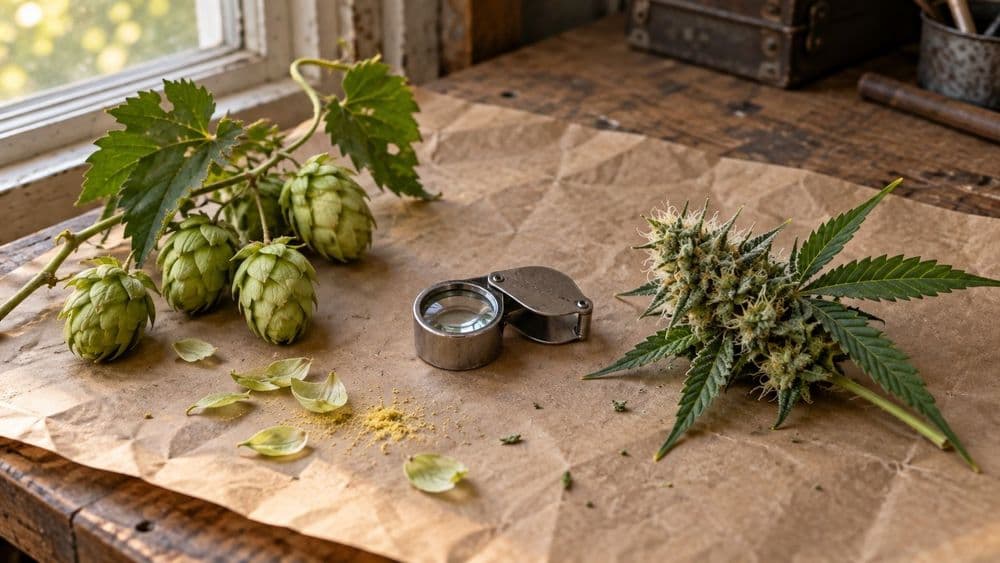
Are hops and weed related? Yes. Hops (genus Humulus) and cannabis (genus Cannabis) are the two best-known members of one small plant family, Cannabaceae, and published estimates put their split somewhere between about 16 and 36 million years ago, depending on the method. They share resin glands, a chemical toolkit and several aroma molecules. They do not share cannabinoids: only cannabis carries the genes that make THC and CBD.
The usual answer online says the two plants are "cousins" that parted "about 25 million years ago" and stops there, with no source for the number. Below: the sourced family tree, the chemistry the two plants share and the one thing they do not, a 1975 grafting experiment that tested "THC hops", why some beer smells like weed, and a hop disease now hitting cannabis crops.
Are hops and weed related? Yes: the same small plant family
Botanists group related genera into families. Cannabis and hops both belong to Cannabaceae, and according to a 2018 review of cannabis systematics by John McPartland, the family now holds about 170 species in 10 genera. The surprise is the company they keep. Apart from cannabis and hops, the other 8 genera were once placed in a separate family, Celtidaceae, and they are mostly trees and shrubs:
- Cannabis: the genus that includes both hemp and marijuana-type plants.
- Humulus: the hops, including the brewing hop Humulus lupulus and the Japanese hop Humulus japonicus.
- Celtis: the hackberries, familiar as street and shade trees.
- Trema and Parasponia: tropical trees and shrubs. McPartland notes that Parasponia forms nitrogen-fixing root nodules with rhizobial bacteria, a partnership otherwise associated with legumes.
- Pteroceltis, Aphananthe, Chaetachme, Gironniera and Lozanella: lesser-known woody genera.
The pairing of cannabis and hops is old. The Italian botanist Cesalpino linked cannabis to "her sister genus Humulus" in 1583, as McPartland puts it. What changed is the rest of the family. In 2003 the Angiosperm Phylogeny Group, the consortium that maintains the modern classification of flowering plants, merged Cannabaceae with Celtidaceae on DNA evidence. McPartland calls the result "morphologically counterintuitive", and you can see why: a climbing hop and a hackberry tree look nothing alike. Within that larger group, cannabis and hops form their own branch. For how the cannabis organism itself is built, from root to resin gland, see our guide to cannabis plant anatomy.
When did hops and cannabis split? Four estimates, four methods
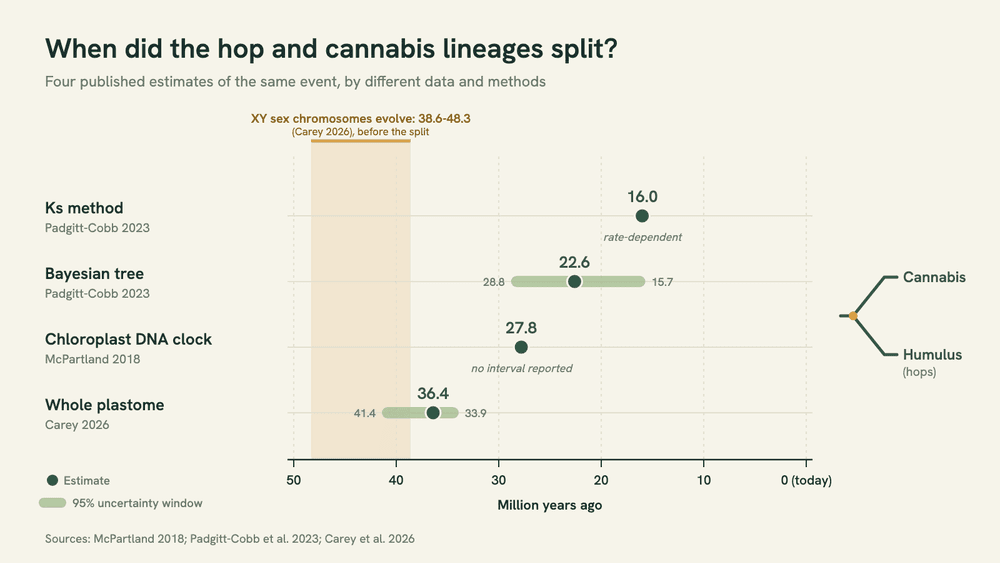
Dating a split between two plant lineages means reading a molecular clock: counting DNA differences and converting them into years, usually anchored by fossils of known age. Three research teams have done this for hops and cannabis with different data and methods, and their answers differ by about 20 million years. Here they are side by side.
| Study | Data and method | Estimate | Uncertainty window |
|---|---|---|---|
| McPartland and Guy, reported in McPartland 2018 | Chloroplast DNA (rbcL and trnL-trnF genes), molecular clock calibrated with 4 fossils | 27.8 million years ago | No interval reported |
| Padgitt-Cobb et al. 2023 | Bayesian time tree of 8 plant species, fossil-calibrated | 22.6 million years ago | 15.7 to 28.8 million (95% HPD) |
| Padgitt-Cobb et al. 2023 | Synonymous substitution rate (Ks) between matching hop and cannabis genes | 16.0 million years ago | Depends on the assumed mutation rate |
| Carey et al. 2026 | Whole chloroplast genomes, Bayesian (BEAST) tree with fossils | 36.4 million years ago | 33.9 to 41.4 million (95% CI) |
The improved Cascade hop genome published in 2023 produced two of those numbers. Its fossil-calibrated tree put the split at about 22.6 million years ago, with a plausible window of roughly 15.7 to 28.8 million years. A second method in the same paper, which counts the DNA changes that do not alter a protein (synonymous substitutions) between matching genes, gave about 16 million. The authors are candid about how fragile that second figure is: with other published mutation rates, the same data give 46 to 79 million years. They also point to the "sparsity of the fossil record" as a source of uncertainty, and note that their estimates roughly agree with earlier ones between 18.23 and 27.8 million years. Sequencing was funded in part by the hop company Hopsteiner, alongside the USDA, and the authors declared no conflicts of interest; it does not change the arithmetic, but it is worth knowing.
The newest estimate is also the oldest. A 2026 study that assembled the sex chromosomes of both hop and cannabis built its tree from whole chloroplast genomes and concluded that the two lineages "began diverging between 33.9 and 41.4 MYA", with a mean of 36.38 million years. So when our page on landrace cannabis cites about 27.8 million years, that is the chloroplast-clock figure from the 2018 review: one valid estimate among four, not the final word. The honest summary is tens of millions of years, with point estimates from about 16 to 36 million and uncertainty windows stretching from about 16 to 41 million.
The tree also had a third branch that did not survive. McPartland describes an extinct sibling genus known from fossils found in central Siberia, and writes that cannabis "lost a sibling perhaps 20 million years ago." Fossil hops themselves are known from the Oligocene, the epoch that ran from about 33.9 to 23 million years ago.
What hops and cannabis share
| Trait | Cannabis (Cannabis sativa) | Hop (Humulus lupulus) |
|---|---|---|
| Family | Cannabaceae | Cannabaceae |
| Chromosomes | 18 + XX/XY | 18 + XX/XY |
| Sexes | Mostly separate male and female plants | Typically separate male and female plants; some plants carry both |
| Genome size (haploid assembly) | About 0.76 to 0.83 billion letters | About 2.4 to 2.8 billion letters |
| Resin glands | Glandular trichomes on female flowers | Lupulin glands (glandular trichomes) in female cones |
| Signature prenylated compounds | Cannabinoids, built from CBGA | Bitter acids (humulone, lupulone) and xanthohumol |
| Makes cannabinoids? | Yes | No: the synthase genes arose on the cannabis branch |
| Main shared aroma molecules | Myrcene, beta-caryophyllene, humulene | Myrcene, beta-caryophyllene, humulene |
| Skunk thiol link | Main skunk odorant (3-methyl-2-butene-1-thiol) | Hop acids break down into the same thiol in light-struck beer |
| Shared pathogen | Hop latent viroid ("dudding", first reported 2019) | Hop latent viroid (described 1988) |
| US legal status | Marijuana is federally controlled; hemp is defined by a THC limit | Ordinary farm crop |
Start with sex. Both plants usually grow as separate male and female individuals, and the hop genome paper describes hop as "diploid (2n = 18 + XX/XY)", the same arrangement cannabis has: 18 ordinary chromosomes plus an X/Y pair. That system is older than the split itself. The 2026 genome study estimated the sex chromosomes evolved 38.6 to 48.3 million years ago, on the ancestral branch before hops and cannabis went separate ways. Our explainer on male vs female cannabis plants covers what that means for flower and seed.
Next, the glands. The "hops" brewers buy are the female cones of Humulus lupulus, and the sticky yellow powder inside is lupulin: glandular trichomes, the same kind of resin gland that coats female cannabis flowers. Our deep dive on trichomes explains how those glands make and store compounds in cannabis. In hops they are dense with bitter acids, which a 2015 study of the hop gland's prenylation enzymes put at more than 30% of the gland's fresh weight.
The chemistry inside those glands follows the same logic. Both plants build their signature compounds in two steps: an enzyme called a type III polyketide synthase makes a ring-shaped core from small building blocks, including malonyl-CoA, then an aromatic prenyltransferase bolts on a chain made from terpene building blocks. That second move is called prenylation. In hops, work on the hop prenyltransferase HlPT-1 describes the products: the alpha-acid humulone, the beta-acid lupulone and the flavonoid xanthohumol. The 2015 study found that two enzymes (PT1L and PT2) carry out three prenylations in a row. In cannabis, a 1998 enzyme study in hemp identified the matching step, which joins geranyl pyrophosphate to olivetolic acid to make CBGA, the parent molecule of the major cannabinoids. Our page on CBGA, the mother cannabinoid, follows that pathway further.
Related is not identical. The hop genome is about three times the size of the cannabis genome: 2.4 to 2.7 billion DNA letters per haploid set in the 2026 assemblies, against 760.6 to 828.8 million for cannabis. A cytogenetic comparison of cannabis and two hop species, which used labeled DNA to see how much each genome recognizes the other, found them "highly differentiated". It also found that the Japanese hop has gone its own way on sex chromosomes, with a multiple XX/XY1Y2 system. The sharpest practical difference is legal, not botanical: hops are an ordinary farm crop, while US law sorts cannabis into hemp and marijuana by THC content, a line our guide to hemp vs marijuana explains.
The shared smell: myrcene, humulene and the terpene trap
Crush a fresh hop cone and a cannabis flower and you may notice some overlap. Part of it is real chemistry. In a 2013 analysis of hop pellets from the Nugget, Saaz and Perle cultivars, researchers found more than 40 volatile compounds, and the main ones in every cultivar were myrcene, beta-caryophyllene and humulene. All three are terpenes that cannabis makes too. Humulene even carries the hop's name: a 2024 review of alpha-humulene notes that it was first identified in the essential oil of Humulus lupulus, "from which it derived its name."
Here is the trap. Shared terpenes do not prove two plants are related. A 2008 PNAS study described beta-caryophyllene as "a common constituent of the essential oils of numerous spice and food plants", most of which are nowhere near the cannabis family. Kinship comes from DNA, which is why the family tree above rests on genomes, not smells. The same study found, in lab binding tests, that beta-caryophyllene attaches to the CB2 cannabinoid receptor. That is a preclinical lab finding, and it makes beta-caryophyllene a terpene with an unusual talent, not a cannabinoid. If the line between the two classes feels fuzzy, start with how cannabinoids and terpenes differ.
What hops do not make: THC, CBD or any cannabinoid
This is the one big difference, and it is written in the genes. After cannabis makes CBGA, a family of enzymes called cannabinoid oxidocyclases (THCA synthase and CBDA synthase are the best known) turns it into the acid forms of THC, CBD and their relatives. A 2021 comparative genomics study of these synthase genes traced their history across the family and concluded that they "originated in the Cannabis lineage from within a larger gene expansion in the Cannabaceae family." In plain terms, the genes that finish THC and CBD arose on the cannabis branch, after it had parted from hops. That is the underlying reason hops make no cannabinoids.
There is a nuance most pages skip. The 2023 hop genome contains genes whose sequences resemble CBDA synthase, and one of them is switched on (expressed) in the plant. But resemblance is all the evidence shows. The researchers identified these genes by sequence similarity alone, the expressed hop copy did not group with the expressed hemp CBDA synthase in their analysis, and the same paper cautions elsewhere that similarity "is not sufficient to assign function." So the accurate statement is narrow: hops carry distant relatives of the cannabinoid genes, and no study has shown a hop plant making THC or CBD.
The difference runs both ways. A 2002 analysis of two hemp cultivars, Felina and Futura, found that the hop-type prenylated flavonoids, the xanthohumol family, are absent from hemp. Each plant has a prenylated signature the other lacks: cannabinoids in cannabis, bitter acids and prenylflavonoids in hops. That has not stopped marketing from blurring the line. In 2017 a supplement maker claimed to have extracted CBD from hops, and University of British Columbia botanist Jonathan Page told Vice that "there has been no reported case of CBD being isolated from the hop plant." The genomics published since then points the same way. Drinks that combine hop flavor with THC are a separate product with cannabis added, covered in our guide to hemp drinks.
The 1975 grafting experiment that tested "THC hops"
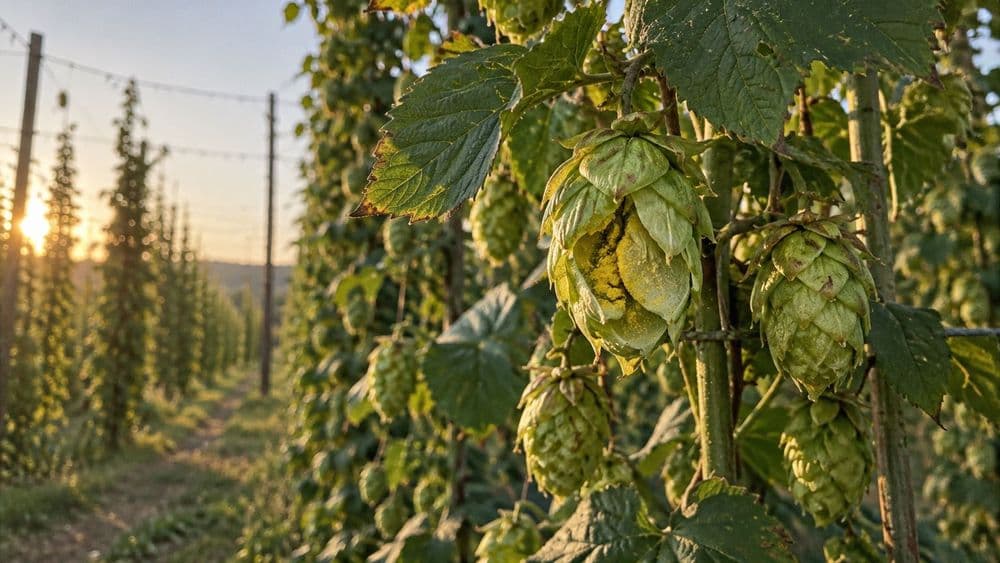
Because hops and cannabis are close relatives, an old idea keeps circulating: join a hop to a cannabis plant and the hop will start making THC. Two chemists tested a version of it decades ago. In a 1975 paper in Phytochemistry, L. Crombie and W. M. L. Crombie grafted cannabis plants together across high-THC and low-THC types, and also cross-grafted cannabis with two hop species, Humulus lupulus and Humulus japonicus.
The grafts took. That alone says something about kinship, because plants from distant lineages rarely form a working graft. But according to a database summary of the paper (the full abstract sits behind the publisher), the authors found no evidence that intermediates or other factors critical to cannabinoid formation moved across the grafts. The hop side stayed a hop. The ability to make cannabinoids lives in the cells that carry the synthase genes, and it did not travel through the join. Nearly 50 years later, the hop genome team still pointed to those grafts as evidence of how close the plants are:
“Successful grafting between C. sativa, H. japonicus, and H. lupulus further underscores the close relationship between these species.”
Keep the limits in view. This is one 1975 study using the analytical tools of its day, and we could check only an abstract-level summary of it, not the full methods. Later readers have interpreted some of its details differently, so the safe takeaway is the core result: the plants can be joined, and cannabinoid-making capacity did not cross. Getting a hop to produce cannabinoids would take genetic engineering, the kind of whole-pathway transfer that researchers reported in brewer's yeast engineered to make cannabinoids in 2019, not a graft. We found no report of a hop plant engineered that way.
Why some beers smell like weed
If you have opened a beer that smelled oddly like cannabis, there are a few possible reasons, and only some of them are terpenes:
- Hop terpenes. Heavily hopped beers, especially dry-hopped ones (hops added after the boil, during or after fermentation, so more aroma survives), carry myrcene, humulene and other volatiles cannabis shares.
- The light-struck thiol. Light breaks down the hop's iso-alpha-acids, the bitter compounds in beer, and the fragments form 3-methyl-2-butene-1-thiol. That is the classic "skunked beer" smell.
- Other sulfur compounds. Both plants make tiny amounts of very potent sulfur volatiles that can push an aroma toward what people call "dank".
The second point is the striking one. A 2001 photochemistry study showed that light drives the breakdown of hop iso-alpha-acids that starts the skunking process, which is why the problem is tied to light hitting the bottle. Then a 2021 analysis of 13 cannabis cultivars identified the same molecule, 3-methyl-2-butene-1-thiol, as the primary odorant behind cannabis's skunk note, and described it as "the primary compound leading to the flavor and aroma of 'skunked beer'." The human nose is extremely sensitive to it: in wine, people can detect it at about 0.5 to 1 nanogram per liter. So the same sulfur molecule turns beer skunky when light hits a clear bottle and gives some cannabis its skunk note. The cannabis side of that story, including when the thiol appears during flowering, is on our page about why weed smells like skunk.
Hop latent viroid: the hop disease now hitting cannabis
A viroid is one of the smallest known plant pathogens: a bare loop of RNA with no protein coat that uses the host's own cells to copy itself. Hop latent viroid (HLVd) was named and sequenced in 1988 in a paper describing "a new viroid occurring worldwide in hops", after viroid-like RNA had been reported in hops from León, Spain, the year before. In hops it is mostly "latent", meaning infected plants rarely show symptoms. They still pay for it. A 2023 review of the viroid collects field studies showing yield losses from 8% in the Wye Challenger variety to 37.5% in a Slovenian cultivar, and drops in bitter alpha-acids of 15% to 30%, reaching 40% in Saaz. The same review reports the viroid in 90% to 100% of the hop collections tested in European countries.
In cannabis, the disease is called "dudding", and it was first reported in California in 2019 (Bektaş and colleagues, Plant Disease, doi:10.1094/PDIS-03-19-0459-PDN). Since then, the 2023 review says, it "has become widespread in cannabis-growing facilities across North America." A 2025 Canadian greenhouse study of how the viroid spreads in cannabis reported these findings:
- The viroid was present in symptomless stock plants and in the cuttings taken from them.
- It spread through recirculated nutrient solution and by root-to-root contact in hydroponic systems.
- It stayed detectable for several days in plant sap and for about 4 weeks in dried tissue.
- It was detected in trichome glands, dried flower and crude resin oil, though not in the winterized oil made from that extract.
- Seed from infected female plants, or pollen from infected males, gave rise to up to 100% infected seedlings.
- Its RNA could still be amplified after 3 to 5 minutes of UV-C light or 30 minutes at 70 to 90 °C. Amplifiable RNA is not proof the viroid stays infectious.
Separately, a 2023 Texas A&M study of the viroid in hemp found HLVd alone in 72% of samples from one diseased production system, measured seed transmission of 58% to 80% in its summary (the results section reports up to 84%), added tomato, cucumber and chrysanthemum to its list of known hosts, and reported reduced levels of valuable metabolites in infected plants at flowering. The authors call the viroid "a major threat to the global cannabis industry." One honest gap remains: controlled measurements of how much potency HLVd costs modern cannabis are scarce. The big numbers that circulate online, such as a nursery's 2021 testing suggesting that most California facilities were affected, were reported in trade press, not in peer-reviewed studies.
Myths about hops and weed, checked
| Myth | Verdict | Why |
|---|---|---|
| Hops are a kind of cannabis | False | Same family, different genus. The lineages split roughly 16 to 36 million years ago, depending on the method. |
| Graft hops onto weed and you get THC hops | False | In 1975 the grafts took, but cannabinoid formation did not cross the join. |
| Hops contain CBD | No reported case | The synthase genes arose on the cannabis branch. A 2017 supplement claim was disputed by a botanist. |
| Beer gets THC from its hops | False | Hops make no THC. THC-infused beverages are a different product with cannabis added. |
| Humulene only comes from hops | Partly true | It was first found in hop oil and is named after hops, but cannabis makes it too. |
| Beer smells like weed because of terpenes | Partly true | Terpenes overlap, but the skunk note is a sulfur thiol formed when light breaks down hop acids. |
| Beta-caryophyllene makes hops a cannabinoid plant | False | It binds the CB2 receptor in lab tests, but it is a terpene, not a cannabinoid. |
What is still unknown
- The exact split date. The four published estimates disagree by about 20 million years, fossils are sparse, and the answer shifts with the assumed mutation rate.
- What the hop CBDA-like genes do. We found no study testing whether the expressed hop copy makes any product at all, and similarity alone does not tell you.
- How much HLVd costs cannabis growers. Spread and transmission are well measured; controlled measurements of potency loss in modern cannabis are not.
- The fine print of 1975. The full methods of the Crombie grafting paper are not openly available, so details beyond the core result are hard to verify.
Frequently asked questions
No. Hops and cannabis are in the same family, Cannabaceae, but they are different genera: hops are Humulus and cannabis is Cannabis. Think of them as sister branches, not one plant in two forms. Published estimates of when the two lineages split range from about 16 to 36 million years ago, depending on the data and method, with uncertainty windows reaching about 41 million years.
No study has found either in hops. The genes that make the acid forms of THC and CBD arose on the cannabis branch of the family after it parted from hops, according to a 2021 genomics study. The hop genome does carry distant look-alike genes, and one is expressed, but no study has shown it doing anything. A 2017 supplement claim of CBD from hops was disputed by botanists.
Hops contain no THC or other cannabinoids made by the cannabis pathway, so they cannot produce a cannabis high. Any effect you feel from beer comes from its alcohol. THC-infused drinks, including hop-flavored ones, are a separate product that contains THC added from cannabis, so check the label and lab report of any drink like that.
Two reasons. Hops and cannabis share aroma terpenes such as myrcene and humulene, so hop-forward beers can smell similar. And when light breaks down the hop acids in beer, they form 3-methyl-2-butene-1-thiol, the same sulfur compound a 2021 study identified as the main source of cannabis's skunk note. In wine, people can smell it at around a nanogram per liter.
The plants are related closely enough that grafts between cannabis and two hop species took in a 1975 study by Crombie and Crombie. But the hop part did not become a cannabinoid plant: a summary of the paper reports no evidence that cannabinoid-forming intermediates or factors crossed the graft. The ability to make cannabinoids depends on genes that hops do not have.
Hop latent viroid is a tiny plant pathogen, a closed loop of 256 RNA letters with no protein coat, named and sequenced in hops in 1988. It was first reported in cannabis in California in 2019, where it causes "dudding" disease, and it has since spread through North American growing facilities. Studies have found it in cuttings, nutrient water, trichomes, dried flower, resin oil and seed.
Humulene was first identified in hop essential oil and is named after the hop genus, Humulus. It is one of the main aroma compounds in hop oil, alongside myrcene and beta-caryophyllene. But it is not exclusive to hops: cannabis makes it too. A shared terpene is not proof of kinship; the DNA is.
Hops are cannabis's closest living relatives, and the comparison only goes so far. To see how the cannabis plant itself is built and where its cannabinoids are actually made, keep exploring with our cannabis plant anatomy guide, from root to resin gland.
Writing about hemp, wellness and the small rituals that keep us balanced.