Landrace Strains: What the Word Means and What Genomes Show
Landrace strains are sold as pure, original cannabis. In crop science the word means something else. Here is what a landrace is, what 110 genomes say about where cannabis came from, and what a landrace name can and cannot tell you.
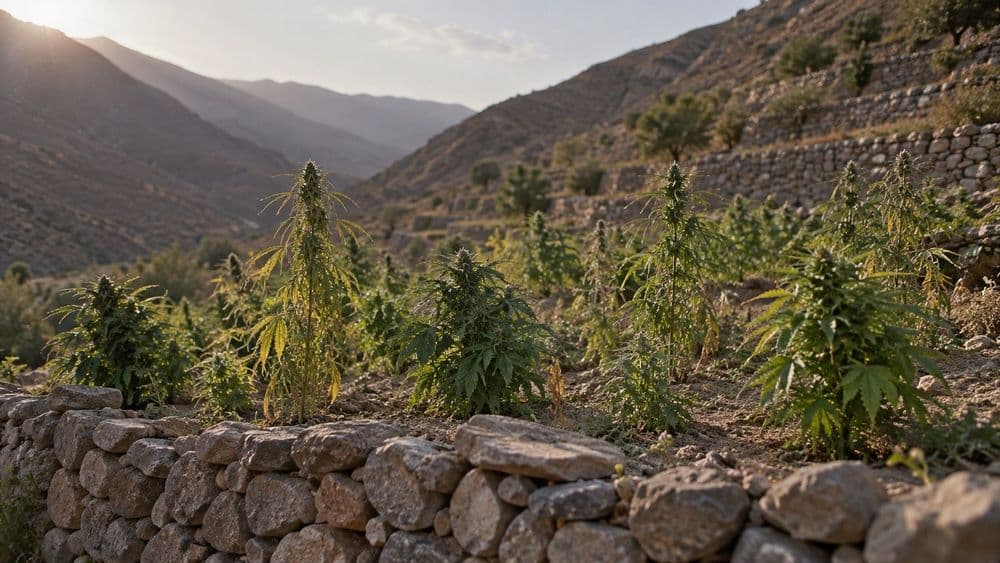
Landrace strains are sold as the original cannabis: old, pure and untouched by breeders. The word comes from farming, though, and in farming it means something less romantic and more interesting. Here is what a landrace actually is, what the newest genome studies say about where cannabis came from, and what a landrace name on a menu can and cannot tell you.
The short answer: a landrace is a cultivated population that farmers kept in one region for generations until it adapted to the local soil, climate and uses. Crop scientists expect landraces to be varied and to keep absorbing outside genes, so the word never meant "pure". A 2021 study of 110 cannabis genomes points to domestication in East Asia roughly 12,000 years ago, and since the 1970s breeders have crossed the old drug landrace groups so heavily that two botanists describe their differences as largely obliterated. A landrace name is a story about ancestry, not a lab result. If you want the parts of the plant first, start with our guide to cannabis plant anatomy.
What "landrace" means in agriculture, and what the menu changed
The word is older than the cannabis industry by about a century. It translates the German Landsorte, a term the agronomist von Rümker introduced in 1908 for the local crop varieties that farmers saved and replanted year after year. Wheat, maize, beans and tomatoes all have landraces. A 2017 review in Frontiers in Plant Science that surveys how crop scientists use the term gives the general definition: a landrace is "a cultivated, genetically heterogeneous variety that has evolved in a certain ecogeographical area and is therefore adapted to the edaphic and climatic conditions and to its traditional management and uses." In plain English, it is a farmer-kept population shaped by one place's soil, weather and habits.
“Despite being considered by many to be inalterable, landraces have been and are in a constant state of evolution.”
Two older definitions that the same review quotes make the point sharper. Villa and colleagues (2005, Plant Genetic Resources, doi:10.1079/PGR200591) describe a landrace as "a dynamic population of a cultivated plant that has historical origin, distinct identity and lacks formal crop improvement, as well as often being genetically diverse, locally adapted and associated with traditional farming systems." Zeven's 1998 review in Euphytica (doi:10.1023/A:1018683119237), still widely cited, goes further: a landrace "becomes 'contaminated' with few genotypes of other landrace(s), or cultivar(s)" and "will continuously adapt itself." Crop science, in other words, expects a landrace to be mixed, to pick up outside genes, and to change. The cannabis menu turned the word into its opposite: "pure, original, never crossed." That second meaning is a marketing convention. It has no agronomic basis, and as you will see below, it is almost impossible to verify.
Landrace, heirloom, cultivar, strain: the vocabulary, side by side
Most confusion about landraces comes from words that sound technical but mean different things to a botanist and to a budtender. The table below lines them up. One row, chemotype, is the only one a lab can confirm directly. Chemotype means the plant's cannabinoid profile (THC-dominant, mixed, or CBD-dominant), and a 2003 study of controlled cannabis crosses found it is set largely by a single gene location with two codominant versions: crossing pure-CBD and pure-THC plants gave mixed offspring, whose own offspring split 1:2:1. If the different families of cannabinoids are new to you, that hub explains what those compounds are.
| Term | In crop science | On a menu | Can you verify it? |
|---|---|---|---|
| Landrace | A farmer-kept, locally adapted, genetically varied population that keeps evolving | "Pure, original, never crossed" | An origin claim only; no seed packet or label proves it |
| Heirloom | No agreed botanical definition in cannabis | Usually a landrace kept going for generations outside its home region | A grower convention, not a standard; any specific year rule is informal |
| IBL (inbred line) | A line crossed within itself for many generations so its offspring come out alike | "Stable", "breeds true" | Only by growing out offspring or by genotyping |
| Hybrid (F1) | First-generation offspring of two genetically distinct parents | "Indica-dominant", "50/50" | The percentages are breeder claims; names often do not match genetics |
| Cultivar | A named variety that meets formal naming rules; few commercial drug "strains" have met them | Used interchangeably with strain | Registered hemp cultivars, yes; most drug "strains", no |
| Chemotype | Classification by cannabinoid ratio, set largely by one gene location | Rarely printed; implied by "CBD strain" | Yes: a lab report (COA) measures it |
| Strain | No formal botanical rank; a trade name | Every name on the menu | Not from the name alone; one database listed 14,348 names by 2019 |
Where cannabis came from: what 110 genomes say
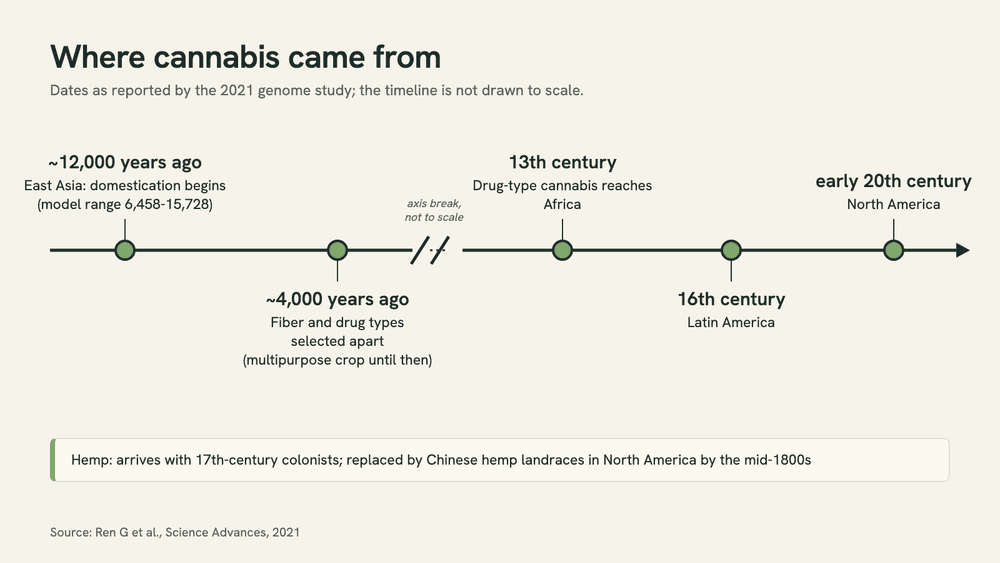
The 2021 genome study, led by Guangpeng Ren and published in Science Advances, set out to read cannabis history from whole genomes. The team combined 82 newly sequenced plants with 28 published genomes, kept 104 after quality filtering, and compared about 12 million single-letter DNA differences. The plants fell into four groups: a basal group of feral plants and landraces from China (plus two US feral plants likely descended from 19th-century Chinese landraces), a hemp-type group, a drug-type feral group from southern China, India and Pakistan, and a drug-type group of 35 cultivars. Every modern hemp and drug cultivar in the study traced back to an ancestral gene pool that today survives in those Chinese landraces and feral plants.
From those genomes, the model estimated that cultivated cannabis split from the basal group about 12,000 years ago. The 95% confidence interval is wide, from 6,458 to 15,728 years, so read it as "roughly 12,000 years, give or take thousands." The study points to East Asia as the place of domestication, arguing against the older idea of a Central Asian origin. That cuts against a line repeated on strain sites, that all cannabis traces back to a single plant from the Hindu Kush. The authors also infer that early domesticated cannabis stayed a multipurpose crop until about 4,000 years ago, when farmers began selecting fiber and drug types in different directions. Their historical summary has drug-type cannabis reaching Africa by the 13th century, Latin America in the 16th century, and North America in the early 20th century. Ren and colleagues declared no competing interests.
Two other dates are often blurred with this one, so keep them separate. A 2018 review of cannabis systematics by John McPartland uses fossil pollen to place the genus's center of origin on the northeastern Tibetan Plateau, and a DNA clock to estimate that cannabis and hops split about 27.8 million years ago. That is about where the plant evolved, millions of years before people. McPartland lists an affiliation with GW Pharmaceuticals on this review and on the 2020 taxonomy cited below, though this one declares no competing financial interests. And some of the earliest directly dated chemical evidence of people burning cannabis comes from a 2019 analysis of wooden braziers at the Jirzankal Cemetery in the eastern Pamirs (a different research team), where residues showed that plants with high levels of psychoactive compounds had been burned at least 2,500 years ago.
Do pure landrace strains still exist?
Probably not in the sense a seed listing implies. Start with the wild ancestor. The 2021 study sampled feral plants that could have been wild cannabis, and found they "are not wild types, but historical escapes from domesticated forms"; the authors suggest that the plant's truly wild progenitors may have gone extinct. They also call for more sampling of feral populations before that is settled. So even the most wild-looking cannabis in that study turned out to be farm lines that went feral.
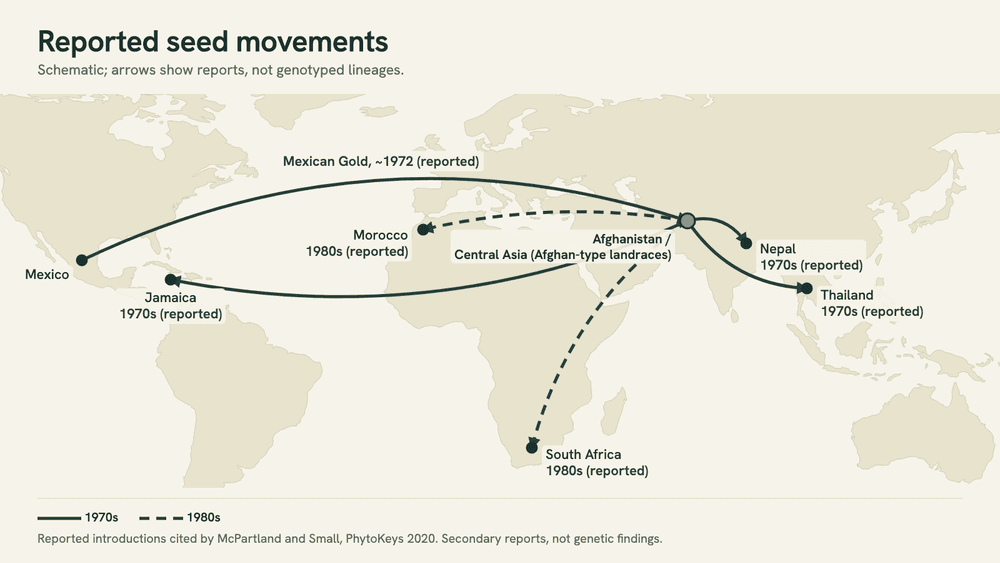
The drug-type landraces have had a rougher half-century. In a 2020 taxonomy of cannabis by McPartland and Small, built on about 1,100 herbarium specimens and a review of published chemical and genetic data, the authors write that "breeders have haphazardly hybridized Central Asian and South Asian landraces, and largely obliterated their phenotypic differences", and that "already 35 years ago, unhybridized landraces had become difficult to obtain in the USA and Europe." The traffic ran both ways. The authors cite reports of a seed importer bringing "Mexican Gold" into Afghanistan around 1972, of Afghan-type plants being introduced into Nepal, Jamaica and Thailand in the 1970s, and of Central Asian genetics reaching South Africa and Morocco in the 1980s. Those are secondary reports drawn from books and grower accounts, but if they are right, the source regions themselves received outside seed. Pollen does the rest: cannabis is wind-pollinated, so genes travel between neighboring plantings, which is why the basics in our explainer on male and female cannabis plants matter for any population that claims to be unmixed. The authors call the remaining Central and South Asian drug landraces "critically endangered reservoirs of germplasm" and argue that collecting and conserving them is urgent. Across crops in general, the 2017 review notes, many landraces now survive mainly in gene banks.
Famous landrace names and what is actually documented
Lists of "true OG landraces" rarely cite anything. Here is what peer-reviewed sources do and do not say about the best-known names. The most striking finding comes from a 2015 genotyping study of marijuana and hemp by Sawler and colleagues, which tested 14,031 genetic markers in 81 marijuana samples (modern commercial strains and landraces) and 43 hemp samples. One sample sold as Jamaican Lamb's Bread, listed as 100% sativa, was nearly identical (a genetic similarity score of 0.98) to a sample from Afghanistan listed as 100% indica. The authors themselves note that "sample mix-up cannot be excluded", so this is one data point, not a verdict on every Lamb's Bread. Several of the study's authors were employed by or funded through Anandia Labs, a competing interest the paper states.
| Name | Reported origin | What a peer-reviewed source documents | Status |
|---|---|---|---|
| Afghani, Hindu Kush | Afghanistan and the Hindu Kush range | Central Asian landraces formed the historic "Indica" group; the authors cite reports of them disappearing through hybridization and of "Mexican Gold" seed imported into Afghanistan around 1972 | The landrace group is documented; any named seed line today is unverified |
| Thai | Thailand | The authors cite reports of Central Asian lines introduced into Thailand in the 1970s | Reported origin; the source region reportedly received outside seed |
| Lamb's Bread | Jamaica | One sample sold under this name nearly matched an Afghan "indica" sample (similarity 0.98; mix-up not excluded); Central Asian lines reported introduced into Jamaica in the 1970s | Reported origin; the one genotyped sample did not fit its label |
| Durban Poison | South Africa | Central Asian genetics reported introduced into South Africa in the 1980s; no genome study of the named line found | Reported origin only |
| Moroccan kif | Morocco | Traditional landrace resin was described as mixed THC/CBD; production has since shifted toward THC-dominant plants; Central Asian genetics reported introduced in the 1980s | Regional history documented; today's material is not the old landrace |
| Acapulco Gold, Panama Red, Colombian Gold | Mexico, Panama, Colombia | No genome study we found documents these as distinct genetic lineages | Reported origin only |
The Moroccan row matters if you have read about traditional hashish. A 2019 analysis of European cannabis potency trends summarizes earlier work showing that traditional landrace resin from Morocco carried modest THC with roughly equal CBD, and that Moroccan production later shifted toward THC-dominant plants. Our guide to what hash is and how it is made covers that resin tradition in more detail. The pattern across the table is the same: the place names are real, the plant populations once were, and no study we found has genetically tied the seed sold under those names today back to them.
Indica, sativa and the old geographic labels
"Indica" and "sativa" began as rough labels for landrace groups from different places. McPartland and Small put it directly: "'Sativa' formerly represented landraces of South Asian heritage, and 'Indica' formerly represented Central Asian landraces," and their identification key "is not intended for the identification of 'Sativa' and 'Indica' strains commercially available today." The old groups did differ chemically. Pooling 47 studies of plants collected from the 1970s to the 1990s, the authors report that Central Asian landraces always had a THC-to-CBD ratio below 7 (a weighted mean of 3.56), while South Asian landraces sat at 7 or above (a weighted mean of 97.14). In other words, the Afghan-type plants of that era carried far more CBD relative to THC than the South Asian ones did. They also note that THCV, a less common cannabinoid, "is commonly present, especially in landraces from South Asia and Africa"; our comparison of THCV and CBD explains that molecule. Since then, they write, ratios in plants sold as "Indica" have climbed so far that "now there is little or no difference between 'Indica' and 'Sativa'."
Modern genetics agrees. A 2021 study of Dutch medical cannabis chemically profiled 297 samples and genotyped 137 with more than 100,000 markers, and found "Sativa" and "Indica" samples "genetically indistinct on a genome-wide scale." The labels did line up with a few aroma compounds: myrcene concentration, for example, explained 21.2% of the variation in where samples sat on a five-point Sativa-to-Indica label scale, and the labels were associated with variation in a small set of terpene synthase genes. So the labels carry a weak chemical signal, not a reliable ancestry. That study was funded primarily by Bedrocan, a medical cannabis producer that employed two of its co-authors, and it covers the Dutch market only. McPartland's 2018 review adds that everyday "Sativa" and "Indica" "totally misalign" with the formal botanical names, and his 2020 paper with Small notes that the strain AK-47 won "Best Sativa" at the 1999 Cannabis Cup and "Best Indica" four years later. Aroma differences are a separate topic, covered in our piece on why some cannabis smells like skunk. Whether either label predicts how cannabis feels is a different question, which our look at couch lock and the indica label takes apart; this page makes no effect claims for any landrace.
- What the labels once meant: "Sativa" for South Asian landraces and "Indica" for Central Asian (Afghan-type) landraces.
- What they track now: a weak association with a few terpenes such as myrcene, not genome-wide ancestry.
- What they do not tell you: a product's cannabinoid content, its lineage, or how it will affect you.
Hemp landraces: the fiber side of the family
Landraces are not only a drug-cannabis story. McPartland and Small describe the domesticated variety as "composed of fiber-type and oilseed landraces and cultivars", and the 2021 genome study's hemp-type group included 13 landraces alongside 5 feral plants and 20 cultivars. The ancestral basal group at the root of the whole family tree is made of feral plants and landraces from China. The study's historical summary adds a North American twist: hemp arrived with 17th-century colonists, and those colonial lines were later replaced by Chinese hemp landraces by the middle of the 1800s. Hemp grown today descends from this pool through bred cultivars.
Selection also left a mark you can see in the genes. The 2021 study reports an extensive loss of the full THCA synthase gene (the enzyme that makes THC's acid precursor) in hemp-type cultivars, and of the full CBDA synthase gene in drug-type cultivars. That fits the single-gene chemotype switch from the 2003 crossing study. The 2015 genotyping study adds a result that surprises many readers: hemp shared a greater proportion of its genetic variants with "indica"-type marijuana than with "sativa"-type. The legal line between hemp and marijuana is a separate matter of THC content, which our explainer on hemp versus marijuana covers.
What a landrace name can and cannot tell you
Put the research together and a landrace name becomes easy to read for what it is. Two background pieces help with the checklist below: the aroma compounds that labels loosely track are made in the resin glands described in our explainer on what trichomes are, and the same genetics can express differently with light, temperature and growing conditions, which is part of why indoor and outdoor flower differ. Use the checklist whenever a name or region is doing the selling.
- 1Read the name as a lineage claim. "Afghani" or "Acapulco Gold" is a seller's story about ancestry, not a genetic test. In the 2015 genotyping study, same-name samples were closer to differently named ones in 6 of 17 comparisons.
- 2Ignore "pure". Crop science expects landraces to be mixed, and the source regions are reported to have received outside seed in the 1970s and 1980s. Purity cannot be confirmed from a label.
- 3Ask for the lab report. THC, CBD, CBG, THCV and the rest are measured on a certificate of analysis (COA), batch by batch. A region does not predict them: old Afghan-type landraces carried relatively more CBD than today's "Indica" material.
- 4Expect terpenes to vary within a name. The labels track a few aroma compounds only loosely.
- 5Remember the environment. The same genetics can express differently depending on how and where the plant was grown.
- 6Do not read effects into the word. No study we found shows a landrace, or a landrace name, produces a particular effect.
This is the same logic we apply to hemp products. A Planntz tincture's chemistry is printed on a public, per-batch third-party COA, not inferred from where the hemp came from. The Full Spectrum CBD tincture, for example, lists 250 mg/mL of CBD (15,000 mg in a 60 mL bottle), and its COAs report trace THC of about 0.24%, under 0.3%; the Broad Spectrum batches report non-detected THC on the mango and natural flavors. Those numbers come from the lab, batch by batch, not from the plant's backstory.
What is still unknown
The genetics is young, and every study here has gaps. The 2021 genome study sampled mostly central and eastern Asia, its domestication date has a range of more than 9,000 years, and the authors ask for more sampling of feral plants. McPartland and Small note that much of the remaining unhybridized landrace diversity has not been available for whole-genome analysis. The 2015 genotyping study predates the CBD hemp boom and used a modest sample, and the 2021 labeling study covers only the Dutch market. We found no genetic atlas of named landraces, so for Acapulco Gold, Durban Poison and their peers, no published genome study we found has checked the name against the plant. What is clear is the direction of the evidence: cannabis is older and more mixed than the menu suggests, and a lab report tells you more than a place name.
Frequently asked questions
In crop science, a landrace is a cultivated population that farmers kept in one region for generations until it adapted to the local soil, climate and uses. It is expected to be genetically varied and to keep evolving. On a cannabis menu, "landrace" usually means a pure, original, never-crossed line, a meaning that crop science does not share and that a label cannot verify.
"Heirloom" has no agreed botanical definition in cannabis. Growers usually use it for a landrace that has been kept going for generations outside its home region. You will see specific year rules quoted online; treat those as conventions, not a standard.
We found no study showing that they are. In plants collected from the 1970s to the 1990s, Central Asian (Afghan-type) landraces had a THC-to-CBD ratio below 7, with a weighted mean of 3.56, so they carried relatively more CBD than the "Indica" material the same authors describe today, whose ratios have since climbed. Strength is a lab number: the cannabinoid content of any batch is measured on its certificate of analysis, not predicted by the label.
Probably few, and none you can confirm from a name. A 2021 genome study found that supposedly wild plants were escapes from old crops and suggested truly wild cannabis may be extinct. A 2020 taxonomy described Central and South Asian drug landraces as critically endangered and noted that unhybridized landraces were already hard to obtain in the US and Europe by the mid-1980s. Some local populations likely persist, and gene banks hold others.
Hemp is a use type, not a landrace, but many hemp landraces exist or existed. The 2021 genome study's hemp-type group included 13 landraces, the ancestral group at the root of the family tree was made of Chinese feral plants and landraces, and Chinese hemp landraces replaced colonial hemp in North America by the mid-1800s. Hemp grown today descends from that pool through bred cultivars.
Two answers, for two questions. The genus likely evolved on the northeastern Tibetan Plateau, based on fossil pollen, millions of years ago. People first domesticated it in East Asia, according to a 2021 study of 110 genomes, roughly 12,000 years ago (with a model range of about 6,500 to 15,700 years). That study argues against the older idea of a Central Asian origin, the region that includes the Hindu Kush.
Measure, don't infer. A landrace name tells you a story about ancestry; a certificate of analysis tells you what is actually in a batch. If you have never read one, our step-by-step guide to reading a COA shows where THC, CBD and the minor cannabinoids sit on the page.
Writing about hemp, wellness and the small rituals that keep us balanced.