What Is Couch Lock? What Actually Causes It (Not Indica)
Couch lock is real, but most explanations for it are not. Human studies tie heavy sedation after THC to dose and route, while the indica, CB2 and myrcene stories trace back to fuzzy labels, a receptor mix-up and mice given injections.
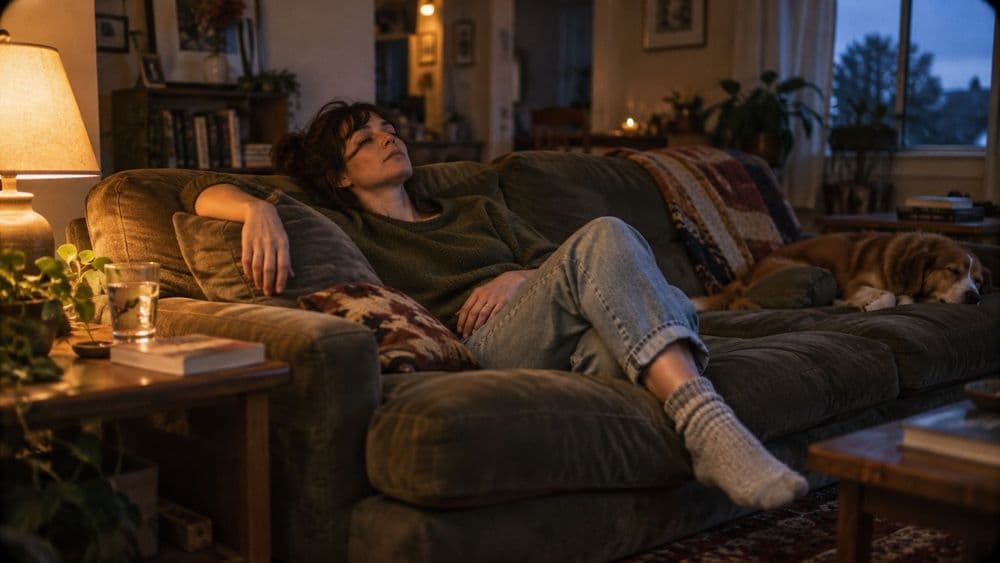
Couch lock is slang for the heavy, sink-into-the-sofa feeling some people get after using THC: limbs that feel weighted, no urge to get up and a steady pull toward sleep. It is a real and common report. The explanations you usually hear for it, though, mostly do not hold up: that it comes from indica strains, from CB2 receptors in your body, or from a terpene called myrcene. This guide checks each one against the published research.
The short answer: in controlled human studies, how sleepy and slowed people felt tracked how much THC they took and how they took it. Strain labels barely map to plant genetics or chemistry. The felt high, whether you call it a body high or a head high, runs through CB1 receptors in the brain, not CB2 receptors in your muscles. And the myrcene idea rests on an expert interview and on mice injected with far more myrcene than cannabis contains. This page is general information for adults 21 and over. It is not advice on how to get, or avoid, any particular kind of high.
What couch lock is, and why there is no medical term for it
There is no medical or scientific definition of couch lock. It is a word people use to describe their own experience, and nobody has published a study of "couch lock" as such. What researchers can measure is what people report on rating scales after taking THC. When people describe couch lock, they usually mean some mix of the following:
- Arms and legs that feel heavy or weighted down
- Little or no urge to get up, even when you meant to
- Sleepiness, or drifting in and out of a doze
- Slower movements and reactions
- Small tasks, like finding your phone or answering a message, feeling like more effort than usual
- A mind that may still be busy while the body feels stuck
Those descriptions line up with items researchers do measure. In a Johns Hopkins crossover study of 17 adults who rarely used cannabis, published in 2018, inhaled THC raised ratings of feeling "sleepy" in every active condition compared with placebo, and made routine tasks feel harder in three of the four. Ratings of feeling alert dropped in two of the four. One result surprises people: ratings of feeling "relaxed" did not differ from placebo. So the lab version of couch lock looks less like calm and more like sleepiness plus effort. NIDA's overview of cannabis lists impaired "body movement" among its short-term effects, which fits the same picture.
Couch lock is also short-lived: it is an acute feeling that fades as the high does. Whether cannabis affects drive and motivation over weeks and months is a separate question, covered in our look at whether weed makes you lazy.
Body high vs head high: what the words actually describe
People often sort a THC experience into two kinds. A "head high" usually means changes in thinking and mood: euphoria, scattered or racing thoughts, time that seems to stretch, sometimes anxiety. A "body high" usually means physical sensations: heaviness, warmth, tingling, loose muscles and, at the far end, couch lock. The words are useful for describing what you feel. The mistake is assuming they point to two different places where THC acts.
| Term | What people describe | What researchers actually measure | Where it is generated |
|---|---|---|---|
| Head high | Euphoria, scattered or racing thoughts, altered sense of time, sometimes anxiety | Ratings such as "how high", "how stoned", "drug effect" and "anxious"; memory and attention tests | The brain, through CB1 receptors |
| Body high | Heaviness, warmth, tingling, loose muscles | Ratings such as "sleepy", "alert" (lower) and "difficulty performing routine tasks"; movement and reaction tests | Also the brain: the body is where you feel it, not where THC produces it |
| Couch lock | The heaviest end of a body high: hard to get up, pulled toward sleep | No dedicated measure; the closest are sleepiness and routine-task ratings | The brain, as far as current evidence shows |
The best human evidence on where the high comes from is a 2001 NIDA study of 63 healthy men. Before smoking cannabis, the men took either a placebo or an experimental drug that blocks the CB1 receptor. At the top dose, the blocker cut their ratings of how high they felt, how stoned they felt and how strong the drug effect was by 38% to 43%, and their THC blood levels did not change. The authors wrote that the results "confirm, for the first time in humans, the central role of CB1 receptors." The block was partial and the study included only men, but the direction is clear: the feeling runs through CB1, a receptor concentrated in the brain. Our primer on cannabinoids and their receptors covers the background.
That is why a common explanation on dispensary sites gets the biology backwards. One puts it this way: a body high "happens when cannabinoids, often CBD along with THC, interact with CB2 receptors in your peripheral tissues." CB2 was first described in a 1993 Nature paper that cloned it from immune cells in the spleen. Two years later, a survey of human tissues found CB2's genetic message 10 to 100 times more abundant than CB1's in immune tissue, while CB1 was "mainly expressed in the central nervous system." CB2 is an immune-system receptor first. Nothing in the human evidence points to it as the source of the felt high, in your head or anywhere else.
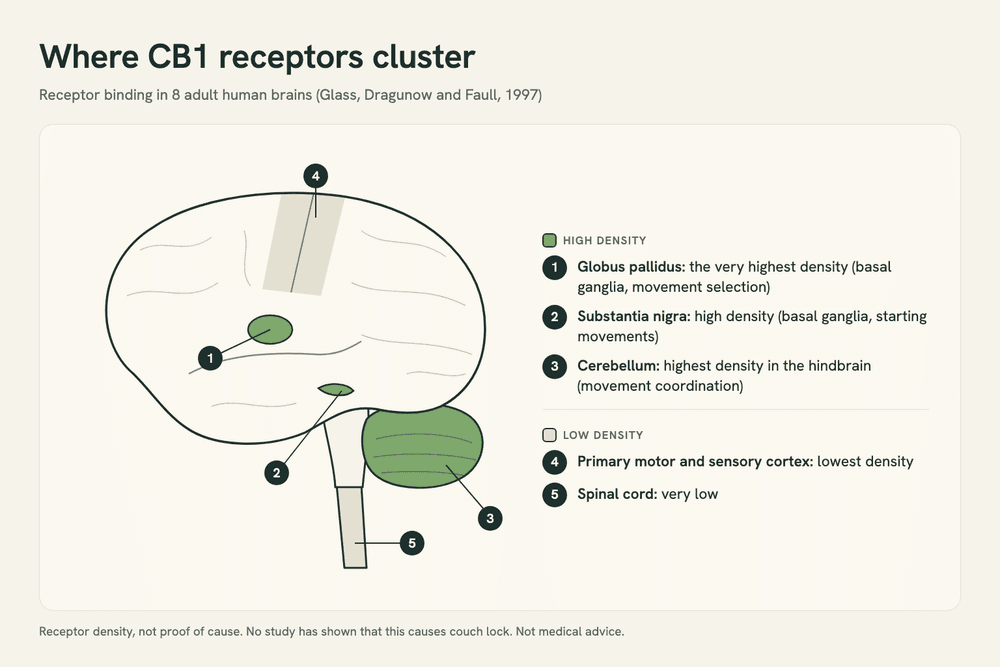
So why would a brain receptor make your body feel heavy? Anatomy offers a plausible answer. In a 1997 map of CB1 receptors in eight adult human brains, binding was densest in the globus pallidus and the substantia nigra, parts of the basal ganglia that help select and start movements, and high in the cerebellum, which coordinates them. It was lowest in the primary motor and sensory areas of the cortex and very low in the spinal cord. Nobody has shown that this causes couch lock. It does mean a heavy, slow body can plausibly begin in the brain's movement circuits rather than in your muscles.
What causes couch lock? The evidence points to THC dose and route
If couch lock is mostly sleepiness and effort, the useful question is what makes those stronger. In the Johns Hopkins study, the answer was the amount of THC and the way it was taken. Participants, 9 men and 8 women who had not used cannabis in the previous 30 days, inhaled placebo, a lower THC dose and a higher THC dose, both smoked and vaporized, in separate double-blind sessions. Every measure of how strong the high felt climbed with dose, and the same dose felt stronger vaporized than smoked. On a 0 to 100 scale, peak "drug effect" ratings ran from 45.7 for the lower smoked dose to 77.5 for the higher vaporized dose. Some effects and measurable impairment lasted up to about six hours on average.
Keep the limits in view: 17 people, all infrequent users, lab-prepared cannabis, and a study designed to compare routes, not to study couch lock. Still, it is the kind of evidence the popular explanations lack: a controlled comparison in people, with a placebo.
Route matters in a second way. When the same research group had 17 infrequent users eat THC in brownies, nothing was felt for 30 to 60 minutes, effects peaked at 1.5 to 3 hours, and the team tracked effects for 8 hours. Swallowed THC also passes through the liver, which turns some of it into a second active compound; the liver metabolite that makes edibles feel different has its own guide, and why edibles take so long to kick in covers the timing.
Two more variables shape how heavy a session feels. Product strength is one, though the THC percentage printed on a label is a rougher guide than it looks, as our analysis of whether THC percentage matters explains. Tolerance is the other. In a 2008 Yale study that gave THC intravenously, 30 frequent users had blunted responses to several THC effects compared with 22 controls, though not to its euphoria. That study did not measure sedation, so it cannot say whether tolerance changes couch lock, but it helps explain why two people describe the same product so differently.
Is couch lock from indica? What the label audits found
The belief that indica means body and sativa means head is real and measurable. In a 2014 web survey of 95 medical cannabis users, respondents said indica was better for sedation and sleep, and sativa for energy and euphoria. A survey records what people expect and report. It cannot check what was actually in the jar, and its authors called for "prospective definitive trials." Two much larger studies later checked the jars.
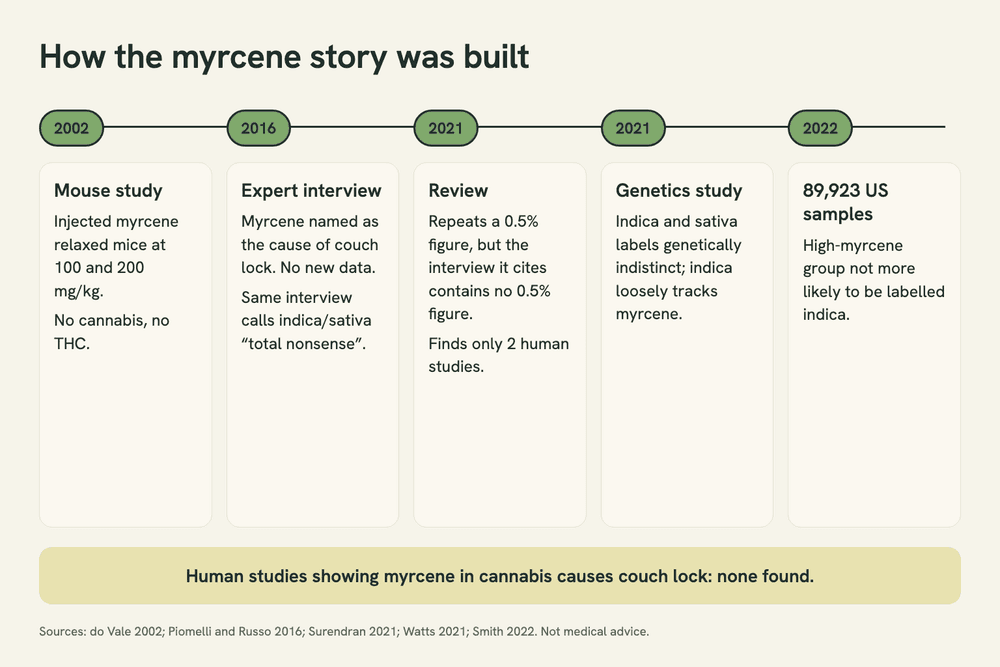
A 2021 Nature Plants study profiled the chemistry of 297 cannabis samples from the Dutch market and genotyped 137 of them at more than 100,000 genetic markers. Plants sold as indica and sativa were "genetically indistinct on a genome-wide scale." The labels were not meaningless, though. They tracked a handful of aroma genes, and the strongest link was between indica labelling and myrcene, whose concentration explained 21.2% of the variation in labels. So an indica label tells you a little about smell. Whether that smell molecule makes anyone sleepy is a separate question, taken up in the next section. The study was funded by Bedrocan, a Dutch cannabis producer that employed two of the authors.
A 2022 analysis of 89,923 lab-tested samples from six US states went further. The indica, sativa and hybrid labels were scattered through the chemical data, with THC-dominant samples "highly intermingled, with no obvious segregation of data points by commercial label." Even the high-myrcene chemical group was not more likely to carry an indica label. Individual terpenes "were rarely present at more than 0.5% weight," most sat below 0.2%, and total terpenes averaged about 2% of the flower's weight. Hold on to that 0.5% figure for the myrcene arithmetic below. One of the authors worked for Leafly, and the study says nothing about effects. Put together, here is what a strain label can and cannot tell you:
- It can hint at aroma: indica labels loosely track myrcene and a few other aroma compounds.
- It does not reflect ancestry across the genome: indica and sativa samples were genetically indistinct.
- It does not reliably sort chemistry: across 89,923 US samples, the labels showed no clear grouping.
- It has never been tested as a predictor of couch lock in a controlled human study.
Does myrcene cause couch lock? Tracing the claim to its source
Myrcene is a terpene, one of the aroma compounds in cannabis, and it is the usual suspect on page one of search results. The idea that it causes couch lock is often traced to a 2016 journal interview with neurologist Ethan Russo, a prominent cannabinoid researcher, who said sedation in most common strains "is attributable to their myrcene content, a monoterpene with a strongly sedative couch-lock effect that resembles a narcotic." The interview is expert opinion; it did not report new data. And in the same three pages, Russo had this to say about the indica and sativa labels:
“The sativa / indica distinction as commonly applied in the lay literature is total nonsense and an exercise in futility.”
He urged everyone to "abandon the sativa / indica nomenclature" and to describe plants by their measured chemistry instead, which is also where this article ends up. In other words, the source most often credited with the myrcene explanation rejected the indica explanation in the same breath.
You may also have read that myrcene above 0.5% causes couch lock. We tried to trace that number. One page that ranks for couch lock links it to a 2021 review, which does repeat the claim, but cites the Russo interview and another review for it, and the interview contains no 0.5% figure. We could not find a study that measured a 0.5% threshold. What the 2021 review of myrcene research does document is the gap: plenty of animal work, but only two human studies, both involving inhaled plant essential oils, and the conclusion that "studies conducted in humans is lacking." It also found "limited robust data" behind the popular claim that myrcene helps THC get into the brain. A disclosure: two of the review's authors worked for, and the other three advised, a company that sells myrcene-containing drinks.
The sedation data behind the myrcene story come from mice. In a 2002 study in the journal Phytomedicine, myrcene injected into the abdomen relaxed mice's muscles on a rotating-rod test at 100 and 200 milligrams per kilogram of body weight, and at the top dose it made a barbiturate's sleep last about 2.6 times longer. The same study found a slightly anxiety-raising effect at the higher doses. It tested isolated myrcene, not cannabis, and no THC was involved.
How does that dose compare with what is in cannabis flower? The FDA's guidance on estimating starting doses for first-in-human trials gives a standard way to scale a mouse dose to a person: divide the mouse dose in mg/kg by 12.3. Here is the arithmetic, worked through as a scale check on the claim.
| Step | Number | Source |
|---|---|---|
| Lowest myrcene dose that relaxed mice (rotating-rod test) | 100 mg/kg, injected into the abdomen | do Vale 2002 (mouse study) |
| Standard mouse-to-human conversion | Divide by 12.3 | FDA 2005 guidance, Table 1 |
| Human-equivalent dose | About 8.1 mg/kg | Arithmetic |
| For a 70 kg (154 lb) adult | About 570 mg of myrcene | Arithmetic |
| Myrcene in 1 g of flower at 0.5% by weight (the high end; terpenes rarely exceed it) | 5 mg | Smith 2022 (89,923 US samples) |
| Flower weight that would hold about 570 mg of myrcene, before any losses | About 114 g (roughly 4 oz): the size of the gap, not an amount anyone would use | Arithmetic |
Even with generous assumptions, a full gram of flower at the high end of myrcene content holds less than a hundredth of the human-scaled dose that relaxed mice. That does not prove myrcene does nothing in people. It shows the mouse data cannot carry the claim. The same goes for other terpenes named as couch-lock culprits, such as linalool and beta-caryophyllene: we found no human study showing that any terpene in cannabis causes couch lock. For what terpenes are, and how they differ from THC and CBD, see our side-by-side of cannabinoids and aroma compounds. Our review of the entourage effect covers what happened when researchers actually added terpenes to THC in human trials.
When heavy sedation becomes a safety problem
Couch lock is a form of impairment, and the risk comes mostly from what gets added to it and from what people try to do while in it. The heaviness also raises whether cannabis counts as a depressant, a classification question with a less obvious official answer than you might expect. For safety, the most relevant fact sits on THC's own drug label. The FDA label for dronabinol, a prescription form of THC, warns that sedation and sleepiness add up when it is combined with other drugs that slow the brain, and names alcohol, benzodiazepines, opioids, antihistamines and muscle relaxants among them. The evidence-based way to handle couch lock is harm reduction:
- 1Do not drive, bike or operate machinery while you feel heavy or slowed, or for as long as the effects last.
- 2Do not add alcohol. Its impairment stacks on top of THC's.
- 3Do not combine THC with sleep aids, sedating antihistamines, benzodiazepines, opioids or muscle relaxants without talking to your prescriber or pharmacist first.
- 4Do not skip or change a prescription on your own to make room for cannabis.
- 5Remember that eaten THC builds later and lasts longer than inhaled THC, so the heaviest point can arrive hours after you eat.
- 6Stay somewhere safe and familiar, and tell someone nearby if you feel unwell.
Driving deserves its own line. In a controlled driving-simulator study, a moderate blood THC level combined with a 0.05 breath alcohol level produced the same lane weaving as a 0.08 breath alcohol level alone. If you feel couch-locked, you are not fit to drive, and alcohol makes it worse. Our crossfaded guide covers alcohol plus THC in depth, and the research and rules on cannabinoids and driving cover impairment and the law.

There is also no proven antidote. Caffeine is the most common folk fix, yet in a 2025 Johns Hopkins study of 20 adults, run with Canopy Growth as a registered collaborator, adding caffeine to oral THC "produced minimal changes" in THC's subjective effects and performance, although the authors noted signals for perceived driving impairment. The evidence keeps pointing back to dose: the heaviness lifts as the THC wears off.
If the heaviness came with vomiting, a pounding heart or panic, you may be dealing with overconsumption rather than couch lock; what happens when you take too much THC walks through the signs. And if the plan was simply to sleep it off, whether it is bad to sleep high covers what THC does to sleep and why stacking sedatives at bedtime is a problem.
Where CBD fits
Several sites suggest CBD to "balance out" couch lock. It helps to separate two claims. The first is about CBD on its own. NIDA puts it plainly: "CBD is not intoxicating like THC," though it lists drowsiness among CBD's possible side effects. Whether CBD can get you high has its own detailed answer.
The second claim is that CBD cancels THC's heaviness. The trials do not back that. In a 2023 trial of 46 people who vaped THC with varying amounts of CBD, at CBD-to-THC ratios found in real products, THC's effects were "not significantly modulated by any dose of CBD." An earlier trial of 31 people who took oral CBD before smoking cannabis found no change in the high either. And in a 2024 study of 37 adults, the arm that paired a 450 mg oral dose of CBD with oral THC made people feel higher, not less: "feeling high" rose by 60.5%, and THC exposure in the blood more than doubled. None of this points to CBD as a fix for couch lock. For the broader contrast between the two compounds, see the core differences between CBD and THC.
What is still unknown
The honest summary is that couch lock has been described far more often than it has been studied. The open questions:
- No study has measured couch lock as such. Researchers infer it from sleepiness, alertness and routine-task ratings.
- No controlled human study has tested whether myrcene, at the levels found in cannabis, adds sedation to THC.
- No validated measure separates a "body high" from a "head high". Both terms are self-descriptions.
- The link between CB1 and the brain's movement circuits is anatomical plausibility from eight brains, not a demonstrated mechanism.
- The key dose studies used small groups of infrequent users and lab-prepared cannabis, so they may not reflect daily users or today's high-potency products.
- How tolerance, genetics and setting change the experience remains largely unmeasured.
Couch lock: questions people ask
It fades as THC's effects do. In a lab study of inhaled THC in infrequent users, some effects and measurable impairment lasted up to about six hours on average. Eaten THC peaked at 1.5 to 3 hours in a similar study and was tracked for 8 hours. Treat those as averages from small studies, not as a timetable for when it is safe to drive.
Edibles start later, peak later and last longer than inhaled THC, and the liver converts some swallowed THC into a second active compound, 11-hydroxy-THC. That slower, longer curve is why the heaviest point can arrive hours after eating. No study has compared couch lock across routes directly.
No human study we could find shows that any terpene in cannabis causes couch lock. The myrcene claim rests on a 2016 expert interview and on mice injected with myrcene at doses more than a hundred times what a gram of flower contains, once scaled to a person. Linalool and beta-caryophyllene have no human couch-lock data either.
CBD is not intoxicating, though drowsiness is a listed side effect. As for stopping it, trials at CBD-to-THC ratios found in real products did not change how high people got, and in one 2024 study a large oral CBD dose taken with oral THC made people feel higher, not less.
It is impairment. Do not drive or operate machinery, and do not mix it with alcohol, sleep aids, benzodiazepines, opioids or other sedating medicines. Heavy sleepiness with vomiting, confusion or trouble breathing needs help: call 911, or Poison Control at 1-800-222-1222 if a child may have eaten cannabis.
There is no proven antidote. The evidence points to dose: the heaviness lifts as THC wears off. Stay somewhere safe, do not drive, and do not add alcohol or sedatives. Caffeine made minimal difference to THC's effects in a controlled study, and CBD did not reduce them at product-like ratios.
Strain names turned out to be a weak signal. If you want to know what a product label can actually tell you, the measured cannabinoids and terpenes on a lab report are the place to start: our guide to what a certificate of analysis measures, and what it cannot tell you walks through it line by line.
Writing about hemp, wellness and the small rituals that keep us balanced.