11-Hydroxy-THC: The Route Story Behind the Potency Number
Three pages on the first page of results give three different potency multipliers for 11-hydroxy-THC. The measured story is simpler: it is what CYP2C9 makes from delta-9-THC, and the route you take THC by decides how much of the blood mixture it becomes.

11-hydroxy-THC is the molecule your liver makes out of delta-9-THC, and it is the reason the same amount of THC can produce two very different mixtures in your blood depending on how it got there. It is also one of the most confidently mis-described compounds in cannabis writing. On September 4, 2026, the first page of search results for its name carried three different potency multipliers: 1.5 to 7 times, 2 to 7 times, and 2 to 3 times. One of those pages attached a citation to its number. The study it cited reports mouse behavior, and the one potency measurement in that same abstract found the metabolite and THC equally potent.
Here is the short version, up front. 11-hydroxy-THC, written 11-OH-THC or 11-hydroxy-delta-9-THC, is delta-9-THC with a hydroxyl group added at the carbon that cannabinoid chemists number 11. One enzyme does nearly all of that work, and it is not the pair of enzymes consumer pages name. The interesting thing about this molecule is not that it is "stronger" than THC, because that claim has never been demonstrated cleanly in a person. The interesting thing is that the route decides the mixture. Swallow THC and it passes through your liver before it reaches the rest of you, so the blood you end up with contains roughly as much metabolite as parent. Inhale it and the metabolite is a small fraction of the parent. That difference has been measured since 1983 and re-measured with modern instruments twice in the last decade, and this page prints the numbers.
What 11-hydroxy-THC actually is
11-hydroxy-THC is what delta-9-THC becomes after an enzyme adds a hydroxyl group, an oxygen with a hydrogen on it, to the methyl group hanging off carbon 11. That is the entire modification. Delta-9-THC is C21H30O2 with a molecular weight of 314.5. Its 11-hydroxy metabolite is C21H30O3 at 330.5, which is the parent plus one oxygen atom, 16 mass units heavier, with the same carbon skeleton and the same (6aR,10aR) stereochemistry. It carries CAS number 36557-05-8 and is catalogued as PubChem compound 644022. One caution about that CAS number, because reference-standard catalogues will show you another one: the same record's synonym list also carries 34675-49-5, which is a racemic entry, and the two are not interchangeable.
You will meet the same molecule under three names and they all mean this compound: 11-OH-THC, 11-hydroxy-delta-9-THC, and the full 11-hydroxy-delta-9-tetrahydrocannabinol. There is one genuine oddity here that is worth flagging rather than quietly smoothing over. PubChem's systematic name for it is (6aR,10aR)-9-(hydroxymethyl)-6,6-dimethyl-3-pentyl-6a,7,8,10a-tetrahydrobenzo(c)chromen-1-ol, which says 9-(hydroxymethyl), not 11-hydroxy. Both are correct, and neither is a typo. The systematic name numbers the fused ring system by IUPAC rules; toxicology and pharmacology number cannabinoids by the older convention, in which that same carbon is C11. Nothing about the molecule changes. Only the counting does. If you go looking for this compound in a chemical database and cannot find an "11" anywhere in the name, that is why.
For a compound this often called under-studied, it helps to know roughly how much of a literature there is. On September 4, 2026, a PubMed search for "11-hydroxy-THC" returned 273 records and a search for "11-hydroxy-delta-9-tetrahydrocannabinol" returned 172. The gap is not a mystery, and PubMed tells you where it comes from in its own query translation: the first search is the supplementary concept plus the literal string "11 hydroxy thc" as an all-fields term, and the second is the supplementary concept alone. Narrow the 172 to human subjects and you get 117. Narrow it to PubMed's clinical trial publication type and you get 14. We are going to leave those counts as counts. A number of records is not a reading list, and describing what is inside a result set you have only counted is how confident sentences get written about literatures nobody opened.
The enzyme that makes it is not the pair everybody names
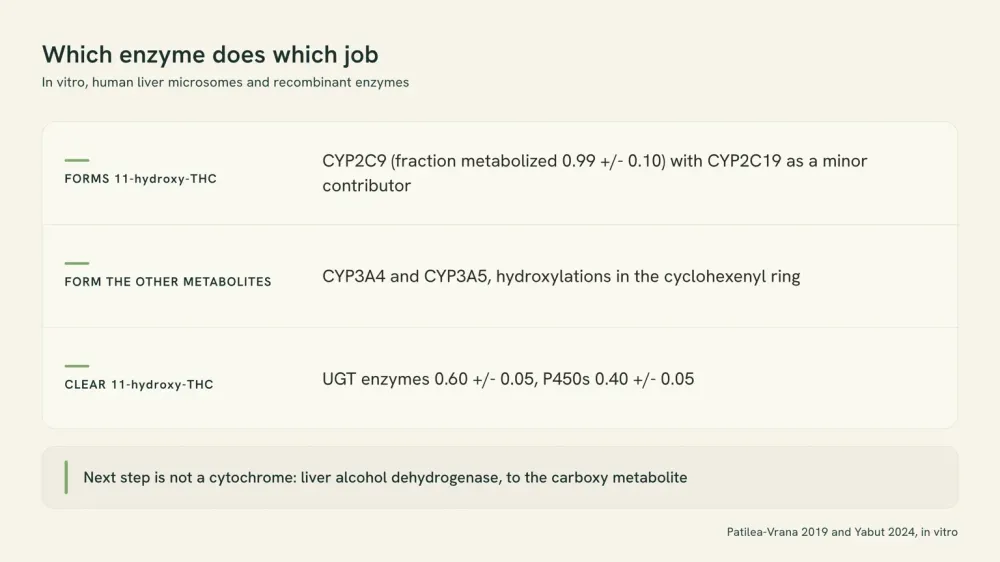
Almost every consumer page about this molecule says it is produced by CYP2C9 and CYP3A4. That sentence compresses two different jobs into one and loses the part worth knowing. Four independent sources separate those jobs the same way, and one of them is a prescription drug label the FDA reviewed.
Start with the label, because it is the least arguable document in the set. MARINOL is a capsule of synthetic delta-9-THC, a Schedule III prescription medicine. It is not a Planntz product, it is not comparable to one, and nothing here is a suggestion that anyone take it. Its prescribing information is public, and section 12.3 of the current MARINOL label on DailyMed, SPL version 5 published February 15, 2023, reads: "Published in vitro data indicates that CYP2C9 and CYP3A4 are the primary enzymes in the metabolism of dronabinol. CYP2C9 appears to be the enzyme responsible for the formation of the primary active metabolite." Read those two sentences as a pair. Both enzymes metabolize the drug. Only one of them makes this molecule.
The laboratory work behind that label sentence is more specific, and all of it is in vitro rather than in people. Working with pooled human liver microsomes and recombinant enzymes, a 2019 University of Washington study put CYP2C9's fraction metabolized for the formation of 11-OH-THC at 0.99 plus or minus 0.10, against 0.82 plus or minus 0.08 for depletion of THC itself, and reported CYP2D6 and CYP2C19 as minor contributors. A 2024 study from the same institution, also in vitro with recombinant enzymes and human liver microsomes, found 11-OH-THC formed by CYP2C9 at an unbound Km of 0.77 nM and by CYP2C19 at 2.2 nM, while "the other three major metabolites" were "formed mainly by recombinant CYP3A4/5". Those other metabolites are hydroxylations elsewhere on the molecule, in the cyclohexenyl ring, not at position 11. Two disclosures belong in this paragraph: that 2024 paper's senior author declares consulting relationships with Merck and Boehringer Ingelheim, and the paper's own headline finding is that a liver fatty-acid binding protein shifts the split between enzymes, which is a reason to read the partition as approximate rather than a reason to drop it.
Selective-inhibitor work in human hepatic microsomes points the same way by a completely different method. There, 11-hydroxylation of delta-9-THC "was markedly inhibited by sulfaphenazole, a selective inhibitor of CYP2C enzymes", while the 8-beta-hydroxylation was "highly inhibited by ketoconazole, a selective inhibitor of CYP3A enzymes", and expressed CYP2C9 catalyzed 11-hydroxylation at 19.2 nmol/min/nmol CYP while expressed CYP3A4 handled the 8-beta-hydroxylation at 6.10 and an epoxidation at 1.71 (Watanabe et al., Life Sci 2007;80(15):1415-9, PMID 17303175; in vitro, human hepatic microsomes and expressed enzymes). So where does CYP3A4 come in? Two places, and neither is the one the shorthand implies. It makes the other metabolites, and it helps get rid of this one: the 2019 in vitro work reports 11-OH-THC being cleared mostly by UGT enzymes, fraction metabolized 0.60 plus or minus 0.05, with P450s covering the remaining 0.40 plus or minus 0.05, and names UGT2B7, UGT1A9, CYP2C9 and CYP3A4 among the contributors. And the step immediately after this molecule is not a cytochrome at all. 11-OH-THC is described as "a key intermediate for further metabolism to 11-nor-delta 9-THC-9-carboxylic acid" by "liver alcohol-dehydrogenase enzymes" (Wall et al., Clin Pharmacol Ther 1983;34(3):352-63, PMID 6309462).
Why the route decides the mixture
Everything distinctive about oral THC starts with an anatomical accident: the blood leaving your gut goes to your liver before it goes anywhere else. A swallowed compound therefore meets the enzymes first and the rest of your body second. That is first-pass metabolism, and we run the argument with numbers, for a different molecule, in our explainer on how long CBD takes to work. We are not going to borrow CBD's figures here, because THC has documents of its own.
The MARINOL label quantifies the effect in one sentence: oral delta-9-THC is "almost completely absorbed (90 to 95%) after single oral doses", and "due to the combined effects of first pass hepatic metabolism and high lipid solubility, only 10 to 20% of the administered dose reaches the systemic circulation." An independent human study reached the same band four decades earlier, comparing area under the curve per dose after oral against intravenous delta-9-THC and reporting a result that "indicated bioavailability of the order of 10% to 20% for both sexes" (Wall 1983, PMID 6309462). Two documents, forty years apart, one band. And the same label section states the consequence this whole article is about: after oral dosing, dronabinol and 11-hydroxy-delta-9-THC "are present in approximately equal concentrations in plasma". Notice the scope of that sentence. The label describes one route, the oral one, because that is the only route the product has. That limitation is precisely the finding.
You can go one level further down and ask which tissue is doing the work. A 2022 study incubated THC with microsomes prepared from several human tissues and reported that in adult human intestinal microsomes, at n = 3 to 5, THC was metabolized by CYP2C9 at a fraction metabolized of 0.89 plus or minus 0.31, with CYP3A covering 0.11 plus or minus 0.050. In the same set of in vitro experiments the authors write that they "did not observe significant depletion of THC/11-OH-THC in adult lung" microsomes. Read that as written, because it is a statement about a preparation rather than about a person: in those lung microsomes, no significant depletion was observed. That is not the same claim as "the lung does nothing". It does, however, line up with the obvious point about inhalation, which is that inhaled THC reaches your circulation without first passing through the organ that makes this metabolite.
The measured numbers, route by route
The core finding here is old and it has never been overturned. In 1983, researchers gave people delta-9-THC both intravenously and by mouth and reported, in the abstract, "major differences in the ratio of the concentration of 11-OH-delta 9-THC to that of delta 9-THC in plasma were found after intravenous dosing (ratio 1:10 to 20) compared with oral administration (ratio 0.5 to 1:1)" (Wall 1983, PMID 6309462). Intravenous, not smoked. That is the route they used and we are not going to silently convert it into a different one. The abstract gives no sample size, the methods are 1983 methods, and it is the starting point rather than the proof.
Two modern studies measured the same thing, with liquid chromatography tandem mass spectrometry, at the two routes people actually use. The oral numbers come from a controlled study of cannabis brownies in healthy adults who had not used cannabis in the previous three months, with N = 6 per dose and a limit of quantitation of 0.5 ng/mL. The inhaled numbers come from a double-blind study in 17 healthy adults with no past-month cannabis use, across six outpatient sessions, with a limit of quantitation of 1 ng/mL. These are two separate studies in two separate groups of people with two different assay floors. The table below is a comparison of two datasets, not a crossover, and every milligram in it is a study condition rather than a suggestion.
| Route and study dose | Mean blood THC Cmax | Mean blood 11-OH-THC Cmax | Metabolite as a share of parent | Study, n, limit of quantitation |
|---|---|---|---|---|
| Oral brownie, 10 mg | 1.0 ng/mL | 1.0 ng/mL | Not divided: both values sit at this study's 0.5 ng/mL assay floor | Vandrey 2017, N = 6, LOQ 0.5 ng/mL |
| Oral brownie, 25 mg | 3.5 ng/mL | 3.3 ng/mL | About 94% (3.3 divided by 3.5) | Vandrey 2017, N = 6, LOQ 0.5 ng/mL |
| Oral brownie, 50 mg | 3.3 ng/mL | 3.2 ng/mL | About 97% (3.2 divided by 3.3) | Vandrey 2017, N = 6, LOQ 0.5 ng/mL |
| Smoked, 10 mg | 3.76 ng/mL | 0.18 ng/mL | Not divided: 0.18 is below this study's 1 ng/mL assay floor | Spindle 2019, n = 17, LOQ 1 ng/mL |
| Smoked, 25 mg | 10.24 ng/mL | 1.12 ng/mL | About 11% (1.12 divided by 10.24) | Spindle 2019, n = 17, LOQ 1 ng/mL |
| Vaporized, 10 mg | 7.53 ng/mL | 1.24 ng/mL | About 16% (1.24 divided by 7.53), with 1.24 just above this study's 1 ng/mL floor | Spindle 2019, n = 17, LOQ 1 ng/mL |
| Vaporized, 25 mg | 14.36 ng/mL | 2.06 ng/mL | About 14% (2.06 divided by 14.36) | Spindle 2019, n = 17, LOQ 1 ng/mL |
Read the middle of that table and the thesis is sitting right there. At the same nominal 25 mg, the metabolite's blood peak is about 94% of the parent's by mouth and about 11% smoked, with vaporizing at about 14%. Same molecule, same nominal amount, two completely different mixtures, and the only variable that changed is the route. The 10 mg rows are the honest caveat and we are not hiding them in a footnote: in the oral study, two participants completed the study with no detectable blood THC at any time point at the 10 mg dose, and five participants had blood THC concentrations that never exceeded 1 ng/mL, so the tidy-looking 1.0 against 1.0 pair at the bottom dose is the assay's floor rather than a finding. The oral authors' own summary sentence is that the mean Cmax and mean time to maximum concentration of 11-OH-THC in whole blood "were similar to THC". The inhaled authors' summary is that blood cannabinoid concentrations "were dose-dependent for both methods of administration, but higher following vaporization compared with smoking". Two of that second paper's co-authors are staff of SAMHSA's Division of Workplace Programs, the federal office that administers workplace drug testing, and one is at RTI International, an independent non-profit research institute.
“The route of administration is important for interpretation of cannabinoid toxicology.”

What "1.5 to 7 times more potent" is actually counting
The multiplier is everywhere, and unusually, it has an address. Of the pages ranking on the first page of results on September 4, 2026, one attached a citation to its "between 1.5 and 7 times more potent" sentence, and every other version of the number on that page of results traces back to the same place. The citation is a single 2020 abstract from RTI International, an independent non-profit research institute. Open it and the range comes apart in your hands.
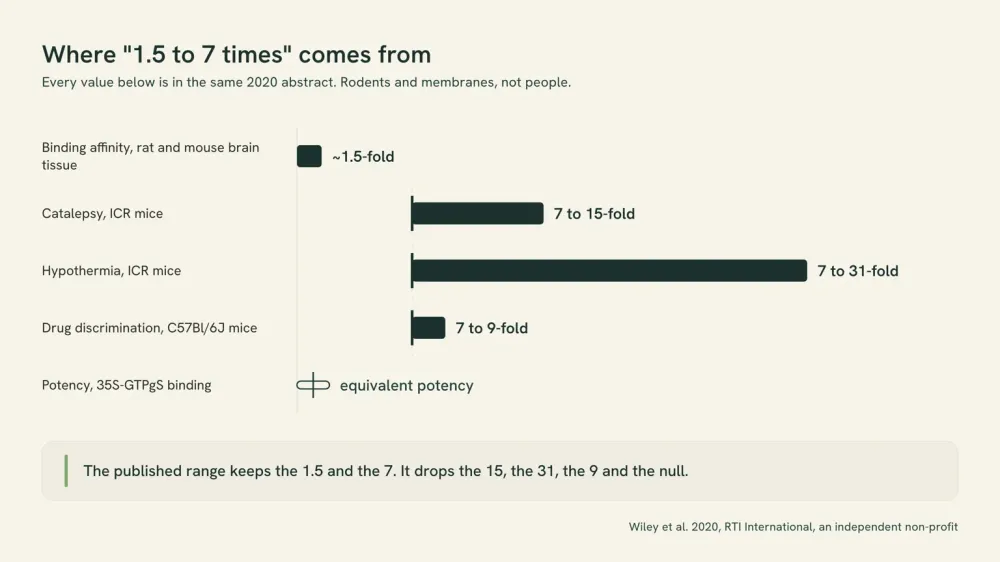
The 2020 paper that citation points to tested THC and 11-OH-THC in brain tissue from rats and mice and in live mice, dosed intraperitoneally. Its abstract reports that in both species and both sexes, "11-OH-THC exhibited marginally higher affinity (~1.5 fold) than THC and both served as partial agonists" in a 35S-GTPgS binding assay "with equivalent potency", and that "11-OH-THC exhibited slightly greater efficacy in rat brain tissue". Then the animal results: "In ICR mice, 11-OH-THC exhibited greater potency than THC in assays of catalepsy (7- to 15-fold) and hypothermia (7- to 31-fold). Further, 11-OH-THC was more potent in THC drug discrimination (7- to 9-fold) in C57Bl/6J mice."
- The 1.5 is not a potency number. It is a binding-affinity fold, measured in brain tissue from rats and mice, and affinity and potency are different measurements.
- The 7 is the bottom of three separate mouse ranges whose upper bounds are 15, 31 and 9. A range built from the smallest number in the set quietly discards the three largest.
- The one potency comparison in the same sentence as the 1.5 found the two compounds equally potent, and that null does not survive into any consumer version of the claim.
It is also worth knowing what those three mouse assays measure, because none of them is a subjective effect. Catalepsy is a mouse holding an imposed posture instead of moving. Hypothermia is a drop in body temperature. Drug discrimination is a mouse pressing the lever it has been trained to press when it has been given THC, which measures whether a compound feels like THC to a mouse, not how strong it feels. Those are legitimate, standard pharmacology endpoints and they tell you something real about the compound. What they do not tell you is a multiplier for a person, and the paper never claims they do.
A 2024 study came at the same question from the other end and dosed 11-OH-THC directly rather than inferring it. In male C57BL/6 mice given the compound intraperitoneally, by tail-vein injection and by oral gavage, the authors report that "when accounting for circulating compound levels and ED50 responses, these data suggest that 11-OH-THC was 153% as active as THC in the tail-flick test of nociception and 78% as active as THC for catalepsy", concluding that it "displayed equal or greater activity than the parent compound THC, even when accounting for pharmacokinetic differences" (Zagzoog et al., J Pharmacol Exp Ther 2024;391(2):194-205, PMID 38858091; the paper is paywalled, so this is its abstract). Mice again, and the tail-flick test is a reflex latency measurement, not pain relief. What the 2024 work adds is a direction rather than a human number: dosed head to head in male mice, the metabolite lands in the same range as the parent, above it on one assay and below it on another.
Binding tightly is not the same as acting strongly
The inference that produces most of the confusion on this topic is a single step: it binds more tightly, therefore it is stronger. Those are separate measurements. Affinity is how well a molecule sticks to a receptor. Potency is how much of it you need to produce a given size of response. Efficacy is how big the largest response it can produce actually is. A molecule can win on one and lose on another, and this one does. We argue the general principle at length in our comparison of THCP and CBD; here we apply it to the exact table that produced the number everybody quotes.
That number comes from a 2022 paper that tested a set of cannabinoids in CHO cells stably expressing human CB1 receptors, entirely in vitro. Its Table 1 reports 11-OH-delta-9-THC with a Ki of 0.37 nM (95% CI 0.10 to 1.3) against delta-9-THC's 35 nM (17 to 71), and in the same row an Emin of 70 plus or minus 1.7% against delta-9-THC's 0.0 plus or minus 3.5. That second figure is not decoration, and the paper explains why: those compounds showed greater Emin values than the comparators, "indicating that they did not completely displace" the radioligand "from hCB1R and suggesting an incomplete overlap of binding sites". A Ki estimated from a curve that bottomed out with roughly 70% of the radioligand still bound is an estimate, and the authors use that word themselves. Some co-authors are at Health Canada's Office of Cannabis Science and Surveillance.
| Measure (in vitro, human CB1) | Delta-9-THC | 11-OH-delta-9-THC | What this measure tells you |
|---|---|---|---|
| Ki, radioligand competition (nM) | 35 (17 to 71), Emin 0.0 +/- 3.5% | 0.37 (0.10 to 1.3), Emin 70 +/- 1.7% | Apparent binding affinity, estimated off a curve that never fully displaced the radioligand |
| cAMP inhibition EC50 (nM) | 5.2 (0.52 to 11) | 11 (2.0 to 49) | Functional potency. The intervals overlap and the paper reports no statistically significant difference |
| cAMP inhibition Emax (%) | 70 +/- 7.7 | 28 +/- 3.9 | Efficacy. The metabolite's maximal response was lower, significantly so against both comparators |
| Betaarrestin2 recruitment EC50 (nM) | 600 | Above 10,000 | Potency on a second signaling pathway, where the metabolite was far weaker |
Put the rows together and the story is not "stronger". In this one in vitro system, the metabolite binds more tightly on an estimated measure, is statistically indistinguishable from THC on functional potency, produces a smaller maximal response, and is far weaker on a second signaling pathway. Two different assays in two different laboratories point the same way on potency: the 2020 abstract above reports "equivalent potency" in a 35S-GTPgS binding assay, and this 2022 paper reports no statistically significant difference in cAMP EC50. Neither result says the two molecules are identical, and "no statistically significant difference" is not the same as "the same". What they jointly say is narrower and more useful: the potency difference the consumer pages assert has not been demonstrated in either assay.
It would be dishonest to stop there, because that same 2022 paper has an animal arm and it runs against the argument we have just made. In male C57BL/6 mice dosed at 10 mg/kg intraperitoneally, "11-OH-Δ9-THC produced equal catalepsy and greater hypothermia and anti-nociceptive responses relative to Δ9-THC", and the authors describe it as having the greatest estimated binding affinity to CB1, the greatest cAMP potency among the minor phytocannabinoids they tested, and the greatest in vivo activity of the set. Mice, intraperitoneal, 10 mg/kg, and anti-nociception in a mouse is a reflex latency rather than pain relief in a person. So the fair summary is a two-part one: in cells the metabolite is not more potent than THC, in mice it does more than THC, and neither of those sentences is a measurement of what a person experiences.
What the human evidence on 11-OH-THC actually contains
The human record on this molecule is thinner than its fame suggests, and the most interesting thing in it is one laboratory correcting itself. In 1972, Lemberger and colleagues reported in Science that 11-hydroxy-delta-9-THC, "administered intravenously to man, produces psychologic and pharmacologic effects that persist for several hours", providing evidence that delta-9-tetrahydrocannabinol "is converted to the 11-hydroxy compound in man, the latter compound being responsible for the effects" (Science 1972;177(4043):62-4, PMID 5041775). That abstract gives no sample size, so we are not going to supply one.
A year later the same first author ran the controlled comparison, and the sentence changed. In a 1973 paper in the Journal of Clinical Investigation, nine casual marihuana smokers received matched 1 mg intravenous doses of each compound. The abstract reports that "a marked tachycardia and psychologic 'high' occurred within 3-5 min after the i.v. administration of 11-OH-Δ9-THC (1 mg) to all subjects", while "in contrast, the peak psychologic 'high' was delayed 10-20 min after the i.v. administration of Δ9-THC (1 mg)". At matched intravenous doses, the difference this study reports is onset, not magnitude, and turning it into a potency claim is a category error. Nine people, no placebo arm, 1973 methods. PMC serves this paper as scanned page images, so only the abstract is machine readable, and only the abstract is quoted here.
“These findings, in conjunction with the marked psychologic high seen after 11-OH-Δ9-THC, suggest that in man, Δ9-THC, the active constituent in marihuana, is converted to 11-OH-Δ9-THC, which is in part responsible for the psychologic effects.”
The most direct modern human data connecting this metabolite to what people report comes from the oral study in the table above, and it should be read with its size in mind. Across sampling timepoints, that study reported Pearson correlations between participants' visual-analog drug-effect ratings and their whole-blood concentrations. At 10 mg the correlation was 0.48 for 11-OH-THC against 0.57 for THC. At 25 mg it was 0.66 against 0.54. At 50 mg it was 0.72 against 0.41. All six values carry the paper's significance marker at the 0.01 level, two-tailed. So at the two higher doses the metabolite tracked reported drug effect better than the parent did, and at the lowest dose it did not, which is the row most summaries would drop. These are correlations across timepoints inside six-person arms. They are an association, not a dose-response model, and not causation.
The researchers who dose this compound directly are blunter about the state of the field than the consumer pages are. The 2024 mouse paper opens by stating that "there is very little research-based evidence concerning the pharmacokinetics and pharmacodynamics of 11-OH-THC as an individual compound." That is their characterization of the literature, published in 2024, and we would rather quote it than invent a superlative of our own.
How to check a potency claim in sixty seconds
You do not need a pharmacology background to audit a sentence like "X is seven times more potent than THC". You need five questions, in order, and they work on any cannabinoid claim you meet, including every claim on this page.
- 1Read the exact words around the multiplier. "More potent", "stronger" and "binds more tightly" are three different claims about three different measurements. If the page does not say which one it means, you already have your answer.
- 2Look for a link or a citation beside the number, not somewhere else on the page. An unsourced multiplier cannot be checked, and a number that cannot be checked should not be repeated.
- 3Open the abstract and find the number with your own eyes. On the 1.5 to 7 claim, the linked abstract contains 1.5 as an affinity fold and 7 as the lower bound of three separate ranges.
- 4Ask which species, which assay and which endpoint, and require all three in the same sentence as the number. Here it is mice and rats, catalepsy and hypothermia and drug discrimination, and none of those endpoints is a subjective effect in a person.
- 5Ask whether the same abstract reports a potency measurement, and what it found. Here it does, and it found the two compounds equally potent in a receptor binding assay. That is the sentence the consumer version drops.
We ran those five questions on the first page of results for this molecule on September 4, 2026. Three of the pages carried three different figures, 1.5 to 7 times, 2 to 7 times and 2 to 3 times. One attached a citation. The citation did not support the sentence it was attached to. We are not naming those pages, because the point is the method rather than the publisher, and because you can run the same check yourself in about a minute and reach your own conclusion. Do it to this article too.
What a drug test targets, and it is not this molecule
This is the shortest section on the page and possibly the most useful correction on it. Federal workplace urine testing does not name 11-OH-THC. In the HHS Mandatory Guidelines' authorized testing panels rule, published at 90 FR 4662 on January 16, 2025 and effective July 7, 2025, the marijuana line's confirmatory analyte is Δ9THCC, delta-9-tetrahydrocannabinol-9-carboxylic acid. That is the carboxy metabolite, one oxidation step further along the chain than the molecule this article is about. Read end to end on September 4, 2026, that rule contains zero occurrences of "hydroxy", "11-OH" or "OH-THC". It was reaffirmed with no revisions at 91 FR 12308 on March 13, 2026.
Two limits on that, and then we hand you off. The rule binds federal agency testing; private employers set their own panels, and none of this is legal advice. And it describes the panel as it stands rather than as it must stay: a 2022 study that dosed the same 21 participants both orally and by vaporizer concluded that while delta-9-THC-COOH "may serve as the most consistent confirmatory analyte under the current drug-testing guidelines", "future work examining 11-OH-Δ9-THC under similar parameters could yield an alternative analyte" that might help distinguish product types. Handle that paper carefully: it carries an erratum stating that its figures 1 and 2 were swapped, so we quote its abstract only and print none of its figure-derived numbers, and its oral and vaporized doses were not matched to each other, so its route comparison is directional rather than quantitative. Everything else about workplace panels, including the cutoffs and the immunoassay behavior, lives on our delta-8 drug test explainer, and the CBD-specific version of the question is covered in what CBD users should know about testing. This page prints no cutoffs, no detection windows and no timing, on purpose.
The CBD question, in one paragraph
One claim that recurs across the pages ranking for this molecule is that CBD softens the effect of oral THC by competing at the same receptors. The best-measured human interaction on this metabolite runs the other way. In a randomized, double-blind, placebo-controlled five-way crossover in 37 healthy volunteers given oral THC, the 450 mg CBD arm raised the AUClast of 11-OH-THC by a ratio of 6.24 (95% CI 4.27 to 9.12, P below 0.0001) against THC alone, and the authors write that "present findings do not support the use of CBD to reduce adverse effects of oral THC" (Gorbenko et al., Clin Pharmacol Ther 2024;116(5):1289-1303, PMID 39054656). Two things to keep straight: 450 mg of CBD is a research dose inside a controlled trial and not a product serving, and one trial is a finding rather than a rule. We are not going to relitigate the CBD and THC interaction here, because our article on the entourage effect carries the whole trial, all four of its exposure ratios and the dose arm each one belongs to.

What is still unknown
The enzyme that makes this metabolite is genetically variable, and the FDA-approved label for oral delta-9-THC says so. Its section 12.5 states that "published data indicate a potentially 2- to 3-fold higher dronabinol exposure in individuals carrying genetic variants associated with diminished CYP2C9 function", and section 8.6 adds that clearance "may be reduced and concentrations may be increased in the presence of CYP2C9 genetic polymorphism". Read the object of those sentences carefully, because it is easy to slide past: they describe exposure to the parent drug, not to 11-OH-THC. The human study behind them gave oral THC to 43 healthy volunteers and reported that the median area under the curve of THC was threefold higher, and that of the carboxy metabolite 70% lower, in CYP2C9∗3/∗3 homozygotes than in ∗1/∗1 homozygotes, with the authors noting a "trend toward increased sedation" in ∗3 carriers (Sachse-Seeboth et al., Clin Pharmacol Ther 2009;85(3):273-6, PMID 19005461). That study did not report an 11-OH-THC area under the curve at all. A trend is not a finding, and ∗3/∗3 homozygotes are a small minority of any population.
The relationship between how much 11-OH-THC is in someone's blood and what that person experiences is not settled either. The strongest human correlations we found are the ones printed above, measured across sampling timepoints inside six-person arms in a single study. The closest thing to a matched human comparison of the two molecules remains the nine-person intravenous study from 1973, at a single 1 mg dose, where the reported difference was in onset. We would rather point at the 2024 paper's own sentence about "very little research-based evidence" than manufacture a stronger claim about how much is missing.
And the metabolic map itself is still being drawn, with this molecule sitting at a branch point on it. A 2023 study measured cannabinoids in whole blood from 308 authentic forensic traffic cases, 222 of them positive for delta-9-THC, and detected HHC-COOH in 84% and 11-OH-HHC in 15% of those delta-9-THC-positive cases, with the median HHC-COOH concentration estimated at about 7% of THC-COOH. In human liver microsomes, the authors report that "HHC-COOH was detected in both the Δ9-THC and 11-OH-THC incubations, while 11-OH-HHC was only detectable in the 11-OH-THC incubation", and they describe their results as "the first evidence of HHC-COOH and 11-OH-HHC being human phase I metabolites of Δ9-THC". That is their claim in their own abstract, and the study design limits what it can support: forensic casework means no known doses, no known timing, and a population defined by being suspected of driving impaired. Read it as a statement about the analytical map rather than about consumers, and note the year. Two metabolites one step downstream of the molecule in this article's title were only confirmed as human metabolites in 2023.
It is the molecule your liver makes from delta-9-THC by adding a hydroxyl group to the carbon that cannabinoid chemists number 11. Its formula is C21H30O3 and its molecular weight is 330.5, against the parent's C21H30O2 at 314.5, so it is the parent plus one oxygen atom. Its CAS number is 36557-05-8 and it is catalogued as PubChem CID 644022. In vitro work in human liver tissue attributes its formation mainly to the enzyme CYP2C9, with CYP2C19 as a minor contributor. It is a different molecule from THC-COOH, which is one further oxidation step along the same path.
Both, in measurably different amounts, and the difference is the whole point. In a controlled oral study with six participants per dose, a 25 mg brownie produced mean whole-blood peaks of 3.5 ng/mL THC and 3.3 ng/mL 11-OH-THC. In a separate controlled study of 17 adults, 25 mg smoked produced 10.24 and 1.12, and 25 mg vaporized produced 14.36 and 2.06. Those are two different studies with different participants and different limits of quantitation, so treat them as two datasets pointing the same way rather than as one experiment. The 1983 finding they echo, measured after intravenous and oral dosing, said the same thing about ratios.
It depends entirely on which measurement you mean, which is exactly why the consumer multipliers disagree with each other. In a 2022 in vitro study in cells expressing human CB1, it bound more tightly on an estimated measure, was not statistically different in functional potency, and produced a smaller maximal response. A 2020 abstract reports equivalent potency in a second receptor assay. In mouse behavioral assays it was more potent than THC, by folds ranging from 7 to 31 depending on which assay and which mouse strain. What is missing from every one of those results is a person: we did not find a controlled human study that produces a clean potency multiplier, and a 2024 paper describes the human evidence on this compound as an individual molecule as very little.
From one 2020 abstract, read selectively. In that abstract the 1.5 is a binding-affinity fold measured in rat and mouse brain tissue, which is not a potency measure at all. The 7 is the lowest number in three separate mouse ranges whose upper bounds are 15, 31 and 9. And the one potency comparison in the same sentence as the 1.5 found the two compounds equally potent. So the published range fuses two different criteria, discards the three largest values, and omits the null that sits between them. The paper itself is careful; the summary of it is not.
The federal workplace urine panel does not name it. The HHS authorized testing panels rule published at 90 FR 4662 lists the marijuana line's confirmatory analyte as delta-9-tetrahydrocannabinol-9-carboxylic acid, the carboxy metabolite, and read end to end on September 4, 2026 that rule contains no occurrence of the word hydroxy. The rule binds federal agency testing; private employers set their own panels, and this is not legal advice. A 2022 study has raised 11-OH-THC as a possible future analyte, which is a proposal rather than a panel. This page prints no cutoffs and no detection windows; our delta-8 drug test explainer covers the panel mechanics.
No, and confusing them is easy because the abbreviations look alike. They are consecutive steps on the same path. 11-OH-THC is C21H30O3 at 330.5 and still carries a hydroxyl group. THC-COOH, properly 11-nor-9-carboxy-delta-9-THC, is what you get when that hydroxyl is oxidized further to a carboxylic acid, and a 1983 human study attributes that step to liver alcohol-dehydrogenase enzymes rather than to a cytochrome. The practical difference is the one in the section above: the second molecule is the one a federal confirmatory urine test names.
In one randomized, double-blind, placebo-controlled five-way crossover in 37 healthy volunteers given oral THC, the 450 mg CBD arm raised the AUClast of 11-OH-THC by a ratio of 6.24 against THC alone, and the authors report that their findings do not support using CBD to reduce the adverse effects of oral THC. That runs opposite to the common claim that CBD takes the edge off. Two caveats travel with it: 450 mg is a research dose inside a controlled trial rather than a product serving, and one trial is a finding rather than a rule. Our article on the entourage effect carries the full trial, all four exposure ratios and the dose arm each one belongs to.
If you arrived here from a page that gave you a multiplier, the thing to take away is not a different multiplier. It is that "how much stronger is it" has been answered in mice and in cell lines and not cleanly in people, while a neighboring question has a measured answer that nobody prints: what the route does to the mixture. About 94% of the parent's blood peak by mouth, about 11% smoked, in two studies published thirty-four and thirty-six years after a 1983 paper said the same thing about ratios. For the wider map of which cannabinoids exist and what each one is, start with our guide to the cannabinoids. For the difference between CBD and THC as compounds and as legal categories, our CBD versus THC comparison covers it.
Writing about hemp, wellness and the small rituals that keep us balanced.