Does CBD Turn Into THC in Your Stomach? The Missing Ingredient
In 2016 an experiment turned CBD into THC in simulated gastric fluid, and every page that quotes it leaves out what was in the beaker: a detergent your stomach does not contain. Here are the actual yields, the human studies at 300, 700 and 4,500 mg, and the route that is real.
Does CBD turn into THC in your stomach? The question sounds like biology and turns out to be a question about a recipe. In 2016 a team dropped 40 mg of pure CBD into 500 mL of simulated gastric fluid, and within two hours about a third of it had become delta-9-THC. That experiment is real, it is published, and almost every page that quotes it leaves out the ingredient that made it work: the medium contained 1% sodium dodecyl sulfate, which is a detergent. Your stomach does not.
Here is the short version, up front. The human evidence does not support meaningful conversion of CBD into THC in the stomach. People have swallowed 300 mg in a controlled pharmacokinetic study, 600 mg in a crossover trial, about 700 mg a day for six weeks, and 4,500 mg in a single fasted dose inside a study a regulator reviewed. Each time the blood was searched for THC with methods that would have found it, and each time it was not there. What is true is that CBD and delta-9-THC are isomers, that acid can close CBD's open ring into a tetrahydrocannabinol, and that under the right laboratory conditions the reaction runs fast. This page reports those conditions in detail, because the conditions are the entire answer. It also will not tell you that CBD cannot become THC, because that is a chemistry claim nobody can make.
Does CBD turn into THC? The short answer is a direction, not a verdict
The chemistry is not in dispute. CBD and delta-9-THC are isomers, both C21H30O2: same atoms, different arrangement. CBD carries an open ring and a free phenol group, and acid can close that ring to give a tetrahydrocannabinol. The reaction is old, it is well characterized, and industry runs it on purpose at scale. The disagreement has only ever been about one thing: whether a human stomach is a place where it happens at a rate that matters.
The most complete published look at the whole controversy is a 2020 open-access review in the journal Toxics. Its conclusions section says two things, and both are load-bearing. First, that in the human studies it examined, no delta-9-THC and none of its metabolites were detected after oral CBD administration. Second, in the reviewers' own words, that "most of the published data support the conclusion that upon oral consumption of CBD products, a conversion of CBD to an amount of Δ9-THC that exceeds the threshold of pharmacological action is not very likely in the human organism". Read that second sentence closely. It says not very likely. It does not say impossible, and neither does this page.
The same review is honest about what disagrees with it, so this page will be too. One animal study, in rats dosed at 10 and 60 mg/kg, did detect delta-9-THC in serum. The reviewers attribute that conflict partly to artifacts of gas chromatography-mass spectrometry and partly to the purity of the CBD reference material used, but they print it rather than bury it. That is why the answer here is a direction rather than a verdict, and why the phrasing throughout is about what the evidence supports rather than about what is possible. If your parent question is what these molecules are and how they relate to each other, our overview of the cannabinoid family is the place to start.
One thing to clear before the evidence, because it arrives in almost the same words and it is a different question. Whether CBD becomes THC in the liver is not what this page is about. The enzymes that act on CBD add hydroxyl groups to it; they do not close its ring. What the liver does make, when THC is what you took in the first place, is a metabolite called 11-hydroxy-THC, and that metabolite has its own page.
What the 2016 experiment actually put in the beaker
The study is Merrick and colleagues, published in Cannabis and Cannabinoid Research in 2016 under the title Identification of Psychoactive Degradants of Cannabidiol in Simulated Gastric and Physiological Fluid. Read the Methods rather than the abstract and the conditions are very specific. Forty milligrams of synthetic CBD, 99% pure, was delivered from a 40 mg/mL methanol stock into 500 mL of medium, leaving the final medium at 0.2% methanol. The medium was simulated gastric fluid equivalent to 0.1 M hydrochloric acid with 0.2% sodium chloride, pepsin-free, and containing 1% sodium dodecyl sulfate. It ran at 37.0 degrees Celsius in a USP Apparatus II dissolution bath with the paddles turning at 125 rpm, sampled out to 180 minutes. Every one of those choices is defensible for a dissolution experiment. Together they describe something that is not a stomach.
| Ingredient or setting | The 2016 experiment | USP simulated gastric fluid | A human stomach |
|---|---|---|---|
| Acid | Equivalent to 0.1 M hydrochloric acid | 7.0 mL hydrochloric acid made up to 1,000 mL, pH 1.2 | Gastric juice, a pH around 1.5 to 1.9 to 3.5 |
| Sodium chloride | 0.2% | 2.0 g per 1,000 mL | Present |
| Pepsin | None, the medium was pepsin-free | 3.2 g per 1,000 mL | Present, alongside gastricsin, trypsin, gastric lipase, amylase and gelatinase |
| Surfactant | 1% sodium dodecyl sulfate | None in the recipe | No detergent of that kind; mucin-glycoproteins instead |
| Temperature | 37.0 degrees Celsius | Not part of the fluid's composition | Body temperature |
| Agitation | USP Apparatus II, paddles at 125 rpm | Not part of the fluid's composition | Peristalsis |
| Time examined | Sampled out to 180 minutes | Not part of the fluid's composition | On the order of 2.5 to 3 hours for 50% gastric emptying |
Two rows in that table deserve attention. The first is the surfactant, and it gets its own section below. The second is pepsin, because its absence is the thread that leads to everything else the medium left out. In a 2017 methods critique published in the same journal, Nahler and colleagues point out that the standard pharmacopeial simulated gastric fluid contains 2.0 g of sodium chloride and 3.2 g of pepsin in 7.0 mL of hydrochloric acid made up to 1,000 mL at pH 1.2, while physiologic gastric juice is, in their description, "a very complex fluid with a pH around 1.5 to 1.9 to 3.5" carrying gastricsin, pepsin, trypsin, gastric lipase, gastric amylase, gelatinase and mucin-glycoproteins. They add that gastric transit runs on the order of 2.5 to 3 hours for 50% emptying, and that standard simulated gastric fluid was built to test the dissolution and disintegration of oral medications and was not developed to study chemical transformations. So the recipe that produced the headline number was not the pharmacopeial one, and the pharmacopeial one was never designed for this question either. That is a commentary rather than an experiment, and its authors are on one side of the argument, which the next paragraph starts pricing in.
Now the disclosure, up front rather than buried in a footnote. The 2016 study was supported by Zynerba Pharmaceuticals. Three of its six authors were Zynerba employees and two more were paid Zynerba consultants, and the paper's discussion recommends transdermal delivery, which was Zynerba's product line. All of that is printed in the paper's own acknowledgments and author disclosure statement. It is not a refutation. The experiment still has to be read on its conditions, and its conditions are above. But the money runs both ways in this argument, and the disclosures on the other side are printed further down this page.
What came out: 12.7 milligrams, and the mass that went missing
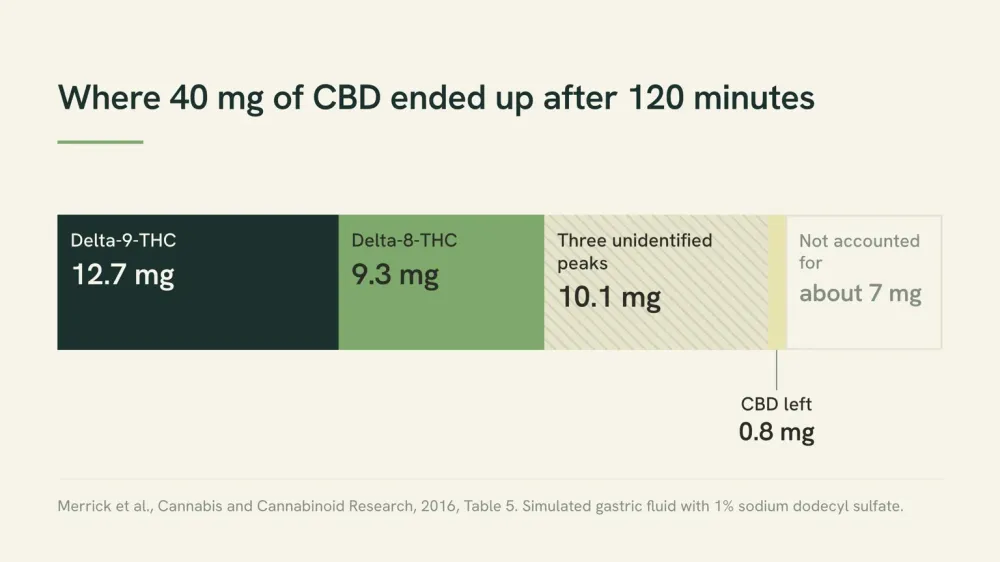
The number everybody quotes from that paper is 85%. In the acidic medium, CBD fell by about 85% at 60 minutes and by more than 98% at 120, following first-order kinetics with a rate constant of -0.031 per minute and an R-squared of 0.9933. That is a clean, well-fitted result. It is also a statement about CBD leaving, not about THC arriving. For what arrived you have to open Table 5, which the paper prints in milligrams rather than percentages, which is very probably why almost nobody quotes it.
Read the 120-minute row straight across, taking each figure as the table prints it. CBD, 0.8 mg. Delta-8-THC, 9.3 mg. Delta-9-THC, 12.7 mg, and the table's own Total THC cell for that row, 21.9 mg. Then three further peaks the paper labels only by relative retention time, at 0.5 mg, 3.2 mg and 6.4 mg: two of the three were confirmed by mass spectrometry to be cannabinoids, the third is described only as most likely a related cannabinoid, and all three were quantified assuming a response factor of 1.0, which the authors say was done to allow mass balance to be evaluated. Take the Total THC the table prints rather than adding the two isomer cells, which come to 22.0 and show the table rounding against itself by a tenth of a milligram, and the row accounts for 32.8 mg of the 40 the run began with. That leaves roughly 7 mg, about 18% of the starting mass, in nothing the table lists at all, while a further 10.1 mg, about a quarter of what went in, sits in the three peaks nobody identified. Against the paper's own printed 40 mg denominator, delta-9-THC specifically peaked at about 32% and the two isomers together at about 55%. By 180 minutes both were falling: 10.6 mg of delta-9-THC, 19.5 mg for the pair. None of that is an error, and imperfect mass balance is routine in a degradation study. It is simply what the table says, and it is more interesting than the headline.
The control is the part that quietly settles the general version of the claim. The same team ran the same CBD, in the same 1% sodium dodecyl sulfate, in HEPES buffer at pH 7.4 instead of acid, for six hours. No delta-8-THC. No delta-9-THC. No other cannabinoid. The Results put it plainly, that in HEPES buffer no degradation of CBD to THC or other cannabinoids was observed over the six-hour duration of the study, and a figure legend adds that a mass spectrum of delta-9-THC in HEPES at 360 minutes is not presented because there was none detected. So the detergent alone does nothing. Acid was doing the work, and the reaction needs both.
The variable nobody quotes: somebody added a detergent
Sodium dodecyl sulfate, also written SDS or sodium lauryl sulfate, is an anionic surfactant. You meet it in shampoo and in laboratory buffers, and its job in a dissolution bath is to get a water-insoluble compound into solution. CBD is a water-insoluble compound: that is why the 2016 run delivered it from a methanol stock in the first place. A molecule that is not dissolved is not in contact with the acid, and a molecule not in contact with the acid cannot react with it. A 2026 review revisiting this literature proposes that gastric conversion needs three conditions at the same time: a low pH, CBD physically accessible to the acid, and stabilization of the protonated intermediate the reaction passes through, which is exactly what an anionic surfactant such as dodecyl sulfate supplies. That review's own verdict, in its abstract, is that concerns about CBD-to-THC conversion in humans remain, at present, a speculative scenario. We were able to read its structured abstract but not its full text, so nothing numeric on this page comes from it.
The cleanest test of that idea was published in 2023 in the Journal of Analytical Toxicology by Hart and colleagues, a team from RTI International, an independent non-profit research institute, from Johns Hopkins, and from SAMHSA's Division of Workplace Programs, the federal office that administers workplace drug testing. They took three CBD products the paper describes as THC-free, an oil, an anhydrous powder and a water-soluble formulation, and incubated them in synthetic gastric fluid for three hours with no surfactant added. The water-soluble product formed a dispersion; the powder and the oil did not mix with the fluid at all. Delta-9-THC formed at less than 0.0006% for the oil, 0.0045% for the powder and up to 0.063% for the water-soluble product. Then they added 1% sodium dodecyl sulfate to the medium and ran a nano-formulated product again. It converted 33% to 36% of itself. No formation of delta-8-THC was observed.
| Experiment | Medium | Surfactant added | Time | Delta-9-THC formed |
|---|---|---|---|---|
| Merrick 2016 | Simulated gastric fluid, equivalent to 0.1 M hydrochloric acid | 1% sodium dodecyl sulfate | 120 minutes to peak | 12.7 mg of the 40 mg started with, about 32% |
| Merrick 2016, neutral control | HEPES buffer at pH 7.4 | 1% sodium dodecyl sulfate | 6 hours | None detected, and no other cannabinoid either |
| Watanabe, as reported by Nahler 2017 | Artificial gastric juice, pepsin-free, pH 1.2 | None | 20 hours | 2.9% |
| Hart 2023, ordinary CBD oil | Synthetic gastric fluid | None | 3 hours | Less than 0.0006% |
| Hart 2023, anhydrous CBD powder | Synthetic gastric fluid | None | 3 hours | 0.0045% |
| Hart 2023, water-soluble product | Synthetic gastric fluid | None | 3 hours | Up to 0.063% |
| Hart 2023, nano-formulated product | Synthetic gastric fluid | 1% sodium dodecyl sulfate | 3 hours | 33% to 36% |
Read the four 2023 rows down the surfactant column, because that is the whole argument. Three products were incubated with no surfactant added, in the same fluid for the same three hours, and all three stayed below a tenth of one percent: less than six ten-thousandths of a percent for the oil, 0.0045% for the powder, up to 0.063% for the water-soluble formulation. The one run with 1% sodium dodecyl sulfate in the medium converted about a third of itself. That is a gap of more than four orders of magnitude between the oil and the surfactant run, and the variable that moved is not the acid, not the temperature and not the incubation time. It is whether somebody added a surfactant. The 2016 medium contained one. A stomach does not. The 2023 authors drew their own conclusion, and it is in their title: an unlikely cause of positive drug tests. At intakes of around 30 mg of CBD a day they judged conversion unlikely to produce a positive urine result. That is their judgment about their own experiment, and it is not a promise about anyone's test.
It is worth saying plainly that this reaction is genuinely useful to somebody. Running it deliberately, in a reactor, with chosen reagents and controlled conditions, is how delta-8 is made from CBD. That is a manufacturing process with a purpose, a yield and a by-product profile. It is not an accident that happens to a person after breakfast, and treating the two as the same event is where most of the confusion on this topic begins.
From the beaker to the extrapolation, and where it stops
The reason the 2016 paper traveled beyond chemistry is a projection in its Discussion. The authors reasoned about a patient taking 700 mg of oral CBD and wrote that even if just 1% of the dose were soluble, total cannabinoid levels would be 6.5 mg after 30 minutes and 13 mg after 60. Take those numbers at face value and do the arithmetic they invite: 1% of 700 mg is 7 mg, and the 60-minute figure is 13. The governing equation is printed in the paper as an image and cannot be reconstructed from the text, so the replenishment assumption behind it is not something a reader can check. That is not an accusation and it is not a claim that the projection is wrong. It is the reason a projection is a projection, and the authors say as much themselves in the same section.
“Determining actual CBD solubility in gastric fluid would require studies in human subjects.”
What happened when people actually swallowed those doses
Everything above happened in glassware. Here is what happened when people swallowed the doses, and in one case when an animal's stomach contents were opened up and analyzed directly. Every milligram figure below is a study's own dosing parameter and none of them is a recommendation.
The oldest record is also the one that matches the 2016 extrapolation almost exactly. In 1991, Consroe and colleagues ran a double-blind, placebo-controlled crossover trial in which 14 patients took 10 mg/kg/day of oral CBD, roughly 700 mg a day, for six weeks, with plasma assayed every week at a sensitivity of about 500 pg/mL. Their abstract's result sentence, in the nomenclature of the time, is that "no plasma delta-1-THC, the major psychoactive cannabinoid of marijuana, was detected in any subject". Delta-1 is what delta-9 was called then. Twenty-one years later, Martin-Santos and colleagues gave 16 healthy men 600 mg of oral CBD, 10 mg of oral THC, or placebo across three sessions. THC produced anxiety, dysphoria, psychotic symptoms, sedation, subjective intoxication and a raised heart rate. CBD did not differ from placebo on any symptomatic or physiological variable, and 11-OH-THC and THC-COOH rose in blood after THC and not after CBD. Same people, same room, two molecules, two completely different results.
| Study | Design and dose | What they measured | Result | Limitation |
|---|---|---|---|---|
| Consroe 1991, human | Double-blind placebo-controlled crossover, 14 patients with Huntington's disease, 10 mg/kg/day oral CBD (about 700 mg/day) for 6 weeks | Weekly plasma, assay sensitive to about 500 pg/mL | No delta-9-THC detected in any subject; CBD's own plasma levels ran 5.9 to 11.2 ng/mL | n=14, one disease population, 1991 instrumentation, plasma and not urine |
| Martin-Santos 2012, human | Randomized double-blind placebo-controlled crossover, 16 healthy men, 600 mg oral CBD against 10 mg oral THC and placebo | Symptoms, physiology, and plasma THC metabolites | CBD did not differ from placebo on any symptomatic or physiological variable; 11-OH-THC and THC-COOH rose after THC and not after CBD | Small, male-only, single dose, 3 hours of observation |
| Crippa 2020, human | 120 healthy adults enrolled and 100 completed, 60 fed after a standardized meal and 60 fasted, single 300 mg oral CBD solution in corn oil | Plasma from 20 minutes to 216 hours, LC-MS/MS validated to 1.5 ng/mL | Neither delta-8-THC nor delta-9-THC detected in any sample, fed or fasted, and no psychotomimetic effects | Single dose not chronic; plasma not urine; four authors affiliated with the manufacturer |
| Wray 2017, minipigs | 3 minipigs, 15 mg/kg synthetic CBD in sesame oil by gavage, twice daily for 4 days plus a single dose on day 5 | Plasma at 1, 2, 4 and 6 hours on days 1 and 5, then the contents of the gastrointestinal tract itself | No THC and no 11-OH-THC in plasma or anywhere in the gut, while stomach CBD averaged 84,500 ng/mL | Animal, n=3, all four authors employed by GW Research |
| Epidiolex label, section 9.1, human | Human abuse potential study in non-dependent adult recreational drug users, cannabidiol at 750, 1,500 and 4,500 mg in the fasted state | Drug Liking and Take Drug Again, against placebo and against dronabinol and alprazolam | All three cannabidiol doses scored within the acceptable placebo range; 10 and 30 mg dronabinol and 2 mg alprazolam did not | A 100 mg/mL prescription oral solution, not a tincture; abuse liability, not a THC assay |
The dedicated modern study is Crippa and colleagues in 2020, which set out to answer this exact question and nothing else. 120 healthy adults, 60 men and 60 women, 60 of them fed after a standardized meal and 60 fasted, of whom 100 completed. A single 300 mg oral CBD solution in corn oil. Plasma sampled from 20 minutes out to 216 hours. An LC-MS/MS method validated to a lower limit of quantification of 1.5 ng/mL that separates CBD at a retention time of 1.44 minutes from delta-9-THC at 1.87 and delta-8-THC at 1.90, so the three could not be mistaken for one another. Their Results section reports that "THC was not detected in plasma after the administration of CBD". Neither isomer appeared in any sample, in either arm. The fasted arm is the one that matters here: a fasted stomach is the most acidic version of the test, and it came back exactly as negative as the fed one. What a meal does to CBD absorption is a real and separate topic, handled on our page on taking CBD with food. Read the study with its conflicts printed, as the journal printed them: four of its authors are affiliated with Prati-Donaduzzi, which manufactured the CBD, three of the academic authors are co-inventors on a CBD patent, and the University of Sao Paulo has a development agreement with that same manufacturer.
The study that answers the obvious design objection is Wray and colleagues in 2017, and it is an animal study, so it should be labeled as one and not extrapolated to anybody's tincture. Three minipigs, a species chosen because its gastrointestinal function tracks human function reasonably well, received 15 mg/kg of synthetic CBD in sesame oil by gavage, twice a day for four days and a single dose on the fifth. Plasma sampled at 1, 2, 4 and 6 hours on days 1 and 5 showed no THC and no 11-OH-THC at a limit of 0.5 ng/mL. Then the animals were euthanized and the contents of the gastrointestinal tract were analyzed directly. No THC and no 11-OH-THC anywhere in the gut, while CBD in the stomach reached a mean of 84,500 ng/mL and in the small intestine 43,900 ng/mL. That is the decisive design point in the whole literature. They did not only check the blood, where a critic can always say the metabolite was missed. They checked inside the stomach, which is where the reaction is supposed to be happening, with a great deal of CBD sitting in it. All four authors are employees of GW Research.
And then there is the document nobody on page one quotes, which is a drug label. Section 9.1 of the prescribing information for Epidiolex, the FDA-approved cannabidiol oral solution, describes a human abuse potential study. Non-dependent adult recreational drug users, which is to say people specifically recruited because they can recognize a drug effect, were given cannabidiol at 750, 1,500 and 4,500 mg in the fasted state. The label reports that responses on positive subjective measures such as Drug Liking and Take Drug Again were within the acceptable placebo range, while 10 and 30 mg of dronabinol, which is synthetic THC, and 2 mg of alprazolam produced large increases that were statistically significantly greater than those produced by cannabidiol. The same section states that Epidiolex is not a controlled substance.
Two boundaries on that, and they are not decoration. The first: Epidiolex is a 100 mg/mL prescription oral solution, dosed by body weight and approved for maintenance at up to 10 mg/kg twice a day, so it is not a tincture and its figures must never be converted into one. The second: nothing in that study is a suggestion that anyone take 4,500 mg of anything, and this page has no dose to recommend. What that study is, is the most demanding version of this test that exists inside a regulator-reviewed document: a very large dose of CBD, on an empty stomach, given to trained observers, with a positive control in the room. The positive control lit up. The cannabidiol did not.
Why the argument stayed alive for a decade
The exchange ran three rounds in the same journal, which is worth knowing because most consumer coverage only reports the first. In 2017 Grotenhermen, Russo and Zuardi published a comment assembling the clinical record against the extrapolation, and its key sentence is quoted often enough to be worth quoting exactly: "Bioconversion of CBD to THC, if it occurred in fact in humans, would be easily documented through increased serum levels of THC or 11-OH-THC. This has never been demonstrated." The 2016 authors replied in the same volume, arguing that detection should target 11-OH-THC and THC-COOH rather than parent THC, that the other degradants the experiment produced, the hydroxylated hexahydrocannabinols, may matter too, and that, in their words, "the circumstances in which this happens, and the subsequent clinical consequences, remain uncertain". A separate group later reported failing to reproduce THC formation under moderate conditions at all, and only got to 27% by acidifying with 0.5 mol/L hydrochloric acid and waiting up to two weeks. That is five times the acid concentration of the 2016 medium, held for two weeks against the two to three hours a meal spends in a stomach. We are reporting that experiment as the 2020 review reports it, and its authors are also the review's authors.
There is one more argument in the 2017 commentary and it is the most elegant thing in this literature. Harvey and Mechoulam, working on human urine after repeated oral CBD at 600 mg a day, cataloged around 33 CBD metabolites. Trace delta-8 and delta-9 forms were in there, at 1.97% and 0.69%. What was not in there was any THC glucuronide metabolite. The body conjugates what it metabolizes, so if a stomach had made THC and the body had processed it, the conjugates would have been in the urine. As Nahler and colleagues put it, "the absence of metabolites of the THCs in the urine would suggest that cyclization had occurred after excretion". In other words the trace THC formed in the sample tube, after the sample left the body. The same commentary reports a separate human study in which oral CBD at 400 mg and 800 mg, given alongside intravenous fentanyl, produced neither THC nor its main metabolites. We did not retrieve those originals and are reporting them as the commentary reports them.
There is a real CBD-to-THC route, and it runs on heat
The honest concession in this article is that a conversion route consumers actually meet does exist, and it has nothing to do with acid. In a 2021 study, pure CBD was pyrolyzed across 250 to 500 degrees Celsius, which is the operating range of an electronic cigarette coil, under both inert and oxidative atmospheres. Between 25% and 52% of it transformed, depending on the temperature. Delta-9-THC was the main pyrolysis product at every temperature in both atmospheres, formed by the same ring closure, accounting for up to 42% of the decomposition products under oxidative conditions and up to 70% under inert ones. Delta-8-THC, cannabinol and cannabichromene were the other predominant products.
The limits are as important as the finding. The material was 15 microliters of a 1 mg/mL certified CBD reference solution, held at each temperature for five minutes with at least three replicates, and it is not an e-liquid: the authors state that the effect of a propylene glycol and vegetable glycerin carrier was not taken into consideration, and their estimate of what this would mean per milliliter of a real product is explicitly an assumption rather than a measurement. This section exists to make one point and then stop. The reaction that will not run in your stomach runs easily on a heating coil, because heat supplies what a stomach does not: the energy to drive the cyclization without needing a molecule to be dissolved in acid first. Nothing here is a recommendation for or against any product format, and this page has no advice to give about devices.
So why did that CBD product feel like something? It was in the bottle
Here is the sentence this whole article exists to deliver. The THC that matters was in the bottle before you swallowed it.
If a CBD product made somebody feel something, or turned up on a screen, the explanations that fit the evidence all sit upstream of the stomach. A full-spectrum product legally contains trace THC. A product can be mislabeled. A product sold in the CBD aisle can be a hemp-derived THC product, which is a different category with the dry-weight math behind it doing the work. None of those explanations requires a stomach to run organic chemistry, and none of them needs a 2016 dissolution experiment to make sense of. Whether CBD itself is intoxicating is a separate question with its own controlled-study record, and the controlled studies on whether CBD is intoxicating are collected on their own page.
There is one place where the 2020 reviewers say this conversion plausibly does reach a consumer, and it is still not the stomach. The strongest and most clinically relevant evidence they found in favor of CBD's conversion to psychotropic metabolites is, in their phrase, "during improper storage": room temperature, daylight and contact with air raise degradation rates, and the route runs from CBD to delta-9-THC to CBN. They attach a caveat in the same section, and it matters as much as the finding. Most of those findings come from long-term storage tests whose timeframes considerably exceed typical storage times of CBD products, and the decomposition rate of delta-9-THC is reported to be higher than that of CBD, so large amounts of THC arising from decomposition are not to be expected in a stored product. Their answer to where this reaction reaches a real person is a badly stored bottle rather than a stomach, and even there they say the amounts are small.

Which is why the honest version of this answer is a certificate rather than a promise. Planntz Full Spectrum CBD is a 60 mL tincture at 250 mg/mL of CBD, and its certificate of analysis reports trace THC at about 0.24%, below the 0.3% federal limit. The CBD plus CBG tincture reports about 0.15% and the CBD plus CBN tincture about 0.14%. Broad Spectrum reports non-detected THC on the mango and natural certificates and a 0.019% trace on lemon. Non-detected on a batch's COA is a measurement made at a stated detection limit, which is not the same thing as the words THC-free, and no product can guarantee a drug-test outcome. The number that matters is on the certificate because a laboratory measured it before anyone swallowed anything. That is the whole point of this section, and it is a far more useful place to look than a stomach.
How to read the next conversion claim you meet
This argument will come back, because the underlying chemistry is real and because a startling in-vitro result is easy to write about. Six questions will tell you within about a minute whether a given claim is describing a person or describing a beaker. They work on any paper in this area, including the ones cited above.
- 1Is it a person or a beaker? An in-vitro result describes a medium. Ask what was in the medium before you ask what came out of it.
- 2Was a surfactant added? Look for sodium dodecyl sulfate, SDS, sodium lauryl sulfate or any solubilizer. If one is there, the experiment is testing solubilized CBD, not swallowed CBD.
- 3How long was the incubation? Two hours, three hours and twenty hours are three different questions, and only the first two are anywhere near a gastric residence time.
- 4Is the number delta-9-THC specifically, or degradants as a class? A page that reports conversion without naming the isomer is usually quoting the larger figure.
- 5Who paid for it? Both sides of this argument are funded and every disclosure is printed at the bottom of the paper. Read it, then judge the experiment on its conditions rather than on its sponsor.
- 6What did they actually measure? Plasma, urine and gut contents answer different questions, and a study that never looked for THC cannot have failed to find it.
The human evidence does not support meaningful conversion. The result that started the argument is a 2016 in-vitro study in which 40 mg of CBD in simulated gastric fluid produced a peak of 12.7 mg of delta-9-THC at 120 minutes, and the medium contained 1% sodium dodecyl sulfate, a detergent, which is what puts a water-insoluble molecule like CBD into solution where acid can reach it. In a 2020 pharmacokinetic study, 120 healthy volunteers took a single 300 mg oral dose of CBD, half of them fed and half fasted, and neither delta-8-THC nor delta-9-THC was detected in any plasma sample down to 1.5 ng/mL. Chemistry says the reaction is possible under the right conditions. Human pharmacology says a stomach is not those conditions.
No route has been demonstrated in human metabolism. The enzymes that act on CBD add hydroxyl groups to it; they do not close its ring. The most elegant indirect evidence comes from urine work reported by Nahler and colleagues in 2017: after repeated oral CBD at 600 mg a day, Harvey and Mechoulam cataloged around 33 CBD metabolites and found trace delta-8 and delta-9 forms at 1.97% and 0.69%, but no THC glucuronide metabolites at all. The body conjugates what it metabolizes, so if THC had been made inside the body, the conjugates should have been there. Their own conclusion was that the cyclization happened after excretion, meaning in the sample rather than in the person. A different question, often confused with this one, is what the liver makes out of THC itself, and our 11-hydroxy-THC article covers it.
That route is documented. In a 2021 pyrolysis study, pure CBD heated across 250 to 500 degrees Celsius, which is the operating range of an electronic cigarette coil, transformed between 25% and 52% of itself depending on temperature, and delta-9-THC was the main pyrolysis product at every temperature in both an inert and an oxidative atmosphere: up to 42% of the decomposition products under oxidative conditions and up to 70% under inert ones. The limits matter as much as the finding. The material was a certified CBD reference solution rather than a real e-liquid, and the authors state that the effect of a propylene glycol and vegetable glycerin carrier was not taken into consideration. Their estimate of what a consumer would meet is explicitly an assumption. This page makes no recommendation about any format.
The explanations that fit the evidence are all about what was in the bottle rather than about what a stomach did to it. A full-spectrum product legally contains trace THC. A product can be mislabeled. A product sold in the CBD aisle can be a hemp-derived THC product, which is a different category entirely. And the 2020 review of this literature named improper storage, meaning room temperature, daylight and contact with air over time, as the place where CBD's conversion to psychotropic metabolites is most clinically relevant, while adding that large amounts from decomposition are not to be expected. If the question underneath yours is whether CBD is intoxicating at all, our article on whether CBD gets you high answers it with the controlled studies.
Yes, and the reason has nothing to do with conversion. A full-spectrum product contains trace THC before you swallow it, always below the 0.3% federal limit but not zero, and a urine screen for cannabis targets THC-COOH, a metabolite the body makes from THC. Broad-spectrum products report non-detected THC on some batch certificates, and non-detected is a measurement made at a stated detection limit rather than a guarantee. No product and no article can promise you a test result. Our guide to CBD and drug testing covers what a panel targets and what a spectrum choice changes.
It belongs to the same chemistry class, run deliberately. Delta-8 manufacturing takes CBD and closes its ring on purpose, in a reactor, with chosen reagents and controlled conditions, which is close to the opposite of an accident in a stomach. Our delta-8 versus CBD article covers what that step involves and why the by-product question is the part worth asking about.
In the beaker it does. In the 2023 experiment, an ordinary CBD oil incubated in synthetic gastric fluid for three hours produced less than 0.0006% delta-9-THC, an anhydrous powder produced 0.0045%, and a water-soluble formulation produced up to 0.063%. Those are all very small numbers and they are more than a hundredfold apart, which tells you that getting CBD into solution is what the reaction needs most. The same team's nano-formulated product converted 33% to 36%, but only after they added 1% sodium dodecyl sulfate to the medium. Their own published conclusion, stated in their title, is that this is an unlikely cause of positive drug tests, and at intakes of around 30 mg of CBD a day they judged conversion unlikely to produce a positive urine result.
If you arrived with the testing question rather than the chemistry one, that is the page to read next. It covers what a workplace panel actually targets, what choosing a spectrum changes and where the residual risk genuinely sits, without promising anyone an outcome: our guide to CBD and drug testing. And if the chemistry is what you came for, the short version is worth repeating on the way out. Acid can close CBD's ring. A detergent makes that easy. A heating coil makes it easier still. A stomach, as far as the human record goes, does neither at a rate that has ever shown up in anybody's blood.
Writing about hemp, wellness and the small rituals that keep us balanced.