Greening Out: What Too Much THC Does and When to Get Help
Greening out is slang for taking in more THC than you can comfortably handle. Here is what it feels like, why edibles catch people out, what to do right now, and the signs that mean it is time to call Poison Help or 911.

Greening out is slang for taking in more THC than you can comfortably handle. Reported effects include a racing or pounding heart, anxiety or paranoia, vomiting, confusion, drowsiness and feeling unsteady on your feet. Here is why edibles catch so many people out, what to do right now, how long the studies say effects last, and the specific signs that mean you should stop waiting it out and call for help.
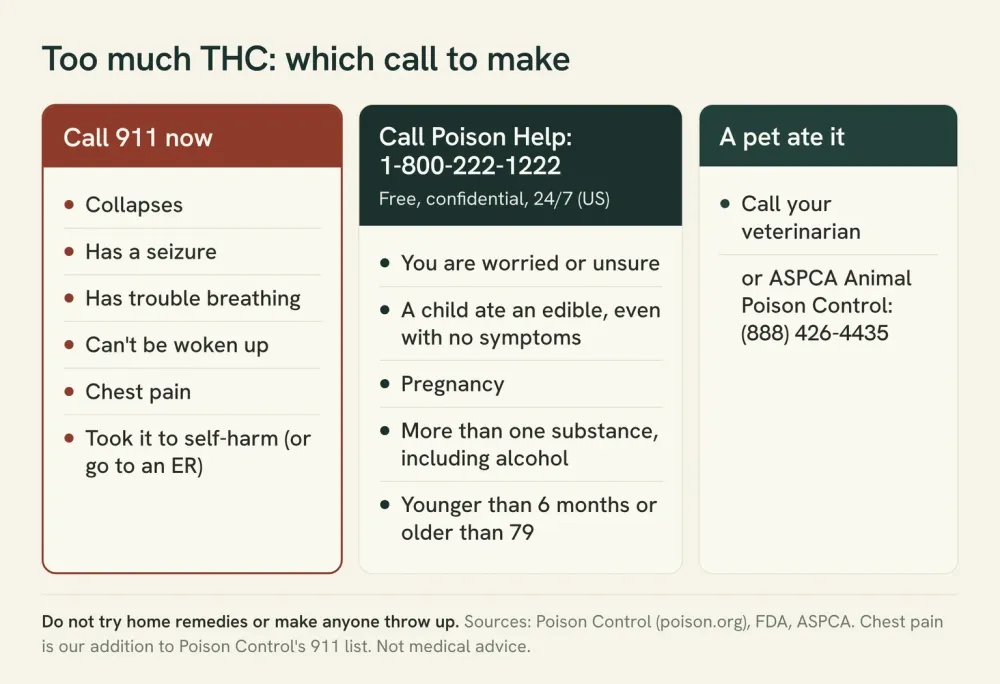
The short answer: greening out is not a medical diagnosis, and no home remedy has been shown in people to end it. What you can do is practical. Stop taking in more of anything, get somewhere safe with another person, do not drive, and know the line between a miserable episode and an emergency. The numbers in the box above come from America's Poison Centers' Poison Help site, which connects callers to the nation's 53 poison centers, and from the National Capital Poison Center's triage page. This page is written for adults 21 and over and for anyone looking after someone who took too much. It gives no THC amount, product or timing advice. One disclosure: Planntz sells a tablet that contains delta-9 THC, and nothing on this page recommends it or any other THC product.
What greening out means, and what clinicians call it
"Greening out" is a slang term, not a diagnosis. People use it for the stretch of time after taking in more THC than they can comfortably handle, whether the cannabis was smoked, vaped or eaten. Clinicians and researchers use plainer words. The Colorado emergency department study discussed below recorded the reason for a visit as "intoxication", and a 2019 emergency medicine review by Wong and Baum is simply titled Acute Cannabis Toxicity.
Four things shape how an episode plays out, and they come up again and again below: the route (swallowed THC arrives later than inhaled THC), experience with cannabis, whatever else was taken at the same time, and who took it. For a child or a pet, an edible is an emergency category of its own.
Why edibles catch so many people out
A 2019 study in Annals of Internal Medicine compared the two routes directly. Researchers reviewed charts from the emergency department of one large academic hospital, the University of Colorado Hospital, covering January 2012 to December 2016. Of 9,973 visits with a cannabis diagnosis code, they judged 2,567 (25.7%) to be at least partly caused by cannabis. Of those, 238 involved edible cannabis and 2,329 involved inhaled cannabis. People in the edible group were more often female (51.3% vs 33.1%), far more often lived outside Colorado (40.8% vs 6.6%) and were less often admitted to the hospital (18.9% vs 32.9%). The authors wrote that this suggests tourists or people new to cannabis may be at greater risk. The design limits travel with every number from this paper: it was a retrospective chart review at a single hospital, exposure was self-reported, and dose data were limited.
| What the visit involved | Edible visits (238) | Inhaled visits (2,329) | Reading it |
|---|---|---|---|
| Intoxication | 48.3% (115 visits) | 27.8% (647 visits) | Higher in edible visits |
| Acute psychiatric symptoms | 18.0% (43 visits) | 10.9% (254 visits) | Higher in edible visits |
| Cardiovascular symptoms | 8.0% | 3.1% | Higher in edible visits |
| Cannabinoid hyperemesis syndrome | 8.4% (20 visits) | 18.0% (420 visits) | Higher in inhaled visits |
| All gastrointestinal symptoms | 15.1% | 32.3% | Higher in inhaled visits |
| All psychiatric visits combined | 26.1% | 24.5% | No meaningful difference |
Two more findings from the same paper deserve a sentence of their own. First, the authors report that severe cardiovascular events, including heart attacks and ventricular dysrhythmias (dangerous heart rhythms), occurred in both the edible and the inhaled groups. Second, for 2014 to 2016, they counted 219 visits attributable to edibles and 1,819 attributable to inhaled cannabis, so edibles made up 10.7% of cannabis-attributable visits. Over the same years, edibles made up an estimated 0.32% of the THC sold in Colorado. That gap is striking, but the 0.32% is an estimate the authors built on their own conversion assumptions about how much THC a kilogram of flower and a single edible unit contain, so read it as a rough signal rather than a measurement. Notice, too, that the table cuts both ways: cannabinoid hyperemesis syndrome and gastrointestinal complaints were more common among inhaled-cannabis visits, and the overall share of psychiatric visits did not differ.
The timing is the part people most often underestimate. In a controlled study of 17 healthy adults who had not used cannabis for at least 60 days, researchers gave brownies at several different THC strengths and assessed participants for 8 hours. Effects "did not manifest until 30-60 min after ingestion", "peak effects occurred 1.5-3 h post-administration", and the higher strengths markedly impaired thinking and physical coordination. The authors concluded that people need better education about how the effects of edibles unfold over time. The CDC's page on cannabis and poisoning gives a similar window in public-health language: edibles can "take from 30 minutes to 2 hours to feel intoxicating effects." Swallowing also changes what reaches the blood, with far more of the metabolite 11-hydroxy-THC relative to THC itself than inhaling produces, and our explainer on 11-hydroxy-THC and the route that makes it covers that chemistry without offering any timeline.
Greening out symptoms, sorted by what they mean
Most descriptions of greening out stop at a list of symptoms. The more useful question is what each symptom means for what you do next. The table sorts the common reports by where each is documented and what the poison-center guidance points to. If you cannot tell which row you are in, call Poison Help. The call is free and confidential, and it is exactly what the line is for.
| What you notice | Where it is documented | Next step |
|---|---|---|
| Anxiety, nervousness or paranoia | Self-rated after THC in a controlled lab study; acute psychiatric symptoms in 18.0% of edible visits at the Colorado hospital | Stay with the person somewhere quiet. Call Poison Help if it is not easing or you are unsure |
| Racing or pounding heart, without chest pain | Increased heart rate in FDA adverse event reports on THC edibles; heart rate peaked within 30 minutes of inhaled cannabis in a lab study | Call Poison Help for advice, and mention any heart condition |
| Vomiting | FDA adverse event reports on THC edibles; America's Poison Centers' list of edible cannabis symptoms | Do not make the person throw up. Call Poison Help |
| Confusion, drowsiness, feeling unsteady on your feet | America's Poison Centers' list of edible cannabis symptoms | Stay somewhere you cannot fall. Call Poison Help if unsure |
| Hallucinations | FDA adverse event reports on THC edibles | Call Poison Help now. Get emergency care if the person may harm themselves |
| Collapse, seizure, trouble breathing, or cannot be woken | Poison Control's 911 criteria | Call 911 immediately |
| Chest pain | Heart attacks and dangerous heart rhythms occurred in both groups of the Colorado emergency department study | Call 911 |
| A child who is very drowsy, has trouble walking or sitting up, or struggles to breathe | The CDC's description of children who ate THC products | Call 911 for breathing trouble or if the child cannot be woken; otherwise call Poison Help now |
| Thoughts of self-harm | Poison Control says immediate evaluation, usually in an ER, is always advised | Call 911 or go to emergency care |
What to do right now if you or a friend is too high
No home remedy has been shown in people to reverse THC, so the steps below are about safety, not speed. They come from poison-center first-aid guidance and from what emergency clinicians look out for. If a 911 sign appears at any point, stop and call.
- 1If anyone has collapsed, had a seizure, is struggling to breathe or cannot be woken, call 911 before doing anything else.
- 2Stop taking in more of anything: no more THC, no alcohol, and no other drugs or sedating medicines.
- 3Do not drive, and do not let the person drive or ride with someone who is impaired. Arrange another way home.
- 4Stay with the person, or ask someone you trust to stay with you. The 911 signs only help if someone is there to notice them.
- 5Move to a quiet, familiar place where nobody can fall, away from stairs, water and traffic.
- 6Keep the package or product nearby, so you can tell a poison specialist what was taken and when.
- 7Do not try home remedies, and do not make anyone throw up.
- 8Call Poison Help at 1-800-222-1222 if you are worried or unsure, and always for a child, a pet, pregnancy or more than one substance.
A few notes on where these steps come from. "Do not try home remedies or try to make someone throw up" is PoisonHelp.org's own first-aid advice for a swallowed poison, and an edible is a swallowed product. Staying with the person is our reasoning rather than a separate agency rule: Poison Control's 911 criteria describe things a person cannot report about themselves, such as collapsing or not waking up, so someone has to be there to see them. Moving away from stairs and traffic follows from unsteadiness being a listed symptom and from the CDC's warning that edibles can lead to serious injury. On the road question, our guide to cannabinoids, impairment and driving explains why feeling fine is not a reliable test and how per se THC laws work.
If you do end up in an emergency department, expect watchful, supportive care rather than a quick fix. In a case report with a review of the literature published in the Western Journal of Emergency Medicine in 2015, a woman who developed psychosis after eating cannabis edibles daily for a week had heart-rhythm and blood-chemistry abnormalities that "resolved over two days with supportive treatment and minimal intervention." The authors write that acute medical complications "are primarily cardiovascular and respiratory in nature", that patients with a toxic ingestion "must be screened for co-ingestion" of other substances, and that clinicians should make sure the patient has a safe way home. That is one case plus a narrative review, not a trial, and the monitoring it describes is a clinician's job, not something to attempt at home.
When to call Poison Help, and when to call 911
The 911 list at the top of this page is short on purpose: collapse, a seizure, trouble breathing, or someone who can't be woken. Outside those signs, the next step is a phone call to a person, not a search. Poison Help at 1-800-222-1222 is free and confidential, poison experts answer 24/7, and your call is routed to a center based on where you are. It covers the US only. Poison Control also runs an online triage tool, and it says that tool should not be used if the person is in any of the situations below. We treat that list as the moments when you should always talk to a specialist.
- Younger than 6 months or older than 79.
- Pregnant.
- Took it with the intent of self-harm. Poison Control says immediate evaluation, usually in an ER, is always advised, so call 911 or go to emergency care.
- Exposed to more than one product or substance, which includes THC taken with alcohol, opioids, sedatives or other drugs.
- A pet. Call your veterinarian or the ASPCA Animal Poison Control Center instead.
Two more situations belong beside that list. A child who ate an edible always gets a call to Poison Help, before any symptoms appear, because the FDA says so in plain words (the children section below has the details). And we treat chest pain as a reason to call 911, even though it is not on Poison Control's list. That is our judgment, and here is what it rests on: in the Colorado emergency department study, severe cardiovascular events including heart attacks occurred in both the edible and inhaled groups, and the FDA's 2022 alert on THC edibles tells people to "Call 9-1-1 or get emergency medical help right away" for serious side effects. If you have a known heart condition, say so when you call.
When a child eats an edible
For children, the answer is never to wait and see. The FDA's alert, dated June 16, 2022, is direct: "Call the local poison control center (1-800-222-1222) if a child has consumed these products. Do not wait for symptoms to call." The agency described THC edibles packaged to look like popular cereals and candies, which is how many children end up eating them. The CDC notes that children who eat THC products may have problems walking or sitting up, or have a hard time breathing, and a child who is struggling to breathe or cannot be woken needs 911.
Each of those numbers measures something slightly different. The FDA reported that from January 1, 2021 through May 31, 2022, it received over 125 adverse event reports involving people who ate THC edibles, and national poison centers received 10,448 single-substance exposure cases involving only THC edibles. Of those cases, 77% involved patients 19 or younger. Separately, 65% were unintentional exposures, and 91% of those unintentional exposures affected pediatric patients. And 79% of all cases required evaluation at a health care facility, of which 7% were admitted to a critical care unit. The 91% is a share of the 65%, and the 7% is a share of the 79%, so these percentages are not slices of one whole. One pediatric case was coded with a death following ingestion of a suspected delta-8 THC edible. Looking only at young children, a 2023 analysis in Pediatrics counted 7,043 edible cannabis exposures in children under 6 from 2017 to 2021, rising from 207 in 2017 to 3,054 in 2021, an increase of 1,375%. Almost all (97.7%) happened at a residence, 22.7% of the children were admitted to a hospital, and 70% of the cases followed to a known outcome involved central nervous system depression. Both datasets are passive reports with no count of how many children lived around edibles, so they show trends, not the risk in any one household.
America's Poison Centers' edible cannabis tracking page reports that from 2019 to 2025, poison centers managed 39,497 cannabis edible exposure cases in patients aged 0 to 19 (source: National Poison Data System, America's Poison Centers; the 2025 count covers part of the year, as read on September 14, 2026). You can reach your local Poison Center by calling the Poison Help line: 1-800-222-1222. The picture changes with age. In an analysis of 36,161 cannabis exposures in people aged 2 to 20 reported to poison centers from 2016 to 2021, exposures were mostly unintentional in children aged 2 to 6 (96.3%) and 7 to 11 (82.4%), and mostly intentional in ages 12 to 17 (79.9%) and 18 to 20 (77.5%).
A newer study widens the lens, and its headline figure is easy to misread. A 2026 study in BMC Public Health counted 41,612 unintentional ingestions of recreational drugs of all kinds by children under 6, reported to US poison centers from 2000 to 2024. Cannabinoids, a category that also includes synthetic and semi-synthetic cannabinoids, made up 84.7% of them. The ingestion rate for all recreational drugs combined, not cannabis alone, rose 3,307%, from 1.05 to 35.91 per 100,000 children under 6, with a rapid increase beginning in 2013, especially involving edible marijuana and psilocybin products. Across all of those drugs, 5.0% of the children had a major effect and six children died. All six were under 3, and the primary substances in those deaths were fentanyl in four and cocaine in two. The authors also note that coding changed over the period (a general code for marijuana edibles was created in 2016, although the first edible case in their data dates from 2013), and that the data are self-reported, incomplete and may be miscoded. Behind statistics like these are cases such as one described by the National Capital Poison Center in its article on children who eat cannabis edibles: a 2-year-old became unusually sleepy and lethargic after a playdate, then had seizures and needed a breathing tube. He had eaten his mother's cannabis gummies, and he made a full recovery after a 36-hour hospital stay.
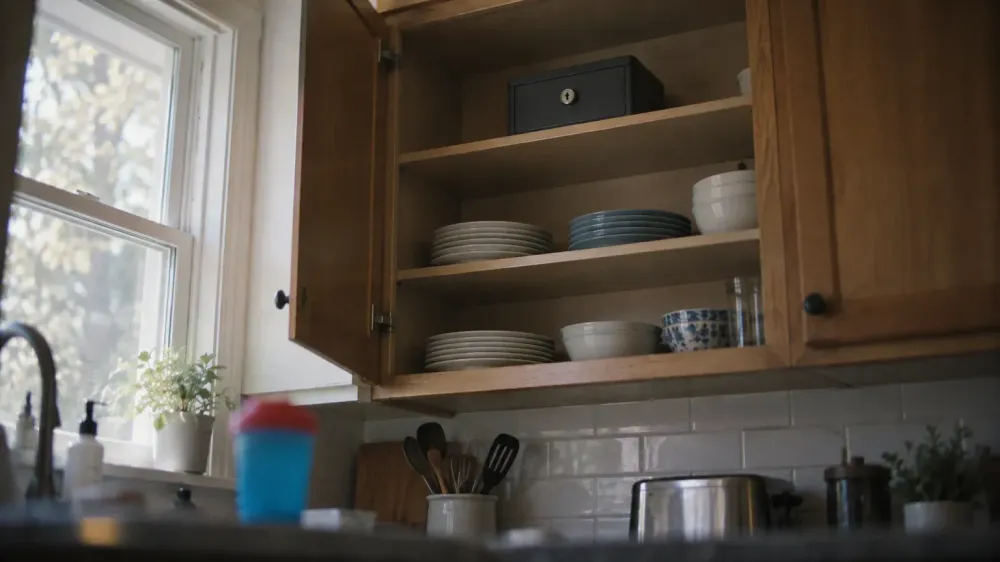
Prevention is mostly storage. America's Poison Centers recommends keeping edibles "up, away and out of reach" and considering a lock-box, and the FDA says to "Always keep these products in a safe place out of reach of children." If what a child swallowed was a CBD product rather than a THC edible, our guide to CBD and children walks through what to do in the first five minutes.
When a dog or cat eats an edible
Pets need a veterinarian, not an internet search. The ASPCA's guidance on marijuana and pets, dated June 8, 2021, notes that animals do not stop at one bite: "they will eat as much as they can get." Among the common signs it lists are unsteadiness on the feet, depression, dilated eyes, dribbling urine, sensitivity to sound and touch, and low body temperature. With products of higher concentration or larger quantities, pets can show low blood pressure, agitation or seizures, and the ASPCA adds: "In rare cases, death has occurred." Call your veterinarian or the ASPCA Animal Poison Control Center at (888) 426-4435, and follow their instructions rather than anything you read online, including this page. Do not try to treat your pet at home.
Be honest on the phone, even if the story is awkward. In a review of 223 dogs with confirmed marijuana or THC toxicity treated at a university teaching hospital from January 2017 to July 2021, 68% of owners denied any possibility of exposure. Signs recorded included loss of coordination (88.3%), hyperesthesia, an exaggerated response to touch or stimulation (75.3%), lethargy (62.5%), urinary incontinence (45.7%) and vomiting (26%). Twenty-two dogs were hospitalized, and every dog in the study survived. That survival figure describes dogs that reached a veterinary hospital and were treated there. It is not evidence that a dog will be fine at home.
How long does greening out last?
Nobody can give you a personal timeline, and a page that promises one is guessing. What research offers is the time course of THC effects measured in controlled studies, which is not the same thing as how long an overconsumption episode lasts. With that limit up front, here is what was measured.
- Inhaled: in a lab study of 17 infrequent users, heart rate and blood THC peaked within 30 minutes and returned to baseline in 3 to 4 hours, while some effects and impairment lasted up to about 6 hours on average.
- Swallowed: in a lab study of 17 adults who had not used cannabis for at least 60 days, effects appeared 30 to 60 minutes after eating and peaked at 1.5 to 3 hours. Participants were followed for 8 hours.
The inhaled figures come from a double-blind crossover study published in JAMA Network Open in 2018, which gave smoked and vaporized cannabis to 17 healthy adults with no cannabis use in the prior month. Its most useful finding for this question is that impairment outlasted the return of heart rate and blood THC to baseline, so a settling heartbeat does not mean the effects are over. Vaporized cannabis also produced stronger effects than the same dose smoked. For edibles, the CDC adds that they can "cause intoxicating effects that last longer than expected, depending on the amount ingested, whether they are eaten on an empty stomach, medications or alcohol used at the same time, and other factors." Both lab studies used measured doses in healthy, infrequent users, which is not what a real overconsumption looks like. If symptoms are getting worse rather than better, or you are simply unsure, call Poison Help.
What greening out can be confused with
Several other problems can look like greening out, and some of them are more serious. You do not have to tell them apart on your own. You only need to know that a few of them change the next step.
- A panic attack. Anxiety and a racing heart can happen with or without THC. If you cannot tell, call Poison Help, and call 911 for chest pain or trouble breathing.
- Cannabinoid hyperemesis syndrome (CHS). Repeated bouts of vomiting in someone with years of regular cannabis use, coming back every few weeks to months. It needs a clinician, not a remedy.
- A heart problem. Chest pain, fainting, or a racing heart with trouble breathing is a 911 call, not a symptom to wait out.
- More than one substance. THC with alcohol, opioids, sedatives or other drugs always calls for a poison specialist, or 911 if any emergency sign appears.
CHS is worth understanding because its best-known feature gets passed around as a greening-out tip. A StatPearls clinical reference chapter on cannabinoid hyperemesis syndrome describes cyclical nausea, vomiting and abdominal pain characterized by "several years of preceding cannabis use" and "a cyclical pattern of hyperemesis every few weeks to months", and it describes symptoms being relieved by hot baths or showers as a characteristic feature. It states that the only definitive treatment is removing cannabis exposure. So a hot shower is a clue to a different, chronic condition, not a fix for being too high. If vomiting keeps coming back in cycles, talk to a clinician rather than self-diagnosing from an article.
The heart is the reason chest pain goes straight to 911. In a study published in Circulation in 2001, researchers interviewed 3,882 people who had had a heart attack about what they did before their symptoms began. The risk of a heart attack starting was 4.8 times the baseline (95% confidence interval 2.4 to 9.5) in the 60 minutes after smoking marijuana, and it fell rapidly afterward. The authors describe marijuana as "a rare trigger": only 9 patients reported using it in the hour before their symptoms, the cannabis was smoked, and the figure is a relative risk, not the chance that any one person will have a heart attack. It does not show that greening out causes heart attacks. It shows why chest pain after THC should not be brushed off as anxiety.
Does CBD, black pepper or lemon help? What the evidence says
Most greening-out advice online is a list of kitchen remedies, so we checked which of them have been tested in people. On September 14, 2026, we searched PubMed for human studies of black pepper or its compound beta-caryophyllene against THC's effects, for clinical trials of food, cold water or cold showers against cannabis intoxication, and for trials that gave CBD after a THC high had already started. We found none. That is a record of our search, not proof that no such study exists. PoisonHelp.org's first-aid advice for a swallowed poison is simpler than any tip: do not try home remedies.

| Remedy | What is known from human research | What that means |
|---|---|---|
| Lemon or limonene | One lab study of 20 healthy adults: vaporized d-limonene inhaled with THC lowered self-rated anxious and paranoid feelings at the top combination; other THC effects were unchanged | Not tested as lemon juice, peel or sniffing citrus, or after a high had started. The authors' institution filed a patent application on the idea |
| Black pepper | No human test found. The idea comes from historical remedies and a 2011 review that proposed plant compounds such as beta-caryophyllene as worth testing | A hypothesis, not evidence |
| Eating food | No human test found of food as a way to shorten or soften intoxication | The CDC lists an empty stomach among factors that change how long edible effects last. That is about absorption, not a remedy |
| Cold water or a cold shower | No human test found | No evidence either way |
| Hot shower or bath | Relief with hot showers is a described feature of cannabinoid hyperemesis syndrome, a different condition | Not a fix for greening out. Vomiting that returns in cycles is a reason to see a clinician |
The lemon idea has one controlled human study behind it in our search, and it is much narrower than the tip. In a 2024 double-blind lab study of 20 healthy adults, inhaling vaporized d-limonene, a compound found in citrus peel, at the same time as THC lowered self-rated "anxious/nervous" and "paranoid" feelings compared with THC alone, at the highest combination tested. Other THC effects were unchanged. The abstract reports that limonene did not alter how THC moved through the body, but the full results show that the same top combination produced higher blood THC than THC alone, and that condition was not randomized and was given to only 12 of the 20 people. The study did not test lemon juice, lemon peel, sniffing citrus, or anything taken after a high had started, and the authors called for research on oral forms. The conflicts belong in the same paragraph: Johns Hopkins filed a patent application on behalf of three of the authors for the use of d-limonene to reduce THC-induced anxiety, and one author founded CReDO Science and advises True Terpenes. The black pepper tip goes back further. A 2011 review in the British Journal of Pharmacology, written by a researcher then working with GW Pharmaceuticals, reproduces what it calls "ancient cannabis antidotes", including lemon, calamus root, pine nuts and black pepper, and presents plant compounds such as beta-caryophyllene, found in black pepper, as putative antidotes to THC's intoxicating effects. That is a hypothesis, and our search found no human test of it.
CBD is the remedy people ask about most, and its evidence status is short. Controlled human trials that gave CBD together with THC have not shown that it reliably blunts a THC high, and in a 2023 crossover trial of 18 healthy adults, brownies containing THC plus CBD increased heart rate and impairment compared with THC alone. The authors wrote that the result contradicts common claims that CBD attenuates THC's adverse effects. We found no trial that gave CBD after THC effects had begun. This page does not suggest taking CBD, or anything else, to come down. Whether CBD can cancel or soften a THC high has its own page, and our review of how CBD and THC interact in the same body walks through the studies behind that answer.
Why it happens again: reading a THC label
The Colorado researchers did not measure why edibles were overrepresented in their emergency department, but they point to possible reasons from other research: "inconsistent dosing, dose stacking, pharmacodynamic variability between routes of exposure, unintentional exposure, and user naiveness." One thing you can check is the label, and it is easy to misread. A THC product can print an amount per serving, an amount for the whole package and a percentage, and those three figures answer different questions. The package figure is the total in the container, not what one piece contains. On a lab certificate, a "Total THC" line is that lab's formula for adding up THC forms, not a second, separate measurement.
If you want to understand what the THC number on a hemp product means, chemically and legally, our guide to hemp-derived THC explains how those figures are defined. This page gives no amount to take, and neither a label nor a lab report can tell you how a given amount will affect you, since route, experience, an empty stomach and anything else you have taken all change the result.
What the evidence cannot tell you
Here is the honest edge of the research on this page, as of our reading on September 14, 2026.
- How risky any single episode is. The Colorado data are a chart review from one hospital, with self-reported exposure and little dose information.
- How often greening out happens. Poison-center counts record calls, with no count of how many people or households had THC, so they show trends rather than risk.
- How long your episode will last. The timing studies used measured doses in healthy, infrequent users, not real-world overconsumption.
- The best way to manage a child's intoxication. A scoping review concluded that evidence on clinical management is limited, and its literature search ended in 2019.
- Whether any home remedy works. We found no human trial of black pepper, food, cold water, or CBD given after a high started, and the single limonene study we found tested something readers do not do.
The pediatric point comes from a 2024 scoping review of 158 sources in the Journal of Child Health Care, which concluded that while the increasing incidence of acute pediatric cannabis intoxication is clear, "evidence around clinical management is limited." What does not depend on any of these gaps is the escalation line. The 911 criteria and the Poison Help number work the same way whatever the research eventually shows.
Questions people ask about greening out
People describe it as being far too high, and the documented symptoms match that: anxiety or paranoia, a racing heart, vomiting, confusion, drowsiness and feeling unsteady. The FDA has also received reports of hallucinations after THC edibles. It can be frightening. Collapse, a seizure, trouble breathing, not waking up and chest pain are not part of an ordinary episode, and each one is a reason to call 911.
Be wary of any page that says flatly that you cannot. In the Colorado emergency department study, no deaths were recorded among the 2,567 visits attributed to cannabis, but heart attacks and dangerous heart rhythms occurred among both edible and inhaled patients. The FDA reported one pediatric case coded with a death after a suspected delta-8 THC edible, and the ASPCA reports rare deaths in pets. The realistic dangers are breathing problems, seizures, heart events, falls and injuries, driving, and mixing THC with other substances. Call 911 for collapse, a seizure, trouble breathing, someone who can't be woken, or chest pain.
There is no reliable personal timeline. In controlled lab studies of infrequent users, heart rate peaked within 30 minutes of inhaled cannabis, with some effects and impairment lasting up to about 6 hours on average, while swallowed THC took 30 to 60 minutes to be felt and peaked at 1.5 to 3 hours. The CDC says edible effects can last longer than expected, depending on the amount, an empty stomach, and medications or alcohol taken at the same time. If symptoms are getting worse instead of better, call Poison Help at 1-800-222-1222.
We found no tested home remedy that ends it. What you can do is stop taking in more of anything, move somewhere safe and quiet, keep someone with you, stay off the road, keep the package handy and call Poison Help if you are worried. PoisonHelp.org advises against home remedies and against making someone throw up. If you go to a hospital, care is watchful and supportive rather than a quick reversal.
The evidence does not support using it that way. Trials that gave CBD together with THC have not shown that it reliably blunts a THC high, a 2023 trial found THC plus CBD raised heart rate and impairment more than THC alone, and we found no trial that gave CBD after a high had started. The CBD section above links to the pages that cover this in depth.
We found no human test of black pepper or its compound beta-caryophyllene against THC's effects; the idea comes from historical remedies and a 2011 review that proposed it for study. For lemon, one 2024 lab study of 20 adults found that vaporized d-limonene, inhaled at the same time as THC, lowered self-rated anxiety and paranoia at the highest combination tested. It did not test lemon juice or anything taken after a high began, and the authors' institution filed a patent application on the idea.
For a child, call Poison Help at 1-800-222-1222 right away, even if the child seems fine. The FDA says: "Do not wait for symptoms to call." Call 911 if the child collapses, has a seizure, has trouble breathing or can't be woken. For a dog or cat, call your veterinarian or the ASPCA Animal Poison Control Center at (888) 426-4435. In both cases, keep the package and do not try home remedies.
No. Greening out is an episode after taking in too much THC. Cannabinoid hyperemesis syndrome is a pattern of repeated nausea, vomiting and abdominal pain in people with years of regular cannabis use, returning in cycles every few weeks to months, often with relief from hot showers. In the Colorado emergency department study it was more common in inhaled-cannabis visits than in edible ones. If vomiting keeps coming back, see a clinician rather than self-diagnosing.
If you came here worried about CBD rather than THC, the same question has a different answer. Our guide to what happens if you take too much CBD covers CBD side effects, interactions with medicines, and when to call a doctor or a poison center.
Writing about hemp, wellness and the small rituals that keep us balanced.