Can You Smoke Weed Out of a Hookah? The Charcoal Is the Part That Changes the Risk
People do put cannabis in hookahs, and about one in ten US adults has tried it. What changes the risk is the burning charcoal, the tobacco often mixed in and an hour-long session. What each adds, what the water misses, and the CO signs to act on.

Can you smoke weed out of a hookah? Yes, people do, and in a national survey about one in ten US adults said they had tried it at least once. What changes the risk is not the cannabis or the water. It is the burning charcoal on top of the bowl, the shisha tobacco that is often mixed in, and a session that runs about an hour. This guide covers what each of those adds, what the water really does, and the carbon monoxide signs that mean get outside and get help. Current as of October 26, 2026.
Can you smoke weed out of a hookah? The short answer
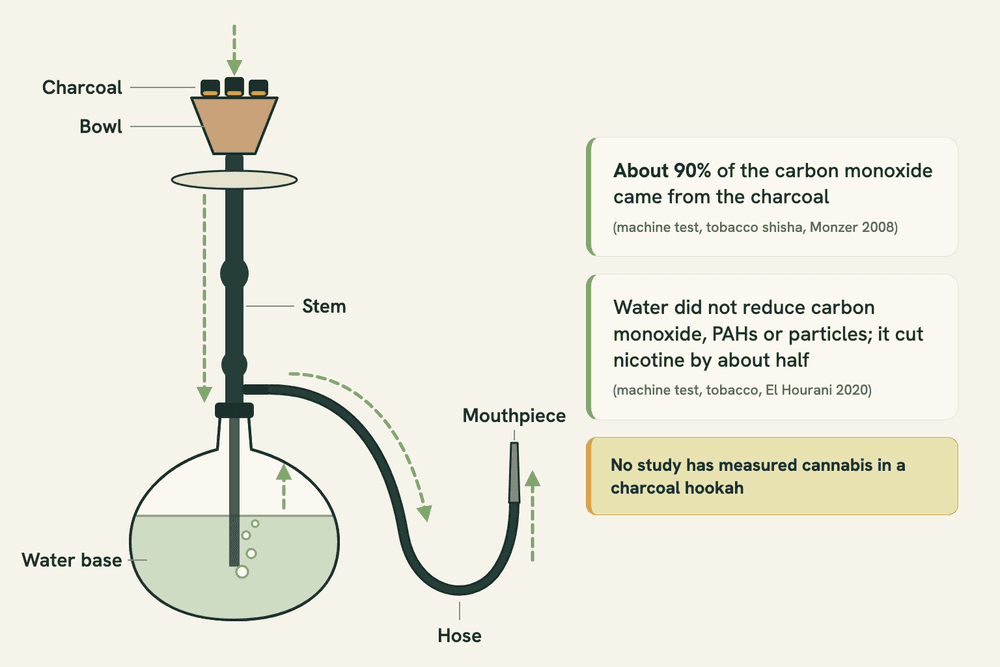
Physically, yes. A traditional hookah heats whatever sits in its bowl with lit charcoal, and that charcoal is the main source of carbon monoxide (CO) in hookah smoke. In lab studies with tobacco and with tobacco-free herbal bowls, leaving out the tobacco did not lower the CO people absorbed, and the water did not remove it. Here is the honest limit up front: we found no published study that measured cannabis smoked in a charcoal hookah. Every hookah exposure number on this page comes from tobacco or tobacco-free waterpipe research, and each one is labeled that way. This is also not a how-to. We do not cover packing, mixing or handling charcoal. It is written for adults 21 and over where adult use is legal under state law; marijuana remains a controlled substance under federal law.
How many people put weed in a hookah, and what else goes in
The best national number comes from the PATH Study, a long-running federal survey of tobacco use. In a 2023 analysis of PATH data covering 34,279 adults, about one in ten US adults (9.7%, roughly 23.6 million people) said they had ever smoked marijuana from a hookah when surveyed between December 2018 and November 2019, up slightly from 8.9% in 2015-16. The question was "Have you ever smoked marijuana from a hookah?", so the figure is ever-use. It says nothing about how often anyone does it now. Adults who had smoked a blunt in the past 30 days had about 3.4 times the odds of having tried it, and adults aged 25 to 44 had higher odds than those aged 18 to 24.
What goes into the bowl alongside the cannabis matters more than the headcount. The PATH researchers note that marijuana is often mixed with shisha tobacco in a hookah, though their survey did not measure how often, and the sources they cite for that are a vendor website and a forum post. The firmer data point is older and narrower. In a 2010 survey of 3,447 students at eight North Carolina colleges, 44% had ever smoked tobacco from a hookah. Of those, 90% had used flavored tobacco and 45% had put marijuana in one, and 23% fell into a group that mainly smoked marijuana, hashish and flavored tobacco. That survey asked about lifetime use, not what went into the same bowl at the same time, but it shows the two usually share the device.
The charcoal is the part that changes the risk
A hookah does not burn its bowl the way a lighter burns the tip of a joint. Lit charcoal sits on top of the bowl and heats what is underneath, and each pull draws air across the coal, through the bowl, down the stem and through the water. That design puts a second burning material in the airflow. When engineers at the American University of Beirut swapped the charcoal for an electric heater set to the same temperatures in a 2008 machine test with tobacco shisha, about 90% of the carbon monoxide disappeared from the smoke. The charcoal was also the source of 75 to 92% of the larger polycyclic aromatic hydrocarbons (PAHs), a family of combustion chemicals that includes known carcinogens, and of more than 95% of benzo(a)pyrene. It was a machine, one tobacco product and no people, but the direction is clear: the coal on top, not the bowl underneath, was the main CO source.
That raises the obvious question for a cannabis-only bowl: if you leave the tobacco out, does the CO go away? The closest human evidence says no. In a 2011 double-blind lab study of 37 occasional hookah smokers, 45-minute sessions with a tobacco-free, flavor-matched herbal preparation raised carboxyhemoglobin (the share of your blood's hemoglobin carrying carbon monoxide instead of oxygen) by 3.9 percentage points, against 3.8 with tobacco, and raised exhaled CO by 27.7 ppm, against 27.9 ppm. The researchers found no differences across conditions. Only the tobacco bowl delivered nicotine. The herbal mix was not cannabis, so this study does not tell you what a cannabis bowl produces. It does tell you that the charcoal heating it was the same, and the charcoal behaved the same.
How much CO is that compared with something familiar? In a 2009 head-to-head lab study of 31 adults, one tobacco hookah session of up to 45 minutes raised exhaled CO by 23.9 ppm, against 2.7 ppm for a single cigarette, about nine times as much, and peak carboxyhemoglobin reached 3.9% against 1.3%. In an Israeli study of 35 healthy volunteers, a single 30-minute tobacco hookah session raised median carboxyhemoglobin from 2.2% to 10.7%; heart and breathing rates rose, and scores on a short memory test (digit span) slipped from 16 to 15. Both were tobacco sessions, and neither study compared a joint. A 2018 paper by FDA tobacco scientists notes that the light-headed "hookah buzz" people describe may come partly from carbon monoxide, not only from nicotine.
Outside the lab, the result shows up in emergency rooms. At a hyperbaric referral center in the Bronx, hookah was behind 22% of serious carbon monoxide cases from 2015 to 2018 (58 of 265) and 41.6% in 2018 alone, more than any other source in the last two years of the study. Hookah patients averaged 28 years old, against 45 for other causes. A German hyperbaric unit treated 61 people for hookah CO poisoning from 2013 to 2016, mean age 23; three in four had fainted, and how sick they felt did not track their blood CO levels well. Nationally, FDA researchers estimated about 1,400 US emergency visits for hookah-related injuries from 2011 to 2019, and more than half were for dizziness, light-headedness, fainting or falls. These were tobacco hookah sessions. Burning cannabis makes its own CO as well, which the layer table below accounts for.
You cannot see or smell carbon monoxide, which is why the signs matter more than the smoke. The CDC's carbon monoxide poisoning basics list the symptoms and warn that burning charcoal gives off CO, and the MedlinePlus entry on carbon monoxide poisoning from the National Library of Medicine says what to do. Timing can mislead you. A 2026 review of published hookah CO cases found poisoning after as little as an hour, in outdoor settings, and in people who were only breathing other people's waterpipe smoke, sometimes with symptoms starting after the session had ended. A headache after a session can have other causes, and our guide to whether weed can cause headaches covers them, but a headache together with dizziness, confusion or fainting around a hookah should be treated as possible CO first.
What the water does, and what it doesn't
The bubbling water is the part people trust. It does change the smoke, just not in the way that matters for carbon monoxide. In a 2020 test that ran the same hookah with and without its water, researchers found the water did not reduce carbon monoxide, nitric oxide, PAHs or the dry particles in the smoke. It did cut nicotine and carbonyl compounds, a group of irritant aldehydes, by about 50%. That is part of why hookah smoke feels smoother. Smoother is not cleaner: the gas that causes poisoning and the particles that travel deep into the lungs came through the same. The test used tobacco shisha on a smoking machine and did not measure cannabinoids.
The World Health Organization's tobacco regulation advisers call the idea that the water filters the smoke "a common misperception" in their 2015 advisory note on waterpipes. The same note says that none of the add-ons sold to make hookahs less harmful, such as charcoal or cotton mouthpiece filters, water additives and bubble meshes, "has been tested empirically", and that, except for nicotine, smoke from tobacco-free waterpipe preparations has the same toxicant content and biological activity as tobacco smoke. Depending on which toxicant you look at, WHO puts one session anywhere from less than one to tens of cigarette equivalents.
For cannabis, the only water data we found are about bongs, not hookahs: a 1996 machine test of bongs, sponsored by two cannabis-reform groups and not peer reviewed, reported that the water held back more THC than tar, which if it holds would mean more smoke for the same effect. For what any cannabis smoke does to your airways, and what the bong evidence does and does not show, see our guide to why weed makes you cough.
Tobacco in the bowl: what mixing adds
Shisha is tobacco, usually sweetened and flavored. Putting it in the bowl with cannabis adds a second drug and its own set of toxicants, not just flavor. In the 2009 head-to-head study, a hookah session delivered about as much nicotine as a cigarette (peak plasma nicotine 10.2 against 10.6 ng/mL), and in the Israeli study serum nicotine rose from 1.2 to 26.8 ng/mL after 30 minutes. WHO's advisory note names that nicotine as the reason waterpipe tobacco carries dependence potential. A sweet, smooth smoke can make it easy to forget that a session is also a nicotine dose.
For the lungs, the combination appears to matter. In a 2009 Canadian population study of 878 adults aged 40 and over, people who smoked tobacco and had also smoked more than 50 joints in their lifetime had close to three times the odds of COPD (odds ratio 2.90), while cannabis-only smoking was not associated with it. That study was about cigarettes and joints, not hookahs. The PATH authors make the hookah version of the point themselves, writing that the combined toxicant exposure of marijuana and tobacco may represent an increased health burden. That is their view, not a measurement. Tobacco-leaf wraps raise the same issue in another format, which the comparison further down points to.
Long sessions and a shared hose
A joint is over in a few minutes. A typical hookah session runs about an hour, according to WHO, and it is usually a group activity. When researchers recorded real hookah café sessions of 52 smokers, they counted an average of 171 puffs of about 530 mL each, roughly 2.8 puffs a minute. A smoking machine replaying that pattern through one 10 g bowl of tobacco shisha collected 145 mg of carbon monoxide, 802 mg of tar and 2.94 mg of nicotine. In the 2009 head-to-head study, one hookah session added up to 48.6 liters of puffed smoke, against 1 liter for a cigarette. If you are new to cannabis, that is a lot of smoke for a first time; our first-time smoking guide covers what to expect.
- More puffs: about 171 in a recorded café session (tobacco), far more than a joint.
- More volume: 48.6 liters of smoke in one tobacco hookah session in the lab, against 1 liter for a cigarette.
- More charcoal time: the coal burns for the whole session, and case reports describe CO poisoning after as little as an hour.
- Group pacing: when the hose goes around, nobody tracks the total, and it is easy to lose count of how much you have had.
- One mouthpiece, many mouths: sharing is the default in a group, which matters for the infection question below.
On infection, the evidence is thinner than the warnings you may have heard. WHO's advisory note says that because mouthpieces are shared there is potential transmission of infectious diseases, while noting that three Egyptian studies found no link to hepatitis C and that tuberculosis has case reports but no formal study. What is documented is contamination: when Turkish researchers swabbed 182 hookahs in seven lounges, the mouthpieces and handles were colonized with bacteria, the water jars often grew Gram-negative bacteria, and only one of the seven lounges had any hygiene procedure. One Australian tuberculosis cluster centered on a shared marijuana water pipe, though the statistics could not prove the pipe was the route. A plausible route with limited proof is the honest summary.
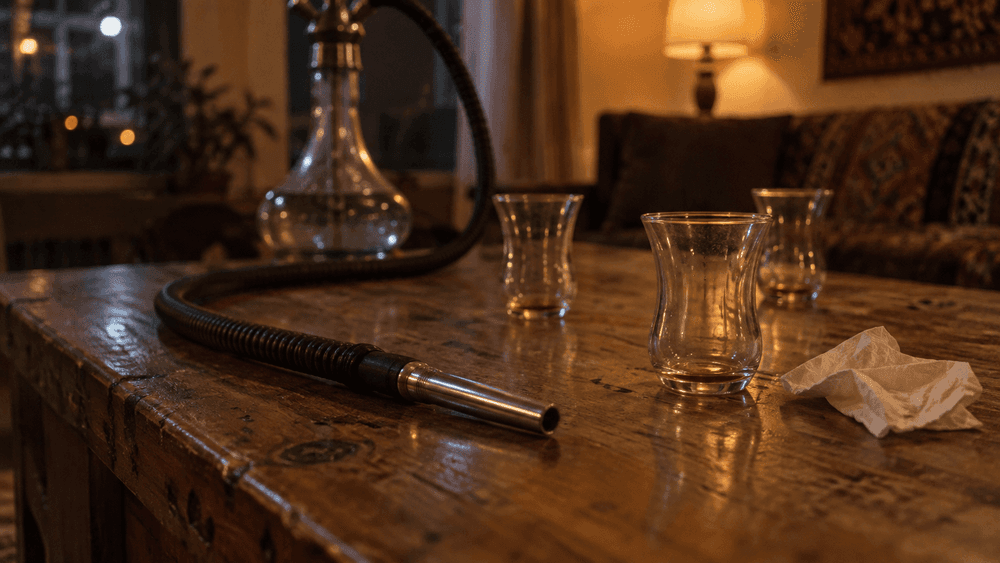
What each layer of a hookah session adds
Put together, a cannabis hookah session is several exposures stacked in one device. The table below separates them and says which ones are still there if there is no tobacco in the bowl. The cannabis row draws on a Health Canada comparison that machine-smoked cannabis and tobacco the same way: cannabis smoke carried up to 20 times the ammonia of tobacco smoke and 3 to 5 times the hydrogen cyanide and nitrogen oxides. That study used rolled cigarettes, not a hookah.
| Layer | What it adds | Evidence (and what was studied) | Still there in a cannabis-only bowl? |
|---|---|---|---|
| Charcoal | Most of the carbon monoxide (about 90%), most of the larger PAHs, more than 95% of benzo(a)pyrene | Monzer 2008, machine test with tobacco shisha; Blank 2011, 37 people, tobacco-free herbal bowl (not cannabis) | Yes. The coal is the same whatever is in the bowl. |
| Tobacco shisha | Nicotine at about cigarette levels, dependence potential, tobacco toxicants | Eissenberg 2009, 31 adults; Shihadeh 2005 machine yields; WHO 2015 | No, if no tobacco is used. A tobacco-free herbal bowl still carried the charcoal's CO (Blank 2011). |
| Cannabis | Its own combustion smoke (carbon monoxide, ammonia, hydrogen cyanide, nitrogen oxides, known carcinogens) plus THC | Moir 2008, Health Canada, machine-smoked rolled cannabis vs tobacco; Wu 1988, 15 men smoking joints; neither a hookah | Yes. |
| Water | Cools the smoke; about 50% less nicotine and carbonyls; no drop in CO, PAHs or particles | El Hourani 2020, machine test with tobacco; cannabinoids not measured | Yes, with the same limits. |
| Shared hose | Bacteria on mouthpieces and handles; a potential infection route with limited proof | Altindis 2020, 182 lounge hookahs; WHO 2015 | Yes, whenever a mouthpiece is shared. |
Hookah vs joint vs bong vs vaporizer: what actually changes
People usually ask how a hookah compares with the way they already use cannabis. The useful comparison is the heat source, because it decides where the carbon monoxide comes from. This is not a ranking: no study has put cannabis through a hookah and compared it with the other three, and each row rests on different, small evidence.
| Device | What burns or heats | Where the CO comes from | What the evidence covers |
|---|---|---|---|
| Hookah | Burning charcoal on top of the bowl | Mainly the charcoal (about 90% in a tobacco machine test), plus whatever burns in the bowl | Tobacco and tobacco-free herbal bowls only |
| Joint | The cannabis and the paper burn together | The burning plant material itself | 1988 study of 15 men: nearly 5 times the carboxyhemoglobin rise of a tobacco cigarette |
| Bong | A flame lit to the bowl; smoke passes through water | The burning cannabis; in hookah tests, water did not remove CO | No controlled study shows the water sends less tar to the lungs |
| Vaporizer | Electric heat, below the point of combustion | No burning material in the device | Two small lab studies: exhaled CO rose after smoking, not after vaporizing |
Each row has a page that covers it in depth. The joint figure comes from a 1988 New England Journal of Medicine study of 15 men who smoked both, and our blunt vs joint comparison walks through what a joint and a tobacco-leaf wrap each add, with what rolling papers are made of as the companion piece. Dry herb vaporizers vs smoking covers the two lab studies and their limits, and the cough guide linked above covers bongs.
Can you smoke weed at a hookah lounge?
Generally, no. Hookah lounges are businesses built around tobacco and open to the public, and state cannabis laws generally keep consumption out of public places. California is a clear example: the state's Department of Cannabis Control says adults 21 and over can use cannabis on private property but not in public places like restaurants or bars, cannot smoke it anywhere it is illegal to smoke tobacco, and that property owners can ban it on their property. Other states and cities set their own rules, and some are stricter. Marijuana remains a controlled substance under federal law; adult use is legal only under state law, to adults 21 and over. The April 2026 DEA final rule moved only FDA-approved marijuana drugs and state-licensed medical marijuana to Schedule III; it did not make adult use federally legal.
At home, the rules can come from your housing. HUD's 2016 smoke-free public housing rule bans smoking tobacco, naming waterpipes (hookahs), inside public housing and within 25 feet of the buildings; it is a tobacco rule, and cannabis in federal housing is handled separately. Our guide to whether you can get evicted for smoking weed covers how leases and federal housing law treat cannabis. Hemp-derived CBD flower has its own legal status, separate from marijuana's, explained in is CBD flower legal.

What the research does not tell us
Be clear about the gap. A PubMed search on October 26, 2026 for hookah or waterpipe studies involving marijuana or cannabis returned 194 records, and a screen of every title found none that measured carbon monoxide, carboxyhemoglobin, THC or toxicants from cannabis smoked in a charcoal hookah. Every hookah exposure number on this page comes from tobacco or tobacco-free herbal waterpipe research. We found no study of cannabis in an electric hookah. The national prevalence figure is self-reported ever-use, so it says nothing about how often people do it or how much they smoke. The one bubbler test used tobacco, so what hookah water does to cannabinoids is unmeasured. And the hyperbaric and emergency-room series come from single centers that see the most serious cases, which tells you poisoning happens, not how often per session.
Frequently asked questions
Not in the way most people think. In a 2020 machine test with tobacco, the water did not reduce carbon monoxide, PAHs or particles, though it cut nicotine and some irritant aldehydes by about half, which is part of why the smoke feels smoother. WHO's tobacco regulation advisers call the filtering belief a common misperception and note that the add-on filters and bowl additives sold for hookahs have not been tested. We found no study that measured what a hookah's water does to cannabis smoke.
Yes. It is documented in emergency and hyperbaric centers in the US, Germany and Lebanon, mostly in young adults, with fainting as a common sign. One Bronx center traced 41.6% of its serious CO cases in 2018 to hookahs. A 2026 review of case reports found poisoning after as little as an hour, outdoors, and from secondhand smoke, sometimes with symptoms starting after the session. These cases involved tobacco hookahs, but most of the CO comes from the charcoal. If someone has a headache, dizziness, confusion or faints, move them to fresh air and seek immediate medical attention (call 911). Poison Help: 1-800-222-1222.
No study answers that directly, so here is what changes by layer. The cannabis in the bowl still produces combustion smoke. A hookah adds charcoal, its main source of carbon monoxide, and often tobacco, which adds nicotine. It usually means a session of about an hour and many more puffs, about 171 in recorded tobacco café sessions. The water cools the smoke but did not remove CO, PAHs or particles in a tobacco test. Whether that adds up to more or less harm than a joint for cannabis has not been measured.
In a 2008 machine test with tobacco shisha, replacing the charcoal with an electric heater at the same temperatures removed about 90% of the carbon monoxide. That is one measurement of tobacco in one lab setup, not a recommendation. We found no study of cannabis in an electric hookah, plant material heated in a bowl still makes smoke, and WHO treats electronic hookahs and hookah pens as a different kind of device that is still being researched.
People do, and leaving the tobacco out removes the nicotine. It does not remove the charcoal. In a double-blind study of 37 hookah smokers, a tobacco-free herbal bowl raised blood carbon monoxide as much as tobacco did. That herbal bowl was not cannabis, and with cannabis in the bowl, its own combustion smoke is still there.
Hemp flower is still plant material, so the same combustion facts apply: smoke from whatever burns in the bowl plus carbon monoxide from the charcoal, with the same evidence gap, since we found no study that measured it. The legal picture for hemp-derived CBD flower is different from marijuana's and varies by state; our guide on whether CBD flower is legal covers it.
FDA tobacco scientists note that the hookah buzz may be related to nicotine, carbon monoxide or other inhalants. Dizziness, light-headedness, fainting and falls together made up more than half of hookah-related emergency visits in an FDA national estimate. A buzz that turns into dizziness, confusion or fainting is a reason to get to fresh air and get help, not to keep going.
Whatever burns in the bowl, the smoke reaches the same airways. For what any cannabis smoke does to them, and why a smoother hit is not a cleaner one, read why weed makes you cough.
Writing about hemp, wellness and the small rituals that keep us balanced.