Can You Get Evicted for Smoking Weed? Leases, State Law, HUD
A private landlord, a state that protects medical patients, and a landlord who takes federal money each answer this differently. What your lease, Arizona and Minnesota law, the federal housing statute and HUD's memos say, current as of October 2026.
Can you get evicted for smoking weed? In many situations you can, even in a state where cannabis is legal. Who can evict you, and on what grounds, depends on which of three landlords you have: a private landlord with a lease, a landlord in a state that protects medical cannabis patients, or a landlord who takes federal housing money. For the third, the answer is written into federal statute, and the April 2026 Schedule III order has not changed it so far. This guide is current as of October 2, 2026.
The short answer. State legalization protects you from arrest. It does not rewrite your lease. A private landlord can generally put a no-smoking clause in the lease, and breaking it can lead to a lease violation notice and, through your state's eviction process, an eviction. Some states, such as Arizona and Minnesota, stop landlords from refusing to rent to you only because you hold a medical card, with an exception when a federal benefit is at stake, but those laws protect the card, not smoking in the unit. And if you live in public housing, pay rent with a Section 8 voucher, or rent in a HUD-assisted building, federal law requires housing providers to set standards that prohibit admitting any household with a member they determine is "illegally using a controlled substance," while leaving the eviction of current tenants to their discretion. This page is for renters in all three situations, including Section 8 tenants who hold a state medical card and want to know what the law says after April 2026.
Can you get evicted for smoking weed? It depends on which of three landlords you have
Most pages answer this question with "check your lease" and "it depends on your state." Both are true, but they skip the part that matters most for people in subsidized housing. The table below sorts the question by who your landlord is, because that decides which rules apply to you. Arizona and Minnesota are illustrations, not a survey of all 50 states: state laws differ, and many states have no specific protection for medical patients in housing at all.
| Your landlord | Can they ban smoking weed? | Can they refuse to rent to you over cannabis? | Can they evict you over it? | Where the rule comes from |
|---|---|---|---|---|
| Private landlord, no special state protection | Generally yes, through a no-smoking or illegal-activity clause | Generally yes, unless state or local law says otherwise | Yes, for a lease violation, through your state's eviction process | Your lease and your state's landlord-tenant law |
| Private landlord in a state that protects medical patients (examples: Arizona, Minnesota) | Yes. Minnesota also bans smoking cannabis in multifamily buildings by statute, with an exemption for medical cannabis | Not solely because you hold a medical card or are on the registry, unless the landlord would lose a federal benefit | For breaking the lease, yes; for card status alone, only under the federal-benefit exception | A.R.S. 36-2813 and 36-2851; Minn. Stat. 342.56 and 342.57 |
| Federally assisted housing (public housing, Section 8, HUD multifamily and others) | Yes. HUD says owners may not adopt lease terms or policies that affirmatively permit occupancy by a household member who uses marijuana | Must refuse admission to a household with a member currently illegally using a controlled substance | Allowed, not required: the housing agency or owner decides | 42 U.S.C. 13661 and 13662; HUD memos from 2011 and 2014 |
Most renters are in the first row. If you hold a medical card, the second row may also apply, depending on your state. And if any part of your rent is paid by a federal housing program, you are in the third row, even if your landlord is a private person: the federal rules come with the voucher, not with the building's owner.
Your lease is the first rule
Your lease is the first rulebook, and in a private rental it is usually the one that decides the outcome. A no-smoking clause, an "illegal activity" clause or a nuisance clause can each be grounds for a lease violation notice, even where cannabis is legal for adults. Some legalization laws leave this power with property owners explicitly. Arizona's adult-use law says, in so many words, that it does not restrict anyone who "occupies, owns or controls property" from choosing to "prohibit or regulate conduct otherwise allowed by this chapter on or in such property." How much notice you get, and whether you get a chance to fix the problem first, depends on your state's landlord-tenant law. These are the four kinds of clauses that most often come up:
- No-smoking clause: bans smoking in the unit and often on balconies, patios and in common areas. It usually does not care what you smoke, so legal cannabis, tobacco and hemp flower are treated the same.
- Illegal-activity clause: bans illegal activity, and some leases name federal law. Outside two narrow categories, marijuana is still Schedule I federally, so this wording may reach use your state allows.
- Nuisance or quiet-enjoyment clause: bans conduct that interferes with neighbors' use of their homes. Smoke or odor that drifts into other units is the usual trigger.
- Cultivation or alteration clause: rules on growing plants, adding grow lights, or changing ventilation or electrical load. Arizona's adult-use law lets property owners prohibit or regulate growing on their property.
Smell is often how these disputes start. Landlords often hear about smoking from neighbors, and state law can give them their own reason to act on those complaints. In Minnesota, using adult-use cannabis flower in a way that is "offensive to the senses" or interferes with someone's "comfortable enjoyment of life or property" is a legal nuisance. A neighbor can go to court for an order to stop it and the greater of actual damages or $250, and can sue a landlord that fails to enforce its own lease or policy on adult-use cannabis for the greater of damages or $500 (Minn. Stat. 342.82). Smoke drifting through a wall is a lease and neighbor issue, which is a different thing from exposure: whether secondhand smoke can make you fail a drug test is a separate question with its own evidence.
What state law protects, and what it does not
Some states have written protections for medical cannabis patients into their housing rules. In the two states below, the pattern is the same: they protect your status as a patient, meaning a landlord cannot turn you away or penalize you just for being one, and they make an exception when the landlord would lose a federal benefit. Neither gives you a right to smoke in the unit. Two examples, quoted from the statutes, show how this works. They are illustrations, not a rule for your state.
Arizona. Under the state's medical marijuana law, "No school or landlord may refuse to enroll or lease to and may not otherwise penalize a person solely for his status as a cardholder, unless failing to do so would cause the school or landlord to lose a monetary or licensing related benefit under federal law or regulations" (A.R.S. 36-2813). That protects the card, not smoking in the unit. Arizona's adult-use law, quoted above, separately lets property owners prohibit or regulate use and growing, and it does not require anyone to leave possession, use or growing unrestricted if doing so would cost them a federal monetary or licensing-related benefit. Adults may grow up to six plants at their primary residence, with a cap of 12 per residence, but a lease can still forbid it.
Minnesota. Minnesota goes further. A landlord may not refuse to lease to, or otherwise penalize, a patient enrolled in the state's medical cannabis registry solely because of that enrollment, and may not refuse to rent to, or penalize, a patient solely because cannabis is a controlled substance under federal law. The enrollment protection gives way when renting would violate federal law or cost the landlord a federal monetary or licensing-related benefit. Even then, a landlord must give the patient written notice at least 14 days before taking an action the section otherwise prohibits, citing the specific federal law or regulation and naming the benefit at stake (Minn. Stat. 342.57). If you have seen these protections cited as Minn. Stat. 152.32, that section was repealed effective December 1, 2025, and the protection now lives in 342.57.
Minnesota also bans, by statute, "the vaporizing or smoking of cannabis flower, cannabis products, artificially derived cannabinoids, or hemp-derived consumer products" in a multifamily housing building, "including balconies and patios," with a $250 civil fine (Minn. Stat. 342.56). Medical cannabis flower and medical cannabinoid products are exempt from that statutory ban. That exemption is not the same as a right to smoke under your lease: a landlord's no-smoking clause can still apply.
Federally assisted housing: Section 8, public housing and HUD properties
"Federally assisted housing" reaches further than many people assume. The statute's own list covers public housing, tenant-based Section 8 (housing choice vouchers), project-based Section 8, HUD's housing programs for older adults (Section 202) and for people with disabilities (Section 811), Section 236 properties, and USDA rural rental housing under sections 514 and 515, among others. "Owner" includes any person or entity with the legal right to lease the unit. If a private landlord accepts your voucher, the voucher rules travel with you. The core rule dates from the Quality Housing and Work Responsibility Act of 1998 and reads:
“Notwithstanding any other provision of law, a public housing agency or an owner of federally assisted housing ... shall establish standards that prohibit admission ... for any household with a member (A) who the public housing agency or owner determines is illegally using a controlled substance.”
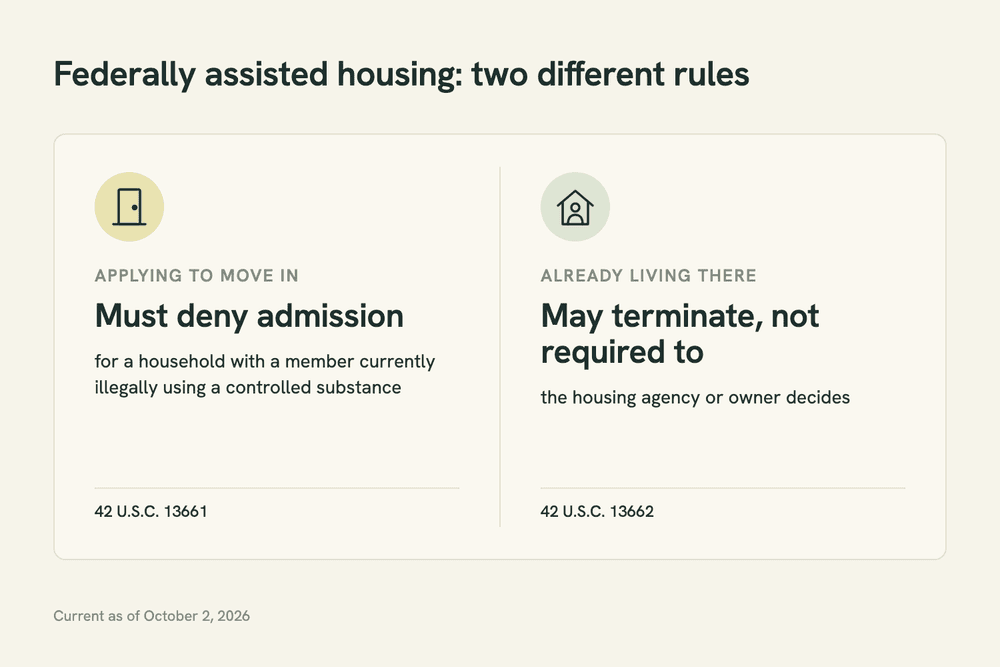
Notice the split between applying and living there. For applicants, the word is "shall": denial is mandatory. For people already living there, the companion section on termination says the agency or owner must have standards or lease terms that "allow" it to end the tenancy or assistance of a household with a member who is illegally using a controlled substance. Allow is not require. Whether to use that power is left to each housing agency or owner, and their written policies differ. The stakes of a drug-related eviction go beyond one apartment: a household evicted from federally assisted housing for drug-related criminal activity can be barred from federally assisted housing for three years, unless it completes an approved rehabilitation program or the circumstances that led to the eviction no longer exist (42 U.S.C. 13661(a)).
HUD has put this split in writing more than once. In a January 20, 2011 legal opinion from HUD's Office of General Counsel, the general counsel concluded that housing providers "must deny admission" to applicants currently using medical marijuana, may not allow it as a disability accommodation, and keep "statutorily-authorized discretion" over whether to evict current residents who use it. The memo gave two reasons there is no accommodation: current users of illegal drugs, including medical marijuana, are excluded from the disability definitions in federal disability law, and allowing it would be a "fundamental alteration" under the Fair Housing Act. A provider that lets a medical user stay may do so "as an exercise of that discretion, but not as a reasonable accommodation." A December 29, 2014 memo to owners of HUD multifamily properties repeats the same structure: deny admission, never adopt lease provisions or policies that "affirmatively permit occupancy" by a household member who uses marijuana, and keep the discretion to evict or not evict current tenants. Both memos were written when all marijuana was Schedule I.
HUD's most recent public word is shorter. Asked whether a housing agency can make a reasonable accommodation for medical marijuana in a state that allows it, HUD's own FAQ, published in January 2022 and still online in October 2026, answers "No," describes marijuana as "a Schedule 1 substance," and says that "absent a change in Federal law, HUD does not have the discretion to admit users of marijuana, including medical marijuana." It has not been updated for the April 2026 order.
One rule that often gets mixed into this topic does not actually cover cannabis. HUD's 2016 smoke-free public housing rule required public housing agencies, by July 30, 2018, to ban lit tobacco products (cigarettes, cigars, pipes) and hookahs inside public housing units, in indoor common areas and within 25 feet of the buildings. The rule never mentions marijuana or cannabis, and it does not apply to Section 8 voucher units at all. It does not need to mention marijuana: in federally assisted housing, marijuana is reached through the drug-use provisions above, which apply whether you smoke it, vape it or eat it.
One person's use can put the whole lease at risk
The federal rules apply to households, not just to the person who signed the lease. The leading case is HUD v. Rucker, decided by the Supreme Court on March 26, 2002. The Oakland Housing Authority had moved to evict four tenants. Two of the cases began because the tenants' grandsons, both listed on the leases, "were caught in the apartment complex parking lot smoking marijuana." In the others, a daughter was found with cocaine three blocks away and a caregiver had cocaine in the unit. The Court ruled unanimously, with one justice not taking part, that the federal public housing lease statute, which makes drug-related criminal activity "on or off such premises" by a tenant, a household member or a guest cause for termination, lets a housing authority end the lease "regardless of whether the tenant knew, or should have known" about the activity. The Court also stressed that the statute "does not require the eviction of any tenant who violated the lease provision. Instead, it entrusts that decision to the local public housing authorities."
In practice, that means a roommate, an adult child or a visiting guest can put a public housing lease at risk. Admission works the same way: the federal screening rule is written around "any household with a member" who is illegally using a controlled substance, so one person's use can affect a whole family's application. Household use matters in other legal settings too; our guide to how marijuana use comes up in child custody cases covers family court.
Does Schedule III change any of this? An open question
On April 28, 2026, a federal order moved two narrow categories of marijuana to Schedule III: marijuana in an FDA-approved drug product, and marijuana subject to a state medical marijuana license. Everything else, including adult-use marijuana bought under a state recreational law, "remains a schedule I controlled substance." The order does not mention housing or HUD. It is in effect: a federal appeals court declined to pause it in September 2026, without deciding whether it is lawful. Our explainer on the medical marijuana Schedule III ruling covers what the order does and the legal challenges against it. Here we look only at what it might mean for housing.
For adult-use marijuana, nothing changed: it is still Schedule I, so HUD's reasoning applies exactly as before. For registered medical patients, the question is genuinely open. Two pieces of federal text point toward a different answer than HUD's 2011 opinion. First, the April rule added a provision (21 CFR 1301.13(k)(5)) under which a certification that state law deems sufficient for medical use is enough for a DEA-registered dispenser to dispense marijuana to that patient. Second, HUD's 2011 reasoning on accommodation rested on the federal disability law definition of "illegal use of drugs," and that definition "does not include the use of a drug taken under supervision by a licensed health care professional, or other uses authorized by the Controlled Substances Act or other provisions of Federal law." Those are arguments, not answers. The rule speaks to dispensing by registered businesses, not to whether a tenant's use is legal for HUD purposes, and a tenant usually cannot tell whether a given dispensary holds a DEA registration yet. No HUD document and no court decision we found has applied any of this to housing.
As of October 2, 2026, we found no new HUD guidance on marijuana after the April 2026 order: nothing from HUD on the subject in the Federal Register, and HUD's FAQ is unchanged. Congress has not changed the law either. Bills introduced in both chambers on December 17, 2025 (S. 3537 and H.R. 6807, the Marijuana in Federally Assisted Housing Parity Act of 2025) would carve state-legal marijuana out of the federal housing definition of drug-related criminal activity. As of October 2, 2026, both were still sitting in committee.
Where CBD and hemp fit
Under federal law, the definition of marijuana excludes hemp, which through November 11, 2026 means cannabis with no more than 0.3% delta-9 THC by dry weight. Hemp-derived CBD that meets that definition is not a controlled substance, so the federal housing drug rules, which turn on "controlled substance," do not reach it. That does not put CBD outside your lease. A no-smoking clause can still cover smoking hemp flower, because smoking hemp is still smoking, and a no-vaping clause can cover a CBD vape. Minnesota's statutory ban on smoking in multifamily buildings names hemp-derived consumer products explicitly. The product also has to actually meet the hemp definition; how hemp and marijuana differ legally comes down to THC content, and mislabeled products exist. What counts as hemp changes in two steps, on November 12 and December 11, 2026, which our 2026 hemp ban explainer walks through. For hemp flower specifically, see whether CBD flower is legal, and for the wider picture, our hub on the legal status of CBD.
If you get a lease violation or eviction notice
A notice is the start of a legal process, not the end of one, and the process is set by your state and sometimes your city. These steps describe the process in general terms. They are not a strategy for any particular case.
- 1Read the notice and find the exact lease clause or rule it cites. Write down the conduct it describes and the dates it mentions.
- 2Note the deadline and the type of notice. Some let you fix the violation (often called a notice to cure); others ask you to leave (a notice to quit). Names and deadlines come from state and sometimes local law.
- 3In federally assisted housing, ask the housing agency or owner for its written admission and termination policy and its review or hearing process. Federal law leaves eviction to its discretion.
- 4If you are a registered medical cannabis patient in Minnesota and the landlord is relying on federal law, check whether you received the 14-day written notice naming the federal law and the benefit at stake that Minn. Stat. 342.57 requires.
- 5Contact a legal aid office, a tenant union or a landlord-tenant attorney in your area, and bring the notice and your lease.
- 6Keep copies of everything: the lease, the notice, any letters, texts or emails, and the dates you received them.
What this page cannot tell you
This is general information, not legal advice. It describes federal law, HUD's published guidance, and two state examples as of October 2, 2026. Several things that will matter in a real case are outside what any general page can answer:
- Your specific lease, including how its smoking, illegal-activity, guest and nuisance clauses are worded.
- Your state's eviction procedure and notice periods, and any city or county ordinance, rent-stabilization rule or building smoke-free policy.
- How a court in your state would rule on your facts. Nothing here predicts an outcome.
- Your housing agency's or owner's written policy, and how it uses the discretion federal law gives it.
- How other program layers apply to your building, such as tax-credit financing combined with vouchers.
- What HUD, the courts or Congress will do next on Schedule III.
Housing is one of several places where federal cannabis law still reaches people in legal states. The same tension shows up at work, covered in whether you can be fired for failing a drug test, and in how marijuana use affects immigration cases.
Frequently asked questions
A landlord can, if your lease bans smoking or illegal activity, or if the smoke becomes a nuisance for neighbors. State legalization protects you from arrest; it does not override a lease. Arizona's adult-use law, for example, says outright that property owners may prohibit or regulate conduct the law otherwise allows on their property. How the eviction itself works, including notice periods and whether you get a chance to fix the violation, depends on your state's landlord-tenant law.
It depends on your state. In Arizona and Minnesota, a landlord may not refuse to rent to you or penalize you solely because you hold a medical card or are on the patient registry, unless renting would cost the landlord a federal benefit (or, in Minnesota, violate federal law). Minnesota also requires 14 days' written notice naming the federal law before a landlord acts under that exception. Many states have no such protection. Even where it exists, it protects your status, and a lease can still ban smoking in the unit.
Federal law requires housing agencies and owners to refuse admission to a household with a member they determine is currently illegally using a controlled substance (42 U.S.C. 13661). For current tenants, the law requires lease terms that allow termination, but it does not require eviction: the agency or owner decides (42 U.S.C. 13662). An eviction for drug-related criminal activity can bar a household from federally assisted housing for three years unless a rehabilitation program or waiver applies. These rules follow your voucher to a private landlord.
In public housing, the law allows it. In HUD v. Rucker (2002), the Supreme Court held that a housing authority can end a lease over a household member's or guest's drug activity even if the tenant did not know about it, and two of those cases began with grandsons smoking marijuana in the parking lot. The Court also said the law permits eviction; it does not require it. In a private rental, check what your lease says about guests and other occupants.
Smell is usually how a landlord finds out, and it can be treated as evidence of a no-smoking violation or as a nuisance to neighbors, depending on your lease. Some states give neighbors their own remedy: in Minnesota, adult-use cannabis smoke that is offensive to the senses can be a legal nuisance, and a neighbor can sue a landlord that fails to enforce its own cannabis policy. What happens next follows your lease and your state's eviction process.
That is an open question. Adult-use marijuana is still Schedule I, so nothing changed for it. For registered medical patients, there are arguments that use under a state medical program is no longer illegal use, but as of October 2, 2026 HUD has not updated its guidance and no court has ruled. Bills that would change the housing rules are still in committee. The safest assumption is that HUD's written position stands until HUD or a court says otherwise.
A landlord can ban smoking and vaping, and that can include smoking hemp flower or vaping a CBD product. Minnesota's statute banning smoking and vaping in multifamily buildings names hemp-derived products explicitly. A CBD oil that meets the federal hemp definition is not a controlled substance, so the federal housing drug rules do not reach it, but your lease still applies to how you use any product in the unit.
In a private rental, that depends on whether your state allows home growing at all and whether your lease forbids it. Arizona, for example, allows up to six plants at a primary residence, but its adult-use law lets property owners prohibit or regulate conduct the law allows on their property, which includes growing. In federally assisted housing, the federal definition of drug-related criminal activity covers the illegal manufacture of a controlled substance, and growing marijuana outside federal law falls within it.
Where to go next. For how federal and state rules interact for CBD and hemp products more broadly, including what changes in November and December 2026, start with our guide to whether CBD is legal where you live.
Writing about hemp, wellness and the small rituals that keep us balanced.